
Modelling using Mappings Mappings The finite mapping type
- Slides: 28
Modelling using Mappings • Mappings: • The finite mapping type constructor • Value definitions: enumeration, comprehension • Operators on mappings • Case Study: the tracking manager 1
The finite mapping type constructor A mapping is a functional relationship between two sets of values: a domain and a range. Mappings are common in many models, e. g. “Each bank account has exactly one balance” “Each reactor has an input, an output and an operating temperature. ” Mappings represent one-to-one or many-to-one relationships, but not one-to-many! 2
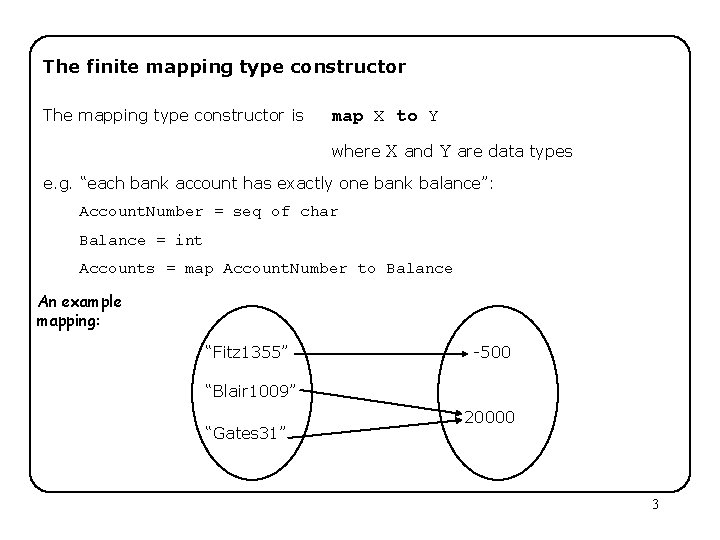
The finite mapping type constructor The mapping type constructor is map X to Y where X and Y are data types e. g. “each bank account has exactly one bank balance”: Account. Number = seq of char Balance = int Accounts = map Account. Number to Balance An example mapping: “Fitz 1355” -500 “Blair 1009” “Gates 31” 20000 3
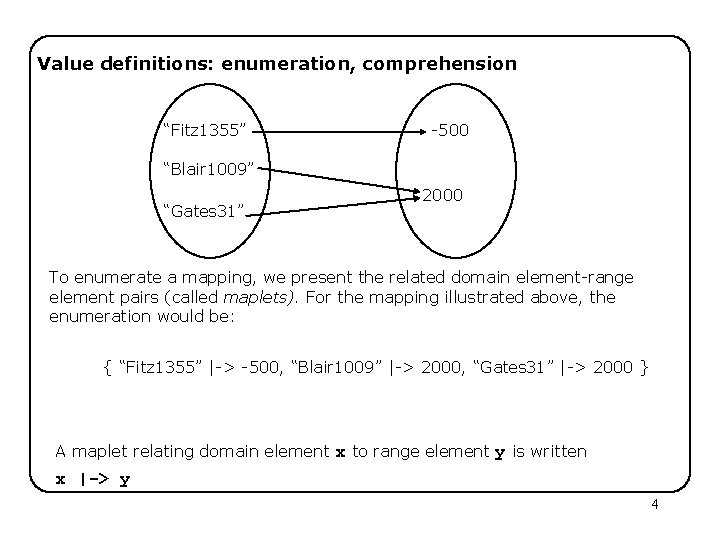
Value definitions: enumeration, comprehension “Fitz 1355” -500 “Blair 1009” “Gates 31” 2000 To enumerate a mapping, we present the related domain element-range element pairs (called maplets). For the mapping illustrated above, the enumeration would be: { “Fitz 1355” |-> -500, “Blair 1009” |-> 2000, “Gates 31” |-> 2000 } A maplet relating domain element x to range element y is written x |-> y 4
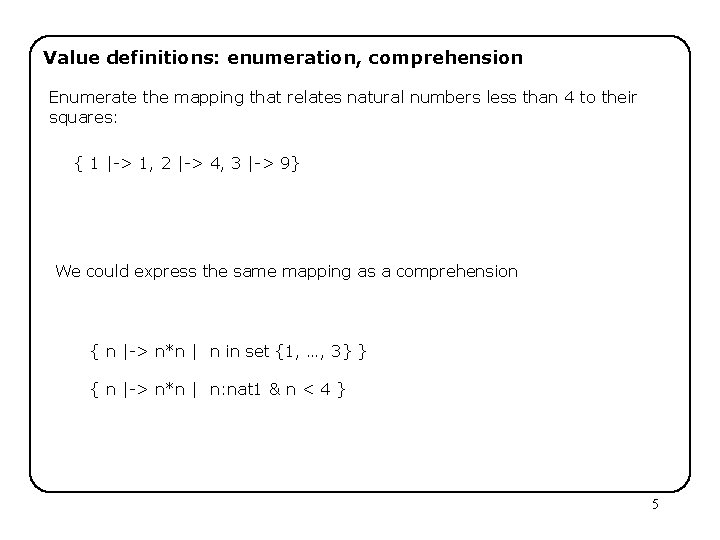
Value definitions: enumeration, comprehension Enumerate the mapping that relates natural numbers less than 4 to their squares: { 1 |-> 1, 2 |-> 4, 3 |-> 9} We could express the same mapping as a comprehension { n |-> n*n | n in set {1, …, 3} } { n |-> n*n | n: nat 1 & n < 4 } 5
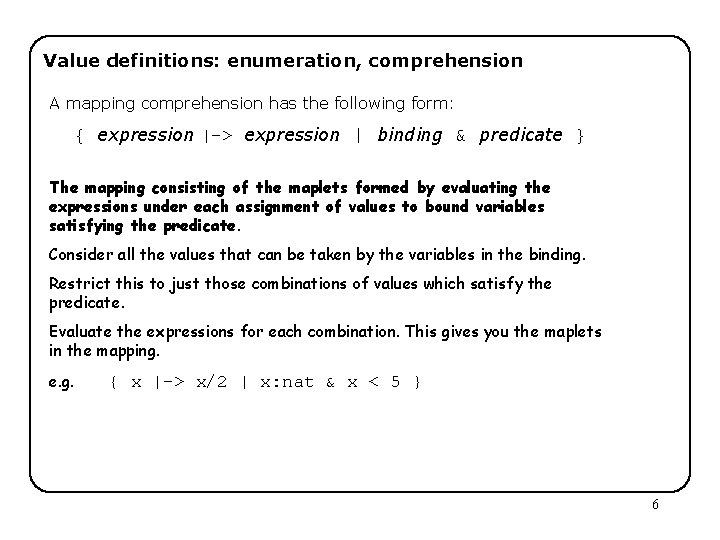
Value definitions: enumeration, comprehension A mapping comprehension has the following form: { expression |-> expression | binding & predicate } The mapping consisting of the maplets formed by evaluating the expressions under each assignment of values to bound variables satisfying the predicate. Consider all the values that can be taken by the variables in the binding. Restrict this to just those combinations of values which satisfy the predicate. Evaluate the expressions for each combination. This gives you the maplets in the mapping. e. g. { x |-> x/2 | x: nat & x < 5 } 6
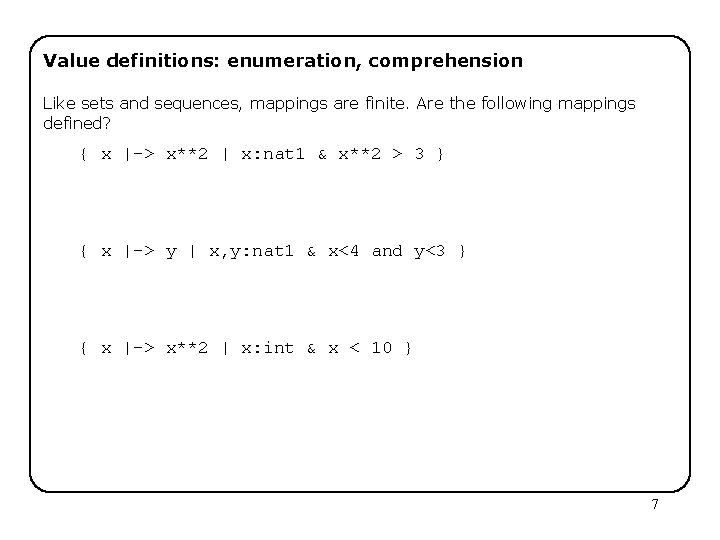
Value definitions: enumeration, comprehension Like sets and sequences, mappings are finite. Are the following mappings defined? { x |-> x**2 | x: nat 1 & x**2 > 3 } { x |-> y | x, y: nat 1 & x<4 and y<3 } { x |-> x**2 | x: int & x < 10 } 7
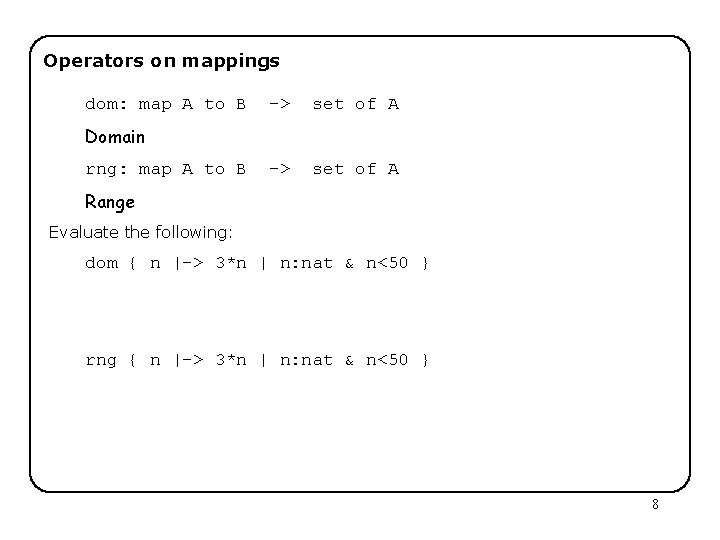
Operators on mappings dom: map A to B -> set of A Domain rng: map A to B Range Evaluate the following: dom { n |-> 3*n | n: nat & n<50 } rng { n |-> 3*n | n: nat & n<50 } 8
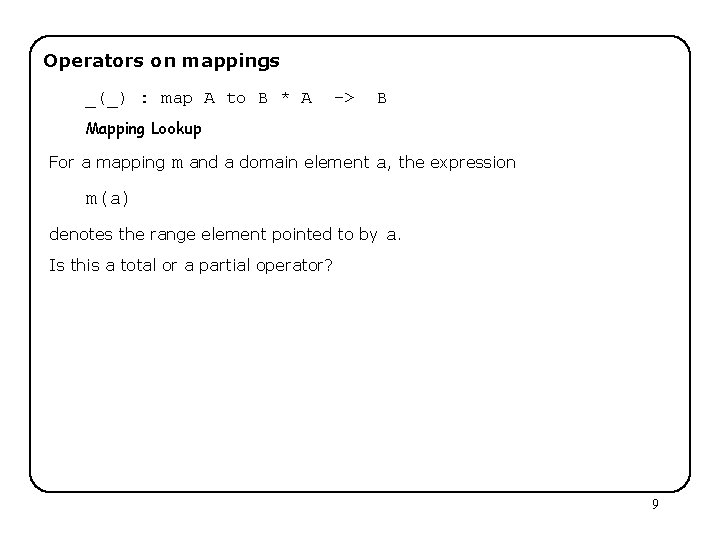
Operators on mappings _(_) : map A to B * A -> B Mapping Lookup For a mapping m and a domain element a, the expression m(a) denotes the range element pointed to by a. Is this a total or a partial operator? 9
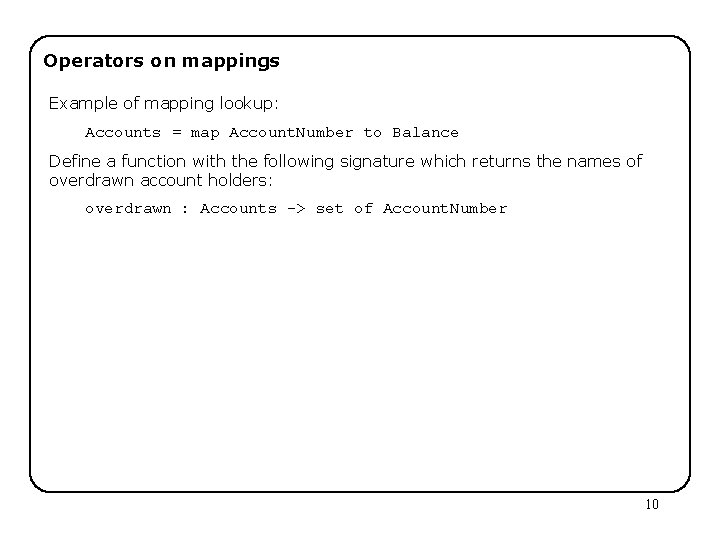
Operators on mappings Example of mapping lookup: Accounts = map Account. Number to Balance Define a function with the following signature which returns the names of overdrawn account holders: overdrawn : Accounts -> set of Account. Number 10
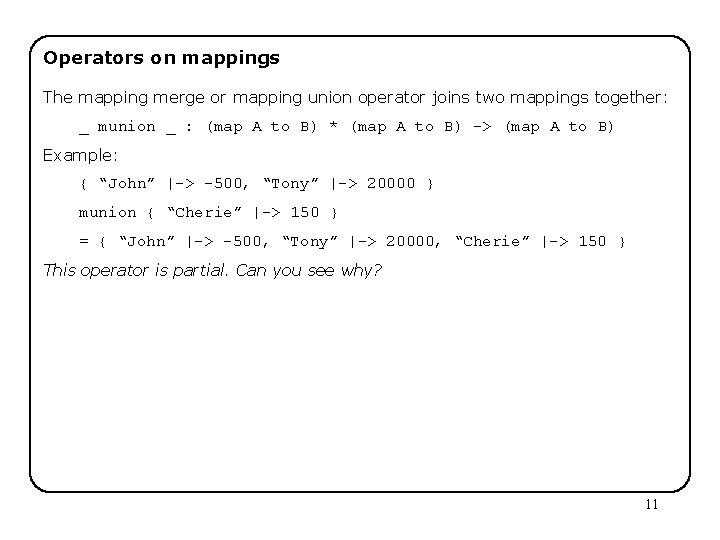
Operators on mappings The mapping merge or mapping union operator joins two mappings together: _ munion _ : (map A to B) * (map A to B) -> (map A to B) Example: { “John” |-> -500, “Tony” |-> 20000 } munion { “Cherie” |-> 150 } = { “John” |-> -500, “Tony” |-> 20000, “Cherie” |-> 150 } This operator is partial. Can you see why? 11
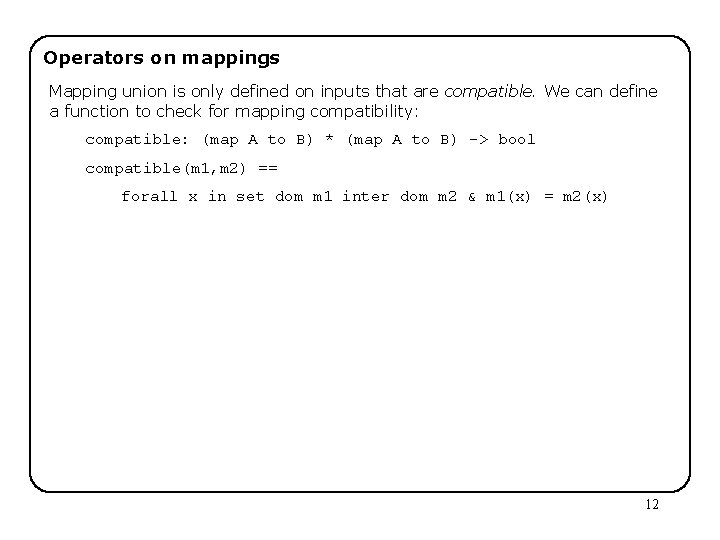
Operators on mappings Mapping union is only defined on inputs that are compatible. We can define a function to check for mapping compatibility: compatible: (map A to B) * (map A to B) -> bool compatible(m 1, m 2) == forall x in set dom m 1 inter dom m 2 & m 1(x) = m 2(x) 12
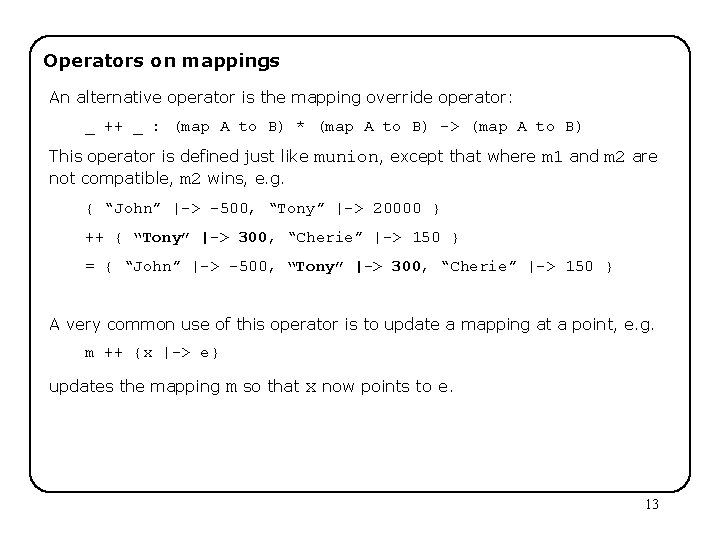
Operators on mappings An alternative operator is the mapping override operator: _ ++ _ : (map A to B) * (map A to B) -> (map A to B) This operator is defined just like munion, except that where m 1 and m 2 are not compatible, m 2 wins, e. g. { “John” |-> -500, “Tony” |-> 20000 } ++ { “Tony” |-> 300, “Cherie” |-> 150 } = { “John” |-> -500, “Tony” |-> 300, “Cherie” |-> 150 } A very common use of this operator is to update a mapping at a point, e. g. m ++ {x |-> e} updates the mapping m so that x now points to e. 13
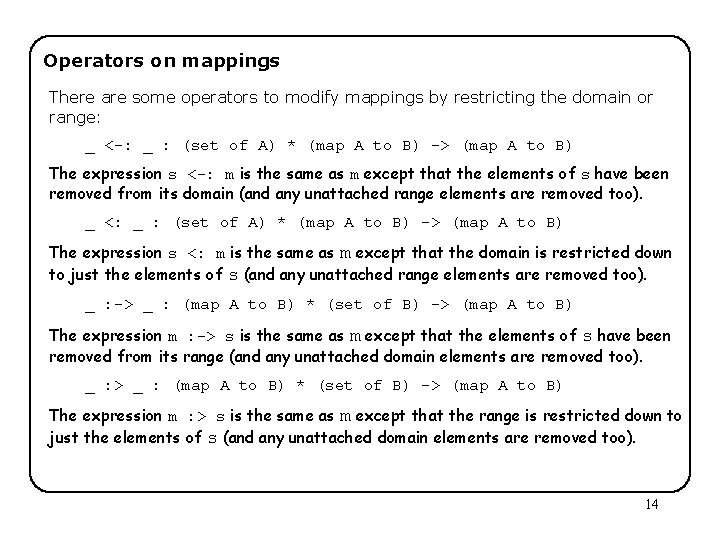
Operators on mappings There are some operators to modify mappings by restricting the domain or range: _ <-: _ : (set of A) * (map A to B) -> (map A to B) The expression s <-: m is the same as m except that the elements of s have been removed from its domain (and any unattached range elements are removed too). _ <: _ : (set of A) * (map A to B) -> (map A to B) The expression s <: m is the same as m except that the domain is restricted down to just the elements of s (and any unattached range elements are removed too). _ : -> _ : (map A to B) * (set of B) -> (map A to B) The expression m : -> s is the same as m except that the elements of s have been removed from its range (and any unattached domain elements are removed too). _ : > _ : (map A to B) * (set of B) -> (map A to B) The expression m : > s is the same as m except that the range is restricted down to just the elements of s (and any unattached domain elements are removed too). 14
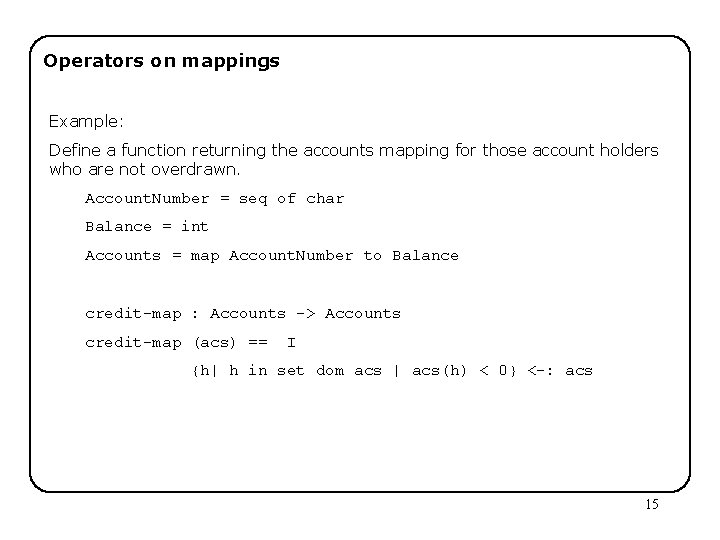
Operators on mappings Example: Define a function returning the accounts mapping for those account holders who are not overdrawn. Account. Number = seq of char Balance = int Accounts = map Account. Number to Balance credit-map : Accounts -> Accounts credit-map (acs) == I {h| h in set dom acs | acs(h) < 0} <-: acs 15
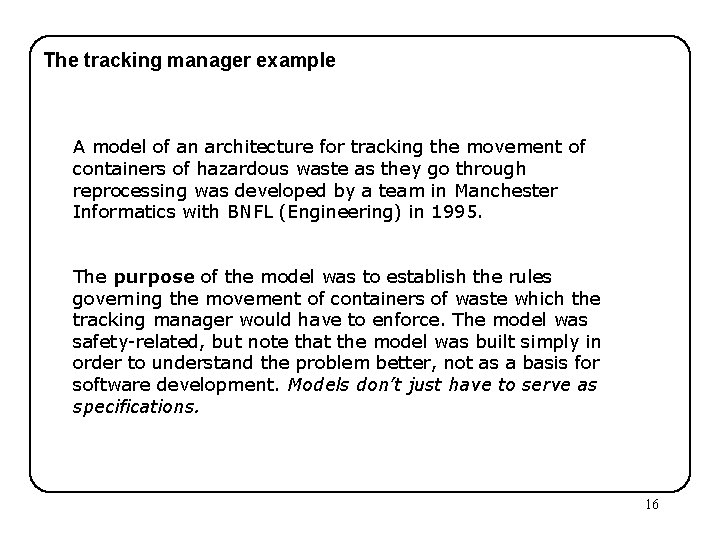
The tracking manager example A model of an architecture for tracking the movement of containers of hazardous waste as they go through reprocessing was developed by a team in Manchester Informatics with BNFL (Engineering) in 1995. The purpose of the model was to establish the rules governing the movement of containers of waste which the tracking manager would have to enforce. The model was safety-related, but note that the model was built simply in order to understand the problem better, not as a basis for software development. Models don’t just have to serve as specifications. 16
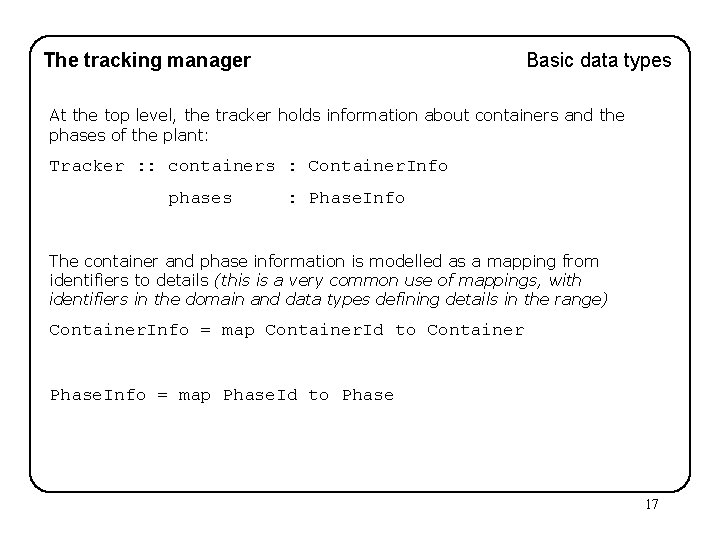
The tracking manager Basic data types At the top level, the tracker holds information about containers and the phases of the plant: Tracker : : containers : Container. Info phases : Phase. Info The container and phase information is modelled as a mapping from identifiers to details (this is a very common use of mappings, with identifiers in the domain and data types defining details in the range) Container. Info = map Container. Id to Container Phase. Info = map Phase. Id to Phase 17
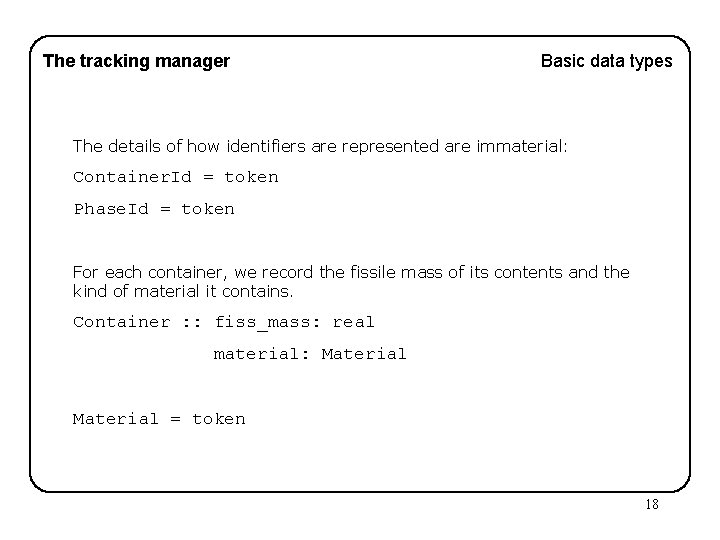
The tracking manager Basic data types The details of how identifiers are represented are immaterial: Container. Id = token Phase. Id = token For each container, we record the fissile mass of its contents and the kind of material it contains. Container : : fiss_mass: real material: Material = token 18
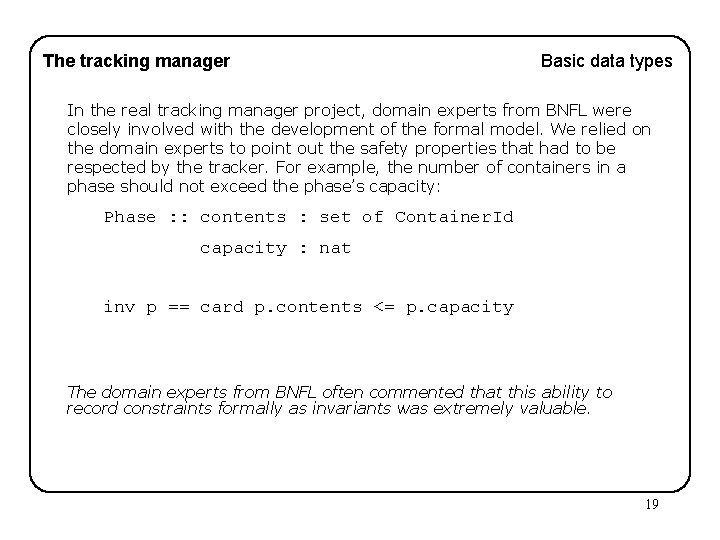
The tracking manager Basic data types In the real tracking manager project, domain experts from BNFL were closely involved with the development of the formal model. We relied on the domain experts to point out the safety properties that had to be respected by the tracker. For example, the number of containers in a phase should not exceed the phase’s capacity: Phase : : contents : set of Container. Id capacity : nat inv p == card p. contents <= p. capacity The domain experts from BNFL often commented that this ability to record constraints formally as invariants was extremely valuable. 19
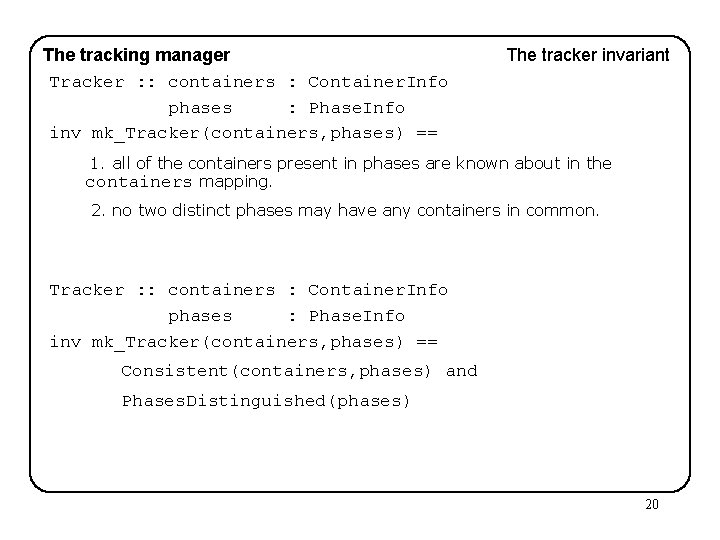
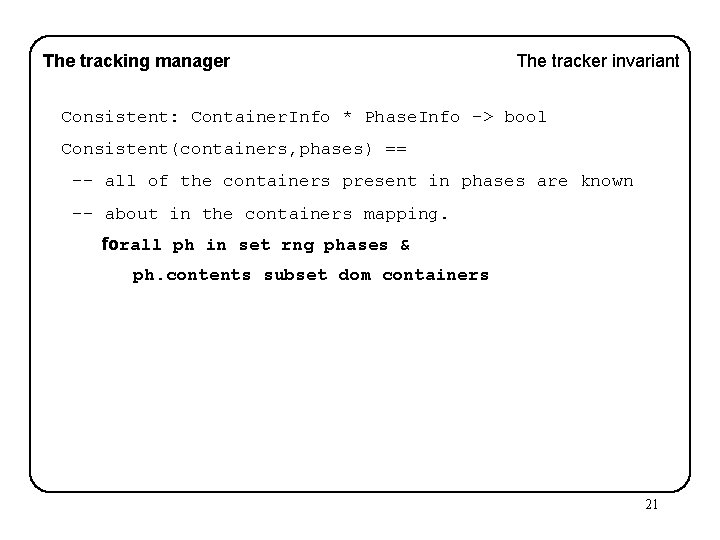
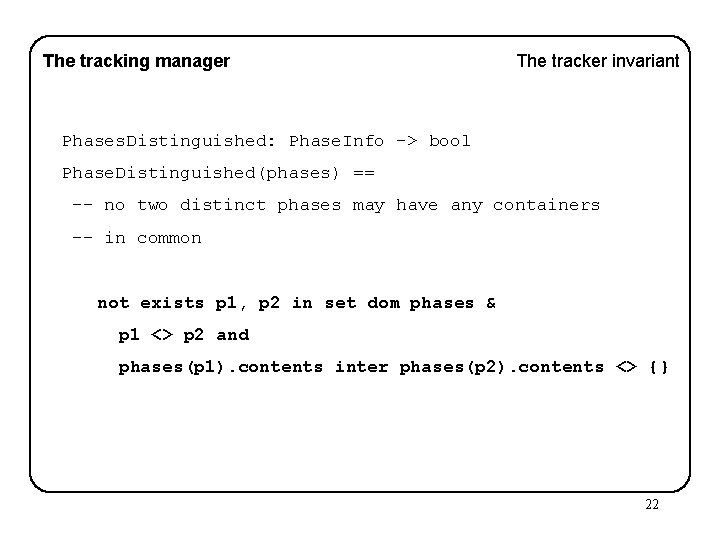
The tracking manager Tracker : : containers : Container. Info phases : Phase. Info inv mk_Tracker(containers, phases) == The tracker invariant 1. all of the containers present in phases are known about in the containers mapping. 2. no two distinct phases may have any containers in common. Tracker : : containers : Container. Info phases : Phase. Info inv mk_Tracker(containers, phases) == Consistent(containers, phases) and Phases. Distinguished(phases) 20
The tracking manager The tracker invariant Consistent: Container. Info * Phase. Info -> bool Consistent(containers, phases) == -- all of the containers present in phases are known -- about in the containers mapping. forall ph in set rng phases & ph. contents subset dom containers 21
The tracking manager The tracker invariant Phases. Distinguished: Phase. Info -> bool Phase. Distinguished(phases) == -- no two distinct phases may have any containers -- in common not exists p 1, p 2 in set dom phases & p 1 <> p 2 and phases(p 1). contents inter phases(p 2). contents <> {} 22
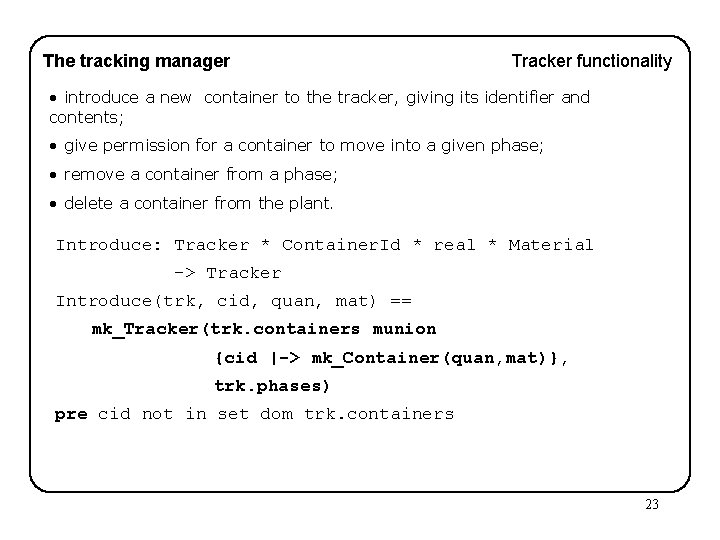
The tracking manager Tracker functionality • introduce a new container to the tracker, giving its identifier and contents; • give permission for a container to move into a given phase; • remove a container from a phase; • delete a container from the plant. Introduce: Tracker * Container. Id * real * Material -> Tracker Introduce(trk, cid, quan, mat) == mk_Tracker(trk. containers munion {cid |-> mk_Container(quan, mat)}, trk. phases) pre cid not in set dom trk. containers 23
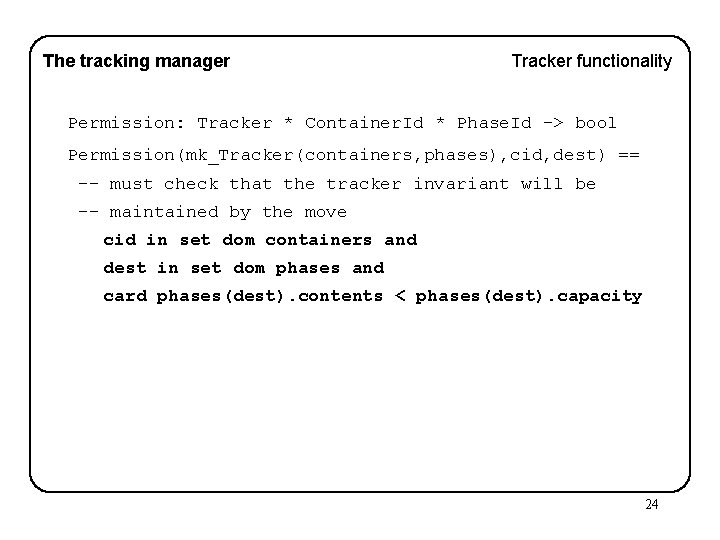
The tracking manager Tracker functionality Permission: Tracker * Container. Id * Phase. Id -> bool Permission(mk_Tracker(containers, phases), cid, dest) == -- must check that the tracker invariant will be -- maintained by the move cid in set dom containers and dest in set dom phases and card phases(dest). contents < phases(dest). capacity 24
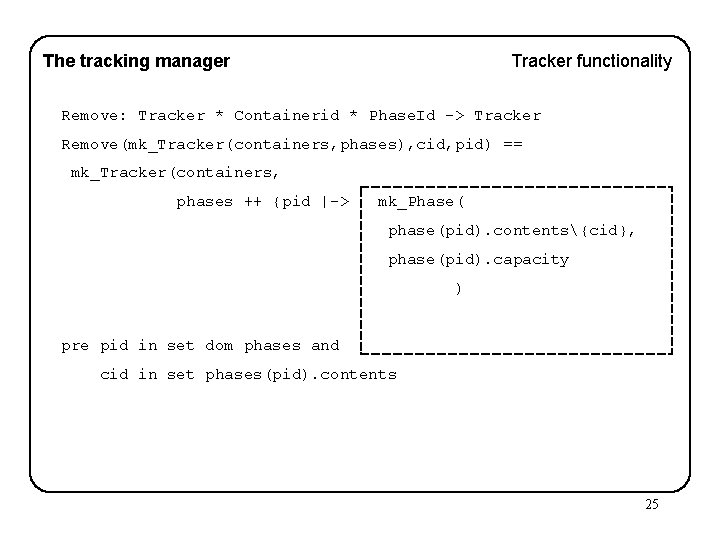
The tracking manager Tracker functionality Remove: Tracker * Containerid * Phase. Id -> Tracker Remove(mk_Tracker(containers, phases), cid, pid) == mk_Tracker(containers, phases ++ {pid |-> mk_Phase( phase(pid). contents{cid}, phase(pid). capacity ) pre pid in set dom phases and cid in set phases(pid). contents 25
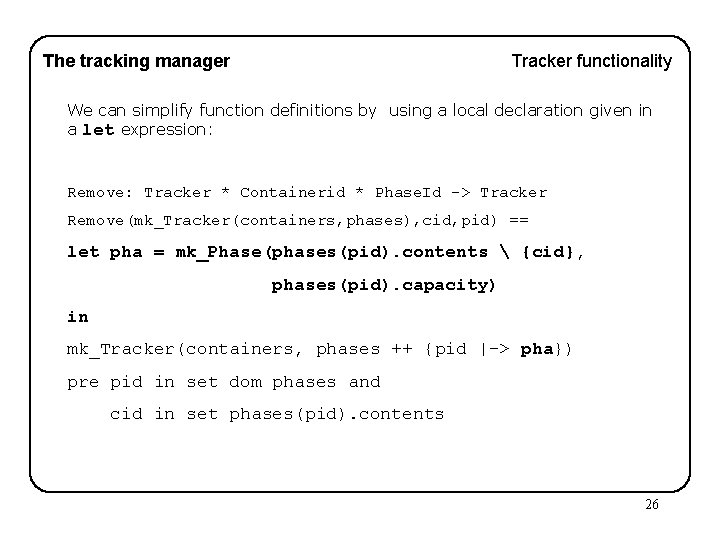
The tracking manager Tracker functionality We can simplify function definitions by using a local declaration given in a let expression: Remove: Tracker * Containerid * Phase. Id -> Tracker Remove(mk_Tracker(containers, phases), cid, pid) == let pha = mk_Phase(phases(pid). contents {cid}, phases(pid). capacity) in mk_Tracker(containers, phases ++ {pid |-> pha}) pre pid in set dom phases and cid in set phases(pid). contents 26
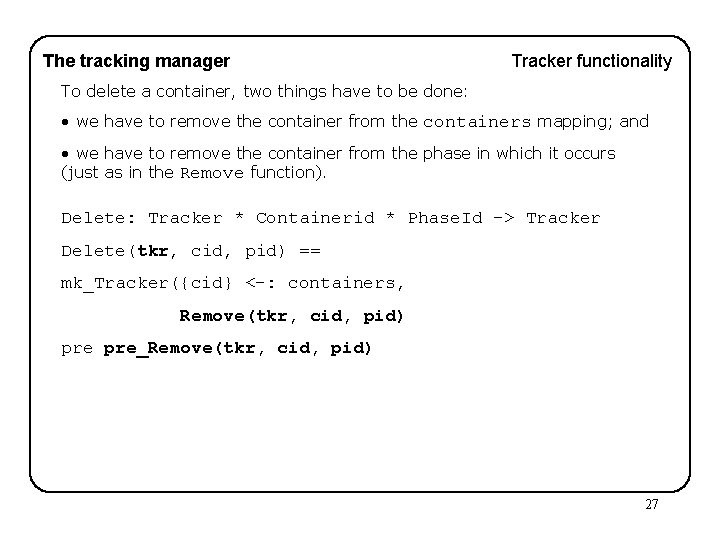
The tracking manager Tracker functionality To delete a container, two things have to be done: • we have to remove the container from the containers mapping; and • we have to remove the container from the phase in which it occurs (just as in the Remove function). Delete: Tracker * Containerid * Phase. Id -> Tracker Delete(tkr, cid, pid) == mk_Tracker({cid} <-: containers, Remove(tkr, cid, pid) pre_Remove(tkr, cid, pid) 27
Review • Mappings represent functional relations between two sets of values: the domain and the range. • Mapping values can be defined by enumeration or comprehension as sets of maplets. • Operators to extract the domain and range, mapping lookup and for combining mappings by union or override. Some operators are partial. 28