
Modelling the transport behaviour of an ideal pollutants
Modelling the transport behaviour of an ideal pollutants in the heterogeneous aquifer under different anisotropy factors and simulation of the funneland-gate system. GTX 718 Modelling By Muravha Sedzani Elia (28234422) 2012 -08 -23 2021 -09 -14 1
Table of contents 1. Introduction…………………… ……. 3 2. The funnel and gate system……………. . 5 3. Methodology…………………… ……… 6 4. Results and discussion………………. 9 5. Conclusion…………………… ……… 12 6. References…………………… ……… 13 2021 -09 -14 2
1. Introduction o The aim of the topic is to model the transport behaviour of the ideal pollutants in the heterogeneous aquifer under different anisotropic factors. o The change in the solution behaviour when anisotropic factor is assumed to be Khx=0. 5 Khy. o Modelling the minimum width of the funnel and gate system in such a way that all the pollutants are removed at the gate through a drain. 2021 -09 -14 3
1. Introduction Given parameters: o Dimension of the model: 600 mx 300 m o Top layer: b = 30 m : unconfined with K=8 m/day and neff=0. 25 : Khx=3 Khy o Bottom layer: b = 10 m : K=5 m/day and neff=0. 2 o Contaminant source width: 200 m o Drain cell: h= 37. 5 m o Heads: 39 m in the western flow boundary and 38 m in the eastern flow boundary. 2021 -09 -14 4
2. The funnel and gate system o The funnel and gate system is an alternative to pump-andtreat system for pollutants remediation. o The pollutants migrate from the source into the reactive barrier known as a gate, where physical, chemical or biological processes take place to remove all the pollutants from the groundwater. o The funnel and gate system consist of impermeable layer of clay acting as a bedrock to prevent underflow of pollutants and water. o In the funnel and gate system configuration, water and pollutants are directed by the low permeability flow boundary to pass through the reactive gate or drain. (Starr and Cherry, 1994) and (Powel et al. 1998). 2021 -09 -14 5
3. Methodology o The transport behaviour of the pollutants from the source were simulated using PMWIN version 5. 3. o The model consist of 120 x 5 m columns and 60 x 5 m o Transient simulation flow type was chosen for the model and the default specific storage of 0. 0001 [1/L] was used. o The specific yield of the top layer was assumed to be 0. 10 and bottom layer was 0. 08. 2021 -09 -14 6
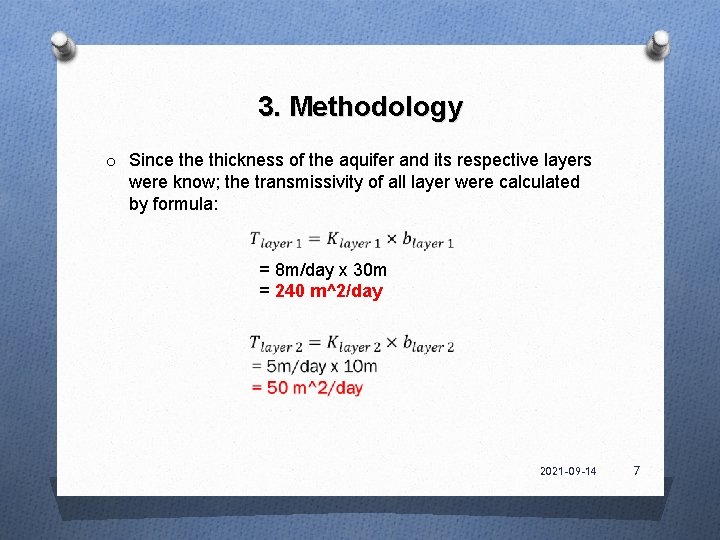
3. Methodology o Since thickness of the aquifer and its respective layers were know; the transmissivity of all layer were calculated by formula: = 8 m/day x 30 m = 240 m^2/day 2021 -09 -14 7
3. Methodology o The vertical hydraulic conductivities of the top and bottom layers were assumed to be 10% of their horizontal hydraulic conductivity. o The vertical leakance of the top layer was assumed to be 0. 000001. o The drain cell at the gate of the funnel was placed in cell coordinates of (100, 33). o The conductance of the flow barrier assumed to be 1 x 10 -7 m/day and the thickness of the barrier was 1 m. 2021 -09 -14 8
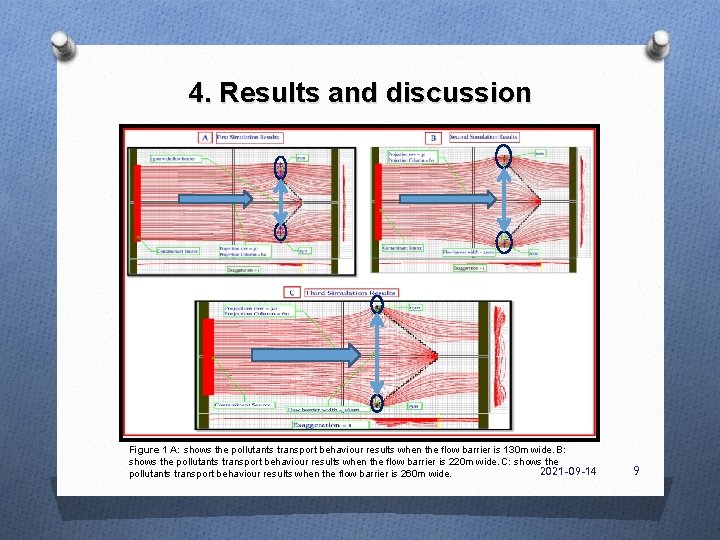
4. Results and discussion Figure 1 A: shows the pollutants transport behaviour results when the flow barrier is 130 m wide. B: shows the pollutants transport behaviour results when the flow barrier is 220 m wide. C: shows the 2021 -09 -14 pollutants transport behaviour results when the flow barrier is 260 m wide. 9
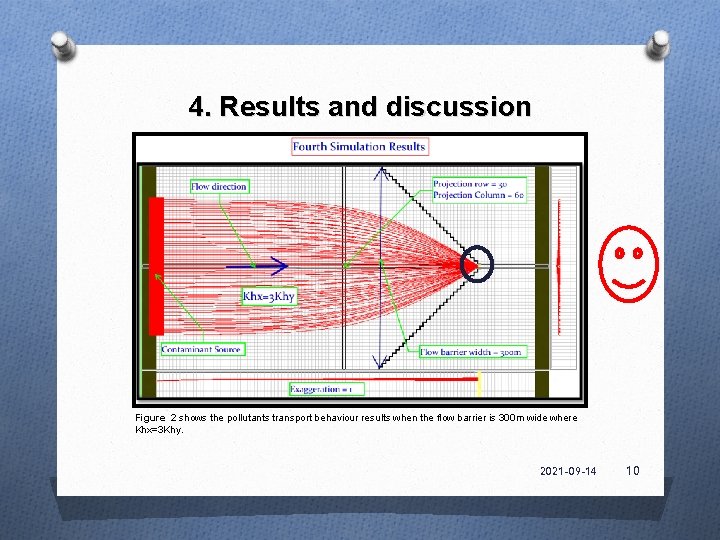
4. Results and discussion Figure 2 shows the pollutants transport behaviour results when the flow barrier is 300 m wide where Khx=3 Khy. 2021 -09 -14 10
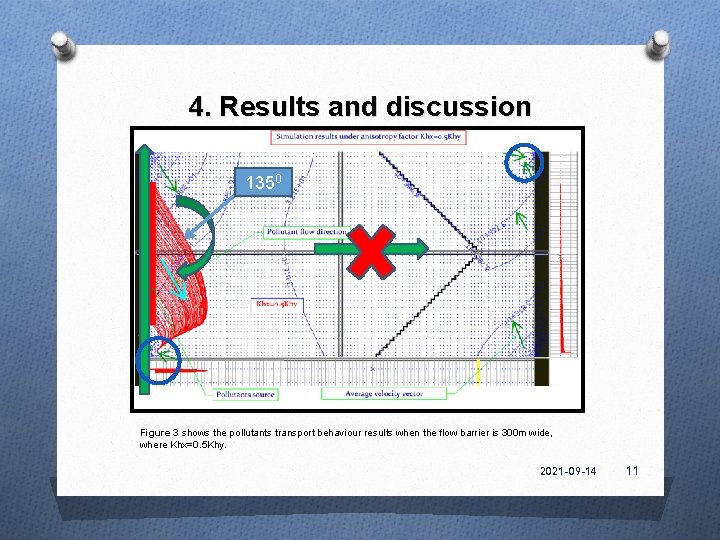
4. Results and discussion 1350 Figure 3 shows the pollutants transport behaviour results when the flow barrier is 300 m wide, where Khx=0. 5 Khy. 2021 -09 -14 11
5. Conclusion o Several simulations of the funnel and gate system were conducted with different assumptions of the minimum width for the model. The minimum width of the funnel and gate system required to redirect all the pollutants through the drain was 300 m. o The transport behaviour of the pollutants under Khx=3 Khy was similar to the natural flow gradient of groundwater and was highly influenced by the variation in the degree of anisotropic factor. o Change in anisotropic factor in a model changes the flow behaviour , direction and velocity vectors of the solution. 2021 -09 -14 12
6. References 1. Chiang, W. and Kinzelbach, W. (1998). Processing Modflow: A Simulation System for Modelling Groundwater Flow and Pollution. Hamburg. Zürich. Pp-331. 2. Powel, M. R. , Blowes, D. W. , GIllham, R. W. , Schultz, D. , Sivavec, T. , Puls, R. W. , Vogan, J. L. , Powel, D. P. and Landis, R. (1998). Permeable Reactive Barrier Technologies for Contaminant Remediation. United States Environmental Protection Agency. EPA/600/R-98/125: Washington DC. Pp 102 3. Starr, R. C. and Cherry, J. A. (1994). In Situ Remediation of Contaminated Ground Water: The Funnel-and-Gate System. EG&G Idaho, Inc. Canada. 32: 465 -476. 2021 -09 -14 13
- Slides: 13