
Modelling the GRB light curves using a shock
Modelling the GRB light curves using a shock wave model Saša Simić Luka Č. Popović Luca Grassitelli
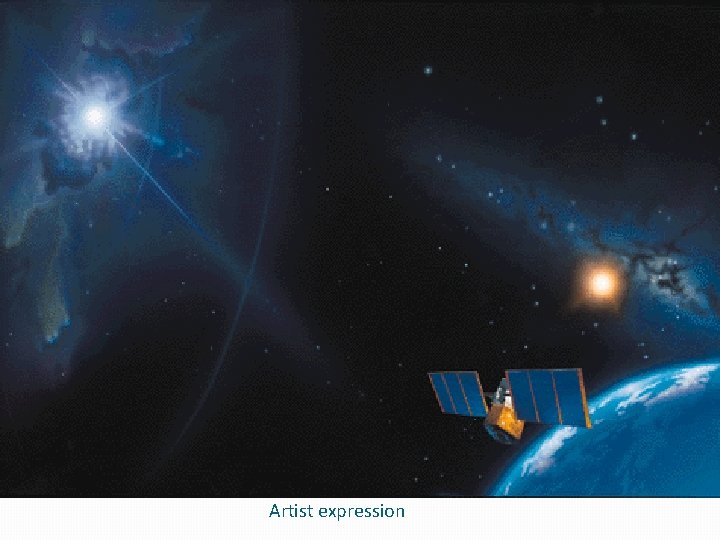
GRBs – Strongest explosion in the Universe Artist expression
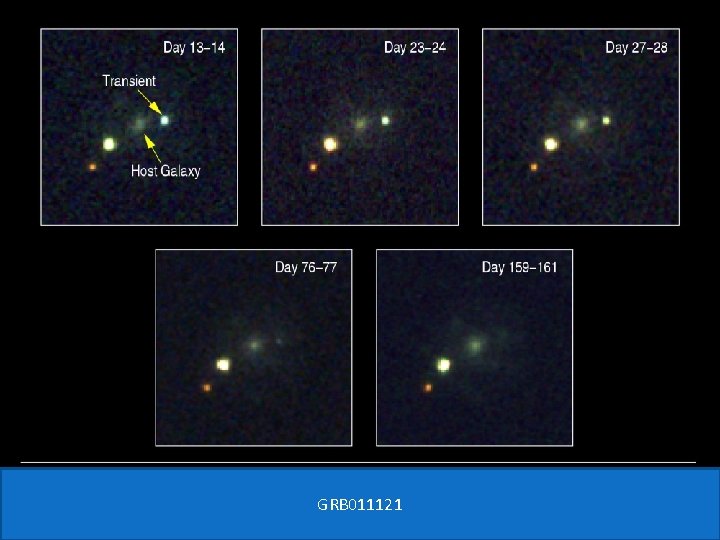
What do gamma ray bursts actually look like? GRB 011121
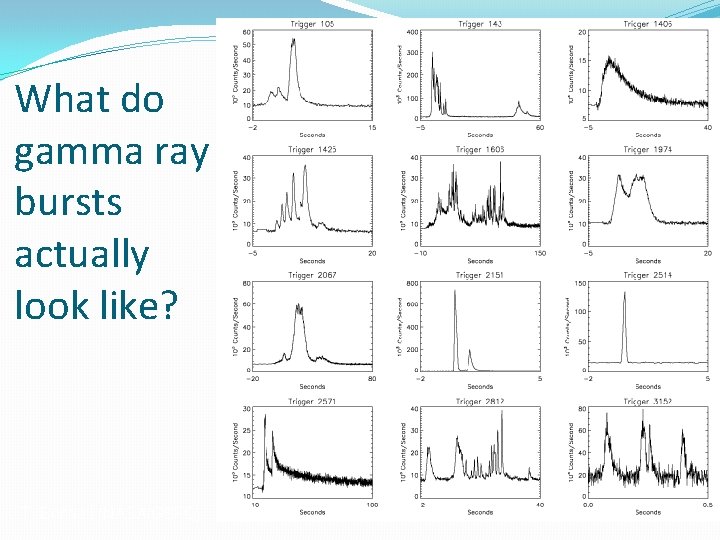
What do gamma ray bursts actually look like? J. T. Bonnell (NASA/GSFC)
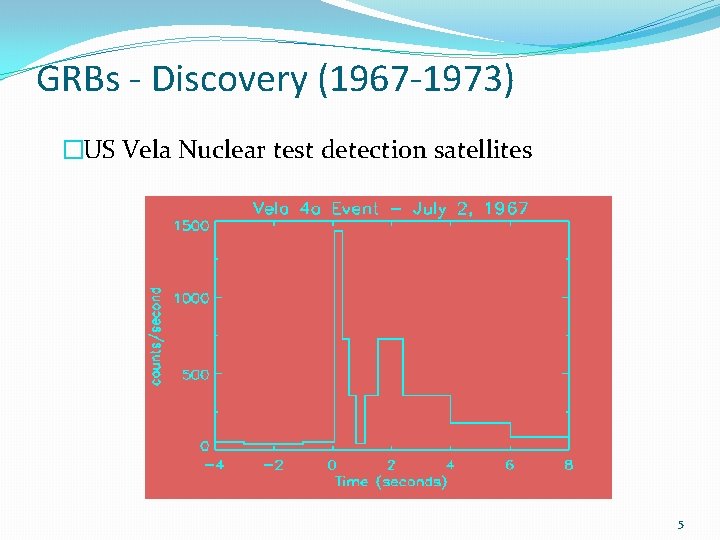
GRBs - Discovery (1967 -1973) �US Vela Nuclear test detection satellites 5
GRB, tell me who you are… �GRBs remained a complete mystery for almost 30 years ! �More than 150 different theories: �Magnetic flares �Black Hole evaporation �Anti-matter accretion �Deflected AGN jet �Magnetars, Soft Gamma-Ray Repeaters (SGRs) �Mini BH devouring NS � messages from the Aliens �…. . 6
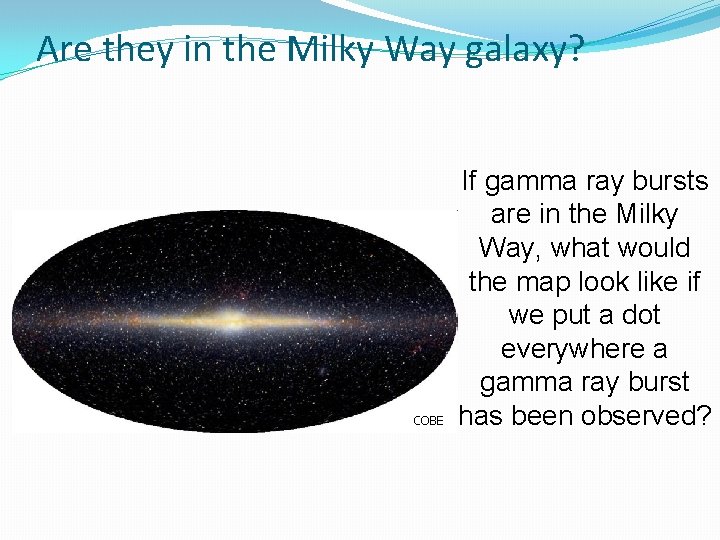
Are they in the Milky Way galaxy? COBE If gamma ray bursts are in the Milky Way, what would the map look like if we put a dot everywhere a gamma ray burst has been observed?
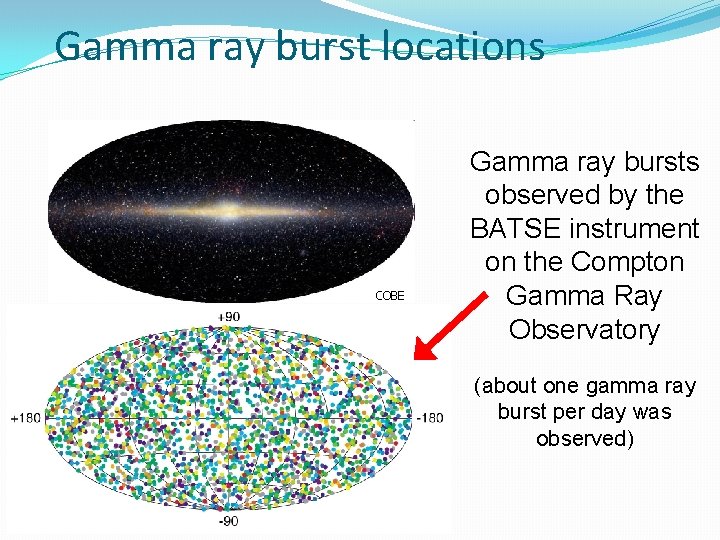
Gamma ray burst locations COBE Gamma ray bursts observed by the BATSE instrument on the Compton Gamma Ray Observatory (about one gamma ray burst per day was observed)
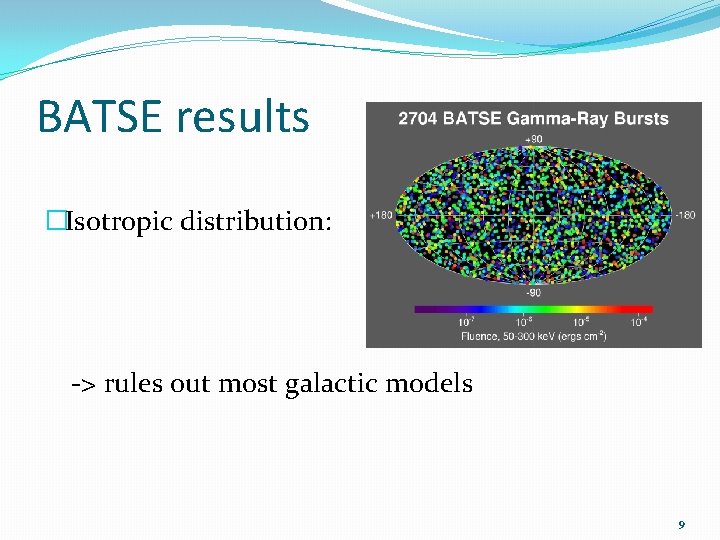
BATSE results �Isotropic distribution: -> rules out most galactic models 9
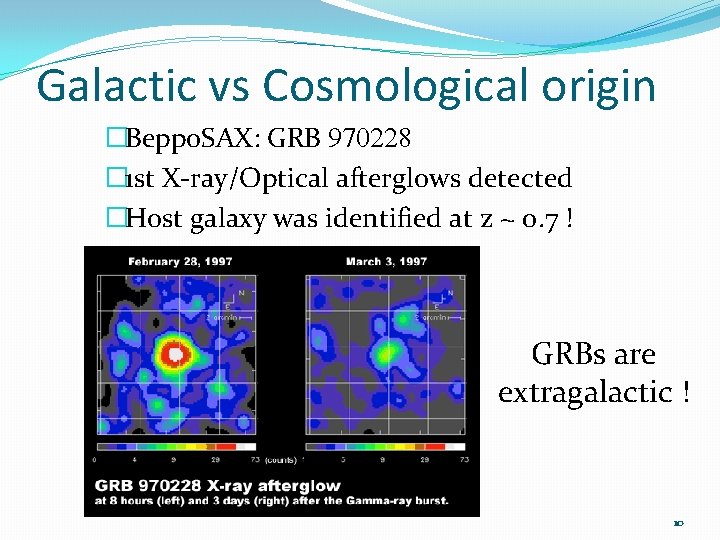
Galactic vs Cosmological origin �Beppo. SAX: GRB 970228 � 1 st X-ray/Optical afterglows detected �Host galaxy was identified at z ~ 0. 7 ! GRBs are extragalactic ! 10
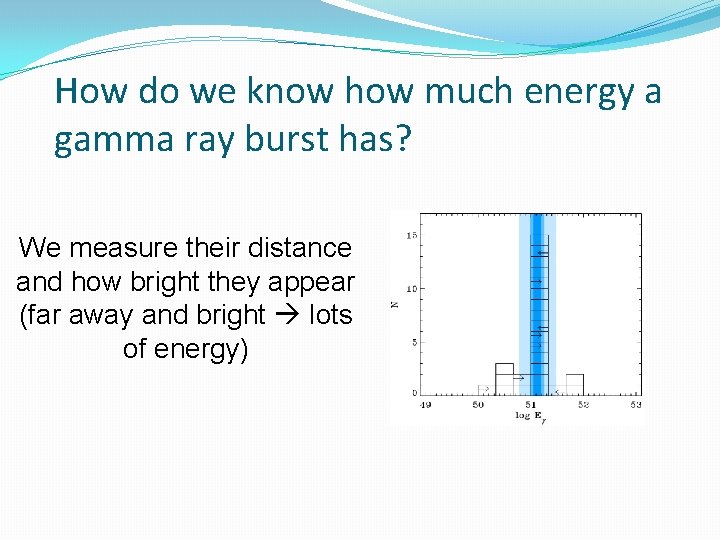
How do we know how much energy a gamma ray burst has? We measure their distance and how bright they appear (far away and bright lots of energy)
Consequence of cosmological origin of GRBs �Tremendous isotropic-equivalent energy: � 1050 -1054 ergs released in a short time scale only in the form of gamma-rays. (sun: 1033 erg/sec; supernova: 1051 ergs on a month time scale) �GRBs have been observed up to z ~ 6. 3 -> hope to use GRB as cosmological tool (similar as Type Ia supernovae) 12
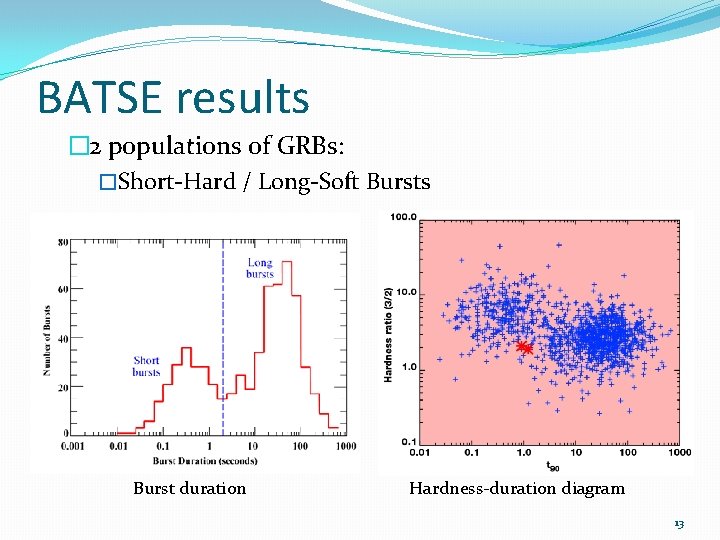
BATSE results � 2 populations of GRBs: �Short-Hard / Long-Soft Bursts Burst duration Hardness-duration diagram 13
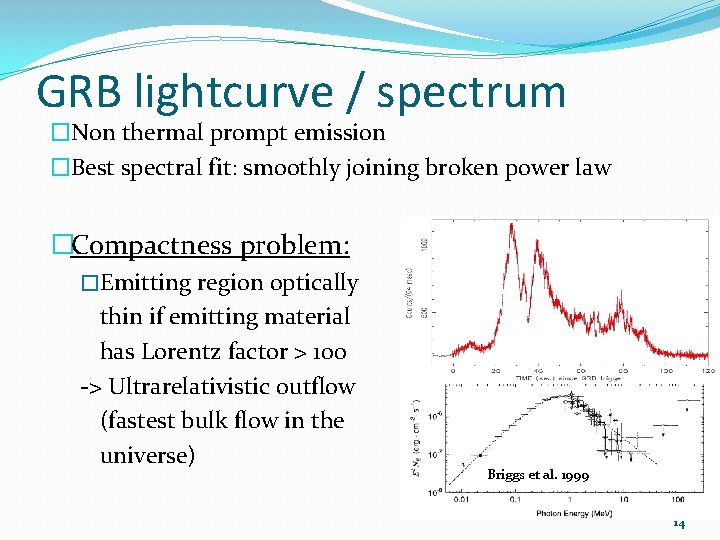
GRB lightcurve / spectrum �Non thermal prompt emission �Best spectral fit: smoothly joining broken power law �Compactness problem: �Emitting region optically thin if emitting material has Lorentz factor > 100 -> Ultrarelativistic outflow (fastest bulk flow in the universe) Briggs et al. 1999 14
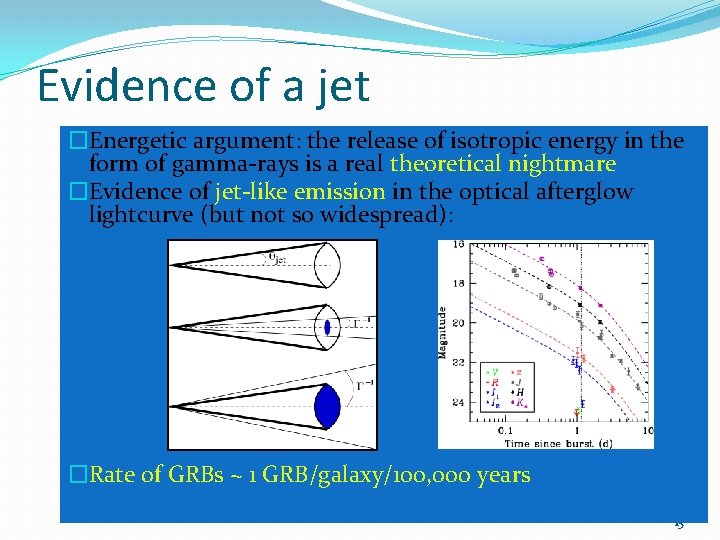
Evidence of a jet �Energetic argument: the release of isotropic energy in the form of gamma-rays is a real theoretical nightmare �Evidence of jet-like emission in the optical afterglow lightcurve (but not so widespread): �Rate of GRBs ~ 1 GRB/galaxy/100, 000 years 15
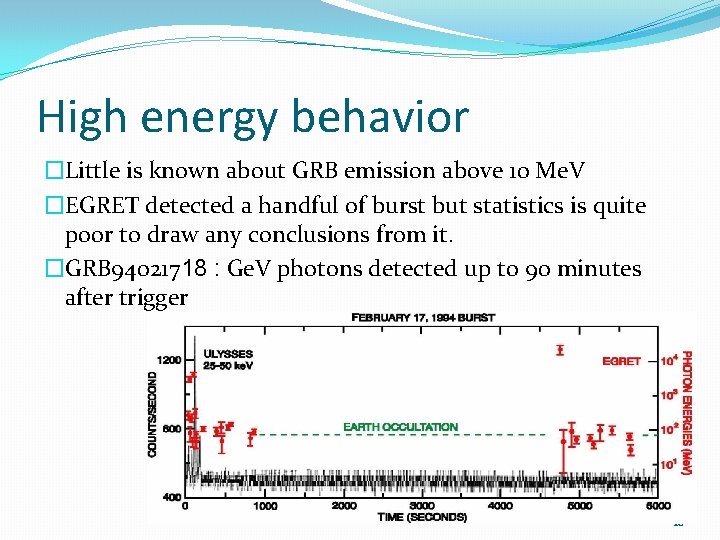
High energy behavior �Little is known about GRB emission above 10 Me. V �EGRET detected a handful of burst but statistics is quite poor to draw any conclusions from it. �GRB 94021718 : Ge. V photons detected up to 90 minutes after trigger 16
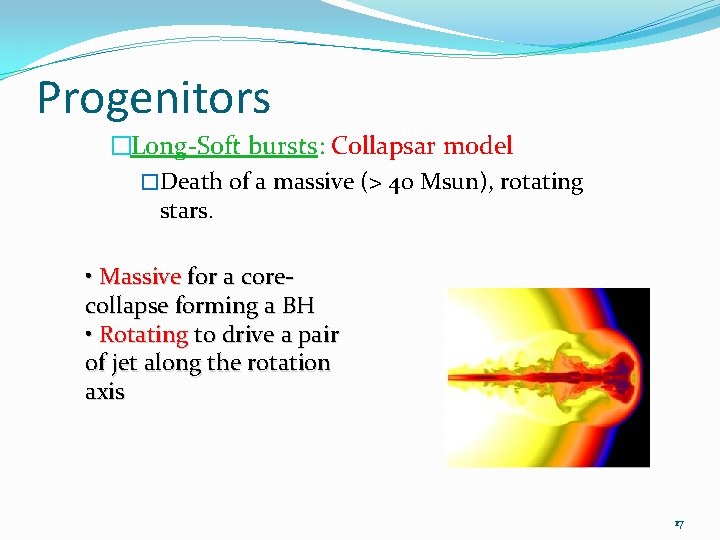
Progenitors �Long-Soft bursts: Collapsar model �Death of a massive (> 40 Msun), rotating stars. • Massive for a corecollapse forming a BH • Rotating to drive a pair of jet along the rotation axis 17
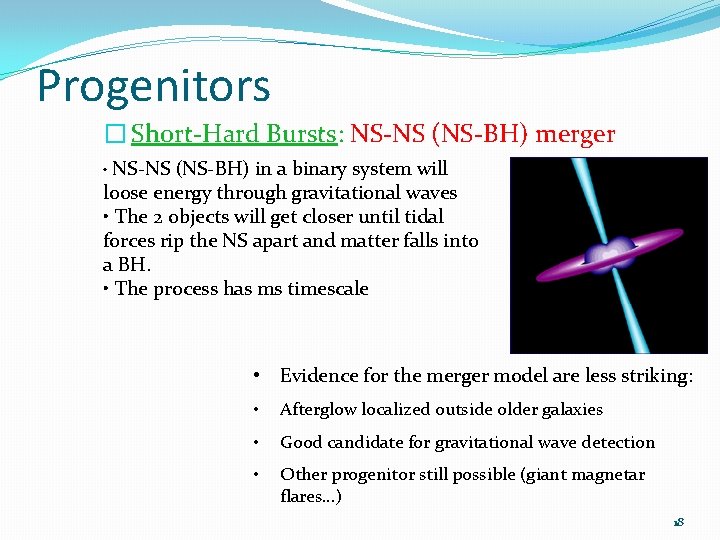
Progenitors � Short-Hard Bursts: NS-NS (NS-BH) merger • NS-NS (NS-BH) in a binary system will loose energy through gravitational waves • The 2 objects will get closer until tidal forces rip the NS apart and matter falls into a BH. • The process has ms timescale • Evidence for the merger model are less striking: • Afterglow localized outside older galaxies • Good candidate for gravitational wave detection • Other progenitor still possible (giant magnetar flares…) 18
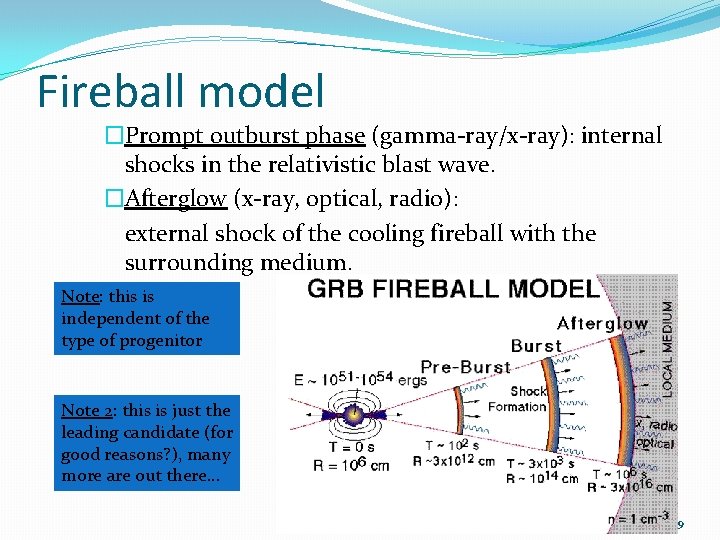
Fireball model �Prompt outburst phase (gamma-ray/x-ray): internal shocks in the relativistic blast wave. �Afterglow (x-ray, optical, radio): external shock of the cooling fireball with the surrounding medium. Note: this is independent of the type of progenitor Note 2: this is just the leading candidate (for good reasons? ), many more are out there… 19
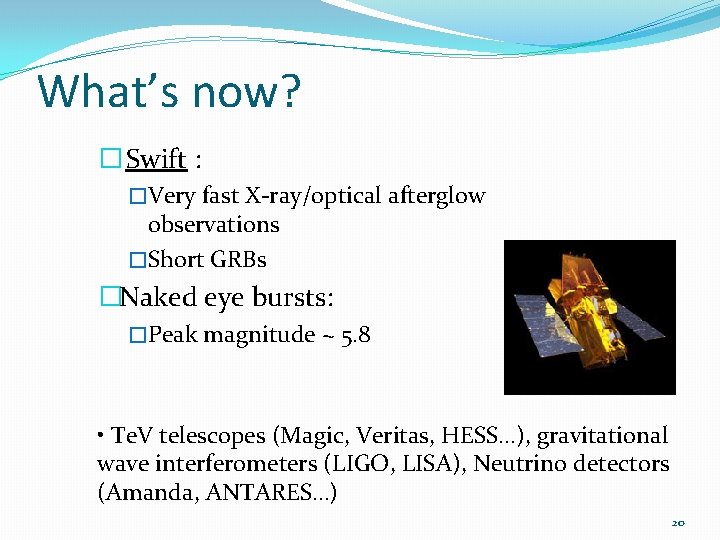
What’s now? � Swift : �Very fast X-ray/optical afterglow observations �Short GRBs �Naked eye bursts: �Peak magnitude ~ 5. 8 • Te. V telescopes (Magic, Veritas, HESS…), gravitational wave interferometers (LIGO, LISA), Neutrino detectors (Amanda, ANTARES…) 20
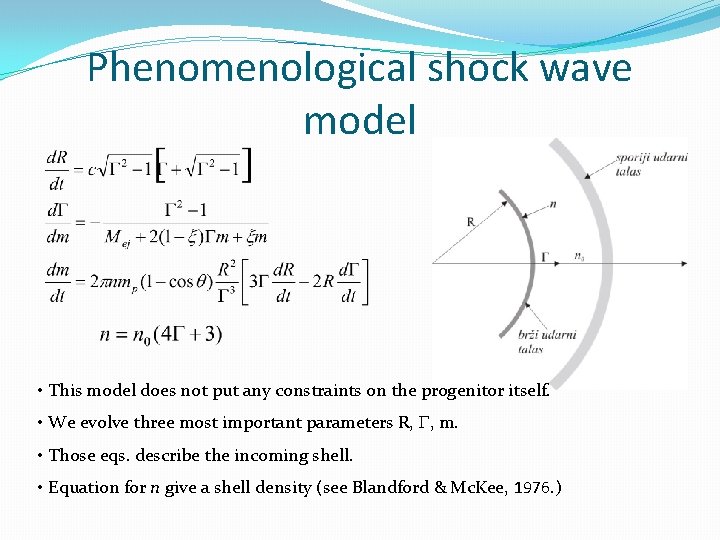
Phenomenological shock wave model • This model does not put any constraints on the progenitor itself. • We evolve three most important parameters R, G, m. • Those eqs. describe the incoming shell. • Equation for n give a shell density (see Blandford & Mc. Kee, 1976. )
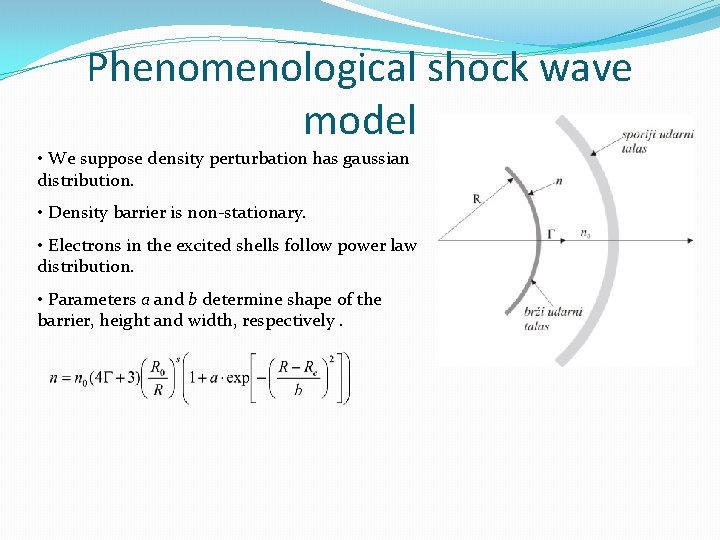
Phenomenological shock wave model • We suppose density perturbation has gaussian distribution. • Density barrier is non-stationary. • Electrons in the excited shells follow power law distribution. • Parameters a and b determine shape of the barrier, height and width, respectively.
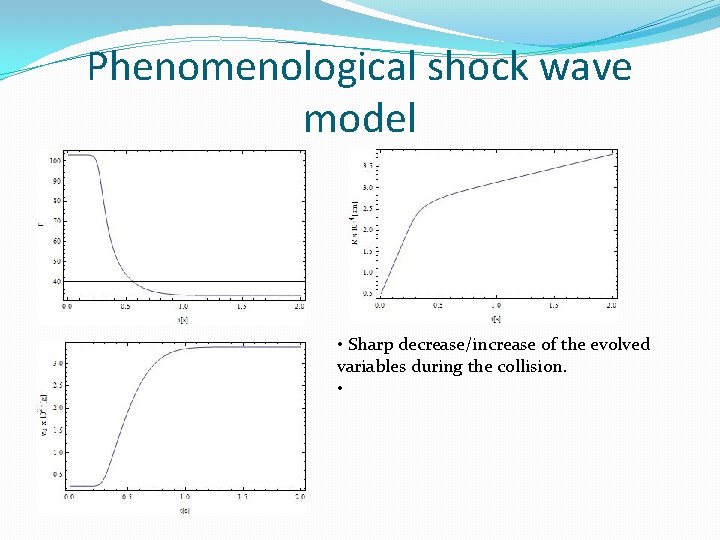
Phenomenological shock wave model • Sharp decrease/increase of the evolved variables during the collision. •
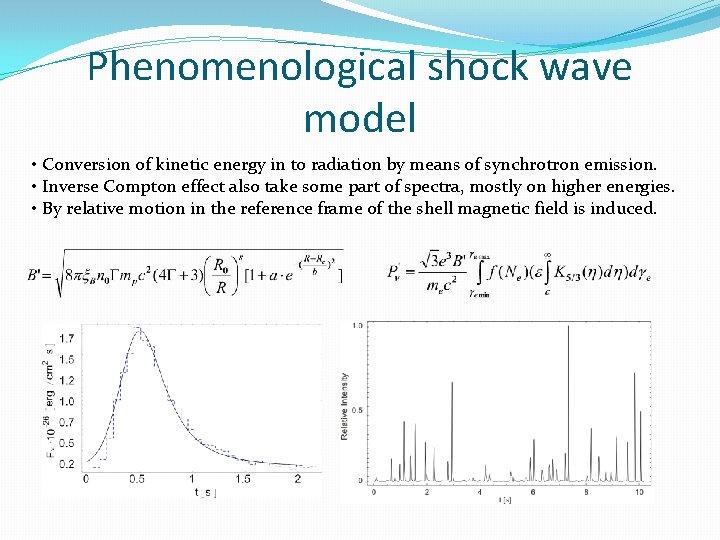
Phenomenological shock wave model • Conversion of kinetic energy in to radiation by means of synchrotron emission. • Inverse Compton effect also take some part of spectra, mostly on higher energies. • By relative motion in the reference frame of the shell magnetic field is induced.
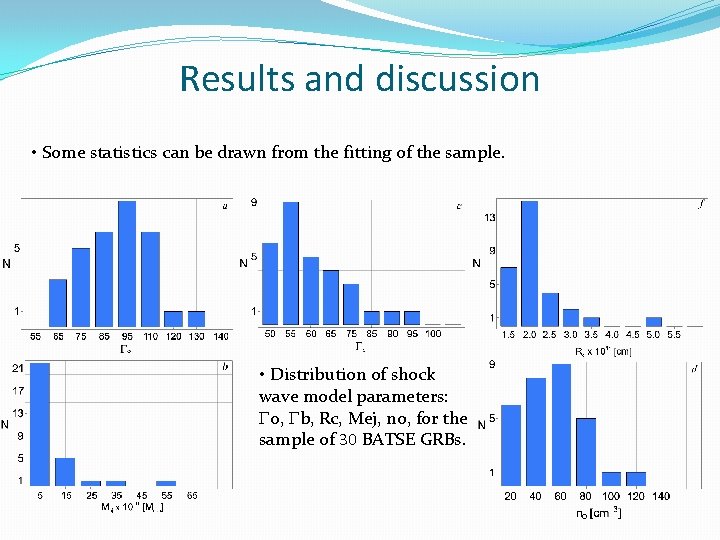
Results and discussion • Some statistics can be drawn from the fitting of the sample. • Distribution of shock wave model parameters: G 0, Gb, Rc, Mej, no, for the sample of 30 BATSE GRBs.
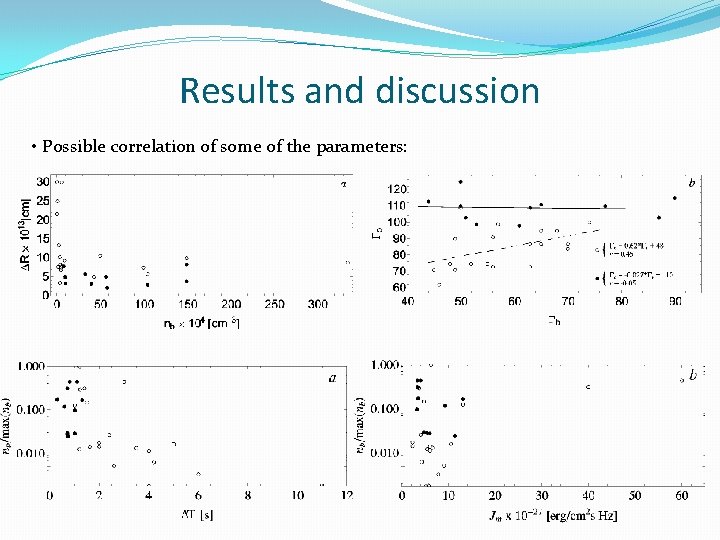
Results and discussion • Possible correlation of some of the parameters:
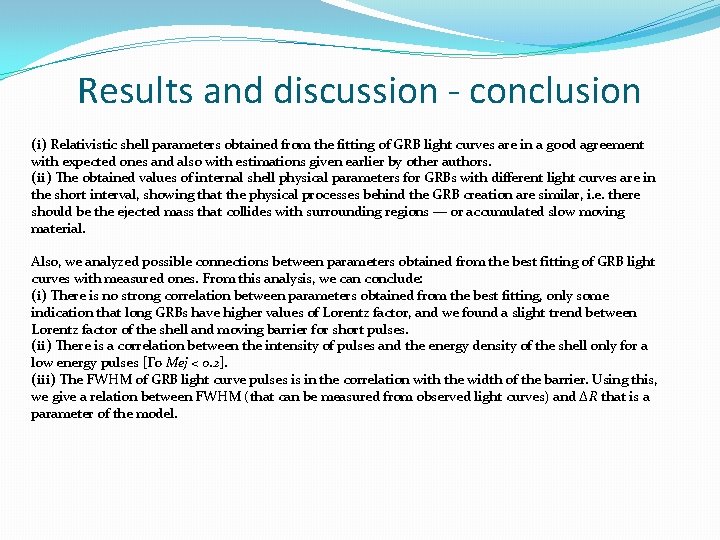
Results and discussion - conclusion (i) Relativistic shell parameters obtained from the fitting of GRB light curves are in a good agreement with expected ones and also with estimations given earlier by other authors. (ii) The obtained values of internal shell physical parameters for GRBs with different light curves are in the short interval, showing that the physical processes behind the GRB creation are similar, i. e. there should be the ejected mass that collides with surrounding regions — or accumulated slow moving material. Also, we analyzed possible connections between parameters obtained from the best fitting of GRB light curves with measured ones. From this analysis, we can conclude: (i) There is no strong correlation between parameters obtained from the best fitting, only some indication that long GRBs have higher values of Lorentz factor, and we found a slight trend between Lorentz factor of the shell and moving barrier for short pulses. (ii) There is a correlation between the intensity of pulses and the energy density of the shell only for a low energy pulses [Γ 0 Mej < 0. 2]. (iii) The FWHM of GRB light curve pulses is in the correlation with the width of the barrier. Using this, we give a relation between FWHM (that can be measured from observed light curves) and ΔR that is a parameter of the model.

Thank you
- Slides: 28