
Modelling Scenarios for Water Resources Planning WEAP Jordan
- Slides: 37
Modelling Scenarios for Water Resources Planning WEAP Jordan Model Arab Water Week 2019 3. 3. 2019 Page 1
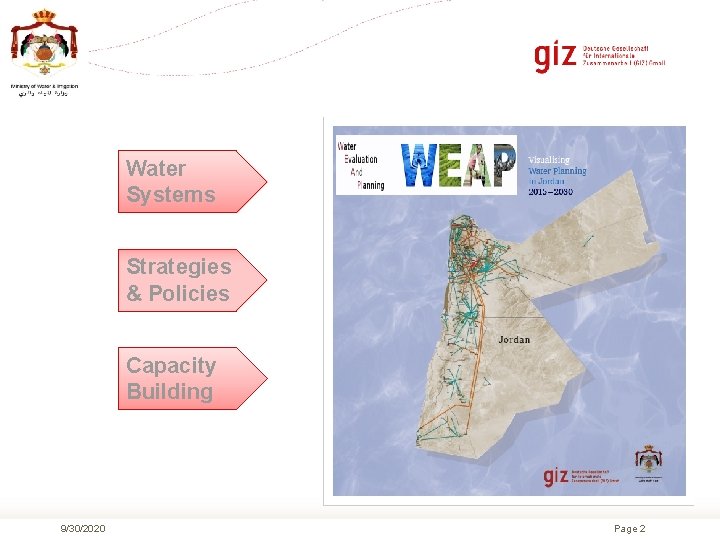
Water Systems Strategies & Policies Capacity Building 9/30/2020 Page 2
Parts of the presentation § WEAP concept and the application developed for Jordan (CW model) § Results of CW model for Domestic Sector Country and Governorate levels (i. e. Irbid and As Samra WWTP) 30/09/2020 Page 3
WEAP Model 30/09/2020 Page 4
Has been developed for more than 25 years by the Stockholm Environment Institute (SEI). 30/09/2020 Page 5
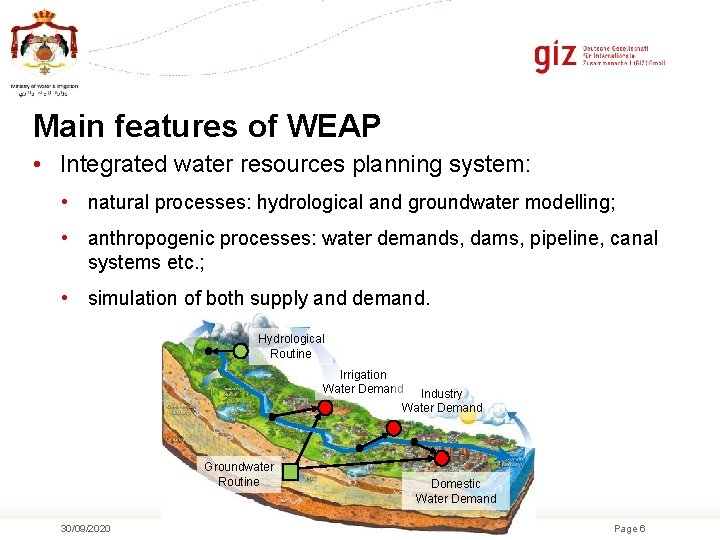
Main features of WEAP • Integrated water resources planning system: • natural processes: hydrological and groundwater modelling; • anthropogenic processes: water demands, dams, pipeline, canal systems etc. ; • simulation of both supply and demand. Hydrological Routine Irrigation Water Demand Industry Water Demand Groundwater Routine 30/09/2020 Domestic Water Demand Type presentation title here Page 6
Main features of WEAP • GIS-based, graphical drag & drop interface. • Number of built-in routines (ex. plant growth, water quality and financial analysis) and functions. • User-defined variables. • Strong scenario management functionality for medium to long term analysis. • Can be coupled with other models: • Groundwater flow model: MODFLOW. • Surface water quality model: Qual 2 K. • Socio-economic model: MYWAS. 30/09/2020 Page 7
Application developed in Jordan Countrywide Model 30/09/2020 Page 8
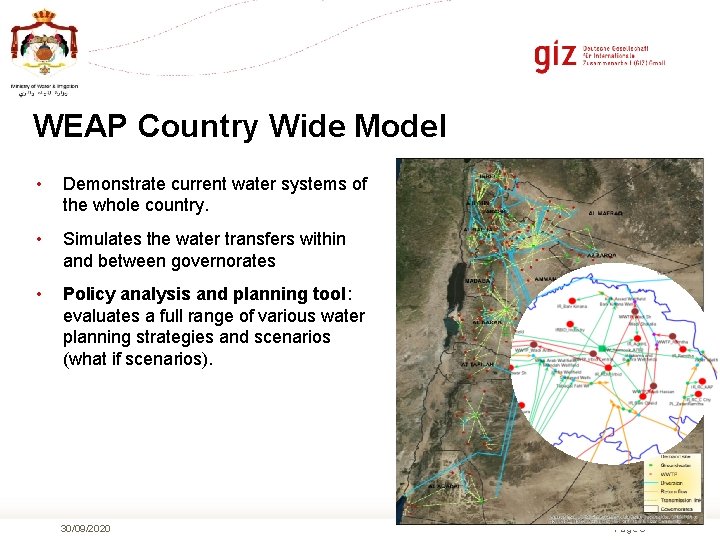
WEAP Country Wide Model • Demonstrate current water systems of the whole country. • Simulates the water transfers within and between governorates • Policy analysis and planning tool: evaluates a full range of various water planning strategies and scenarios (what if scenarios). 30/09/2020 Page 9
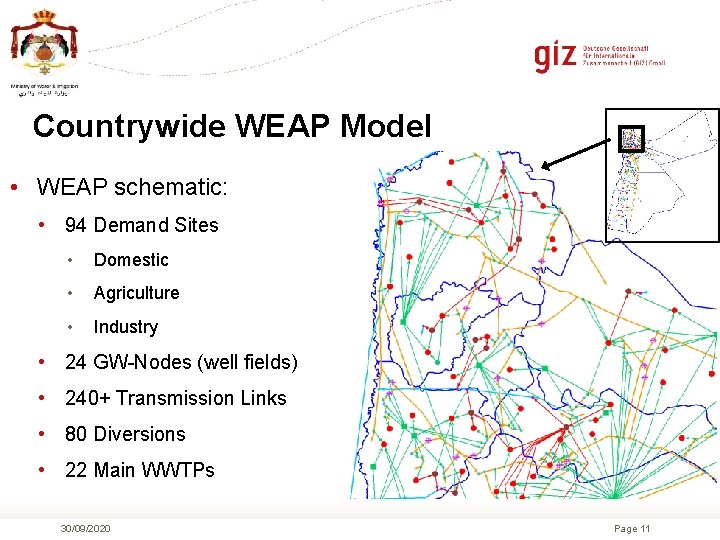
Countrywide WEAP Model • WEAP schematic: • 94 Demand Sites • Domestic • Agriculture • Industry • 24 GW-Nodes (well fields) • 240+ Transmission Links • 80 Diversions • 22 Main WWTPs 30/09/2020 Page 11
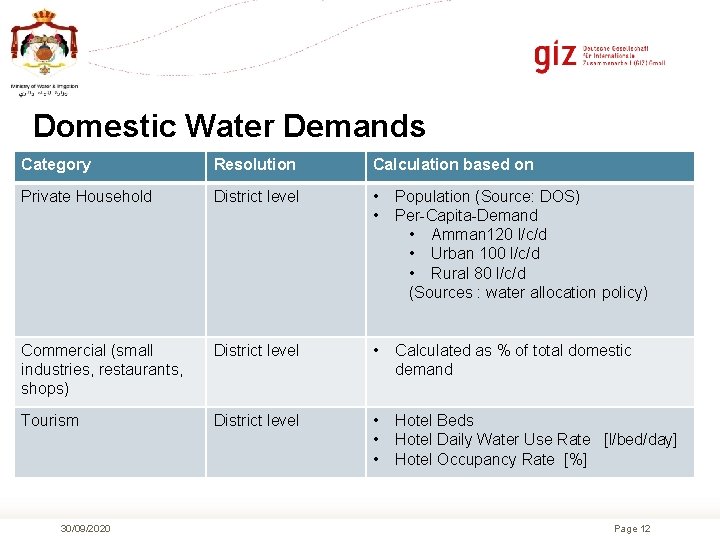
Domestic Water Demands Category Resolution Calculation based on Private Household District level • • Population (Source: DOS) Per-Capita-Demand • Amman 120 l/c/d • Urban 100 l/c/d • Rural 80 l/c/d (Sources : water allocation policy) Commercial (small industries, restaurants, shops) District level • Calculated as % of total domestic demand Tourism District level • • • Hotel Beds Hotel Daily Water Use Rate [l/bed/day] Hotel Occupancy Rate [%] 30/09/2020 Page 12
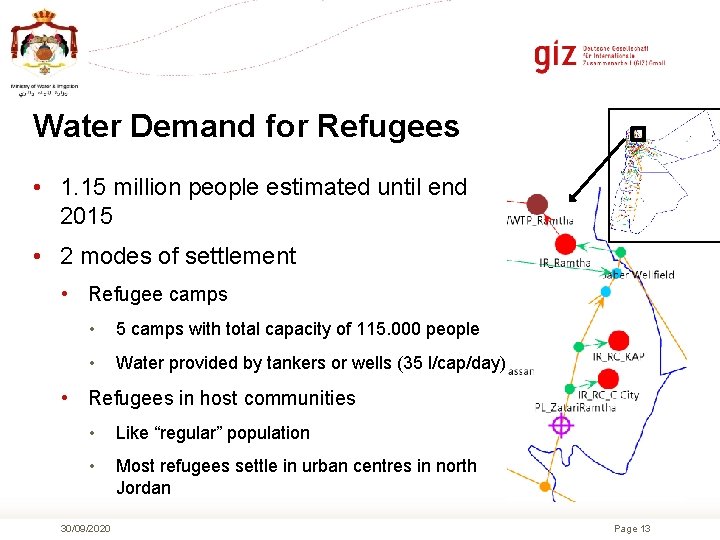
Water Demand for Refugees • 1. 15 million people estimated until end 2015 • 2 modes of settlement • Refugee camps • 5 camps with total capacity of 115. 000 people • Water provided by tankers or wells (35 l/cap/day) • Refugees in host communities • Like “regular” population • Most refugees settle in urban centres in north Jordan 30/09/2020 Page 13
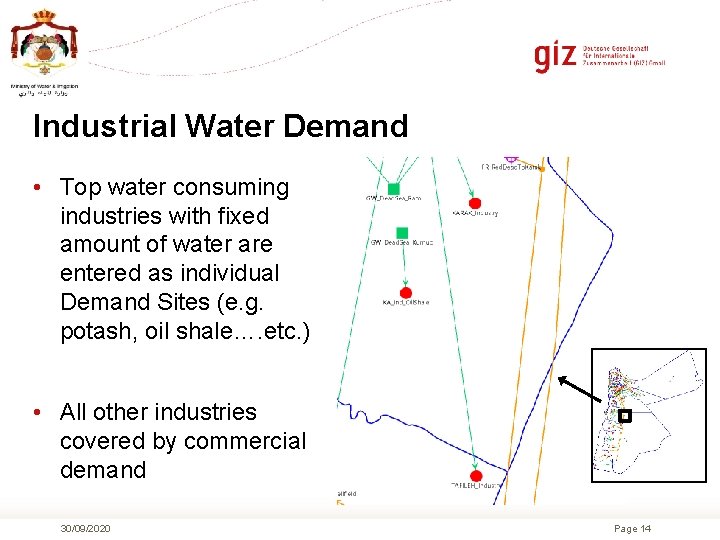
Industrial Water Demand • Top water consuming industries with fixed amount of water are entered as individual Demand Sites (e. g. potash, oil shale…. etc. ) • All other industries covered by commercial demand 30/09/2020 Page 14
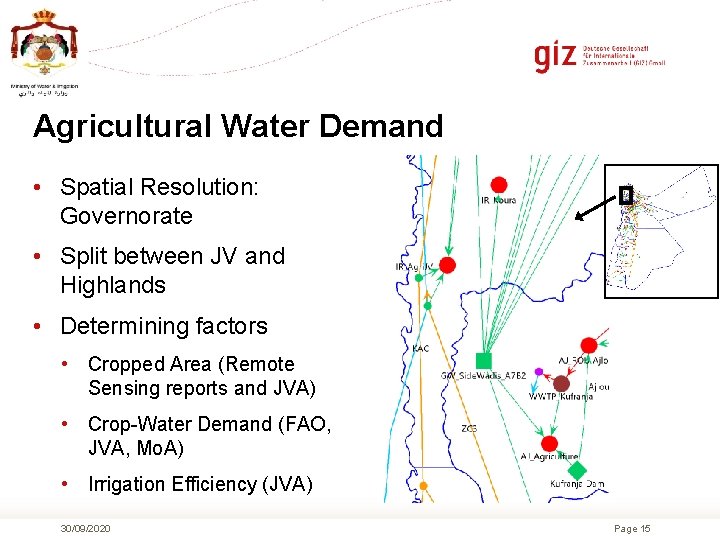
Agricultural Water Demand • Spatial Resolution: Governorate • Split between JV and Highlands • Determining factors • Cropped Area (Remote Sensing reports and JVA) • Crop-Water Demand (FAO, JVA, Mo. A) • Irrigation Efficiency (JVA) 30/09/2020 Page 15
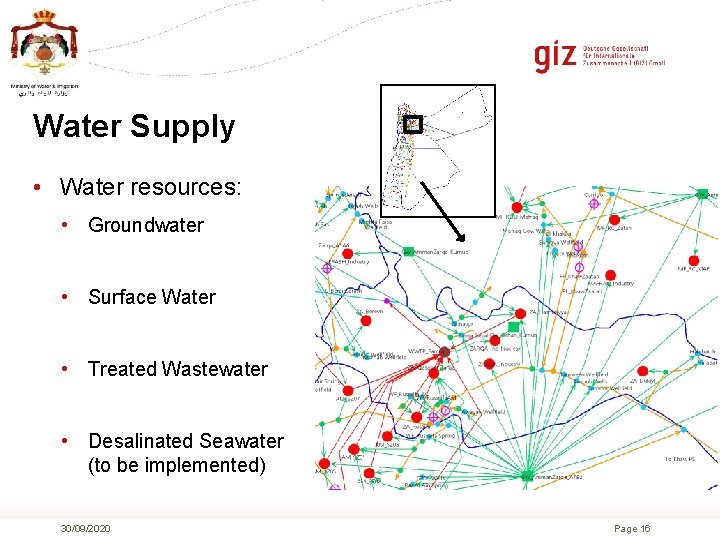
Water Supply • Water resources: • Groundwater • Surface Water • Treated Wastewater • Desalinated Seawater (to be implemented) 30/09/2020 Page 16
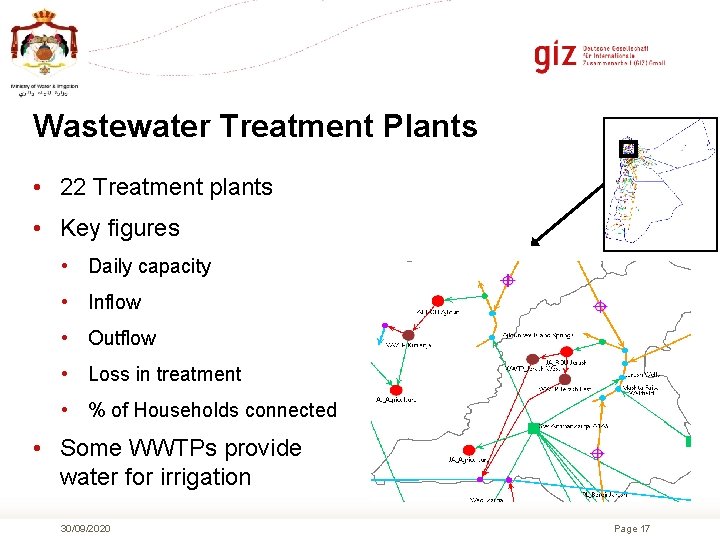
Wastewater Treatment Plants • 22 Treatment plants • Key figures • Daily capacity • Inflow • Outflow • Loss in treatment • % of Households connected • Some WWTPs provide water for irrigation 30/09/2020 Page 17
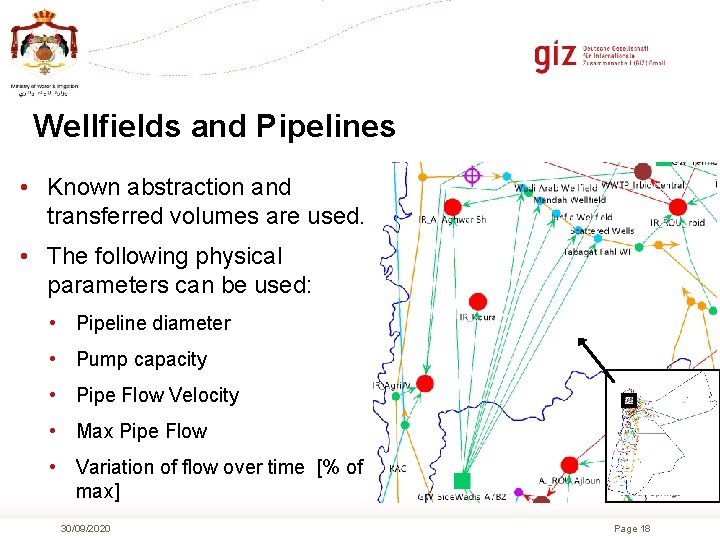
Wellfields and Pipelines • Known abstraction and transferred volumes are used. • The following physical parameters can be used: • Pipeline diameter • Pump capacity • Pipe Flow Velocity • Max Pipe Flow • Variation of flow over time [% of max] 30/09/2020 Page 18
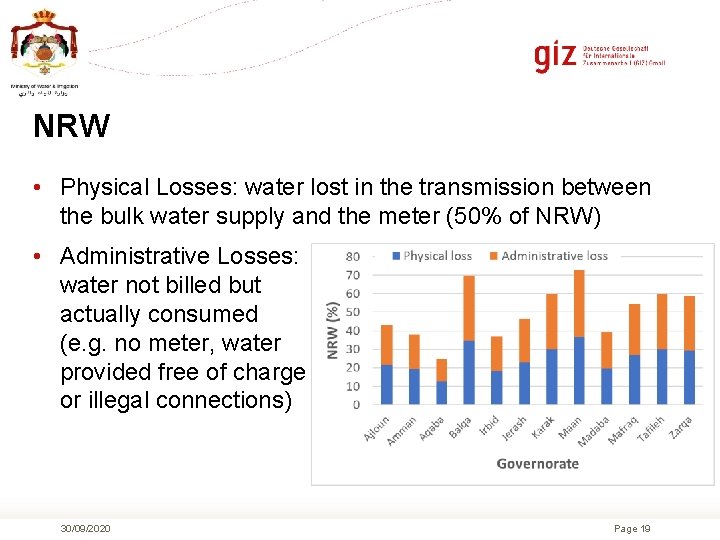
NRW • Physical Losses: water lost in the transmission between the bulk water supply and the meter (50% of NRW) • Administrative Losses: water not billed but actually consumed (e. g. no meter, water provided free of charge or illegal connections) 30/09/2020 Page 19
Results of Scenarios Country level -Domestic Sector 30/09/2020 Page 20
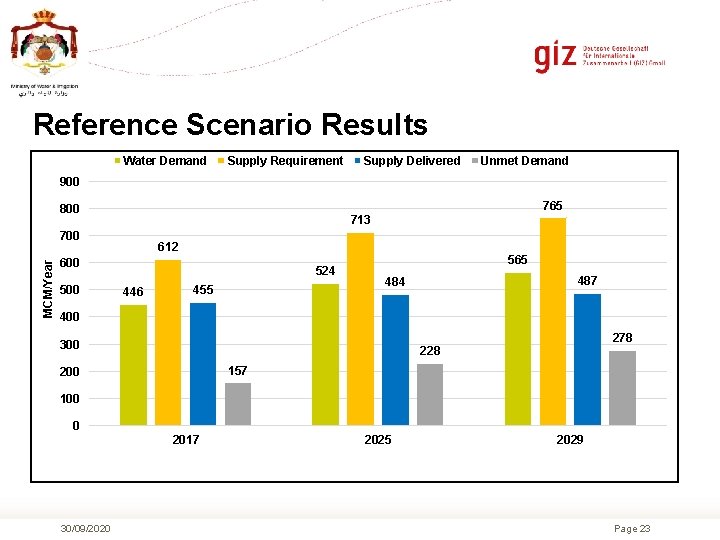
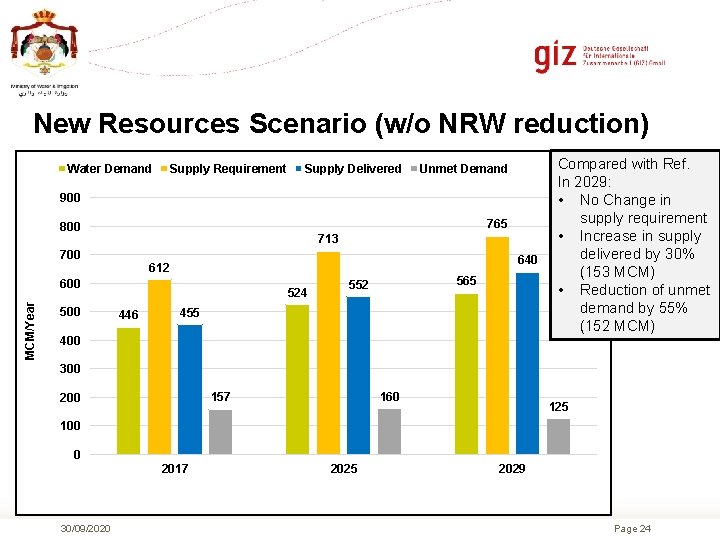
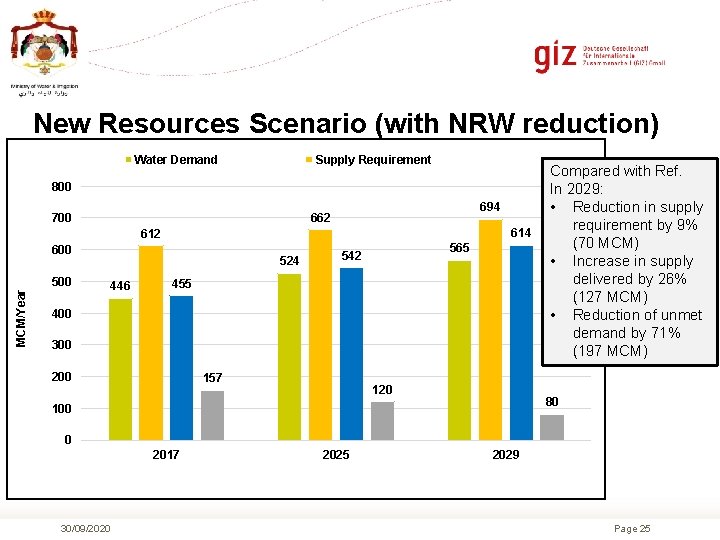
Examined scenarios • Reference scenario: • Current situation (2017). • Demographic growth. • Projects under implementation (ex. Wadi Arab phase 1). • New Resources: • Major projects according to CIP the (ex. Desalination projects , Wadi Arab phase 2). • Expansion of WWTPs and connections according to CIP and National Wastewater Master Plan. • Reduction in NRW according to the Water Reallocation Policy 30/09/2020 Page 21
Terms: Domestic Water Demand: the amount of required water at demand site according to the Allocation Policy Supply Requirement: water demand including physical losses Supply Delivered: the amount of supplied water (Pumped) to demand sites, restricted by the pre-defined supply requirement 30/09/2020 Page 22
Reference Scenario Results Water Demand Supply Requirement Supply Delivered Unmet Demand 900 765 800 713 MCM/Year 700 612 600 524 446 455 565 487 484 400 300 278 228 157 200 100 0 2017 30/09/2020 2025 2029 Page 23
New Resources Scenario (w/o NRW reduction) Water Demand Supply Requirement Supply Delivered Unmet Demand 900 765 800 713 700 640 612 MCM/Year 600 524 446 565 552 455 400 Compared with Ref. In 2029: • No Change in supply requirement • Increase in supply delivered by 30% (153 MCM) • Reduction of unmet demand by 55% (152 MCM) 300 160 157 200 125 100 0 2017 30/09/2020 2025 2029 Page 24
New Resources Scenario (with NRW reduction) Water Demand Supply Requirement 800 694 662 700 614 612 600 MCM/Year 500 524 446 565 542 455 400 300 200 157 120 Compared with Ref. In 2029: • Reduction in supply requirement by 9% (70 MCM) • Increase in supply delivered by 26% (127 MCM) • Reduction of unmet demand by 71% (197 MCM) 80 100 0 2017 30/09/2020 2025 2029 Page 25
3. 2 Irbid Governorate 30/09/2020 Page 26
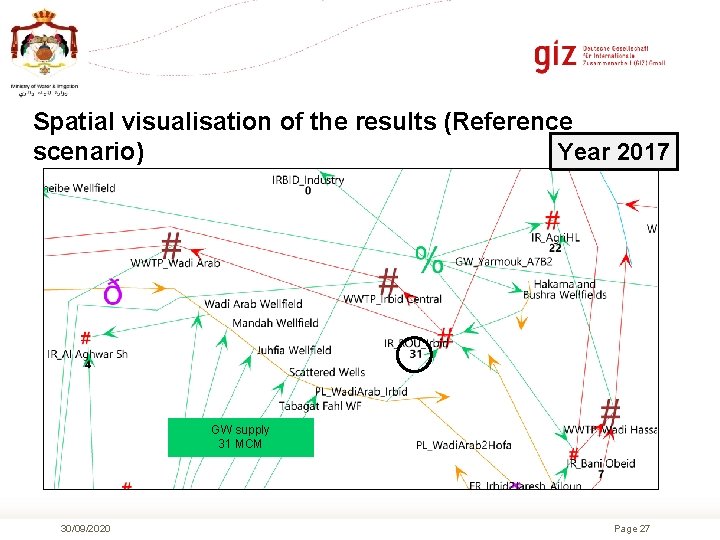
Spatial visualisation of the results (Reference Year 2017 scenario) GW supply 31 MCM 30/09/2020 Page 27
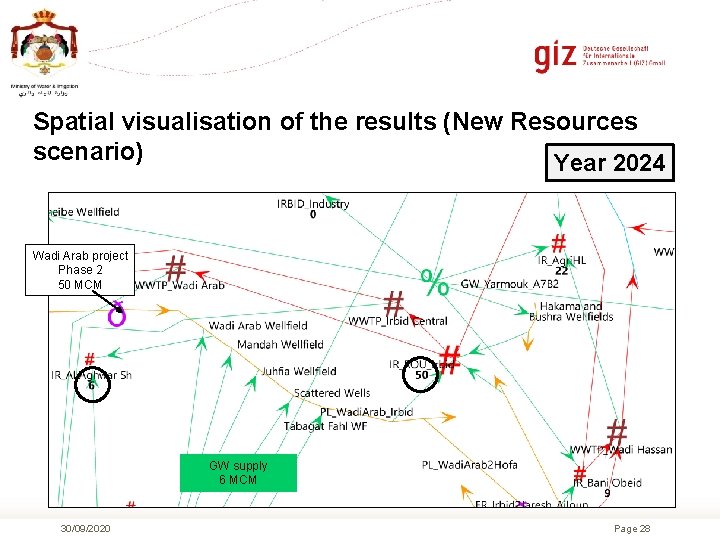
Spatial visualisation of the results (New Resources scenario) Year 2024 Wadi Arab project Phase 2 50 MCM GW supply 31 MCM GW supply 6 MCM 30/09/2020 Page 28
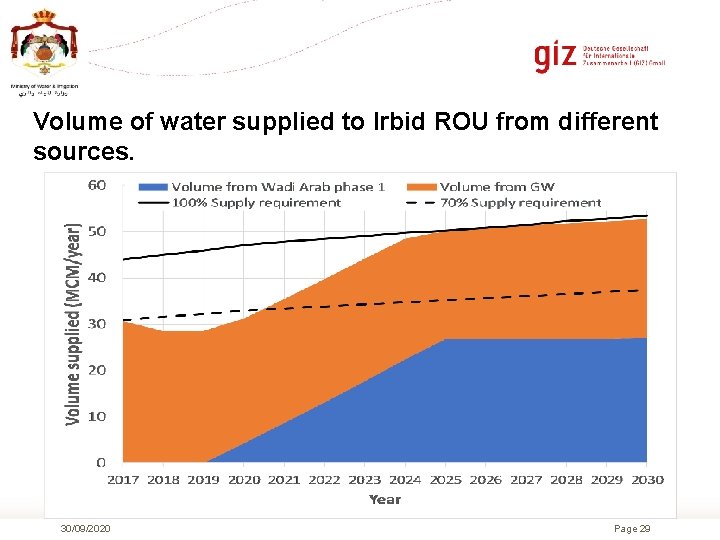
Volume of water supplied to Irbid ROU from different sources. 30/09/2020 Page 29
As Samra WWTP 30/09/2020 Page 30
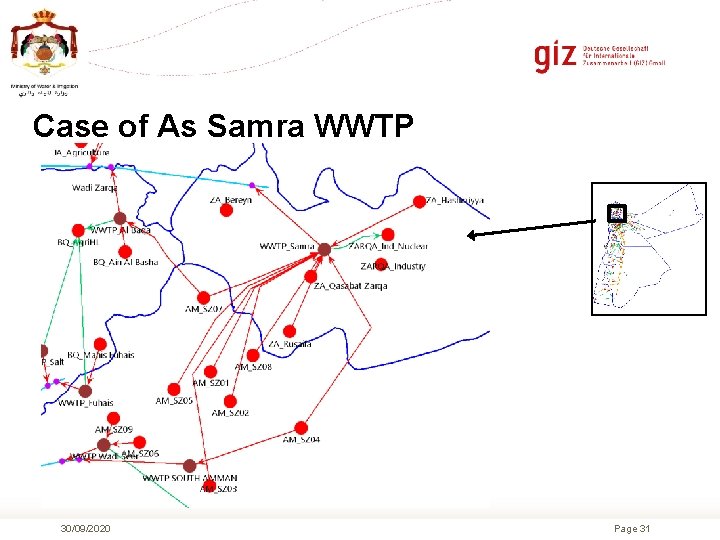
Case of As Samra WWTP 30/09/2020 Page 31
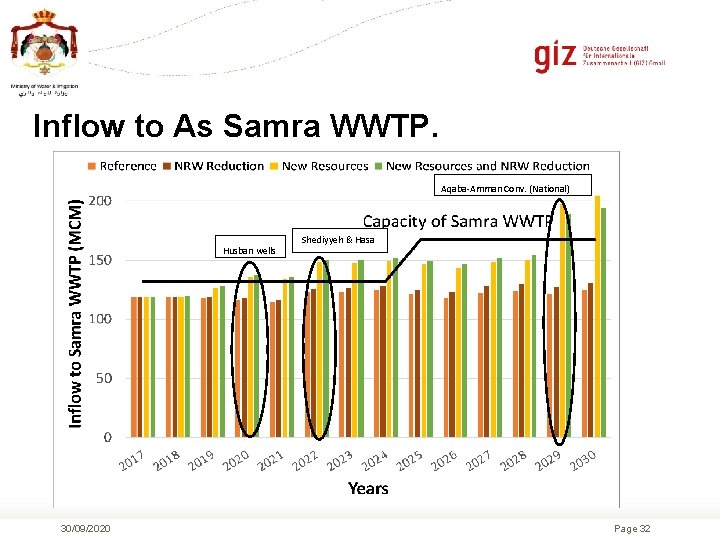
Inflow to As Samra WWTP. Aqaba-Amman Conv. (National) Husban wells 30/09/2020 Shediyyeh & Hasa Page 32
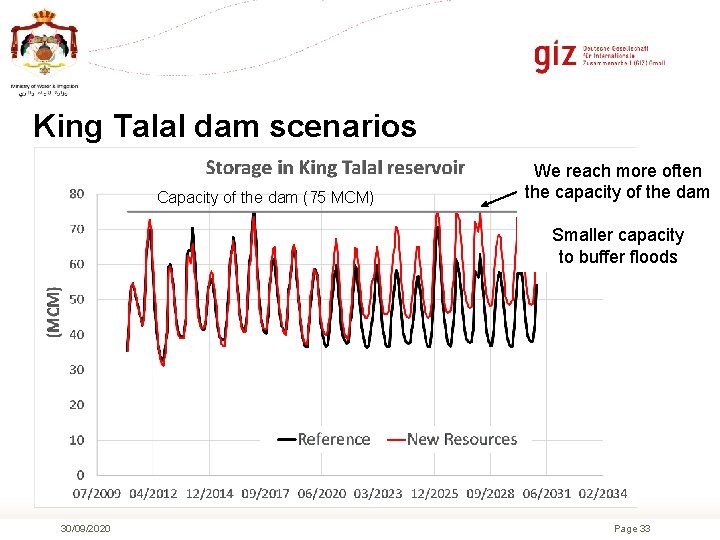
King Talal dam scenarios Capacity of the dam (75 MCM) We reach more often the capacity of the dam Smaller capacity to buffer floods 30/09/2020 Page 33
Outcomes • Although the optimistic scenario can improve further the coverage of domestic water, however, some governorates do not reach allocation targets by year 2030. • Applying reduction NRW to ~40% save around 48 MCM by 2030, more useful in some governorates (i. e. , Balqa and Ma’an). 30/09/2020 Page 34
Outcomes: • Wadi Al Arab Phase 1: improve the supply almost 100% of requirement of Irbid ROU in year 2030. • Phase 2 of Wadi Al Arab can be useful: • to reduce the amount of GW abstraction currently supply Irbid ROU, and/or • to keep the same amount of GW abstraction for other districts in Irbid and North governorates • If the supply is limited (to 70% of the supply requirement), abstraction of groundwater can be reduced in Phase 1, even further in Phase 2. 30/09/2020 Page 35
Outcomes: • Upgrading As Samra WWTP should be considered while planned projects for water supply is implemented (i. e. , Hussban and Shediyyeh -Hasa). • A further large upgrade will be required in case Aqaba-Amman Conveyance project is implemented. • Additional water stored in King Talal Dam could be used increasing irrigated areas in the Jordan Valley to substitute the fresh resources and reallocate these resources for domestic uses. 30/09/2020 Page 36
Thank You Q&A 30/09/2020 Page 37
Ø Which issues and scenarios would you like to examine with WEAP? Ø How could DSS be useful to support decision making for water resources planning? 30/09/2020 Page 38