
Modelling of regional CO 2 balance Tiina Markkanen
Modelling of regional CO 2 balance Tiina Markkanen with Tuula Aalto, Tea Thum, Jouni Susiluoto and Niina Puttonen 06/03/2021
Contents • Modeling framework in Snowcarbo • Models • REMO – regional climate model • JSBACH – land surface scheme • • Demonstration of model performance • Regional • Local Conclusions and future perspectives Finnish Meteorological Institute 06/03/2021 2
Modelling framework in Snowcarbo Models applied: • REgional climate MOdel of MPI -M, Hamburg REMO Produce regional climatic forcing • Land surface scheme (LSS) of GCM ECHAM JSBACH Produce regional CO 2 balance consisting of assimilation and emissions in ecosystems Finnish Meteorological Institute 06/03/2021 3
Modelling framework in Snowcarbo Relatively high spatial resolution • ~18 km High time resolution • 1 hour Stays close to actual weather of target years 2001 -2011 • Climate initialised once per day REMO and JSBACH are offline coupled • REMO does not get feedback from JSBACH but interacts with its own surface scheme Finnish Meteorological Institute 06/03/2021 4
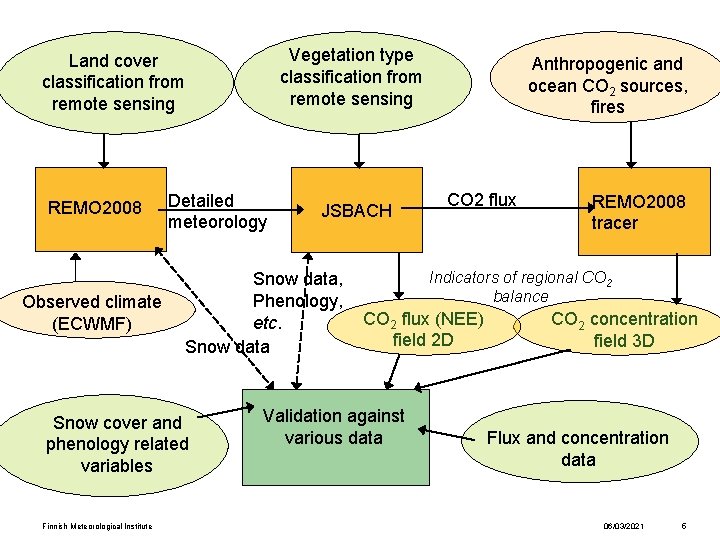
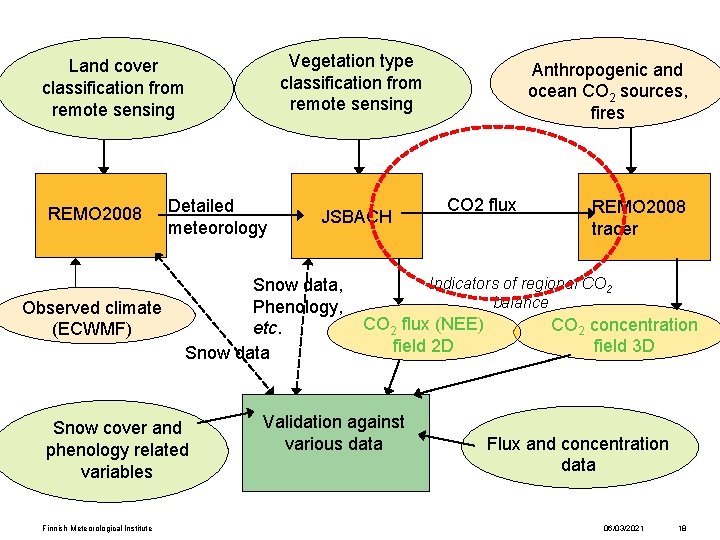
Vegetation type classification from remote sensing Land cover classification from remote sensing REMO 2008 Observed climate (ECWMF) Detailed meteorology Snow data, Phenology, etc. Snow data Snow cover and phenology related variables Finnish Meteorological Institute JSBACH Anthropogenic and ocean CO 2 sources, fires CO 2 flux REMO 2008 tracer Indicators of regional CO 2 balance CO 2 flux (NEE) field 2 D Validation against various data CO 2 concentration field 3 D Flux and concentration data 06/03/2021 5
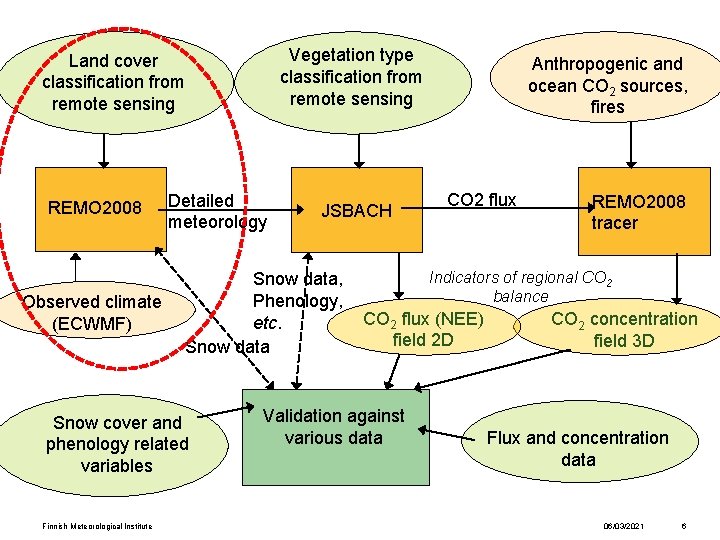
Vegetation type classification from remote sensing Land cover classification from remote sensing REMO 2008 Observed climate (ECWMF) Detailed meteorology Snow data, Phenology, etc. Snow data Snow cover and phenology related variables Finnish Meteorological Institute JSBACH Anthropogenic and ocean CO 2 sources, fires CO 2 flux REMO 2008 tracer Indicators of regional CO 2 balance CO 2 flux (NEE) field 2 D Validation against various data CO 2 concentration field 3 D Flux and concentration data 06/03/2021 6
REMO: forcing and initialisation Regional climate model requires as boundary data • Atmospheric conditions Wind speeds, Temperature, Humidity • Sea surface temperature, ice cover • Surface parameter fields As initial data in addition to those above • Soil temperature and moisture Sources of initial and boundary meteorological data • General circulation models • Re-analysis data products, here ERA-Interim, ECMWF Finnish Meteorological Institute 06/03/2021 7
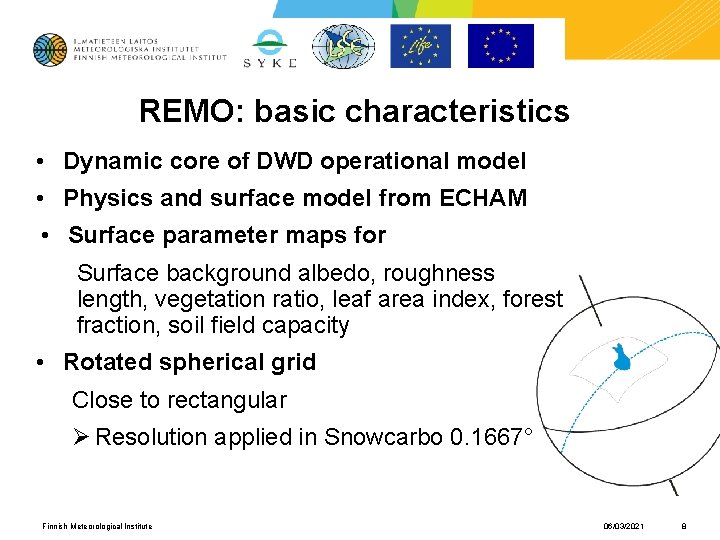
REMO: basic characteristics • Dynamic core of DWD operational model • Physics and surface model from ECHAM • Surface parameter maps for Surface background albedo, roughness length, vegetation ratio, leaf area index, forest fraction, soil field capacity • Rotated spherical grid Close to rectangular Ø Resolution applied in Snowcarbo 0. 1667° Finnish Meteorological Institute 06/03/2021 8
REMO: surface parameter maps Standard land cover of USGS classified according to Olson cover types (n=100) Parameter values allocated to each Olson type Parameters aggregated from 1 km USGS map to maps of resolution of the model In Snowcarbo the USGS map is replaced by National Corine Land Cover (CLC), European CLC and Globcover datasets Ø Allocations from new land cover classes to Olson ones needed Finnish Meteorological Institute 06/03/2021 9
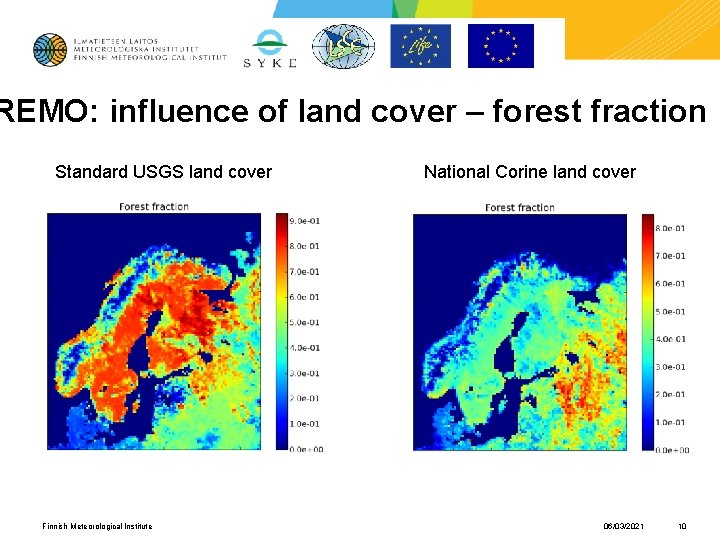
REMO: influence of land cover – forest fraction Standard USGS land cover Finnish Meteorological Institute National Corine land cover 06/03/2021 10
REMO: In this project runs in forecast mode • Model initialised daily at 6 pm • Spun-up until midnight in order to let the flowfield to develop into a reasonable state • Run for 24 consequent hours with hourly output Ø Weather stays close to observed Ø Sensitive to meteorological boundary Ø Not very sensitive to surface parameterisation Finnish Meteorological Institute 06/03/2021 11
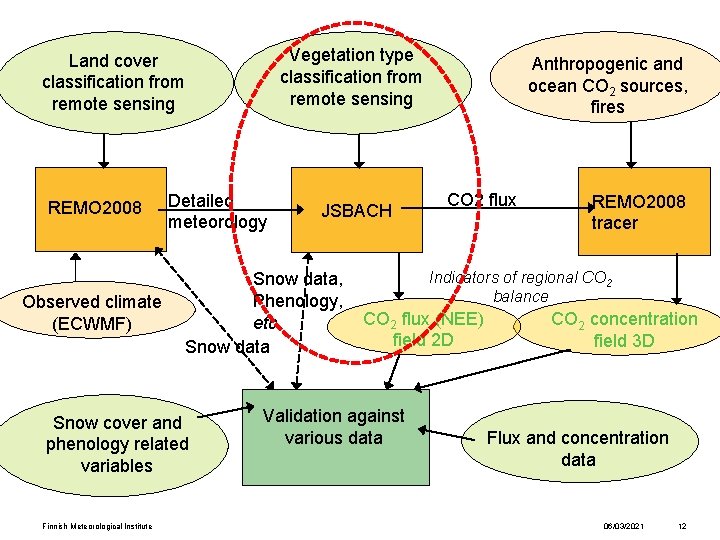
Vegetation type classification from remote sensing Land cover classification from remote sensing REMO 2008 Observed climate (ECWMF) Detailed meteorology Snow data, Phenology, etc. Snow data Snow cover and phenology related variables Finnish Meteorological Institute JSBACH Anthropogenic and ocean CO 2 sources, fires CO 2 flux REMO 2008 tracer Indicators of regional CO 2 balance CO 2 flux (NEE) field 2 D Validation against various data CO 2 concentration field 3 D Flux and concentration data 06/03/2021 12
Modelling framework in Snowcarbo: JSBACH LSS of ECHAM to account for • Surface energy partitioning – e. g. water balance • Carbon cycle In offline coupled mode JSBACH is used to account for ecosystem carbon balance - CO 2 exchange Process model Processes described down to as small scale as possible • Limited by computational resources Finnish Meteorological Institute 06/03/2021 13
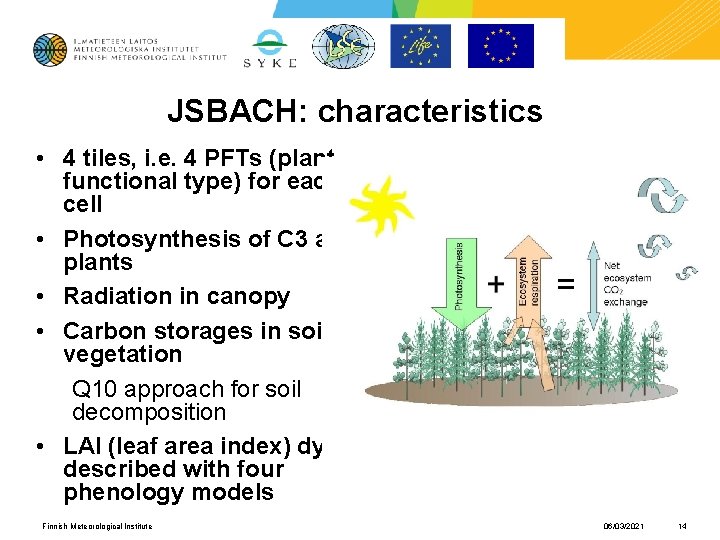
JSBACH: characteristics • 4 tiles, i. e. 4 PFTs (plant functional type) for each grid cell • Photosynthesis of C 3 and C 4 plants • Radiation in canopy • Carbon storages in soil and vegetation Q 10 approach for soil decomposition • LAI (leaf area index) dynamics described with four phenology models Finnish Meteorological Institute 06/03/2021 14
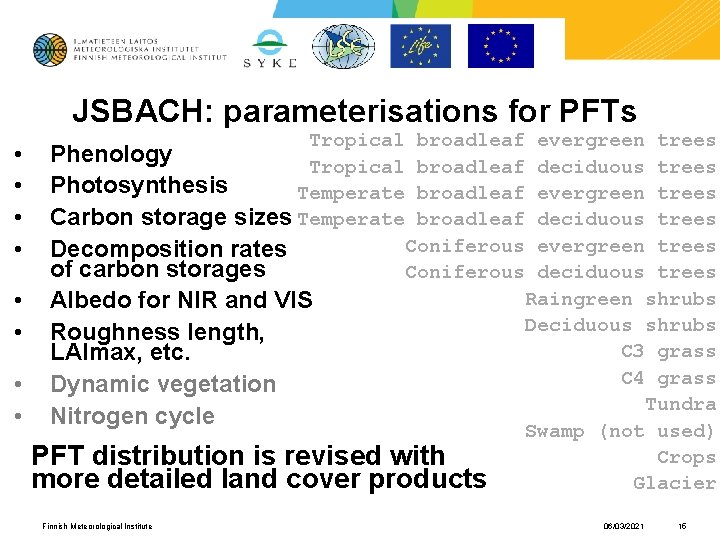
JSBACH: parameterisations for PFTs • • Tropical Phenology Tropical Photosynthesis Temperate Carbon storage sizes Temperate Decomposition rates of carbon storages Albedo for NIR and VIS Roughness length, LAImax, etc. Dynamic vegetation Nitrogen cycle broadleaf Coniferous PFT distribution is revised with more detailed land cover products Finnish Meteorological Institute evergreen trees deciduous trees Raingreen shrubs Deciduous shrubs C 3 grass C 4 grass Tundra Swamp (not used) Crops Glacier 06/03/2021 15
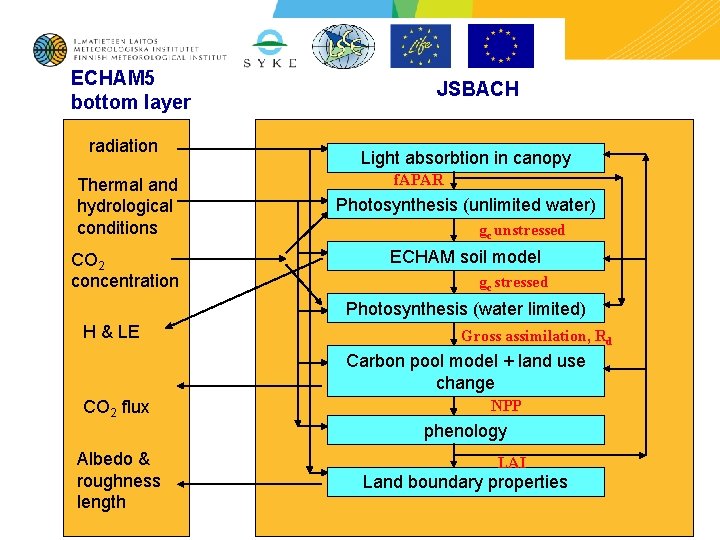
ECHAM 5 bottom layer radiation Thermal and hydrological conditions CO 2 concentration JSBACH Light absorbtion in canopy f. APAR Photosynthesis (unlimited water) gc unstressed ECHAM soil model gc stressed Photosynthesis (water limited) H & LE Gross assimilation, Rd Carbon pool model + land use change CO 2 flux NPP phenology Albedo & roughness length LAI Land boundary properties 06/03/2021 16
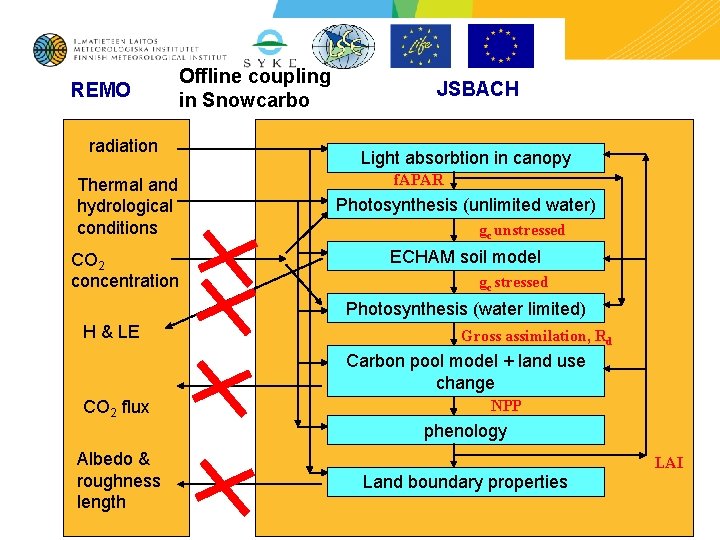
REMO Offline coupling in Snowcarbo radiation Thermal and hydrological conditions CO 2 concentration JSBACH Light absorbtion in canopy f. APAR Photosynthesis (unlimited water) gc unstressed ECHAM soil model gc stressed Photosynthesis (water limited) H & LE Gross assimilation, Rd Carbon pool model + land use change CO 2 flux NPP phenology Albedo & roughness length LAI Land boundary properties 06/03/2021 17
Vegetation type classification from remote sensing Land cover classification from remote sensing REMO 2008 Observed climate (ECWMF) Detailed meteorology Snow data, Phenology, etc. Snow data Snow cover and phenology related variables Finnish Meteorological Institute JSBACH Anthropogenic and ocean CO 2 sources, fires CO 2 flux REMO 2008 tracer Indicators of regional CO 2 balance CO 2 flux (NEE) field 2 D Validation against various data CO 2 concentration field 3 D Flux and concentration data 06/03/2021 18
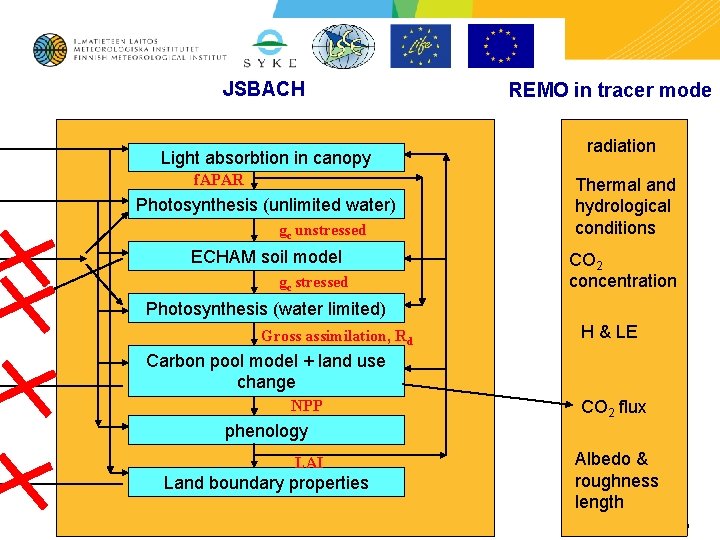
JSBACH Light absorbtion in canopy f. APAR Photosynthesis (unlimited water) gc unstressed ECHAM soil model gc stressed REMO in tracer mode radiation Thermal and hydrological conditions CO 2 concentration Photosynthesis (water limited) Gross assimilation, Rd H & LE Carbon pool model + land use change NPP CO 2 flux phenology LAI Land boundary properties Albedo & roughness length 06/03/2021 19
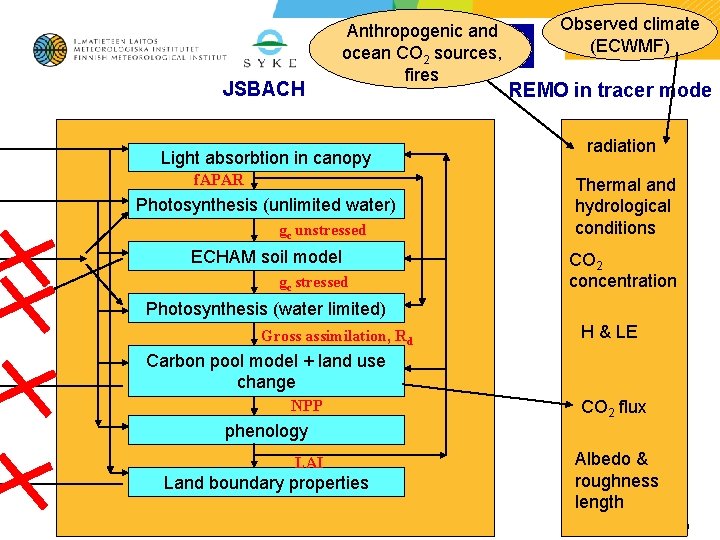
JSBACH Anthropogenic and ocean CO 2 sources, fires Light absorbtion in canopy f. APAR Photosynthesis (unlimited water) gc unstressed ECHAM soil model gc stressed Observed climate (ECWMF) REMO in tracer mode radiation Thermal and hydrological conditions CO 2 concentration Photosynthesis (water limited) Gross assimilation, Rd H & LE Carbon pool model + land use change NPP CO 2 flux phenology LAI Land boundary properties Albedo & roughness length 06/03/2021 20
REMO tracer run Uses the same meteorological initial and boundary data as the first REMO run Additionally • Gets CO 2 flux estimates of vegetation from JSBACH • Utilizes prescribed anthropogenic and land fire emissions from a database • Ocean sources from a database • Requires background CO 2 concentrations Produces 3 D CO 2 concentration fields Finnish Meteorological Institute 06/03/2021 21
Demonstration of model performance JSBACH was forced • regionally with REMO derived climatic forcing Forecast mode for climate model Standard land cover in both models Default carbon storages in JSBACH • for flux measurement sites Sodankylä and Hyytiälä About a decade of measurements as climatic forcing 1000 years spin up for soil carbon storages with present climate Finnish Meteorological Institute 06/03/2021 22
Demonstration of model performance Regional daily average NEE <start animation> Finnish Meteorological Institute 06/03/2021 23
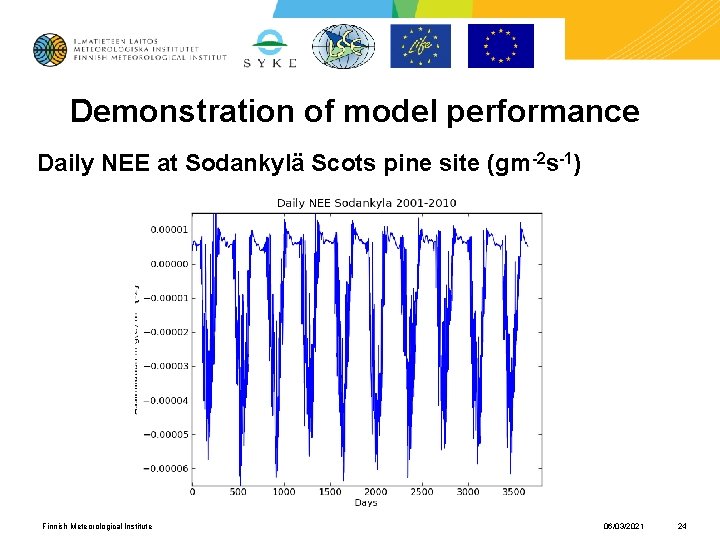
Demonstration of model performance Daily NEE at Sodankylä Scots pine site (gm-2 s-1) Finnish Meteorological Institute 06/03/2021 24
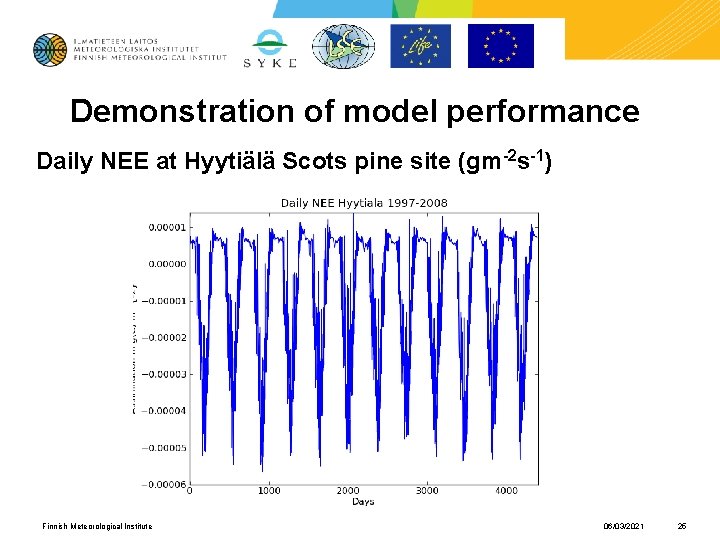
Demonstration of model performance Daily NEE at Hyytiälä Scots pine site (gm-2 s-1) Finnish Meteorological Institute 06/03/2021 25
Conclusions and future perspectives § Assimilation and emissions of CO 2 in ecosystems explicitly modeled § Offline coupled REMO – JSBACH framework produces CO 2 balance in high temporal and in relatively high regional resolution § National level estimates of CO 2 balance can be extracted from the regional maps To be done Ø Evaluation of the results against CO 2 flux and concentration data Ø Adjustment of the relevant parameters in order to produce better regional estimates Finnish Meteorological Institute 06/03/2021 26
- Slides: 26