
MODELLING OF HYDROGEN JET FIRES USING CFD Deiveegan

- Slides: 16
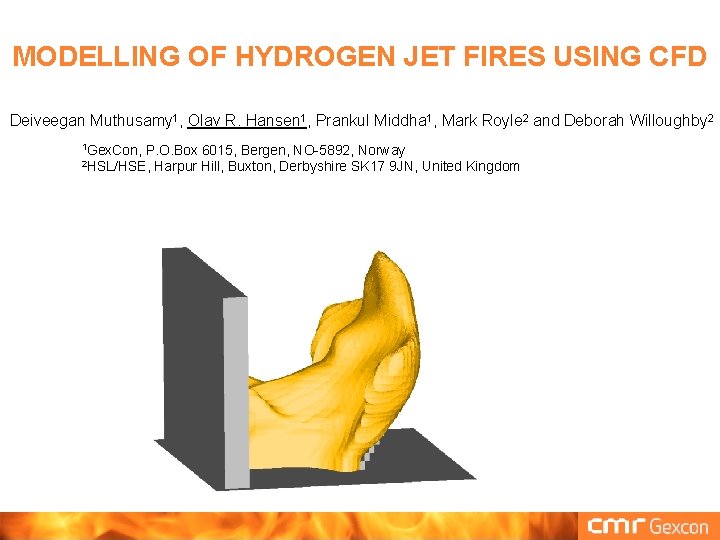
MODELLING OF HYDROGEN JET FIRES USING CFD Deiveegan Muthusamy 1, Olav R. Hansen 1, Prankul Middha 1, Mark Royle 2 and Deborah Willoughby 2 1 Gex. Con, P. O. Box 6015, Bergen, NO-5892, Norway Harpur Hill, Buxton, Derbyshire SK 17 9 JN, United Kingdom 2 HSL/HSE,
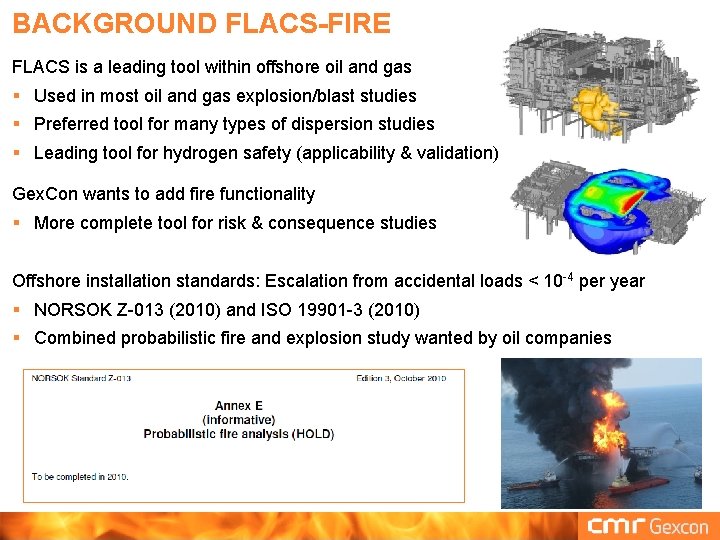
BACKGROUND FLACS-FIRE FLACS is a leading tool within offshore oil and gas § Used in most oil and gas explosion/blast studies § Preferred tool for many types of dispersion studies § Leading tool for hydrogen safety (applicability & validation) Gex. Con wants to add fire functionality § More complete tool for risk & consequence studies Offshore installation standards: Escalation from accidental loads < 10 -4 per year § NORSOK Z-013 (2010) and ISO 19901 -3 (2010) § Combined probabilistic fire and explosion study wanted by oil companies
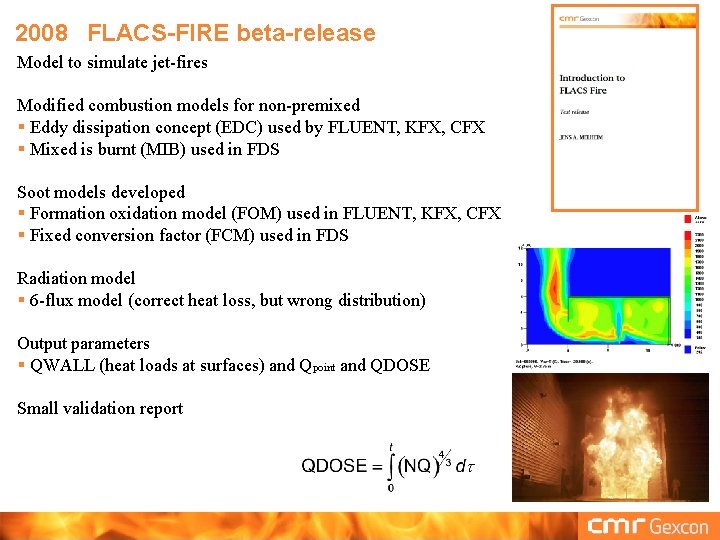
2008 FLACS-FIRE beta-release Model to simulate jet-fires Modified combustion models for non-premixed § Eddy dissipation concept (EDC) used by FLUENT, KFX, CFX § Mixed is burnt (MIB) used in FDS Soot models developed § Formation oxidation model (FOM) used in FLUENT, KFX, CFX § Fixed conversion factor (FCM) used in FDS Radiation model § 6 -flux model (correct heat loss, but wrong distribution) Output parameters § QWALL (heat loads at surfaces) and Qpoint and QDOSE Small validation report
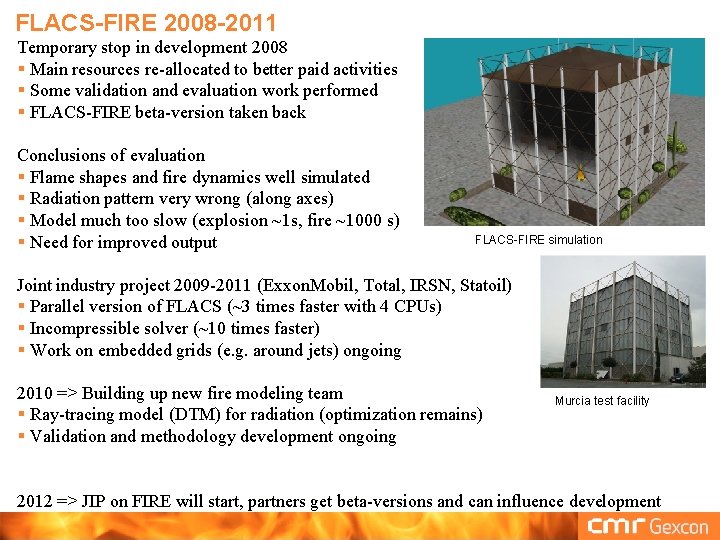
FLACS-FIRE 2008 -2011 Temporary stop in development 2008 § Main resources re-allocated to better paid activities § Some validation and evaluation work performed § FLACS-FIRE beta-version taken back Conclusions of evaluation § Flame shapes and fire dynamics well simulated § Radiation pattern very wrong (along axes) § Model much too slow (explosion ~1 s, fire ~1000 s) § Need for improved output FLACS-FIRE simulation Joint industry project 2009 -2011 (Exxon. Mobil, Total, IRSN, Statoil) § Parallel version of FLACS (~3 times faster with 4 CPUs) § Incompressible solver (~10 times faster) § Work on embedded grids (e. g. around jets) ongoing 2010 => Building up new fire modeling team § Ray-tracing model (DTM) for radiation (optimization remains) § Validation and methodology development ongoing Murcia test facility 2012 => JIP on FIRE will start, partners get beta-versions and can influence development
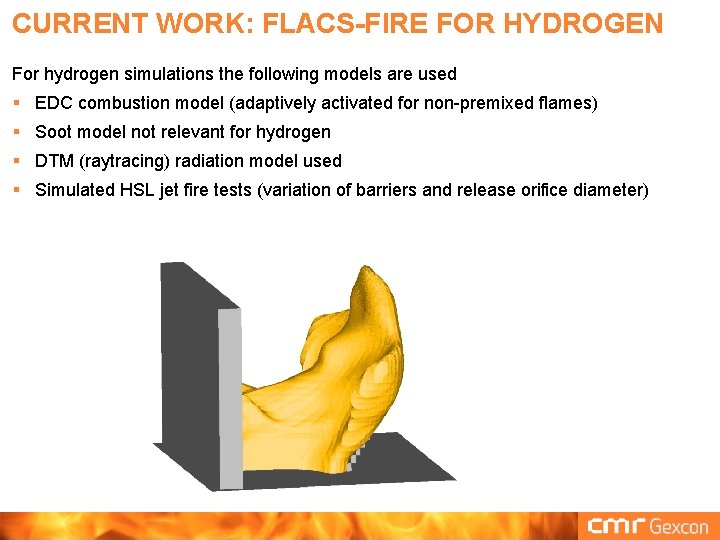
CURRENT WORK: FLACS-FIRE FOR HYDROGEN For hydrogen simulations the following models are used § EDC combustion model (adaptively activated for non-premixed flames) § Soot model not relevant for hydrogen § DTM (raytracing) radiation model used § Simulated HSL jet fire tests (variation of barriers and release orifice diameter)
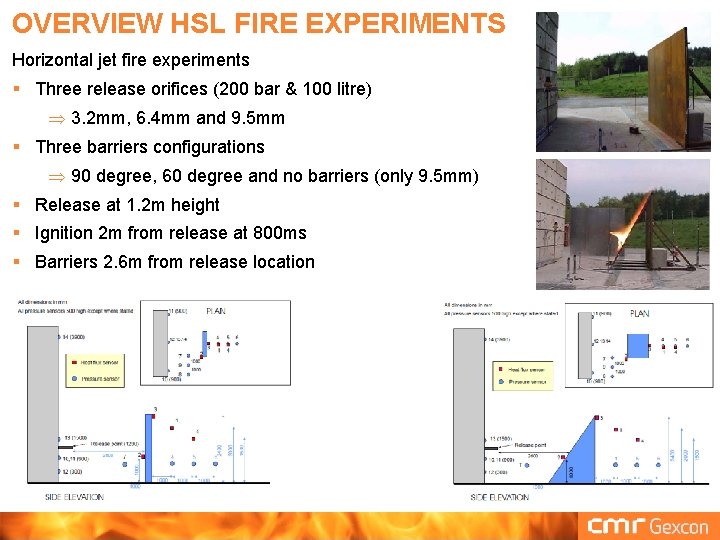
OVERVIEW HSL FIRE EXPERIMENTS Horizontal jet fire experiments § Three release orifices (200 bar & 100 litre) Þ 3. 2 mm, 6. 4 mm and 9. 5 mm § Three barriers configurations Þ 90 degree, 60 degree and no barriers (only 9. 5 mm) § Release at 1. 2 m height § Ignition 2 m from release at 800 ms § Barriers 2. 6 m from release location
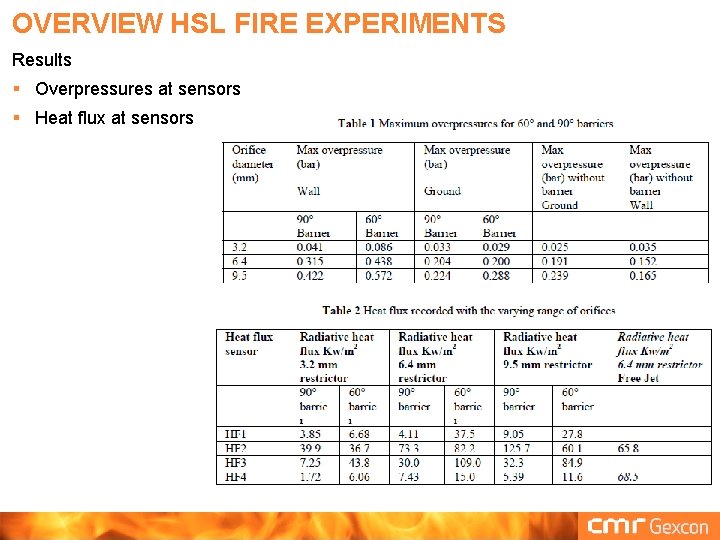
OVERVIEW HSL FIRE EXPERIMENTS Results § Overpressures at sensors § Heat flux at sensors
Gex. Con did not focus on explosion pressures Guidelines for grid and time step for explosion and fire are different § For this study we optimized grid and timestep for fire => did not study pressures Previously demonstrated that FLACS can predict exploding hydrogen jets well FZK (KIT) ignited jets Sandia/SRI tunnel tests Sandia/SRI barrier tests
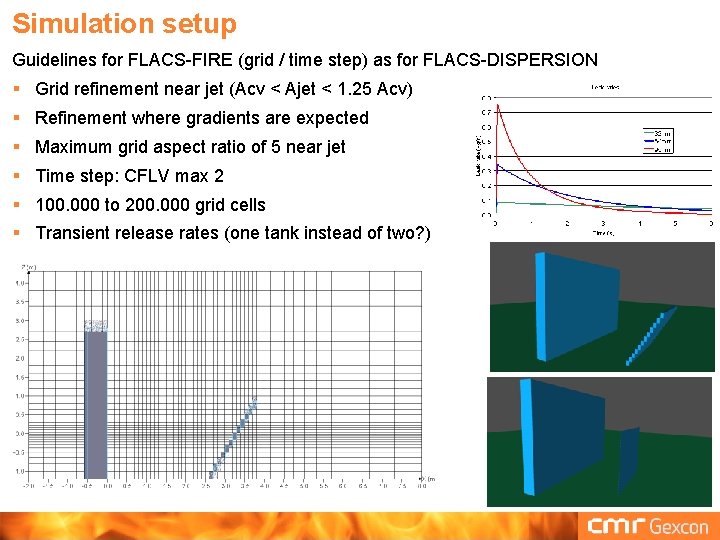
Simulation setup Guidelines for FLACS-FIRE (grid / time step) as for FLACS-DISPERSION § Grid refinement near jet (Acv < Ajet < 1. 25 Acv) § Refinement where gradients are expected § Maximum grid aspect ratio of 5 near jet § Time step: CFLV max 2 § 100. 000 to 200. 000 grid cells § Transient release rates (one tank instead of two? )
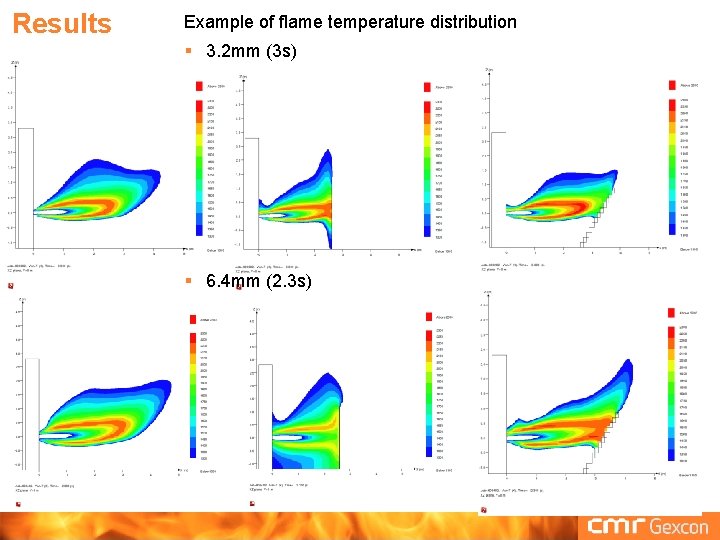
Results Example of flame temperature distribution § 3. 2 mm (3 s) § 6. 4 mm (2. 3 s)
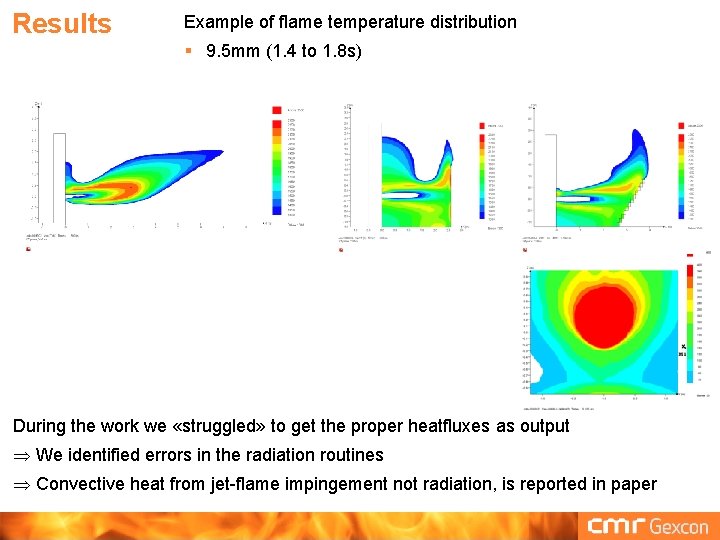
Results Example of flame temperature distribution § 9. 5 mm (1. 4 to 1. 8 s) During the work we «struggled» to get the proper heatfluxes as output Þ We identified errors in the radiation routines Þ Convective heat from jet-flame impingement not radiation, is reported in paper
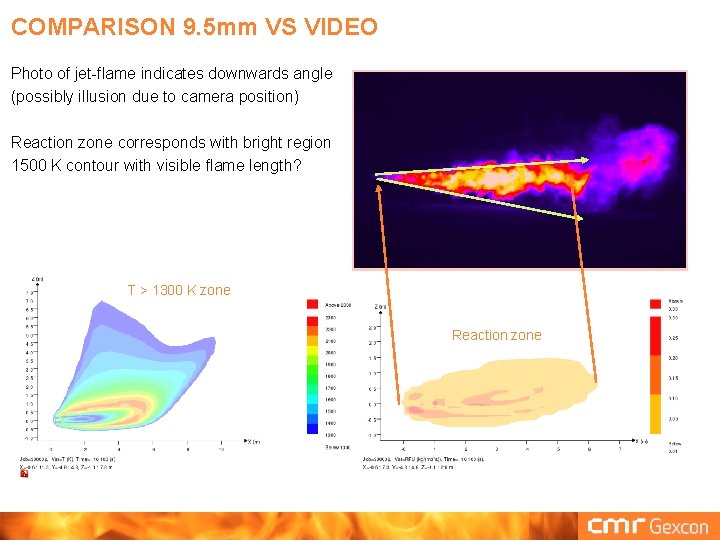
COMPARISON 9. 5 mm VS VIDEO Photo of jet-flame indicates downwards angle (possibly illusion due to camera position) Reaction zone corresponds with bright region 1500 K contour with visible flame length? T > 1300 K zone Reaction zone
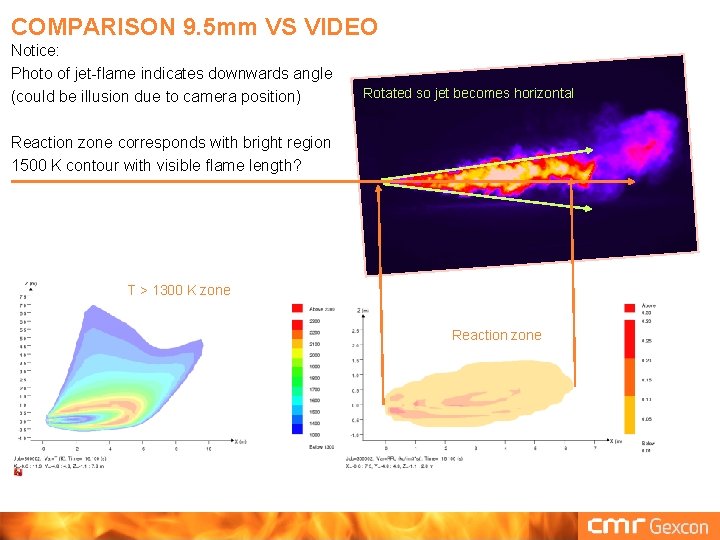
COMPARISON 9. 5 mm VS VIDEO Notice: Photo of jet-flame indicates downwards angle (could be illusion due to camera position) Rotated so jet becomes horizontal Reaction zone corresponds with bright region 1500 K contour with visible flame length? T > 1300 K zone Reaction zone
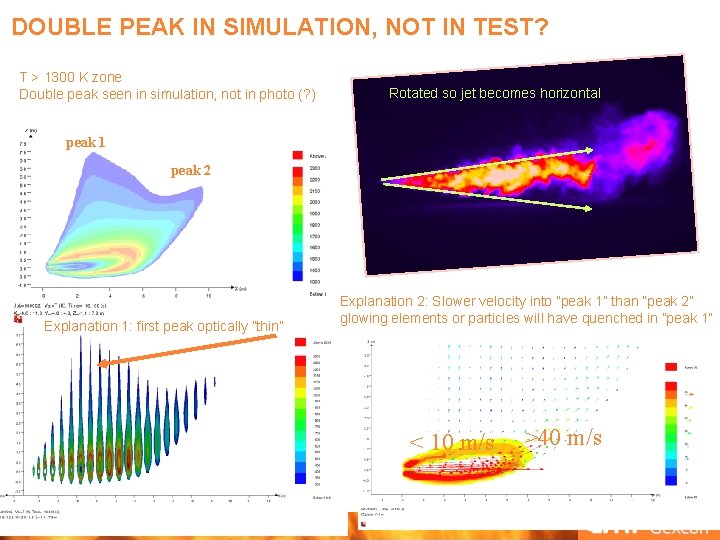
DOUBLE PEAK IN SIMULATION, NOT IN TEST? T > 1300 K zone Double peak seen in simulation, not in photo (? ) Rotated so jet becomes horizontal peak 1 peak 2 Explanation 1: first peak optically ”thin” Explanation 2: Slower velocity into ”peak 1” than ”peak 2” glowing elements or particles will have quenched in ”peak 1” < 10 m/s >40 m/s
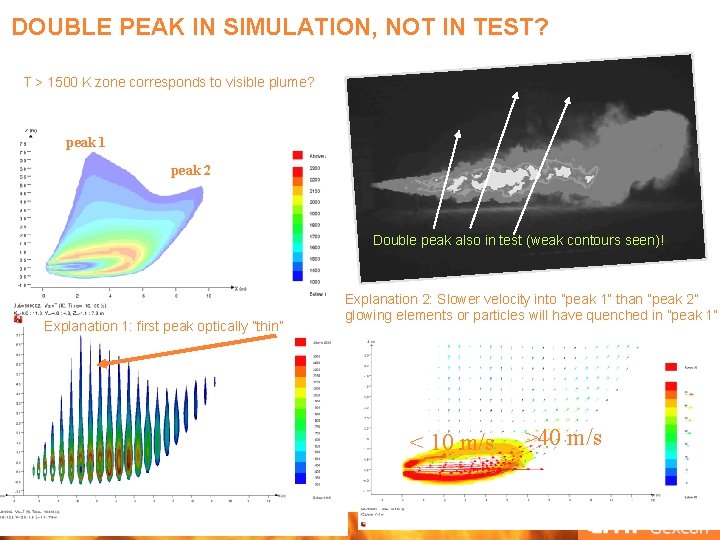
DOUBLE PEAK IN SIMULATION, NOT IN TEST? T > 1500 K zone corresponds to visible plume? peak 1 peak 2 Double peak also in test (weak contours seen)! Explanation 1: first peak optically ”thin” Explanation 2: Slower velocity into ”peak 1” than ”peak 2” glowing elements or particles will have quenched in ”peak 1” < 10 m/s >40 m/s
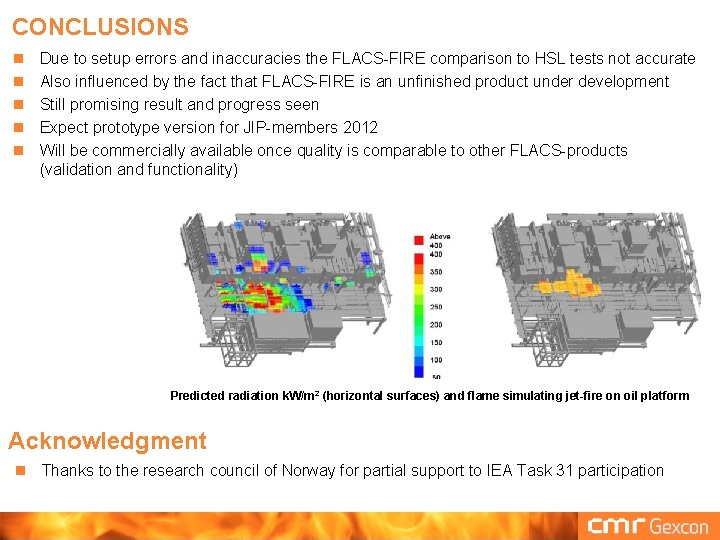
CONCLUSIONS n n n Due to setup errors and inaccuracies the FLACS-FIRE comparison to HSL tests not accurate Also influenced by the fact that FLACS-FIRE is an unfinished product under development Still promising result and progress seen Expect prototype version for JIP-members 2012 Will be commercially available once quality is comparable to other FLACS-products (validation and functionality) Predicted radiation k. W/m 2 (horizontal surfaces) and flame simulating jet-fire on oil platform Acknowledgment n Thanks to the research council of Norway for partial support to IEA Task 31 participation