
Modelling marine populations from physics to evolution A

- Slides: 21
Modelling marine populations – from physics to evolution A Nordic Marine Academy Course held 10 – 16 October 2005 at Espegrend Field Station, Bergen, Norway
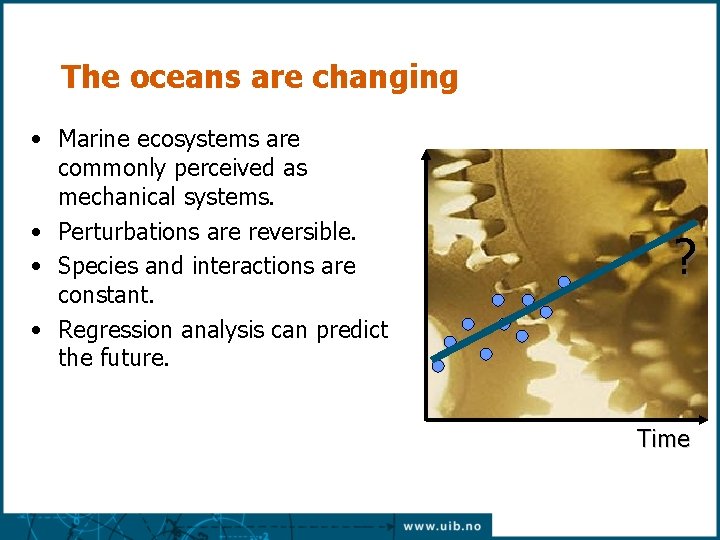
The oceans are changing • Marine ecosystems are commonly perceived as mechanical systems. • Perturbations are reversible. • Species and interactions are constant. • Regression analysis can predict the future. ? Time
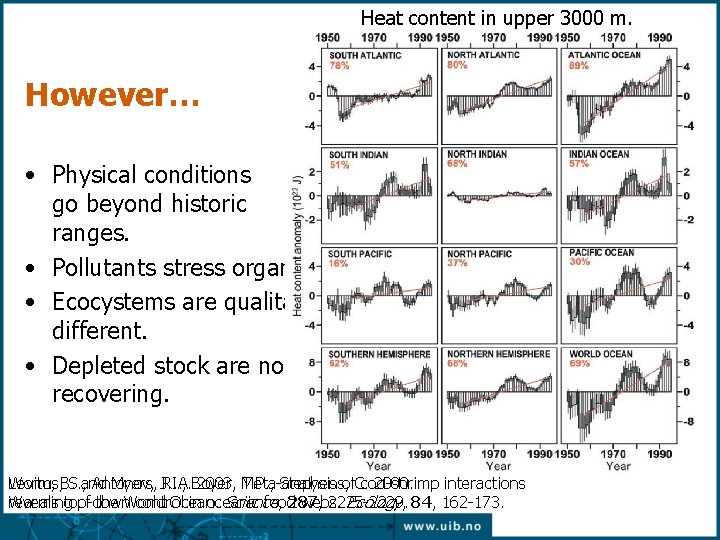
Heat content in upper 3000 m. However… • Physical conditions go beyond historic ranges. • Pollutants stress organisms. • Ecocystems are qualitatively different. • Depleted stock are not recovering. Levitus, B. S. , and Antonov, T. P. , Stephens, of. C. cod-shrimp 2000. Worm, Myers, J. I. , R. A. Boyer, 2003. Meta-analysis interactions Warming of the World Ocean. Science , 287, 2225 -2229. reveals top-down control in oceanic food webs. Ecology, 84, 162 -173.
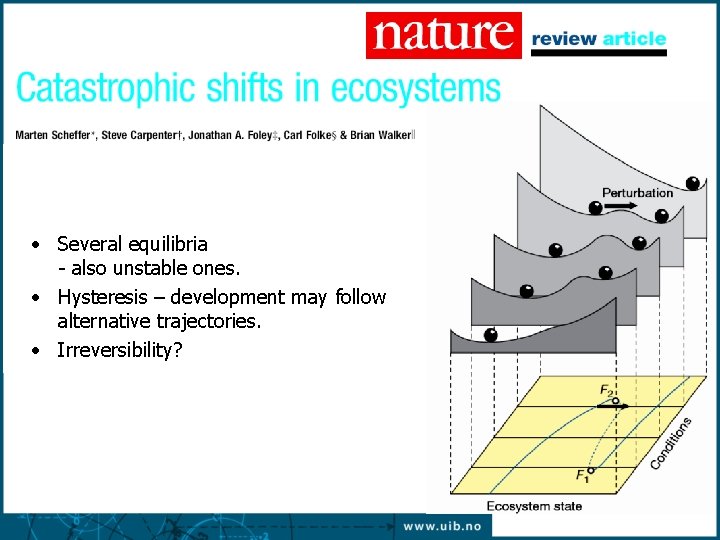
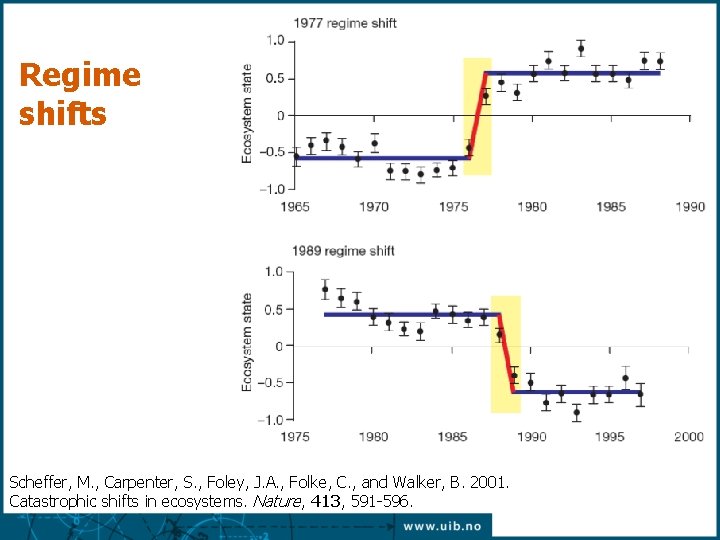
• Several equilibria - also unstable ones. • Hysteresis – development may follow alternative trajectories. • Irreversibility?
Regime shifts Scheffer, M. , Carpenter, S. , Foley, J. A. , Folke, C. , and Walker, B. 2001. Catastrophic shifts in ecosystems. Nature, 413, 591 -596.
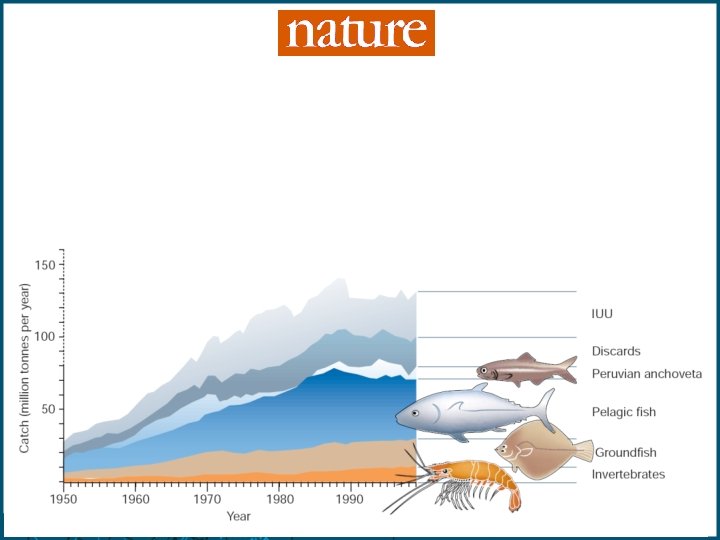
World catches
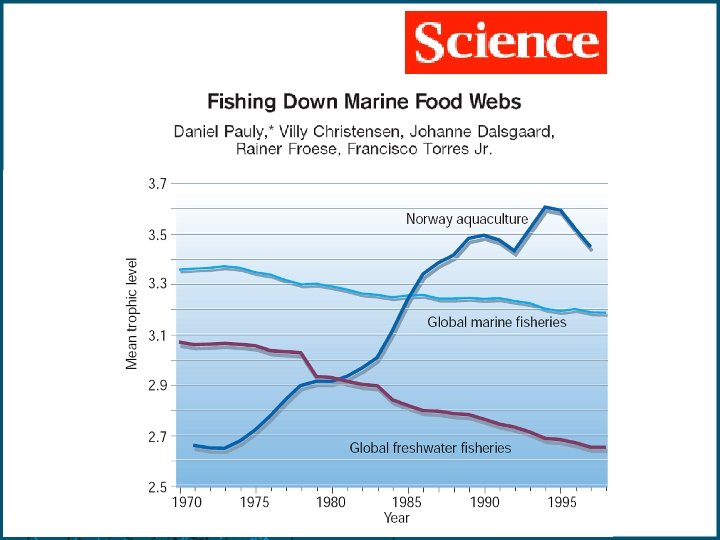
Fishing down
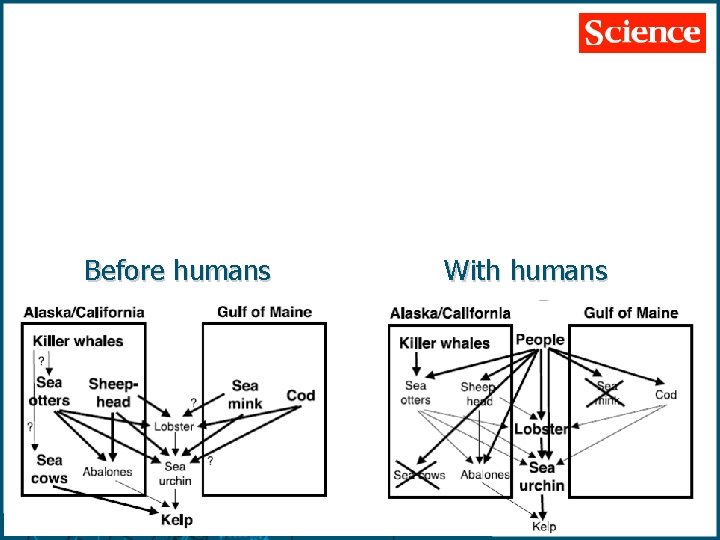
Altered ecosystem structure: Kelp forests Before humans With humans
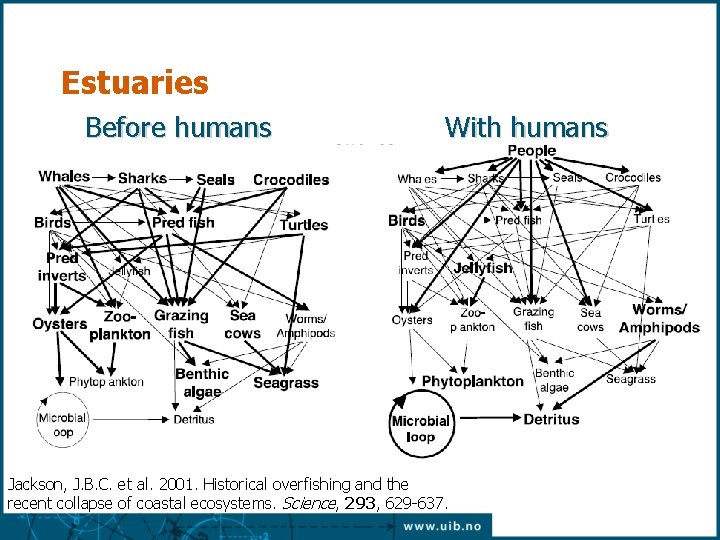
Estuaries Before humans With humans Jackson, J. B. C. et al. 2001. Historical overfishing and the recent collapse of coastal ecosystems. Science, 293, 629 -637.
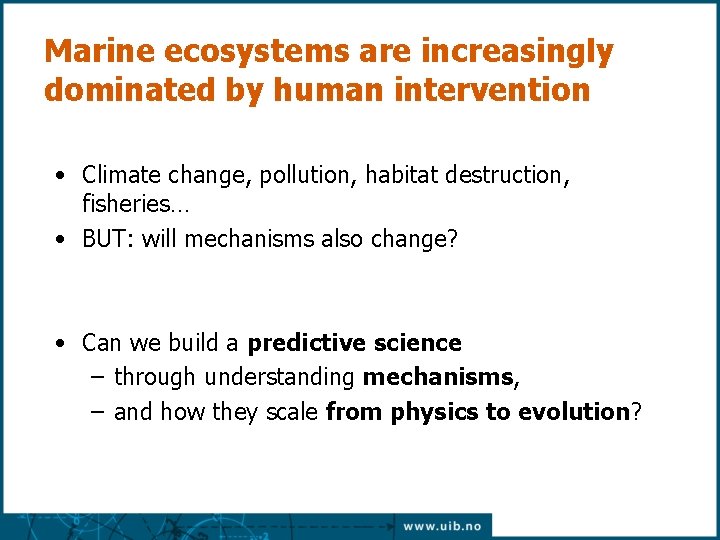
Marine ecosystems are increasingly dominated by human intervention • Climate change, pollution, habitat destruction, fisheries… • BUT: will mechanisms also change? • Can we build a predictive science – through understanding mechanisms, – and how they scale from physics to evolution?
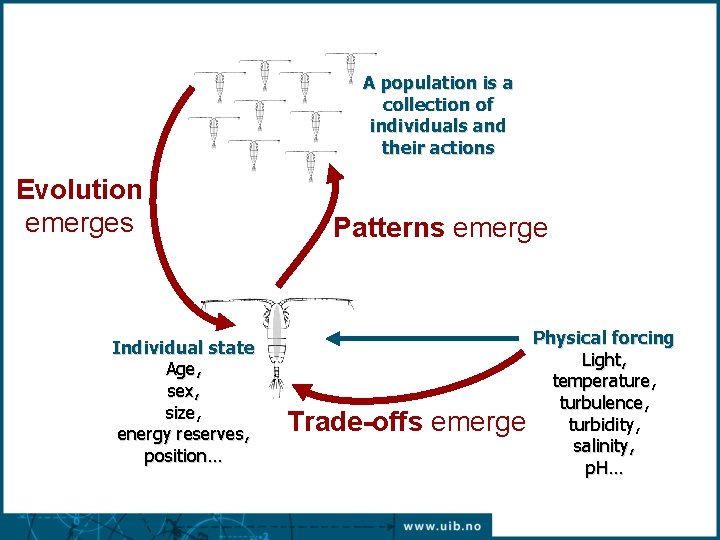
A population is a collection of individuals and their actions Evolution emerges Individual state Age, sex, size, energy reserves, position… Patterns emerge Trade-offs emerge Physical forcing Light, temperature, turbulence, turbidity, salinity, p. H…
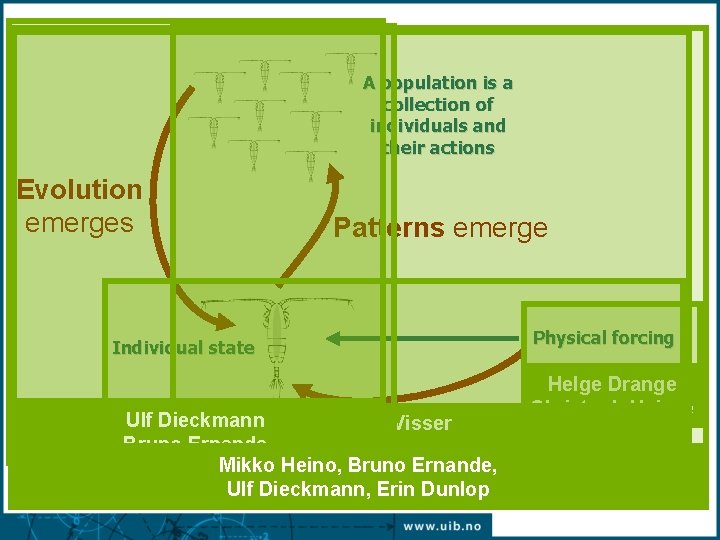
A population is a collection of individuals and their actions Evolution emerges Patterns emerge Individual state Ulf Dieckmann Trade-offs Andy Visser emerge Bruno Ernande Øyvind Fiksen Per Jonsson Geir Huse Mikko Jørgensen Heino, Bruno Ernande, Christian Espen Strand Ulf Dieckmann, Erin Dunlop Physical forcing Helge Drange Christoph Heinze
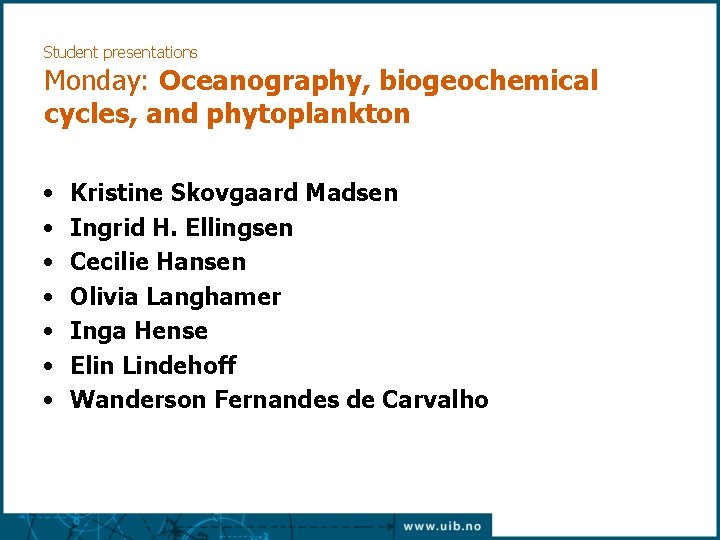
Student presentations Monday: Oceanography, biogeochemical cycles, and phytoplankton • • Kristine Skovgaard Madsen Ingrid H. Ellingsen Cecilie Hansen Olivia Langhamer Inga Hense Elin Lindehoff Wanderson Fernandes de Carvalho
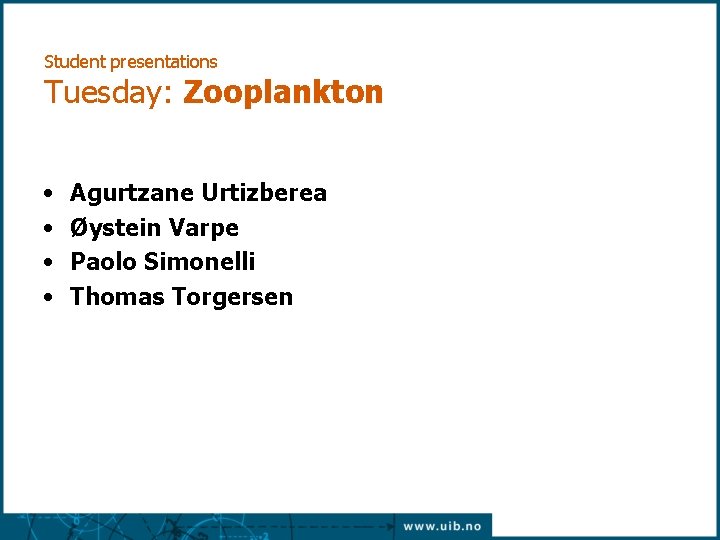
Student presentations Tuesday: Zooplankton • • Agurtzane Urtizberea Øystein Varpe Paolo Simonelli Thomas Torgersen
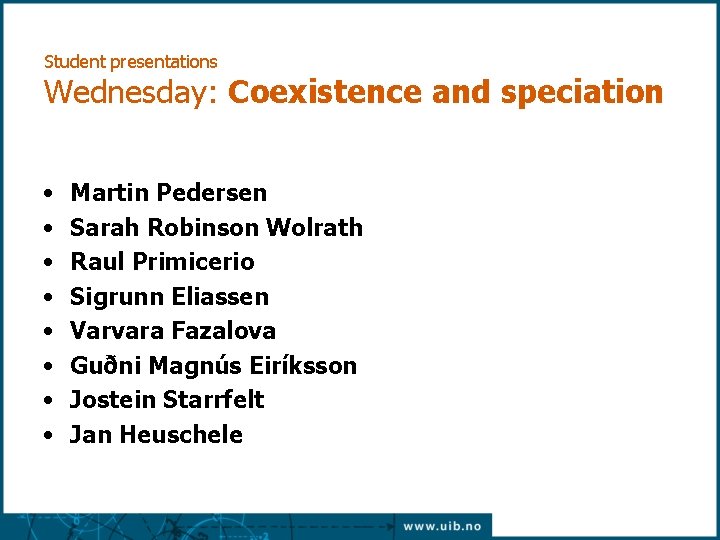
Student presentations Wednesday: Coexistence and speciation • • Martin Pedersen Sarah Robinson Wolrath Raul Primicerio Sigrunn Eliassen Varvara Fazalova Guðni Magnús Eiríksson Jostein Starrfelt Jan Heuschele
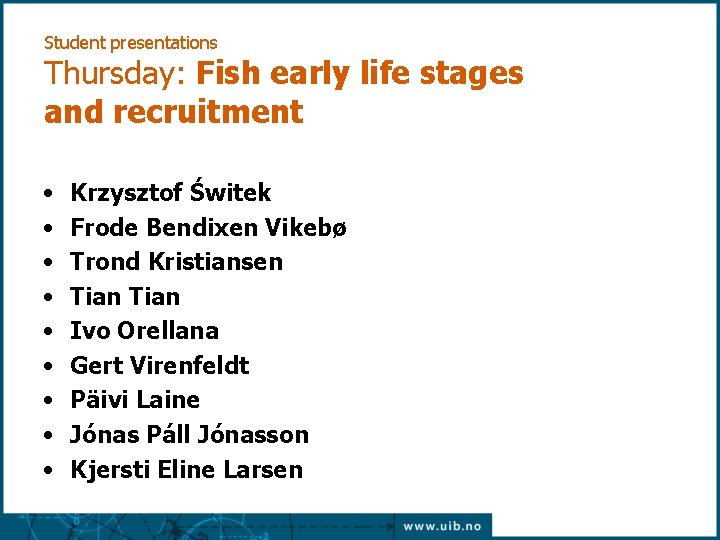
Student presentations Thursday: Fish early life stages and recruitment • • • Krzysztof Świtek Frode Bendixen Vikebø Trond Kristiansen Tian Ivo Orellana Gert Virenfeldt Päivi Laine Jónas Páll Jónasson Kjersti Eline Larsen
Student presentations Saturday: Fisheries-induced evolution • • Davnah Urbach Paul Venturelli Anne Maria Eikeset Shahaama Abdul Sattar Karin Nilsson Dorothy Dankel Geir Halnes Erin Dunlop
Administrative information • Travel costs. • Course diploma. • Lock office building from dinner starts until breakfast is over. • Please be quiet after midnight. • Computers: – Computer room with printer. – Internet in rooms. • Discuss, discuss!
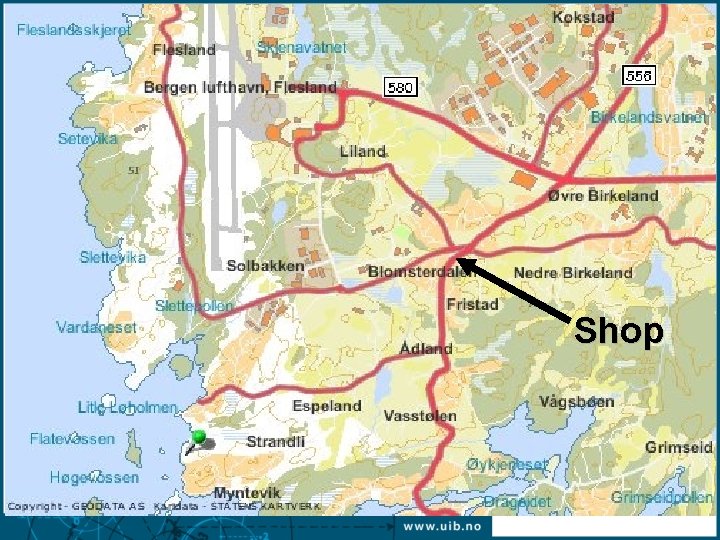
Social information • Food: – Allergies, vegetarians… – Snack when you like! – …but help us keep the kitchen tidy. • Soda, beer, and wine. • Sauna (and swimming). • Evening in Bergen. • Shops… Shop
Questions?