
Modelling Composite Materials Introduction to ESAComp A Catinaccio
- Slides: 30
Modelling Composite Materials: Introduction to ESAComp A. Catinaccio CERN EP-DT-EO LBNL Composites Workshop Berkley, March 2016 01/03/2016 Page 1
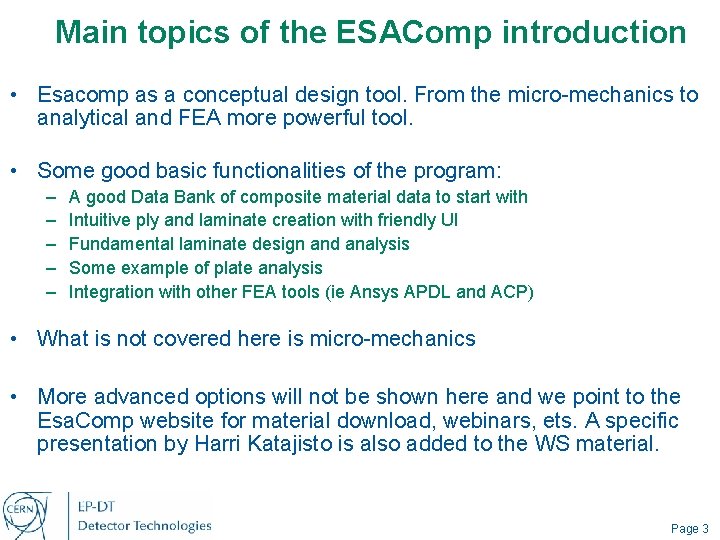
Main topics of the ESAComp introduction • Esacomp as a conceptual design tool. From the micro-mechanics to analytical and FEA more powerful tool. • Some good basic functionalities of the program: – – – A good Data Bank of composite material data to start with Intuitive ply and laminate creation with friendly UI Fundamental laminate design and analysis Some example of plate analysis Integration with other FEA tools (ie Ansys APDL and ACP) • What is not covered here is micro-mechanics • More advanced options will not be shown here and we point to the Esa. Comp website for material download, webinars, ets. A specific presentation by Harri Katajisto is also added to the WS material. Page 3
Harri Katajisto Page 4
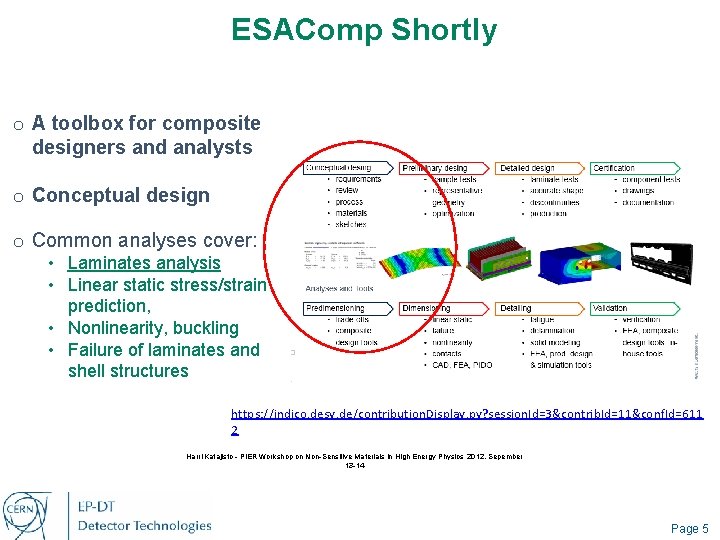
ESAComp Shortly o A toolbox for composite designers and analysts o Conceptual design o Common analyses cover: • Laminates analysis • Linear static stress/strain prediction, • Nonlinearity, buckling • Failure of laminates and shell structures https: //indico. desy. de/contribution. Display. py? session. Id=3&contrib. Id=11&conf. Id=611 2 Harri Katajisto - PIER Workshop on Non-Sensitive Materials in High Energy Physics 2012, Sepember 13 -14 Page 5
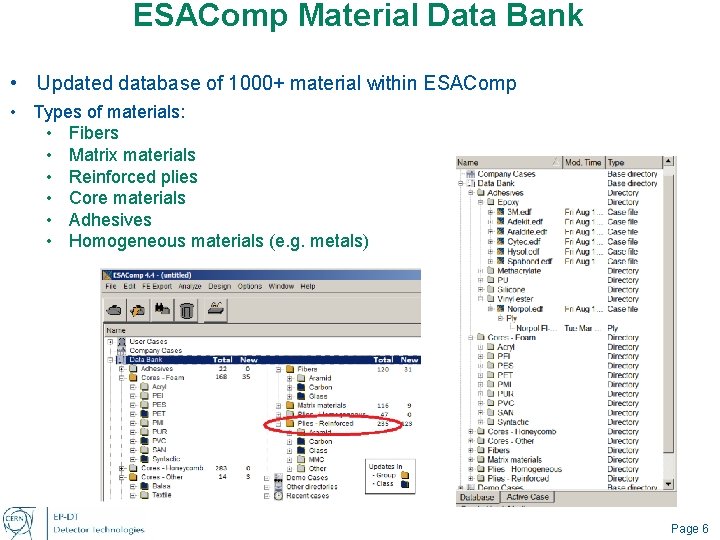
ESAComp Material Data Bank • Updated database of 1000+ material within ESAComp • Types of materials: • Fibers • Matrix materials • Reinforced plies • Core materials • Adhesives • Homogeneous materials (e. g. metals) Page 6
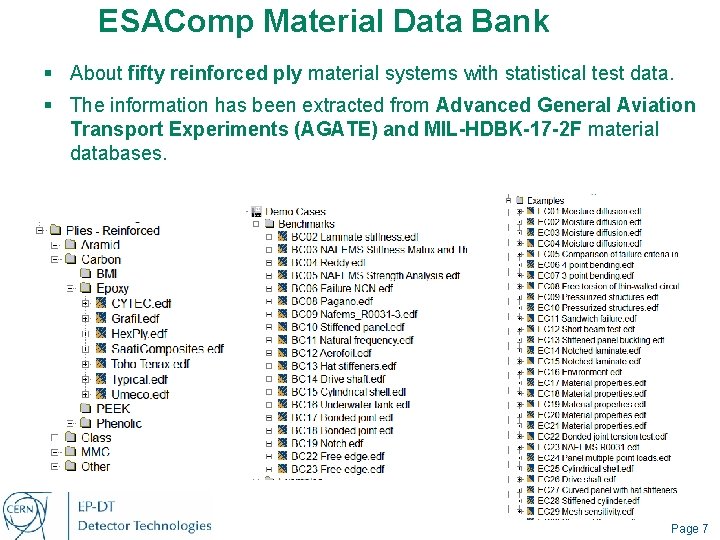
ESAComp Material Data Bank § About fifty reinforced ply material systems with statistical test data. § The information has been extracted from Advanced General Aviation Transport Experiments (AGATE) and MIL-HDBK-17 -2 F material databases. Page 7
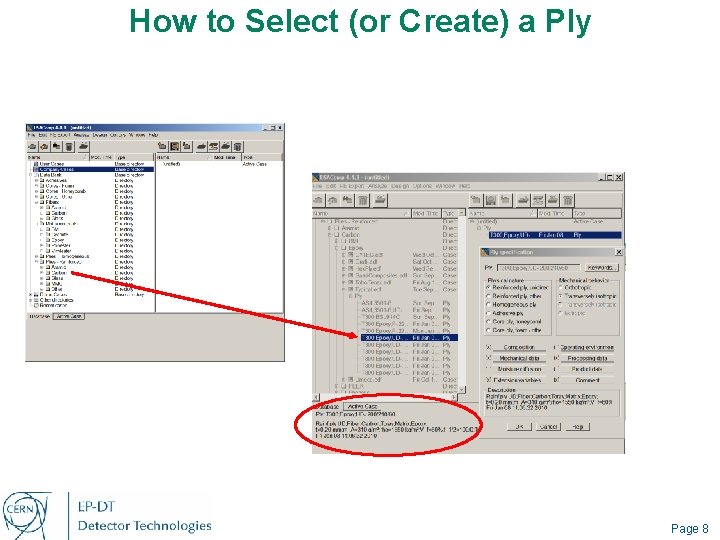
How to Select (or Create) a Ply Page 8
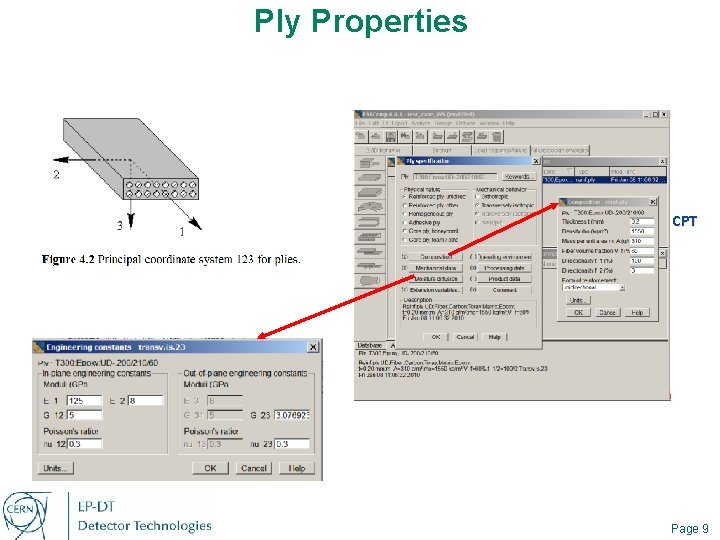
Ply Properties CPT Page 9
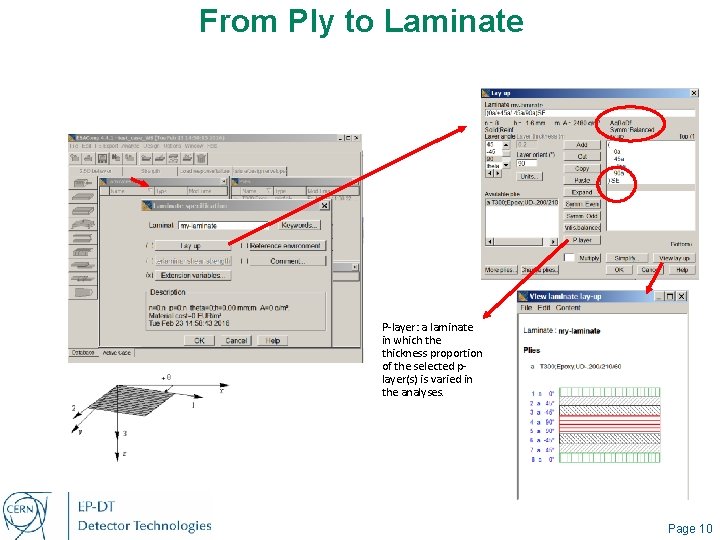
From Ply to Laminate P-layer: a laminate in which the thickness proportion of the selected player(s) is varied in the analyses. Page 10
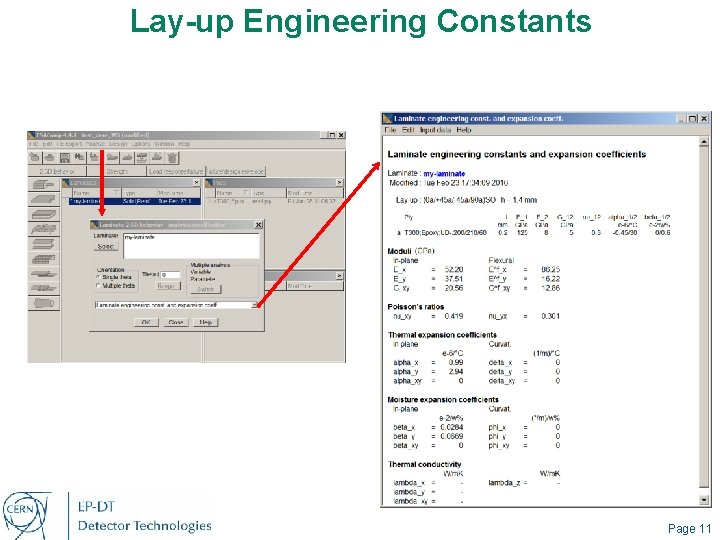
Lay-up Engineering Constants Page 11
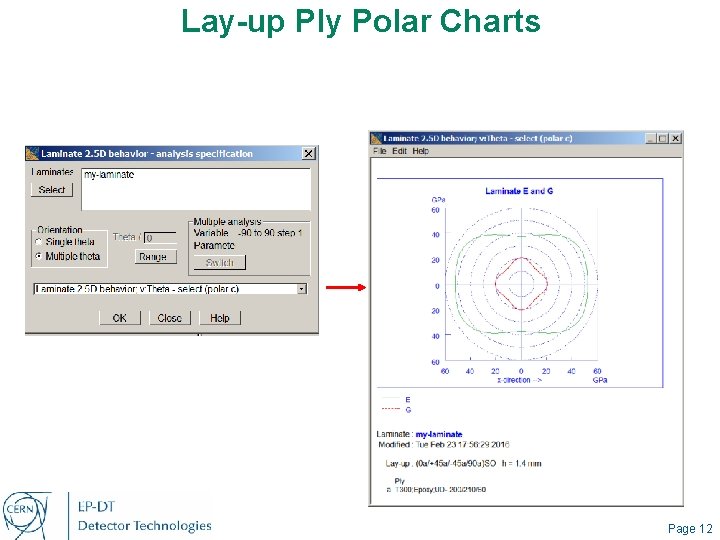
Lay-up Ply Polar Charts Page 12
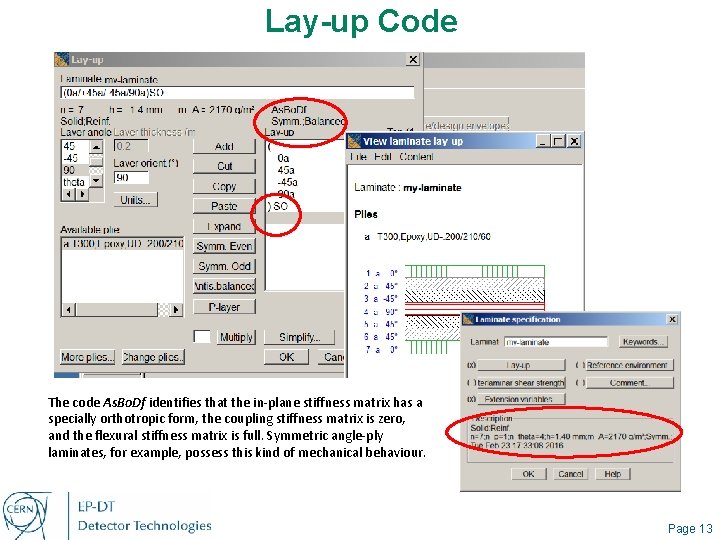
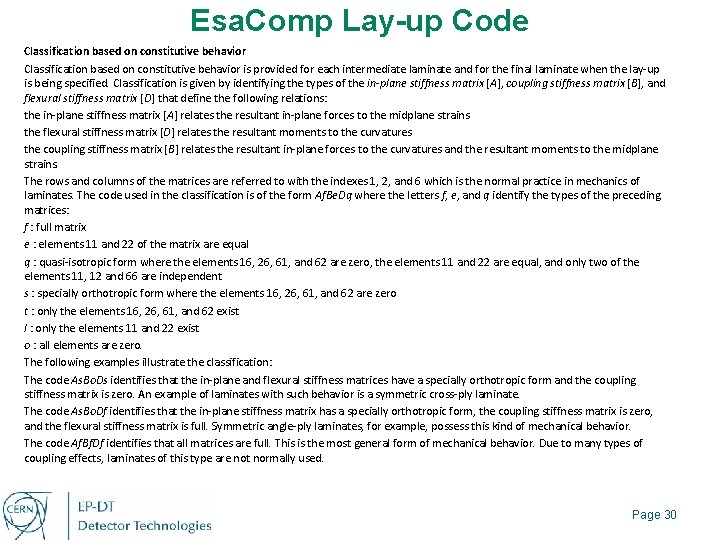
Lay-up Code The code As. Bo. Df identifies that the in-plane stiffness matrix has a specially orthotropic form, the coupling stiffness matrix is zero, and the flexural stiffness matrix is full. Symmetric angle-ply laminates, for example, possess this kind of mechanical behaviour. 12 Page 13
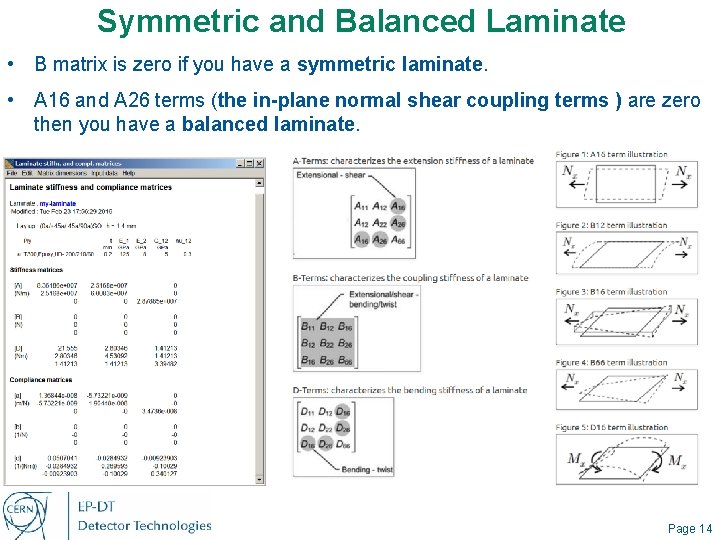
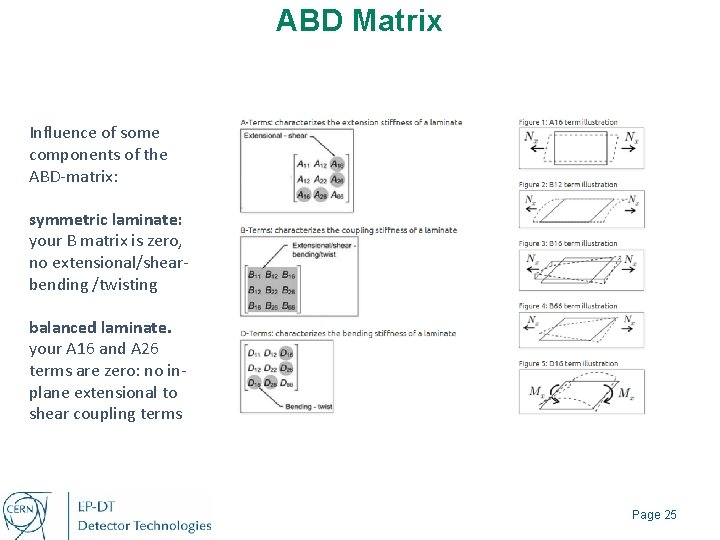
Symmetric and Balanced Laminate • B matrix is zero if you have a symmetric laminate. • A 16 and A 26 terms (the in-plane normal shear coupling terms ) are zero then you have a balanced laminate. Page 14
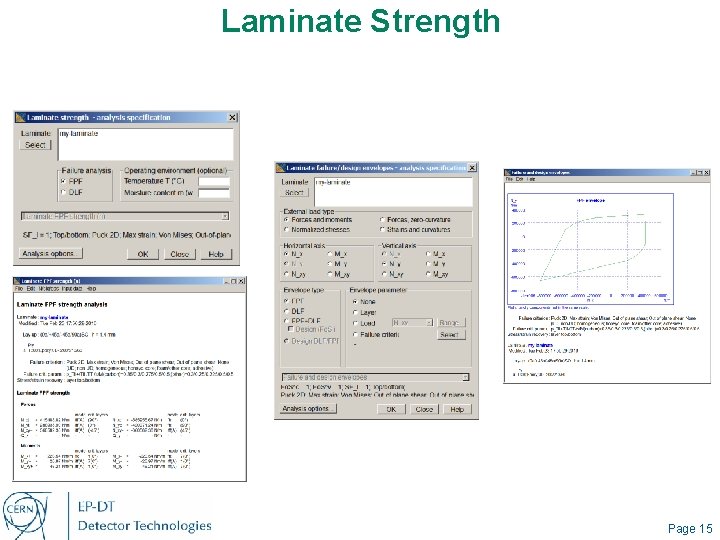
Laminate Strength Page 15
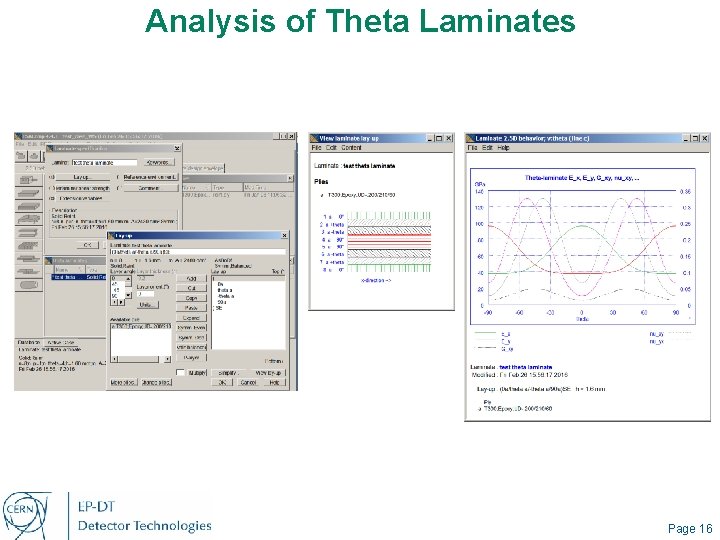
Analysis of Theta Laminates Page 16
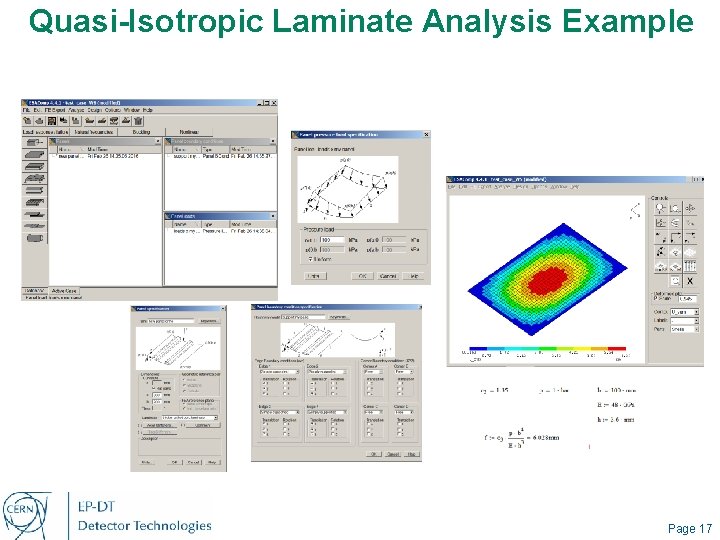
Quasi-Isotropic Laminate Analysis Example Page 17
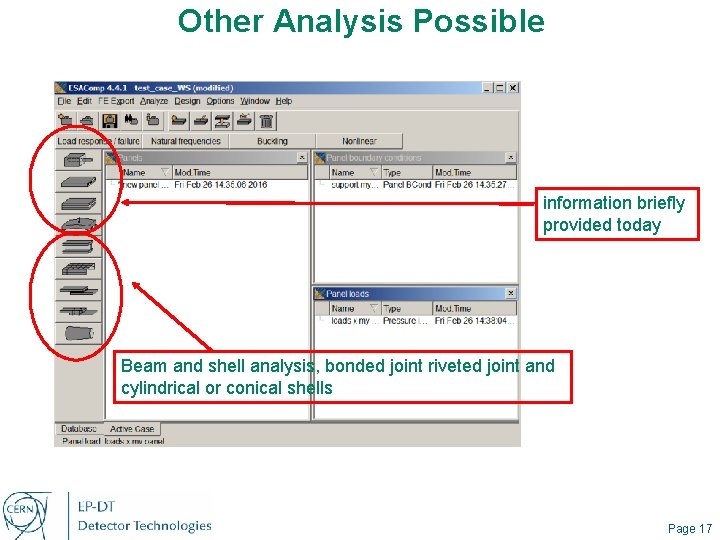
Other Analysis Possible information briefly provided today Beam and shell analysis, bonded joint riveted joint and cylindrical or conical shells Page 17
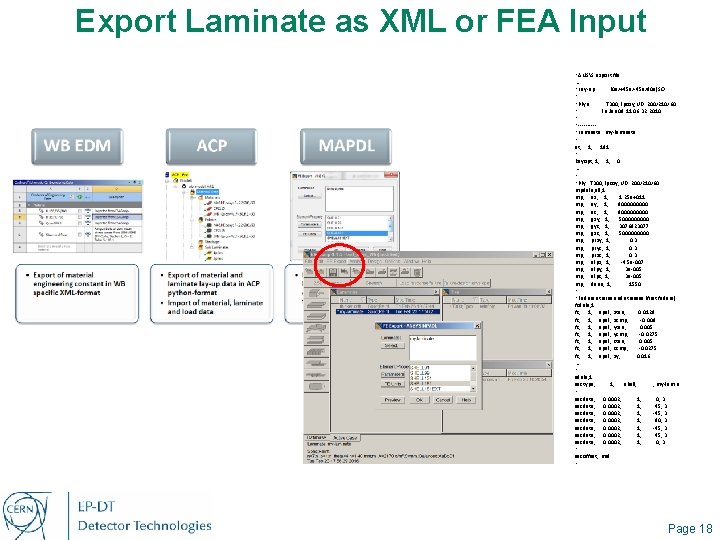
Export Laminate as XML or FEA Input ! ANSYS export file …. ! Lay-up : (0 a/+45 a/-45 a/90 a)SO ! ! Ply a T 300; Epoxy; UD-. 200/210/60 ! Fri Jan 08 11: 06: 32 2010 ! ! -----! Laminate : my-laminate ! et, 1, 181 ! keyopt, 1, 1, 0 … ! ! Ply : T 300; Epoxy; UD-. 200/210/60 mpdele, all, 1 mp, ex, 1, 1. 25 e+011 mp, ey, 1, 800000 mp, ez, 1, 800000 mp, gxy, 1, 500000 mp, gyz, 1, 3076923077 mp, gxz, 1, 500000 mp, prxy, 1, 0. 3 mp, pryz, 1, 0. 3 mp, prxz, 1, 0. 3 mp, alpx, 1, -4. 5 e-007 mp, alpy, 1, 3 e-005 mp, alpz, 1, 3 e-005 mp, dens, 1, 1550 ! ! Failure strains and stresses (first failure) fcdele, 1 fc, 1, epel, xten, 0. 0128 fc, 1, epel, xcmp, -0. 008 fc, 1, epel, yten, 0. 005 fc, 1, epel, ycmp, -0. 0275 fc, 1, epel, zten, 0. 005 fc, 1, epel, zcmp, -0. 0275 fc, 1, epel, xy, 0. 016 …. ! sdele, 1 sectype, 1, shell, , my-lamin ! secdata, 0. 0002, 1, 0, 3 secdata, 0. 0002, 1, 45, 3 secdata, 0. 0002, 1, -45, 3 secdata, 0. 0002, 1, 90, 3 secdata, 0. 0002, 1, -45, 3 secdata, 0. 0002, 1, 0, 3 ! secoffset, mid ! Page 18
Additional Material Page 19
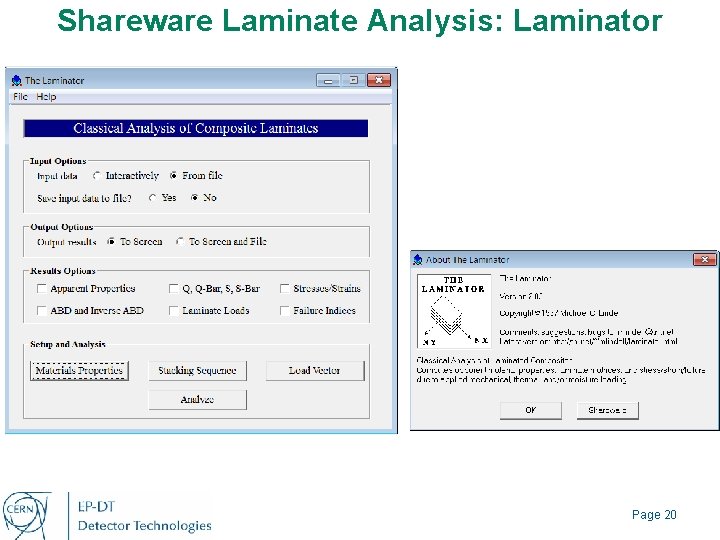
Shareware Laminate Analysis: Laminator Page 20
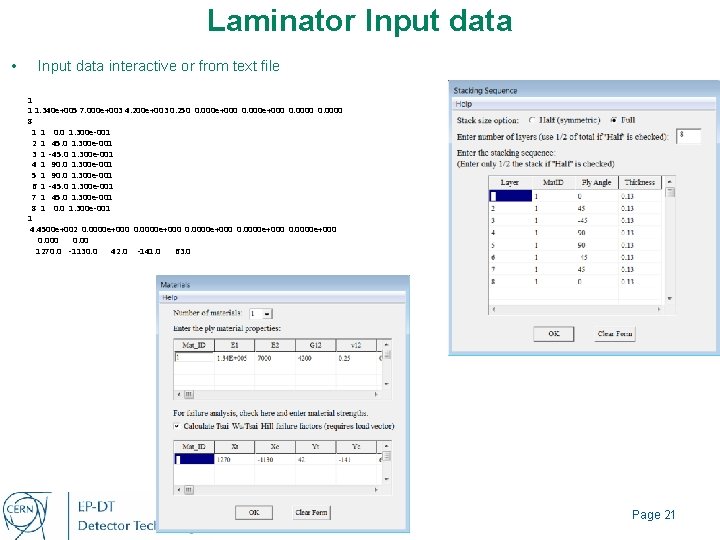
Laminator Input data • Input data interactive or from text file 1 1 1. 340 e+005 7. 000 e+003 4. 200 e+003 0. 250 0. 000 e+000 0. 0000 8 1 1 0. 0 1. 300 e-001 2 1 45. 0 1. 300 e-001 3 1 -45. 0 1. 300 e-001 4 1 90. 0 1. 300 e-001 5 1 90. 0 1. 300 e-001 6 1 -45. 0 1. 300 e-001 7 1 45. 0 1. 300 e-001 8 1 0. 0 1. 300 e-001 1 4. 4500 e+002 0. 0000 e+000 0. 00 1270. 0 -1130. 0 42. 0 -141. 0 63. 0 Page 21
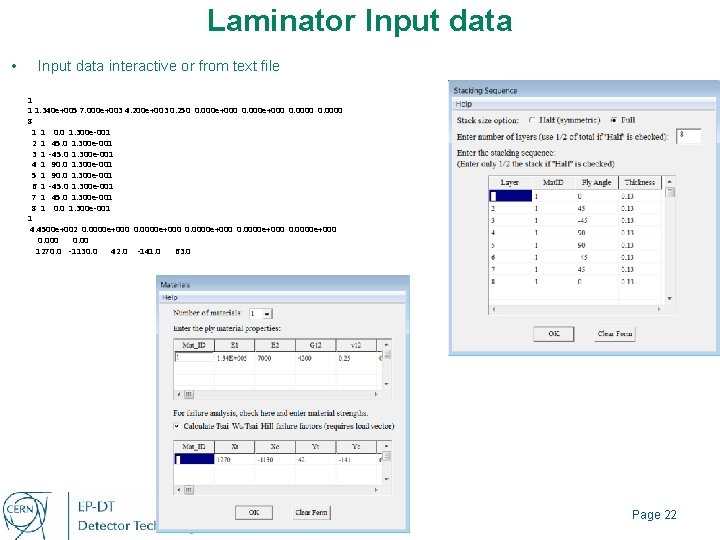
Laminator Input data • Input data interactive or from text file 1 1 1. 340 e+005 7. 000 e+003 4. 200 e+003 0. 250 0. 000 e+000 0. 0000 8 1 1 0. 0 1. 300 e-001 2 1 45. 0 1. 300 e-001 3 1 -45. 0 1. 300 e-001 4 1 90. 0 1. 300 e-001 5 1 90. 0 1. 300 e-001 6 1 -45. 0 1. 300 e-001 7 1 45. 0 1. 300 e-001 8 1 0. 0 1. 300 e-001 1 4. 4500 e+002 0. 0000 e+000 0. 00 1270. 0 -1130. 0 42. 0 -141. 0 63. 0 Page 22
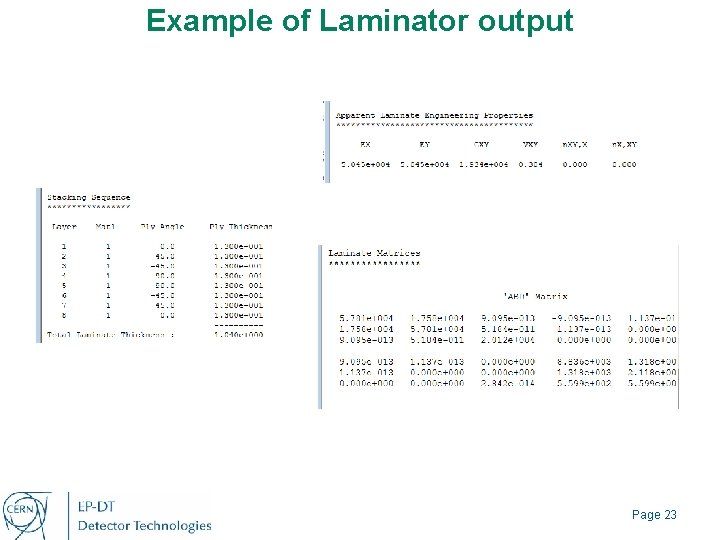
Example of Laminator output Page 23
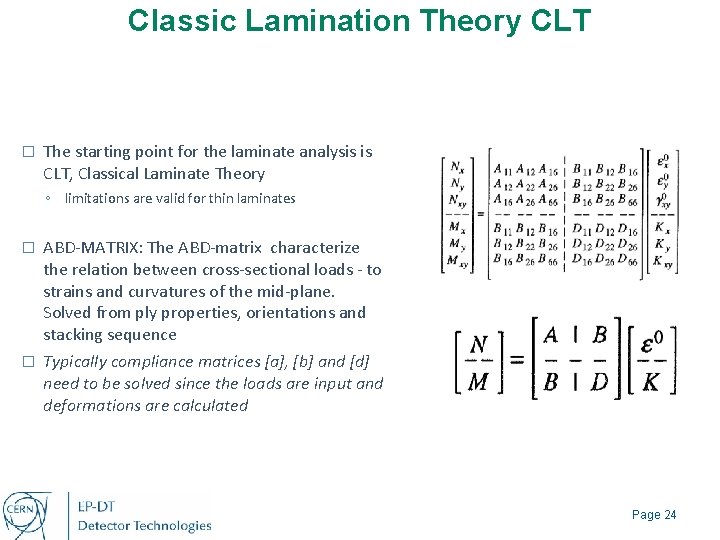
Classic Lamination Theory CLT � The starting point for the laminate analysis is CLT, Classical Laminate Theory ◦ limitations are valid for thin laminates � ABD-MATRIX: The ABD-matrix characterize the relation between cross-sectional loads - to strains and curvatures of the mid-plane. Solved from ply properties, orientations and stacking sequence � Typically compliance matrices [a], [b] and [d] need to be solved since the loads are input and deformations are calculated Page 24
ABD Matrix Influence of some components of the ABD-matrix: symmetric laminate: your B matrix is zero, no extensional/shearbending /twisting balanced laminate. your A 16 and A 26 terms are zero: no inplane extensional to shear coupling terms Page 25
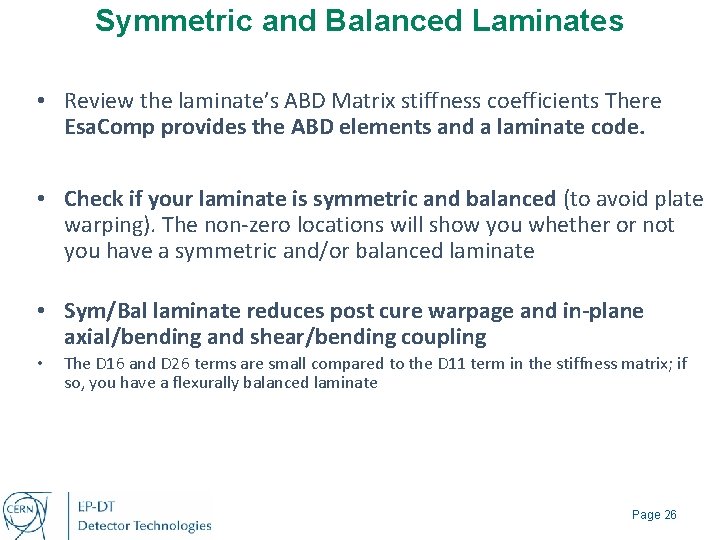
Symmetric and Balanced Laminates • Review the laminate’s ABD Matrix stiffness coefficients There Esa. Comp provides the ABD elements and a laminate code. • Check if your laminate is symmetric and balanced (to avoid plate warping). The non-zero locations will show you whether or not you have a symmetric and/or balanced laminate • Sym/Bal laminate reduces post cure warpage and in-plane axial/bending and shear/bending coupling • The D 16 and D 26 terms are small compared to the D 11 term in the stiffness matrix; if so, you have a flexurally balanced laminate Page 26
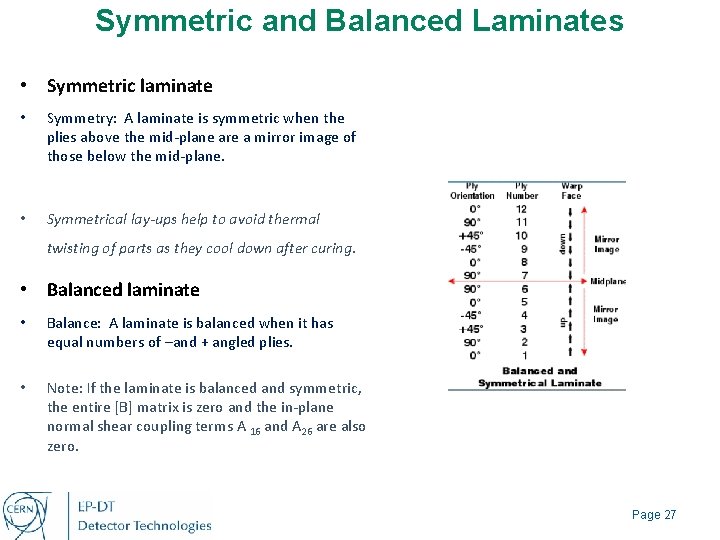
Symmetric and Balanced Laminates • Symmetric laminate • Symmetry: A laminate is symmetric when the plies above the mid-plane are a mirror image of those below the mid-plane. • Symmetrical lay-ups help to avoid thermal twisting of parts as they cool down after curing. • Balanced laminate • Balance: A laminate is balanced when it has equal numbers of –and + angled plies. • Note: If the laminate is balanced and symmetric, the entire [B] matrix is zero and the in-plane normal shear coupling terms A 16 and A 26 are also zero. Page 27
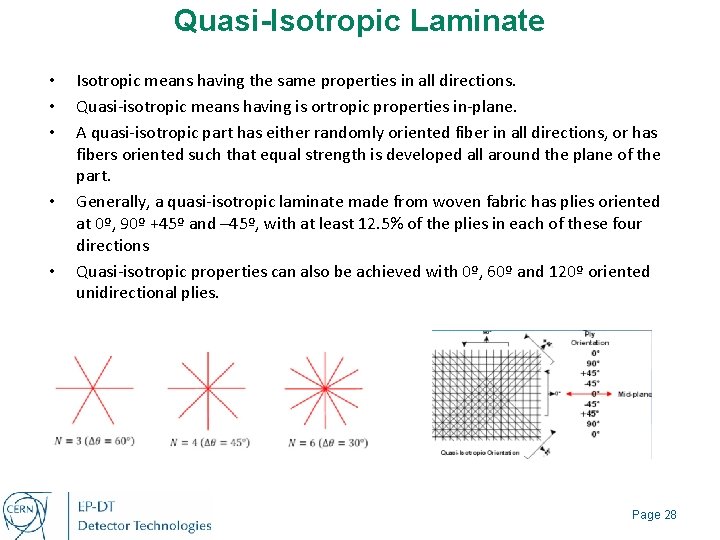
Quasi-Isotropic Laminate • • • Isotropic means having the same properties in all directions. Quasi-isotropic means having is ortropic properties in-plane. A quasi-isotropic part has either randomly oriented fiber in all directions, or has fibers oriented such that equal strength is developed all around the plane of the part. Generally, a quasi-isotropic laminate made from woven fabric has plies oriented at 0º, 90º +45º and – 45º, with at least 12. 5% of the plies in each of these four directions Quasi-isotropic properties can also be achieved with 0º, 60º and 120º oriented unidirectional plies. Page 28
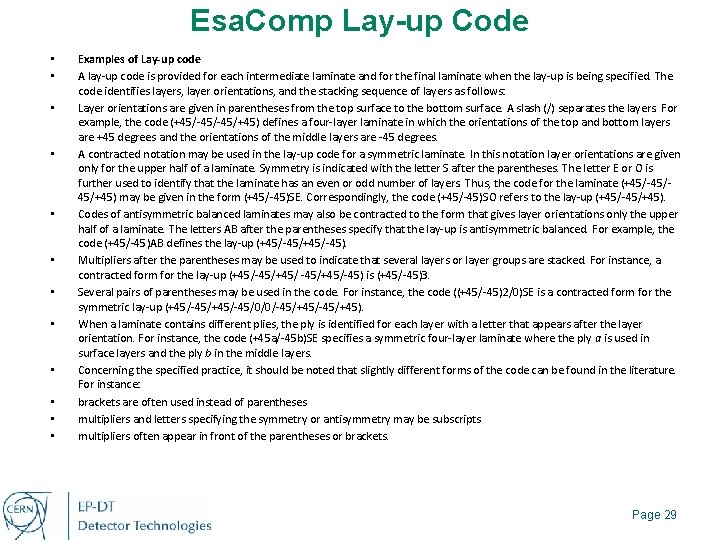
Esa. Comp Lay-up Code • • • Examples of Lay-up code A lay-up code is provided for each intermediate laminate and for the final laminate when the lay-up is being specified. The code identifies layers, layer orientations, and the stacking sequence of layers as follows: Layer orientations are given in parentheses from the top surface to the bottom surface. A slash (/) separates the layers. For example, the code (+45/-45/+45) defines a four-layer laminate in which the orientations of the top and bottom layers are +45 degrees and the orientations of the middle layers are -45 degrees. A contracted notation may be used in the lay-up code for a symmetric laminate. In this notation layer orientations are given only for the upper half of a laminate. Symmetry is indicated with the letter S after the parentheses. The letter E or O is further used to identify that the laminate has an even or odd number of layers. Thus, the code for the laminate (+45/-45/45/+45) may be given in the form (+45/-45)SE. Correspondingly, the code (+45/-45)SO refers to the lay-up (+45/-45/+45). Codes of antisymmetric balanced laminates may also be contracted to the form that gives layer orientations only the upper half of a laminate. The letters AB after the parentheses specify that the lay-up is antisymmetric balanced. For example, the code (+45/-45)AB defines the lay-up (+45/-45/+45/-45). Multipliers after the parentheses may be used to indicate that several layers or layer groups are stacked. For instance, a contracted form for the lay-up (+45/-45/+45/-45) is (+45/-45)3. Several pairs of parentheses may be used in the code. For instance, the code ((+45/-45)2/0)SE is a contracted form for the symmetric lay-up (+45/-45/0/0/-45/+45). When a laminate contains different plies, the ply is identified for each layer with a letter that appears after the layer orientation. For instance, the code (+45 a/-45 b)SE specifies a symmetric four-layer laminate where the ply a is used in surface layers and the ply b in the middle layers. Concerning the specified practice, it should be noted that slightly different forms of the code can be found in the literature. For instance: brackets are often used instead of parentheses multipliers and letters specifying the symmetry or antisymmetry may be subscripts multipliers often appear in front of the parentheses or brackets. Page 29
Esa. Comp Lay-up Code Classification based on constitutive behavior is provided for each intermediate laminate and for the final laminate when the lay-up is being specified. Classification is given by identifying the types of the in-plane stiffness matrix [A], coupling stiffness matrix [B], and flexural stiffness matrix [D] that define the following relations: the in-plane stiffness matrix [A] relates the resultant in-plane forces to the midplane strains the flexural stiffness matrix [D] relates the resultant moments to the curvatures the coupling stiffness matrix [B] relates the resultant in-plane forces to the curvatures and the resultant moments to the midplane strains. The rows and columns of the matrices are referred to with the indexes 1, 2, and 6 which is the normal practice in mechanics of laminates. The code used in the classification is of the form Af. Be. Dq where the letters f, e, and q identify the types of the preceding matrices: f : full matrix e : elements 11 and 22 of the matrix are equal q : quasi-isotropic form where the elements 16, 26, 61, and 62 are zero, the elements 11 and 22 are equal, and only two of the elements 11, 12 and 66 are independent s : specially orthotropic form where the elements 16, 26, 61, and 62 are zero t : only the elements 16, 26, 61, and 62 exist l : only the elements 11 and 22 exist o : all elements are zero. The following examples illustrate the classification: The code As. Bo. Ds identifies that the in-plane and flexural stiffness matrices have a specially orthotropic form and the coupling stiffness matrix is zero. An example of laminates with such behavior is a symmetric cross-ply laminate. The code As. Bo. Df identifies that the in-plane stiffness matrix has a specially orthotropic form, the coupling stiffness matrix is zero, and the flexural stiffness matrix is full. Symmetric angle-ply laminates, for example, possess this kind of mechanical behavior. The code Af. Bf. Df identifies that all matrices are full. This is the most general form of mechanical behavior. Due to many types of coupling effects, laminates of this type are not normally used. Page 30