
Modellazione e valutazione di un ambiente applicativo su

Modellazione e valutazione di un ambiente applicativo su una intranet 1
Caratterizzazione del carico Applicazioni considerate sulla intranet: 1) Corporate training: web based application 2) Access to local file system 2
Ipotesi sulle infrastrutture: • Tutti i file server e il web server hanno una singola CPU ed un singolo disco • FDDI e il router sono molto veloci rispetto alla Lan Ethernet, quindi sono modellati come semplici ritardi (delay), quindi centro di servizio senza coda di attesa. • Tutte le altre componenti sono modellate come code con serventi con tempi di servizio indipendenti dal carico 3
Ipotesi sugli utenti: • • numero degli utenti finito un utente genera una nuova richiesta, dopo aver ricevuto la risposta dalla precedente, dopo un ritardo pari al “think time” 85% degli utenti lavora con il file system locale 15% con il Web Server 4
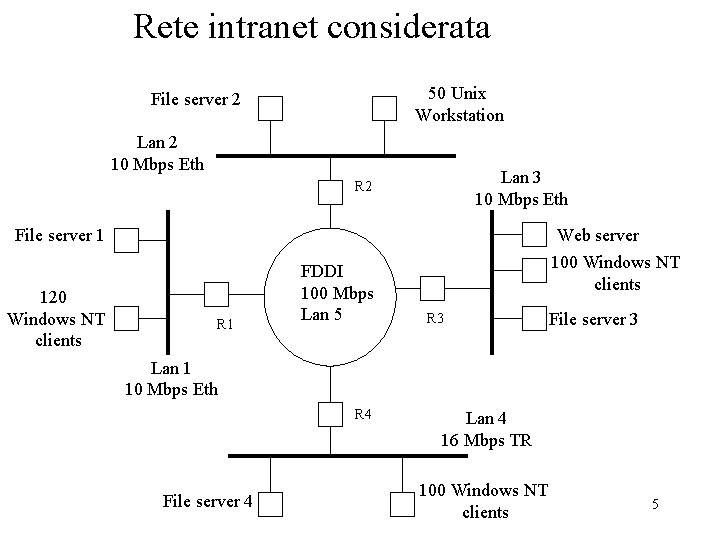
Rete intranet considerata 50 Unix Workstation File server 2 Lan 2 10 Mbps Eth Lan 3 10 Mbps Eth R 2 File server 1 120 Windows NT clients Web server R 1 FDDI 100 Mbps Lan 5 100 Windows NT clients R 3 File server 3 Lan 1 10 Mbps Eth R 4 File server 4 Lan 4 16 Mbps TR 100 Windows NT clients 5
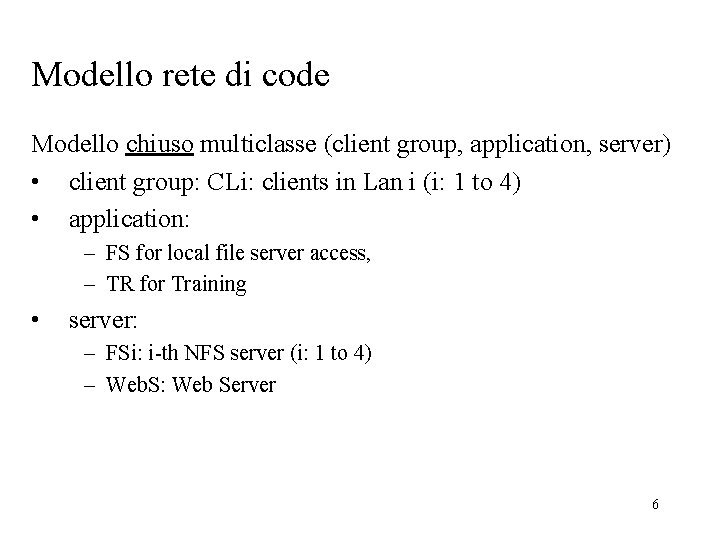
Modello rete di code Modello chiuso multiclasse (client group, application, server) • client group: CLi: clients in Lan i (i: 1 to 4) • application: – FS for local file server access, – TR for Training • server: – FSi: i-th NFS server (i: 1 to 4) – Web. S: Web Server 6
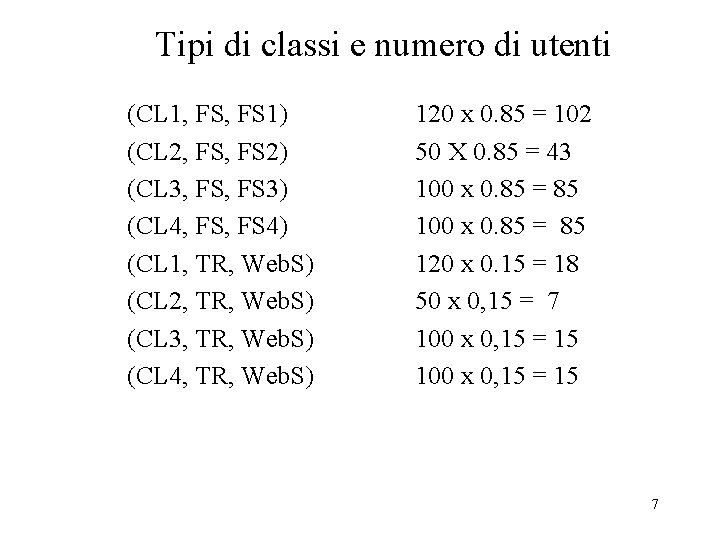
Tipi di classi e numero di utenti (CL 1, FS 1) (CL 2, FS 2) (CL 3, FS 3) (CL 4, FS 4) (CL 1, TR, Web. S) (CL 2, TR, Web. S) (CL 3, TR, Web. S) (CL 4, TR, Web. S) 120 x 0. 85 = 102 50 X 0. 85 = 43 100 x 0. 85 = 85 120 x 0. 15 = 18 50 x 0, 15 = 7 100 x 0, 15 = 15 7
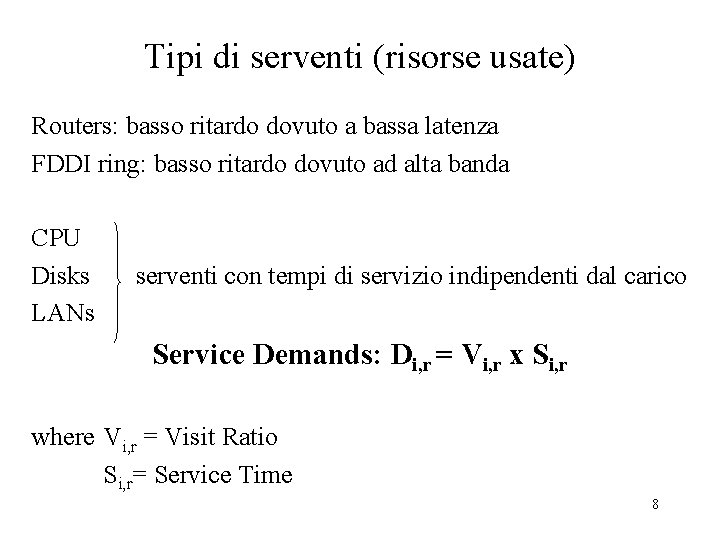
Tipi di serventi (risorse usate) Routers: basso ritardo dovuto a bassa latenza FDDI ring: basso ritardo dovuto ad alta banda CPU Disks LANs serventi con tempi di servizio indipendenti dal carico Service Demands: Di, r = Vi, r x Si, r where Vi, r = Visit Ratio Si, r= Service Time 8
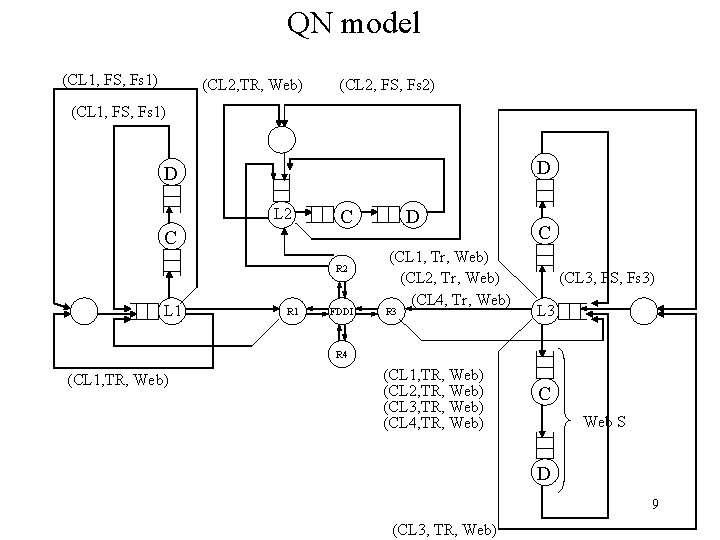
QN model (CL 1, FS, Fs 1) (CL 2, TR, Web) (CL 2, FS, Fs 2) (CL 1, FS, Fs 1) D D L 2 C C R 2 L 1 R 1 FDDI D (CL 1, Tr, Web) (CL 2, Tr, Web) (CL 4, Tr, Web) R 3 C (CL 3, FS, Fs 3) L 3 R 4 (CL 1, TR, Web) (CL 2, TR, Web) (CL 3, TR, Web) (CL 4, TR, Web) C Web S D 9 (CL 3, TR, Web)
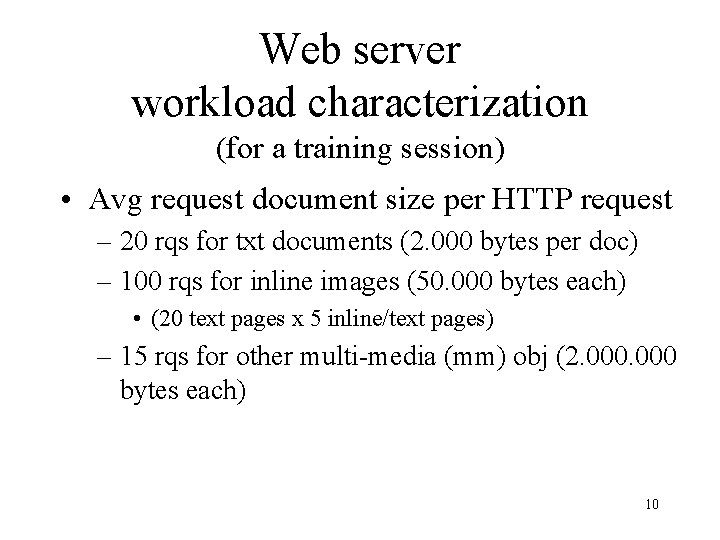
Web server workload characterization (for a training session) • Avg request document size per HTTP request – 20 rqs for txt documents (2. 000 bytes per doc) – 100 rqs for inline images (50. 000 bytes each) • (20 text pages x 5 inline/text pages) – 15 rqs for other multi-media (mm) obj (2. 000 bytes each) 10
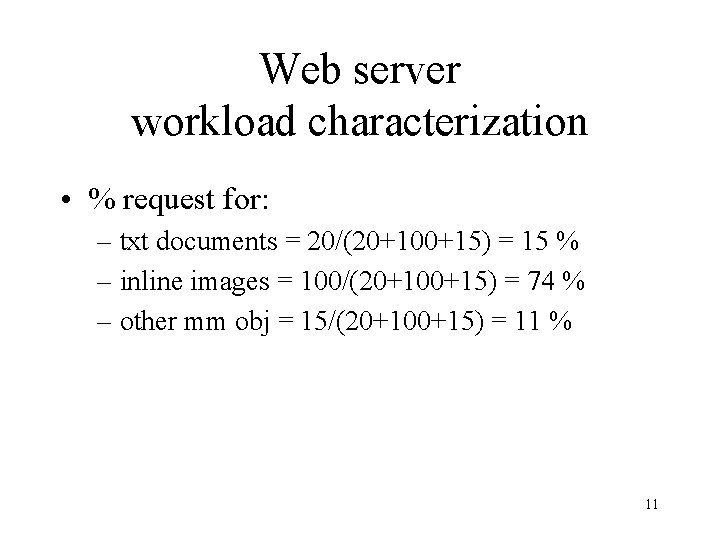
Web server workload characterization • % request for: – txt documents = 20/(20+100+15) = 15 % – inline images = 100/(20+100+15) = 74 % – other mm obj = 15/(20+100+15) = 11 % 11
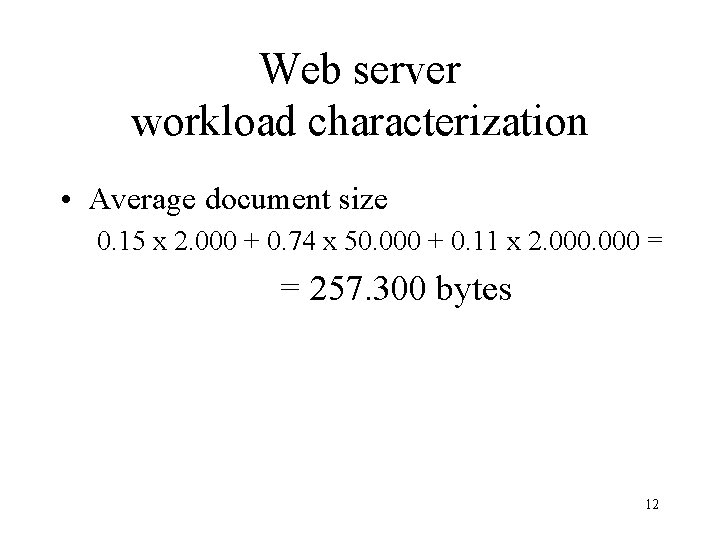
Web server workload characterization • Average document size 0. 15 x 2. 000 + 0. 74 x 50. 000 + 0. 11 x 2. 000 = = 257. 300 bytes 12
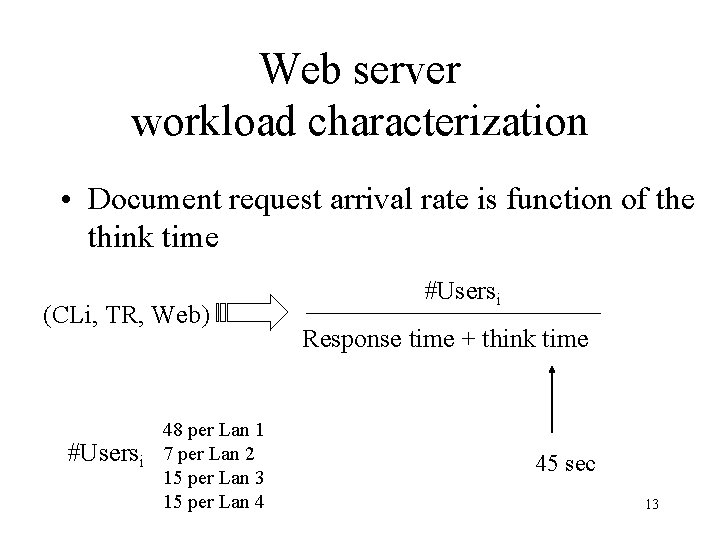
Web server workload characterization • Document request arrival rate is function of the think time (CLi, TR, Web) 48 per Lan 1 #Usersi 7 per Lan 2 15 per Lan 3 15 per Lan 4 #Usersi Response time + think time 45 sec 13
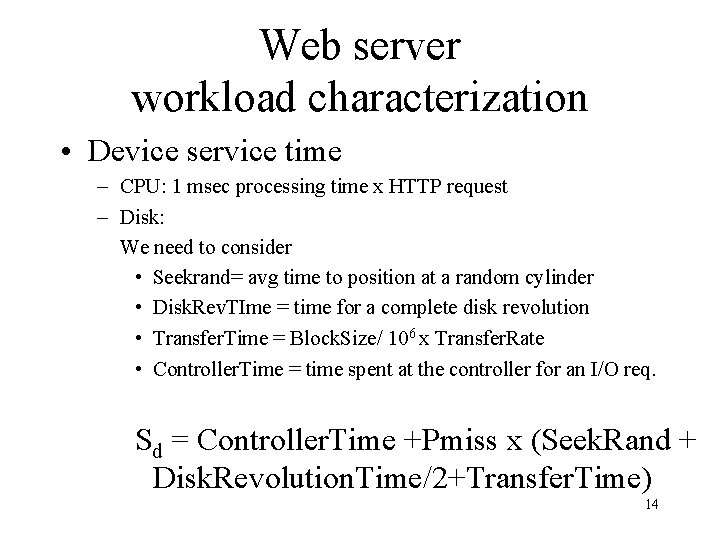
Web server workload characterization • Device service time – CPU: 1 msec processing time x HTTP request – Disk: We need to consider • Seekrand= avg time to position at a random cylinder • Disk. Rev. TIme = time for a complete disk revolution • Transfer. Time = Block. Size/ 106 x Transfer. Rate • Controller. Time = time spent at the controller for an I/O req. Sd = Controller. Time +Pmiss x (Seek. Rand + Disk. Revolution. Time/2+Transfer. Time) 14
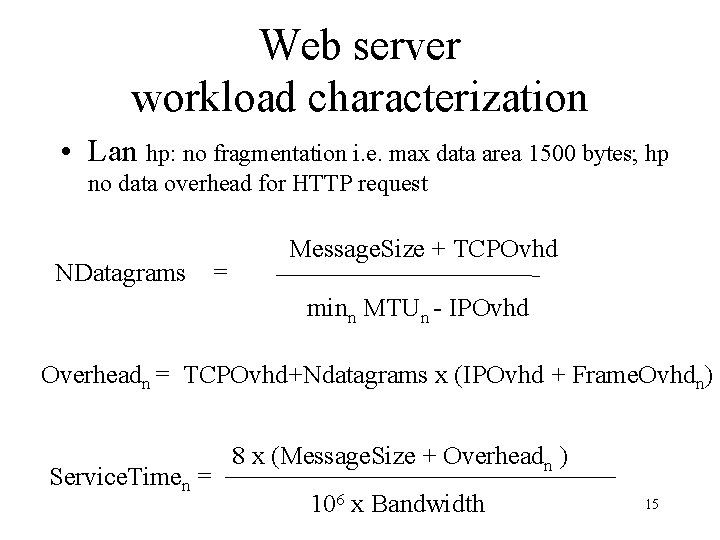
Web server workload characterization • Lan hp: no fragmentation i. e. max data area 1500 bytes; hp no data overhead for HTTP request NDatagrams = Message. Size + TCPOvhd minn MTUn - IPOvhd Overheadn = TCPOvhd+Ndatagrams x (IPOvhd + Frame. Ovhdn) Service. Timen = 8 x (Message. Size + Overheadn ) 106 x Bandwidth 15
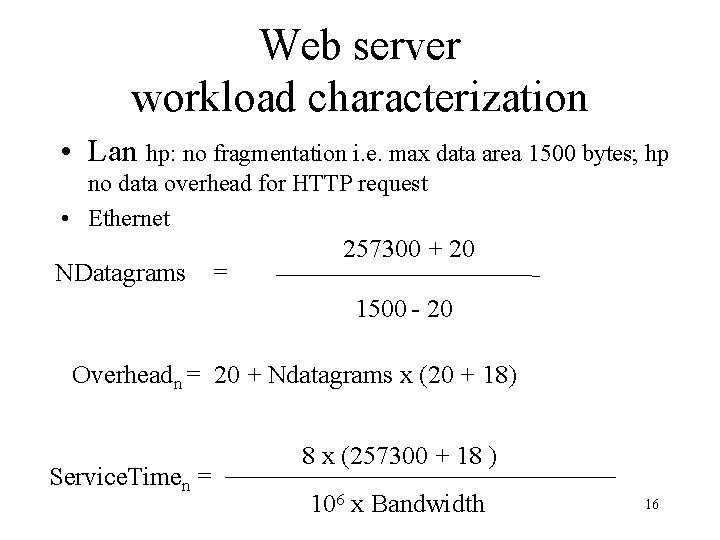
Web server workload characterization • Lan hp: no fragmentation i. e. max data area 1500 bytes; hp no data overhead for HTTP request • Ethernet NDatagrams = 257300 + 20 1500 - 20 Overheadn = 20 + Ndatagrams x (20 + 18) Service. Timen = 8 x (257300 + 18 ) 106 x Bandwidth 16
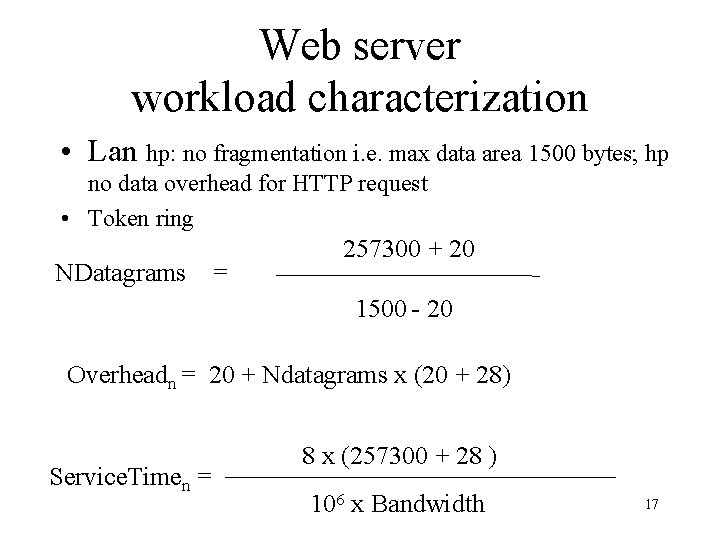
Web server workload characterization • Lan hp: no fragmentation i. e. max data area 1500 bytes; hp no data overhead for HTTP request • Token ring NDatagrams = 257300 + 20 1500 - 20 Overheadn = 20 + Ndatagrams x (20 + 28) Service. Timen = 8 x (257300 + 28 ) 106 x Bandwidth 17
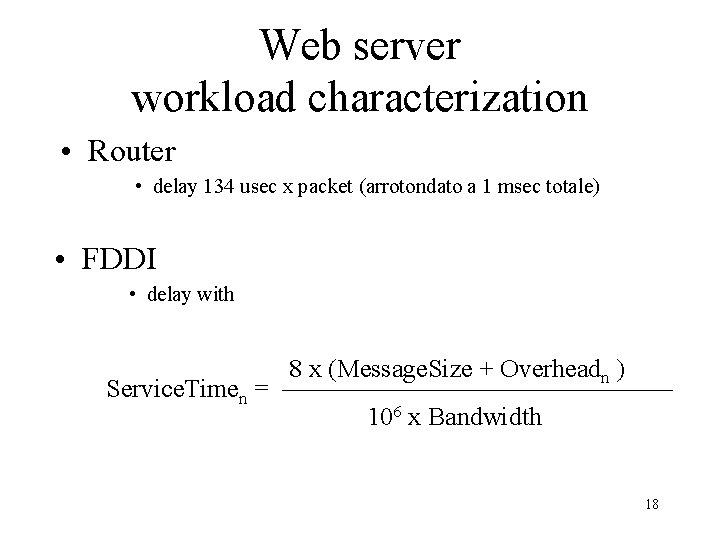
Web server workload characterization • Router • delay 134 usec x packet (arrotondato a 1 msec totale) • FDDI • delay with Service. Timen = 8 x (Message. Size + Overheadn ) 106 x Bandwidth 18
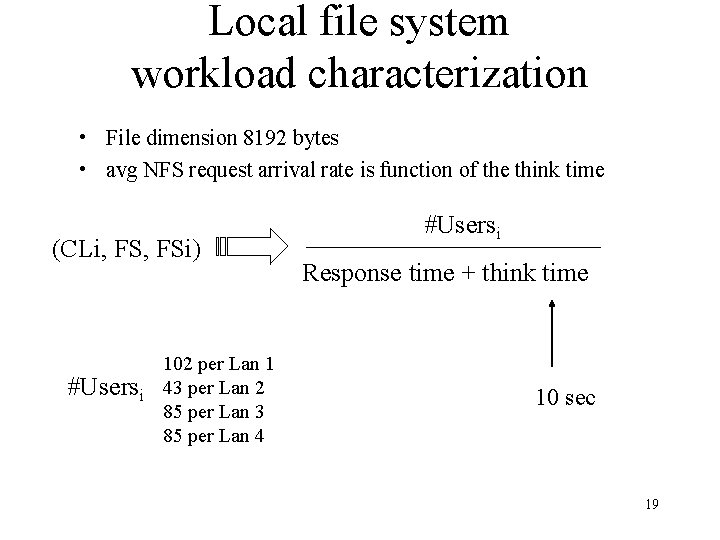
Local file system workload characterization • File dimension 8192 bytes • avg NFS request arrival rate is function of the think time (CLi, FSi) 102 per Lan 1 #Usersi 43 per Lan 2 85 per Lan 3 85 per Lan 4 #Usersi Response time + think time 10 sec 19
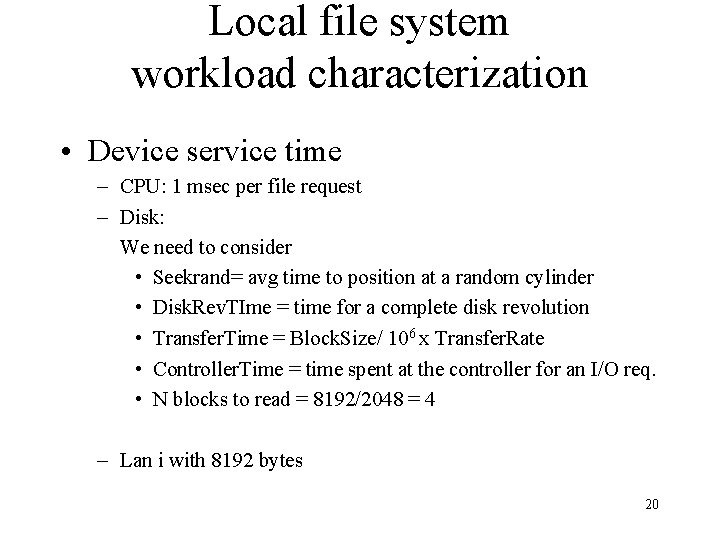
Local file system workload characterization • Device service time – CPU: 1 msec per file request – Disk: We need to consider • Seekrand= avg time to position at a random cylinder • Disk. Rev. TIme = time for a complete disk revolution • Transfer. Time = Block. Size/ 106 x Transfer. Rate • Controller. Time = time spent at the controller for an I/O req. • N blocks to read = 8192/2048 = 4 – Lan i with 8192 bytes 20
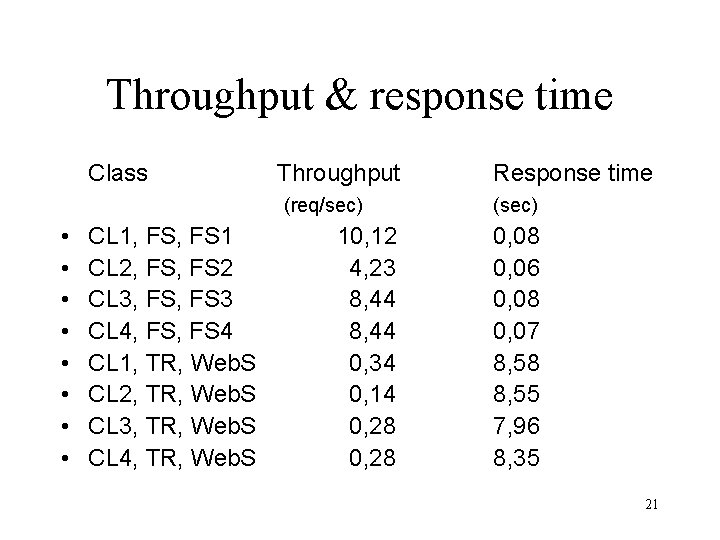
Throughput & response time Class Throughput (req/sec) • • CL 1, FS 1 CL 2, FS 2 CL 3, FS 3 CL 4, FS 4 CL 1, TR, Web. S CL 2, TR, Web. S CL 3, TR, Web. S CL 4, TR, Web. S 10, 12 4, 23 8, 44 0, 34 0, 14 0, 28 Response time (sec) 0, 08 0, 06 0, 08 0, 07 8, 58 8, 55 7, 96 8, 35 21
- Slides: 21