
MODELIZATION OF RADIATIONINDUCED DAMAGE IN FLUKA AND MATERIAL
![BDF Results: H/He[appm] vs DPA Water TZM W Ta Courtesy: J. Canhoto-Espadanal 27 -28/11/2017](https://slidetodoc.com/presentation_image/e83dfd397d9cc0ee7f8ac2b8217c2c6e/image-18.jpg "BDF Results: H/He[appm] vs DPA Water TZM W Ta Courtesy: J. Canhoto-Espadanal 27 -28/11/2017")
![DPA High-Z BLIP [FLUKA vs MARS] 1. 2 DPA / 1. 03 1012 p+](https://slidetodoc.com/presentation_image/e83dfd397d9cc0ee7f8ac2b8217c2c6e/image-20.jpg "DPA High-Z BLIP [FLUKA vs MARS] 1. 2 DPA / 1. 03 1012 p+")

![Lindhard partition function x [1/2] The partition function gives the fraction of stopping power](https://slidetodoc.com/presentation_image/e83dfd397d9cc0ee7f8ac2b8217c2c6e/image-33.jpg "Lindhard partition function x [1/2] The partition function gives the fraction of stopping power")
![Irradiation on Cu. Cr. Zr [3] • Peak value obtained of 0. 002 DPA](https://slidetodoc.com/presentation_image/e83dfd397d9cc0ee7f8ac2b8217c2c6e/image-46.jpg "Irradiation on Cu. Cr. Zr [3] • Peak value obtained of 0. 002 DPA")
- Slides: 46
MODELIZATION OF RADIATION-INDUCED DAMAGE IN FLUKA AND MATERIAL DAMAGE ESTIMATES FOR CERN INJECTORS AND FUTURE FACILITIES Jose A. Briz EN-STI-FDA, CERN V. Vlachoudis and F. Cerutti EN-STI-FDA (CERN) 1 st Workshop of ARIES WP 17 Power Mat - Politecnico de Torino 27 -28/11/2017 1 st Workshop of ARIES WP 17 Power. Mat – 27 -28/11/2017 1
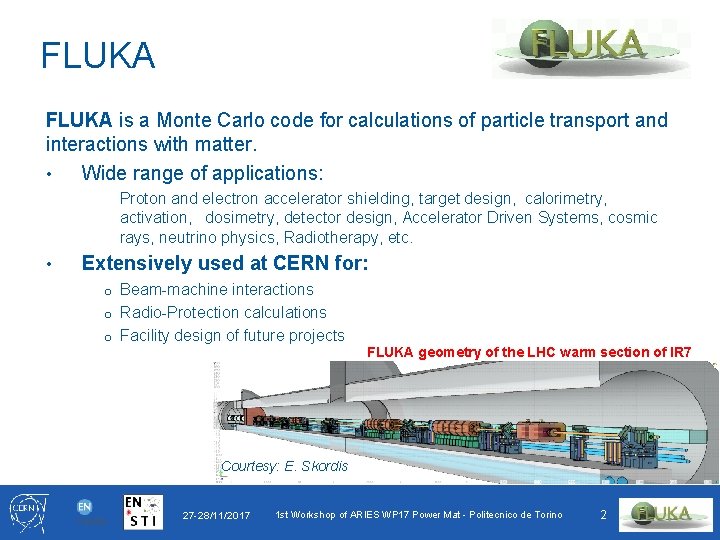
FLUKA is a Monte Carlo code for calculations of particle transport and interactions with matter. • Wide range of applications: Proton and electron accelerator shielding, target design, calorimetry, activation, dosimetry, detector design, Accelerator Driven Systems, cosmic rays, neutrino physics, Radiotherapy, etc. • Extensively used at CERN for: o Beam-machine interactions o Radio-Protection calculations o Facility design of future projects FLUKA geometry of the LHC warm section of IR 7 Courtesy: E. Skordis 27 -28/11/2017 1 st Workshop of ARIES WP 17 Power Mat - Politecnico de Torino 2
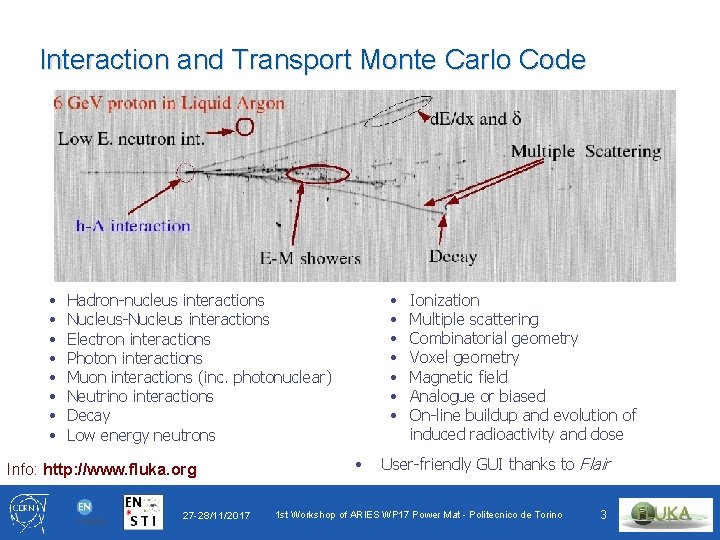
Interaction and Transport Monte Carlo Code • • • • Hadron-nucleus interactions Nucleus-Nucleus interactions Electron interactions Photon interactions Muon interactions (inc. photonuclear) Neutrino interactions Decay Low energy neutrons Info: http: //www. fluka. org 27 -28/11/2017 • Ionization Multiple scattering Combinatorial geometry Voxel geometry Magnetic field Analogue or biased On-line buildup and evolution of induced radioactivity and dose User-friendly GUI thanks to Flair 1 st Workshop of ARIES WP 17 Power Mat - Politecnico de Torino 3
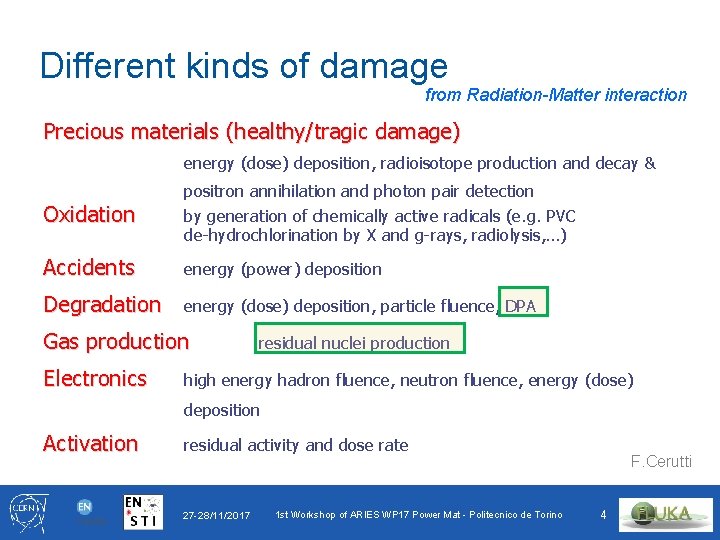
Different kinds of damage from Radiation-Matter interaction Precious materials (healthy/tragic damage) energy (dose) deposition, radioisotope production and decay & Oxidation positron annihilation and photon pair detection by generation of chemically active radicals (e. g. PVC de-hydrochlorination by X and g-rays, radiolysis, …) Accidents energy (power) deposition Degradation energy (dose) deposition, particle fluence, DPA Gas production Electronics residual nuclei production high energy hadron fluence, neutron fluence, energy (dose) deposition Activation residual activity and dose rate 27 -28/11/2017 1 st Workshop of ARIES WP 17 Power Mat - Politecnico de Torino F. Cerutti 4
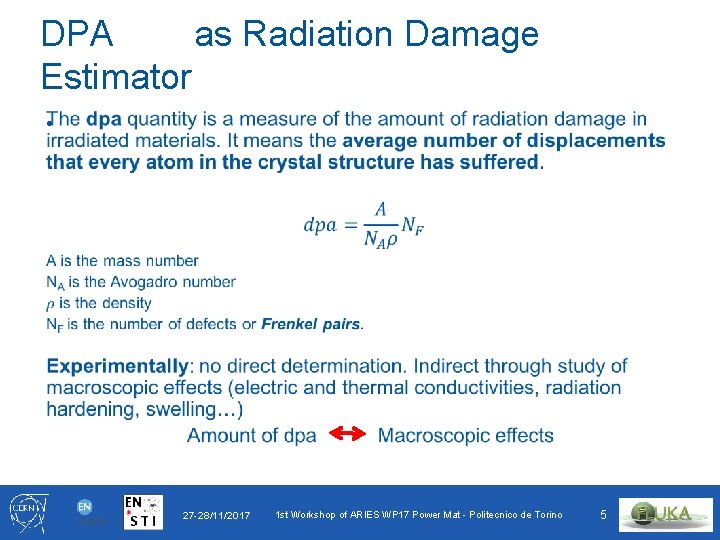
DPA as Radiation Damage Estimator • 27 -28/11/2017 1 st Workshop of ARIES WP 17 Power Mat - Politecnico de Torino 5
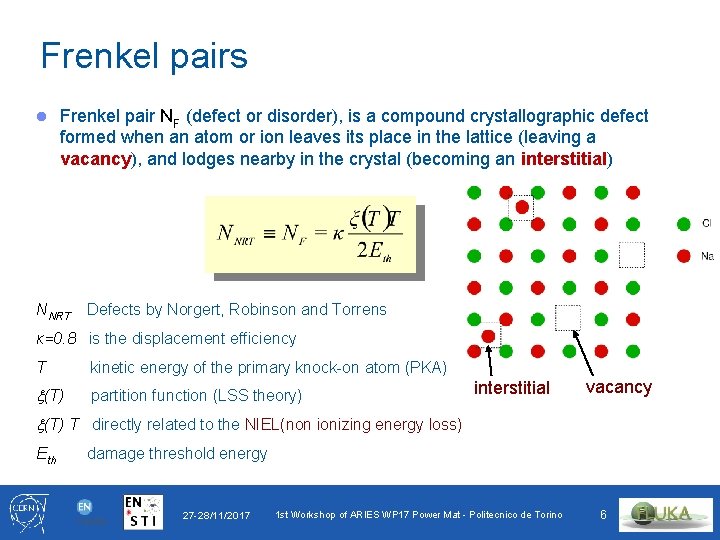
Frenkel pairs Frenkel pair NF (defect or disorder), is a compound crystallographic defect formed when an atom or ion leaves its place in the lattice (leaving a vacancy), and lodges nearby in the crystal (becoming an interstitial) NNRT Defects by Norgert, Robinson and Torrens κ=0. 8 is the displacement efficiency T kinetic energy of the primary knock-on atom (PKA) x(T) partition function (LSS theory) interstitial vacancy x(T) T directly related to the NIEL(non ionizing energy loss) Eth damage threshold energy 27 -28/11/2017 1 st Workshop of ARIES WP 17 Power Mat - Politecnico de Torino 6
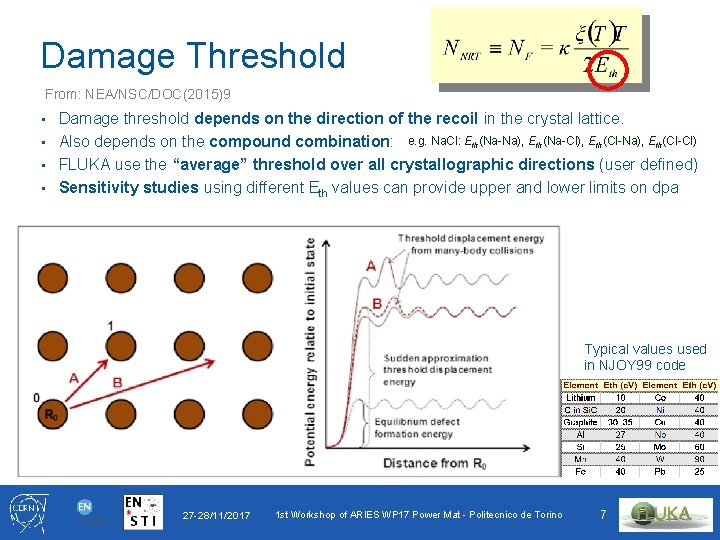
Damage Threshold From: NEA/NSC/DOC(2015)9 Damage threshold depends on the direction of the recoil in the crystal lattice. • Also depends on the compound combination: e. g. Na. Cl: Eth(Na-Na), Eth(Na-Cl), Eth(Cl-Na), Eth(Cl-Cl) • FLUKA use the “average” threshold over all crystallographic directions (user defined) • Sensitivity studies using different Eth values can provide upper and lower limits on dpa • Typical values used in NJOY 99 code 27 -28/11/2017 1 st Workshop of ARIES WP 17 Power Mat - Politecnico de Torino 7
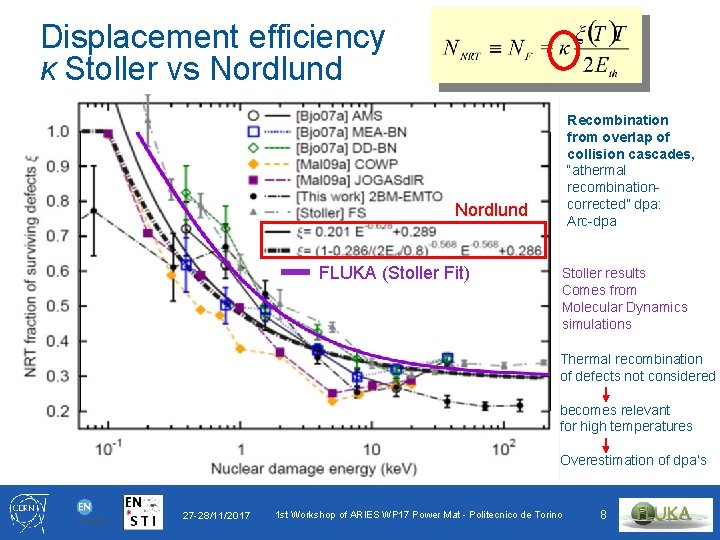
Displacement efficiency κ Stoller vs Nordlund Recombination from overlap of collision cascades, “athermal recombinationcorrected” dpa: Arc-dpa Nordlund FLUKA (Stoller Fit) Stoller results Comes from Molecular Dynamics simulations Thermal recombination of defects not considered becomes relevant for high temperatures 2728/11/2017 1 st Workshop of ARIES WP 17 Power Mat - Politecnico de Torino 27 -28/11/2017 8 Overestimation of dpa’s 1 st Workshop of ARIES WP 17 Power Mat - Politecnico de Torino 8
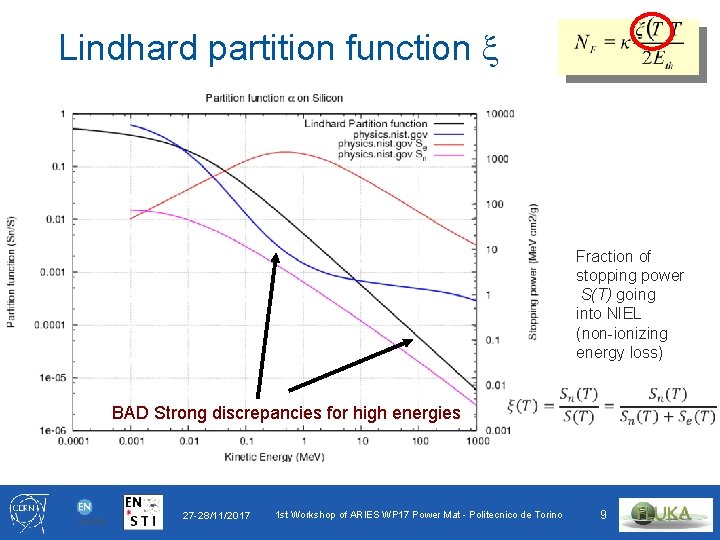
Lindhard partition function x Fraction of stopping power S(T) going into NIEL (non-ionizing energy loss) BAD Strong discrepancies for high energies 27 -28/11/2017 1 st Workshop of ARIES WP 17 Power Mat - Politecnico de Torino 9
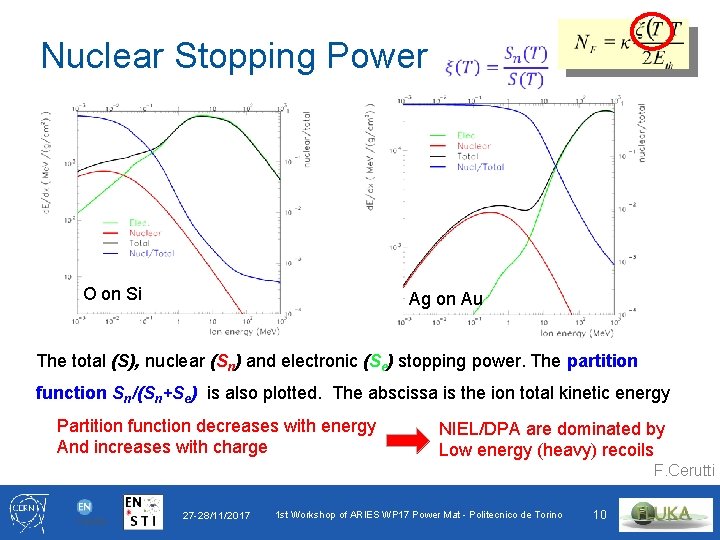
Nuclear Stopping Power O on Si Ag on Au The total (S), nuclear (Sn) and electronic (Se) stopping power. The partition function Sn/(Sn+Se) is also plotted. The abscissa is the ion total kinetic energy Partition function decreases with energy And increases with charge NIEL/DPA are dominated by Low energy (heavy) recoils F. Cerutti 27 -28/11/2017 1 st Workshop of ARIES WP 17 Power Mat - Politecnico de Torino 10
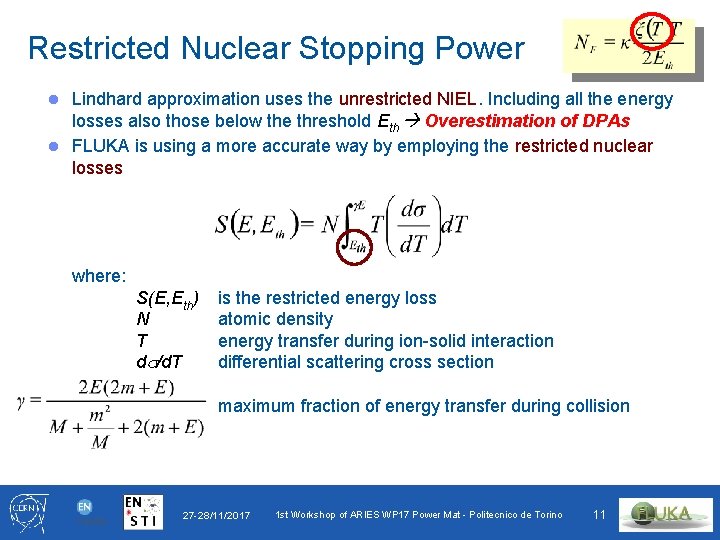
Restricted Nuclear Stopping Power Lindhard approximation uses the unrestricted NIEL. Including all the energy losses also those below the threshold Eth Overestimation of DPAs FLUKA is using a more accurate way by employing the restricted nuclear losses where: S(E, Eth) N T ds/d. T is the restricted energy loss atomic density energy transfer during ion-solid interaction differential scattering cross section maximum fraction of energy transfer during collision 27 -28/11/2017 1 st Workshop of ARIES WP 17 Power Mat - Politecnico de Torino 11
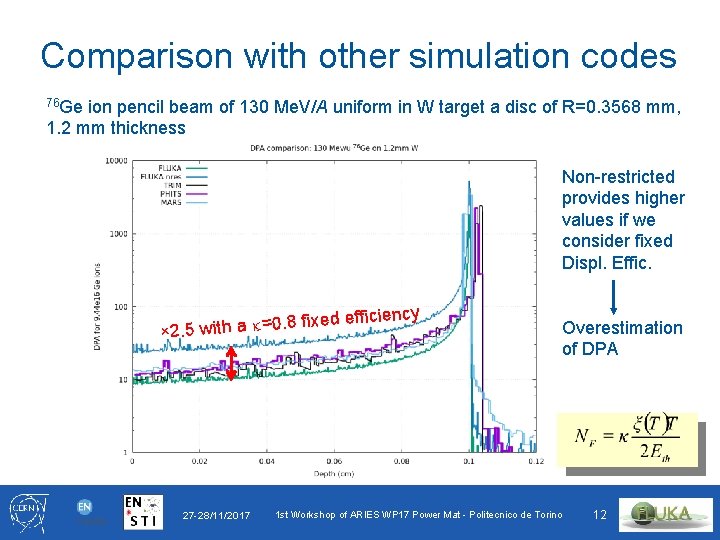
Comparison with other simulation codes 76 Ge ion pencil beam of 130 Me. V/A uniform in W target a disc of R=0. 3568 mm, 1. 2 mm thickness Non-restricted provides higher values if we consider fixed Displ. Effic. fficiency e d e ix f. 8 0 = k × 2. 5 with a 27 -28/11/2017 Overestimation of DPA 1 st Workshop of ARIES WP 17 Power Mat - Politecnico de Torino 12
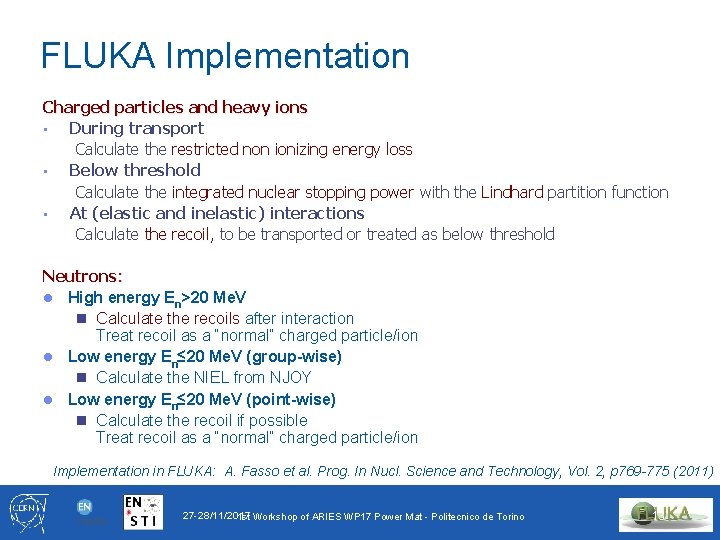
FLUKA Implementation Charged particles and heavy ions • During transport Calculate the restricted non ionizing energy loss • Below threshold Calculate the integrated nuclear stopping power with the Lindhard partition function • At (elastic and inelastic) interactions Calculate the recoil, to be transported or treated as below threshold Neutrons: High energy En>20 Me. V Calculate the recoils after interaction Treat recoil as a “normal” charged particle/ion Low energy En≤ 20 Me. V (group-wise) Calculate the NIEL from NJOY Low energy En≤ 20 Me. V (point-wise) Calculate the recoil if possible Treat recoil as a “normal” charged particle/ion Implementation in FLUKA: A. Fasso et al. Prog. In Nucl. Science and Technology, Vol. 2, p 769 -775 (2011) 27 -28/11/2017 1 st Workshop of ARIES WP 17 Power Mat - Politecnico de Torino 13
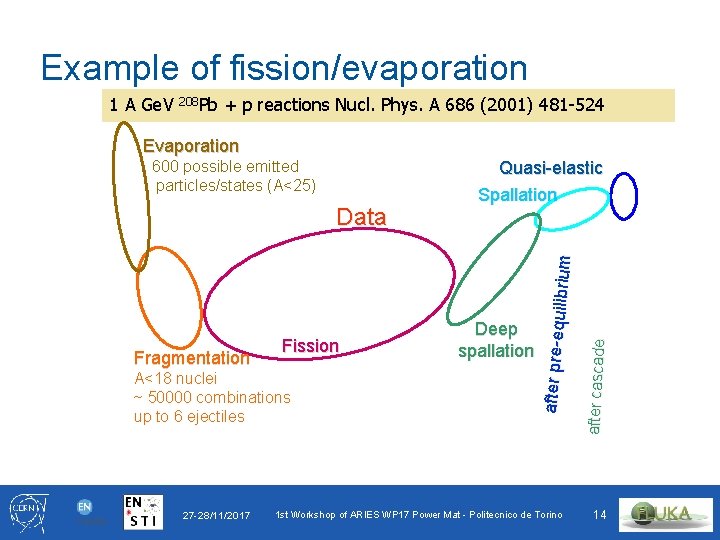
Example of fission/evaporation 1 A Ge. V 208 Pb + p reactions Nucl. Phys. A 686 (2001) 481 -524 Evaporation Fragmentation Fission A<18 nuclei ~ 50000 combinations up to 6 ejectiles 27 -28/11/2017 Deep spallation 1 st Workshop of ARIES WP 17 Power Mat - Politecnico de Torino after cascade Data Quasi-elastic Spallation after pre-equ ilibrium 600 possible emitted particles/states (A<25) 14
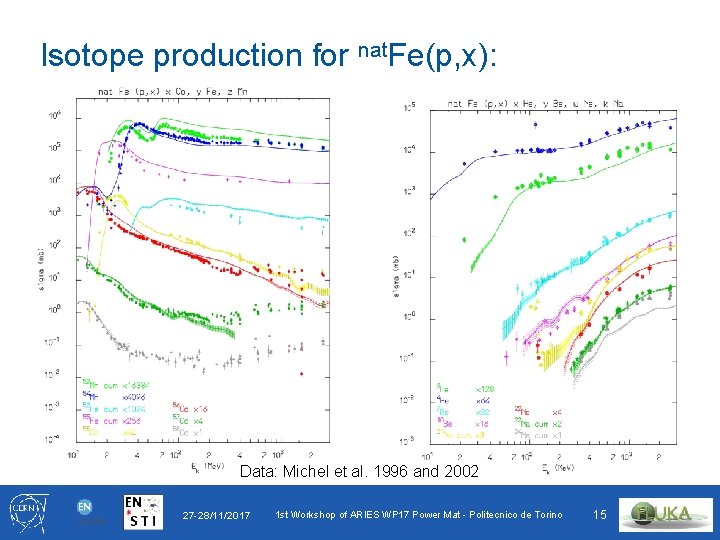
Isotope production for nat. Fe(p, x): Data: Michel et al. 1996 and 2002 27 -28/11/2017 1 st Workshop of ARIES WP 17 Power Mat - Politecnico de Torino 15
Estimates for CERN injectors and future facilities • Beam Dump Facility • BLIP capsule • PS Internal Beam Dumps 27 -28/11/2017 1 st Workshop of ARIES WP 17 Power Mat - Politecnico de Torino 16
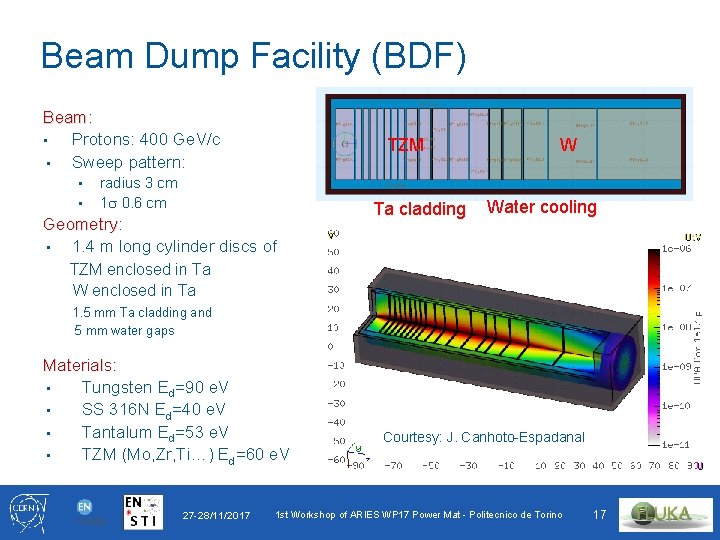
Beam Dump Facility (BDF) Beam: • Protons: 400 Ge. V/c • Sweep pattern: • • TZM radius 3 cm 1 s 0. 6 cm Geometry: • 1. 4 m long cylinder discs of TZM enclosed in Ta Ta cladding W Water cooling W enclosed in Ta 1. 5 mm Ta cladding and 5 mm water gaps Materials: • Tungsten Ed=90 e. V • SS 316 N Ed=40 e. V • Tantalum Ed=53 e. V • TZM (Mo, Zr, Ti…) Ed=60 e. V 27 -28/11/2017 Courtesy: J. Canhoto-Espadanal 1 st Workshop of ARIES WP 17 Power Mat - Politecnico de Torino 17
BDF Results: H/He[appm] vs DPA Water TZM W Ta Courtesy: J. Canhoto-Espadanal 27 -28/11/2017 1 st Workshop of ARIES WP 17 Power Mat - Politecnico de Torino 18
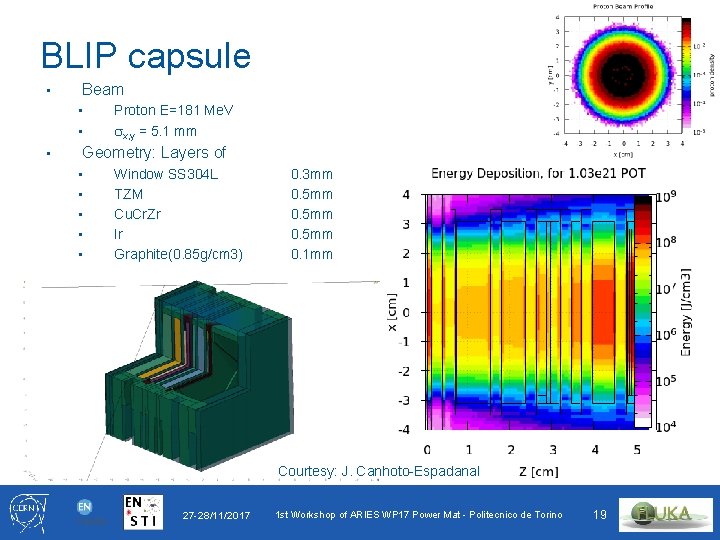
BLIP capsule • Beam • • • Proton E=181 Me. V sx, y = 5. 1 mm Geometry: Layers of • • • Window SS 304 L TZM Cu. Cr. Zr Ir Graphite(0. 85 g/cm 3) 0. 3 mm 0. 5 mm 0. 1 mm Courtesy: J. Canhoto-Espadanal 27 -28/11/2017 1 st Workshop of ARIES WP 17 Power Mat - Politecnico de Torino 19
DPA High-Z BLIP [FLUKA vs MARS] 1. 2 DPA / 1. 03 1012 p+ 1. 0 0. 8 0. 6 0. 4 0. 2 0. 0 TZM FLUKA Courtesy: J. Canhoto-Espadanal 27 -28/11/2017 Cu. Cr. Zr FLUKA-NRES Ir Graphite 0. 85 MARS Note: NRT model of MARS 1 st Workshop of ARIES WP 17 Power Mat - Politecnico de Torino 20
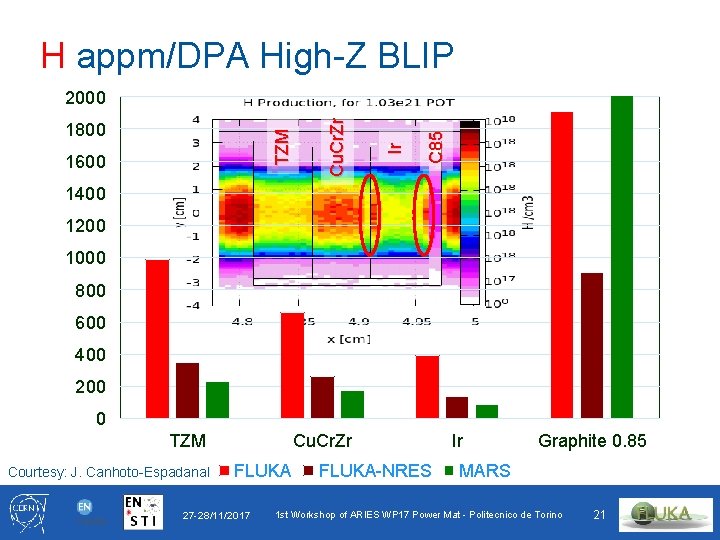
H appm/DPA High-Z BLIP C 85 1600 Ir TZM 1800 Cu. Cr. Zr 2000 1400 1200 1000 800 600 400 200 0 TZM Courtesy: J. Canhoto-Espadanal Cu. Cr. Zr FLUKA 27 -28/11/2017 FLUKA-NRES Ir Graphite 0. 85 MARS 1 st Workshop of ARIES WP 17 Power Mat - Politecnico de Torino 21
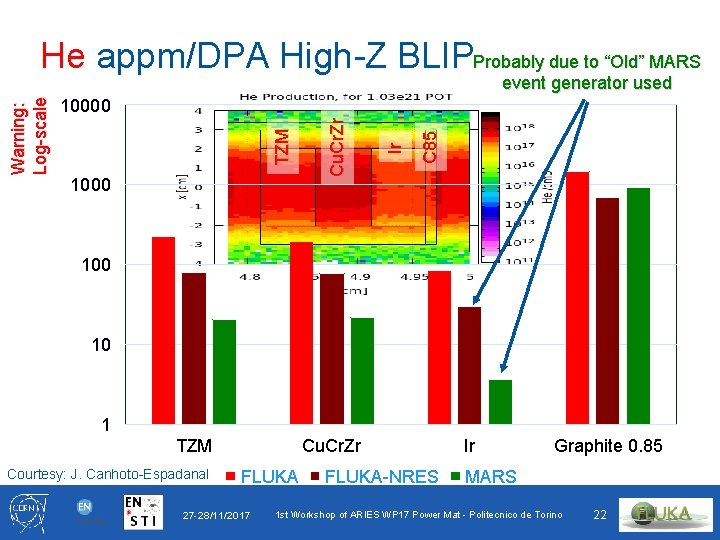
He appm/DPA High-Z BLIPProbably due to “Old” MARS 1000 C 85 Ir Cu. Cr. Zr 10000 TZM Warning: Log-scale event generator used 100 10 1 TZM Courtesy: J. Canhoto-Espadanal Cu. Cr. Zr FLUKA 27 -28/11/2017 FLUKA-NRES Ir Graphite 0. 85 MARS 1 st Workshop of ARIES WP 17 Power Mat - Politecnico de Torino 22
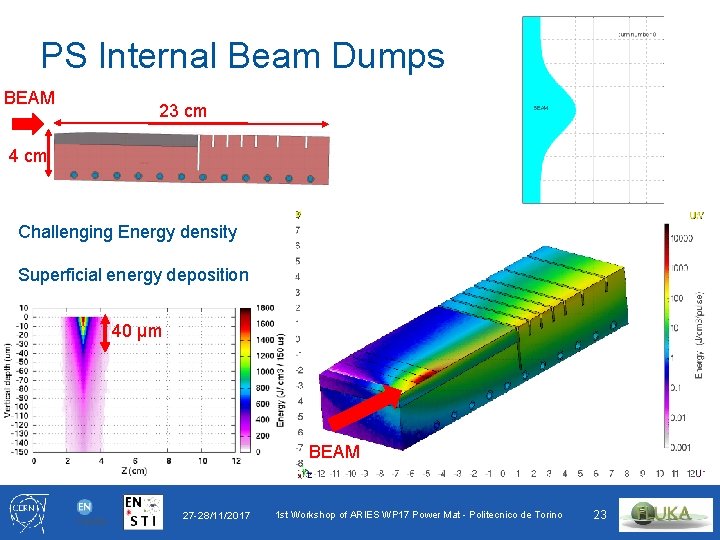
PS Internal Beam Dumps BEAM 23 cm 4 cm Challenging Energy density Superficial energy deposition 40 µm BEAM 27 -28/11/2017 1 st Workshop of ARIES WP 17 Power Mat - Politecnico de Torino 23
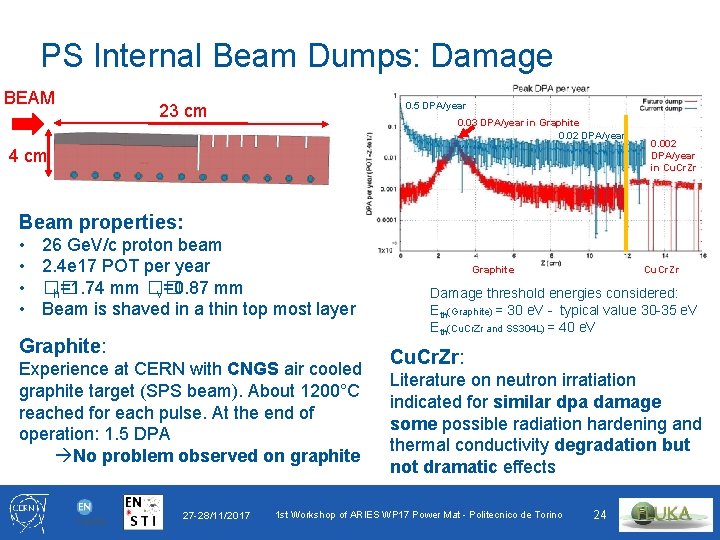
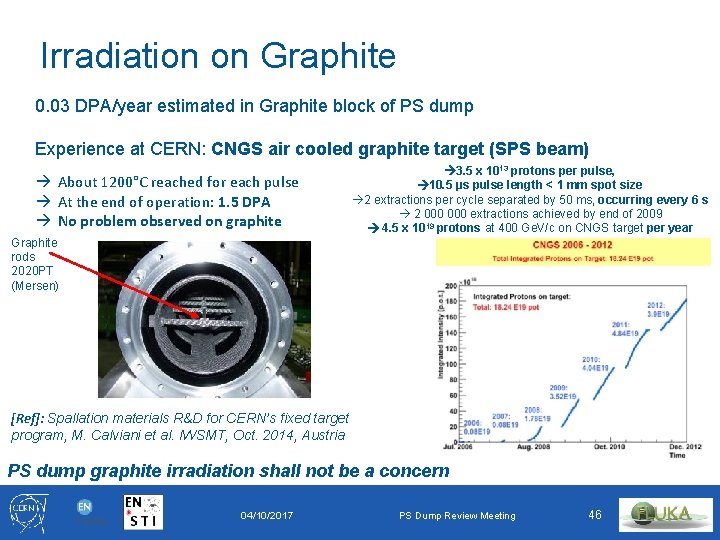
PS Internal Beam Dumps: Damage BEAM 0. 5 DPA/year 23 cm 0. 03 DPA/year in Graphite 0. 02 DPA/year 4 cm 0. 002 DPA/year in Cu. Cr. Zr Beam properties: • • 26 Ge. V/c proton beam 2. 4 e 17 POT per year �� h=1. 74 mm �� v=0. 87 mm Beam is shaved in a thin top most layer Graphite: Experience at CERN with CNGS air cooled graphite target (SPS beam). About 1200°C reached for each pulse. At the end of operation: 1. 5 DPA No problem observed on graphite 27 -28/11/2017 Cu. Cr. Zr Graphite Damage threshold energies considered: Eth(Graphite) = 30 e. V - typical value 30 -35 e. V Eth(Cu. Cr. Zr and SS 304 L) = 40 e. V Cu. Cr. Zr: Literature on neutron irratiation indicated for similar dpa damage some possible radiation hardening and thermal conductivity degradation but not dramatic effects 1 st Workshop of ARIES WP 17 Power Mat - Politecnico de Torino 24
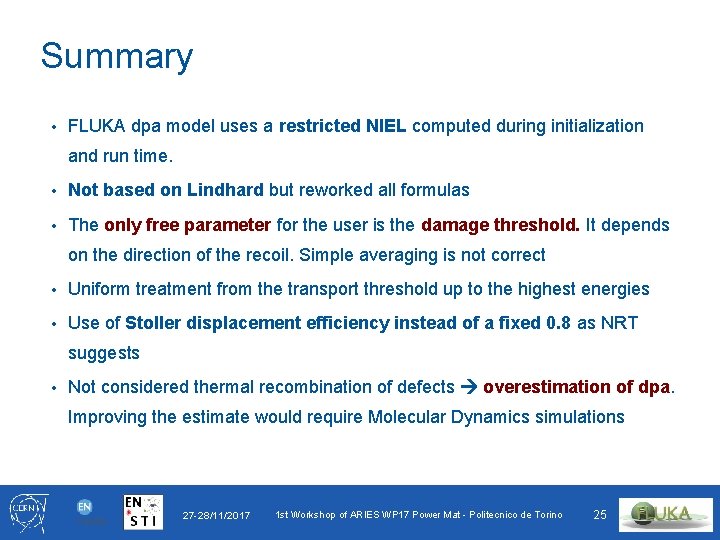
Summary • FLUKA dpa model uses a restricted NIEL computed during initialization and run time. • Not based on Lindhard but reworked all formulas • The only free parameter for the user is the damage threshold. It depends on the direction of the recoil. Simple averaging is not correct • Uniform treatment from the transport threshold up to the highest energies • Use of Stoller displacement efficiency instead of a fixed 0. 8 as NRT suggests • Not considered thermal recombination of defects overestimation of dpa. Improving the estimate would require Molecular Dynamics simulations 27 -28/11/2017 1 st Workshop of ARIES WP 17 Power Mat - Politecnico de Torino 25
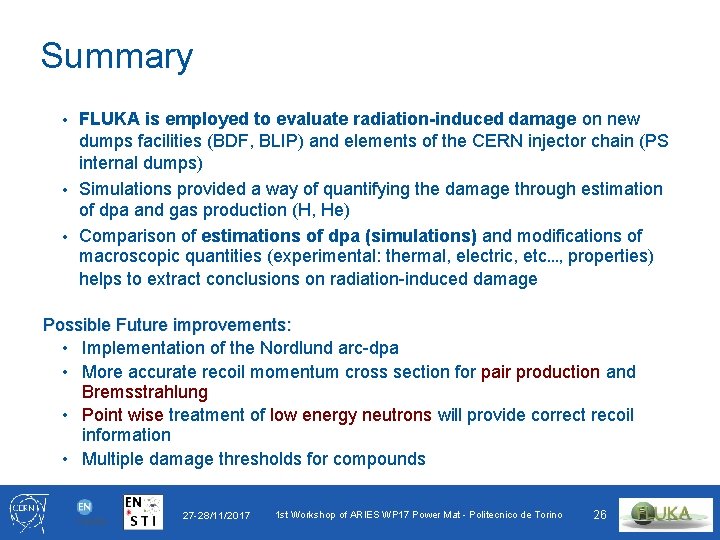
Summary FLUKA is employed to evaluate radiation-induced damage on new dumps facilities (BDF, BLIP) and elements of the CERN injector chain (PS internal dumps) • Simulations provided a way of quantifying the damage through estimation of dpa and gas production (H, He) • Comparison of estimations of dpa (simulations) and modifications of macroscopic quantities (experimental: thermal, electric, etc…, properties) helps to extract conclusions on radiation-induced damage • Possible Future improvements: • Implementation of the Nordlund arc-dpa • More accurate recoil momentum cross section for pair production and Bremsstrahlung • Point wise treatment of low energy neutrons will provide correct recoil information • Multiple damage thresholds for compounds 27 -28/11/2017 1 st Workshop of ARIES WP 17 Power Mat - Politecnico de Torino 26
Thank you for your attention! Any question? 27 -28/11/2017 1 st Workshop of ARIES WP 17 Power Mat - Politecnico de Torino 27
Extra slides 27 -28/11/2017 1 st Workshop of ARIES WP 17 Power Mat - Politecnico de Torino 28
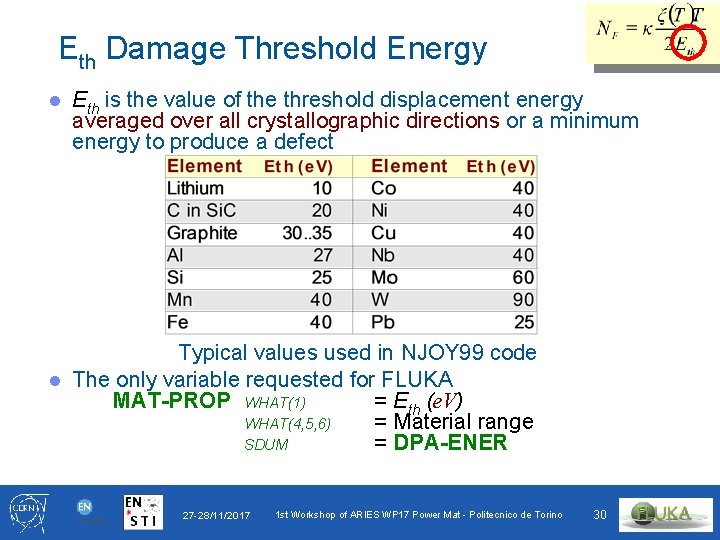
Eth Damage Threshold Energy Eth is the value of the threshold displacement energy averaged over all crystallographic directions or a minimum energy to produce a defect Typical values used in NJOY 99 code The only variable requested for FLUKA MAT-PROP WHAT(1) = Eth (e. V) WHAT(4, 5, 6) = Material range SDUM = DPA-ENER 27 -28/11/2017 1 st Workshop of ARIES WP 17 Power Mat - Politecnico de Torino 30
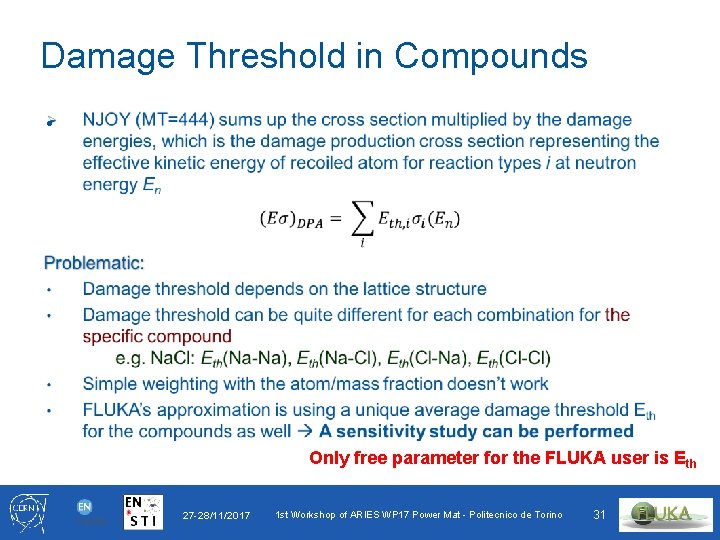
Damage Threshold in Compounds • Only free parameter for the FLUKA user is Eth 27 -28/11/2017 1 st Workshop of ARIES WP 17 Power Mat - Politecnico de Torino 31
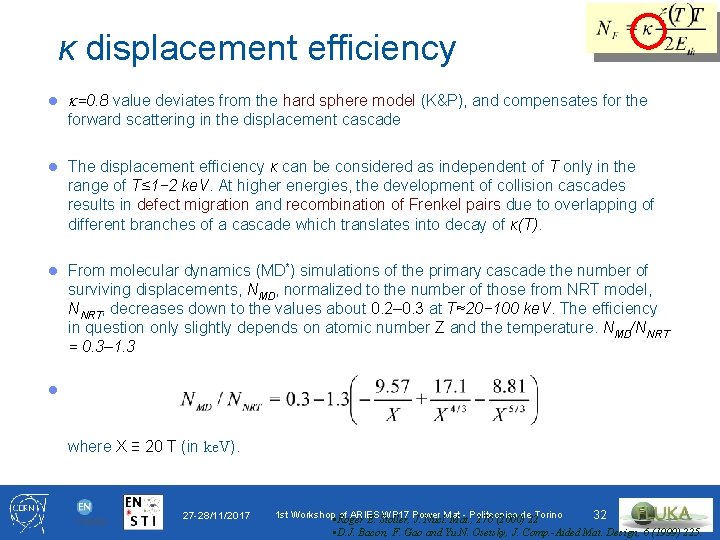
κ displacement efficiency k=0. 8 value deviates from the hard sphere model (K&P), and compensates for the forward scattering in the displacement cascade The displacement efficiency κ can be considered as independent of T only in the range of T≤ 1− 2 ke. V. At higher energies, the development of collision cascades results in defect migration and recombination of Frenkel pairs due to overlapping of different branches of a cascade which translates into decay of κ(T). From molecular dynamics (MD*) simulations of the primary cascade the number of surviving displacements, NMD, normalized to the number of those from NRT model, NNRT, decreases down to the values about 0. 2– 0. 3 at T≈20− 100 ke. V. The efficiency in question only slightly depends on atomic number Z and the temperature. NMD/NNRT = 0. 3– 1. 3 where X ≡ 20 T (in ke. V). 27 -28/11/2017 1 st Workshop of ARIES WP 17 Power Mat - Politecnico de Torino • Roger E. Stoller, J. Nucl. Mat. , 276 (2000) 22 32 • D. J. Bacon, F. Gao and Yu. N. Osetsky, J. Comp. -Aided Mat. Design, 6 (1999) 225.
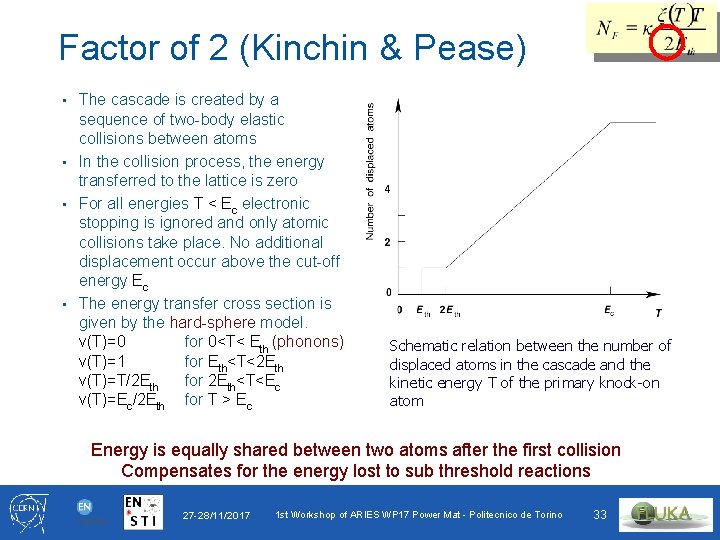
Factor of 2 (Kinchin & Pease) The cascade is created by a sequence of two-body elastic collisions between atoms • In the collision process, the energy transferred to the lattice is zero • For all energies T < Ec electronic stopping is ignored and only atomic collisions take place. No additional displacement occur above the cut-off energy Ec • The energy transfer cross section is given by the hard-sphere model. ν(T)=0 for 0<T< Eth (phonons) ν(T)=1 for Eth<T<2 Eth ν(T)=T/2 Eth for 2 Eth<T<Ec ν(T)=Ec/2 Eth for T > Ec • Schematic relation between the number of displaced atoms in the cascade and the kinetic energy T of the primary knock-on atom Energy is equally shared between two atoms after the first collision Compensates for the energy lost to sub threshold reactions 27 -28/11/2017 1 st Workshop of ARIES WP 17 Power Mat - Politecnico de Torino 33
Lindhard partition function x [1/2] The partition function gives the fraction of stopping power S that goes to NIEL Approximations used: Electrons do not produce recoil nuclei with appreciable energy, lattice binding energy is neglected, etc. . . where approximated to Z, A 1 2 T charge and mass projectile medium recoil energy (e. V) Nice feature: It can handle any projectile Z 1, A 1 whichever charged particle 27 -28/11/2017 1 st Workshop of ARIES WP 17 Power Mat - Politecnico de Torino 34
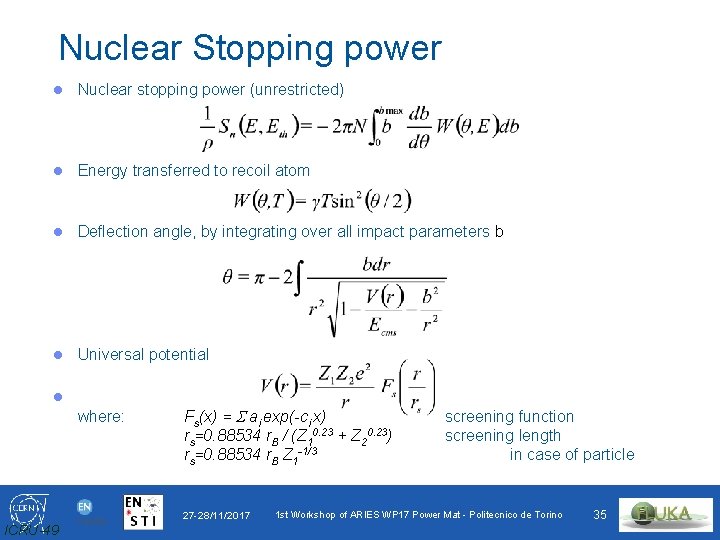
Nuclear Stopping power Nuclear stopping power (unrestricted) Energy transferred to recoil atom Deflection angle, by integrating over all impact parameters b Universal potential where: Fs(x) = S ai exp(-ci x) rs=0. 88534 r. B / (Z 10. 23 + Z 20. 23) rs=0. 88534 r. B Z 1 -1/3 27 -28/11/2017 ICRU-49 screening function screening length in case of particle 1 st Workshop of ARIES WP 17 Power Mat - Politecnico de Torino 35
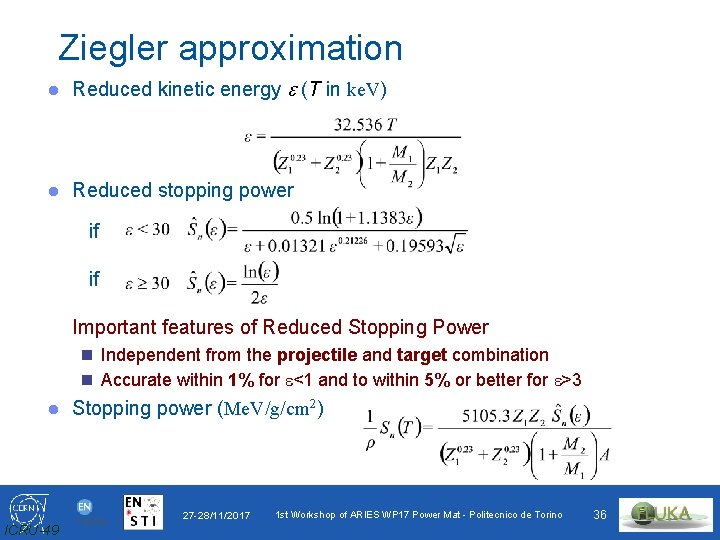
Ziegler approximation Reduced kinetic energy e (T in ke. V) Reduced stopping power if Important features of Reduced Stopping Power Independent from the projectile and target combination Accurate within 1% for e<1 and to within 5% or better for e>3 Stopping power (Me. V/g/cm 2) 27 -28/11/2017 ICRU-49 1 st Workshop of ARIES WP 17 Power Mat - Politecnico de Torino 36
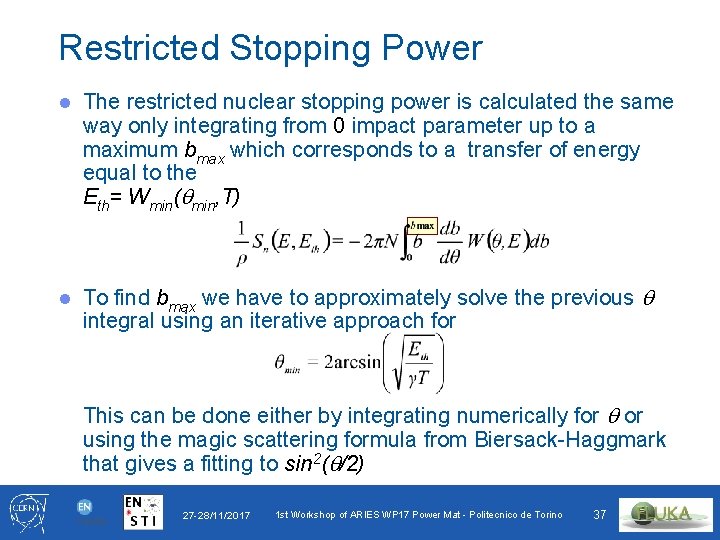
Restricted Stopping Power The restricted nuclear stopping power is calculated the same way only integrating from 0 impact parameter up to a maximum bmax which corresponds to a transfer of energy equal to the Eth= Wmin(qmin, T) To find bmax we have to approximately solve the previous q integral using an iterative approach for This can be done either by integrating numerically for q or using the magic scattering formula from Biersack-Haggmark that gives a fitting to sin 2(q/2) 27 -28/11/2017 1 st Workshop of ARIES WP 17 Power Mat - Politecnico de Torino 37
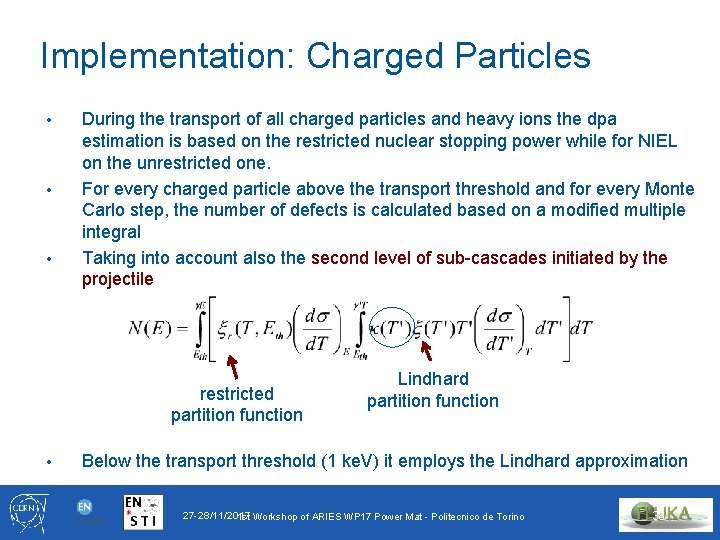
Implementation: Charged Particles • • • During the transport of all charged particles and heavy ions the dpa estimation is based on the restricted nuclear stopping power while for NIEL on the unrestricted one. For every charged particle above the transport threshold and for every Monte Carlo step, the number of defects is calculated based on a modified multiple integral Taking into account also the second level of sub-cascades initiated by the projectile restricted partition function • Lindhard partition function Below the transport threshold (1 ke. V) it employs the Lindhard approximation 27 -28/11/2017 1 st Workshop of ARIES WP 17 Power Mat - Politecnico de Torino 38
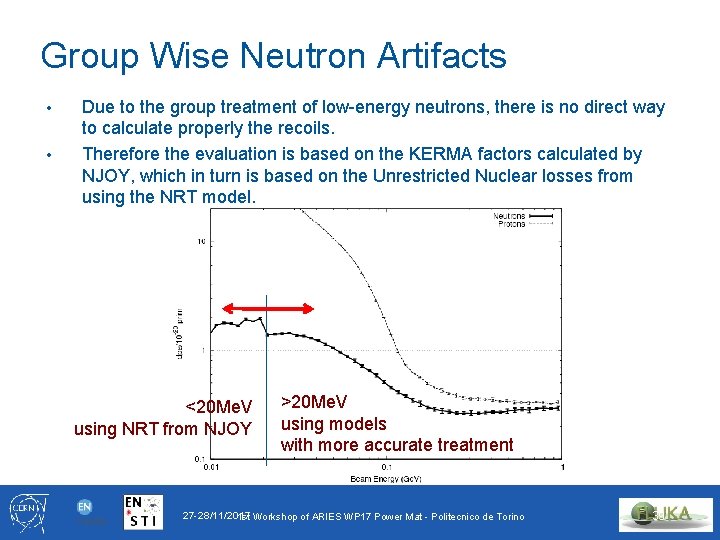
Group Wise Neutron Artifacts • • Due to the group treatment of low-energy neutrons, there is no direct way to calculate properly the recoils. Therefore the evaluation is based on the KERMA factors calculated by NJOY, which in turn is based on the Unrestricted Nuclear losses from using the NRT model. <20 Me. V using NRT from NJOY >20 Me. V using models with more accurate treatment 27 -28/11/2017 1 st Workshop of ARIES WP 17 Power Mat - Politecnico de Torino 39
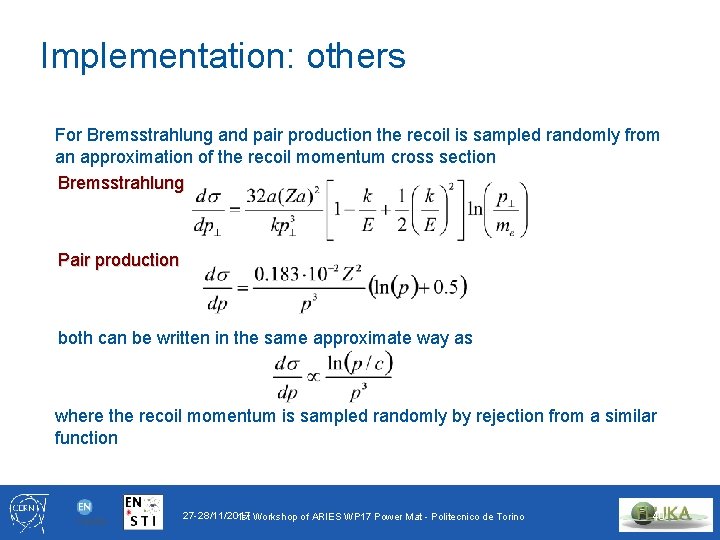
Implementation: others For Bremsstrahlung and pair production the recoil is sampled randomly from an approximation of the recoil momentum cross section Bremsstrahlung Pair production both can be written in the same approximate way as where the recoil momentum is sampled randomly by rejection from a similar function 27 -28/11/2017 1 st Workshop of ARIES WP 17 Power Mat - Politecnico de Torino 40
Coalescence: Ø d, t, 3 He, and alpha’s generated during the (G)INC and preequilibrium stage Ø All possible combinations of (unbound) nucleons and/or light fragments checked at each stage of system evolution Ø FOM evaluation based on phase space “closeness” used to decide whether a light fragment is formed rather than not q FOM evaluated in the CMS of the candidate fragment at the time of minimum distance q Naively a momentum or position FOM should be used, but not both due to quantum non commutation q … however the best results are obtained with a Wigner transform FOM (assuming gaussian wave packets) which should be the correct way of considering together positions and momenta Ø Binding energy redistributed between the emitted fragment and residual excitation (exact conservation of 4 -momenta) 1 st Workshop of ARIES WP 17 Power Mat - Politecnico de Torino 41 27 -28/11/2017
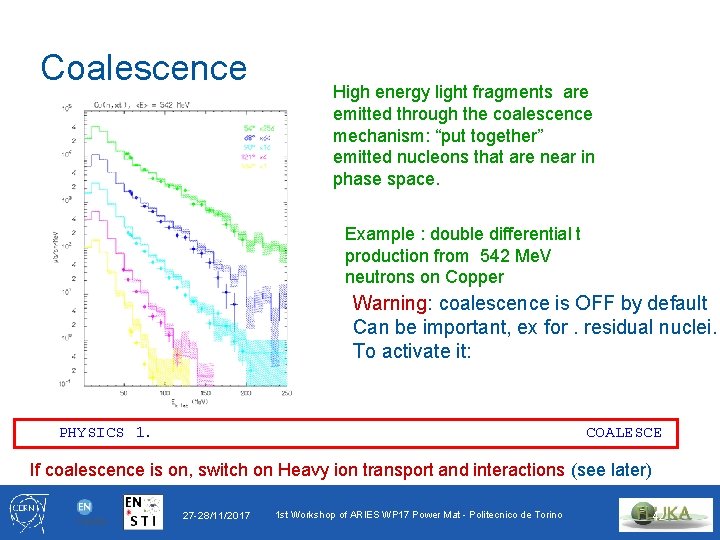
Coalescence High energy light fragments are emitted through the coalescence mechanism: “put together” emitted nucleons that are near in phase space. Example : double differential t production from 542 Me. V neutrons on Copper Warning: coalescence is OFF by default Can be important, ex for. residual nuclei. To activate it: PHYSICS 1. COALESCE If coalescence is on, switch on Heavy ion transport and interactions (see later) 27 -28/11/2017 1 st Workshop of ARIES WP 17 Power Mat - Politecnico de Torino 42
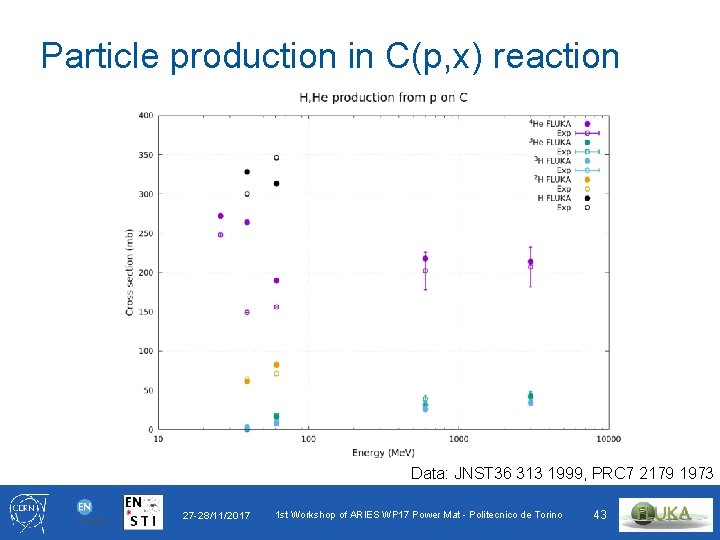
Particle production in C(p, x) reaction Data: JNST 36 313 1999, PRC 7 2179 1973 27 -28/11/2017 1 st Workshop of ARIES WP 17 Power Mat - Politecnico de Torino 43
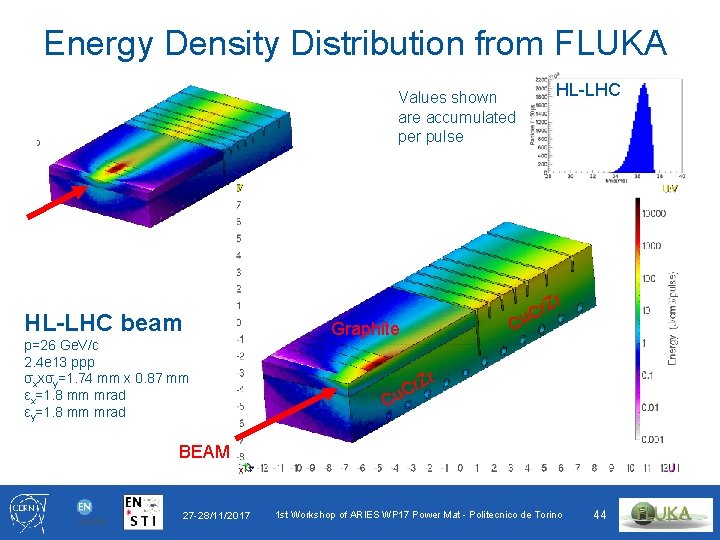
Energy Density Distribution from FLUKA HL-LHC Values shown are accumulated per pulse HL-LHC beam p=26 Ge. V/c 2. 4 e 13 ppp σxxσy=1. 74 mm x 0. 87 mm εx=1. 8 mm mrad εy=1. 8 mm mrad Zr r C Cu Graphite Zr r C Cu BEAM 27 -28/11/2017 1 st Workshop of ARIES WP 17 Power Mat - Politecnico de Torino 44
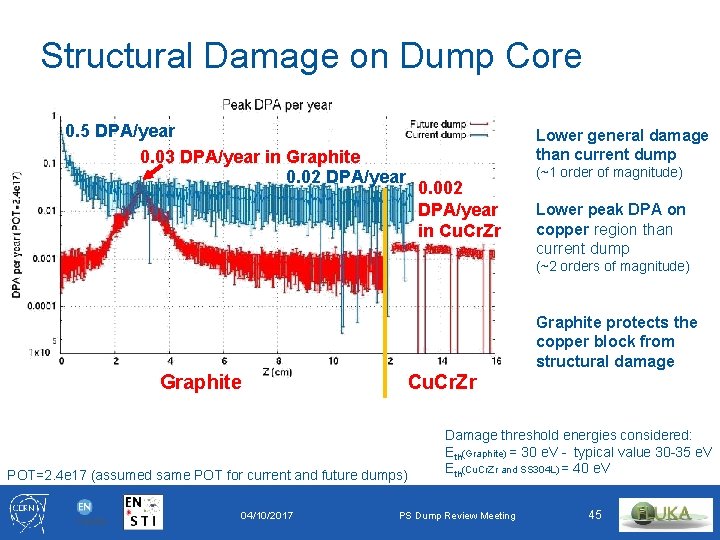
Structural Damage on Dump Core 0. 5 DPA/year 0. 03 DPA/year in Graphite 0. 02 DPA/year Lower general damage than current dump 0. 002 DPA/year in Cu. Cr. Zr (~1 order of magnitude) Lower peak DPA on copper region than current dump (~2 orders of magnitude) Graphite Cu. Cr. Zr POT=2. 4 e 17 (assumed same POT for current and future dumps) 04/10/2017 Graphite protects the copper block from structural damage Damage threshold energies considered: Eth(Graphite) = 30 e. V - typical value 30 -35 e. V Eth(Cu. Cr. Zr and SS 304 L) = 40 e. V PS Dump Review Meeting 45
Irradiation on Graphite 0. 03 DPA/year estimated in Graphite block of PS dump Experience at CERN: CNGS air cooled graphite target (SPS beam) About 1200°C reached for each pulse At the end of operation: 1. 5 DPA No problem observed on graphite 3. 5 x 10¹³ protons per pulse, 10. 5 µs pulse length < 1 mm spot size 2 extractions per cycle separated by 50 ms, occurring every 6 s 2 000 extractions achieved by end of 2009 4. 5 x 10¹⁹ protons at 400 Ge. V/c on CNGS target per year Graphite rods 2020 PT (Mersen) [Ref]: Spallation materials R&D for CERN’s fixed target program, M. Calviani et al. IWSMT, Oct. 2014, Austria PS dump graphite irradiation shall not be a concern 04/10/2017 PS Dump Review Meeting 46
Irradiation on Cu. Cr. Zr [3] • Peak value obtained of 0. 002 DPA per year (0. 04 DPA in 20 years) in Cu. Cr. Zr block of PS Dump • Localized peak DPA • Information for neutron irradiation found in literature • Cu. Cr. Zr shows radiation hardening until saturation values around 0. 1 – 0. 5 DPA [1][3] Some hardening may occur • Plastic region Elastic region Cu. Cr. Zr is void swelling resistant [1][2] [1] (below 2% density change for up to 150 DPA [1]) • Some thermal conductivity degradation may occur (5 – 10 % reduction for doses > 0. 1 DPA at < 150 °C [2]) [1] C. Bobeldijk (ed. ). (1994). Atomic and Plasma-Material Interaction Data for Fusion. Vol. 5. Supplement to the Journal Nuclear Fusion [2] S. A. Fabritsiev & S. J. Zinkle & B. N. Singh. (1996). Evaluation of copper alloys for fusion reactor divertor and first wall components. Journal of Nuclear Materials. Vol. 233237. pp. 127 -137. [3] M. Li & M. A. Sokolov & S. J. Zinkle. (2009). Tensile and fracture toughness properties of neutron-irradiated Cu. Cr. Zr. Journal of Nuclear Materials. Vol. 393. pp. 36 -46. 04/10/2017 PS Dump Review Meeting 47