
Modeling Variable Source Area Hydrology With WEPP Winter
Modeling Variable Source Area Hydrology With WEPP Winter Erosion Processes and Modeling Meeting USDA-ARS National Soil Erosion Research Laboratory West Lafayette, Indiana May 1 -3, 2007 E. S. Brooks 1, B. Crabtree 2 S. Dun 4, J. A. Hubbart 7, J. Boll 3, J. Wu 5, W. J. Elliot 6 1 Research Support Scientist, 2 Graduate Research Assistant, 3 Associate Professor, Biol. &Agr. Engr. , Univ. of Idaho, Moscow, ID 83844 -2060 4 Graduate Research Assistant, 5 Associate Professor, Biol. Systems Engineering, Washington State University, Pullman, WA 99164 6 Research Leader, Rocky Mtn. Res. Station, USDA-FS, Moscow, ID 83843 7 Graduate Research Assistant, Forest Resources, Univ. of Idaho, Moscow
Research Direction • Evaluation of conservation practices in 10 -100 km 2 watersheds (USDA-CEAP) • Assessing the cumulative effects of land management practices on sediment loading at the watershed outlet • Both Ag. and Forested watersheds (Paradise Creek and Mica Creek watersheds)
Variable Source Area Hydrology • Runoff producing areas are directly related to the local soil water storage capacity (i. e. saturation excess runoff) – Extent varies by season, event – Where is it important? • Shallow soils (i. e. perched WTs) • Steep converging slopes (e. g. toe slopes) • Low intensity rainfall and/or snowmelt
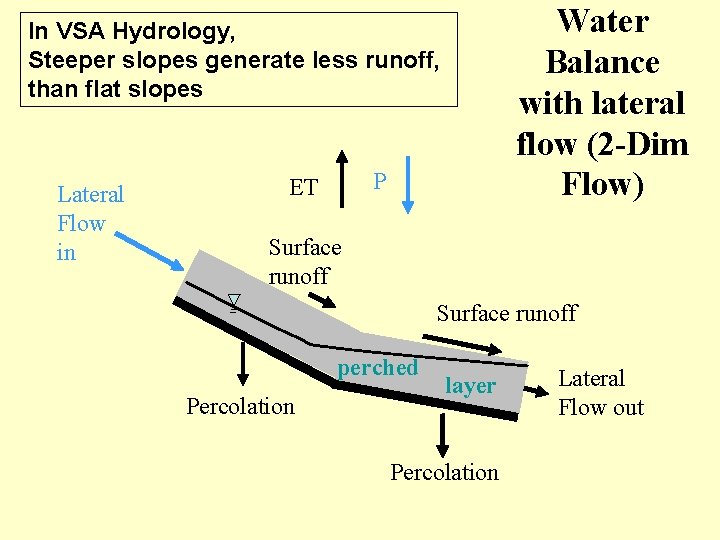
Water Balance with lateral flow (2 -Dim Flow) In VSA Hydrology, Steeper slopes generate less runoff, than flat slopes Lateral Flow in P ET Surface runoff perched Percolation layer Percolation Lateral Flow out
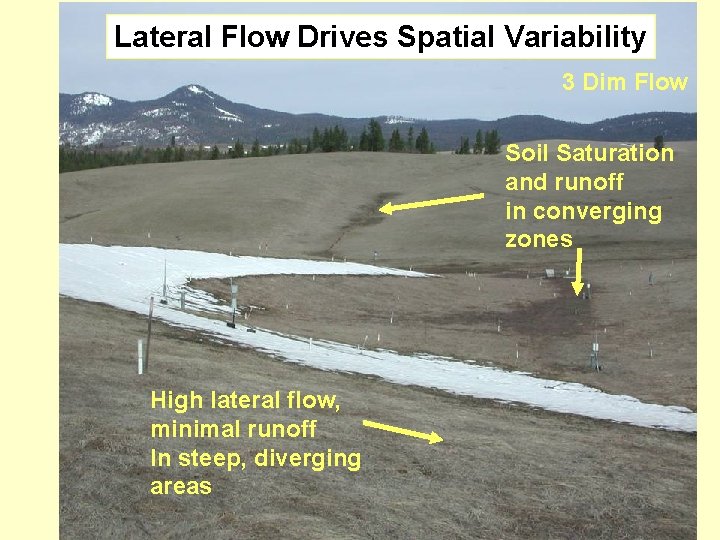
Lateral Flow Drives Spatial Variability 3 Dim Flow Soil Saturation and runoff in converging zones High lateral flow, minimal runoff In steep, diverging areas
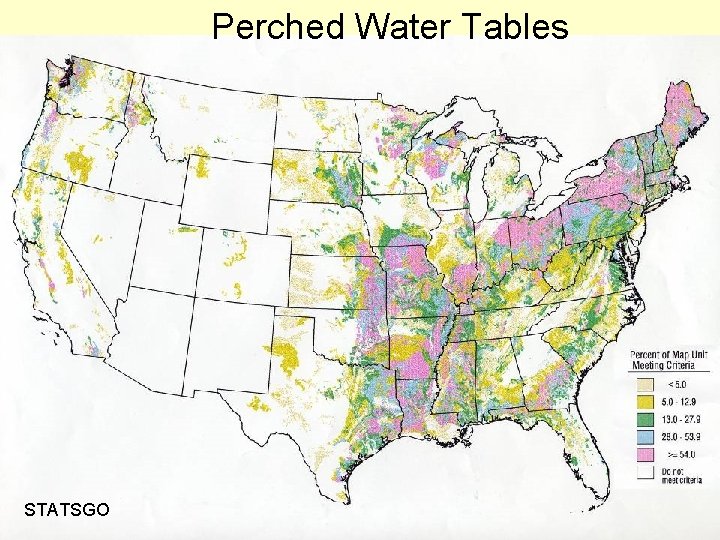
Perched Water Tables STATSGO

Perched Water Tables
VSA Hydrology in WEPP • Lateral flow is calculated in WEPP by OFE • Convergence of lateral flow along a hillslope can only be simulated in WEPP with multiple OFEs – Convergence of lateral flow drives the distribution of VSA runoff on a hillslope
Single Hillslope: Lateral flow, Runoff, Erosion and Deposition Small lateral flow at the outlet does not mean lateral flow is not important!!
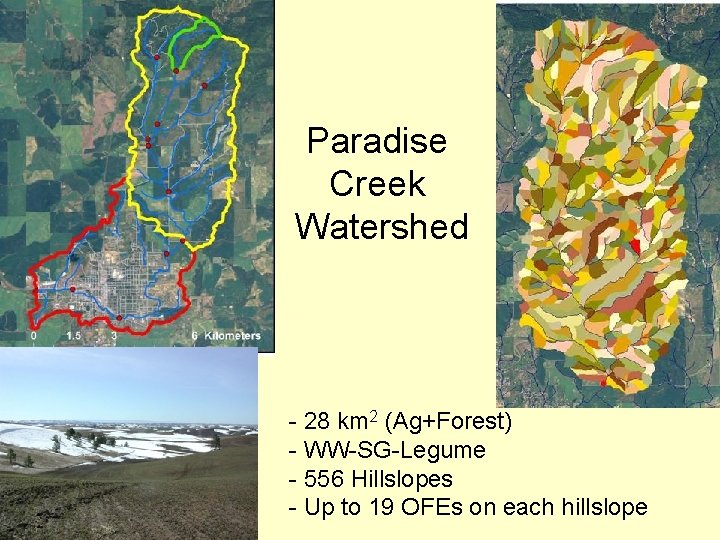
Paradise Creek Watershed - 28 km 2 (Ag+Forest) - WW-SG-Legume - 556 Hillslopes - Up to 19 OFEs on each hillslope
Applying WEPP to Large Watersheds • Use GEOWEPP to generate single OFE slope, soil, management files, and hillslope/channel structure • Convert single OFE files to multiple OFE files • Run the program as a batch file • Extract hillslope output (including percolation) to generate streamflow

Application to Paradise Creek

Paradise Creek Watershed
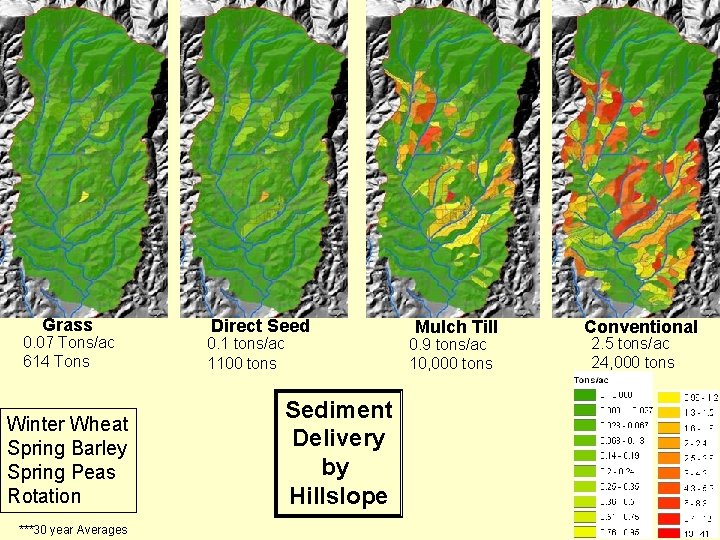
Grass 0. 07 Tons/ac 614 Tons Winter Wheat Spring Barley Spring Peas Rotation ***30 year Averages Direct Seed 0. 1 tons/ac 1100 tons Sediment Delivery by Hillslope Mulch Till 0. 9 tons/ac 10, 000 tons Conventional 2. 5 tons/ac 24, 000 tons
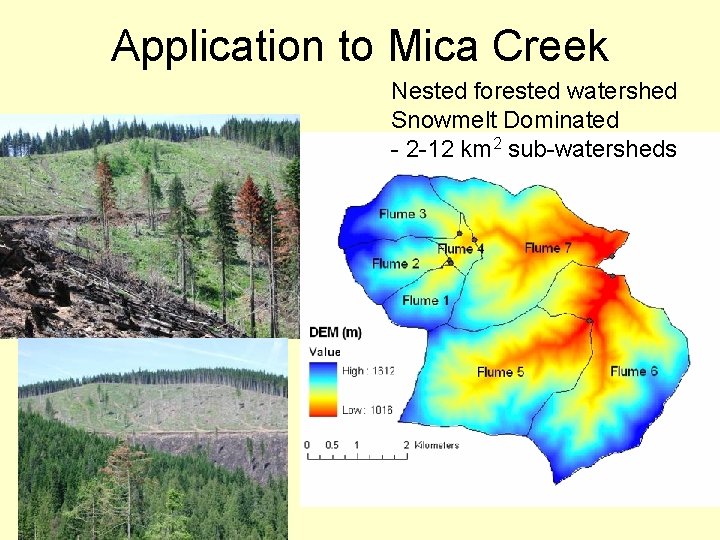
Application to Mica Creek Nested forested watershed Snowmelt Dominated - 2 -12 km 2 sub-watersheds
Soil Moisture Routing Model (Frankenberger et al. , 1999)
WEPP “Fitted” Snowmelt
WEPP Simulations Rain Passes Through Snow pack
Simulation on a 39% North Facing Slope
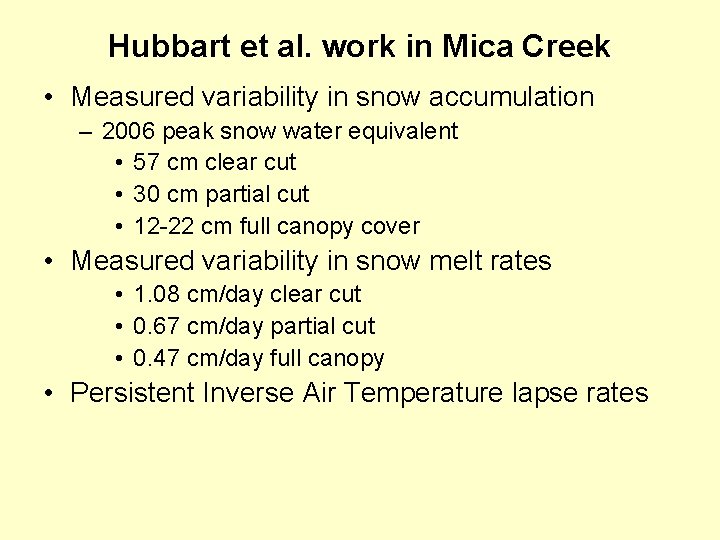
Hubbart et al. work in Mica Creek • Measured variability in snow accumulation – 2006 peak snow water equivalent • 57 cm clear cut • 30 cm partial cut • 12 -22 cm full canopy cover • Measured variability in snow melt rates • 1. 08 cm/day clear cut • 0. 67 cm/day partial cut • 0. 47 cm/day full canopy • Persistent Inverse Air Temperature lapse rates
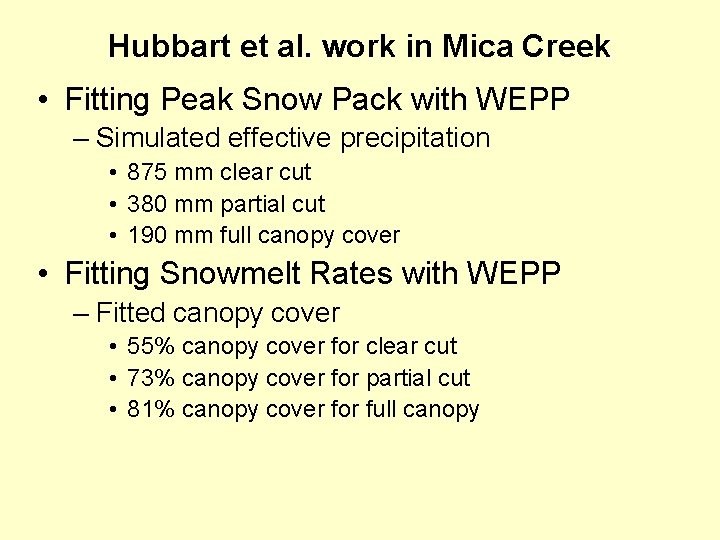
Hubbart et al. work in Mica Creek • Fitting Peak Snow Pack with WEPP – Simulated effective precipitation • 875 mm clear cut • 380 mm partial cut • 190 mm full canopy cover • Fitting Snowmelt Rates with WEPP – Fitted canopy cover • 55% canopy cover for clear cut • 73% canopy cover for partial cut • 81% canopy cover for full canopy

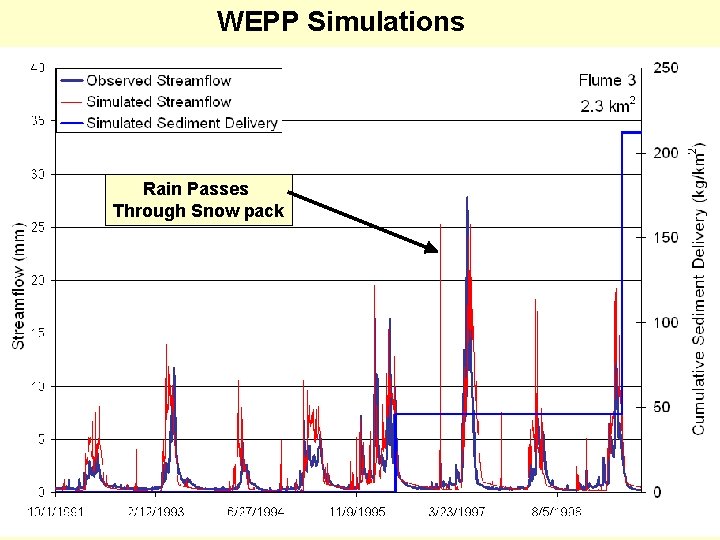
WEPP Snowmelt • Primary limitations in high elevation, forests – – – – Does not simulate snow pack temperature (i. e. cold content) Rain assumed to pass through the snow pack Maximum snow density is 350 kg/m 3 Snow settling rates too small Over-sensitivity to canopy cover/solar radiation (i. e. Melt A) Ignores topographic shading Ignores snow interception, sublimation, and drifting • A daily model applied on an hourly time step - Modifications by Hendricks to the US Army Corps Engineers approach assumed applicable on an hourly time step
Snowmelt Variability with Multiple OFEs North Facing Slope
Snowmelt Variability with Multiple OFEs South Facing Slope
VSA Hydrology Summary • The spatial distribution of VSA runoff highly correlated with converging subsurface lateral flow • Simulation of VSA Hydrology requires multiple OFEs • Multiple OFEs yield more realistic runoff distribution maps and hydrograph recessions
Snowmelt Recommendations • Need research on the effects of canopy on interception, drifting, sublimation • Add in an hourly, physically based approach – snow pack temperature algorithms – Improve snow pack density relationships – Incorporate snow liquid water holding capacity

EXTRA SLIDES
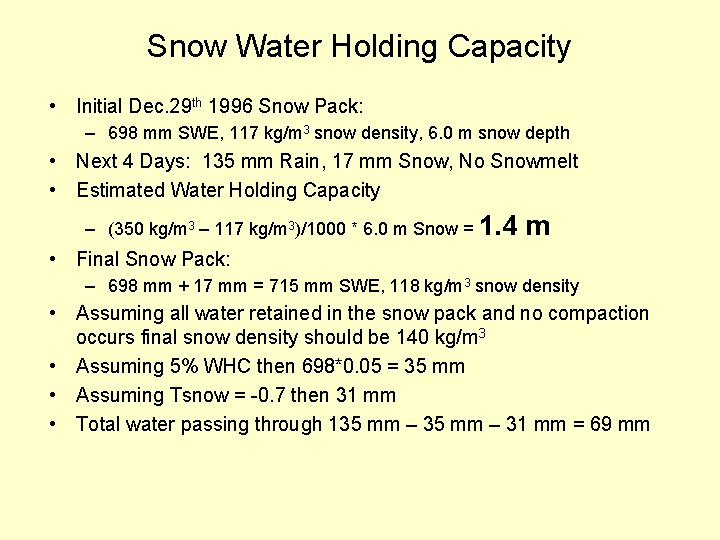
Snow Water Holding Capacity • Initial Dec. 29 th 1996 Snow Pack: – 698 mm SWE, 117 kg/m 3 snow density, 6. 0 m snow depth • Next 4 Days: 135 mm Rain, 17 mm Snow, No Snowmelt • Estimated Water Holding Capacity – (350 kg/m 3 – 117 kg/m 3)/1000 * 6. 0 m Snow = 1. 4 m • Final Snow Pack: – 698 mm + 17 mm = 715 mm SWE, 118 kg/m 3 snow density • Assuming all water retained in the snow pack and no compaction occurs final snow density should be 140 kg/m 3 • Assuming 5% WHC then 698*0. 05 = 35 mm • Assuming Tsnow = -0. 7 then 31 mm • Total water passing through 135 mm – 31 mm = 69 mm


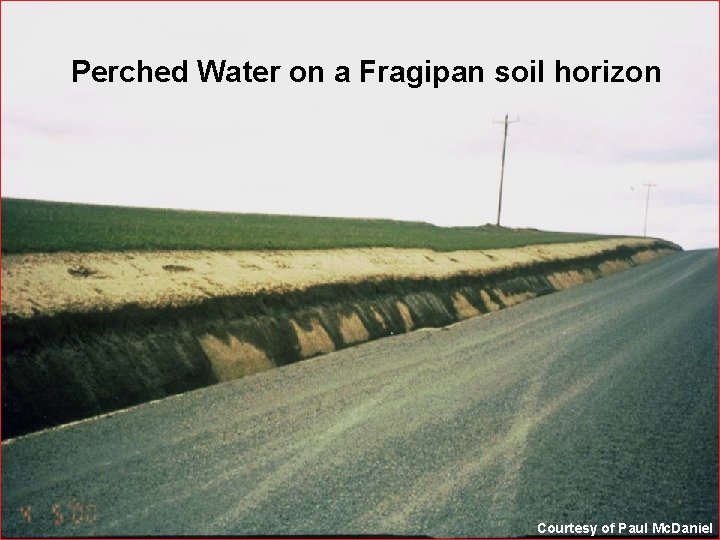
Perched Water on a Fragipan soil horizon Courtesy of Paul Mc. Daniel
Single Hillslope: Runoff
- Slides: 32