
Modeling Under PSD Air quality models screening and
- Slides: 8
Modeling Under PSD • Air quality models (screening and refined) are used in various ways under the PSD program. • Step 1: Significant Impact Analysis – Use of either screening or refined model to determine if emissions from PSD project alone are significant through use of Significant Impact Levels (SILs) • Step 2: Cumulative Impact Analysis – Use of refined models to determine cumulative impacts from PSD project in conjunction with nearby sources does not cause or contribute to violations of applicable NAAQS and increments. 1
Modeling Guidance for 1 -Hour NO 2 NAAQS Under PSD • PSD regulations require that modeling be conducted in accordance the “Guideline on Air Quality Models” • AERMOD is the EPA ‘Preferred’ Model for PSD modeling for all criteria pollutants (except O 3). • Appendix W outlines 3 -tiered screening level procedures to address conversion of NO 2 from NOx emissions. – We believe that sources will benefit significantly from use of the conversion guidance (Tier 3 options) rather than conservative assumptions that all or most NOx is NO 2 (Tier 1 & 2 options) – Fully expect more “Tier 3” uses of AERMOD with detailed screening methods (Ozone Limiting Method and Plume Volume Molar Ratio Method) that will need to be approved by Regional Offices and may need to be vetted through Model Clearinghouse 2
Preliminary Assessment: Source Impacts for the 1 -Hour NO 2 NAAQS • New major sources with lower level releases (short stacks) may show modeled violations of the NAAQS • Some states (e. g. , in Regions 4, 6, and 7) are reporting preliminary “permitting challenges” with respect to new 1 -hour NO 2 NAAQS. • Minor sources that have not historically been required to model may have trouble meeting the new NAAQS • In order to better understand the extent of the problem, OAQPS is compiling details of the preliminary data being reported to identify emissions input assumptions, form of hourly impacts relative to standard, NOX chemistry options 3
• • Upcoming Modeling Guidance for NO 2 NAAQS EPA’s current regulatory permit model, AERMOD will be used for modeling compliance with the NO 2 1 -hr NAAQS, with additional guidance and tools to be provided to facilitate its use Provide clarification memo on how Appendix W’s 3 -tiered screening level procedures, involving the conversion of NOx to NO 2, apply to new hourly standard – Tier 1 = 100% conversion – Tier 2 = 75% conversion based on ambient ratio method – Tier 3 = Case-by-case methods requiring more detailed inputs (stack ratios, background O 3, etc). – Also will provide background on inventory development methods to generate hourly emissions for purposes of modeling NO 2 • Provide post-processing capability within AERMOD to generate appropriate modeling results for comparison to new hourly standard • Date for issuing guidance and providing processing tool: May 28, 2010 • Once nonattainment designations are completed for NO 2, modeling and technical guidance needed to S/L/T to support nonattainment SIP 4
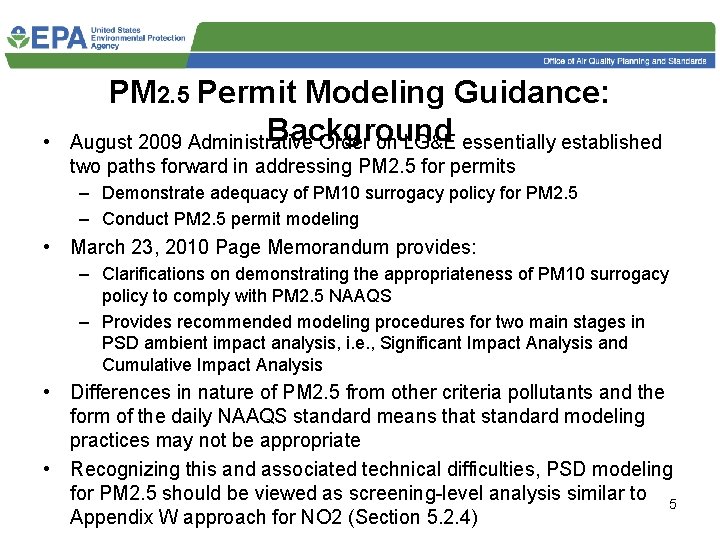
• PM 2. 5 Permit Modeling Guidance: Background August 2009 Administrative Order on LG&E essentially established two paths forward in addressing PM 2. 5 for permits – Demonstrate adequacy of PM 10 surrogacy policy for PM 2. 5 – Conduct PM 2. 5 permit modeling • March 23, 2010 Page Memorandum provides: – Clarifications on demonstrating the appropriateness of PM 10 surrogacy policy to comply with PM 2. 5 NAAQS – Provides recommended modeling procedures for two main stages in PSD ambient impact analysis, i. e. , Significant Impact Analysis and Cumulative Impact Analysis • Differences in nature of PM 2. 5 from other criteria pollutants and the form of the daily NAAQS standard means that standard modeling practices may not be appropriate • Recognizing this and associated technical difficulties, PSD modeling for PM 2. 5 should be viewed as screening-level analysis similar to 5 Appendix W approach for NO 2 (Section 5. 2. 4)
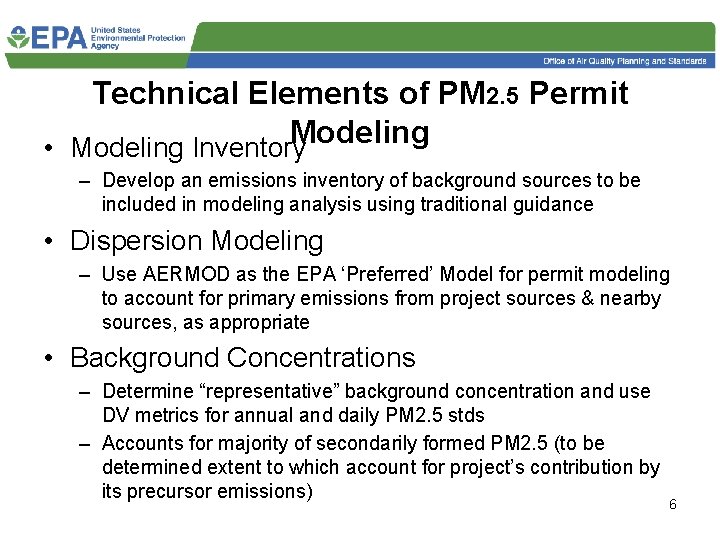
Technical Elements of PM 2. 5 Permit Modeling • Modeling Inventory – Develop an emissions inventory of background sources to be included in modeling analysis using traditional guidance • Dispersion Modeling – Use AERMOD as the EPA ‘Preferred’ Model for permit modeling to account for primary emissions from project sources & nearby sources, as appropriate • Background Concentrations – Determine “representative” background concentration and use DV metrics for annual and daily PM 2. 5 stds – Accounts for majority of secondarily formed PM 2. 5 (to be determined extent to which account for project’s contribution by its precursor emissions) 6
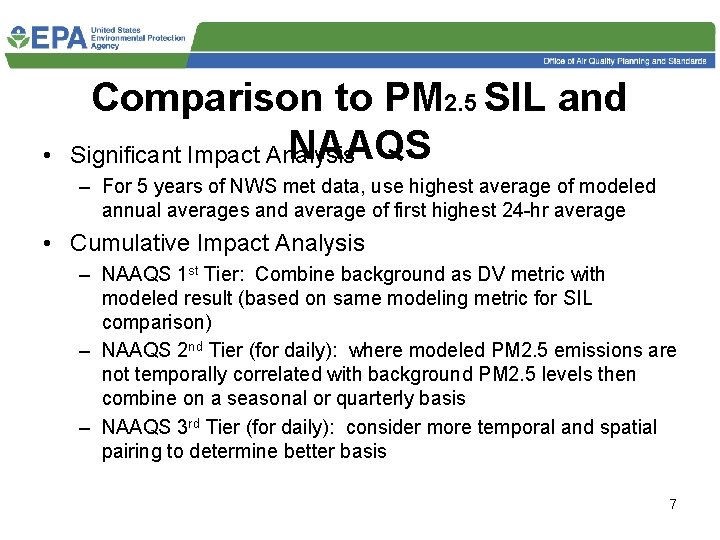
• Comparison to PM 2. 5 SIL and NAAQS Significant Impact Analysis – For 5 years of NWS met data, use highest average of modeled annual averages and average of first highest 24 -hr average • Cumulative Impact Analysis – NAAQS 1 st Tier: Combine background as DV metric with modeled result (based on same modeling metric for SIL comparison) – NAAQS 2 nd Tier (for daily): where modeled PM 2. 5 emissions are not temporally correlated with background PM 2. 5 levels then combine on a seasonal or quarterly basis – NAAQS 3 rd Tier (for daily): consider more temporal and spatial pairing to determine better basis 7
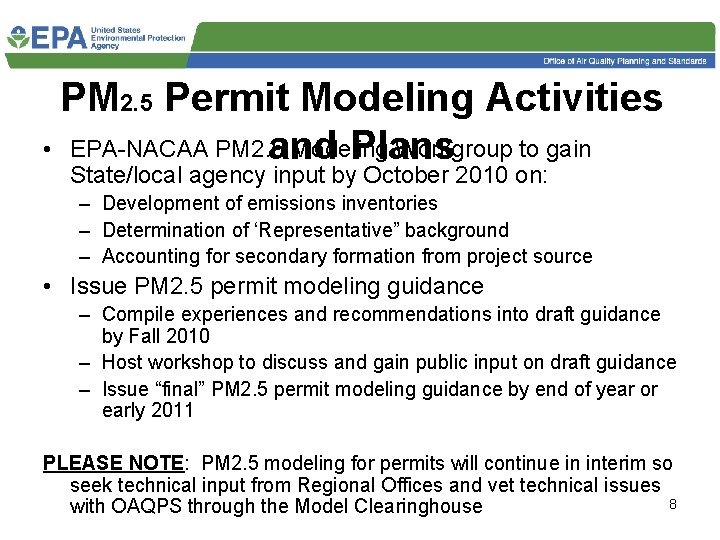
PM 2. 5 Permit Modeling Activities • EPA-NACAA PM 2. 5 Modeling Workgroup to gain and Plans State/local agency input by October 2010 on: – Development of emissions inventories – Determination of ‘Representative” background – Accounting for secondary formation from project source • Issue PM 2. 5 permit modeling guidance – Compile experiences and recommendations into draft guidance by Fall 2010 – Host workshop to discuss and gain public input on draft guidance – Issue “final” PM 2. 5 permit modeling guidance by end of year or early 2011 PLEASE NOTE: PM 2. 5 modeling for permits will continue in interim so seek technical input from Regional Offices and vet technical issues 8 with OAQPS through the Model Clearinghouse