
Modeling the Xray emission and QPO of Swift
- Slides: 27
Modeling the X-ray emission and QPO of Swift J 1644+57 Fayin Wang (王发印) Nanjing University, China Collaborators: K. S. Cheng (HKU), Z. G. Dai (NJU), Y. C. Zou (HUST)
Outline ØTidal disruption event (TDE) and Swift J 1644+57 observation ØX-ray flares of Swift J 164+57 ØLong-term X-ray emission ØQuasi-periodic oscillation (QPO) ØSummary 2021/9/11 FAN 4 Workshop 2
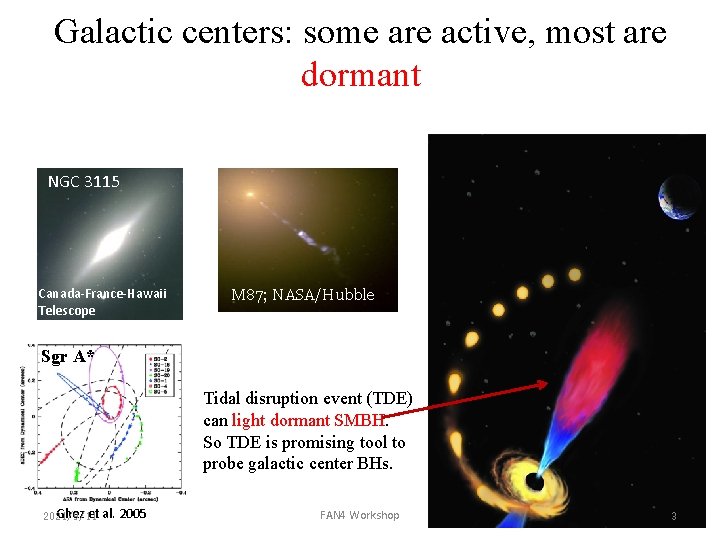
Galactic centers: some are active, most are dormant NGC 3115 Canada-France-Hawaii Telescope M 87; NASA/Hubble Sgr A* Tidal disruption event (TDE) can light dormant SMBH. So TDE is promising tool to probe galactic center BHs. Ghez et al. 2005 2021/9/11 FAN 4 Workshop 3
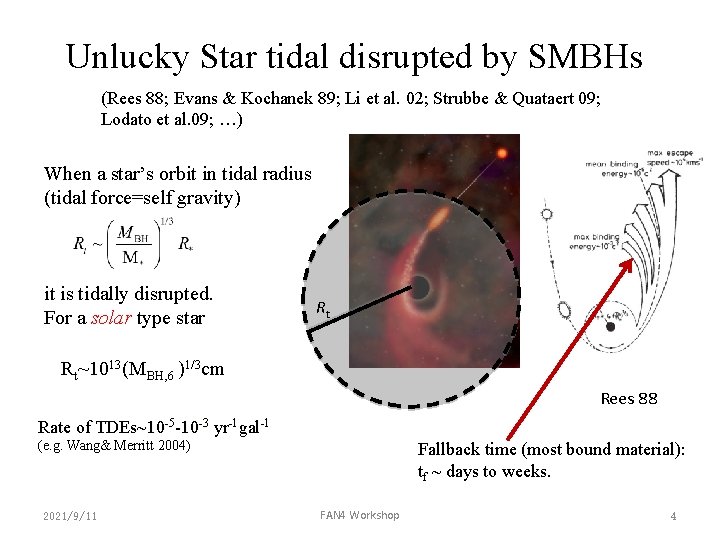
Unlucky Star tidal disrupted by SMBHs (Rees 88; Evans & Kochanek 89; Li et al. 02; Strubbe & Quataert 09; Lodato et al. 09; …) When a star’s orbit in tidal radius (tidal force=self gravity) it is tidally disrupted. For a solar type star Rt Rt~1013(MBH, 6 )1/3 cm Rees 88 Rate of TDEs~10 -5 -10 -3 yr-1 gal-1 (e. g. Wang& Merritt 2004) 2021/9/11 Fallback time (most bound material): tf ~ days to weeks. FAN 4 Workshop 4
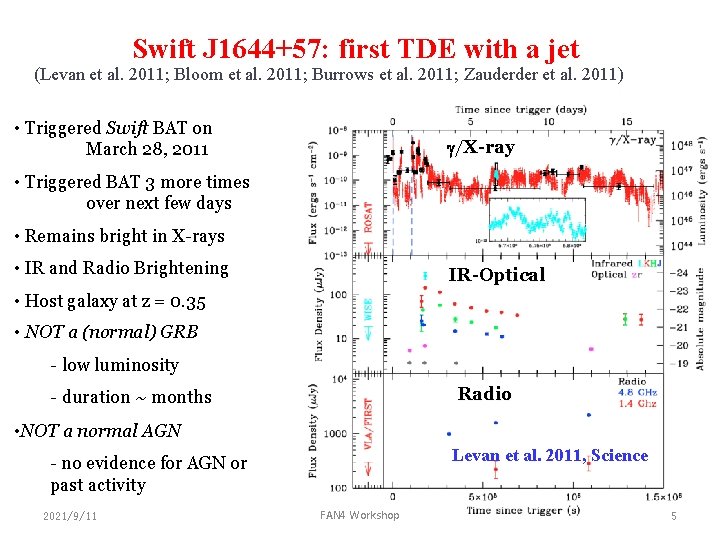
Swift J 1644+57: first TDE with a jet (Levan et al. 2011; Bloom et al. 2011; Burrows et al. 2011; Zauderder et al. 2011) • Triggered Swift BAT on March 28, 2011 /X-ray • Triggered BAT 3 more times over next few days • Remains bright in X-rays • IR and Radio Brightening IR-Optical • Host galaxy at z = 0. 35 • NOT a (normal) GRB - low luminosity Radio - duration ~ months • NOT a normal AGN Levan et al. 2011, Science - no evidence for AGN or past activity 2021/9/11 FAN 4 Workshop 5
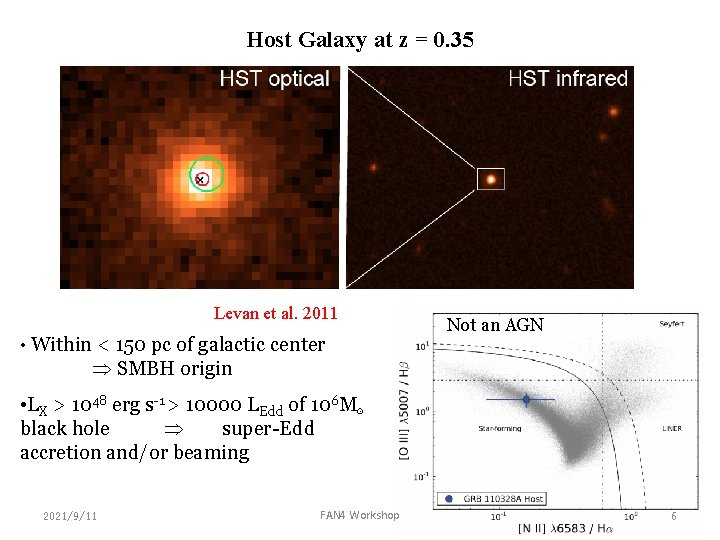
Host Galaxy at z = 0. 35 Levan et al. 2011 • Within < 150 pc of galactic center Not an AGN SMBH origin • LX > 1048 erg s-1 > 10000 LEdd of 106 M⊙ black hole super-Edd accretion and/or beaming 2021/9/11 FAN 4 Workshop 6
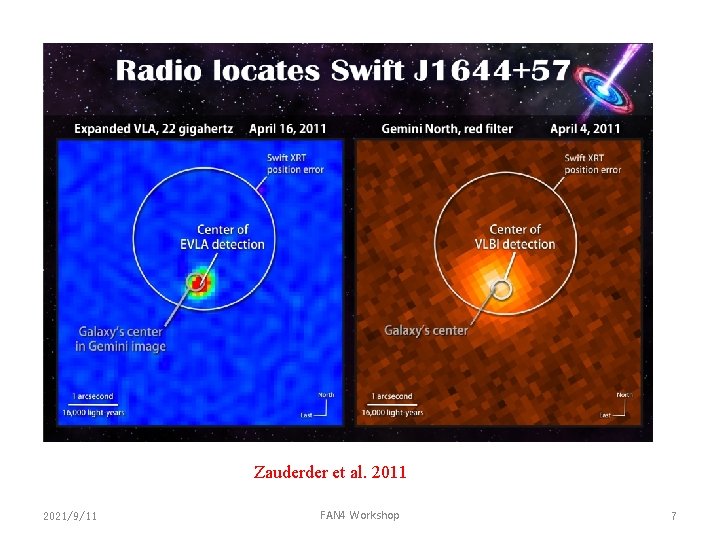
Zauderder et al. 2011 2021/9/11 FAN 4 Workshop 7
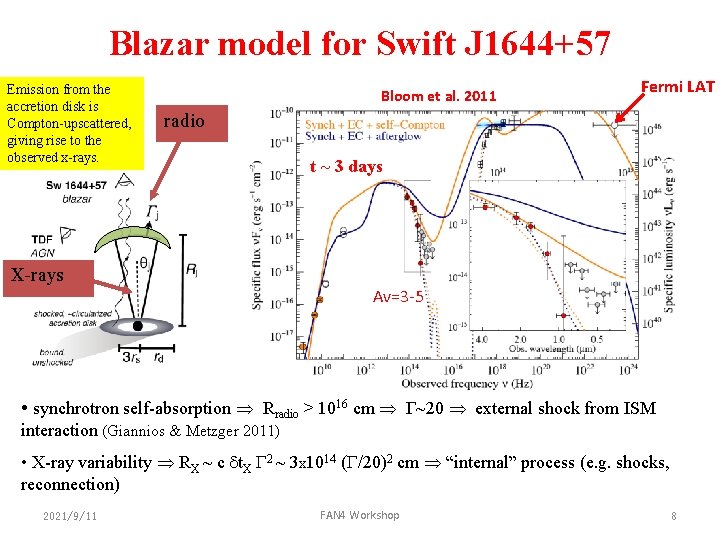
Blazar model for Swift J 1644+57 Emission from the accretion disk is Compton-upscattered, giving rise to the observed x-rays. Bloom et al. 2011 Fermi LAT radio X-rays t ~ 3 days Av=3 -5 • synchrotron self-absorption Rradio > 1016 cm Г~20 external shock from ISM interaction (Giannios & Metzger 2011) • X-ray variability RX ~ c t. X 2 ~ 3 x 10¹⁴ ( /20)2 cm “internal” process (e. g. shocks, reconnection) 2021/9/11 FAN 4 Workshop 8
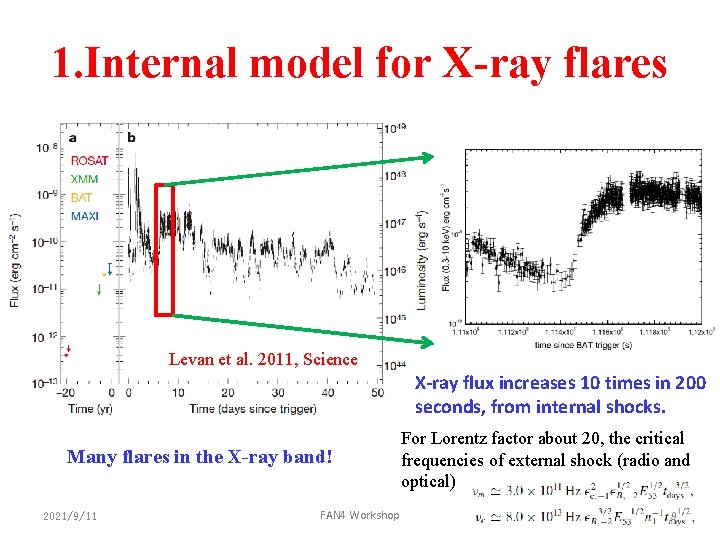
1. Internal model for X-ray flares Levan et al. 2011, Science X-ray flux increases 10 times in 200 seconds, from internal shocks. Many flares in the X-ray band! 2021/9/11 FAN 4 Workshop For Lorentz factor about 20, the critical frequencies of external shock (radio and optical) 9
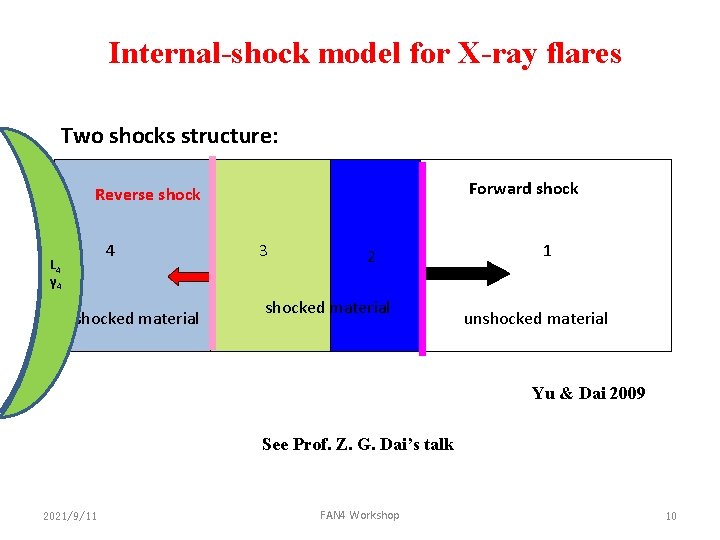
Internal-shock model for X-ray flares Two shocks structure: Forward shock Reverse shock L 1 L 4 γ 1 γ 4 4 unshocked material 3 2 shocked material 1 unshocked material Yu & Dai 2009 See Prof. Z. G. Dai’s talk 2021/9/11 FAN 4 Workshop 10
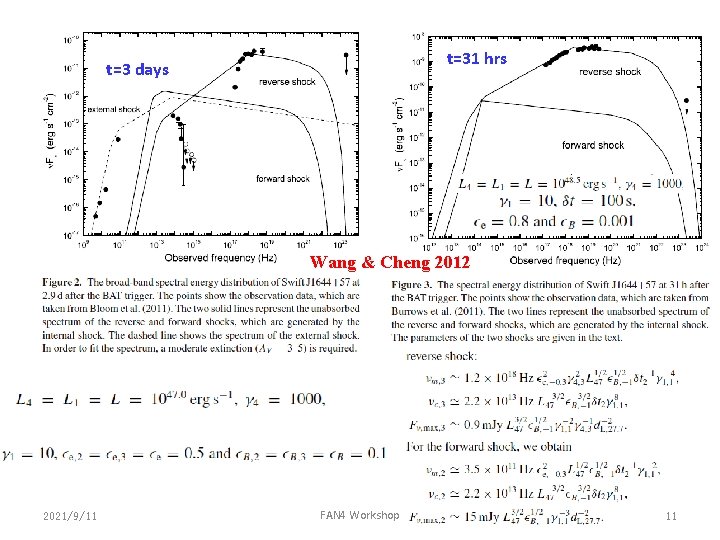
t=31 hrs t=3 days Wang & Cheng 2012 2021/9/11 FAN 4 Workshop 11
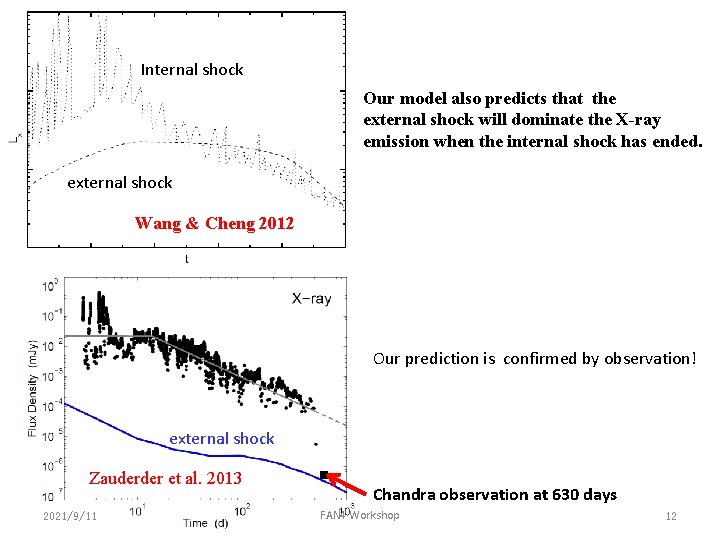
Internal shock Our model also predicts that the external shock will dominate the X-ray emission when the internal shock has ended. external shock Wang & Cheng 2012 Our prediction is confirmed by observation! external shock Zauderder et al. 2013 2021/9/11 Chandra observation at 630 days FAN 4 Workshop 12
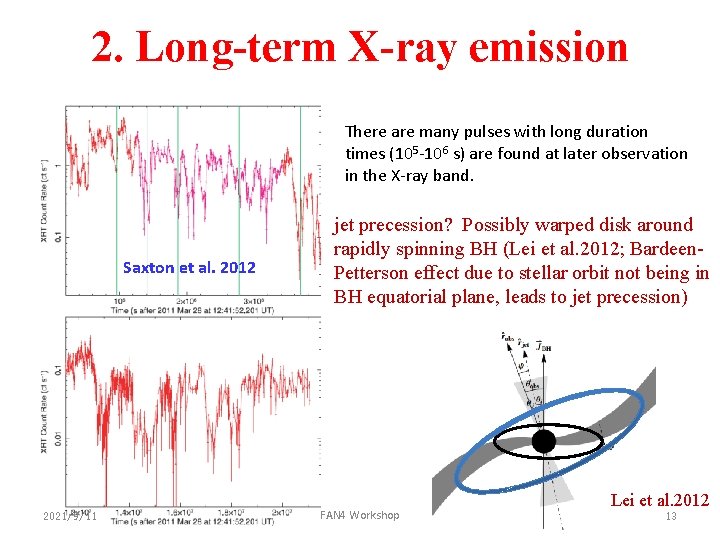
2. Long-term X-ray emission There are many pulses with long duration times (105 -106 s) are found at later observation in the X-ray band. Saxton et al. 2012 2021/9/11 jet precession? Possibly warped disk around rapidly spinning BH (Lei et al. 2012; Bardeen. Petterson effect due to stellar orbit not being in BH equatorial plane, leads to jet precession) FAN 4 Workshop Lei et al. 2012 13
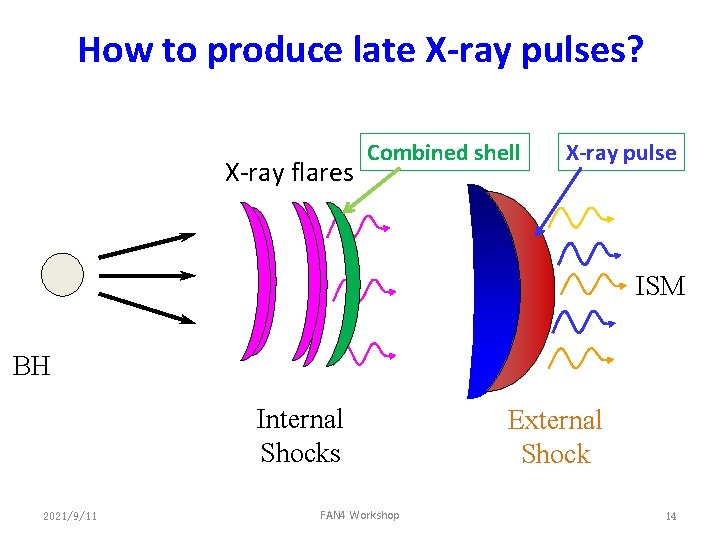
How to produce late X-ray pulses? X-ray flares Combined shell X-ray pulse ISM BH Internal Shocks 2021/9/11 FAN 4 Workshop External Shock 14
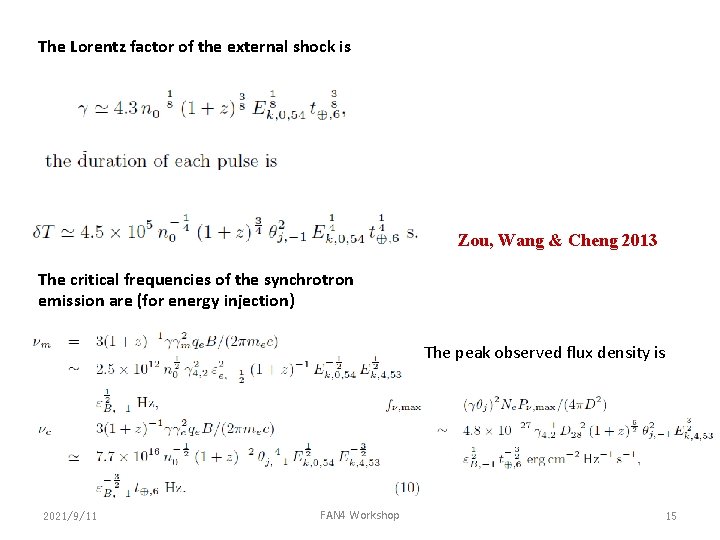
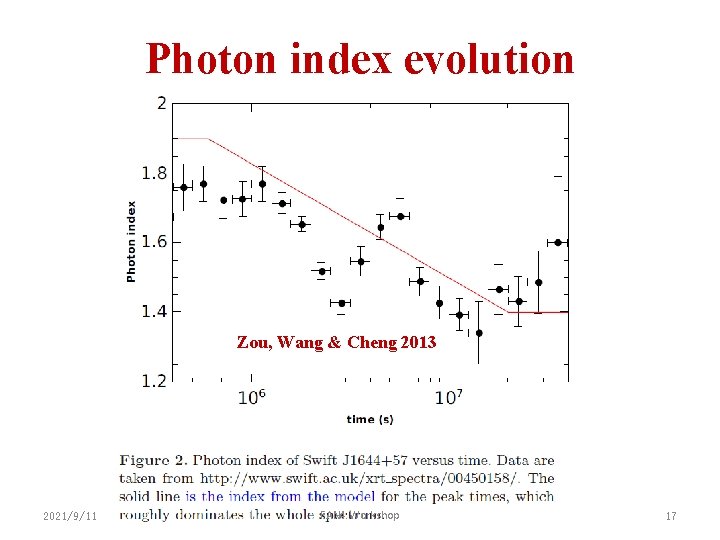
The Lorentz factor of the external shock is Zou, Wang & Cheng 2013 The critical frequencies of the synchrotron emission are (for energy injection) The peak observed flux density is 2021/9/11 FAN 4 Workshop 15
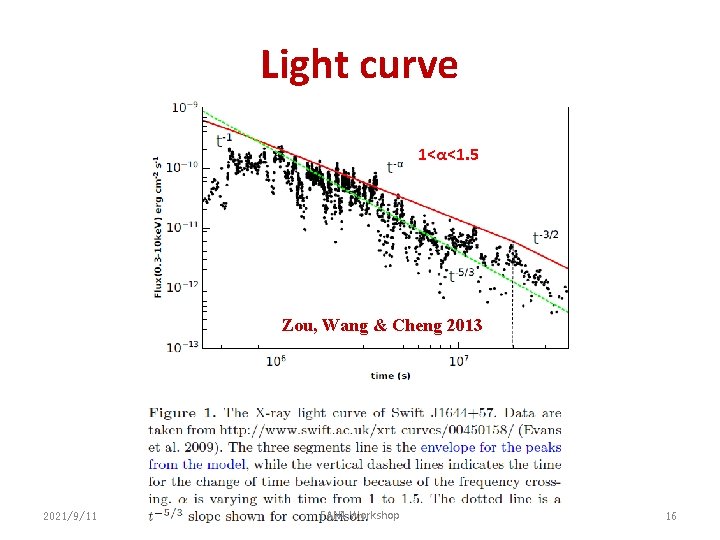
Light curve 1<α<1. 5 Zou, Wang & Cheng 2013 2021/9/11 FAN 4 Workshop 16
Photon index evolution Zou, Wang & Cheng 2013 2021/9/11 FAN 4 Workshop 17
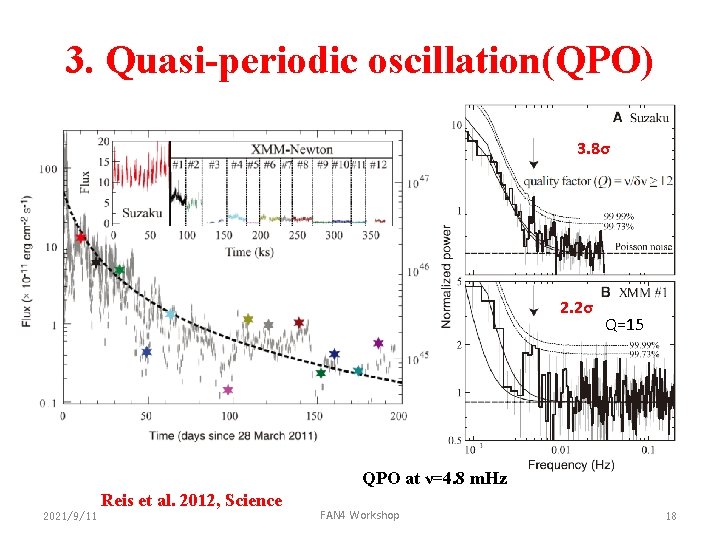
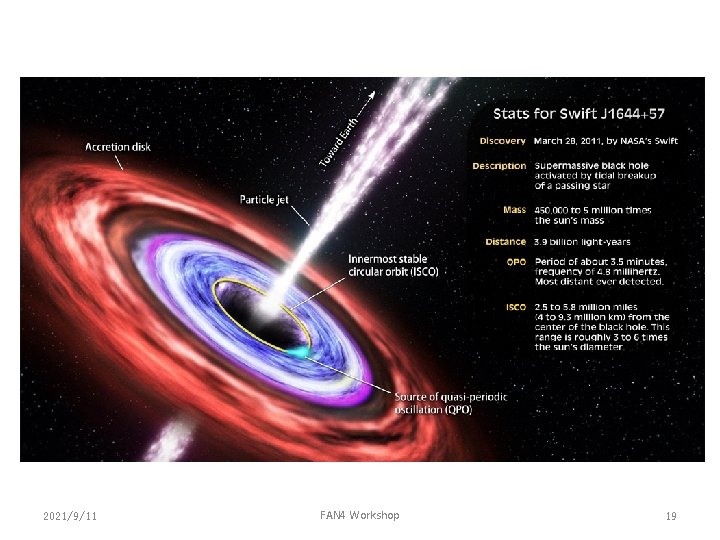
3. Quasi-periodic oscillation(QPO) 3. 8σ 2. 2σ Q=15 QPO at ν=4. 8 m. Hz 2021/9/11 Reis et al. 2012, Science FAN 4 Workshop 18
2021/9/11 FAN 4 Workshop 19
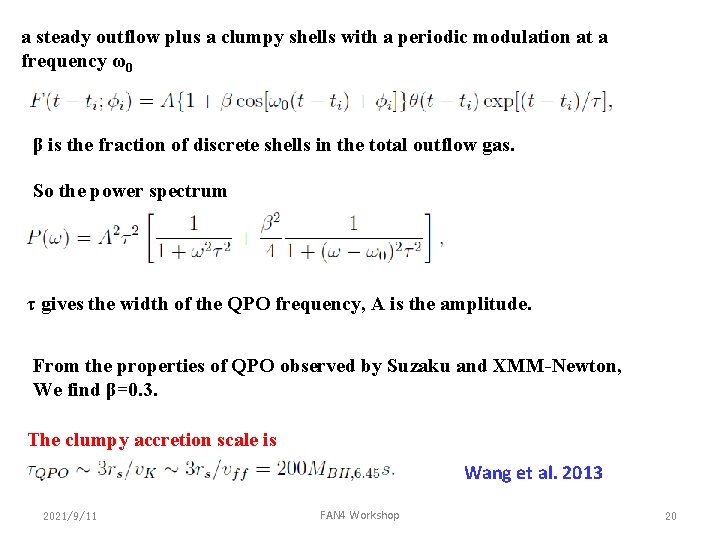
a steady outflow plus a clumpy shells with a periodic modulation at a frequency ω0 β is the fraction of discrete shells in the total outflow gas. So the power spectrum τ gives the width of the QPO frequency, A is the amplitude. From the properties of QPO observed by Suzaku and XMM-Newton, We find β=0. 3. The clumpy accretion scale is Wang et al. 2013 2021/9/11 FAN 4 Workshop 20
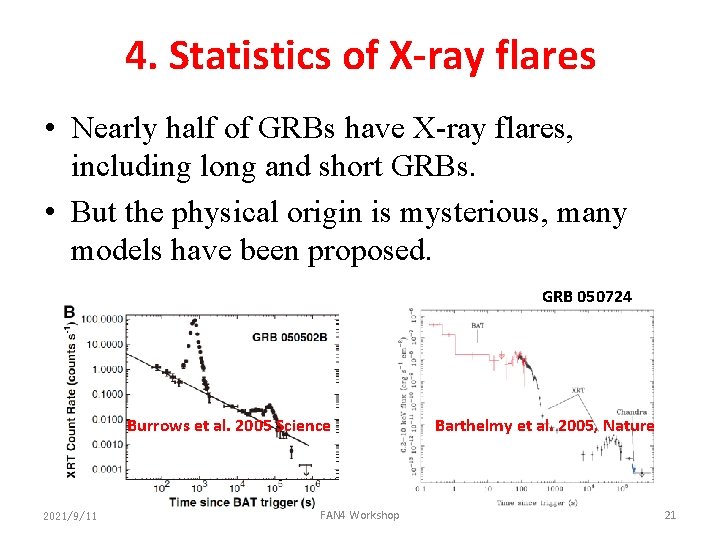
4. Statistics of X-ray flares • Nearly half of GRBs have X-ray flares, including long and short GRBs. • But the physical origin is mysterious, many models have been proposed. GRB 050724 Burrows et al. 2005 Science 2021/9/11 FAN 4 Workshop Barthelmy et al. 2005, Nature 21
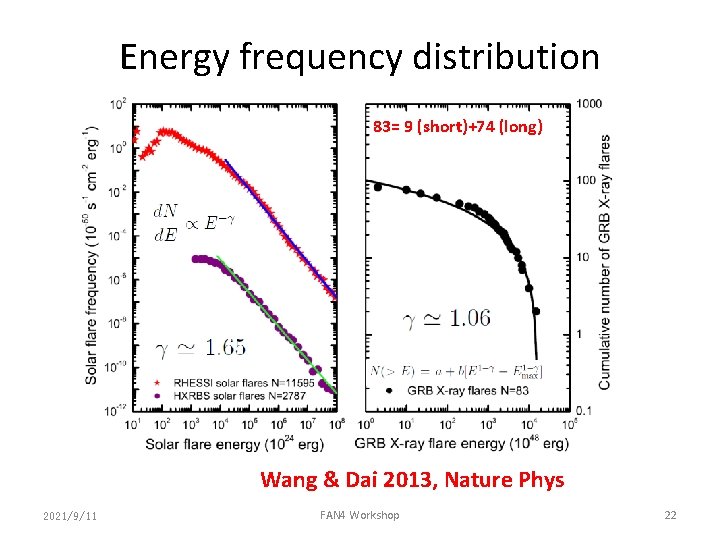
Energy frequency distribution 83= 9 (short)+74 (long) Wang & Dai 2013, Nature Phys 2021/9/11 FAN 4 Workshop 22
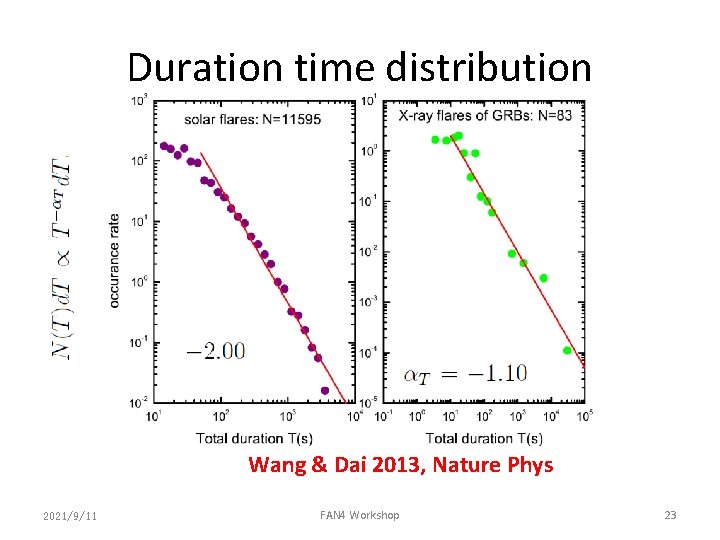
Duration time distribution Wang & Dai 2013, Nature Phys 2021/9/11 FAN 4 Workshop 23
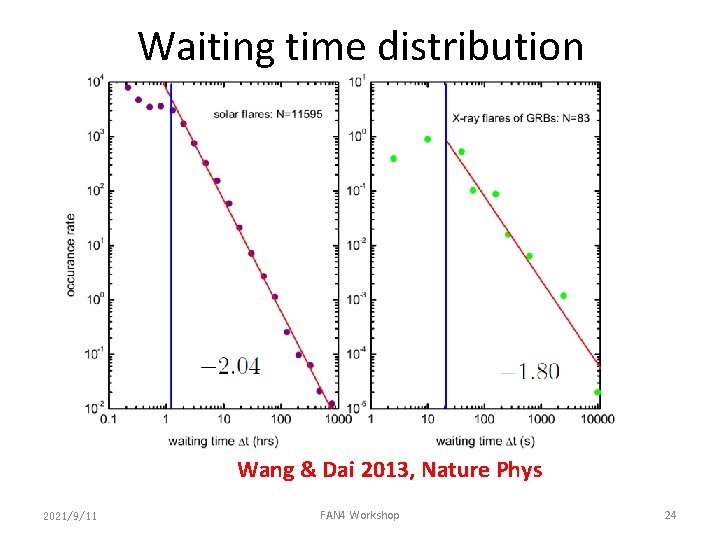
Waiting time distribution Wang & Dai 2013, Nature Phys 2021/9/11 FAN 4 Workshop 24
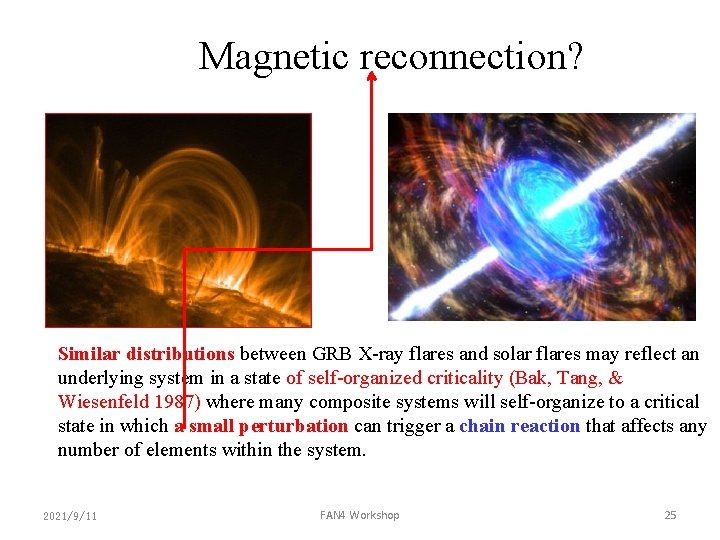
Magnetic reconnection? Similar distributions between GRB X-ray flares and solar flares may reflect an underlying system in a state of self-organized criticality (Bak, Tang, & Wiesenfeld 1987) where many composite systems will self-organize to a critical state in which a small perturbation can trigger a chain reaction that affects any number of elements within the system. 2021/9/11 FAN 4 Workshop 25
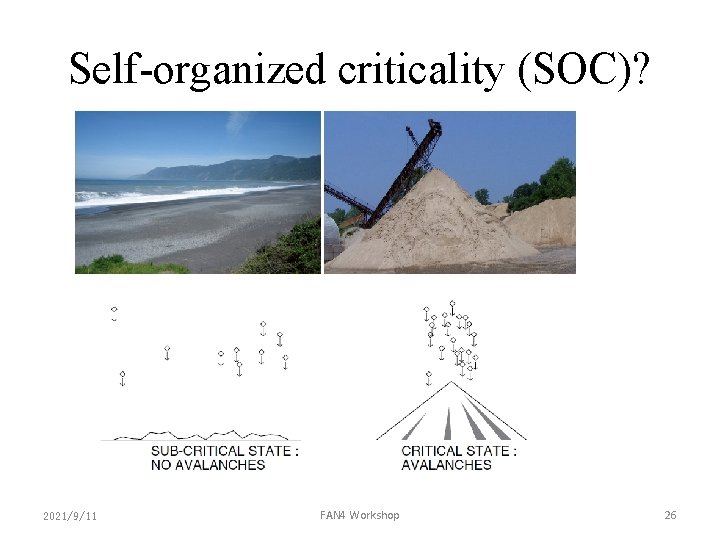
Self-organized criticality (SOC)? 2021/9/11 FAN 4 Workshop 26
Summary • Swift J 1644+57 is the first TDE with jet and QPO • The internal shock model can explain the X-ray flares of Swift J 1644+57 • The energy injection can explain the long term X-ray emission • The clumpy component comprises about 30% of outflow • Strong relativistic jet results in unique properties of this event! • SOC property of GRB X-ray flares Thanks for your attention! 2021/9/11 FAN 4 Workshop 27