
Modeling the structure chemistry and appearance of protoplanetary





- Slides: 22
Modeling the structure, chemistry and appearance of protoplanetary disks Molecular Hydrogen Emission from Protoplanetary Disks Hideko Nomura (Kobe Univ. ), Tom Millar (UMIST)
§ 1 Introduction
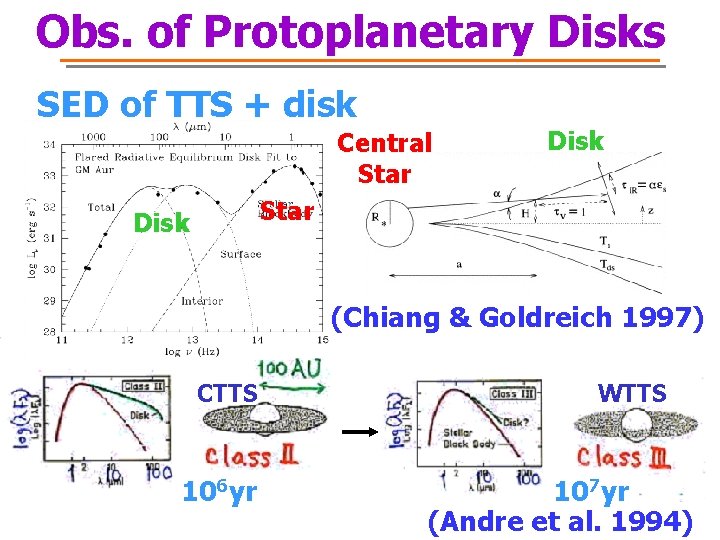
Obs. of Protoplanetary Disks SED of TTS + disk Central Star Disk (Chiang & Goldreich 1997) CTTS 106 yr WTTS 107 yr (Andre et al. 1994)
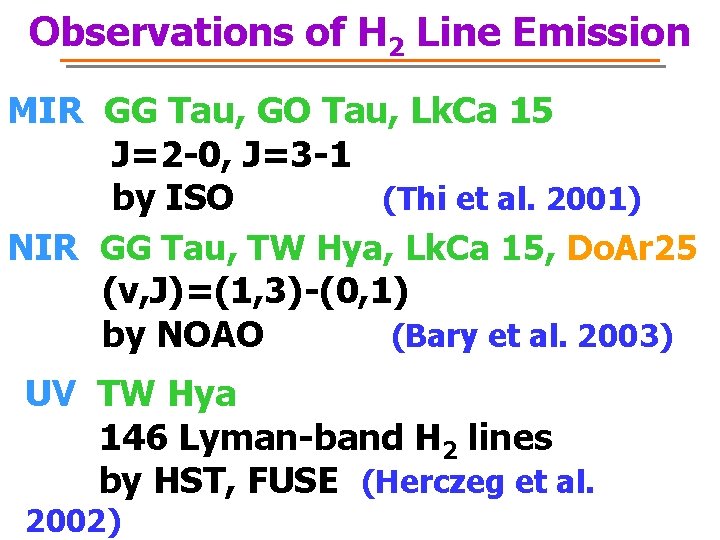
Observations of H 2 Line Emission MIR GG Tau, GO Tau, Lk. Ca 15 J=2 -0, J=3 -1 by ISO (Thi et al. 2001) NIR GG Tau, TW Hya, Lk. Ca 15, Do. Ar 25 (v, J)=(1, 3)-(0, 1) by NOAO (Bary et al. 2003) UV TW Hya 146 Lyman-band H 2 lines by HST, FUSE (Herczeg et al. 2002)
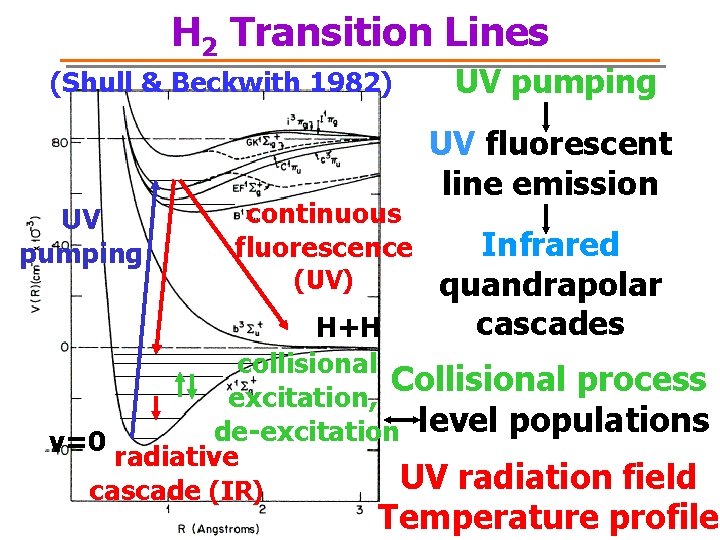
H 2 Transition Lines (Shull & Beckwith 1982) UV pumping continuous fluorescence (UV) UV pumping UV fluorescent line emission Infrared quandrapolar cascades H+H collisional Collisional process excitation, level populations de-excitation v=0 radiative UV radiation field cascade (IR) Temperature profile
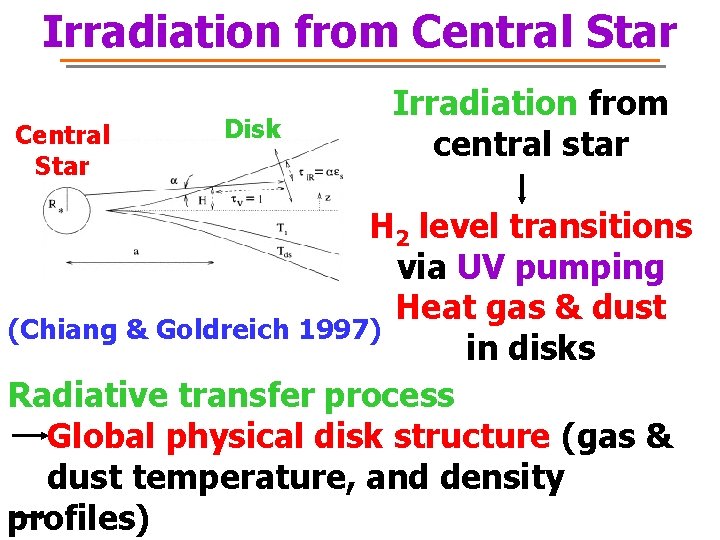
Irradiation from Central Star Disk Irradiation from central star H 2 level transitions via UV pumping Heat gas & dust (Chiang & Goldreich 1997) in disks Radiative transfer process Global physical disk structure (gas & dust temperature, and density profiles)
§ 2 Disk Model
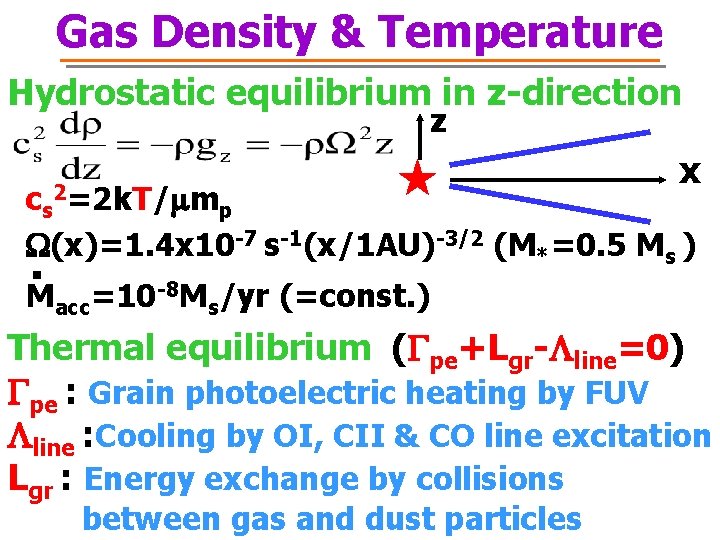
Gas Density & Temperature Hydrostatic equilibrium in z-direction z ★ x cs 2=2 k. T/mmp W(x)=1. 4 x 10 -7 s-1(x/1 AU)-3/2 (M*=0. 5 Ms ) ・ Macc=10 -8 Ms/yr (=const. ) Thermal equilibrium (Gpe+Lgr-Lline=0) Gpe : Grain photoelectric heating by FUV Lline : Cooling by OI, CII & CO line excitation Lgr : Energy exchange by collisions between gas and dust particles
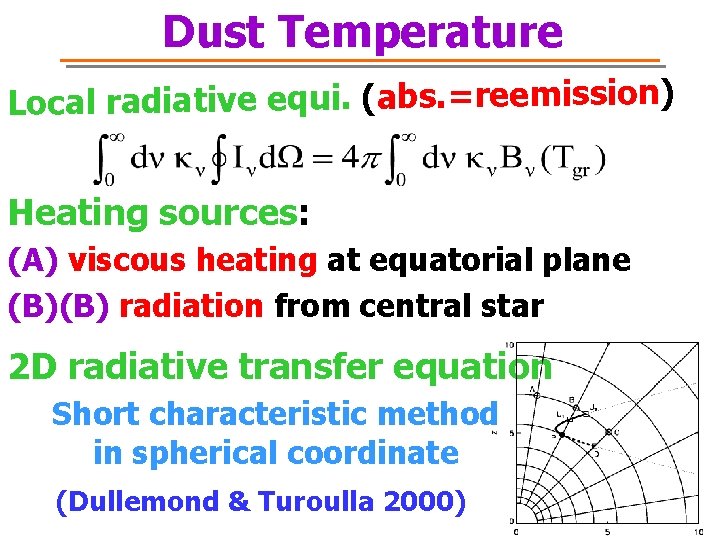
Dust Temperature Local radiative equi. (abs. =reemission) Heating sources: (A) viscous heating at equatorial plane (B)(B) radiation from central star 2 D radiative transfer equation Short characteristic method in spherical coordinate (Dullemond & Turoulla 2000)
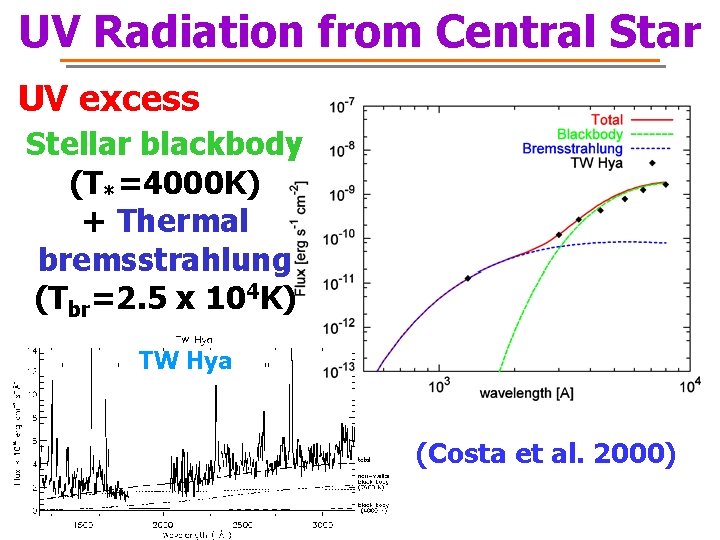
UV Radiation from Central Star UV excess Stellar blackbody (T*=4000 K) + Thermal bremsstrahlung (Tbr=2. 5 x 10⁴ K) TW Hya (Costa et al. 2000)
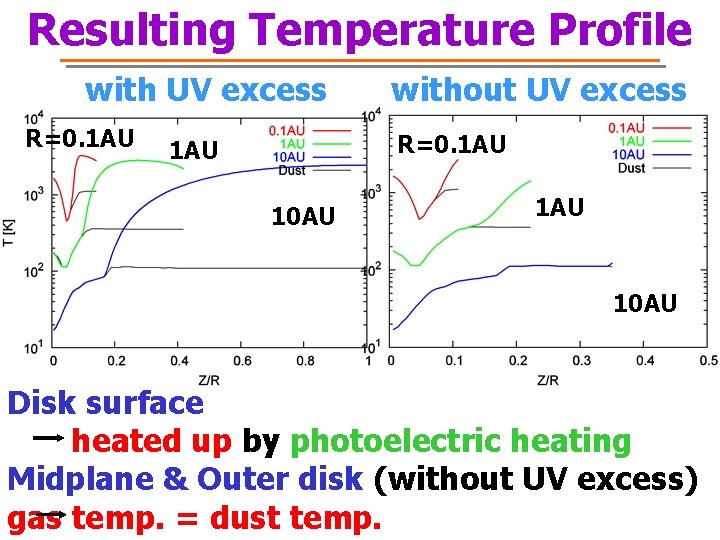
Resulting Temperature Profile with UV excess R=0. 1 AU without UV excess R=0. 1 AU 10 AU Disk surface heated up by photoelectric heating Midplane & Outer disk (without UV excess) gas temp. = dust temp.
§ 3 H 2 Level Populations
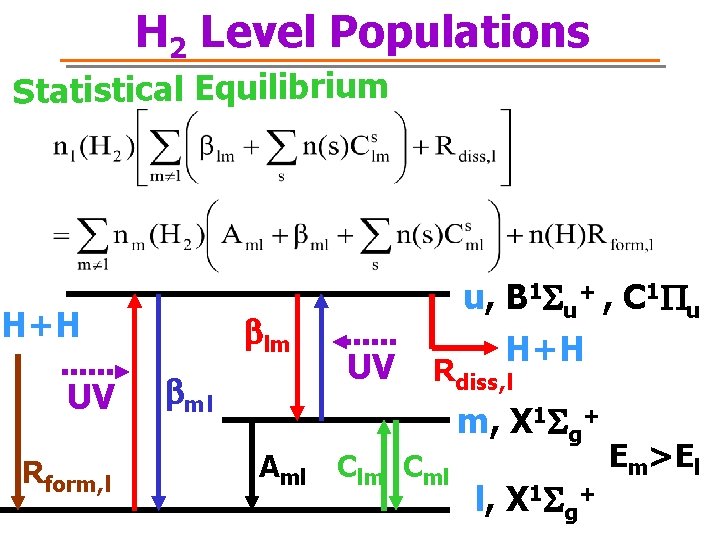
H 2 Level Populations Statistical Equilibrium H+H UV Rform, l blm bml u, B 1 Su+ , C 1 Pu UV H+H Rdiss, l m, X 1 Sg+ Aml Clm Cml l, X 1 Sg+ Em>El
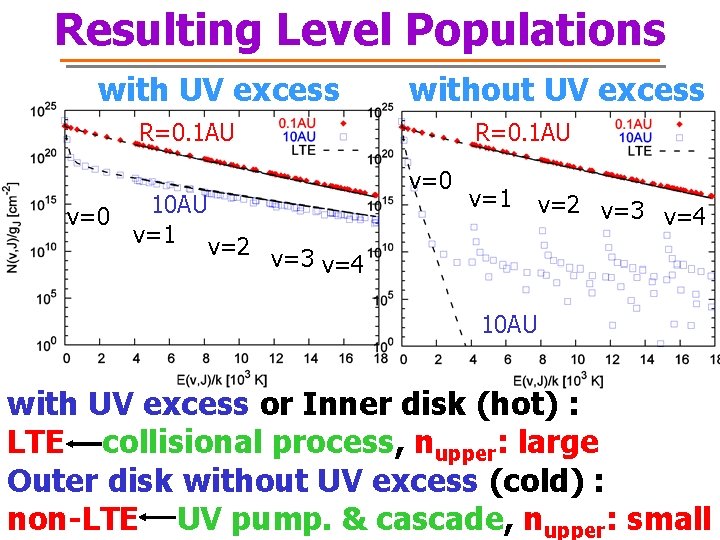
Resulting Level Populations with UV excess without UV excess R=0. 1 AU 10 AU v=0 v=1 v=2 v=3 v=4 10 AU with UV excess or Inner disk (hot) : LTE collisional process, nupper: large Outer disk without UV excess (cold) : non-LTE UV pump. & cascade, nupper: small
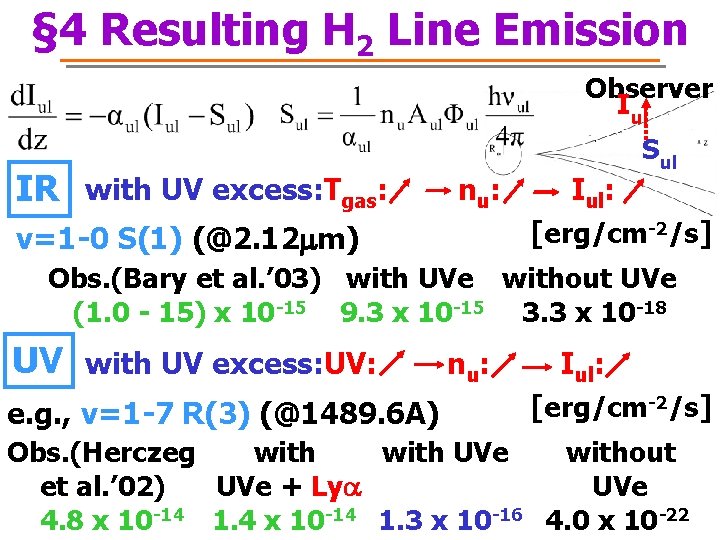
§ 4 Resulting H 2 Line Emission Observer Iul IR with UV excess: Tgas: n u: Iul: Sul [erg/cm-2/s] v=1 -0 S(1) (@2. 12 mm) Obs. (Bary et al. ’ 03) with UVe without UVe (1. 0 - 15) x 10 -15 9. 3 x 10 -15 3. 3 x 10 -18 UV with UV excess: UV: e. g. , v=1 -7 R(3) (@1489. 6 A) n u: Iul: [erg/cm-2/s] Obs. (Herczeg with UVe without et al. ’ 02) UVe + Lya UVe 4. 8 x 10 -14 1. 4 x 10 -14 1. 3 x 10 -16 4. 0 x 10 -22
§ 5 Discussion
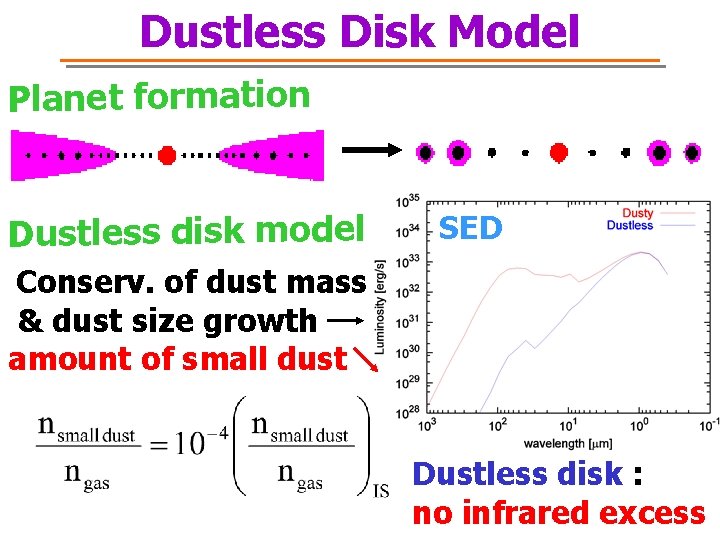
Dustless Disk Model Planet formation Dustless disk model SED Conserv. of dust mass & dust size growth amount of small dust Dustless disk : no infrared excess
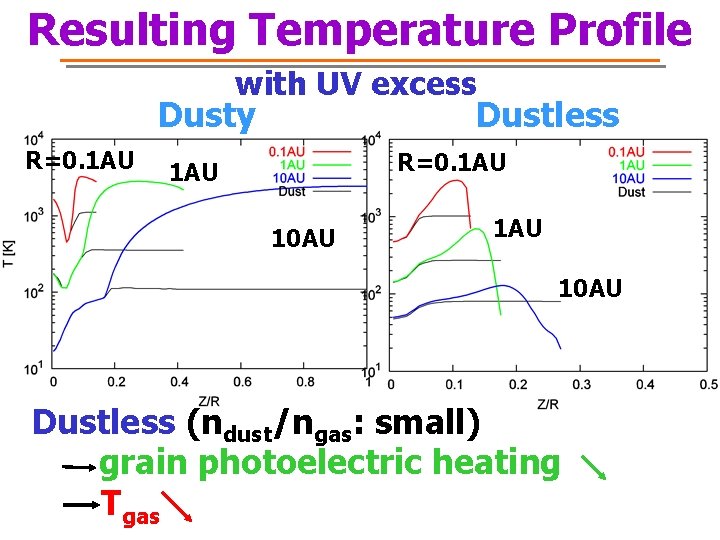
Resulting Temperature Profile with UV excess Dusty R=0. 1 AU Dustless R=0. 1 AU 10 AU Dustless (ndust/ngas: small) grain photoelectric heating Tgas
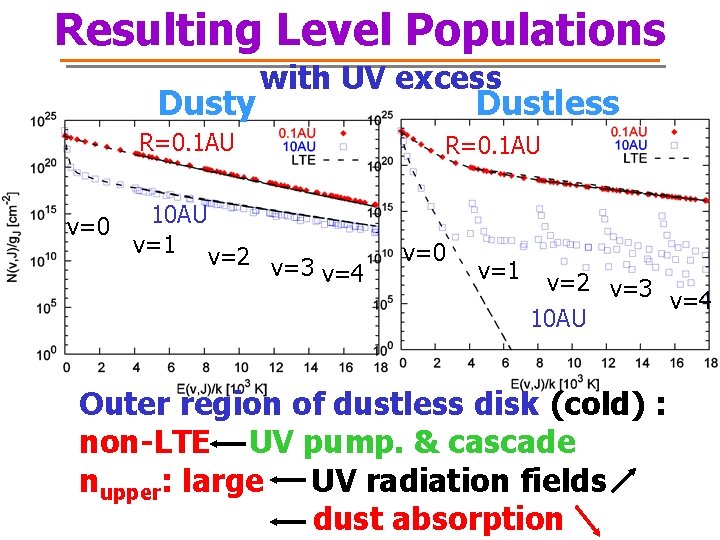
Resulting Level Populations Dusty with UV excess Dustless R=0. 1 AU v=0 10 AU v=1 v=2 R=0. 1 AU v=3 v=4 v=0 v=1 v=2 v=3 v=4 10 AU Outer region of dustless disk (cold) : non-LTE UV pump. & cascade nupper: large UV radiation fields dust absorption
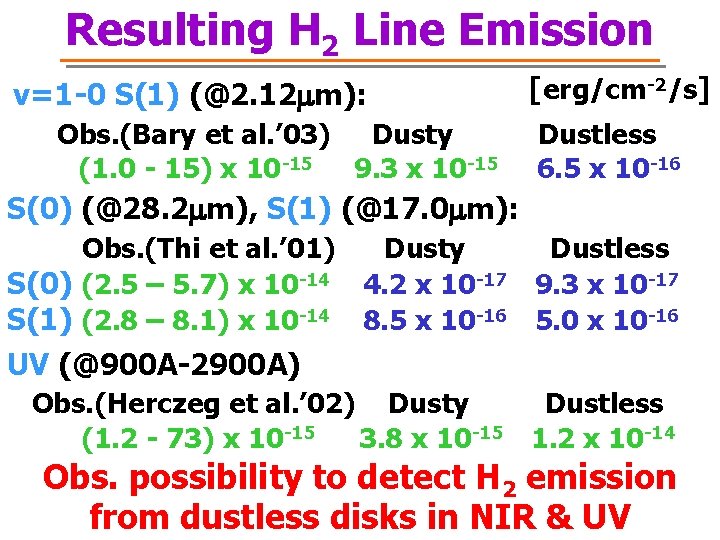
Resulting H 2 Line Emission v=1 -0 S(1) (@2. 12 mm): Obs. (Bary et al. ’ 03) Dusty (1. 0 - 15) x 10 -15 9. 3 x 10 -15 [erg/cm-2/s] Dustless 6. 5 x 10 -16 S(0) (@28. 2 mm), S(1) (@17. 0 mm): Obs. (Thi et al. ’ 01) Dusty Dustless S(0) (2. 5 – 5. 7) x 10 -14 4. 2 x 10 -17 9. 3 x 10 -17 S(1) (2. 8 – 8. 1) x 10 -14 8. 5 x 10 -16 5. 0 x 10 -16 UV (@900 A-2900 A) Obs. (Herczeg et al. ’ 02) Dusty Dustless (1. 2 - 73) x 10 -15 3. 8 x 10 -15 1. 2 x 10 -14 Obs. possibility to detect H 2 emission from dustless disks in NIR & UV
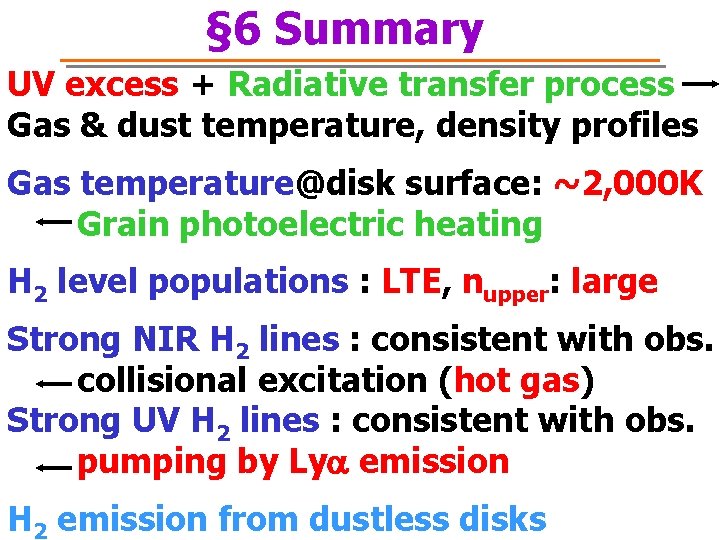
§ 6 Summary UV excess + Radiative transfer process Gas & dust temperature, density profiles Gas temperature@disk surface: ~2, 000 K Grain photoelectric heating H 2 level populations : LTE, nupper: large Strong NIR H 2 lines : consistent with obs. collisional excitation (hot gas) Strong UV H 2 lines : consistent with obs. pumping by Lya emission H 2 emission from dustless disks