
Modeling Stars Measuring the Sizes of Stars Direct
- Slides: 20
Modeling Stars
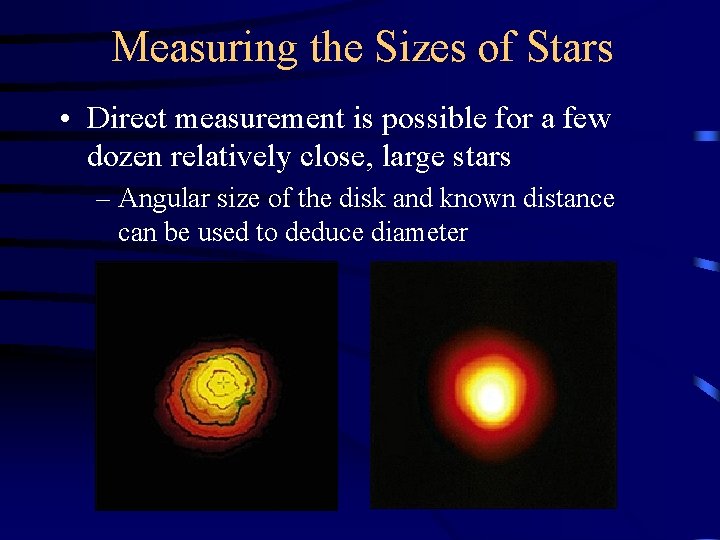
Measuring the Sizes of Stars • Direct measurement is possible for a few dozen relatively close, large stars – Angular size of the disk and known distance can be used to deduce diameter
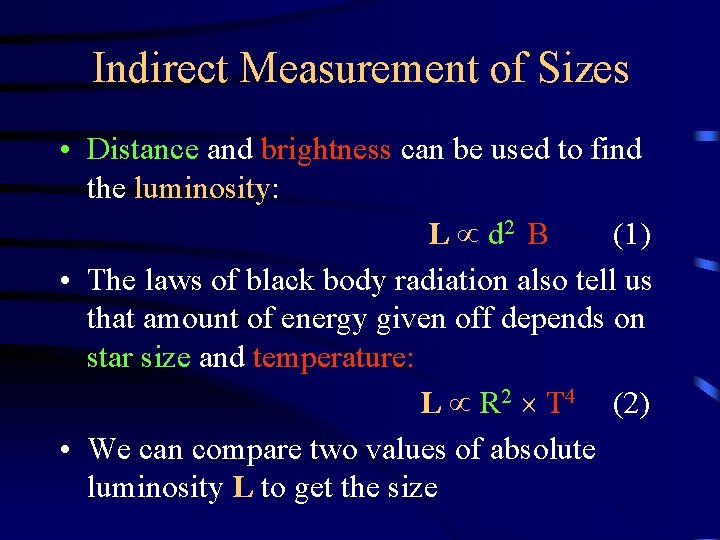
Indirect Measurement of Sizes • Distance and brightness can be used to find the luminosity: L d 2 B (1) • The laws of black body radiation also tell us that amount of energy given off depends on star size and temperature: L R 2 T 4 (2) • We can compare two values of absolute luminosity L to get the size
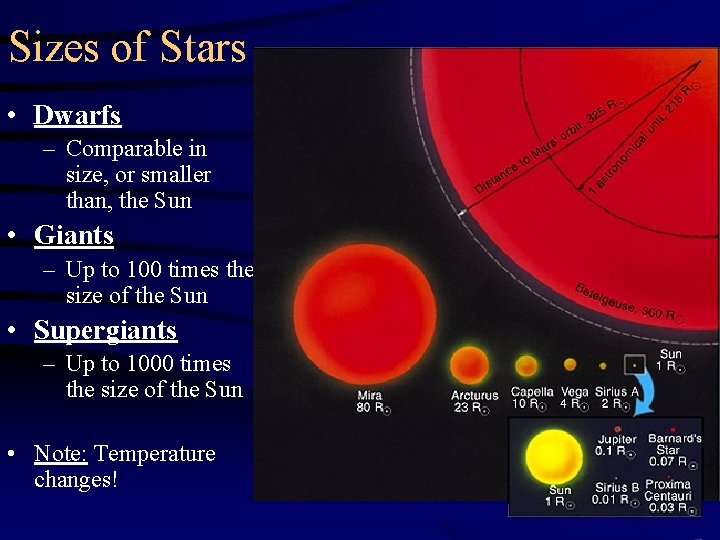
Sizes of Stars • Dwarfs – Comparable in size, or smaller than, the Sun • Giants – Up to 100 times the size of the Sun • Supergiants – Up to 1000 times the size of the Sun • Note: Temperature changes!
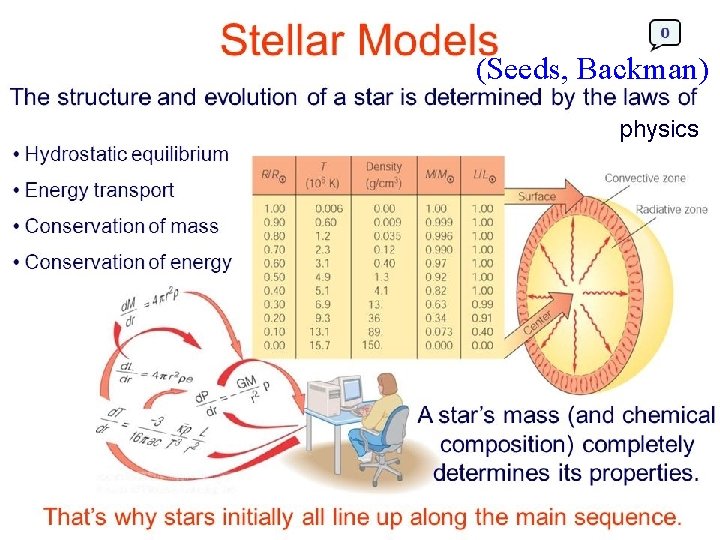
Modeling Stars • Stars are gas(? ) balls • They produce energy (in their center? ) • To remain stable, pressure has to balance gravity • The energy has to be transported to the surface of the star • The star’s surface will radiate according to its temperature (like a blackbody)
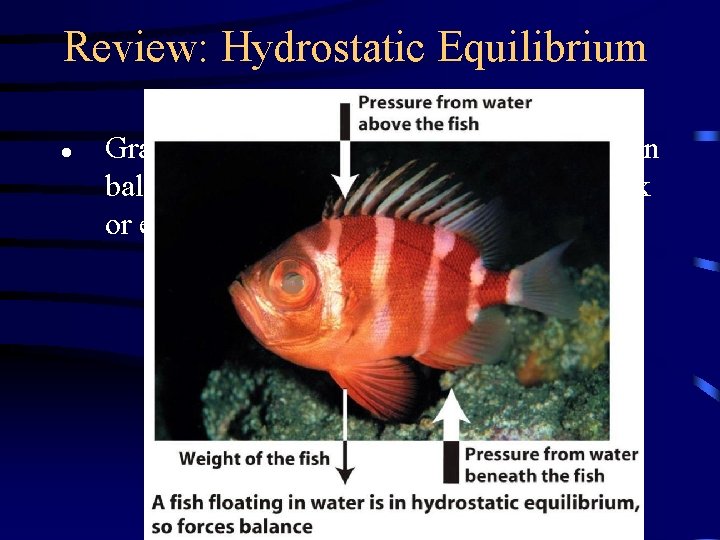
Review: Hydrostatic Equilibrium Gravity and thermodynamic pressure are in balance → the star is stable (doesn't shrink or expand)
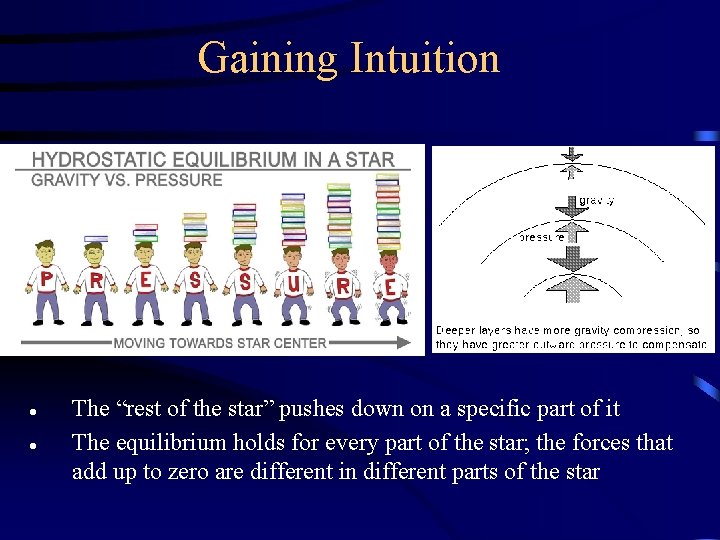
Gaining Intuition The “rest of the star” pushes down on a specific part of it The equilibrium holds for every part of the star; the forces that add up to zero are different in different parts of the star
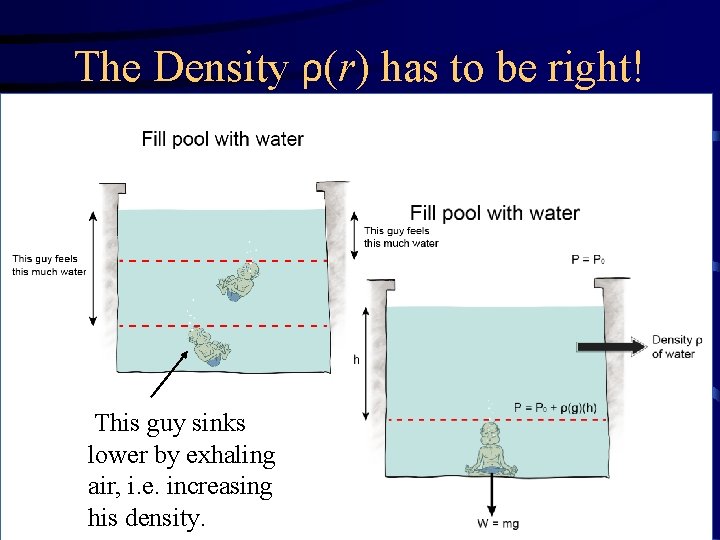
The Density ρ(r) has to be right! This guy sinks lower by exhaling air, i. e. increasing his density. dd Text
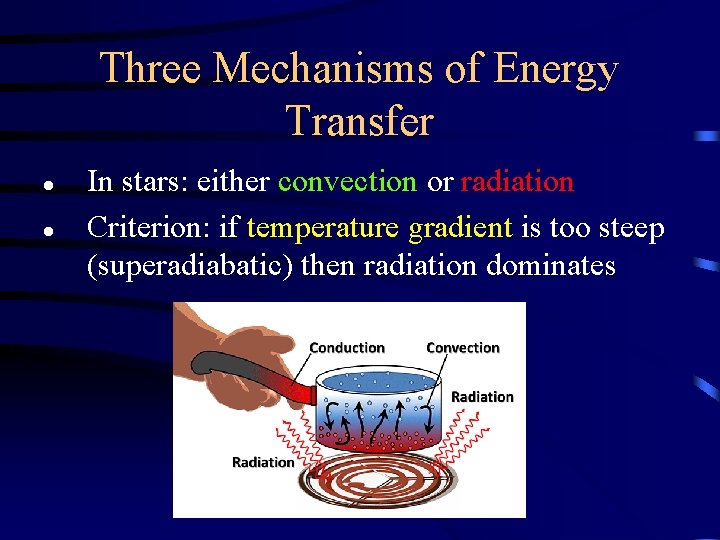
Three Mechanisms of Energy Transfer In stars: either convection or radiation Criterion: if temperature gradient is too steep (superadiabatic) then radiation dominates
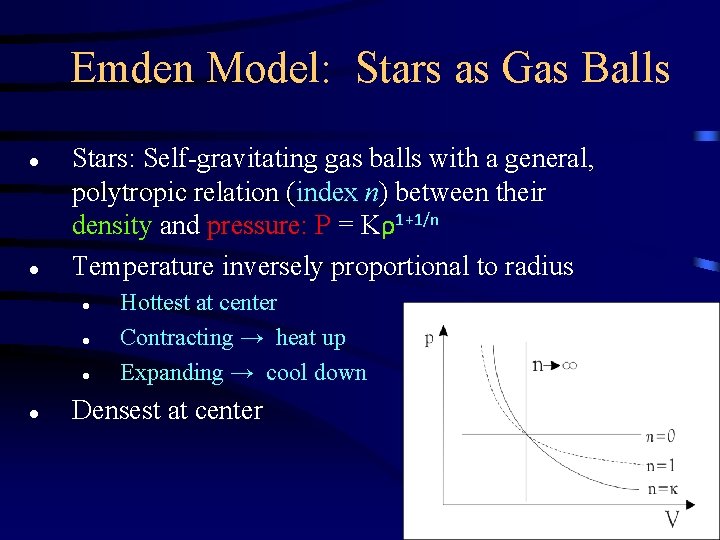
Emden Model: Stars as Gas Balls Stars: Self-gravitating gas balls with a general, polytropic relation (index n) between their density and pressure: P = Kρ1+1/n Temperature inversely proportional to radius Hottest at center Contracting → heat up Expanding → cool down Densest at center
The Scientific Method at Work Theory (stellar energy production, hydrodynamics and radiative stability) PLUS Observation (stellar spectra, HRD) YIELDS Stellar Model, i. e. understanding of Stars
Eddington: Standard model without (knowing about) energy production Adding a new feature: stars are actively producing energy, hence radiative energy transfer is important New property: opacity κ(r) (To which degree does the stellar substance hinder radiation flow? ) Need new equation for new unknown: thermal equilibrium: every “parcel” of the star radiates as much energy as it produces plus receives
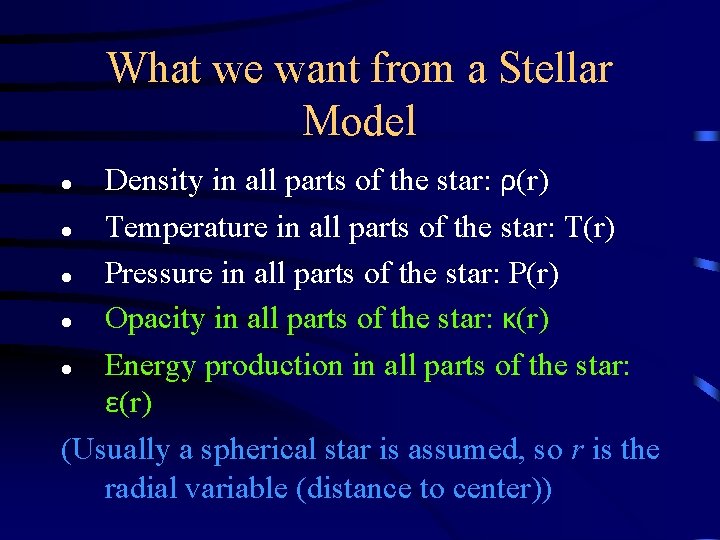
What we want from a Stellar Model Density in all parts of the star: ρ(r) Temperature in all parts of the star: T(r) Pressure in all parts of the star: P(r) Opacity in all parts of the star: κ(r) Energy production in all parts of the star: ε(r) (Usually a spherical star is assumed, so r is the radial variable (distance to center))
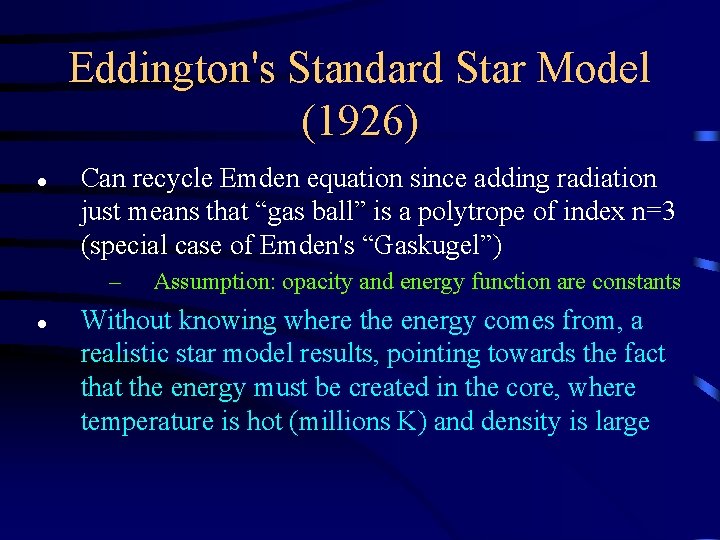
Eddington's Standard Star Model (1926) Can recycle Emden equation since adding radiation just means that “gas ball” is a polytrope of index n=3 (special case of Emden's “Gaskugel”) – Assumption: opacity and energy function are constants Without knowing where the energy comes from, a realistic star model results, pointing towards the fact that the energy must be created in the core, where temperature is hot (millions K) and density is large
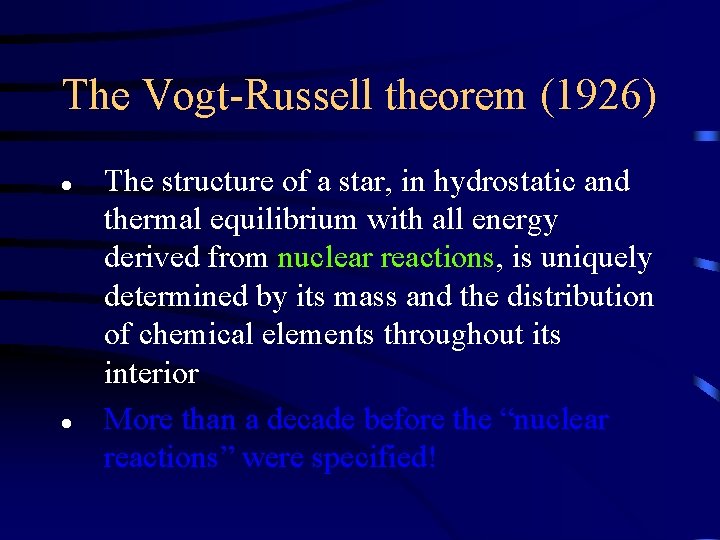
The Vogt-Russell theorem (1926) The structure of a star, in hydrostatic and thermal equilibrium with all energy derived from nuclear reactions, is uniquely determined by its mass and the distribution of chemical elements throughout its interior More than a decade before the “nuclear reactions” were specified!
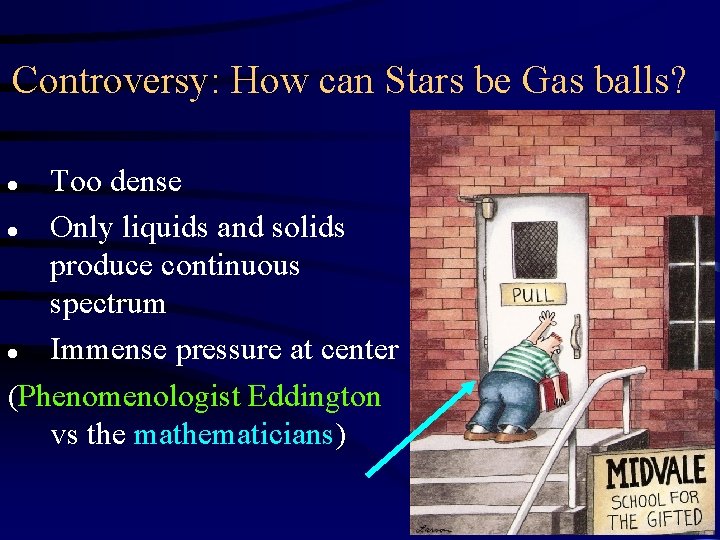
Controversy: How can Stars be Gas balls? Too dense Only liquids and solids produce continuous spectrum Immense pressure at center (Phenomenologist Eddington vs the mathematicians)
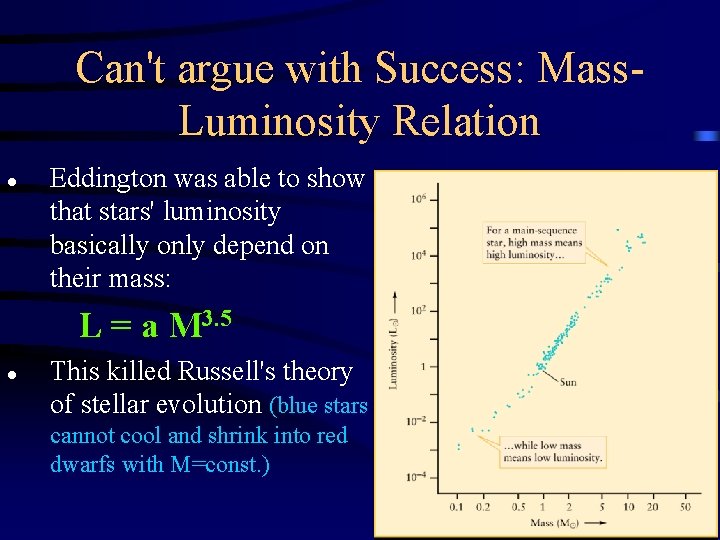
Can't argue with Success: Mass. Luminosity Relation Eddington was able to show that stars' luminosity basically only depend on their mass: L = a M 3. 5 This killed Russell's theory of stellar evolution (blue stars cannot cool and shrink into red dwarfs with M=const. )
Another Problem: Why should stars have a homogeneous composition? Like earth, stars should have densest materials in core? ! Pro: Convection mixes materials! But: radiation does not! Eddington's SM has n=3, so no convection possible
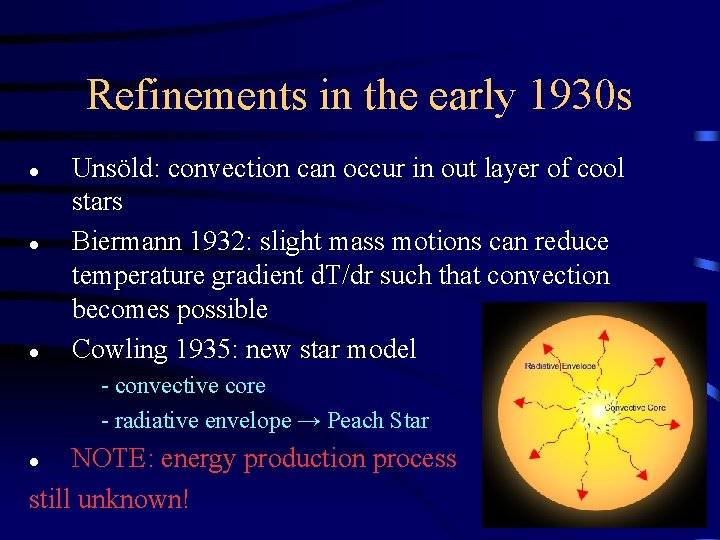
Refinements in the early 1930 s Unsöld: convection can occur in out layer of cool stars Biermann 1932: slight mass motions can reduce temperature gradient d. T/dr such that convection becomes possible Cowling 1935: new star model - convective core - radiative envelope → Peach Star NOTE: energy production process still unknown!
(Seeds, Backman) physics