
Modeling SimulationBased Design Processes via Reusable Decision Centric
Modeling Simulation-Based Design Processes via Reusable Decision Centric Templates 3 -P Information Model for Simulation-Based Multiscale Design Processes Marco Gero Fernández Jitesh H. Panchal Janet K. Allen Farrokh Mistree Christiaan J. J. Paredis Systems Realization Laboratory Georgia Institute of Technology, Atlanta Systems Realization Laboratory --------------------------PDE 2005 Workshop Atlanta 22 April, 2005 1
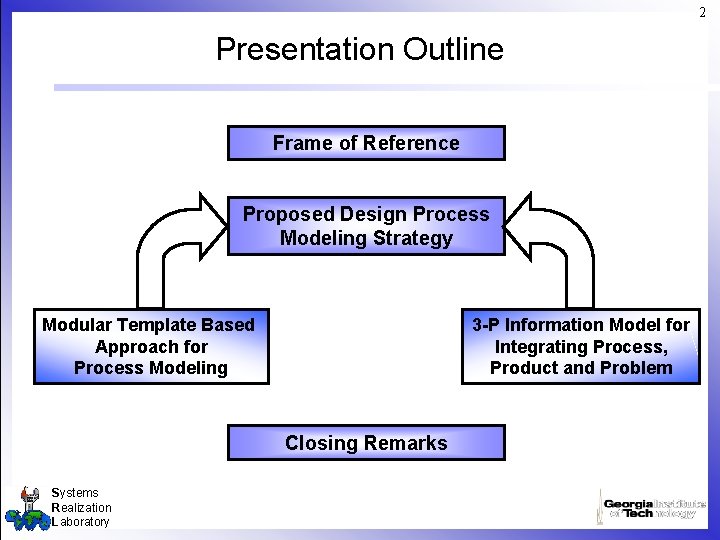
2 Presentation Outline Frame of Reference Proposed Design Process Modeling Strategy Modular Template Based Approach for Process Modeling 3 -P Information Model for Integrating Process, Product and Problem Closing Remarks Systems Realization Laboratory
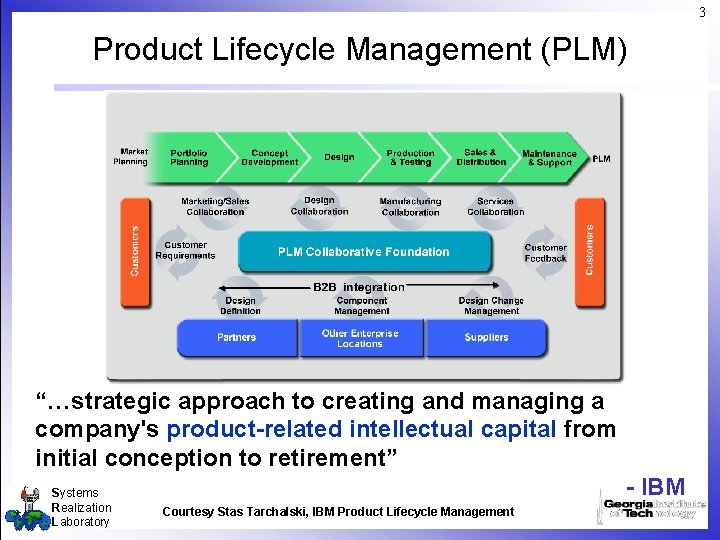
3 Product Lifecycle Management (PLM) “…strategic approach to creating and managing a company's product-related intellectual capital from initial conception to retirement” Systems Realization Laboratory - IBM Courtesy Stas Tarchalski, IBM Product Lifecycle Management
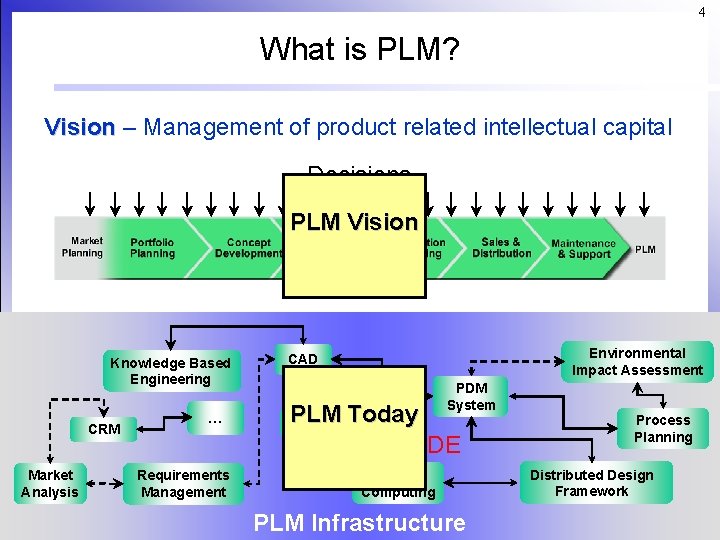
4 What is PLM? Vision – Management of product related intellectual capital Decisions PLM Vision Knowledge Based Engineering CRM Market Analysis Systems Realization Laboratory … Requirements Management Environmental Impact Assessment CAD PDM System PLM Today PDE Analysis Grid Computing PLMInfrastructure Process Planning Distributed Design Framework
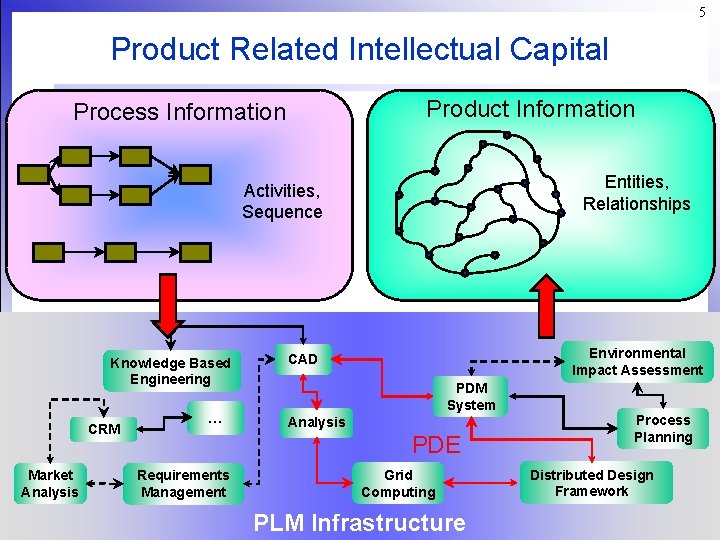
5 Product Related Intellectual Capital Product Information Process Information Entities, Relationships Activities, Sequence Knowledge Based Engineering CRM Market Analysis Systems Realization Laboratory … Environmental Impact Assessment CAD PDM System Analysis PDE Requirements Management Grid Computing PLMInfrastructure Process Planning Distributed Design Framework
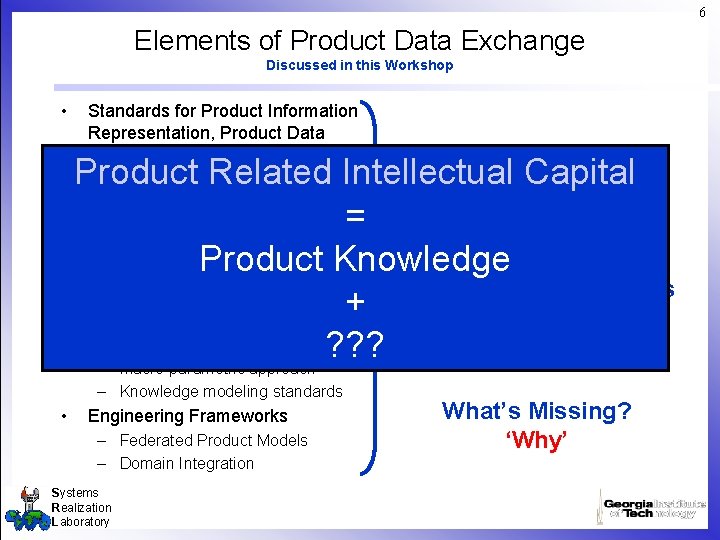
6 Elements of Product Data Exchange Discussed in this Workshop • Standards for Product Information Representation, Product Data Exchange – CAD Data Translation Product Related Intellectual Capital – STEP, EXPRESS = – Sys. ML – Common Data Schema Product • Design-Analysis Integration Knowledge ‘What’ and ‘How’ Data is – COBs + – Abstract Model (Simmetrix) Exchanged • Knowledge Archival ? ? ? – Macro-parametric approach – Knowledge modeling standards • Engineering Frameworks – Federated Product Models – Domain Integration Systems Realization Laboratory What’s Missing? ‘Why’
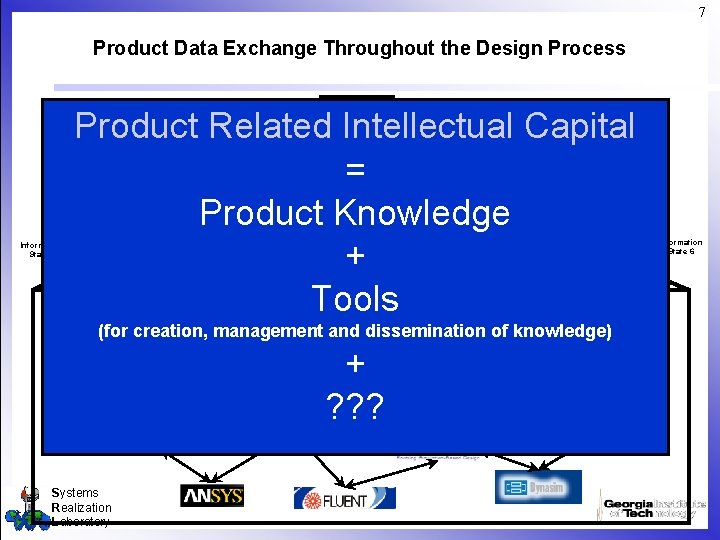
7 Product Data Exchange Throughout the Design Process Requirements Product Specifications Product Related Intellectual Capital = Product Knowledge + Tools Information Stage A Information State 0 Designing T 1 Information Stage B Decision 1 Information State 1 T 2 Information State 2 T 3 Information State 3 Decision 2 T 1 Information State 4 T 2 Information State 5 Information Stage C T 3 (for creation, management and dissemination of knowledge) + ? ? ? Systems Realization Laboratory Information State 6
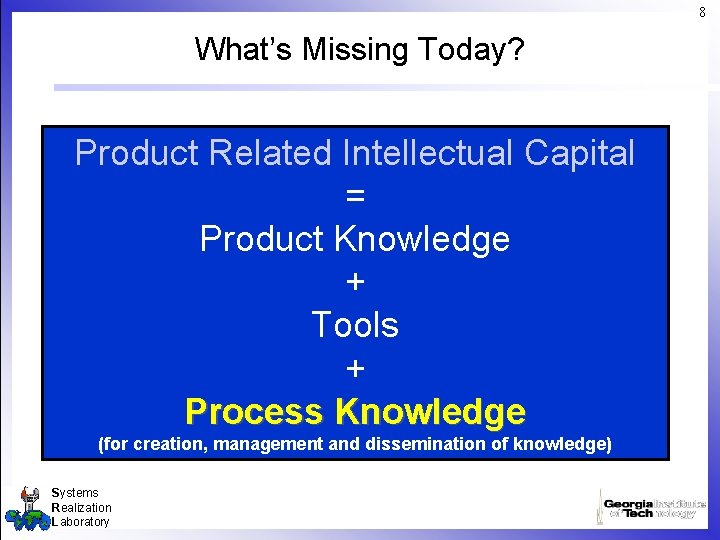
8 What’s Missing Today? Product Related Intellectual Capital = Product Knowledge + Tools + Process Knowledge (for creation, management and dissemination of knowledge) Systems Realization Laboratory
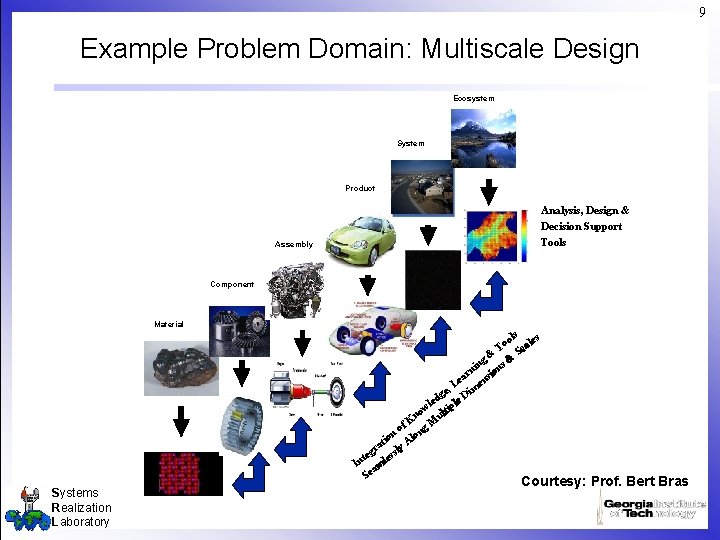
9 Example Problem Domain: Multiscale Design Ecosystem System Product Analysis, Design & Decision Support Tools Assembly Component Material Systems Realization Laboratory ols les To Sca & ng ns & i n ar nsio e e L e, Dim g ed le wl ltip o Kn Mu f o ng it on Alo y ra eg lessl t In am Se Courtesy: Prof. Bert Bras
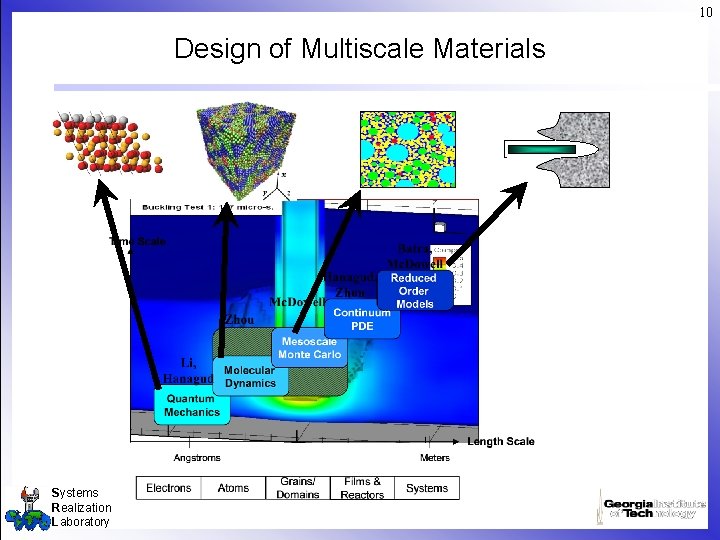
10 Design of Multiscale Materials Systems Realization Laboratory
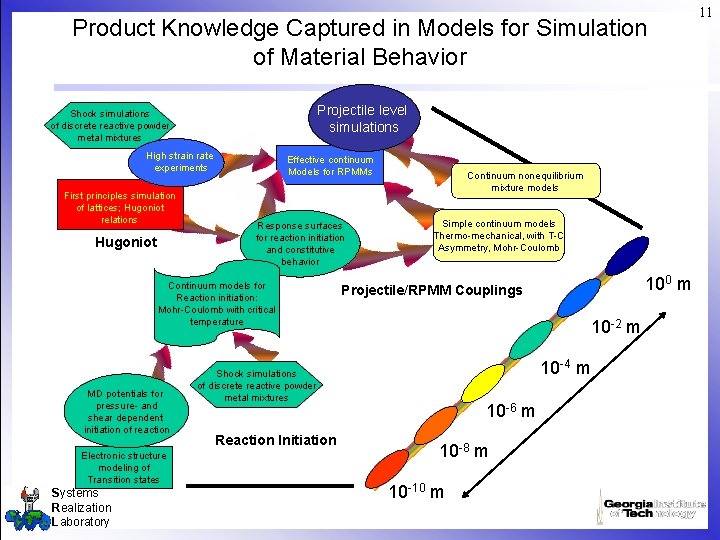
Product Knowledge Captured in Models for Simulation of Material Behavior Projectile level simulations Shock simulations of discrete reactive powder metal mixtures High strain rate experiments First principles simulation of lattices; Hugoniot relations Hugoniot Effective continuum Models for RPMMs Response surfaces for reaction initiation and constitutive behavior Continuum models for Reaction initiation: Mohr-Coulomb with critical temperature MD potentials for pressure- and shear dependent initiation of reaction Electronic structure modeling of Transition states Systems Realization Laboratory Continuum nonequilibrium mixture models Simple continuum models Thermo-mechanical, with T-C Asymmetry, Mohr-Coulomb 10 -2 m 10 -4 m Shock simulations of discrete reactive powder metal mixtures Reaction Initiation 100 m Projectile/RPMM Couplings 10 -6 m 10 -8 m 10 -10 m 11
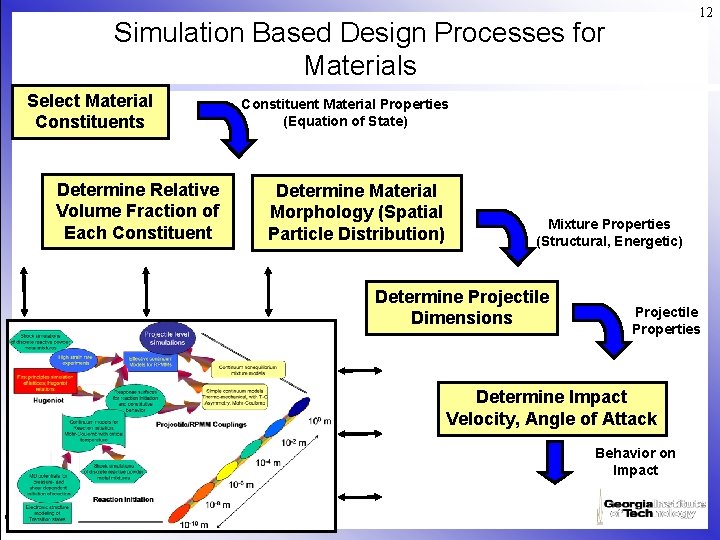
12 Simulation Based Design Processes for Materials Select Material Constituents Determine Relative Volume Fraction of Each Constituent Material Properties (Equation of State) Determine Material Morphology (Spatial Particle Distribution) Mixture Properties (Structural, Energetic) Determine Projectile Dimensions Projectile Properties Determine Impact Velocity, Angle of Attack Behavior on Impact Systems Realization Laboratory
13 Capturing Information About the Product is Necessary NOT SUFFICIENT What’s missing? Decisions and Process Knowledge Systems Realization Laboratory
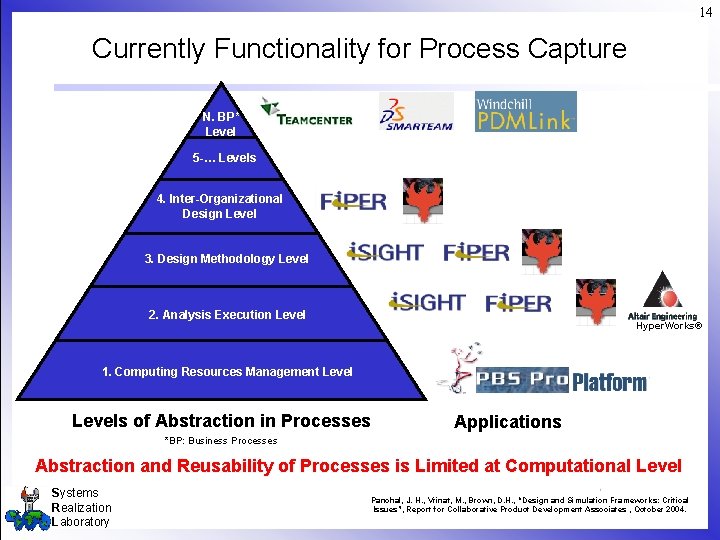
14 Currently Functionality for Process Capture N. BP* Level 5 -… Levels 4. Inter-Organizational Design Level 3. Design Methodology Level 2. Analysis Execution Level Hyper. Works® 1. Computing Resources Management Levels of Abstraction in Processes Applications *BP: Business Processes Abstraction and Reusability of Processes is Limited at Computational Level Systems Realization Laboratory Panchal, J. H. , Vrinat, M. , Brown, D. H. , “Design and Simulation Frameworks: Critical Issues”, Report for Collaborative Product Development Associates , October 2004.
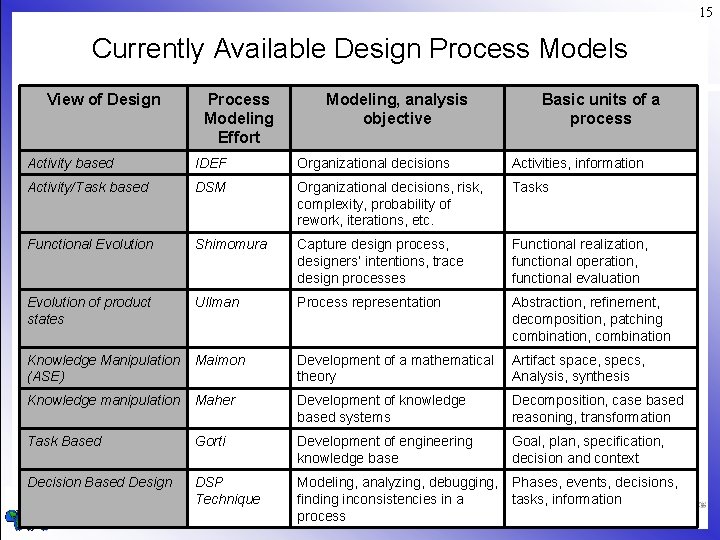
15 Currently Available Design Process Models View of Design Process Modeling Effort Modeling, analysis objective Basic units of a process Activity based IDEF Organizational decisions Activities, information Activity/Task based DSM Organizational decisions, risk, complexity, probability of rework, iterations, etc. Tasks Functional Evolution Shimomura Capture design process, designers’ intentions, trace design processes Functional realization, functional operation, functional evaluation Evolution of product states Ullman Process representation Abstraction, refinement, decomposition, patching combination, combination Knowledge Manipulation (ASE) Maimon Development of a mathematical theory Artifact space, specs, Analysis, synthesis Knowledge manipulation Maher Development of knowledge based systems Decomposition, case based reasoning, transformation Task Based Gorti Development of engineering knowledge base Goal, plan, specification, decision and context Decision Based Design DSP Technique Modeling, analyzing, debugging, Phases, events, decisions, finding inconsistencies in a tasks, information process Systems Realization Laboratory
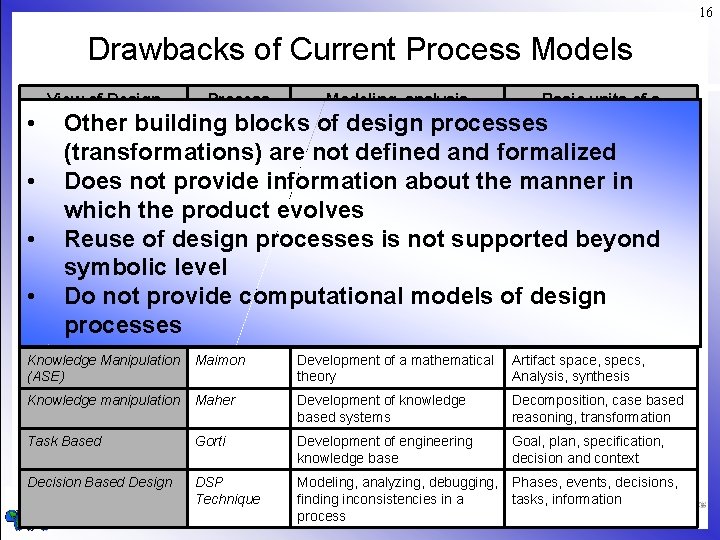
16 Drawbacks of Current Process Models View of Design Process Modeling building blocks Effort • Modeling, analysis Basic units of a objectiveprocesses process of design Other (transformations) are. Organizational not defined and formalized Activity based IDEF decisions Activities, information • Does not provide information about manner in Activity/Task based DSM Organizational decisions, risk, the. Tasks complexity, probability of which the product evolves rework, iterations, etc. • Reuse of design processes isprocess, not supported Functional Evolution Shimomura Capture design Functionalbeyond realization, designers’ intentions, trace functional operation, symbolic level design processes functional evaluation • Doof not models of. Abstraction, design Evolution productprovide Ullman computational Process representation refinement, states decomposition, patching processes combination, combination Knowledge Manipulation (ASE) Maimon Development of a mathematical theory Artifact space, specs, Analysis, synthesis Knowledge manipulation Maher Development of knowledge based systems Decomposition, case based reasoning, transformation Task Based Gorti Development of engineering knowledge base Goal, plan, specification, decision and context Decision Based Design DSP Technique Modeling, analyzing, debugging, Phases, events, decisions, finding inconsistencies in a tasks, information process Systems Realization Laboratory
Requirements for Reusable Design Process Modeling • • Reusability of processes across products and problem formulations Separation of problem (context) related information from product/process specific information Composability of sub processes through modularity Applicability at computational level Insight into product evolution Support for human decision making Formalization of information transformations in design Systems Realization Laboratory 17
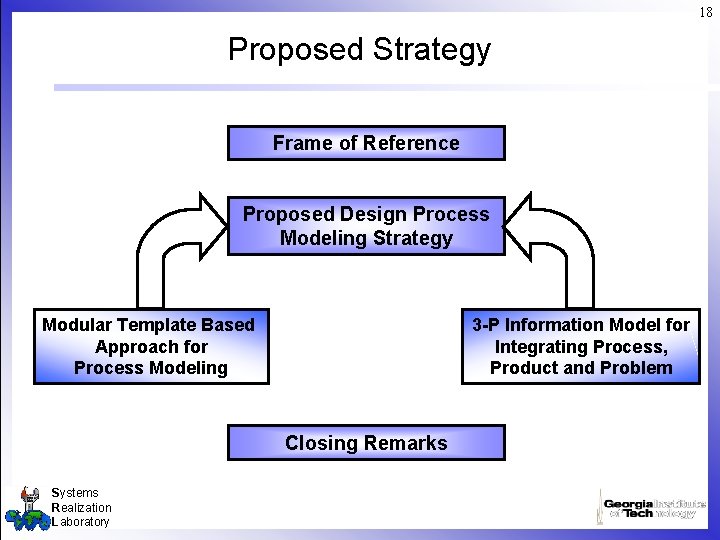
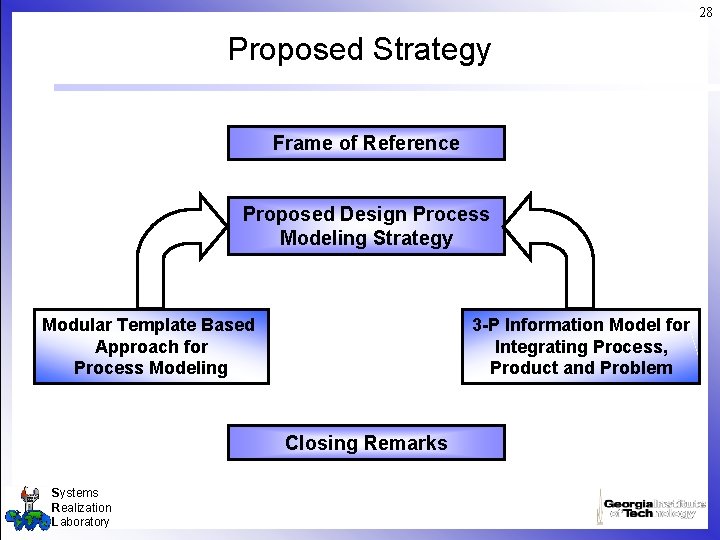
18 Proposed Strategy Frame of Reference Proposed Design Process Modeling Strategy Modular Template Based Approach for Process Modeling 3 -P Information Model for Integrating Process, Product and Problem Closing Remarks Systems Realization Laboratory
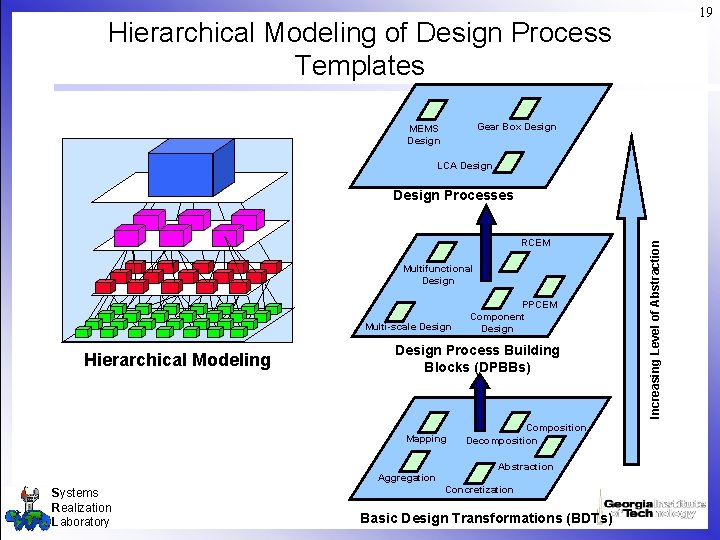
19 Hierarchical Modeling of Design Process Templates Gear Box Design MEMS Design LCA Design RCEM Multifunctional Design Multi-scale Design Hierarchical Modeling PPCEM Component Design Process Building Blocks (DPBBs) Mapping Composition Decomposition Abstraction Aggregation Systems Realization Laboratory Concretization Basic Design Transformations (BDTs) Increasing Level of Abstraction Design Processes
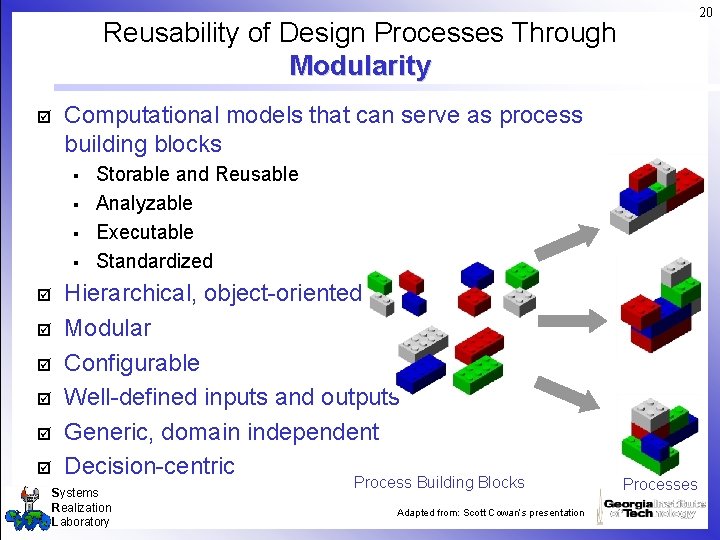
20 Reusability of Design Processes Through Modularity þ Computational models that can serve as process building blocks § § þ þ þ Storable and Reusable Analyzable Executable Standardized Hierarchical, object-oriented Modular Configurable Well-defined inputs and outputs Generic, domain independent Decision-centric Systems Realization Laboratory Process Building Blocks Adapted from: Scott Cowan’s presentation Processes
![21 Our Design Process Model Design Equation [Information State 2] = [Transformation] [Information State](http://slidetodoc.com/presentation_image_h2/10612cae879f288b048f7ecaa18c973c/image-21.jpg "21 Our Design Process Model Design Equation [Information State 2] = [Transformation] [Information State")
21 Our Design Process Model Design Equation [Information State 2] = [Transformation] [Information State 1] Information State A Information State 0 T 1 Information State B Designing T 2 Information State 2 T 3 Information State 3 T 4 Information State 4 Ti = Transformation of information from one state to another [Information State 1] = [T 1] [Information State 0] [Information State 2] = [T 2] [Information State 1] [Information State 3] = [T 3] [Information State 2] [Information State 4] = [T 4] [Information State 3] [Information State 4] = [T 4] [T 3] [T 2] [T 1] [Information State 0] Design Process: Network of Transformations of Information Systems Realization Laboratory
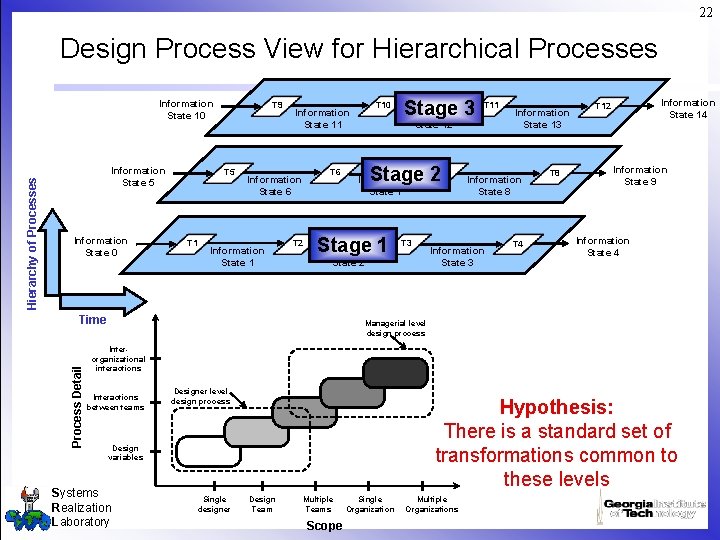
22 Design Process View for Hierarchical Processes Information State 5 Information State 0 T 9 T 5 T 1 T 6 Information State 1 T 10 Information State 11 T 2 Stage Information 3 T 11 State 12 Stage 2 T 3 Information State 7 Stage Information 1 T 3 State 2 Time Process Detail Hierarchy of Processes Information State 10 Information State 13 Information State 8 Information State 3 T 4 T 8 Information State 14 T 12 Information State 9 Information State 4 Managerial level design process Interorganizational interactions Interactions between teams Designer level design process Hypothesis: There is a standard set of transformations common to these levels Design variables Systems Realization Laboratory Single designer Design Team Multiple Teams Scope Single Organization Multiple Organizations
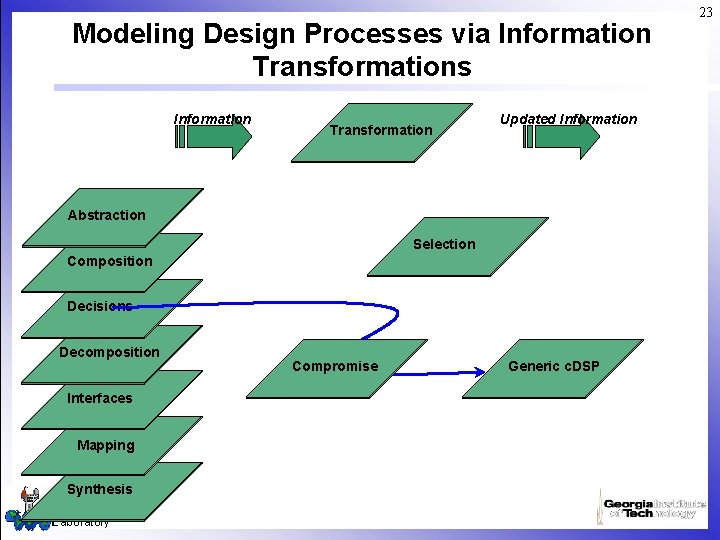
Modeling Design Processes via Information Transformations Information Transformation Updated Information Abstraction Selection Composition Decisions Decomposition Interfaces Mapping Synthesis Systems Realization Laboratory Compromise Generic c. DSP 23
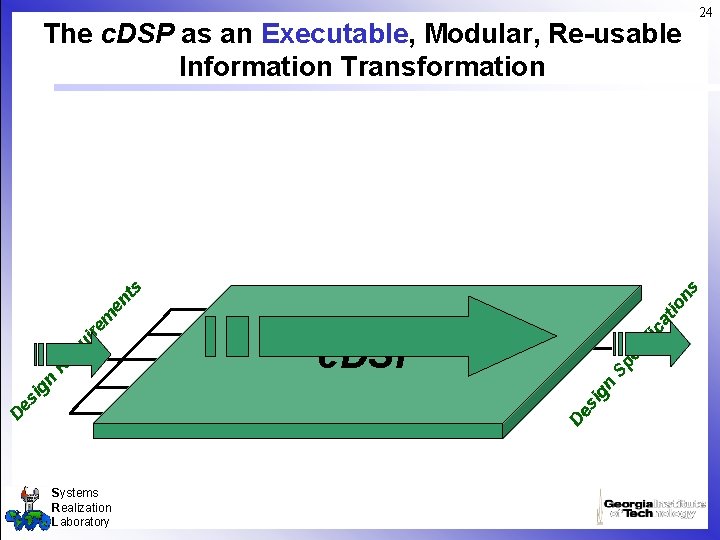
Objective Response Sp Goals Preferences Systems Realization Laboratory c. DSP Analysis gn Parameters ec ifi Driver m re qu i Re si gn De Variables ca tio ns Constraints De si en ts The c. DSP as an Executable, Modular, Re-usable Information Transformation 24
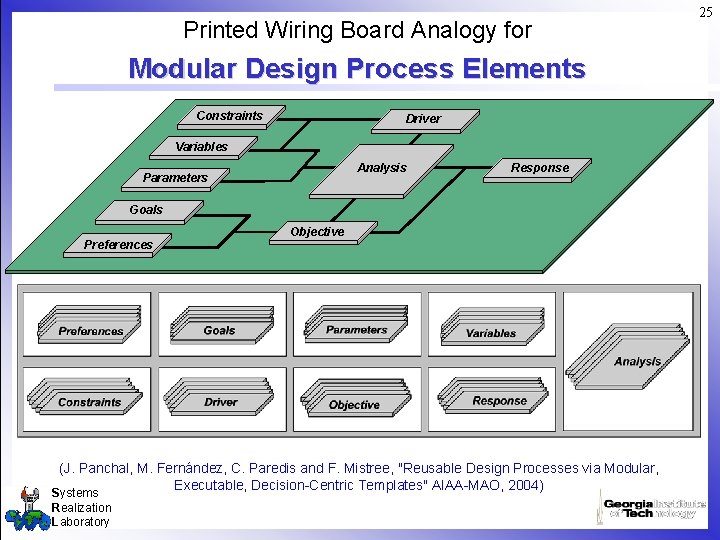
Printed Wiring Board Analogy for Modular Design Process Elements Constraints Driver Variables Analysis Parameters Response Goals Preferences Objective (J. Panchal, M. Fernández, C. Paredis and F. Mistree, "Reusable Design Processes via Modular, Executable, Decision-Centric Templates" AIAA-MAO, 2004) Systems Realization Laboratory 25
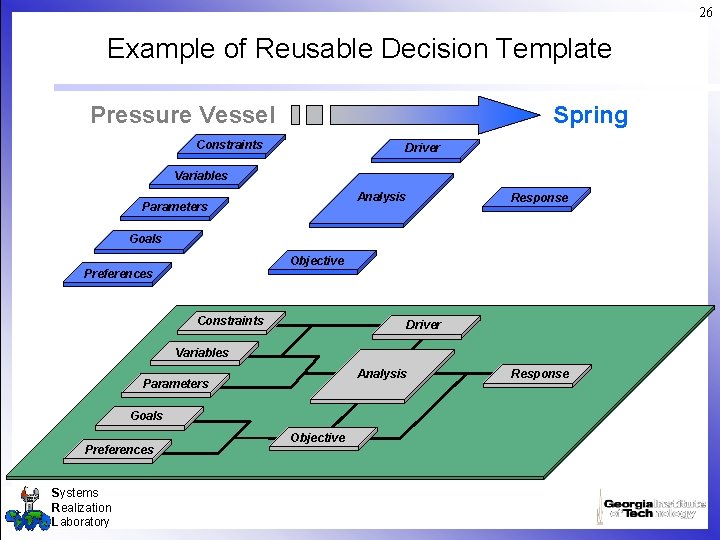
26 Example of Reusable Decision Template Pressure Vessel Spring Constraints Driver Variables Analysis Parameters Response Goals Objective Preferences Constraints Driver Variables Analysis Parameters Goals Preferences Systems Realization Laboratory Objective Response
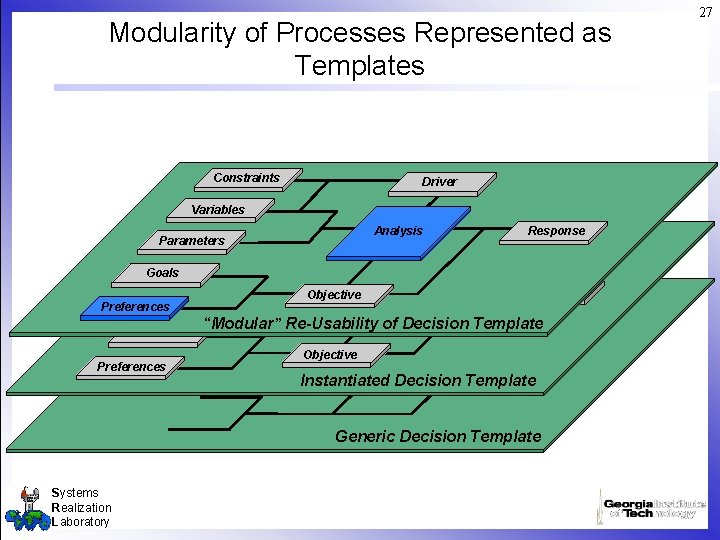
Modularity of Processes Represented as Templates Constraints Driver Variables Analysis Driver Constraints Parameters Response Goals Variables Parameters Preferences Goals Preferences Objective Analysis Response “Modular” Re-Usability of Decision Template Objective Instantiated Decision Template Generic Decision Template Systems Realization Laboratory 27
28 Proposed Strategy Frame of Reference Proposed Design Process Modeling Strategy Modular Template Based Approach for Process Modeling 3 -P Information Model for Integrating Process, Product and Problem Closing Remarks Systems Realization Laboratory
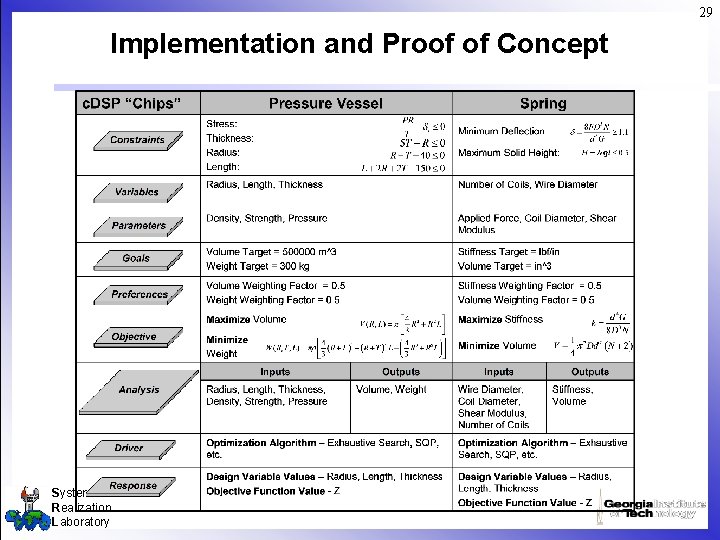
29 Implementation and Proof of Concept Systems Realization Laboratory
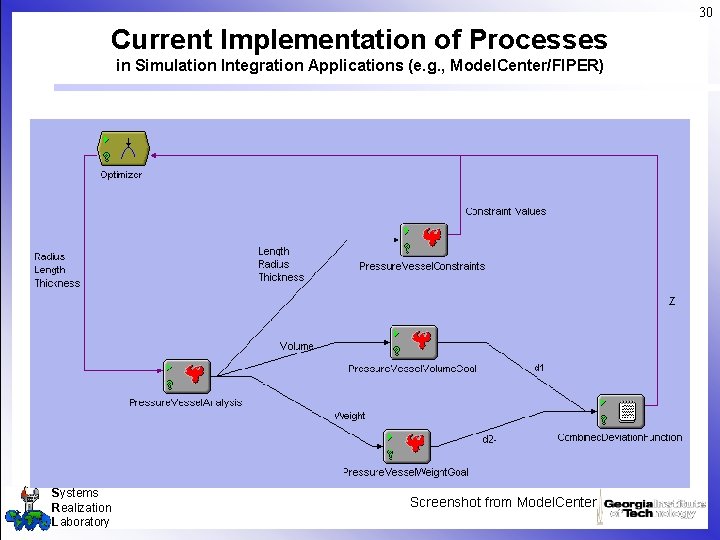
30 Current Implementation of Processes in Simulation Integration Applications (e. g. , Model. Center/FIPER) Systems Realization Laboratory Screenshot from Model. Center
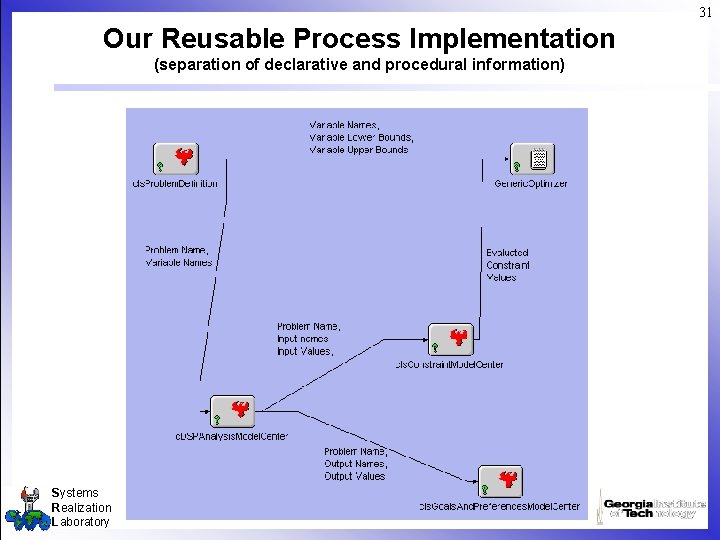
31 Our Reusable Process Implementation (separation of declarative and procedural information) Systems Realization Laboratory
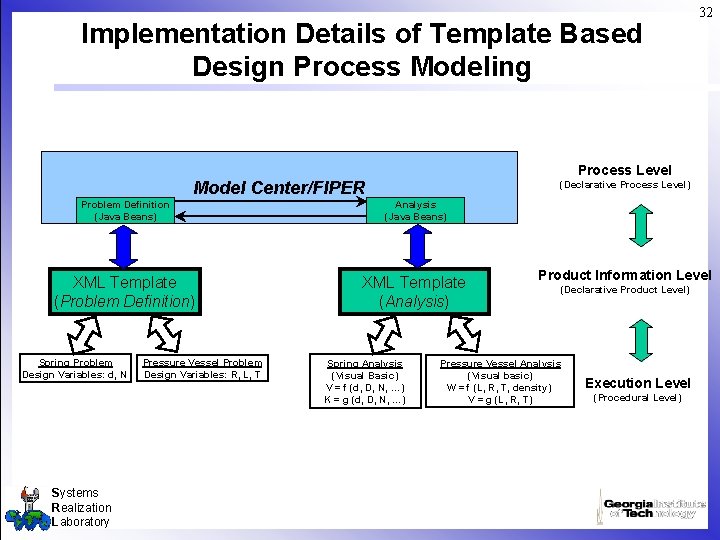
Implementation Details of Template Based Design Process Modeling Process Level Model Center/FIPER (Declarative Process Level) Problem Definition (Java Beans) Analysis (Java Beans) XML Template (Problem Definition) XML Template (Analysis) Spring Problem Design Variables: d, N Systems Realization Laboratory Pressure Vessel Problem Design Variables: R, L, T 32 Spring Analysis (Visual Basic) V = f (d, D, N, …) K = g (d, D, N, …) Product Information Level (Declarative Product Level) Pressure Vessel Analysis (Visual basic) W = f (L, R, T, density) V = g (L, R, T) Execution Level (Procedural Level)
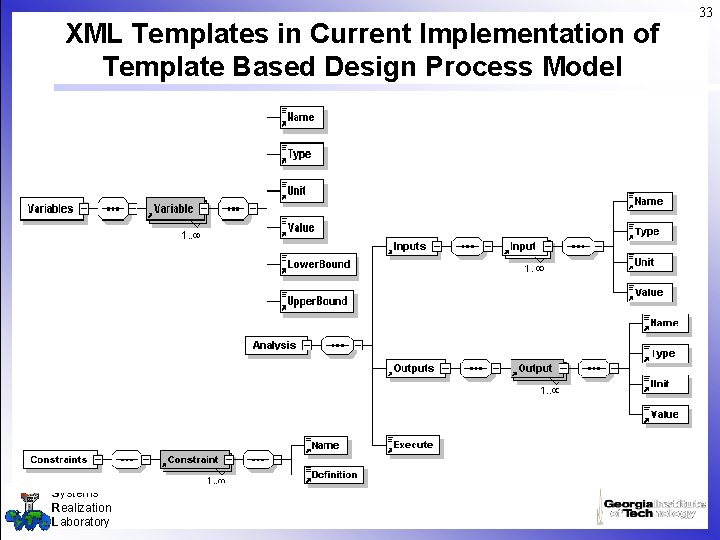
XML Templates in Current Implementation of Template Based Design Process Model Systems Realization Laboratory 33
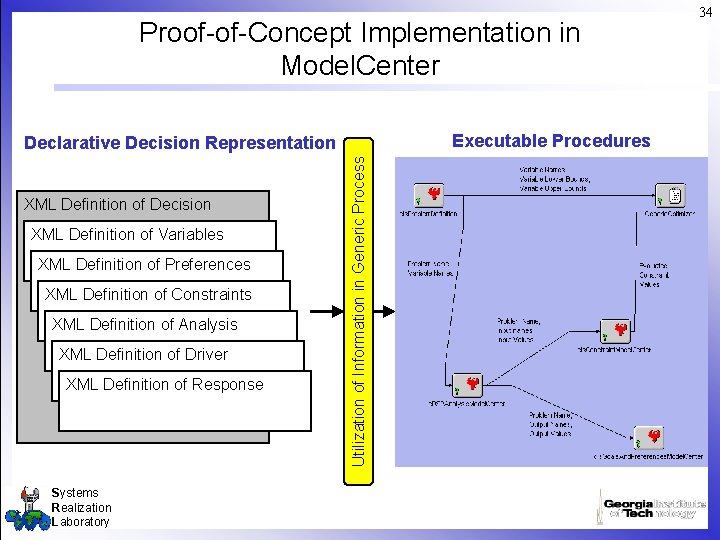
Proof-of-Concept Implementation in Model. Center Executable Procedures XML Definition of Decision XML Definition of Variables XML Definition of Preferences XML Definition of Constraints XML Definition of Analysis XML Definition of Driver XML Definition of Response Systems Realization Laboratory Utilization of Information in Generic Process Declarative Decision Representation 34
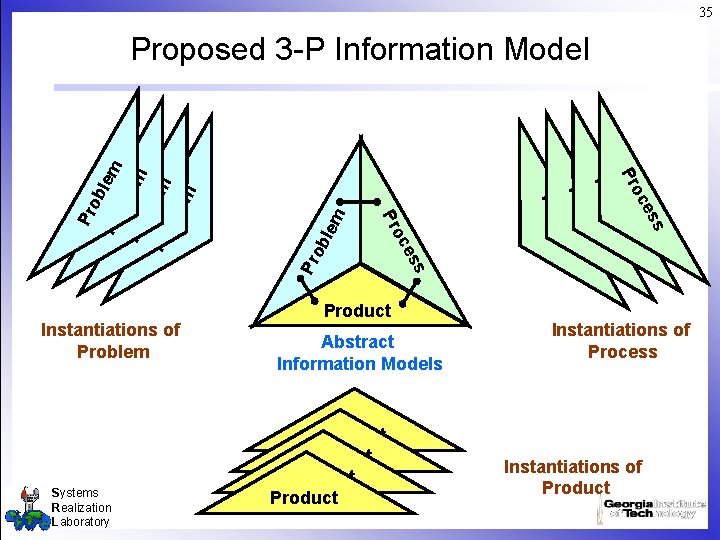
35 Pr ob lem Product Abstract Information Models Product s es oc Pr ess oc Pr Systems Realization Laboratory s Instantiations of Problem es oc Pr Pr ob lem Pr ob le Pr ob m lem Proposed 3 -P Information Model Instantiations of Process Instantiations of Product
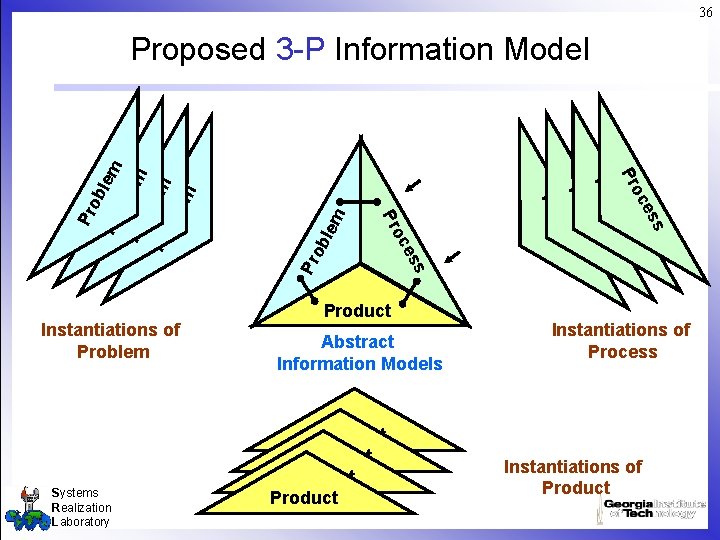
36 Pr ob lem Product Abstract Information Models Product s es oc Pr ess oc Pr Systems Realization Laboratory s Instantiations of Problem es oc Pr Pr ob lem Pr ob le Pr ob m lem Proposed 3 -P Information Model Instantiations of Process Instantiations of Product
Components of 3 P - Problem Information Model (Schema) Systems Realization Laboratory 37
Components of 3 P - Product Information Model (Schema) Systems Realization Laboratory 38
Components of 3 P - Process Information Model (Schema) Systems Realization Laboratory 39
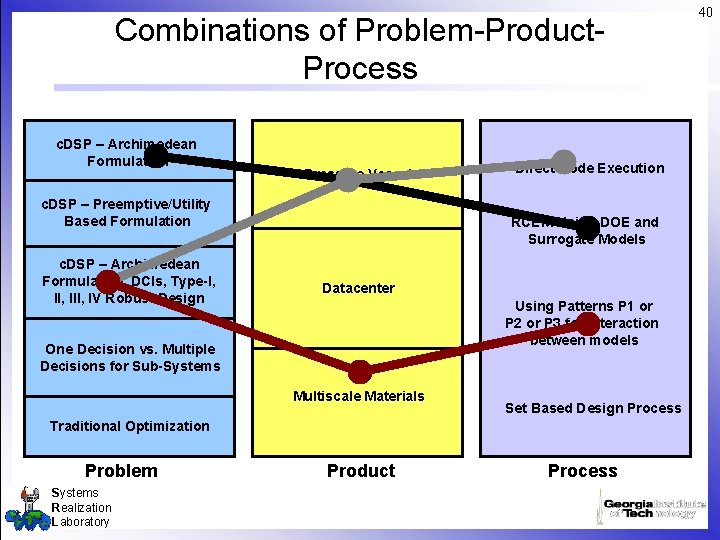
Combinations of Problem-Product. Process c. DSP – Archimedean Formulation Pressure Vessel c. DSP – Preemptive/Utility Based Formulation c. DSP – Archimedean Formulation, DCIs, Type-I, III, IV Robust Design Direct Code Execution RCEM-Using DOE and Surrogate Models Datacenter Using Patterns P 1 or P 2 or P 3 for interaction between models One Decision vs. Multiple Decisions for Sub-Systems Multiscale Materials Set Based Design Process Traditional Optimization Problem Systems Realization Laboratory Product Process 40
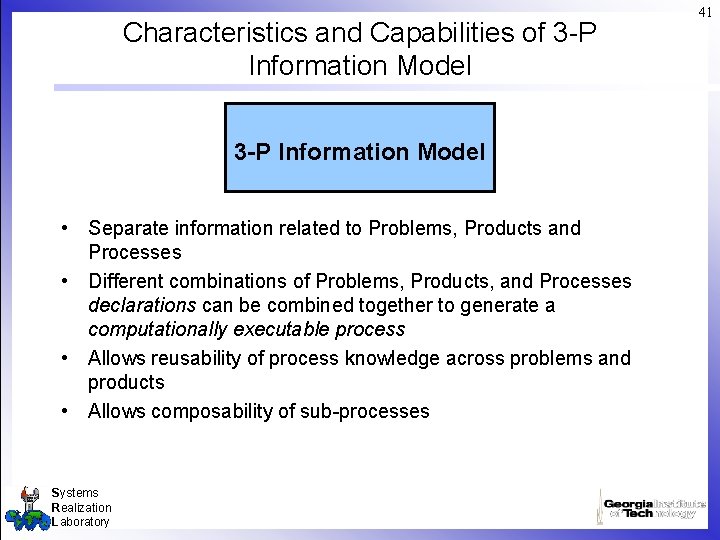
Characteristics and Capabilities of 3 -P Information Model • Separate information related to Problems, Products and Processes • Different combinations of Problems, Products, and Processes declarations can be combined together to generate a computationally executable process • Allows reusability of process knowledge across problems and products • Allows composability of sub-processes Systems Realization Laboratory 41
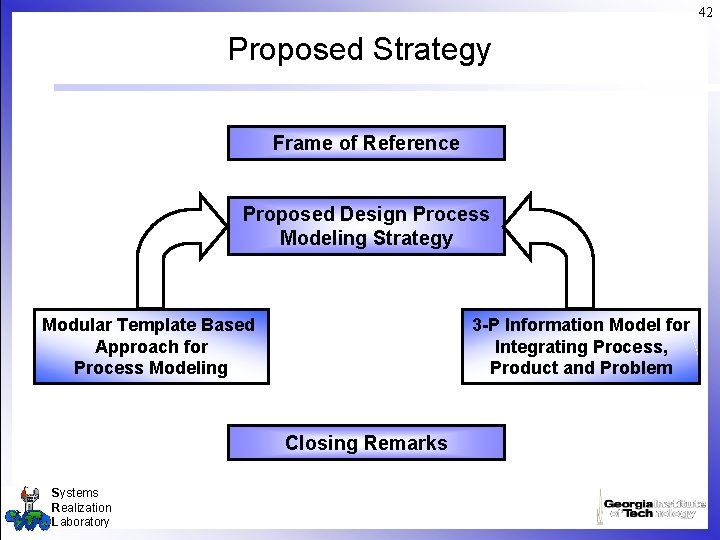
42 Proposed Strategy Frame of Reference Proposed Design Process Modeling Strategy Modular Template Based Approach for Process Modeling 3 -P Information Model for Integrating Process, Product and Problem Closing Remarks Systems Realization Laboratory
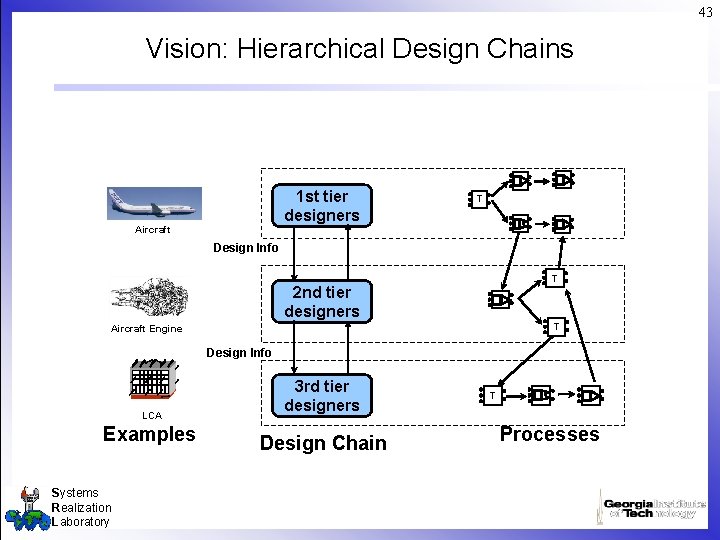
43 Vision: Hierarchical Design Chains 1 st tier designers Aircraft T Design Info T 2 nd tier designers T Aircraft Engine Design Info LCA Examples Systems Realization Laboratory 3 rd tier designers Design Chain T Processes
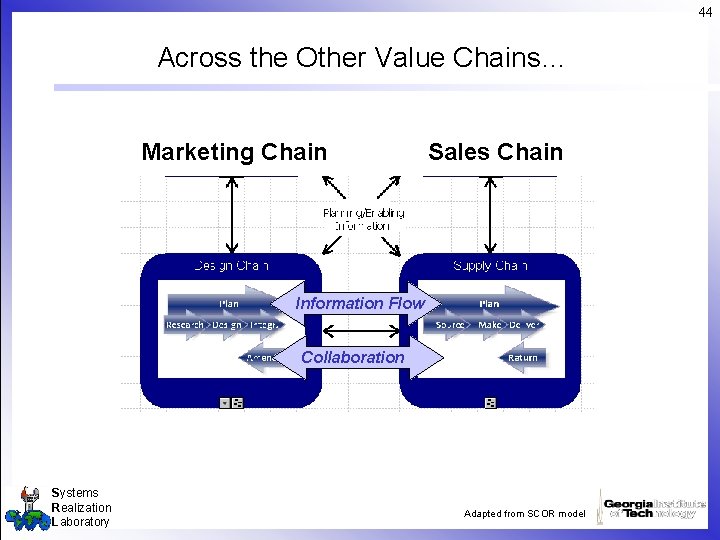
44 Across the Other Value Chains… Marketing Chain Sales Chain Information Flow Collaboration Systems Realization Laboratory Adapted from SCOR model
45 Acknowledgements We gratefully acknowledge support from þ National Science Foundation grants DMI-0085136 and DMI-0100123 þ Air Force Office of Scientific Research grant F 49620 -03 -1 -0348. þ Marco Gero Fernández is supported by a National Science Foundation IGERT Fellowship through the TI: GER Program at the Georgia Tech College of Management (NSF IGERT-0221600) and a President’s Fellowship from the Georgia Institute of Technology. Systems Realization Laboratory
- Slides: 45