
Modeling Primitive Skill Elements in Soar Bryan Stearns
Modeling Primitive Skill Elements in Soar Bryan Stearns University of Michigan June 2016 1
Outline �Motivation �PRIMs Theory: Primitive Skill Elements • Rule Composition �PRIMs in Soar • Learning Operator Composition �Roadmap �Conclusion 2
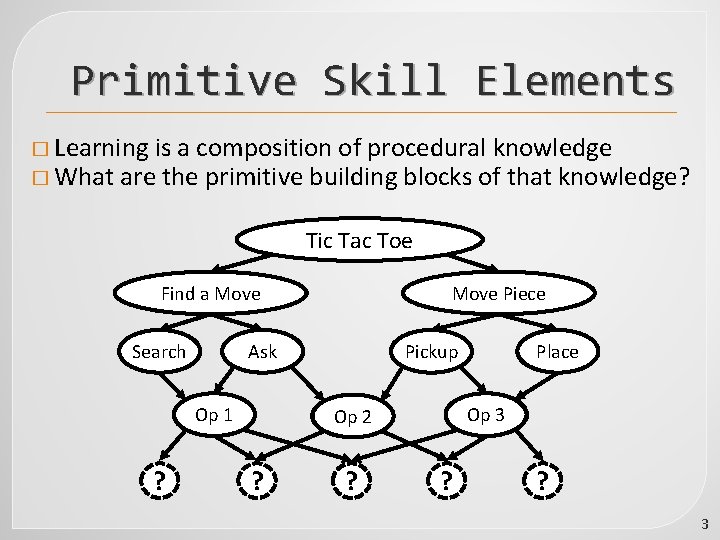
Primitive Skill Elements � Learning is a composition of procedural knowledge � What are the primitive building blocks of that knowledge? Tic Tac Toe Find a Move Search Ask Op 1 ? Move Piece Pickup Op 3 Op 2 ? ? Place ? ? 3
Objectives �Identify the primitive building blocks of procedural knowledge in Soar • Is there a fundamental set of operators? • How may these be composed via chunking? �Exploit primitives for construction of more complex structures and procedures • Increasing the range of knowledge manipulation • Learning internal tasks 4
Outline �Motivation �PRIMs Theory: Primitive Skill Elements • Rule Composition �PRIMs in Soar • Learning Operator Composition �Roadmap �Conclusion 5
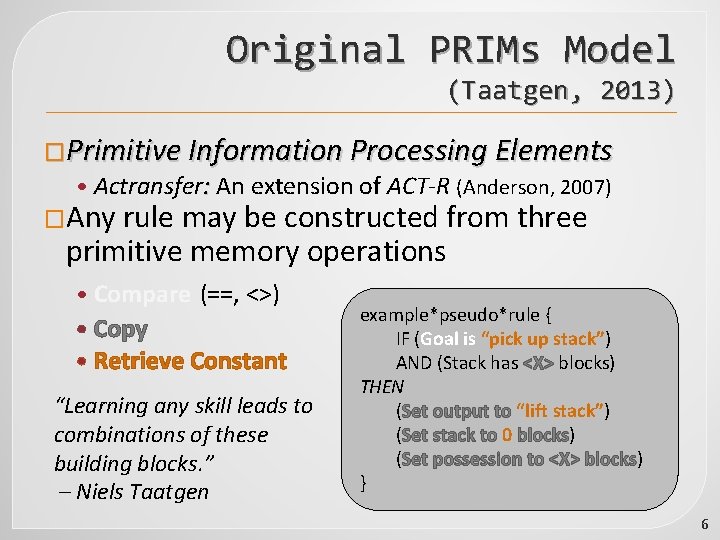
Original PRIMs Model (Taatgen, 2013) �Primitive Information Processing Elements • Actransfer: An extension of ACT-R (Anderson, 2007) �Any rule may be constructed from three primitive memory operations • Compare (==, <>) • Copy • Retrieve Constant “Learning any skill leads to combinations of these building blocks. ” – Niels Taatgen example*pseudo*rule { IF (Goal is “pick up stack”) AND (Stack has <X> blocks) THEN (Set output to “lift stack”) (Set stack to 0 blocks) (Set possession to <X> blocks) } 6
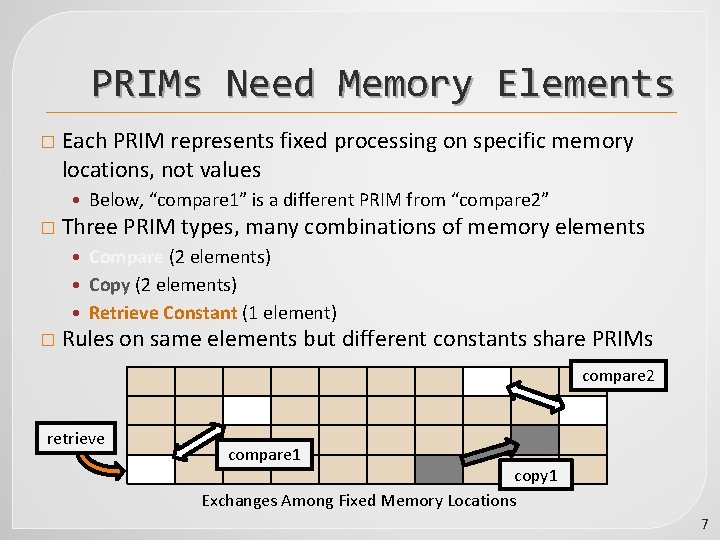
PRIMs Need Memory Elements � Each PRIM represents fixed processing on specific memory locations, not values • Below, “compare 1” is a different PRIM from “compare 2” � Three PRIM types, many combinations of memory elements • Compare (2 elements) • Copy (2 elements) • Retrieve Constant (1 element) � Rules on same elements but different constants share PRIMs compare 2 retrieve compare 1 copy 1 Exchanges Among Fixed Memory Locations 7
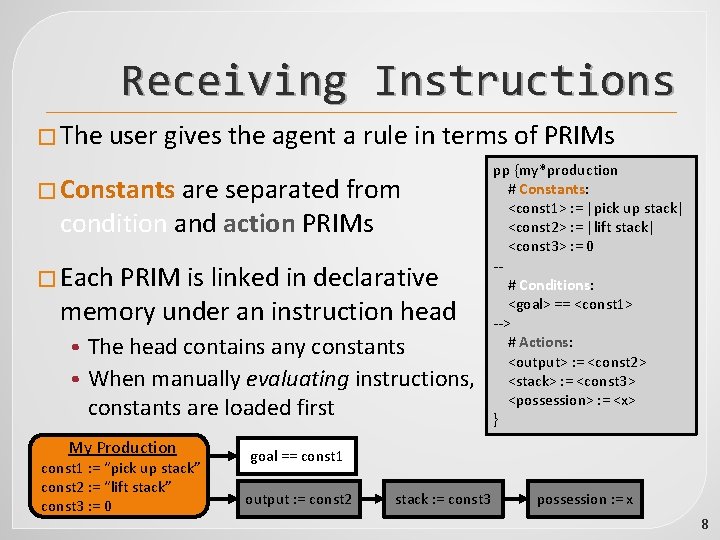
Receiving Instructions � The user gives the agent a rule in terms of PRIMs � Constants are separated from condition and action PRIMs � Each PRIM is linked in declarative memory under an instruction head • The head contains any constants • When manually evaluating instructions, constants are loaded first My Production const 1 : = “pick up stack” const 2 : = “lift stack” const 3 : = 0 pp {my*production # Constants: <const 1> : = |pick up stack| <const 2> : = |lift stack| <const 3> : = 0 -- # Conditions: <goal> == <const 1> --> # Actions: <output> : = <const 2> <stack> : = <const 3> <possession> : = <x> } goal == const 1 output : = const 2 stack : = const 3 possession : = x 8
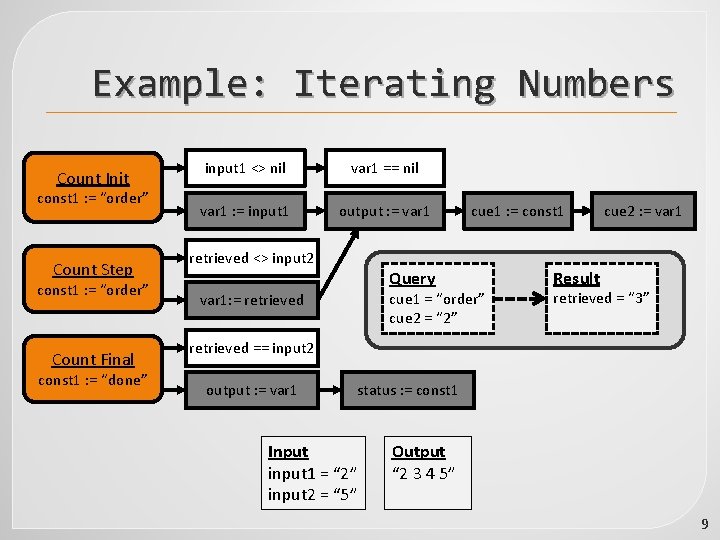
Example: Iterating Numbers Count Init const 1 : = “order” Count Step const 1 : = “order” Count Final const 1 : = “done” input 1 <> nil var 1 == nil var 1 : = input 1 output : = var 1 retrieved <> input 2 Query cue 1 : = const 1 cue 1 = “order” cue 2 = “ 2” var 1: = retrieved cue 2 : = var 1 Result retrieved = “ 3” retrieved == input 2 output : = var 1 status : = const 1 Input input 1 = “ 2” input 2 = “ 5” Output “ 2 3 4 5” 9
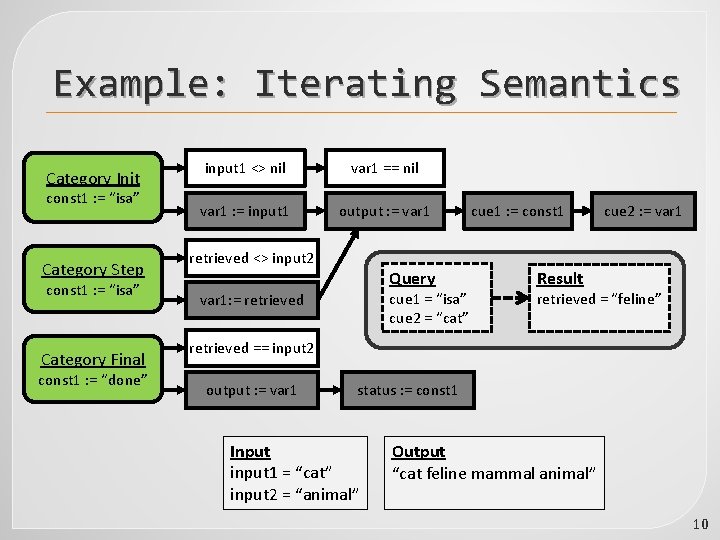
Example: Iterating Semantics Category Init const 1 : = “isa” Category Step const 1 : = “isa” Category Final const 1 : = “done” input 1 <> nil var 1 == nil var 1 : = input 1 output : = var 1 retrieved <> input 2 Query cue 1 : = const 1 cue 1 = “isa” cue 2 = “cat” var 1: = retrieved cue 2 : = var 1 Result retrieved = “feline” retrieved == input 2 output : = var 1 status : = const 1 Input input 1 = “cat” input 2 = “animal” Output “cat feline mammal animal” 10
Outline �Motivation �PRIMs Theory: Primitive Skill Elements • Rule Composition �PRIMs in Soar • Learning Operator Composition �Roadmap �Conclusion 11
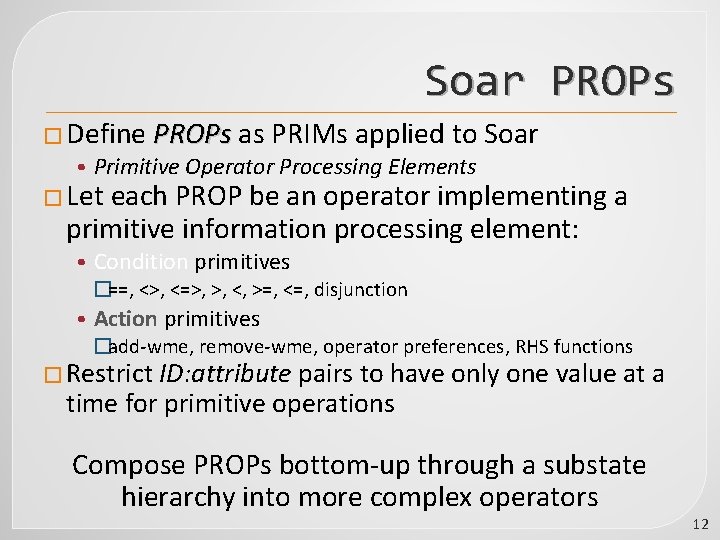
Soar PROPs � Define PROPs as PRIMs applied to Soar PROPs • Primitive Operator Processing Elements � Let each PROP be an operator implementing a primitive information processing element: • Condition primitives �==, <>, <=>, >, <, >=, <=, disjunction • Action primitives �add-wme, remove-wme, operator preferences, RHS functions � Restrict ID: attribute pairs to have only one value at a time for primitive operations Compose PROPs bottom-up through a substate hierarchy into more complex operators 12
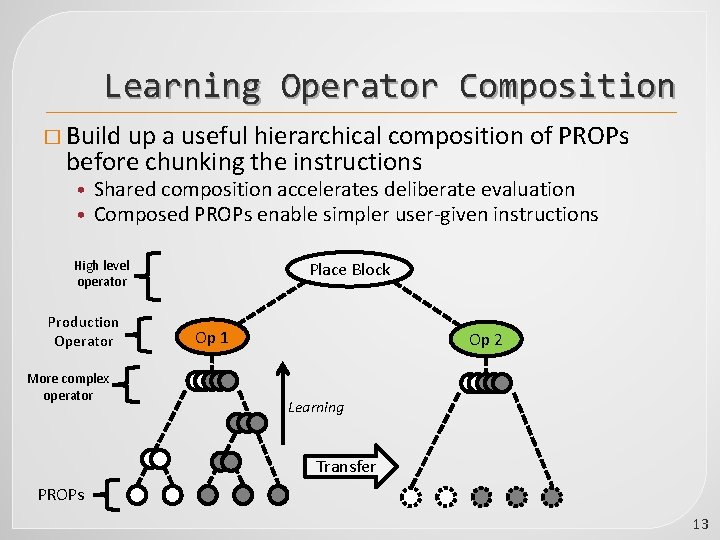
Learning Operator Composition � Build up a useful hierarchical composition of PROPs before chunking the instructions • Shared composition accelerates deliberate evaluation • Composed PROPs enable simpler user-given instructions High level operator Production Operator More complex operator Place Block Op 1 Op 2 Learning Transfer PROPs 13
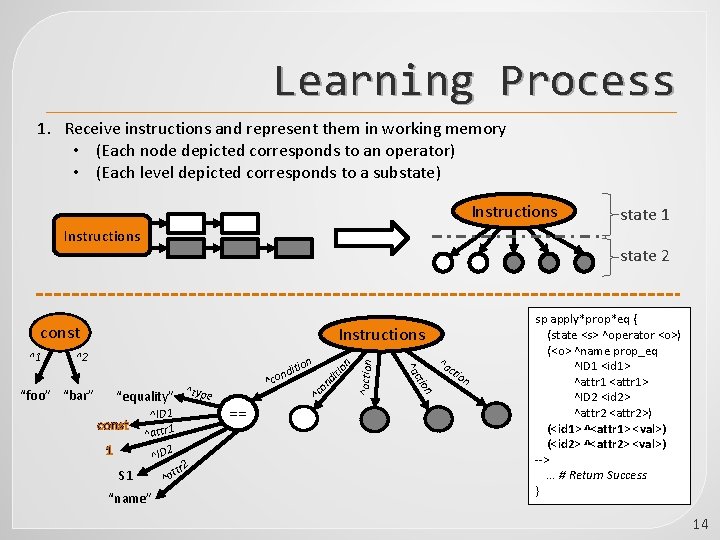
Learning Process 1. Receive instructions and represent them in working memory • (Each node depicted corresponds to an operator) • (Each level depicted corresponds to a substate) Instructions state 2 const 1 ^ID 1 ^attr 1 2 ^ID S 1 “name” tr 2 t ^a == ^action on cti “equality” ^type “foo” “bar” ^a tion ndi ^co di ti ^2 on Instructions ^c on ^1 state 1 ^a c tio n sp apply*prop*eq { (state <s> ^operator <o>) (<o> ^name prop_eq ^ID 1 <id 1> ^attr 1 <attr 1> ^ID 2 <id 2> ^attr 2 <attr 2>) (<id 1> ^<attr 1> <val>) (<id 2> ^<attr 2> <val>) --> … # Return Success } 14
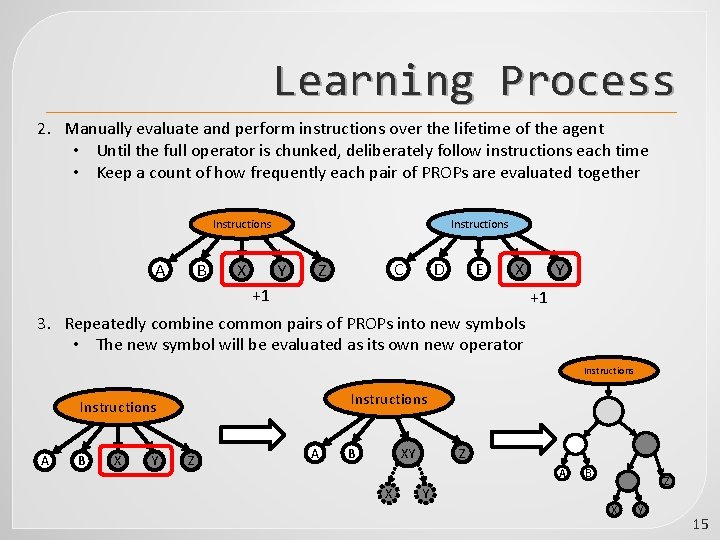
Learning Process 2. Manually evaluate and perform instructions over the lifetime of the agent • Until the full operator is chunked, deliberately follow instructions each time • Keep a count of how frequently each pair of PROPs are evaluated together Instructions A B X Y C Z D E X +1 Y +1 3. Repeatedly combine common pairs of PROPs into new symbols • The new symbol will be evaluated as its own new operator Instructions A B X Y Z A XY B Z A X B Z Y X Y 15
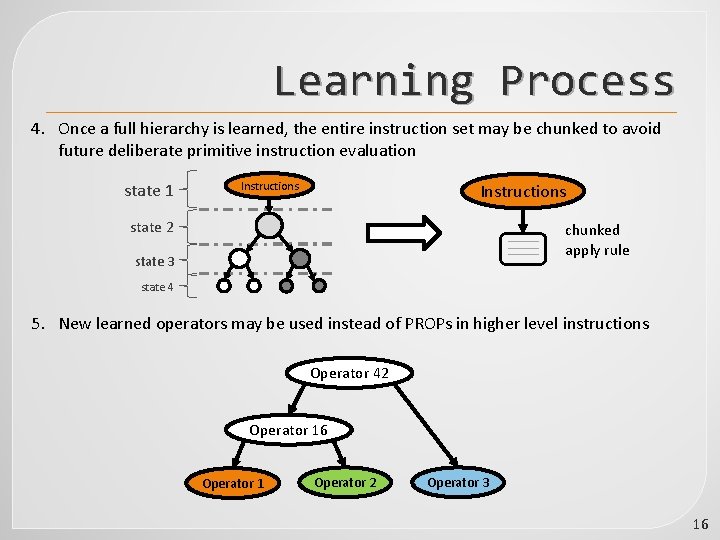
Learning Process 4. Once a full hierarchy is learned, the entire instruction set may be chunked to avoid future deliberate primitive instruction evaluation state 1 Instructions state 2 chunked apply rule state 3 state 4 5. New learned operators may be used instead of PROPs in higher level instructions Operator 42 Operator 16 Operator 1 Operator 2 Operator 3 16
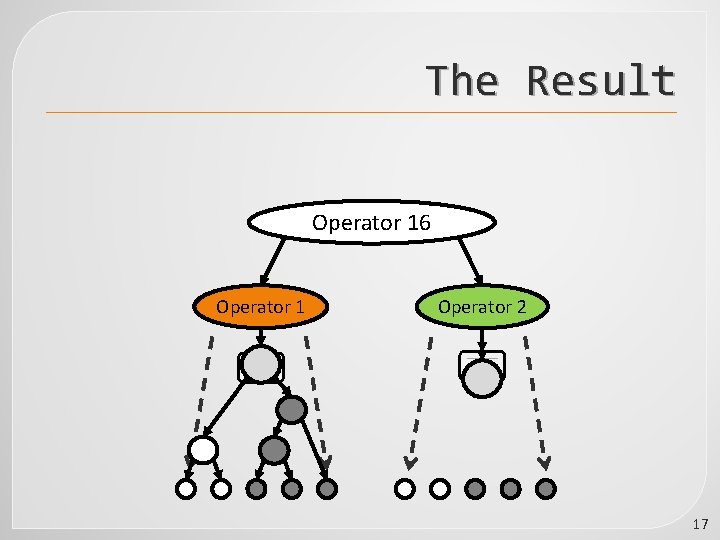
The Result Operator 16 Operator 1 Operator 2 17
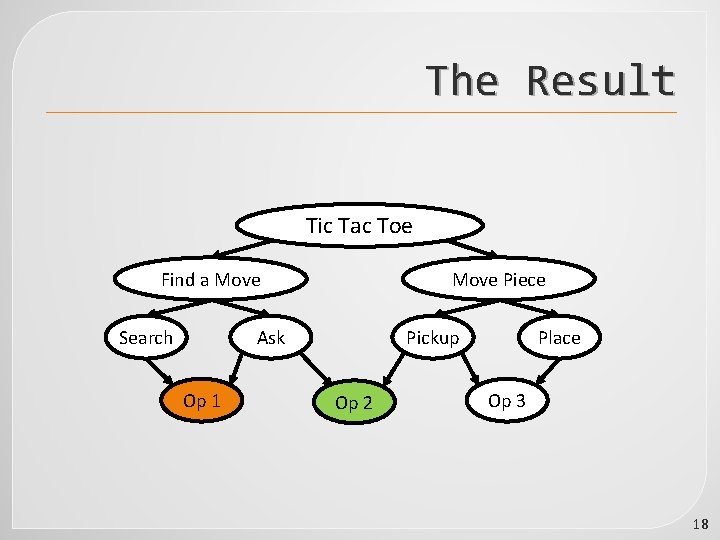
The Result Tic Tac Toe Find a Move Search Move Piece Ask Op 1 Pickup Op 2 Place Op 3 18
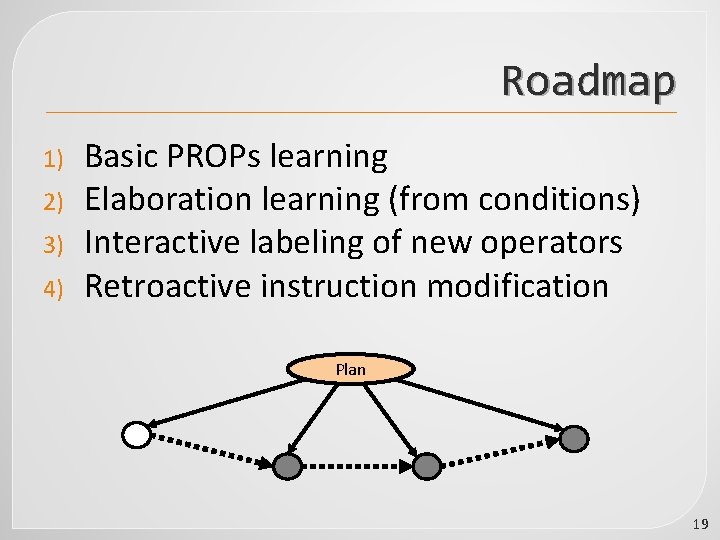
Roadmap 1) 2) 3) 4) Basic PROPs learning Elaboration learning (from conditions) Interactive labeling of new operators Retroactive instruction modification Plan 19
Conclusion �Nuggets • Can be taught procedural reasoning from scratch • Low-level may quickly be extended to high-level • Learned hierarchy can be made viewable and labelable �Coal • Not yet implemented/tested • Writing PROPs instructions requires expert knowledge • ID: attr pairs referenced by PROPs must be kept unique until those PROPs are chunked 20
Bibliography Anderson, J. R. (2007). How can the human mind occur in the physical universe? doi: 10. 1093/acprof: oso/9780195324259. 001. 0001 � Taatgen, N. A. (2013). The nature and transfer of cognitive skills. Psychological Review, 120(3), 439 -471. � 21
Modeling Primitive Skill Elements in Soar Bryan Stearns Questions? 22
- Slides: 22