
Modeling Pedagogical Models in Science Education Luanna Prevost
- Slides: 10
Modeling: Pedagogical Models in Science Education Luanna Prevost MSP Workshop May 18 -20, 2015 University of South Florida
Modeling • The process of building, using and evaluating external representations of systems • Authentic science practice • An important constructivist teaching strategy
Why Models? • Can be manipulated • Simplify • Can represent phenomena that are very large or very small • Represent important components • Focus attention • Communicate ideas
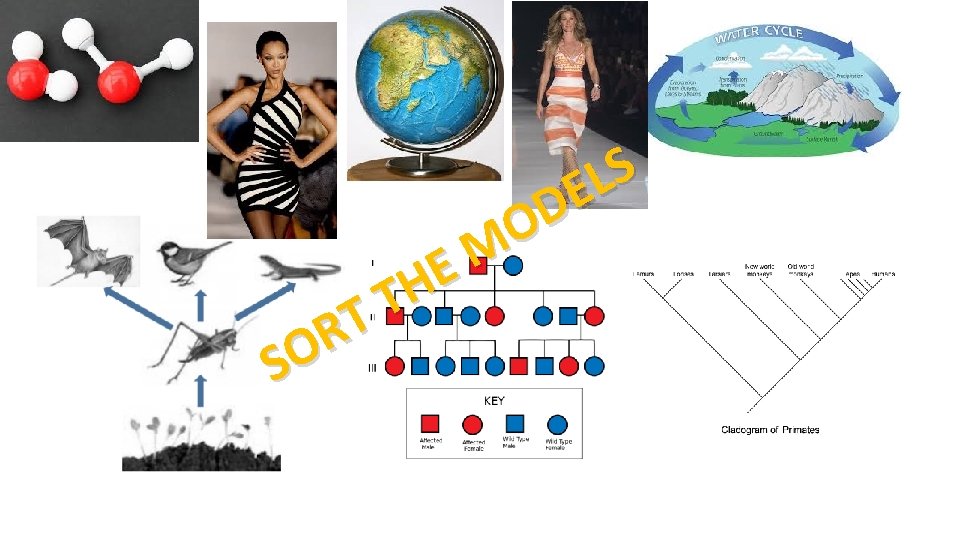
T R SO S L E D O M E TH
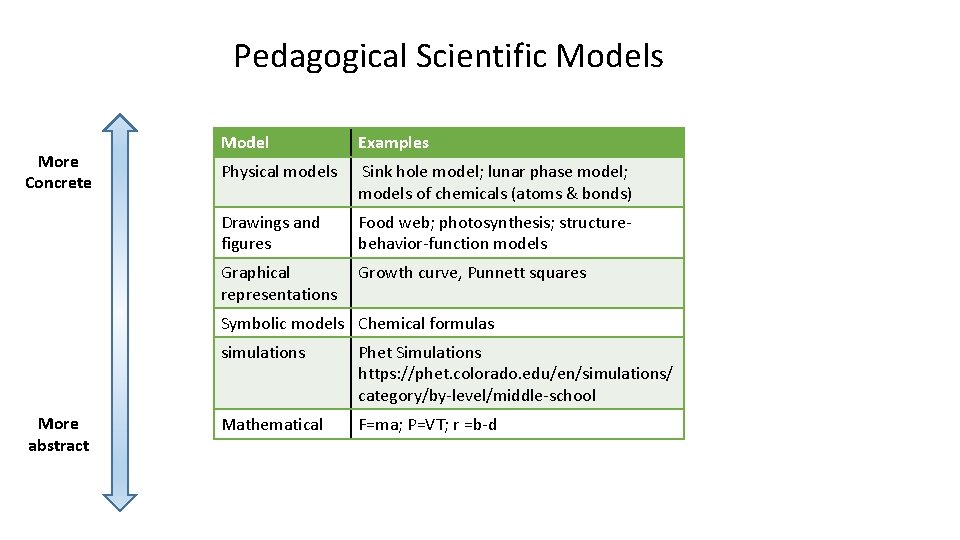
Pedagogical Scientific Models More Concrete Model Examples Physical models Sink hole model; lunar phase model; models of chemicals (atoms & bonds) Drawings and figures Food web; photosynthesis; structurebehavior-function models Graphical representations Growth curve, Punnett squares Symbolic models Chemical formulas More abstract simulations Phet Simulations https: //phet. colorado. edu/en/simulations/ category/by-level/middle-school Mathematical F=ma; P=VT; r =b-d
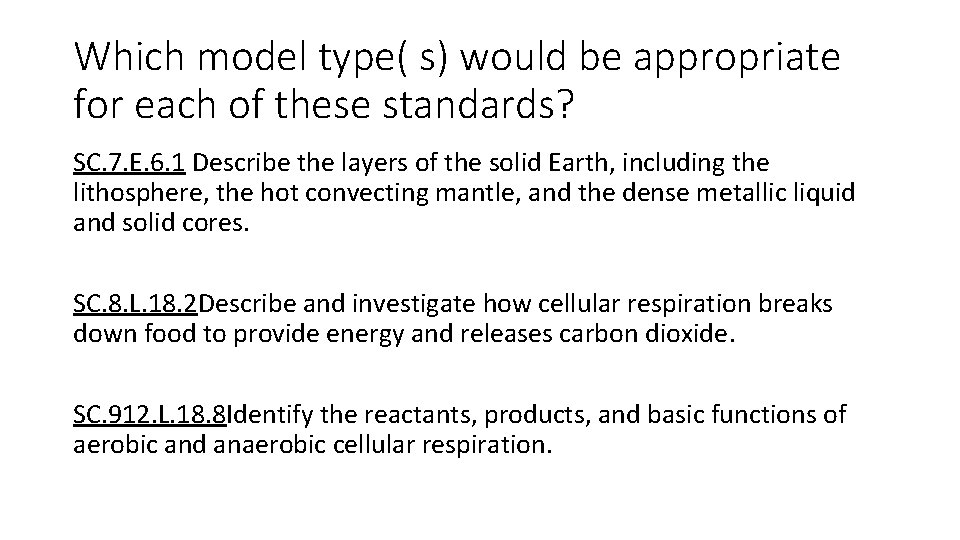
Which model type( s) would be appropriate for each of these standards? SC. 7. E. 6. 1 Describe the layers of the solid Earth, including the lithosphere, the hot convecting mantle, and the dense metallic liquid and solid cores. SC. 8. L. 18. 2 Describe and investigate how cellular respiration breaks down food to provide energy and releases carbon dioxide. SC. 912. L. 18. 8 Identify the reactants, products, and basic functions of aerobic and anaerobic cellular respiration.
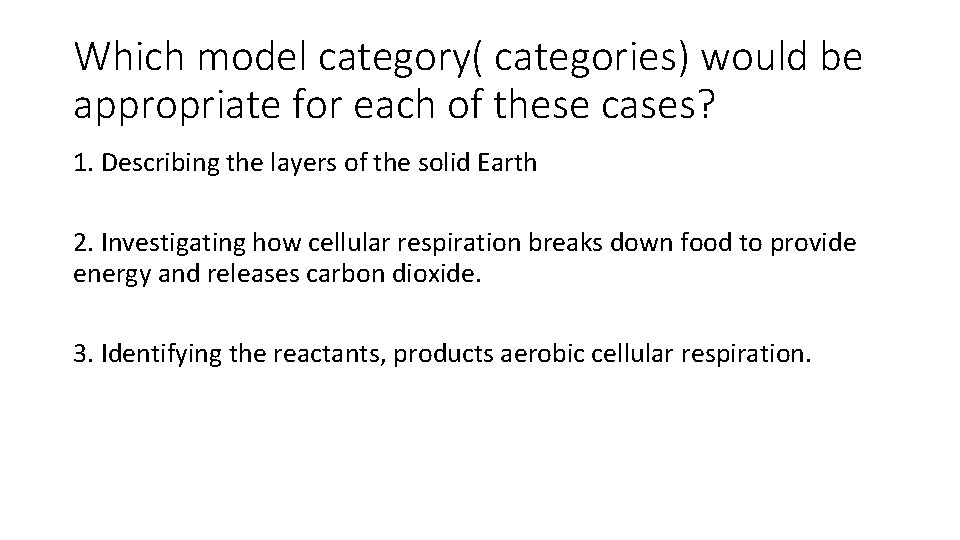
Which model category( categories) would be appropriate for each of these cases? 1. Describing the layers of the solid Earth 2. Investigating how cellular respiration breaks down food to provide energy and releases carbon dioxide. 3. Identifying the reactants, products aerobic cellular respiration.
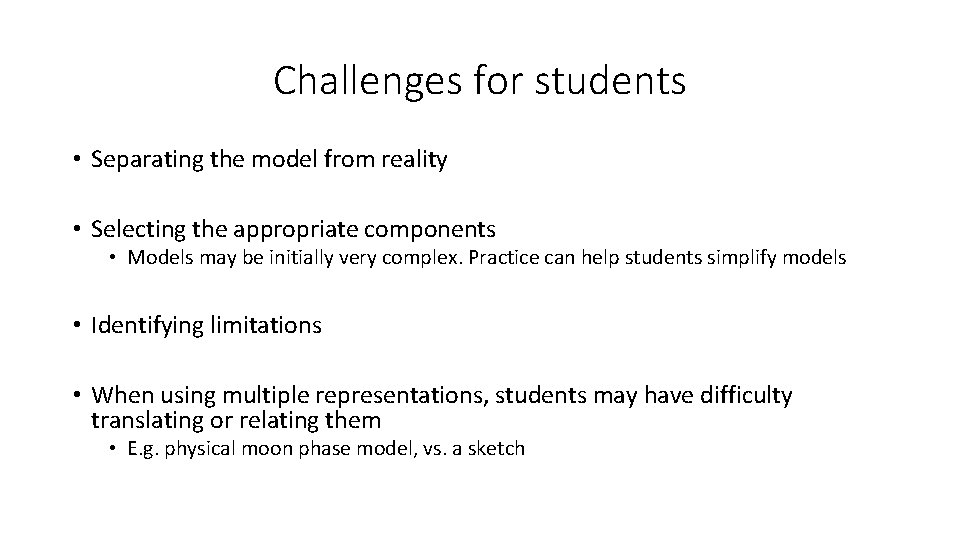
Challenges for students • Separating the model from reality • Selecting the appropriate components • Models may be initially very complex. Practice can help students simplify models • Identifying limitations • When using multiple representations, students may have difficulty translating or relating them • E. g. physical moon phase model, vs. a sketch
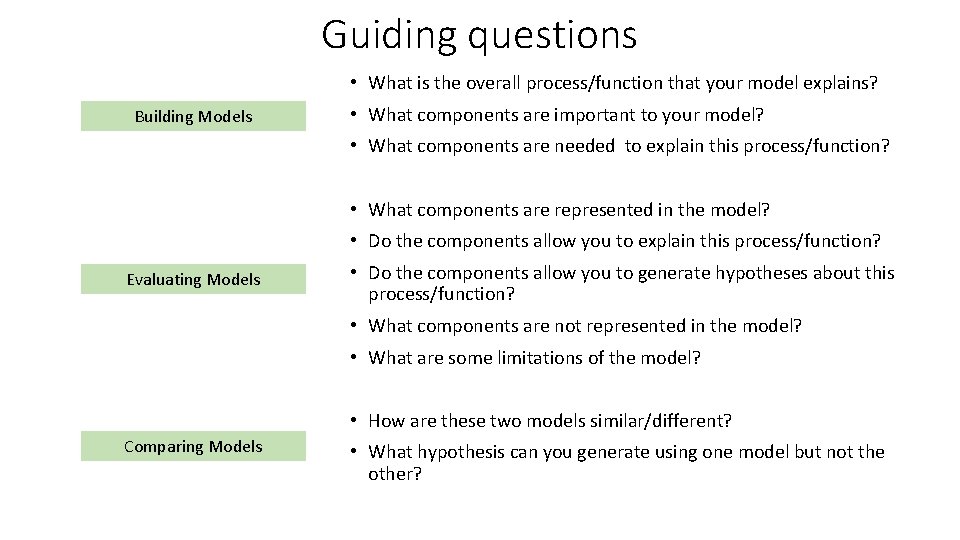
Guiding questions • What is the overall process/function that your model explains? Building Models • What components are important to your model? • What components are needed to explain this process/function? • What components are represented in the model? • Do the components allow you to explain this process/function? Evaluating Models • Do the components allow you to generate hypotheses about this process/function? • What components are not represented in the model? • What are some limitations of the model? • How are these two models similar/different? Comparing Models • What hypothesis can you generate using one model but not the other?
References • Dauer, J. T. , Momsen, J. L. , Speth, E. B. , Makohon-Moore, S. C. , & Long, T. M. (2013). Analyzing change in students’ gene-to-evolution models in college-level introductory biology. Journal of Research in Science Teaching, 50(6), 639– 659. • Harrison, A. G. , & Treagust, D. F. (1996). Secondary students’ mental models of atoms and molecules: Implications for teaching chemistry. Science Education, 80(5), 509– 534. http: //doi. org/10. 1002/(SICI)1098 -237 X(199609)80: 5<509: : AID-SCE 2>3. 0. CO; 2 -F • Harrison, A. G. , & Treagust, D. F. (2000). A typology of school science models. International Journal of Science Education, 22(9), 1011– 1026. http: //doi. org/10. 1080/095006900416884 • Leenaars, F. A. , van Joolingen, W. R. , & Bollen, L. (2013). Using self-made drawings to support modelling in science education. British Journal of Educational Technology, 44(1), 82– 94.