
Modeling Pathways with the pCalculus Concurrent Processes Come
![Global communication channels x ? [y] –Input into y on channel name x? x](https://slidetodoc.com/presentation_image_h2/81dc7e05a7031f91e61187387ab9d613/image-9.jpg "Global communication channels x ? [y] –Input into y on channel name x? x")
![Communication and scope extrusion (new x) (y ! [x]) – Extrusion of local channel](https://slidetodoc.com/presentation_image_h2/81dc7e05a7031f91e61187387ab9d613/image-12.jpg "Communication and scope extrusion (new x) (y ! [x]) – Extrusion of local channel")
- Slides: 27
Modeling Pathways with the p-Calculus: Concurrent Processes Come Alive Aviv Regev Joint work with Udi Shapiro, Bill Silverman and Naama Barkai
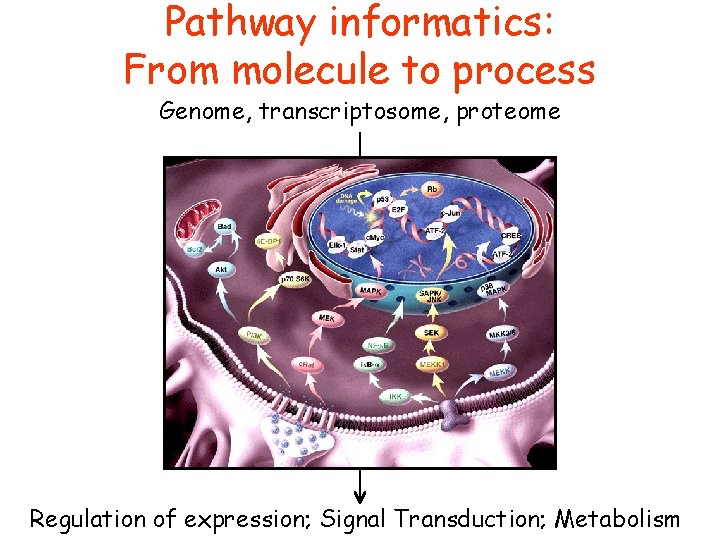
Pathway informatics: From molecule to process Genome, transcriptosome, proteome Regulation of expression; Signal Transduction; Metabolism
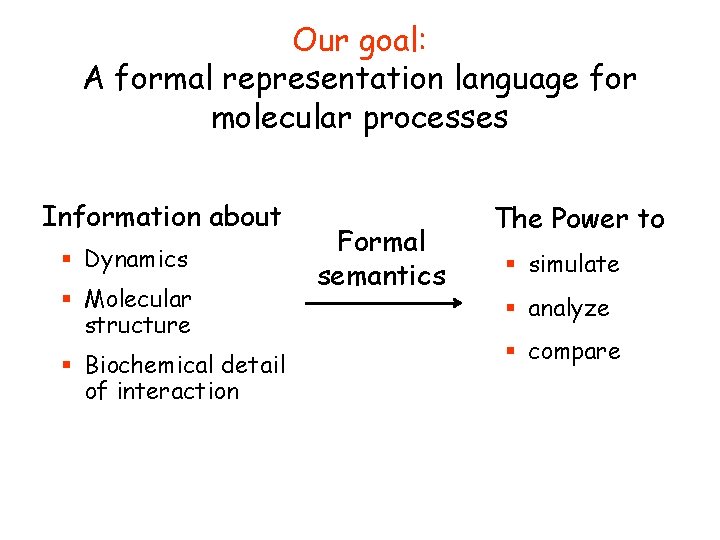
Our goal: A formal representation language for molecular processes Information about § Dynamics § Molecular structure § Biochemical detail of interaction Formal semantics The Power to § simulate § analyze § compare
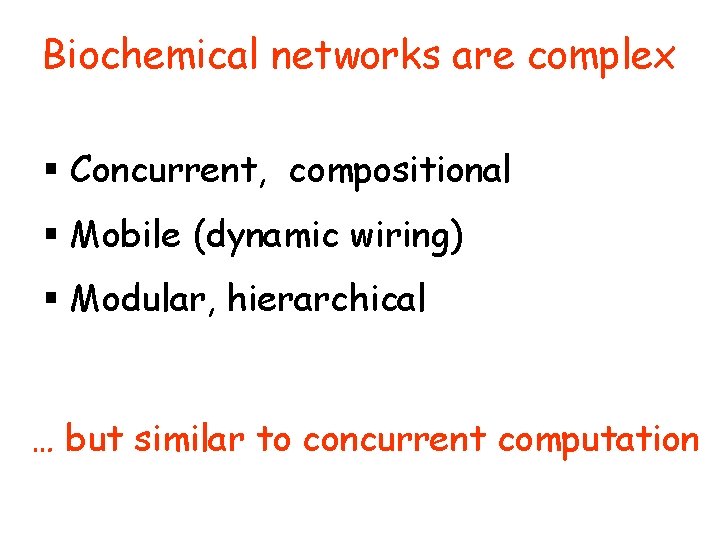
Biochemical networks are complex § Concurrent, compositional § Mobile (dynamic wiring) § Modular, hierarchical … but similar to concurrent computation
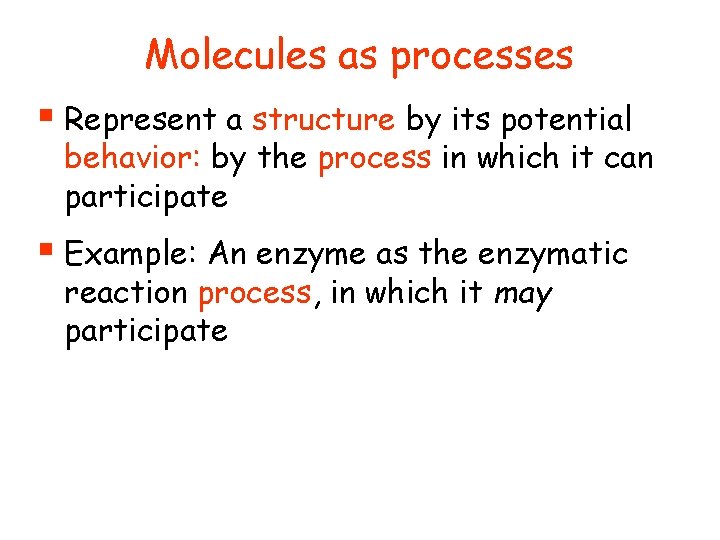
Molecules as processes § Represent a structure by its potential behavior: by the process in which it can participate § Example: An enzyme as the enzymatic reaction process, in which it may participate
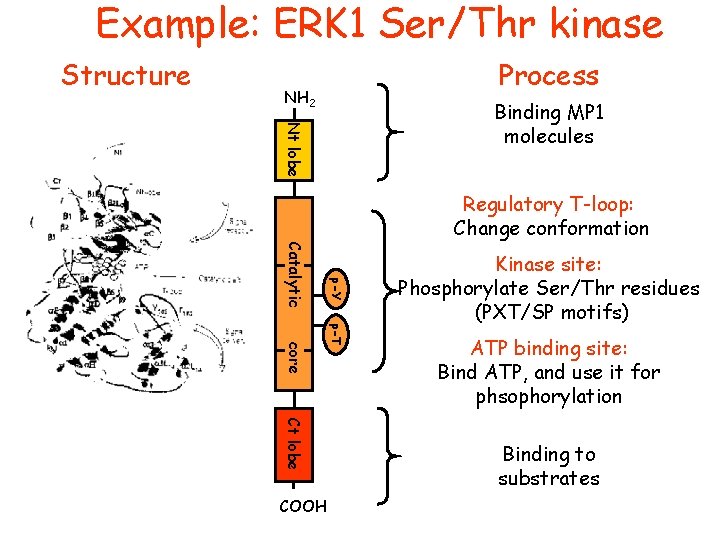
Example: ERK 1 Ser/Thr kinase Structure Process NH 2 Nt lobe Binding MP 1 molecules Regulatory T-loop: Change conformation p-Y Catalytic p-T core Ct lobe COOH Kinase site: Phosphorylate Ser/Thr residues (PXT/SP motifs) ATP binding site: Bind ATP, and use it for phsophorylation Binding to substrates
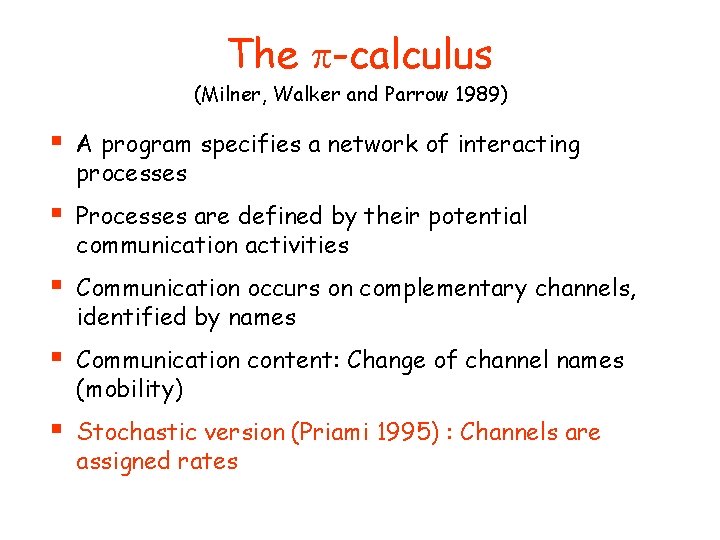
The p-calculus (Milner, Walker and Parrow 1989) § A program specifies a network of interacting processes § Processes are defined by their potential communication activities § Communication occurs on complementary channels, identified by names § Communication content: Change of channel names (mobility) § Stochastic version (Priami 1995) : Channels are assigned rates
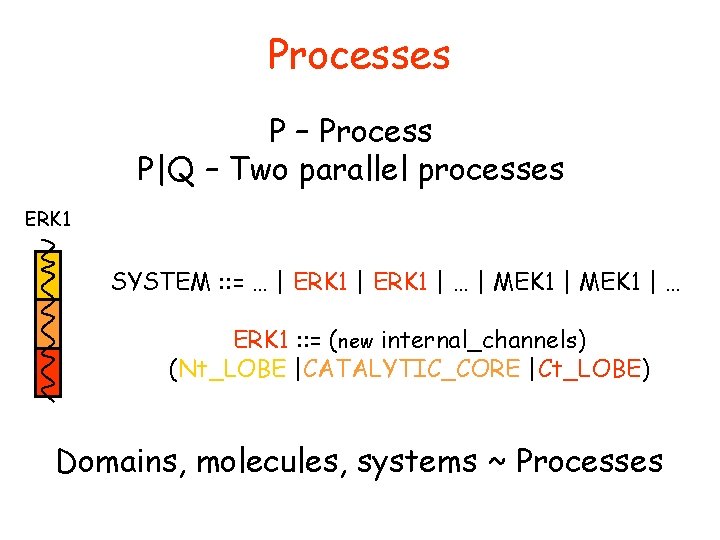
Processes P – Process P|Q – Two parallel processes ERK 1 SYSTEM : : = … | ERK 1 | … | MEK 1 | … ERK 1 : : = (new internal_channels) (Nt_LOBE |CATALYTIC_CORE |Ct_LOBE) Domains, molecules, systems ~ Processes
Global communication channels x ? [y] –Input into y on channel name x? x ! [z] – Output z on channel co-named x! MEK 1 T_LOOP (tyr ): : = tyr ? [tyr]. T_LOOP(tyr) KINASE_ACTIVE_SITE: : = tyr ! [p-tyr]. KINASE_ACTIVE_SITE Complementary molecular structures ~ Global channel names and co-names ERK 1 Y
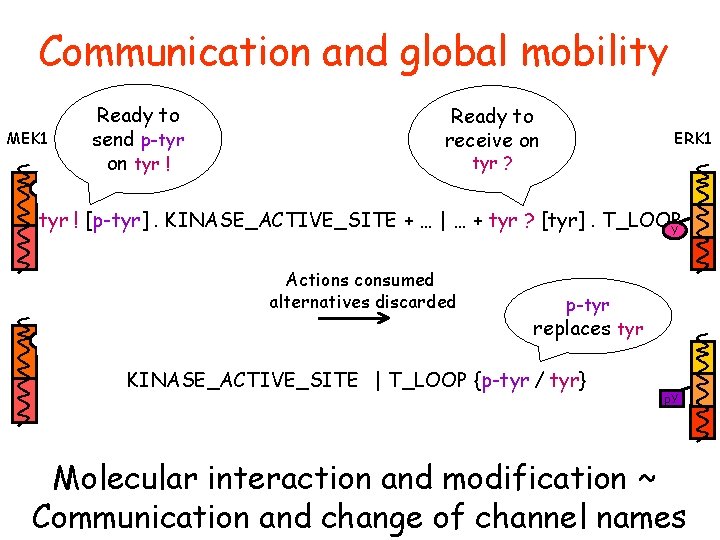
Communication and global mobility MEK 1 Ready to send p-tyr on tyr ! Ready to receive on ERK 1 tyr ? tyr ! [p-tyr]. KINASE_ACTIVE_SITE + … | … + tyr ? [tyr]. T_LOOP Y Actions consumed alternatives discarded p-tyr replaces tyr KINASE_ACTIVE_SITE | T_LOOP {p-tyr / tyr} p. Y Molecular interaction and modification ~ Communication and change of channel names
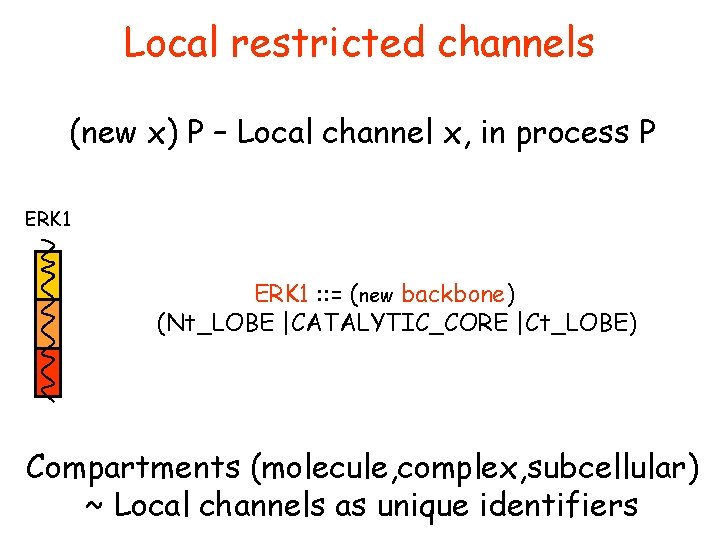
Local restricted channels (new x) P – Local channel x, in process P ERK 1 : : = (new backbone) (Nt_LOBE |CATALYTIC_CORE |Ct_LOBE) Compartments (molecule, complex, subcellular) ~ Local channels as unique identifiers
Communication and scope extrusion (new x) (y ! [x]) – Extrusion of local channel x MP 1 (new backbone) mp 1_erk ! [backbone]. mp 1_mek ! [backbone]. … | mp 1_erk ? [cross_backbone]. cross_backbone ? […] | mp 1_mek ? [cross_backbone]. cross_backbone ! […] MEK 1 ERK 1 Complex formation ~ Exporting local channels
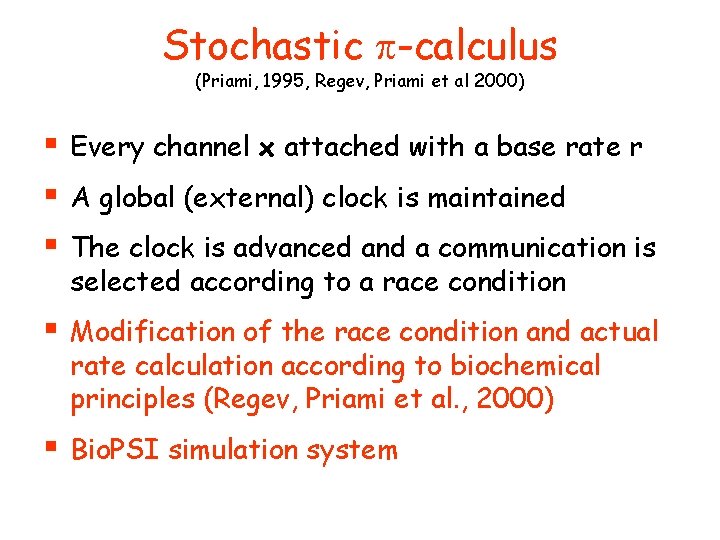
Stochastic p-calculus (Priami, 1995, Regev, Priami et al 2000) § § § Every channel x attached with a base rate r § Modification of the race condition and actual rate calculation according to biochemical principles (Regev, Priami et al. , 2000) § Bio. PSI simulation system A global (external) clock is maintained The clock is advanced and a communication is selected according to a race condition
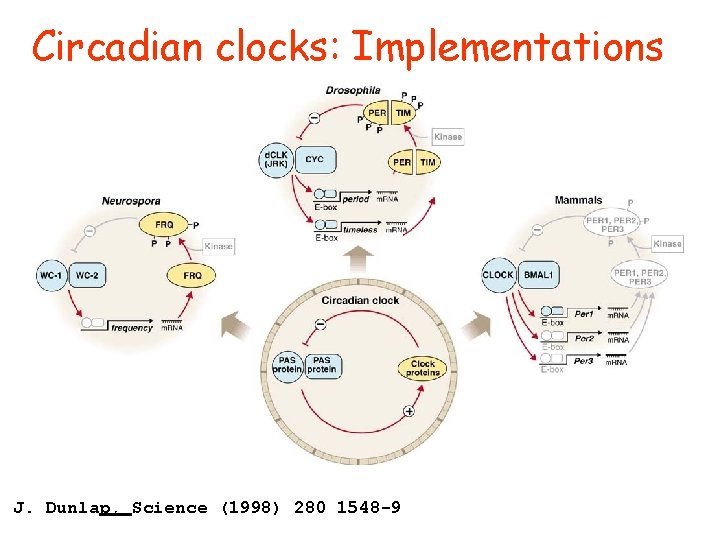
Circadian clocks: Implementations J. Dunlap, Science (1998) 280 1548 -9
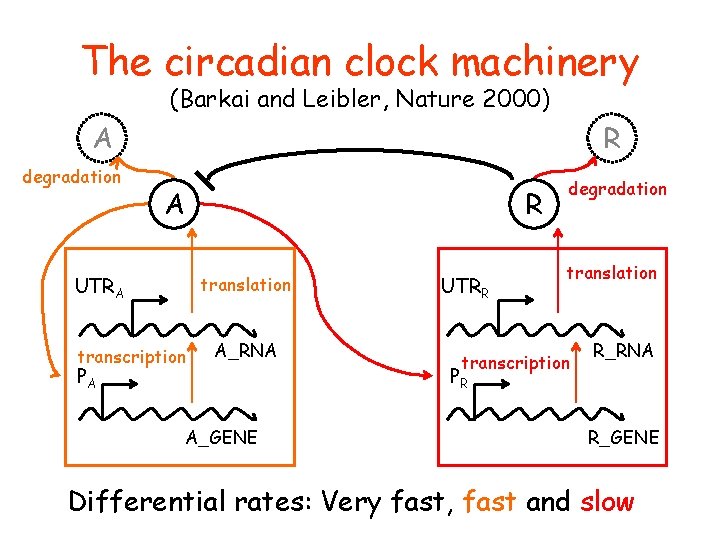
The circadian clock machinery (Barkai and Leibler, Nature 2000) A degradation R A R UTRA translation transcription PA A_RNA A_GENE UTRR degradation translation transcription PR R_RNA R_GENE Differential rates: Very fast, fast and slow
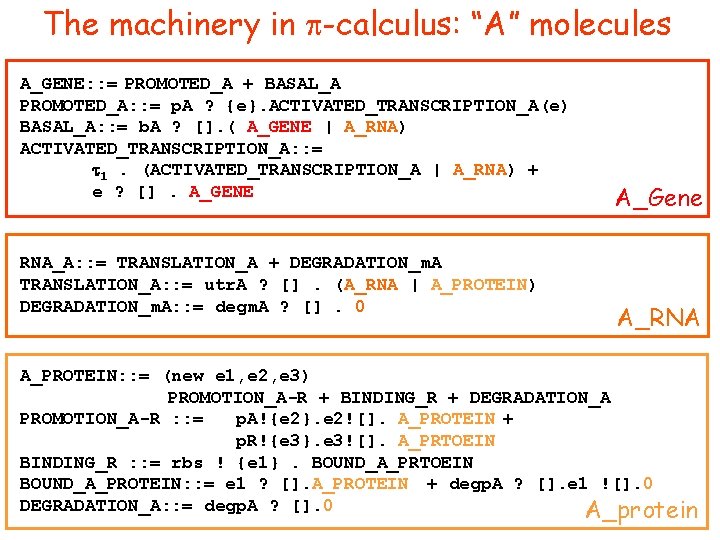
The machinery in p-calculus: “A” molecules A_GENE: : = PROMOTED_A + BASAL_A PROMOTED_A: : = p. A ? {e}. ACTIVATED_TRANSCRIPTION_A(e) BASAL_A: : = b. A ? []. ( A_GENE | A_RNA) ACTIVATED_TRANSCRIPTION_A: : = t 1. (ACTIVATED_TRANSCRIPTION_A | A_RNA) + e ? []. A_GENE RNA_A: : = TRANSLATION_A + DEGRADATION_m. A TRANSLATION_A: : = utr. A ? []. (A_RNA | A_PROTEIN) DEGRADATION_m. A: : = degm. A ? []. 0 A_Gene A_RNA A_PROTEIN: : = (new e 1, e 2, e 3) PROMOTION_A-R + BINDING_R + DEGRADATION_A PROMOTION_A-R : : = p. A!{e 2}. e 2![]. A_PROTEIN + p. R!{e 3}. e 3![]. A_PRTOEIN BINDING_R : : = rbs ! {e 1}. BOUND_A_PRTOEIN BOUND_A_PROTEIN: : = e 1 ? []. A_PROTEIN + degp. A ? []. e 1 ![]. 0 DEGRADATION_A: : = degp. A ? []. 0 A_protein
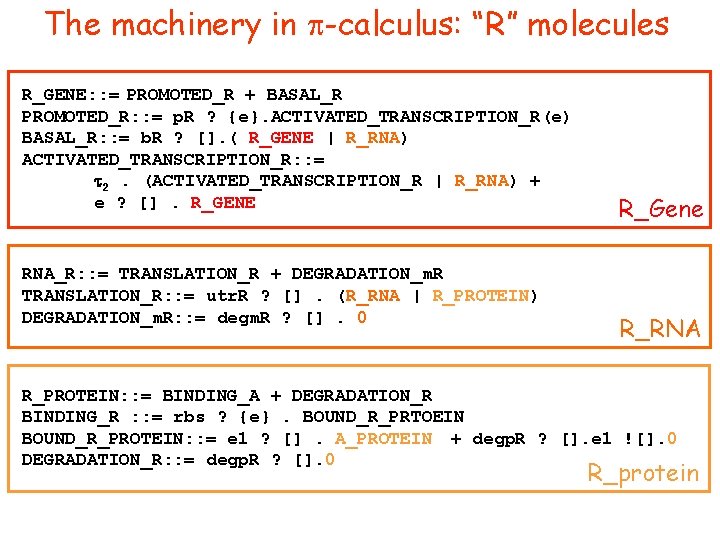
The machinery in p-calculus: “R” molecules R_GENE: : = PROMOTED_R + BASAL_R PROMOTED_R: : = p. R ? {e}. ACTIVATED_TRANSCRIPTION_R(e) BASAL_R: : = b. R ? []. ( R_GENE | R_RNA) ACTIVATED_TRANSCRIPTION_R: : = t 2. (ACTIVATED_TRANSCRIPTION_R | R_RNA) + e ? []. R_GENE RNA_R: : = TRANSLATION_R + DEGRADATION_m. R TRANSLATION_R: : = utr. R ? []. (R_RNA | R_PROTEIN) DEGRADATION_m. R: : = degm. R ? []. 0 R_Gene R_RNA R_PROTEIN: : = BINDING_A + DEGRADATION_R BINDING_R : : = rbs ? {e}. BOUND_R_PRTOEIN BOUND_R_PROTEIN: : = e 1 ? []. A_PROTEIN + degp. R ? []. e 1 ![]. 0 DEGRADATION_R: : = degp. R ? []. 0 R_protein
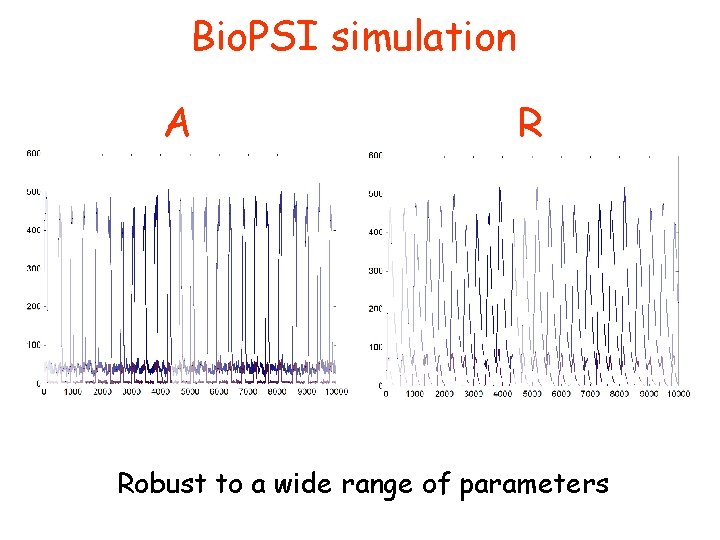
Bio. PSI simulation A R Robust to a wide range of parameters
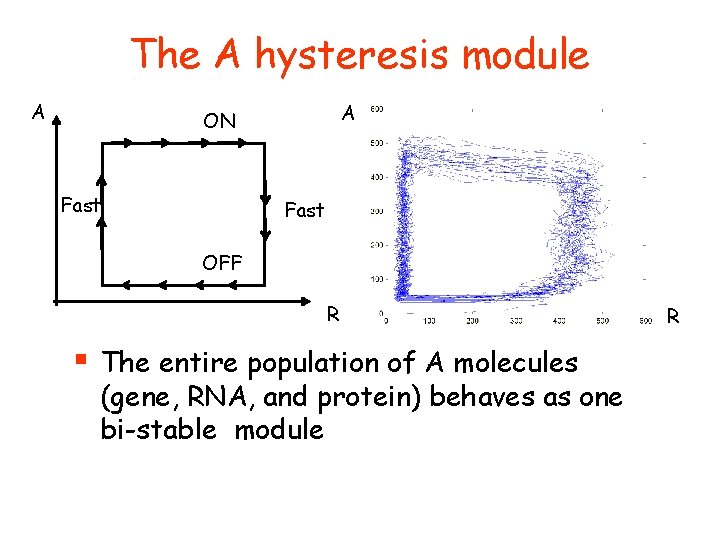
The A hysteresis module A A ON Fast OFF R § The entire population of A molecules (gene, RNA, and protein) behaves as one bi-stable module R
Modular cell biology ? How to identify modules and prove their function? ! Semantic concept: Two processes are equivalent if can be exchanged within any context without changing observable system behavior
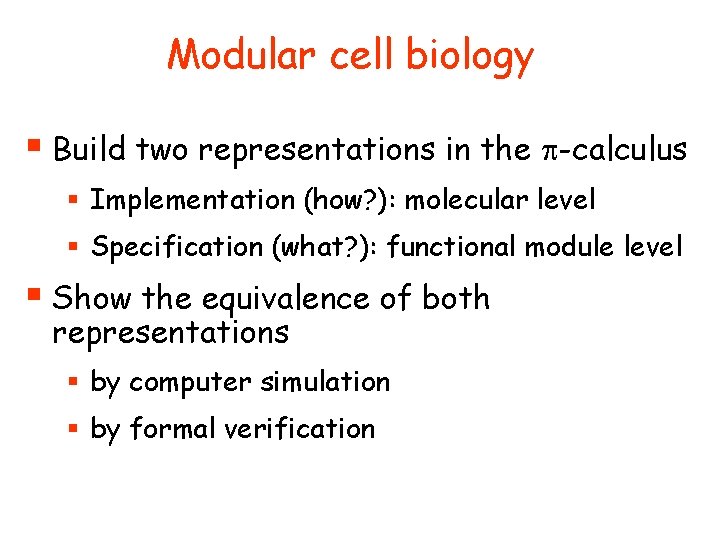
Modular cell biology § Build two representations in the p-calculus § Implementation (how? ): molecular level § Specification (what? ): functional module level § Show the equivalence of both representations § by computer simulation § by formal verification
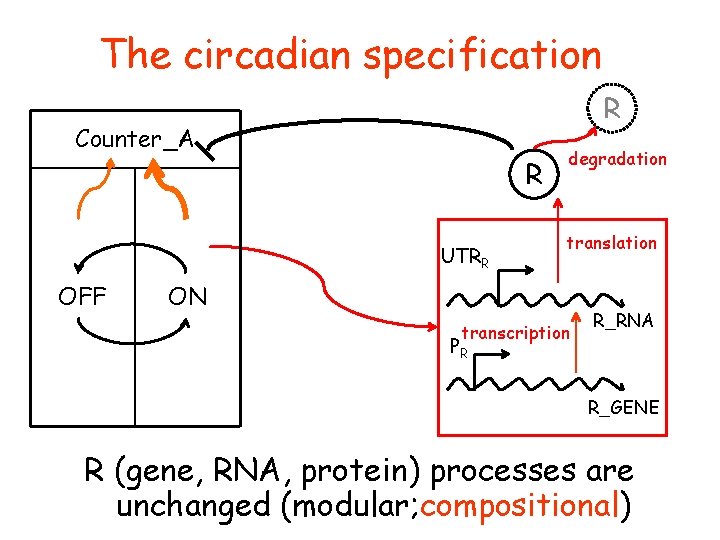
The circadian specification R Counter_A R UTRR OFF degradation translation ON transcription PR R_RNA R_GENE R (gene, RNA, protein) processes are unchanged (modular; compositional)
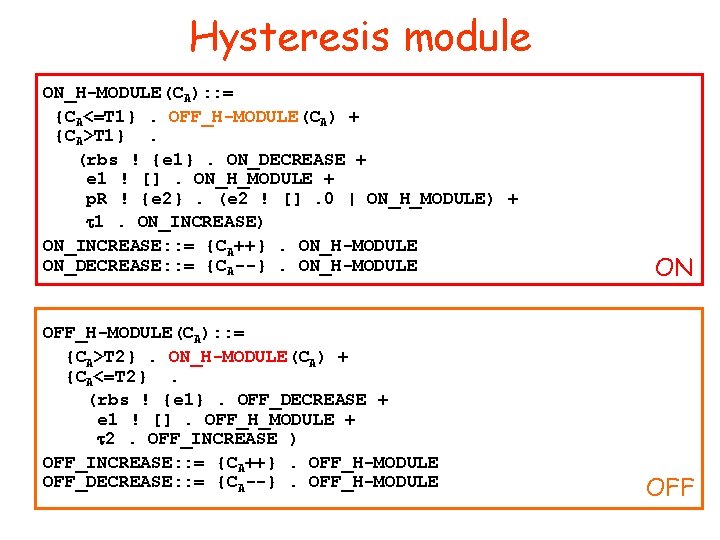
Hysteresis module ON_H-MODULE(CA): : = {CA<=T 1}. OFF_H-MODULE(CA) + {CA>T 1}. (rbs ! {e 1}. ON_DECREASE + e 1 ! []. ON_H_MODULE + p. R ! {e 2}. (e 2 ! []. 0 | ON_H_MODULE) + t 1. ON_INCREASE) ON_INCREASE: : = {CA++}. ON_H-MODULE ON_DECREASE: : = {CA--}. ON_H-MODULE OFF_H-MODULE(CA): : = {CA>T 2}. ON_H-MODULE(CA) + {CA<=T 2}. (rbs ! {e 1}. OFF_DECREASE + e 1 ! []. OFF_H_MODULE + t 2. OFF_INCREASE ) OFF_INCREASE: : = {CA++}. OFF_H-MODULE OFF_DECREASE: : = {CA--}. OFF_H-MODULE ON OFF
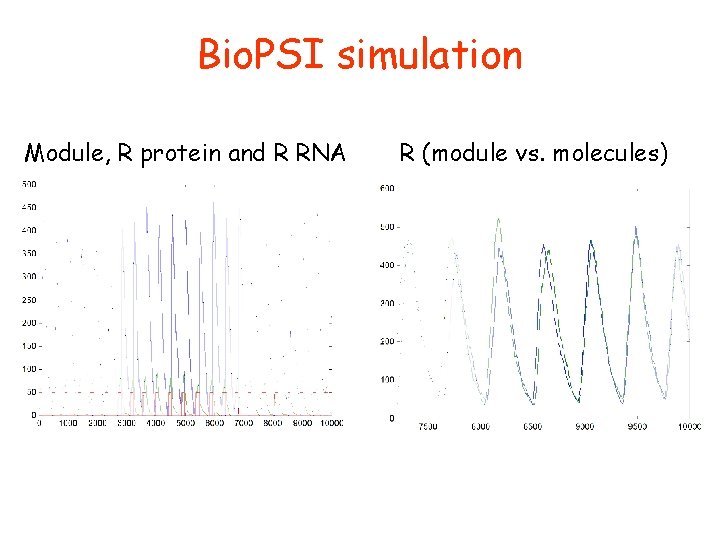
Bio. PSI simulation Module, R protein and R RNA R (module vs. molecules)
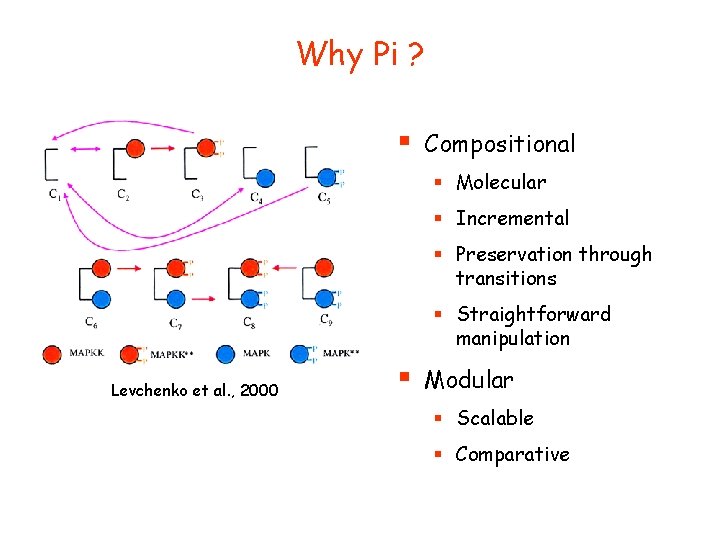
Why Pi ? § Compositional § Molecular § Incremental § Preservation through transitions § Straightforward manipulation Levchenko et al. , 2000 § Modular § Scalable § Comparative
The next step: The homology of process
§ § Udi Shapiro (WIS) Eva Jablonka (TAU) Bill Silverman (WIS) Aviv Regev (TAU, WIS) § § § Naama Barkai (WIS) Corrado Priami (U. Verona) Vincent Schachter (Hybrigenics) www. wisdom. weizmann. ac. il/~aviv