
Modeling of heat and mass transfer during gas
- Slides: 20
Modeling of heat and mass transfer during gas adsorption by aerosol particles in air pollution plumes T. Elperin 1, A. Fominykh 1, I. Katra 2, and B. Krasovitov 1 1 Department of Mechanical Engineering, The Pearlstone Center for Aeronautical Engineering Studies, Ben-Gurion University of the Negev, P. O. B. 653, 8410501, Israel 2 Department of Geography and Environmental Development, Ben-Gurion University of the Negev, P. O. B. 653, 8410501, Israel
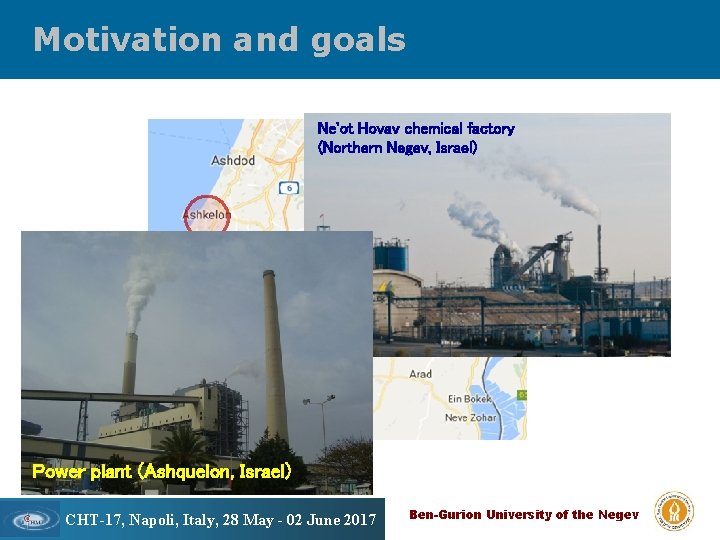
Motivation and goals Scavenging of air pollutions Ne'ot Hovav chemical byfactory cloud and rain droplets (Northern Negev, Israel) Power plant (Ashquelon, Israel) CHT-17, Napoli, Italy, 28 May - 02 June 2017 Ben-Gurion University of the Negev
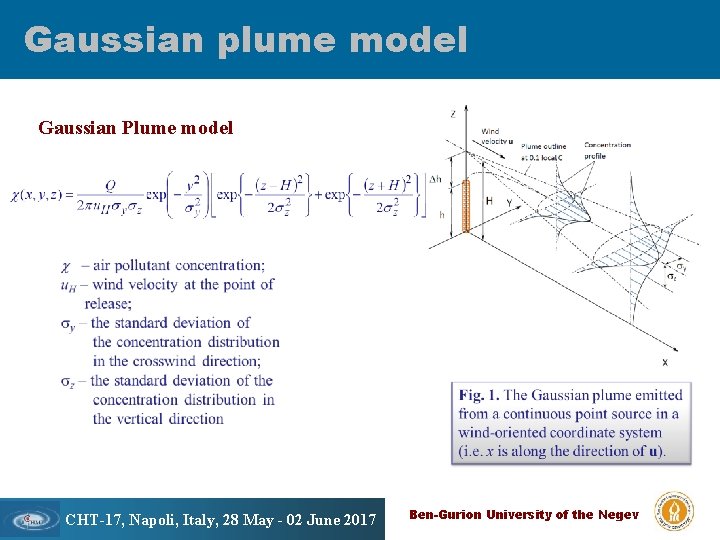
Gaussian plume model Gaussian Plume model CHT-17, Napoli, Italy, 28 May - 02 June 2017 Scavenging of air pollutions by cloud and rain droplets Ben-Gurion University of the Negev
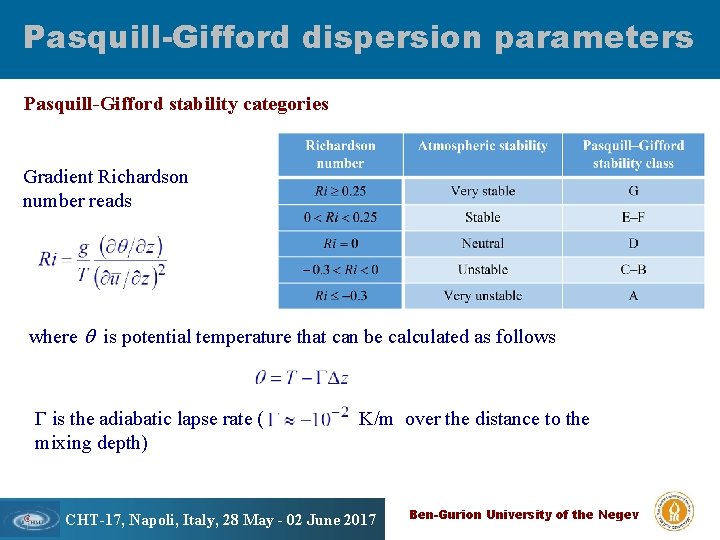
Pasquill-Gifford dispersion parameters Pasquill-Gifford stability categories Gradient Richardson number reads where q is potential temperature that can be calculated as follows Γ is the adiabatic lapse rate ( mixing depth) K/m over the distance to the CHT-17, Napoli, Italy, 28 May - 02 June 2017 Ben-Gurion University of the Negev
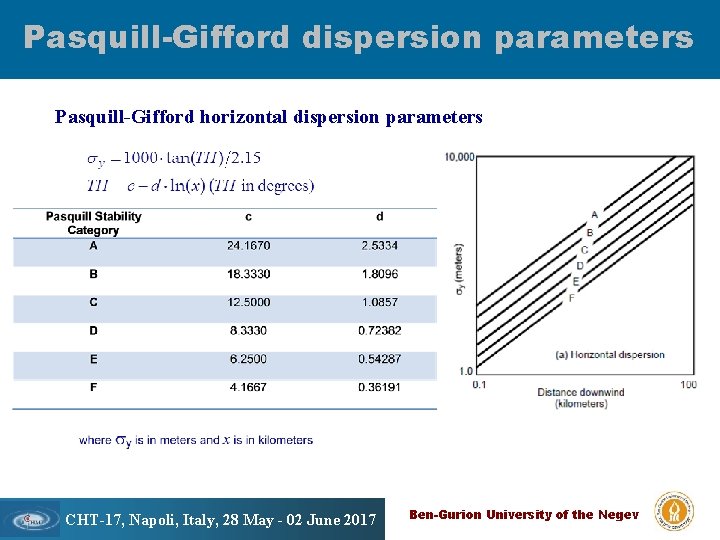
Pasquill-Gifford dispersion parameters Pasquill-Gifford horizontal dispersion parameters CHT-17, Napoli, Italy, 28 May - 02 June 2017 Ben-Gurion University of the Negev
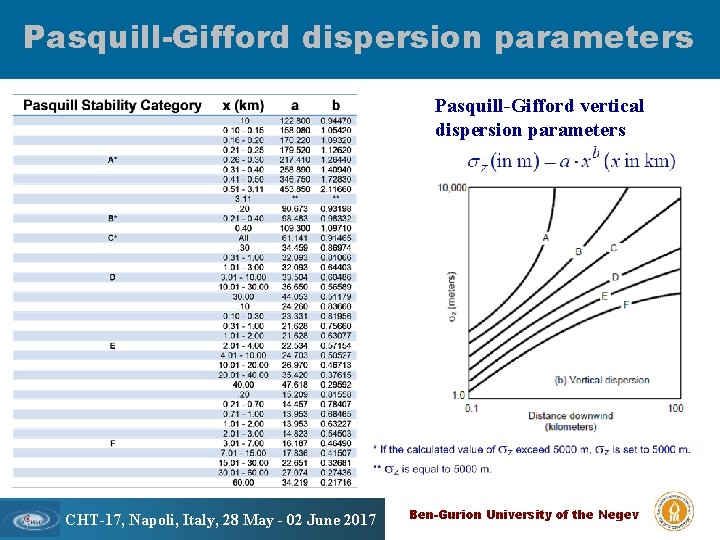
Pasquill-Gifford dispersion parameters Pasquill-Gifford vertical dispersion parameters CHT-17, Napoli, Italy, 28 May - 02 June 2017 Ben-Gurion University of the Negev
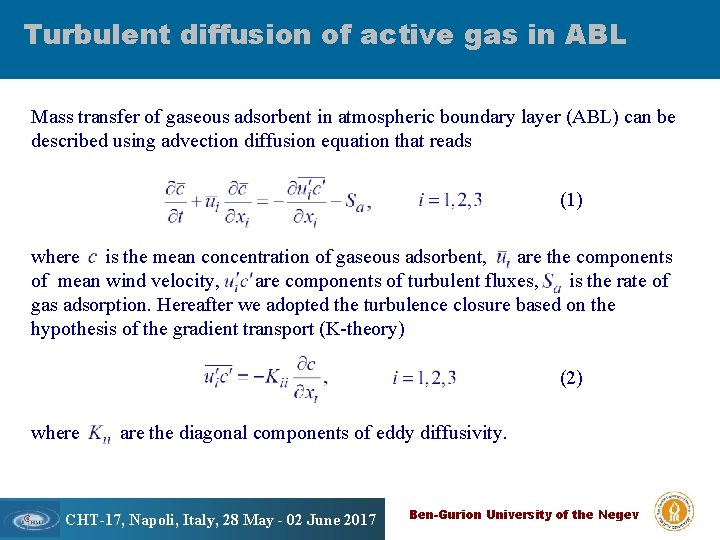
Turbulent diffusion of active gas in ABL Scavenging air pollutions Mass transfer of gaseous adsorbent in atmospheric boundary layerof(ABL) can be by cloud and rain droplets described using advection diffusion equation that reads (1) where is the mean concentration of gaseous adsorbent, are the components of mean wind velocity, are components of turbulent fluxes, is the rate of gas adsorption. Hereafter we adopted the turbulence closure based on the hypothesis of the gradient transport (K-theory) (2) where are the diagonal components of eddy diffusivity. CHT-17, Napoli, Italy, 28 May - 02 June 2017 Ben-Gurion University of the Negev
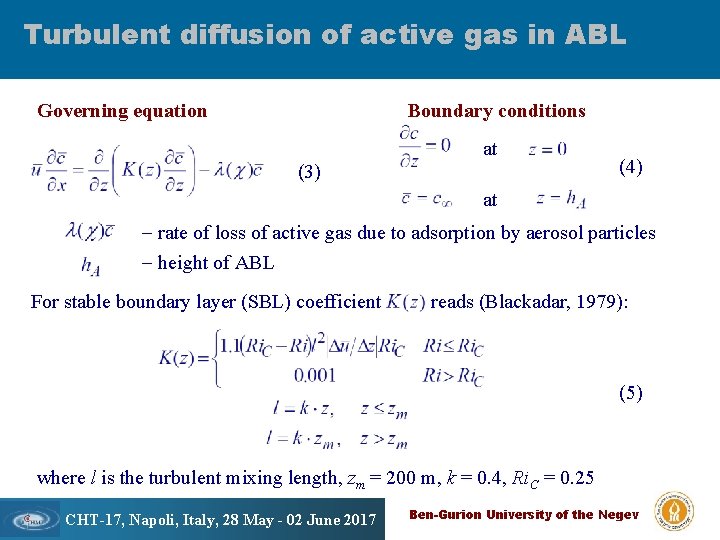
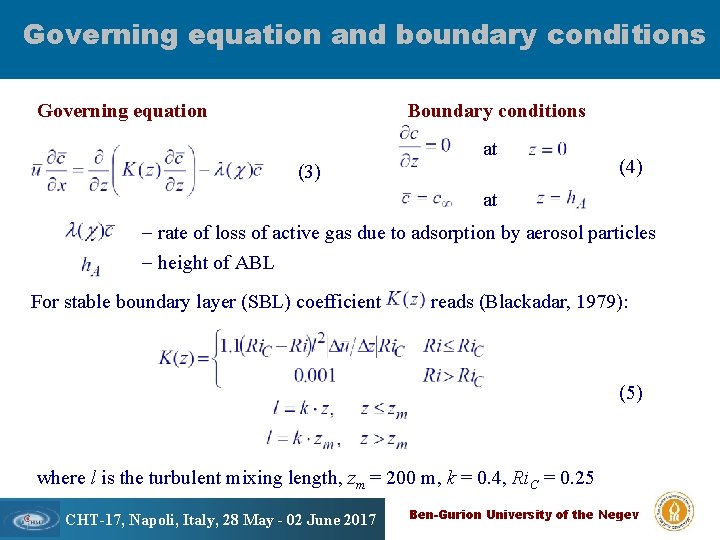
Turbulent diffusion of active gas in ABL Scavenging of air pollutions Boundary conditions Governing equation by cloud and rain droplets at (3) (4) at - rate of loss of active gas due to adsorption by aerosol particles - height of ABL For stable boundary layer (SBL) coefficient reads (Blackadar, 1979): (5) where l is the turbulent mixing length, zm = 200 m, k = 0. 4, Ri. C = 0. 25 CHT-17, Napoli, Italy, 28 May - 02 June 2017 Ben-Gurion University of the Negev
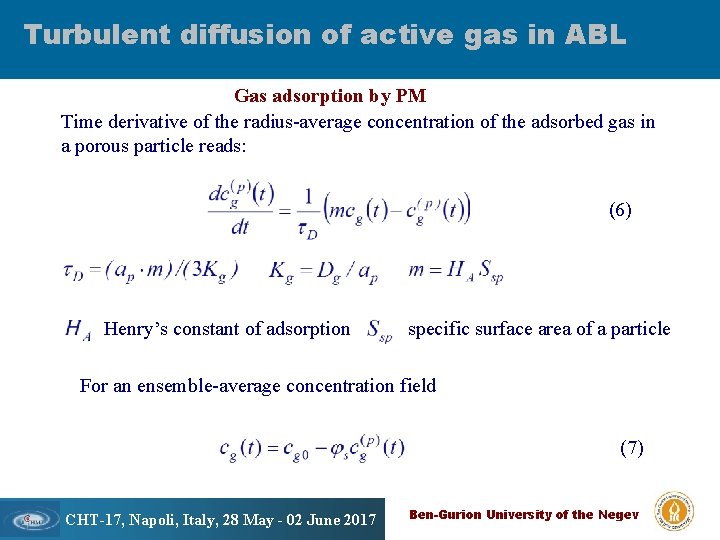
Turbulent diffusion of active gas in ABL Gas adsorption by PM Scavenging of air pollutions Time derivative of the radius-average concentration of theand adsorbed gas in by cloud rain droplets a porous particle reads: (6) Henry’s constant of adsorption specific surface area of a particle For an ensemble-average concentration field (7) CHT-17, Napoli, Italy, 28 May - 02 June 2017 Ben-Gurion University of the Negev
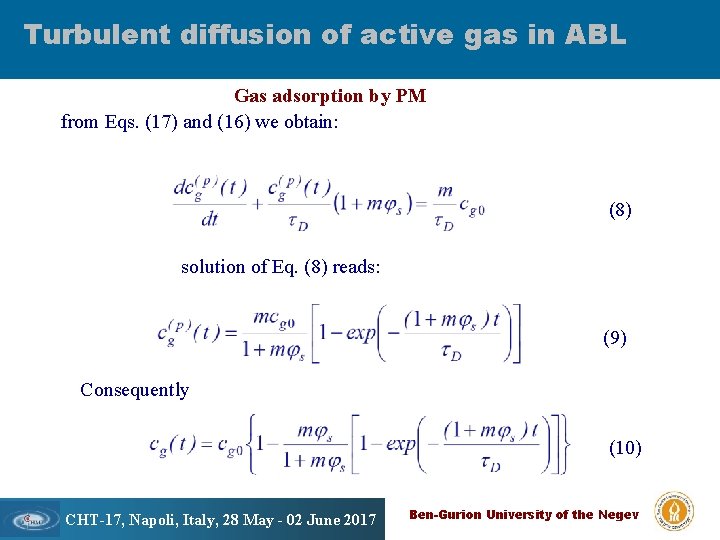
Turbulent diffusion of active gas in ABL Gas adsorption by PM from Eqs. (17) and (16) we obtain: Scavenging of air pollutions by cloud and rain droplets (8) solution of Eq. (8) reads: (9) Consequently (10) CHT-17, Napoli, Italy, 28 May - 02 June 2017 Ben-Gurion University of the Negev
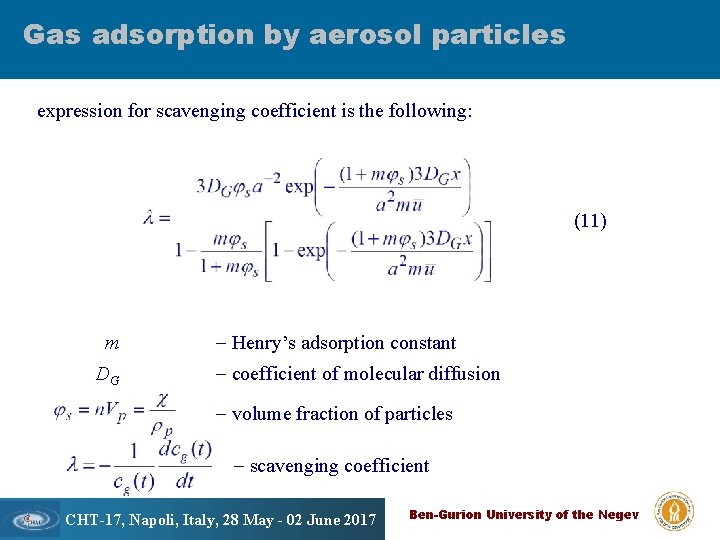
Gas adsorption by aerosol particles Scavenging of air pollutions expression for scavenging coefficient is the following: by cloud and rain droplets (11) m DG - Henry’s adsorption constant - coefficient of molecular diffusion - volume fraction of particles - scavenging coefficient CHT-17, Napoli, Italy, 28 May - 02 June 2017 Ben-Gurion University of the Negev
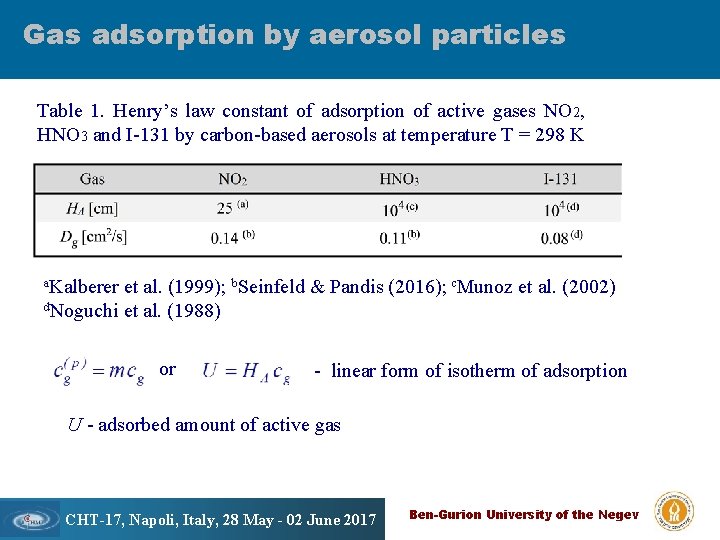
Gas adsorption by aerosol particles Scavenging of air Table 1. Henry’s law constant of adsorption of active gases NO 2, pollutions by cloud HNO 3 and I-131 by carbon-based aerosols at temperature T =and 298 rain K droplets a. Kalberer et al. (1999); b. Seinfeld & Pandis (2016); c. Munoz et al. (2002) d. Noguchi et al. (1988) or - linear form of isotherm of adsorption U - adsorbed amount of active gas CHT-17, Napoli, Italy, 28 May - 02 June 2017 Ben-Gurion University of the Negev
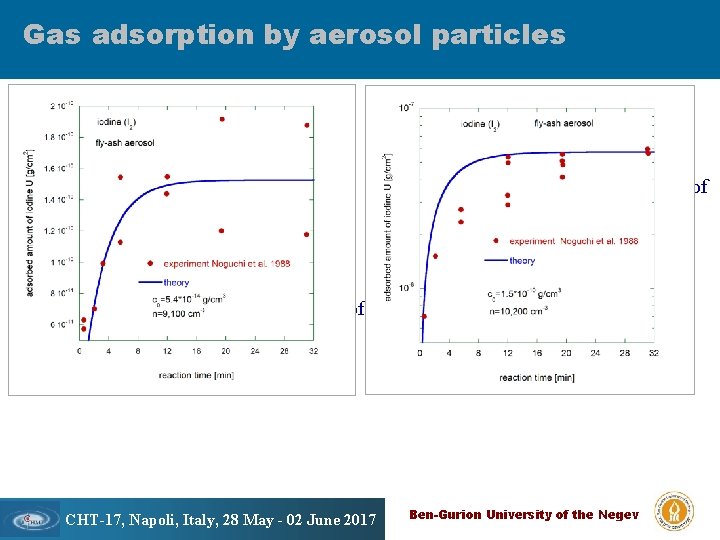
Gas adsorption by aerosol particles Scavenging of air pollutions by cloud and rain droplets Fig. 4. Dependence of adsorbed amount of iodine vs. time ( , , ) Fig. 3. Dependence of adsorbed amount of iodine vs. time ( , , ) CHT-17, Napoli, Italy, 28 May - 02 June 2017 Ben-Gurion University of the Negev
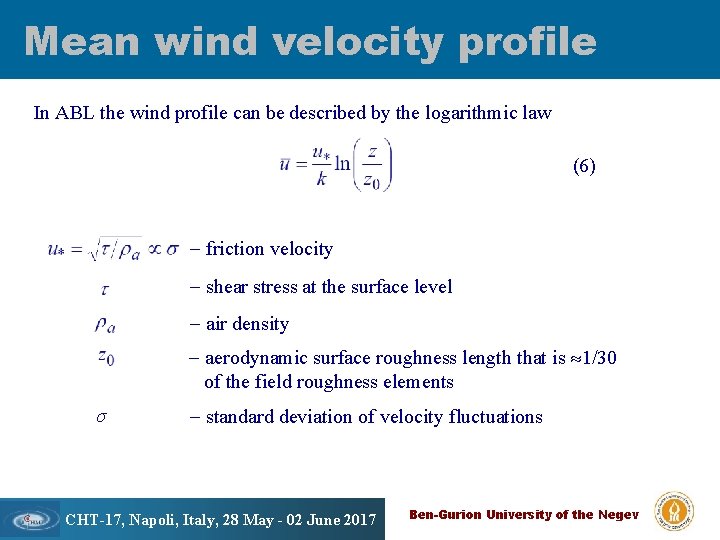
Mean wind velocity profile Scavenging In ABL the wind profile can be described by the logarithmic lawof air pollutions by cloud and rain droplets (6) - friction velocity - shear stress at the surface level - air density - aerodynamic surface roughness length that is 1/30 of the field roughness elements σ - standard deviation of velocity fluctuations CHT-17, Napoli, Italy, 28 May - 02 June 2017 Ben-Gurion University of the Negev
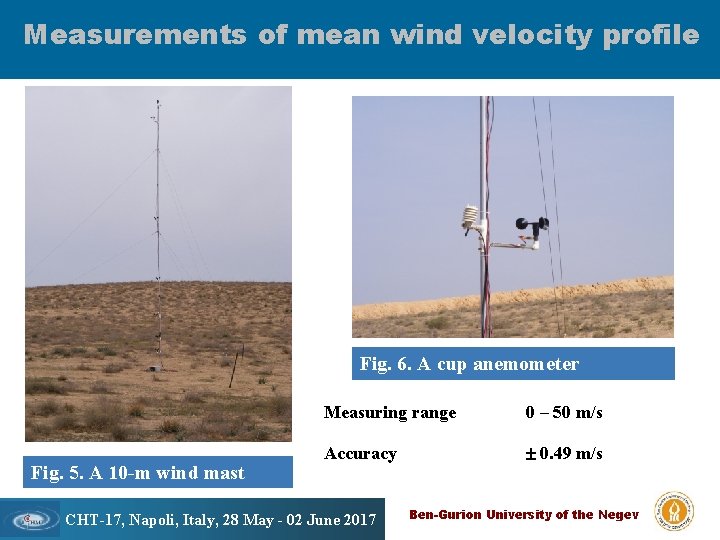
Measurements of mean wind velocity profile Scavenging of air pollutions by cloud and rain droplets Fig. 6. A cup anemometer Fig. 5. A 10 -m wind mast Measuring range 0 – 50 m/s Accuracy 0. 49 m/s CHT-17, Napoli, Italy, 28 May - 02 June 2017 Ben-Gurion University of the Negev
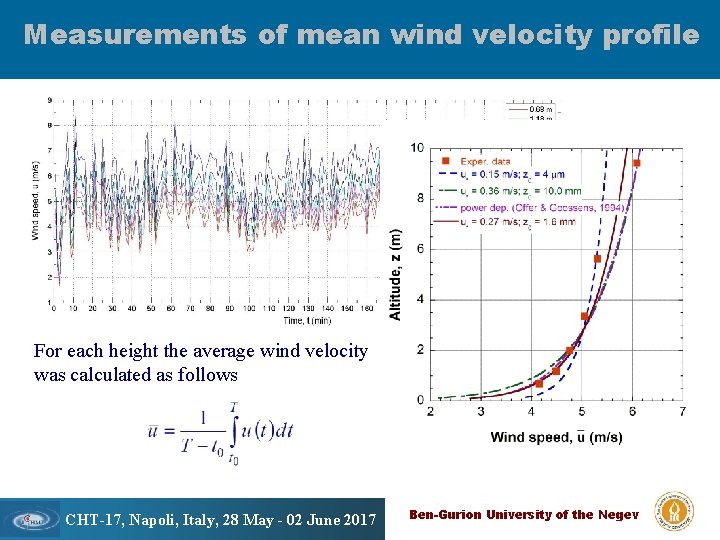
Measurements of mean wind velocity profile Scavenging of air pollutions by cloud and rain droplets For each height the average wind velocity was calculated as follows CHT-17, Napoli, Italy, 28 May - 02 June 2017 Ben-Gurion University of the Negev
Governing equation and boundary conditions Scavenging of air pollutions Boundary conditions Governing equation by cloud and rain droplets at (3) (4) at - rate of loss of active gas due to adsorption by aerosol particles - height of ABL For stable boundary layer (SBL) coefficient reads (Blackadar, 1979): (5) where l is the turbulent mixing length, zm = 200 m, k = 0. 4, Ri. C = 0. 25 CHT-17, Napoli, Italy, 28 May - 02 June 2017 Ben-Gurion University of the Negev
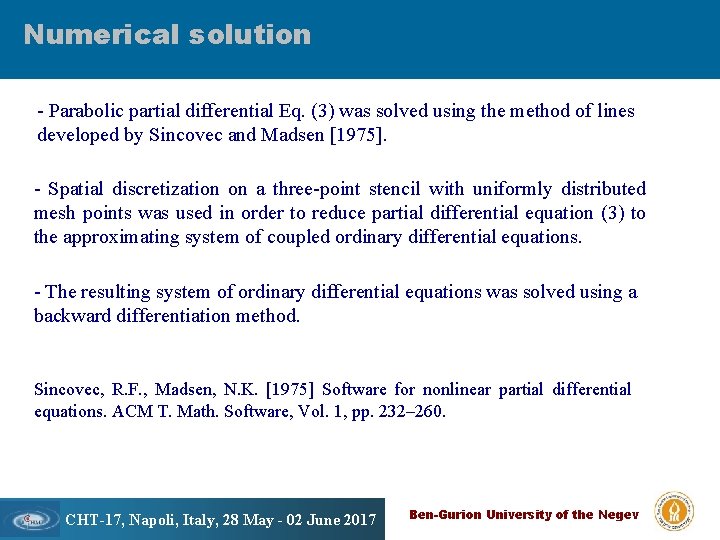
Numerical solution Scavenging of air - Parabolic partial differential Eq. (3) was solved using the method of pollutions lines by cloud and rain droplets developed by Sincovec and Madsen [1975]. - Spatial discretization on a three-point stencil with uniformly distributed mesh points was used in order to reduce partial differential equation (3) to the approximating system of coupled ordinary differential equations. - The resulting system of ordinary differential equations was solved using a backward differentiation method. Sincovec, R. F. , Madsen, N. K. [1975] Software for nonlinear partial differential equations. ACM T. Math. Software, Vol. 1, pp. 232– 260. CHT-17, Napoli, Italy, 28 May - 02 June 2017 Ben-Gurion University of the Negev
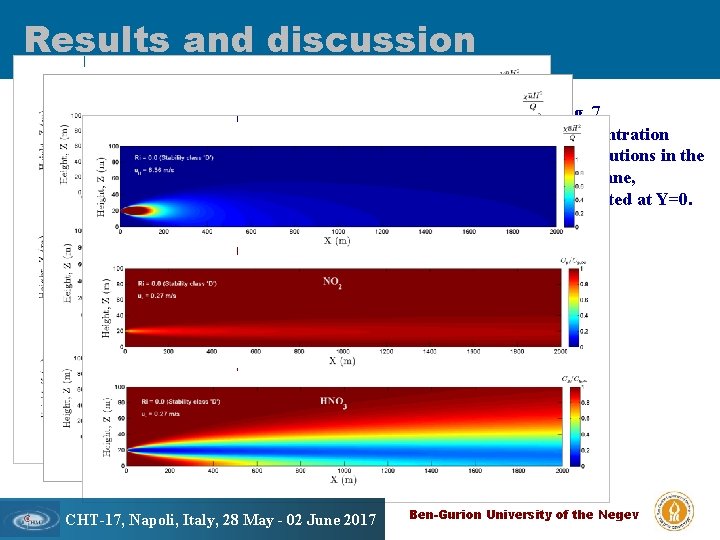
Results and discussion Scavenging of. Fig. 7. air pollutions by cloud and Concentration rain droplets distributions in the XZ-plane, evaluated at Y=0. NO 2 HNO 3 CHT-17, Napoli, Italy, 28 May - 02 June 2017 Ben-Gurion University of the Negev
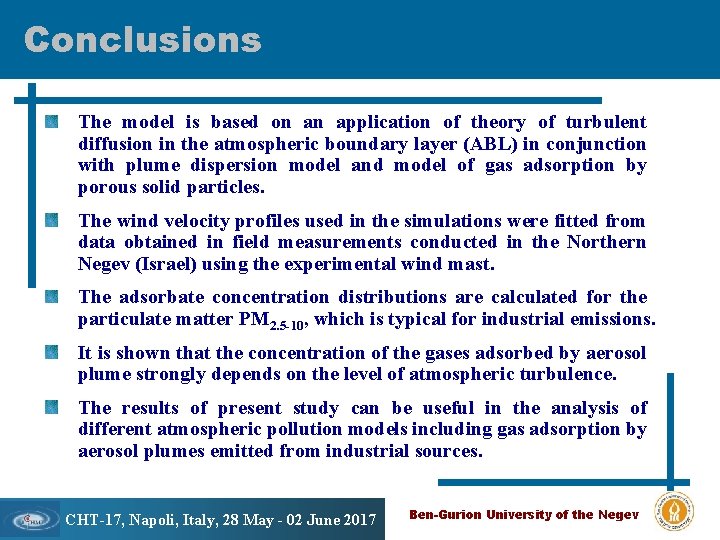
Conclusions The model is based on an application of theory of turbulent diffusion in the atmospheric boundary layer (ABL) in conjunction with plume dispersion model and model of gas adsorption by porous solid particles. The wind velocity profiles used in the simulations were fitted from data obtained in field measurements conducted in the Northern Negev (Israel) using the experimental wind mast. The adsorbate concentration distributions are calculated for the particulate matter PM 2. 5 -10, which is typical for industrial emissions. It is shown that the concentration of the gases adsorbed by aerosol plume strongly depends on the level of atmospheric turbulence. The results of present study can be useful in the analysis of different atmospheric pollution models including gas adsorption by aerosol plumes emitted from industrial sources. CHT-17, Napoli, Italy, 28 May - 02 June 2017 Ben-Gurion University of the Negev