
Modeling of diffusion segregation and decomposition of alloys
- Slides: 28
Modeling of diffusion, segregation and decomposition of alloys using OKMC: Applications to Fe. Cr Ignacio Martin-Bragado 1, Ignacio Dopico 1 and Pedro Castrillo 2 1 IMDEA Materials Institute, Getafe, Spain 2 Department of Electronics, University of Valladolid, Spain
Motivation Why Fe. Cr alloys? Ø Fe. Cr steels are the materials of choice for high temperature applications under irradiation. Ø An approximation to such steels is having a modeling framework for the Fe. Cr alloy Ø Swelling in Fe. Cr alloys under irradiation is around one order of magnitude lower than in pure Fe for the same dose.
Motivation Why atomistic simulations? Ø Requirements for Fe. Cr alloy simulation: • Large periods of time (where MD is too short!) • Relatively big systems (where Lattice KMC is too memory consuming). • Including damage irradiation (from BCA or MD) • Predictive (useful: link to ab-initio). Ø Possible solution: off-lattice OKMC with quasiatomistic Fe. Cr spinodal decomposition model.
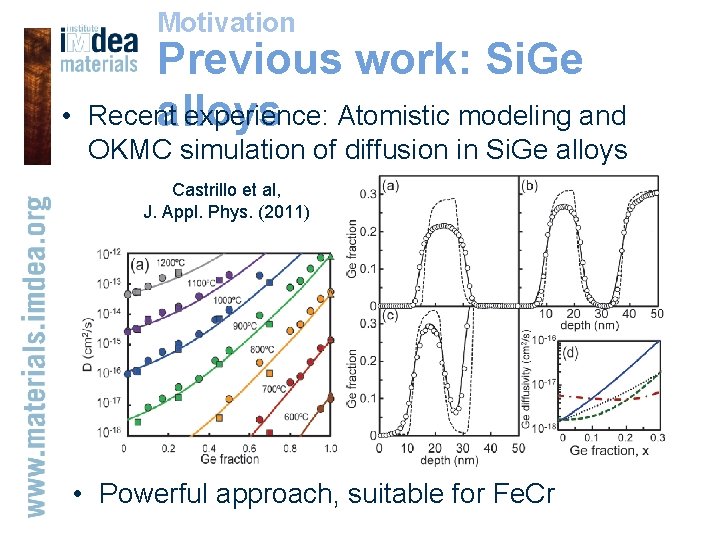
Motivation • Previous work: Si. Ge Recent experience: Atomistic modeling and alloys OKMC simulation of diffusion in Si. Ge alloys Castrillo et al, J. Appl. Phys. (2011) • Powerful approach, suitable for Fe. Cr
This work Goals • The goal it to develop a non-lattice, object KMC model for Fe. Cr alloys able to: Ø Simulate realistic times and sizes. Ø Be integrated in a comprehensive OKMC simulator including other radiation effects. Ø Reproduce and explain interdiffusion and separation. Ø Include the effects of excess point defects.
This work Outline Modeling of diffusion, segregation and decomposition of alloys using OKMC: Applications to Fe. Cr 1. Atomistic model 2. Code implementation 3. Simulation results 4. Conclusions
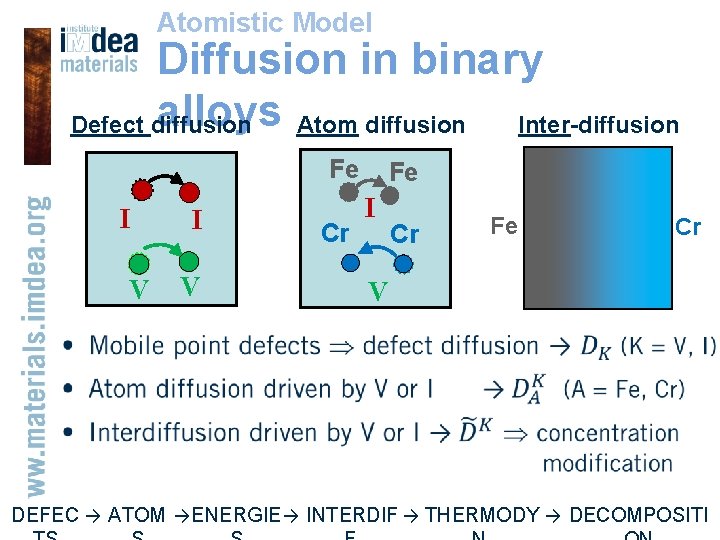
Atomistic Model Diffusion in binary alloys Atom diffusion Inter-diffusion Defect diffusion Fe I V Cr Fe I Cr Fe Cr V • DEFEC → ATOM → ENERGIE → INTERDIF → THERMODY → DECOMPOSITI
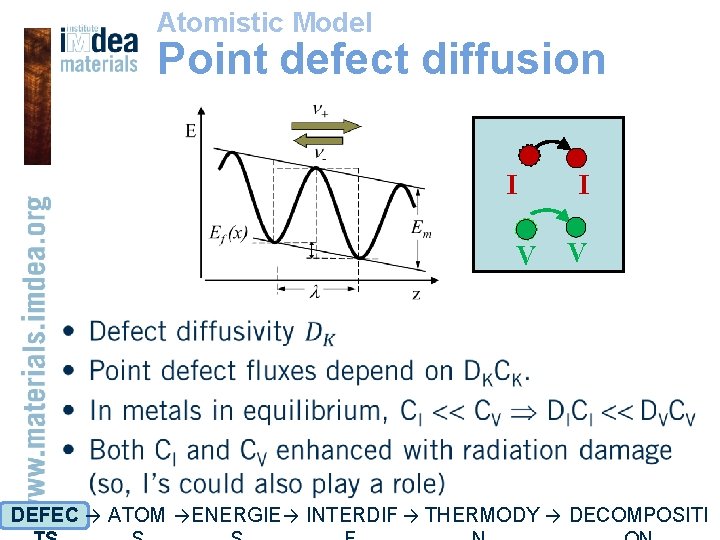
Atomistic Model Point defect diffusion I V • DEFEC → ATOM → ENERGIE → INTERDIF → THERMODY → DECOMPOSITI
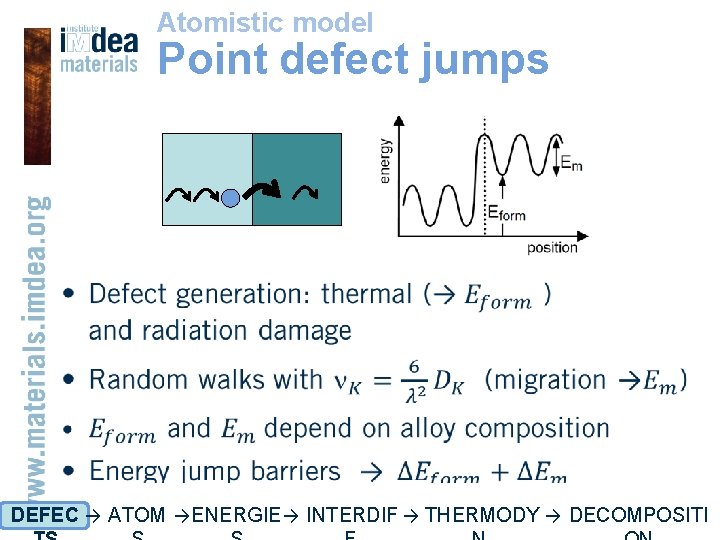
Atomistic model Point defect jumps • DEFEC → ATOM → ENERGIE → INTERDIF → THERMODY → DECOMPOSITI
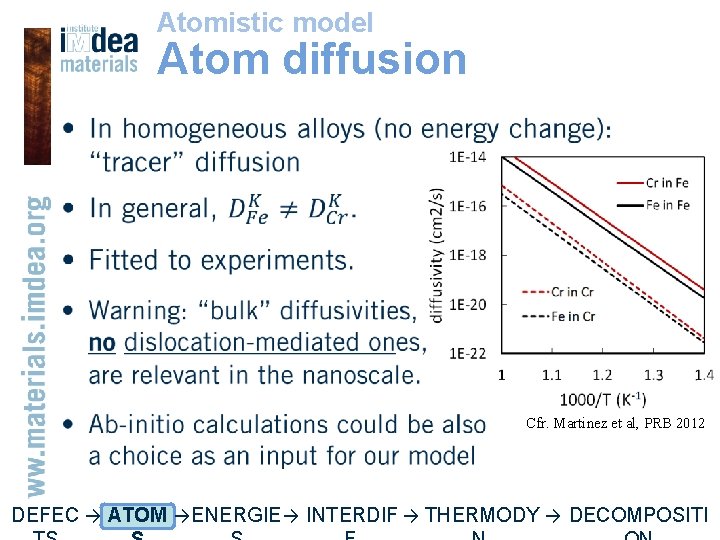
Atomistic model Atom diffusion • Cfr. Martinez et al, PRB 2012 DEFEC → ATOM → ENERGIE → INTERDIF → THERMODY → DECOMPOSITI
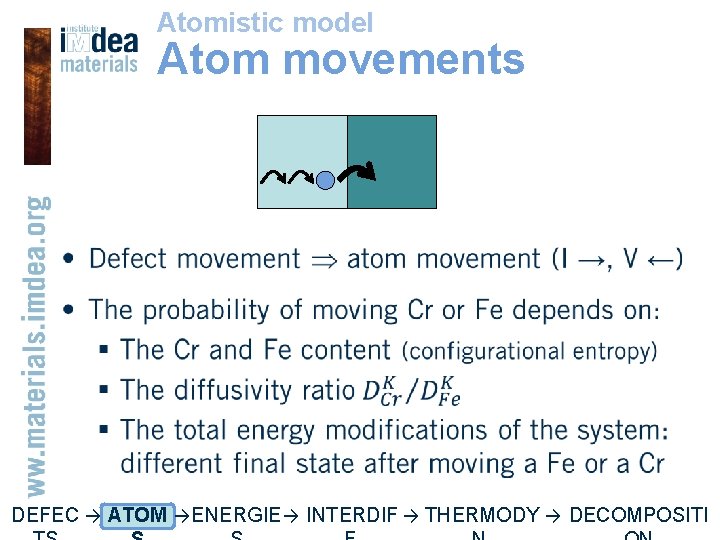
Atomistic model Atom movements • DEFEC → ATOM → ENERGIE → INTERDIF → THERMODY → DECOMPOSITI
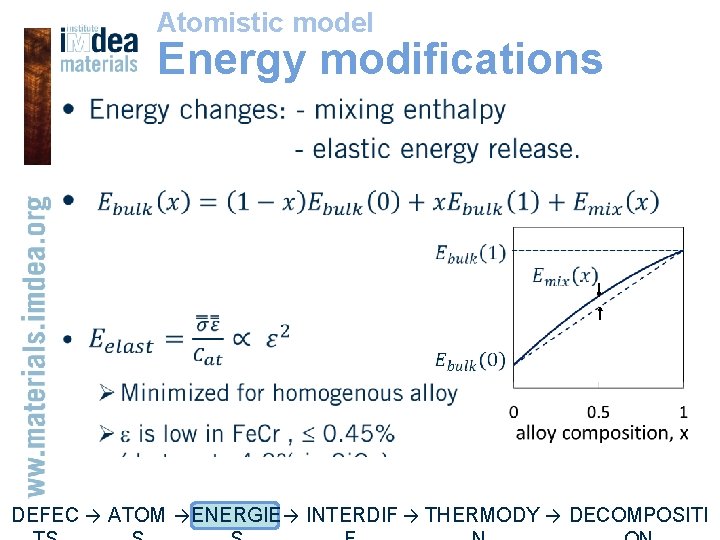
Atomistic model Energy modifications • DEFEC → ATOM → ENERGIE → INTERDIF → THERMODY → DECOMPOSITI
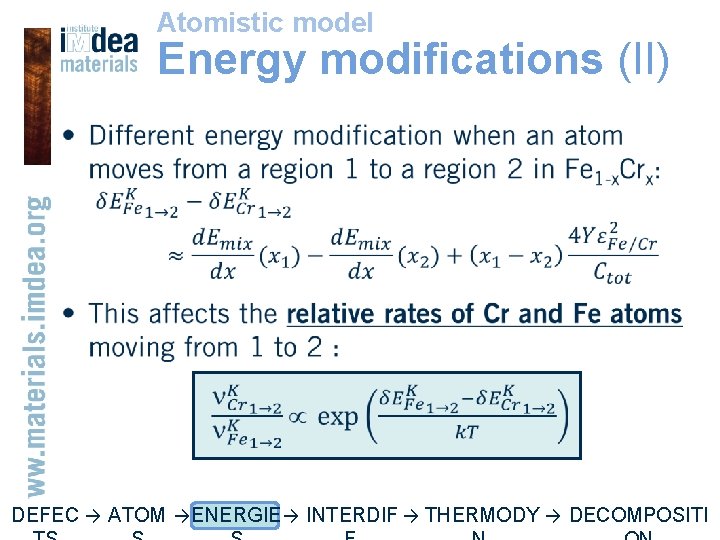
Atomistic model Energy modifications (II) • DEFEC → ATOM → ENERGIE → INTERDIF → THERMODY → DECOMPOSITI
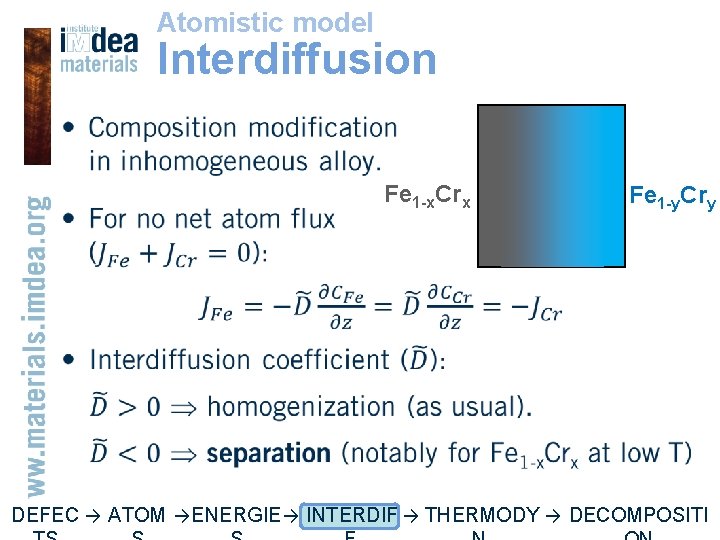
Atomistic model Interdiffusion • Fe 1 -x. Crx Fe 1 -y. Cry DEFEC → ATOM → ENERGIE → INTERDIF → THERMODY → DECOMPOSITI
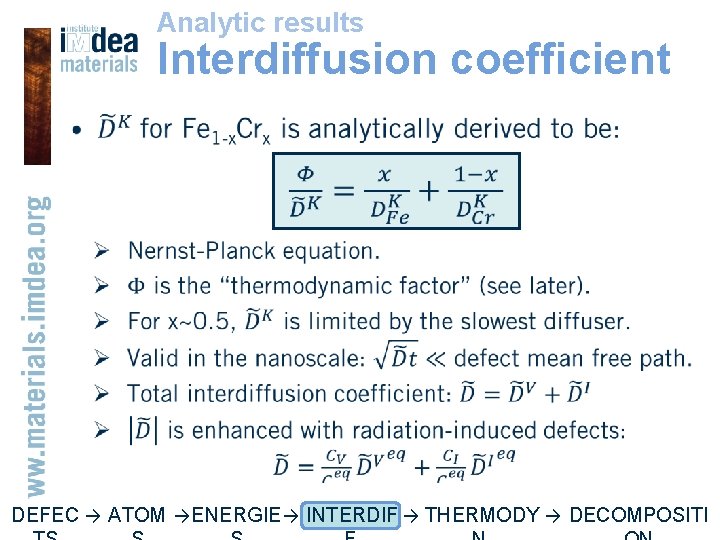
Analytic results Interdiffusion coefficient • DEFEC → ATOM → ENERGIE → INTERDIF → THERMODY → DECOMPOSITI
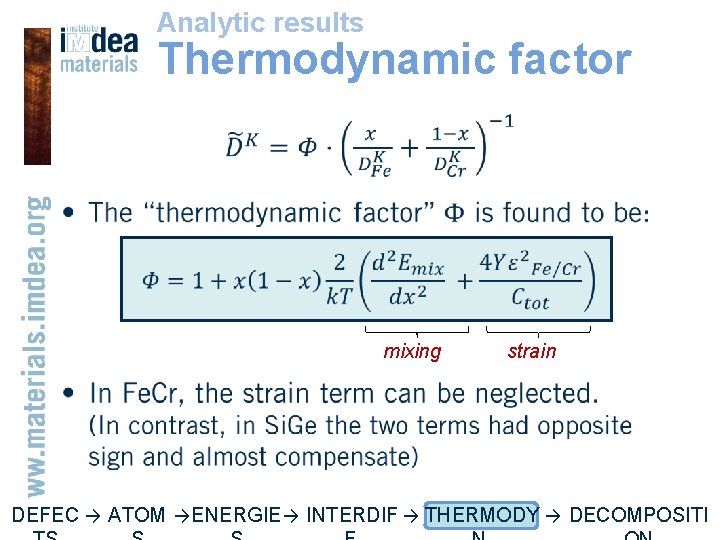
Analytic results Thermodynamic factor • mixing strain DEFEC → ATOM → ENERGIE → INTERDIF → THERMODY → DECOMPOSITI
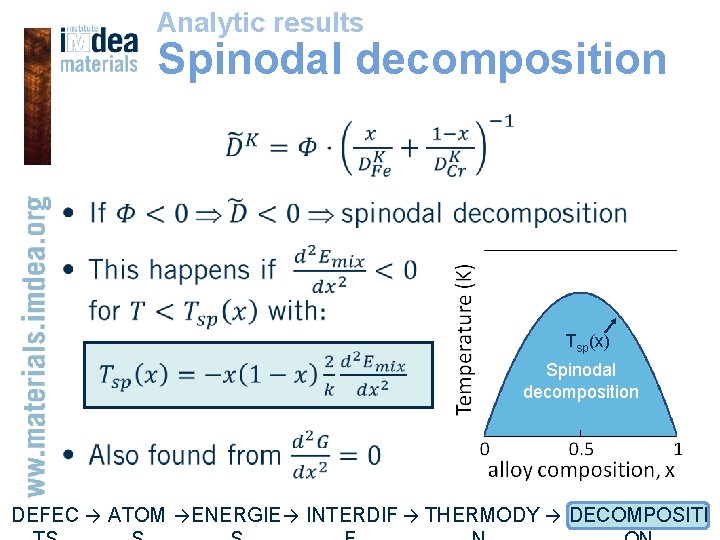
Analytic results Spinodal decomposition • Tsp(x) Spinodal decomposition DEFEC → ATOM → ENERGIE → INTERDIF → THERMODY → DECOMPOSITI
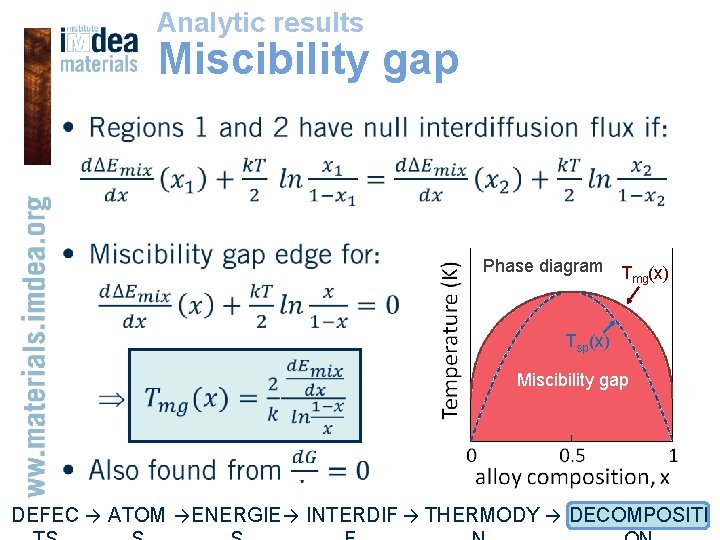
Analytic results Miscibility gap • Phase diagram T (x) mg Tsp(x) Miscibility gap DEFEC → ATOM → ENERGIE → INTERDIF → THERMODY → DECOMPOSITI
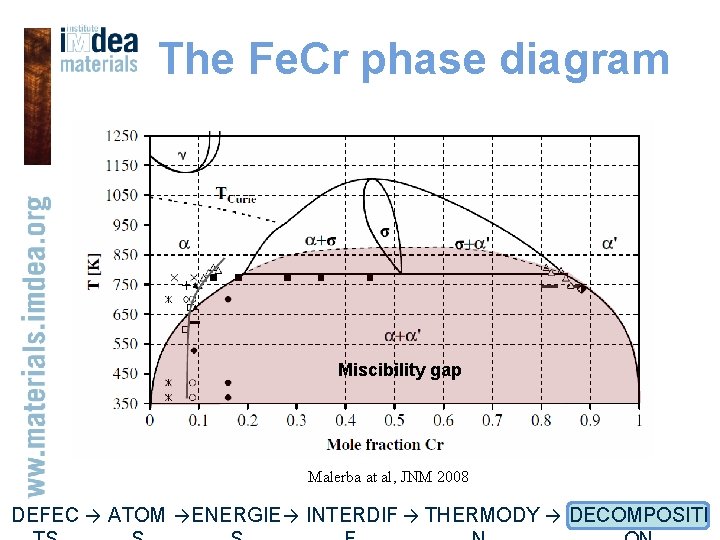
The Fe. Cr phase diagram Miscibility gap Malerba at al, JNM 2008 DEFEC → ATOM → ENERGIE → INTERDIF → THERMODY → DECOMPOSITI
Code implementation Object Kinetic Monte Carlo • Implemented in MMon. Ca code. • using the Object Kinetic Monte Carlo (non-lattice) approach. • Simulation sizes up to ~500 nm. • Simulation driven by events: times from s to years, depending on event rates. • Very suitable for damage evolution simulation.
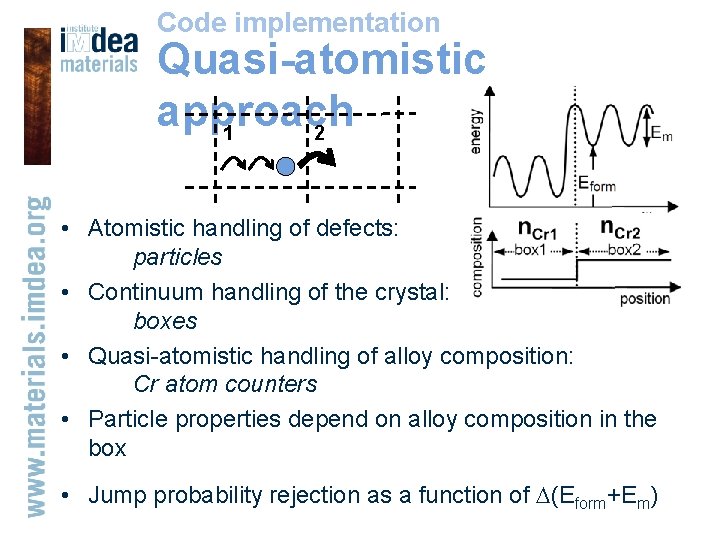
Code implementation Quasi-atomistic approach 2 1 • Atomistic handling of defects: particles • Continuum handling of the crystal: boxes • Quasi-atomistic handling of alloy composition: Cr atom counters • Particle properties depend on alloy composition in the box • Jump probability rejection as a function of (Eform+Em)
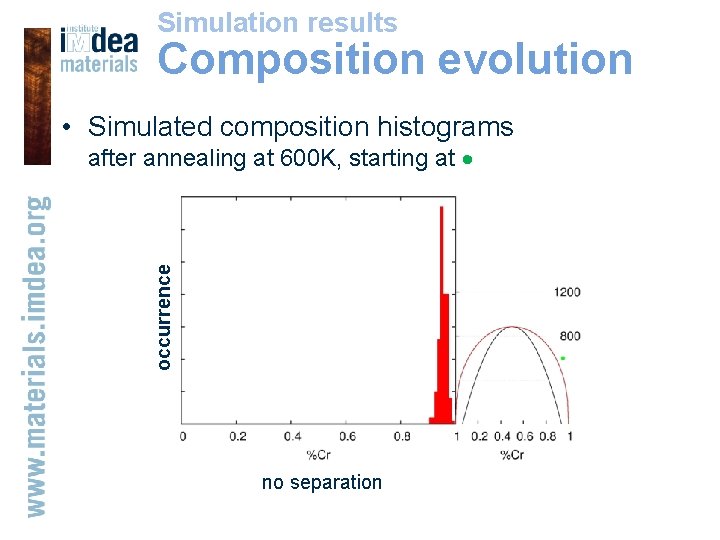
Simulation results Composition evolution • Simulated composition histograms occurrence after annealing at 600 K, starting at nucleation-spinodal decomposition no separation nucleation
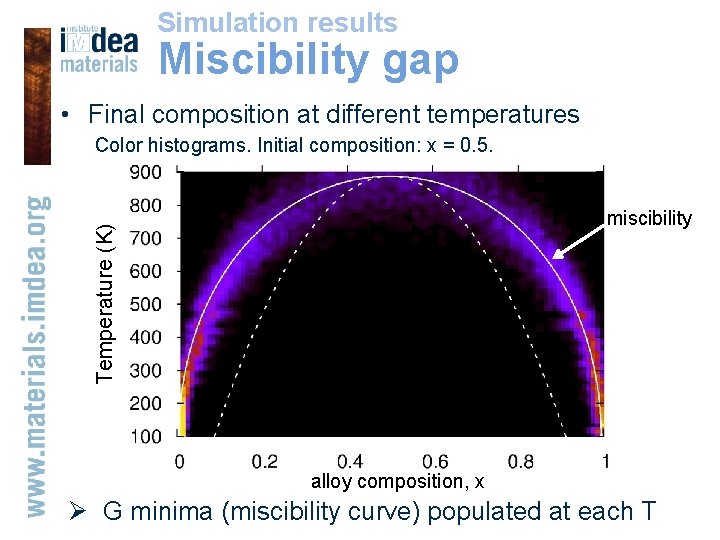
Simulation results Miscibility gap • Final composition at different temperatures Color histograms. Initial composition: x = 0. 5. Temperature (K) miscibility alloy composition, x Ø G minima (miscibility curve) populated at each T
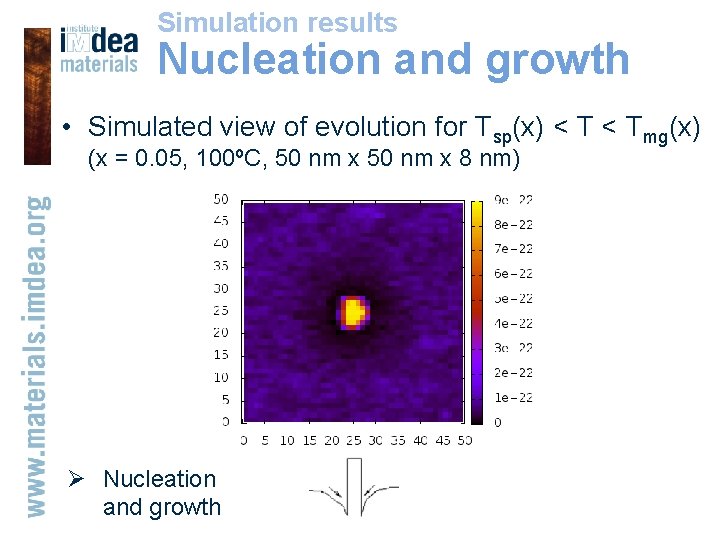
Simulation results Nucleation and growth • Simulated view of evolution for Tsp(x) < Tmg(x) (x = 0. 05, 100ºC, 50 nm x 8 nm) Ø Nucleation and growth
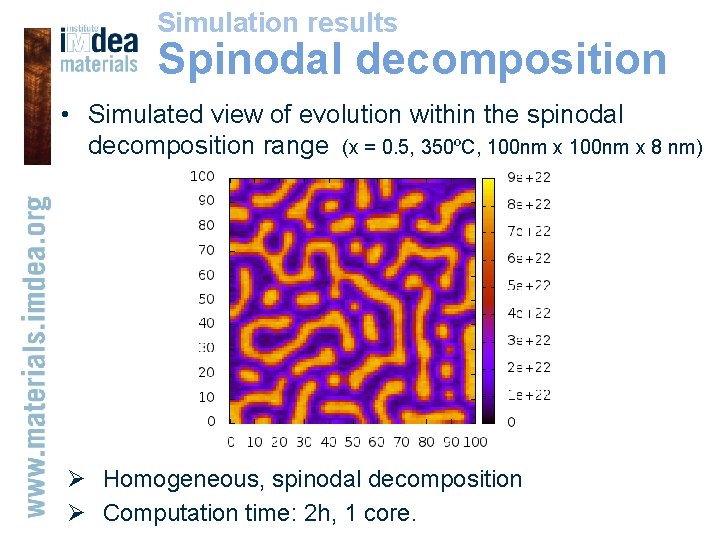
Simulation results Spinodal decomposition • Simulated view of evolution within the spinodal decomposition range (x = 0. 5, 350ºC, 100 nm x 8 nm) Ø Homogeneous, spinodal decomposition Ø Computation time: 2 h, 1 core.
Conclusions Summary ü An efficient off-lattice OKMC model for phase separation in Fe. Cr has been presented. ü Analytical expressions to assist in understanding the results have been shown. ü Part of the Fe. Cr phase diagram is reproduced. ü Results showing nucleation and growth and spinodal decomposition and have been presented. ü The model is integrated in a full OKMC simulator of damage irradiation evolution.
Conclusions Future work • Adjust the mixing enthalpy to better reproduce the experimental phase diagram. • Diffusivities and time-scale validation. • Study and calibrate the effects produced by excess of point defects generated by irradiation. • Finish the full integration into the simulator by including dependencies on Cr concentration to all the simulated defects (clusters, bubbles, …)
THANK YOU VERY MUCH FOR YOUR ATTENTION