
Modeling of complex biological systems Developing a new

Modeling of complex biological systems Developing a new parameter estimation method using Gabriele Petznick, M. Sc. September 26, 2012
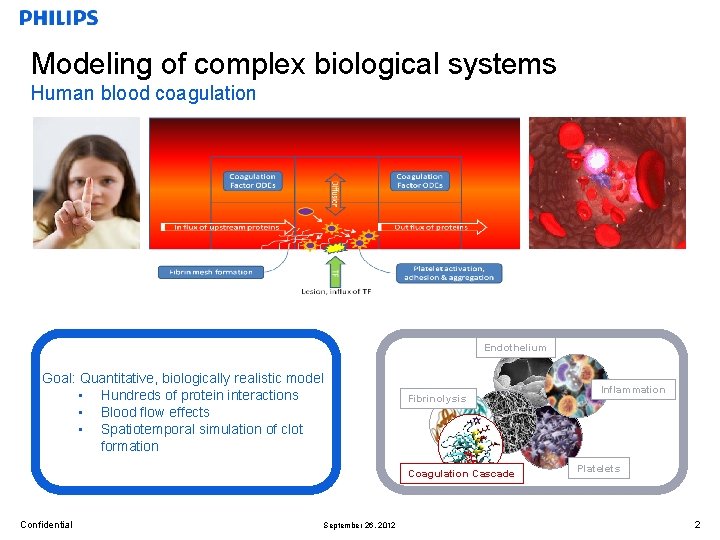
Modeling of complex biological systems Human blood coagulation Endothelium Goal: Quantitative, biologically realistic model • Hundreds of protein interactions • Blood flow effects • Spatiotemporal simulation of clot formation Fibrinolysis Coagulation Cascade Confidential September 26, 2012 Inflammation Platelets 2
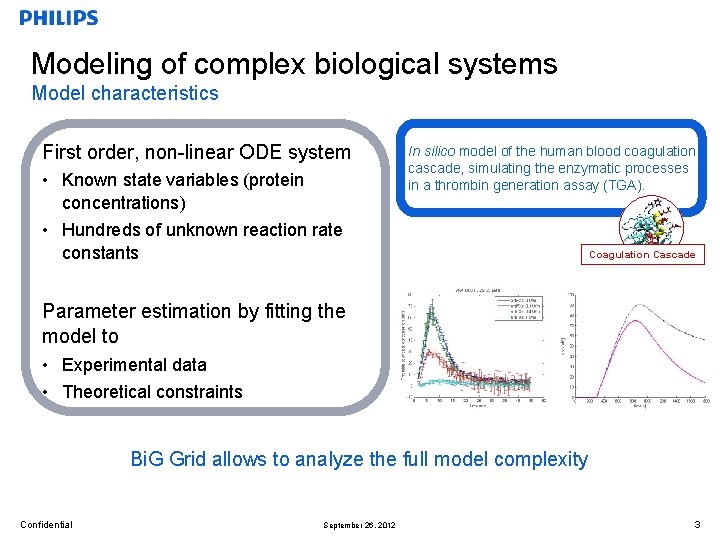
Modeling of complex biological systems Model characteristics First order, non-linear ODE system • Known state variables (protein concentrations) • Hundreds of unknown reaction rate constants In silico model of the human blood coagulation cascade, simulating the enzymatic processes in a thrombin generation assay (TGA). Coagulation Cascade Parameter estimation by fitting the model to • Experimental data • Theoretical constraints Bi. G Grid allows to analyze the full model complexity Confidential September 26, 2012 3

Modeling of complex biological systems Optimization methods Developing a new parameter estimation method Parameter estimation = Solving the inverse problem Why? • Optimization methods minimize misfit between measured and simulated curves as a function of underlying model parameters – Integration of the ODE system for the entire duration of the measurement à Numerical integration requires up to 100% of the computation time (for complex systems) Method that only requires to integrate certain time windows of the ODE system Confidential September 26, 2012 4
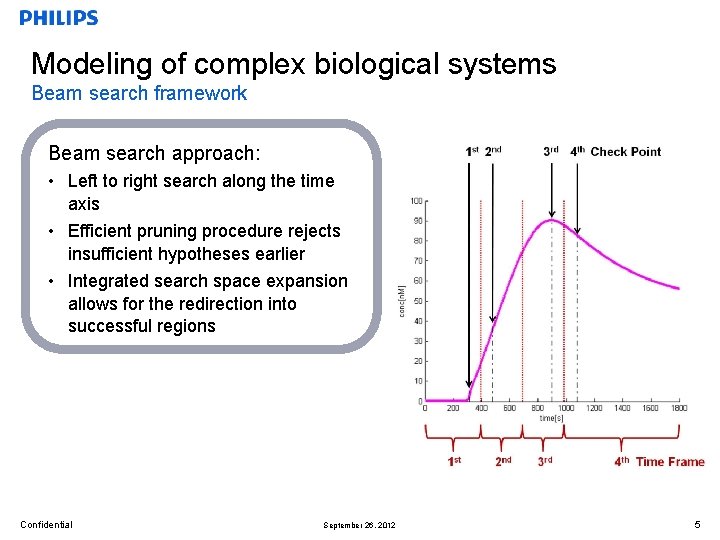
Modeling of complex biological systems Beam search framework Beam search approach: • Left to right search along the time axis • Efficient pruning procedure rejects insufficient hypotheses earlier • Integrated search space expansion allows for the redirection into successful regions Confidential September 26, 2012 5
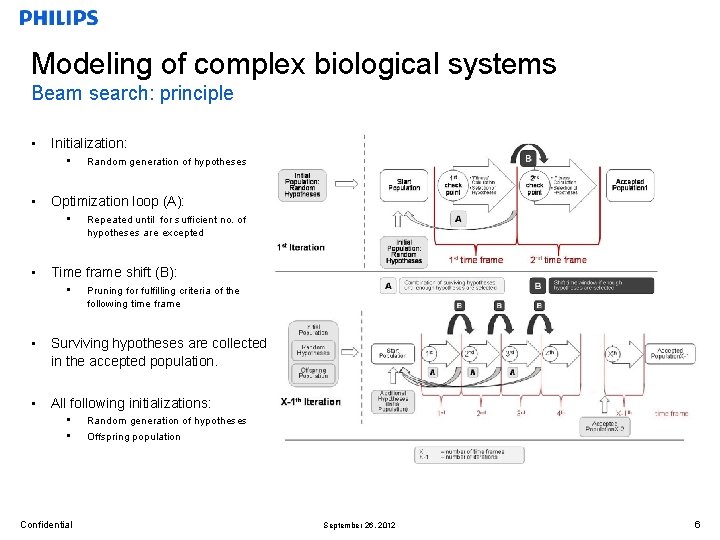
Modeling of complex biological systems Beam search: principle • Initialization: • • Optimization loop (A): • • Random generation of hypotheses Repeated until for sufficient no. of hypotheses are excepted Time frame shift (B): • Pruning for fulfilling criteria of the following time frame • Surviving hypotheses are collected in the accepted population. • All following initializations: • • Confidential Random generation of hypotheses Offspring population September 26, 2012 6
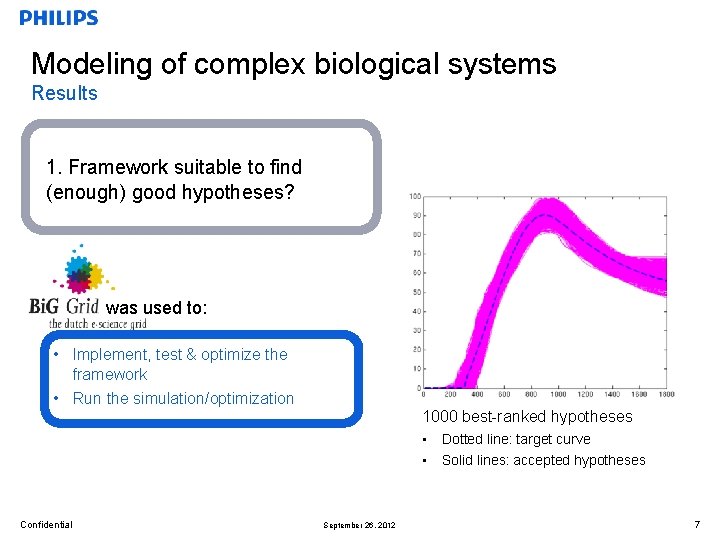
Modeling of complex biological systems Results 1. Framework suitable to find (enough) good hypotheses? was used to: • Implement, test & optimize the framework • Run the simulation/optimization 1000 best-ranked hypotheses • • Confidential September 26, 2012 Dotted line: target curve Solid lines: accepted hypotheses 7
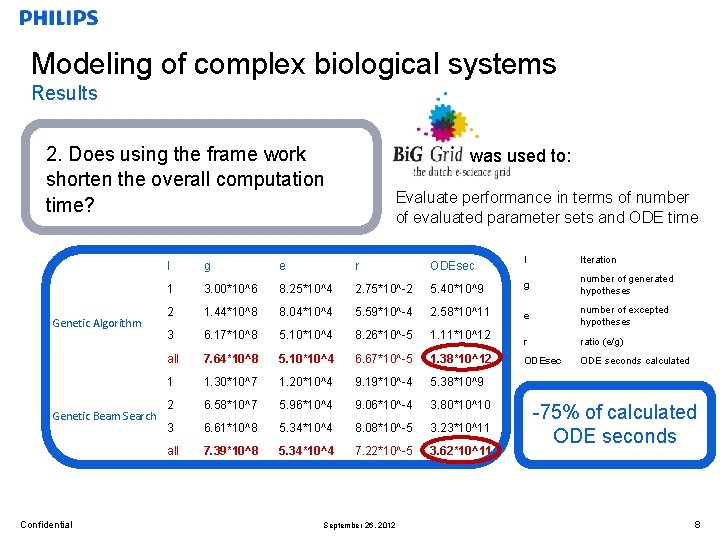
Modeling of complex biological systems Results 2. Does using the frame work shorten the overall computation time? Genetic Algorithm Genetic Beam Search Confidential was used to: Evaluate performance in terms of number of evaluated parameter sets and ODE time I g e r ODEsec I Iteration 1 3. 00*10^6 8. 25*10^4 2. 75*10^-2 5. 40*10^9 g number of generated hypotheses 2 1. 44*10^8 8. 04*10^4 5. 59*10^-4 2. 58*10^11 e number of excepted hypotheses 3 6. 17*10^8 5. 10*10^4 8. 26*10^-5 1. 11*10^12 r ratio (e/g) all 7. 64*10^8 5. 10*10^4 6. 67*10^-5 1. 38*10^12 ODEsec ODE seconds calculated 1 1. 30*10^7 1. 20*10^4 9. 19*10^-4 5. 38*10^9 2 6. 58*10^7 5. 96*10^4 9. 06*10^-4 3. 80*10^10 3 6. 61*10^8 5. 34*10^4 8. 08*10^-5 3. 23*10^11 all 7. 39*10^8 5. 34*10^4 7. 22*10^-5 3. 62*10^11 September 26, 2012 -75% of calculated ODE seconds 8

Modeling of complex biological systems HTC Bi. G Grid Jobs CPU Usage 33718 37343 days provided the resources needed to develop and evaluate a new parameter estimation method Confidential September 26, 2012 9

Confidential September 26, 2012 10

Confidential September 26, 2012 11
• The hemostatic system is a vital protective mechanism responsible for maintaining normal blood flow and preventing blood loss by sealing sites of injury in the vascular system. However, it must be controlled tightly so that neither prolonged bleeding nor redundant or excessive clotting occurs. In vivo the hemostatic balance exists under the influence of various cellular components as well as flow-mediated transport of the plasma coagulation factors. Until now the project mainly focused on developing and validating a mathematical model of the enzymatic coagulation cascade and fibrin formation. This in vitro scheme allows logical, effective laboratory-based screening for coagulation factor abnormalities. However, it lacks several aspects of the in vivo clotting physiology. Our aim is to provide a quantitative, biologically realistic model of all processes involved in hemostasis in vivo, to be able to predict the behavior of normal and pathologic states of the coagulation system. To reach that goal it is necessary to include the missing parts into our existing model. These parts include the interactions of proteins with membrane surfaces, the role of microparticles and cells, and the flow-mediated transport of all players in the system. Confidential September 26, 2012 12
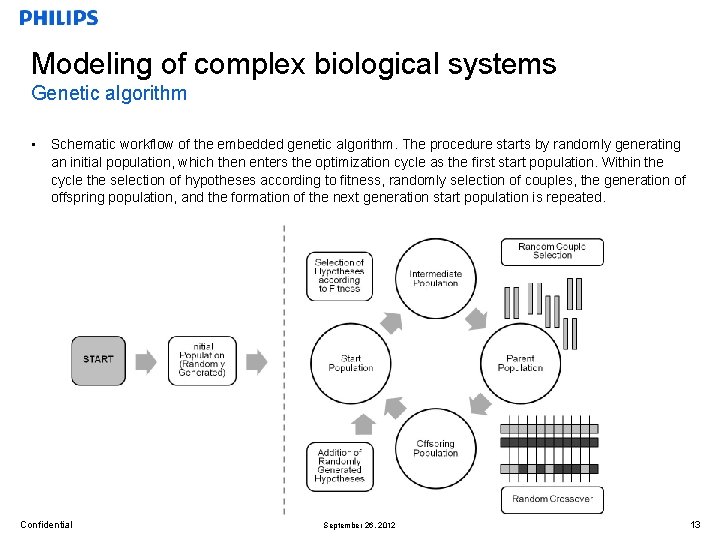
Modeling of complex biological systems Genetic algorithm • Schematic workflow of the embedded genetic algorithm. The procedure starts by randomly generating an initial population, which then enters the optimization cycle as the first start population. Within the cycle the selection of hypotheses according to fitness, randomly selection of couples, the generation of offspring population, and the formation of the next generation start population is repeated. Confidential September 26, 2012 13
- Slides: 13