
Modeling of Chemical Processes Lecture 4 Process design


- Slides: 26
Modeling of Chemical Processes Lecture 4 Process design
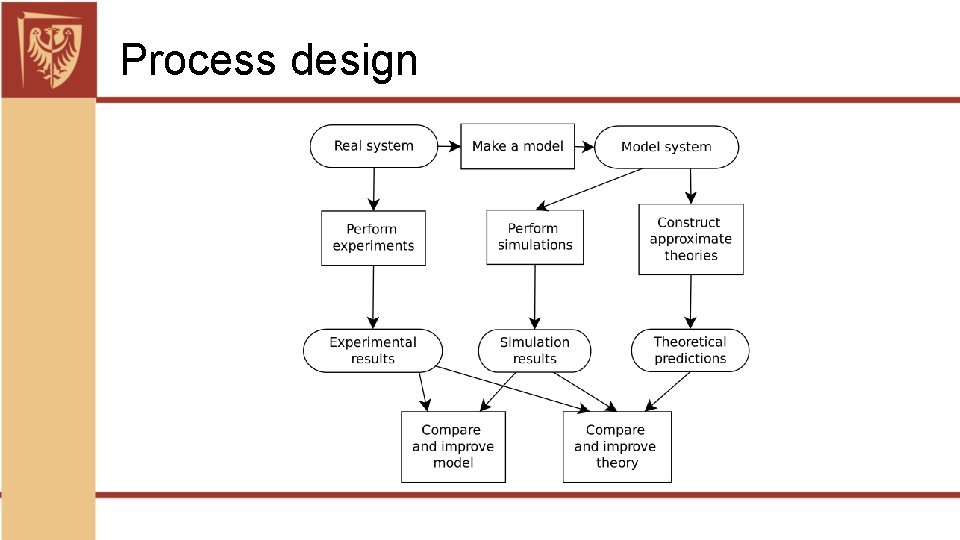
Process design A modern chemical plant consists of interconnected units such as heat exchangers, reactors, distillation columns, mixers etc. with high degree of integration to achieve energy efficiency. Design and operation of such complex plants is a challenging problem. Mathematical modeling and simulation is a cost effective method of designing or understanding behavior of these chemical plants when compared to study through experiments. Mathematical modeling cannot substitute experimentation, however, it can be effectively used to plan the experiments or creating scenarios under different operating conditions.
Process design
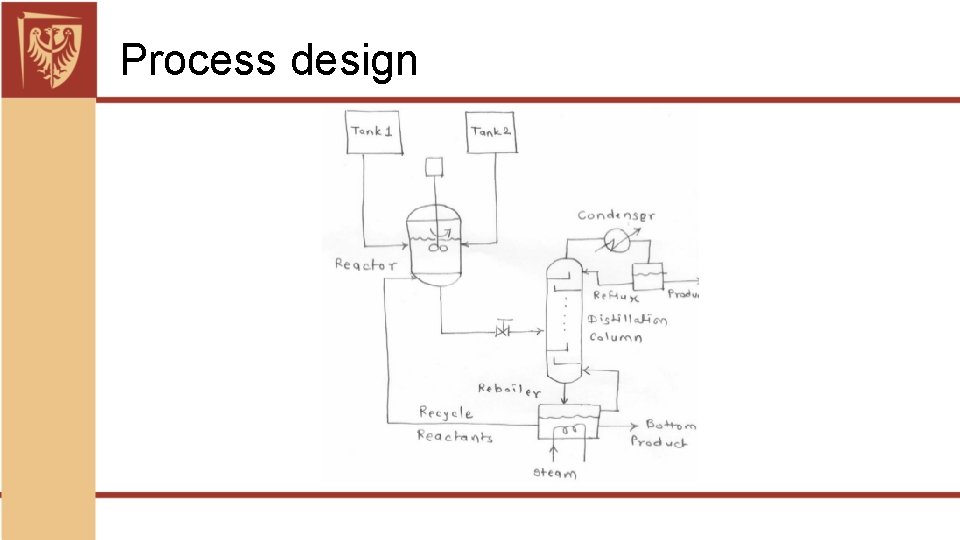
Process design To begin with, let us look at types of problems that can arise in context of modeling and simulation. Consider a typical small chemical plant consisting of a reactor and a distillation column, which is used to separate the product as overhead.
Process design
Process design problem Given: • desired product composition, • raw material composition and availability. To Find: • raw material flow rates, • reactor volume and operating conditions (temperature, pressure etc. ), • distillation column configuration (feed locations and product draws), • reboiler, condenser sizes and operating conditions (recycle and reflux flows, steam flow rate, operating temperatures and pressure etc. )
Process retrofitting Improvements in the existing set-up or operating conditions. Plant may have been designed for certain production capacity and assuming certain raw material quality. We are often required to assess whether: • Is it possible to operate the plant at a different production rate? • What is the effect of changes in raw material quality? • Is it possible to make alternate arrangement of flows to reduce energy consumption?
Dynamic behaviour Every plant is designed ssuming certain ideal composition of raw material quality, temperature and operating temperatures and pressures of utilities. In practice, however, it is impossible to maintain all the operating conditions exactly at the nominal design conditions. Changes in atmospheric conditions of fluctuations in steam header pressure, cooling water temperature, feed quality fluctuations, fouling of catalysts, scaling of heat transfer surfaces etc. keep perturbing the plant from the ideal operating condition. Thus, it becomes necessary to understand transient behavior of the system in order to: • reduce the effects of disturbances on the key operating variables such as product quality • achieve transition from one operating point to an economically profitable operating point. • carry out safety and hazard analysis
Mechanistic models Linear Algebraic Equations. Plant wide or section wide mass balances are carried out at design stage or later during operation for keeping material audit. These models are typical examples of systems of simultaneous linear algebraic equations.
Mechanistic models
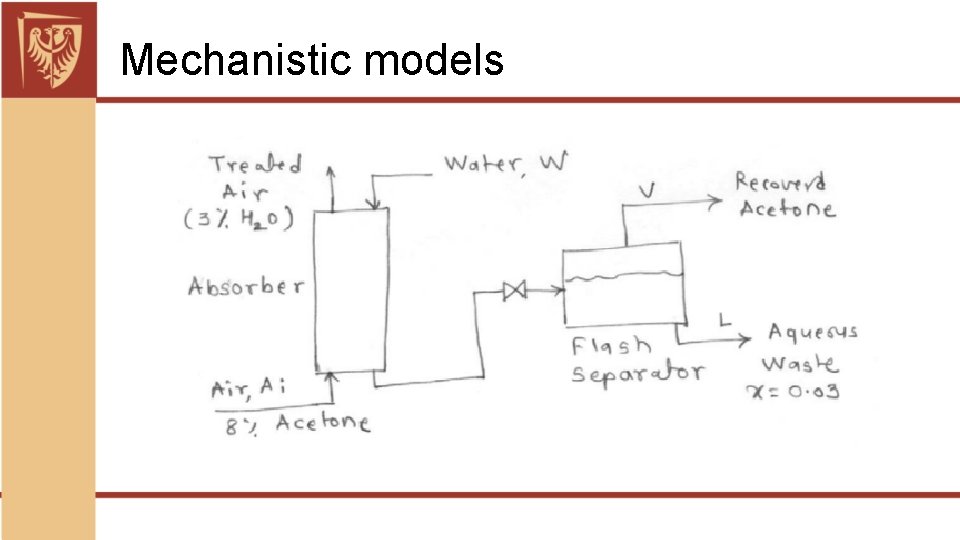
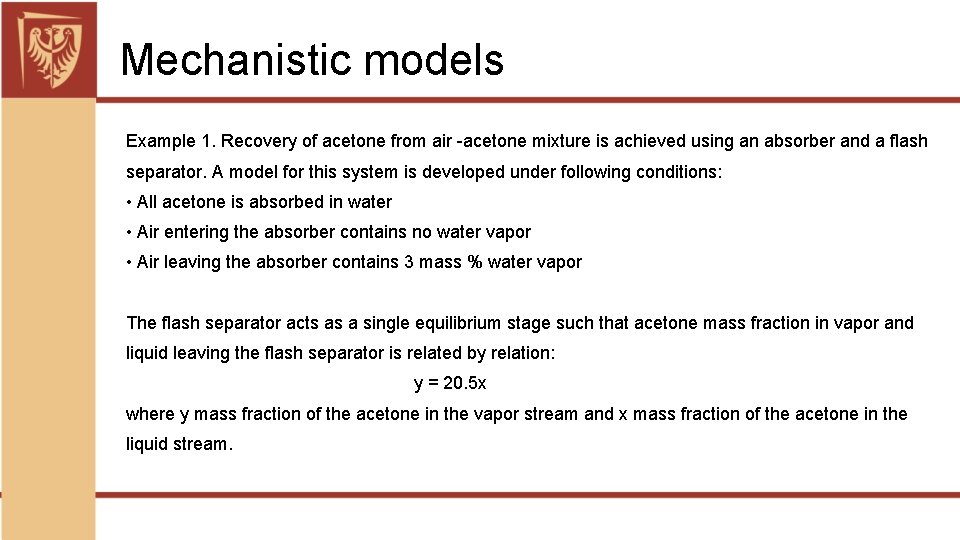
Mechanistic models Example 1. Recovery of acetone from air -acetone mixture is achieved using an absorber and a flash separator. A model for this system is developed under following conditions: • All acetone is absorbed in water • Air entering the absorber contains no water vapor • Air leaving the absorber contains 3 mass % water vapor The flash separator acts as a single equilibrium stage such that acetone mass fraction in vapor and liquid leaving the flash separator is related by relation: y = 20. 5 x where y mass fraction of the acetone in the vapor stream and x mass fraction of the acetone in the liquid stream.
Mechanistic models Operating conditions of the process are as follows • Air in flow: 600 l /hr with 8 mass % acetone • Water flow rate: 500 l/hr It is required that the waste water should have acetone content of 3 mass % and we are required to determine concentration of the acetone in the vapor stream and flow rates of the product streams.
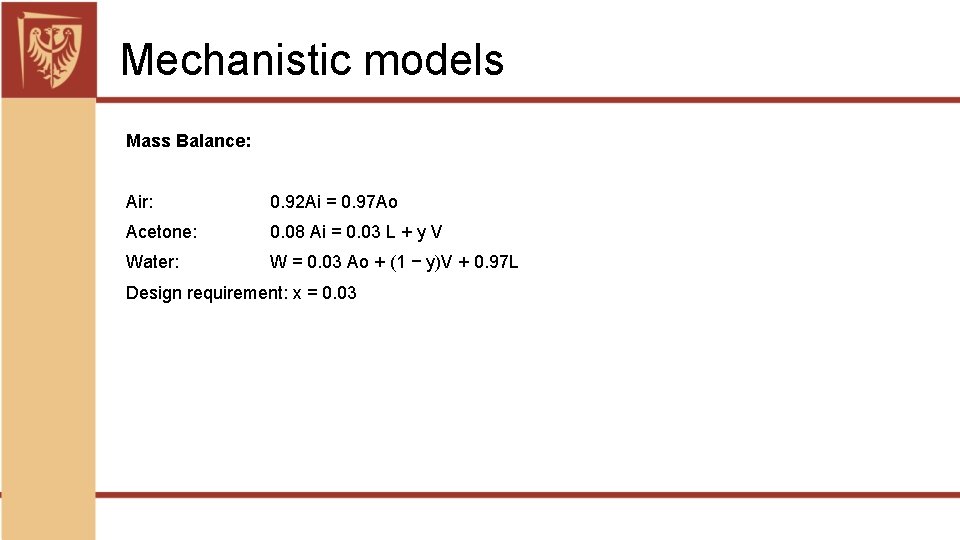
Mechanistic models Mass Balance: Air: 0. 92 Ai = 0. 97 Ao Acetone: 0. 08 Ai = 0. 03 L + y V Water: W = 0. 03 Ao + (1 − y)V + 0. 97 L Design requirement: x = 0. 03
Mechanistic models
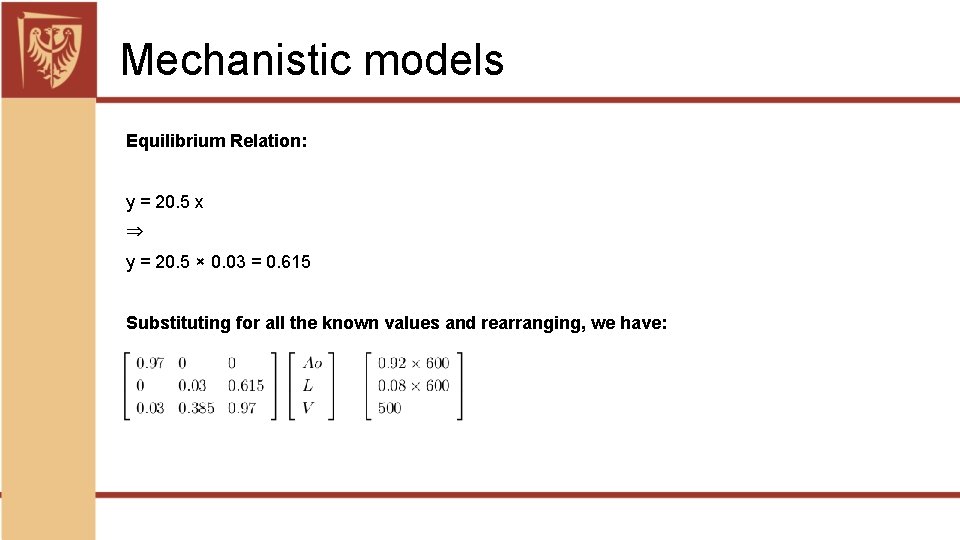
Mechanistic models Equilibrium Relation: y = 20. 5 x ⇒ y = 20. 5 × 0. 03 = 0. 615 Substituting for all the known values and rearranging, we have:
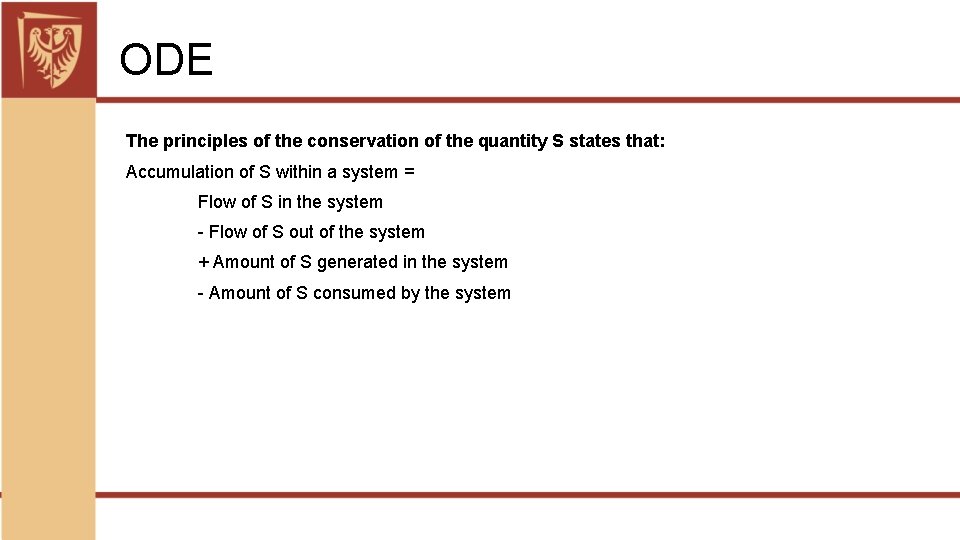
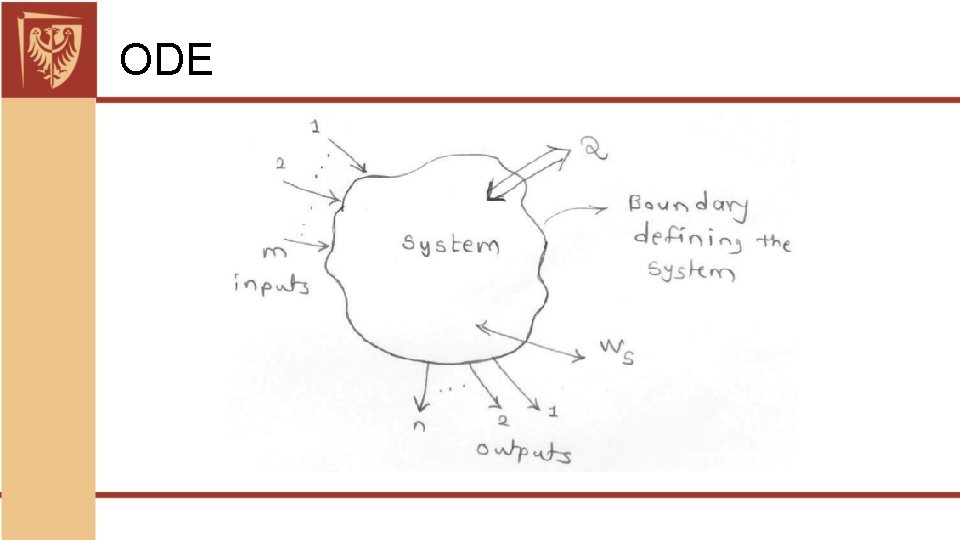
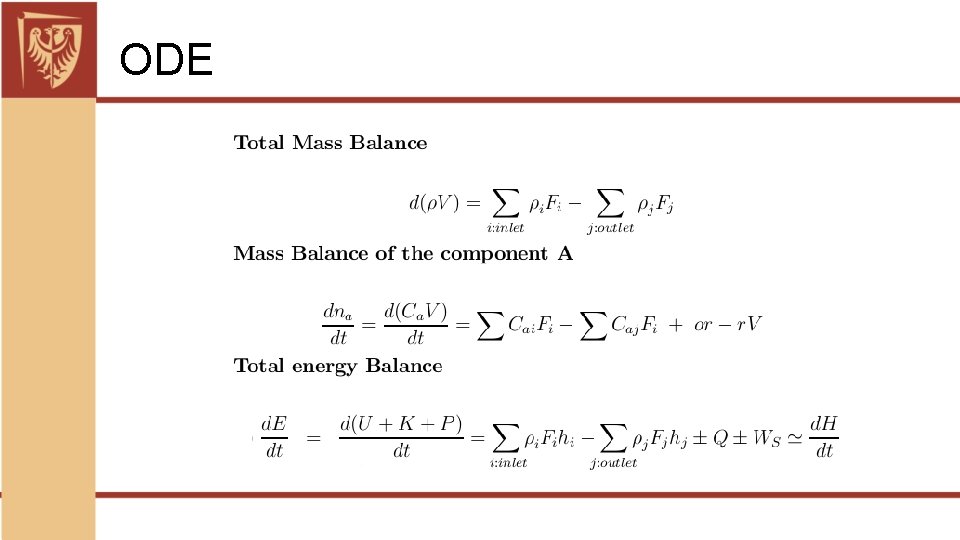
ODE The principles of the conservation of the quantity S states that: Accumulation of S within a system = Flow of S in the system - Flow of S out of the system + Amount of S generated in the system - Amount of S consumed by the system
ODE
ODE
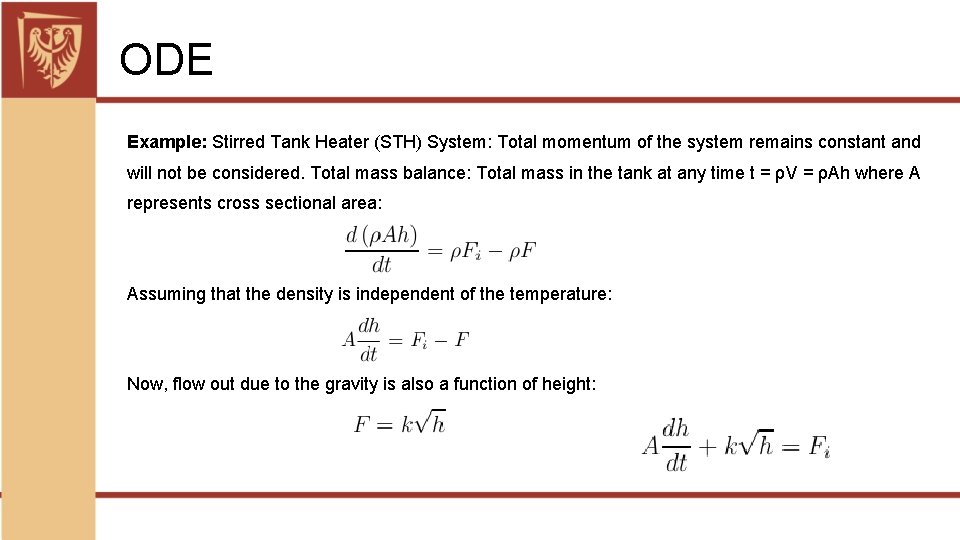
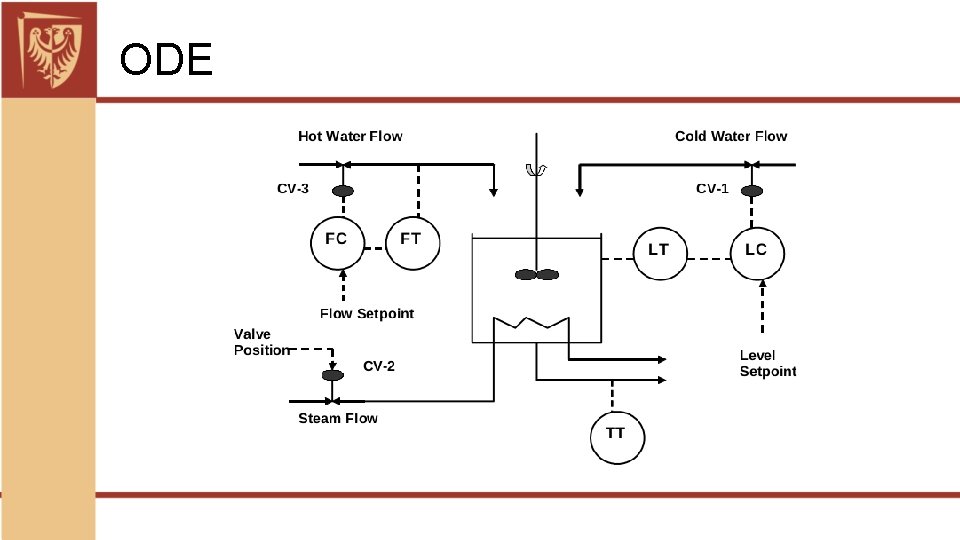
ODE Example: Stirred Tank Heater (STH) System: Total momentum of the system remains constant and will not be considered. Total mass balance: Total mass in the tank at any time t = ρV = ρAh where A represents cross sectional area: Assuming that the density is independent of the temperature: Now, flow out due to the gravity is also a function of height:
ODE
ODE
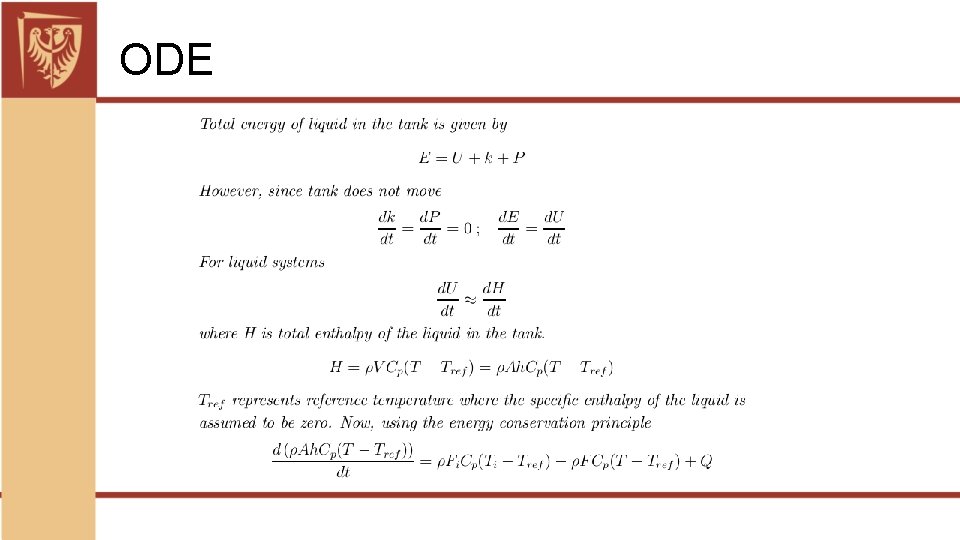
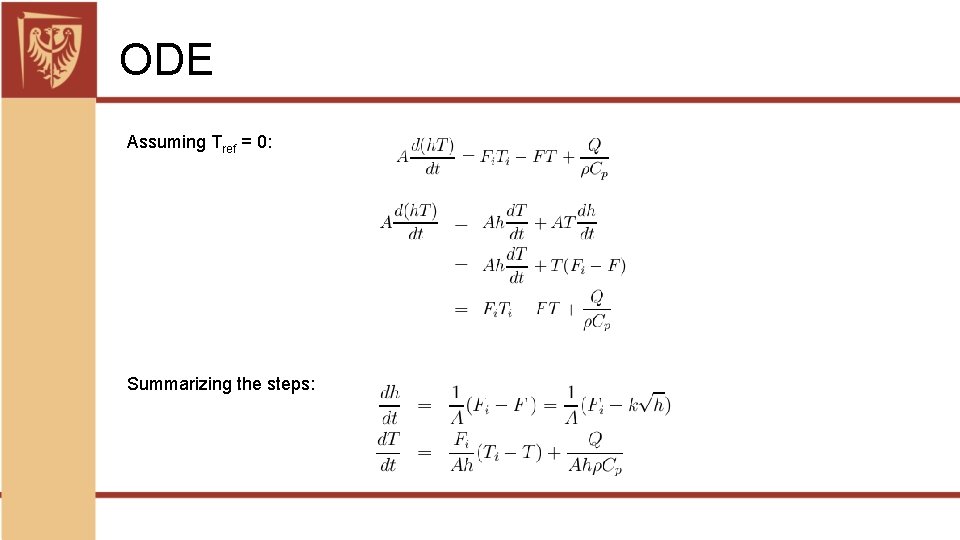
ODE Assuming Tref = 0: Summarizing the steps:
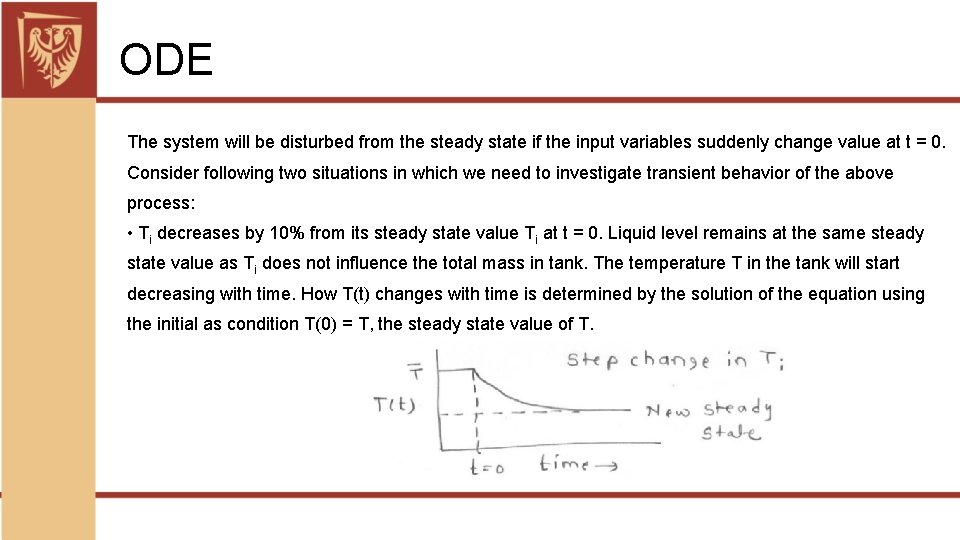
ODE The system will be disturbed from the steady state if the input variables suddenly change value at t = 0. Consider following two situations in which we need to investigate transient behavior of the above process: • Ti decreases by 10% from its steady state value Ti at t = 0. Liquid level remains at the same steady state value as Ti does not influence the total mass in tank. The temperature T in the tank will start decreasing with time. How T(t) changes with time is determined by the solution of the equation using the initial as condition T(0) = T, the steady state value of T.
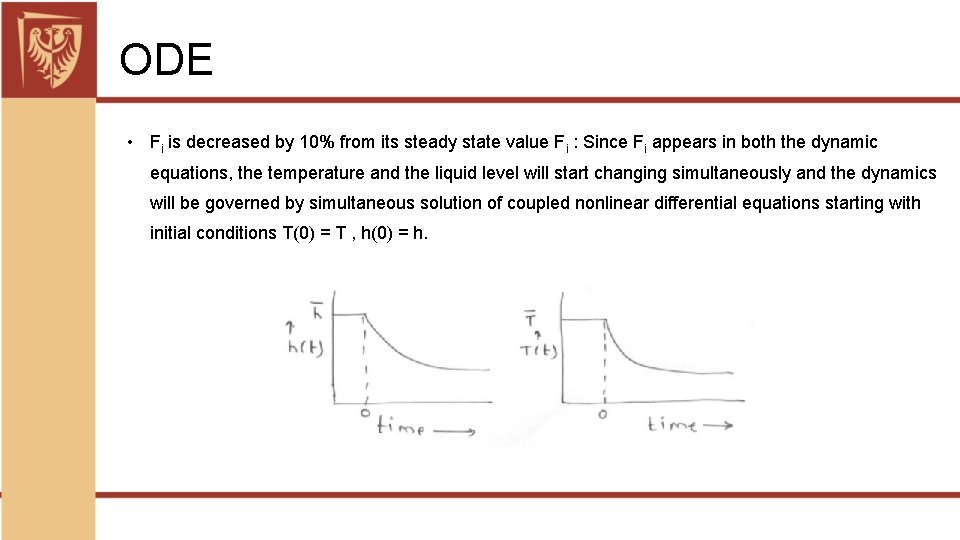
ODE • Fi is decreased by 10% from its steady state value Fi : Since Fi appears in both the dynamic equations, the temperature and the liquid level will start changing simultaneously and the dynamics will be governed by simultaneous solution of coupled nonlinear differential equations starting with initial conditions T(0) = T , h(0) = h.
ODE It is also possible to investigate response of the system for more complex inputs, such as Ti(t) = Ti + ∆Ti sin(ωt) where above function captures daily variation of cooling water inlet temperature. In each case, the transient behavior T(t) and h(t) is computed by solving the system of ODEs subject to given initial conditions and time variation of independent inputs (i. e. forcing functions).
ODE