
Modeling Issues Modeling Enterprises Based on slides from
Modeling Issues Modeling Enterprises Based on slides from S. Easterbrook, N. Niu, E. S. K. Yu
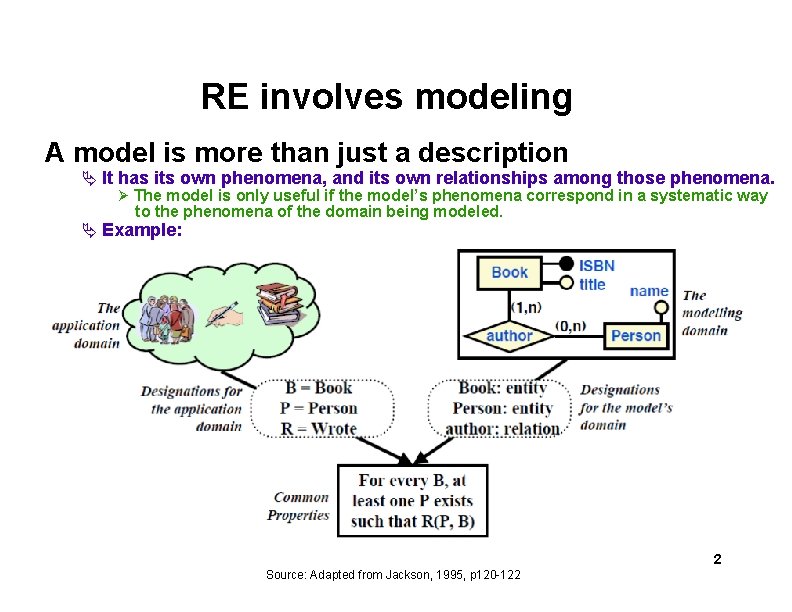
RE involves modeling A model is more than just a description It has its own phenomena, and its own relationships among those phenomena. The model is only useful if the model’s phenomena correspond in a systematic way to the phenomena of the domain being modeled. Example: 2 Source: Adapted from Jackson, 1995, p 120 -122
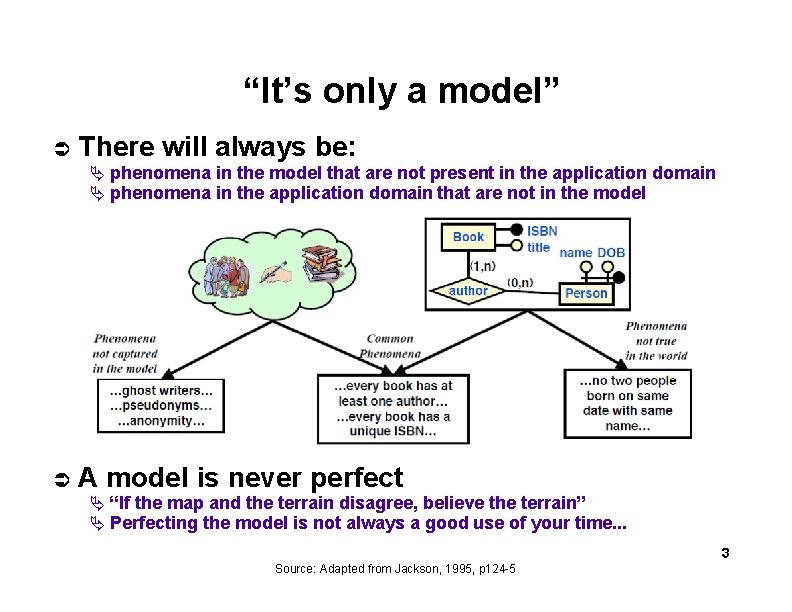
“It’s only a model” There will always be: phenomena in the model that are not present in the application domain phenomena in the application domain that are not in the model A model is never perfect “If the map and the terrain disagree, believe the terrain” Perfecting the model is not always a good use of your time. . . 3 Source: Adapted from Jackson, 1995, p 124 -5
Modeling… Modeling can guide elicitation: It can help you figure out what questions to ask It can help to surface hidden requirements i. e. does it help you ask the right questions? Modeling can provide a measure of progress: Completeness of the models -> completeness of the elicitation (? ) i. e. if we’ve filled in all the pieces of the models, are we done? Modeling can help to uncover problems Inconsistency in the models can reveal interesting things… e. g. conflicting or infeasible requirements e. g. confusion over terminology, scope, etc e. g. disagreements between stakeholders Modeling can help us check our understanding Reason over the model to understand its consequences Does it have the properties we expect? Animate the model to help us visualize/validate the requirements Hickey and Davis paper, 4 roles modeling plays? 4
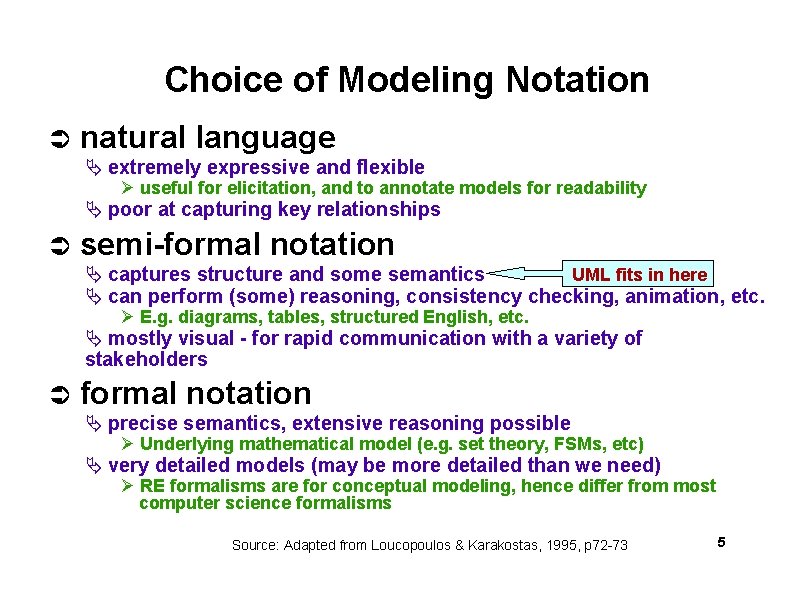
Choice of Modeling Notation natural language extremely expressive and flexible useful for elicitation, and to annotate models for readability poor at capturing key relationships semi-formal notation UML fits in here captures structure and some semantics can perform (some) reasoning, consistency checking, animation, etc. E. g. diagrams, tables, structured English, etc. mostly visual - for rapid communication with a variety of stakeholders formal notation precise semantics, extensive reasoning possible Underlying mathematical model (e. g. set theory, FSMs, etc) very detailed models (may be more detailed than we need) RE formalisms are for conceptual modeling, hence differ from most computer science formalisms Source: Adapted from Loucopoulos & Karakostas, 1995, p 72 -73 5
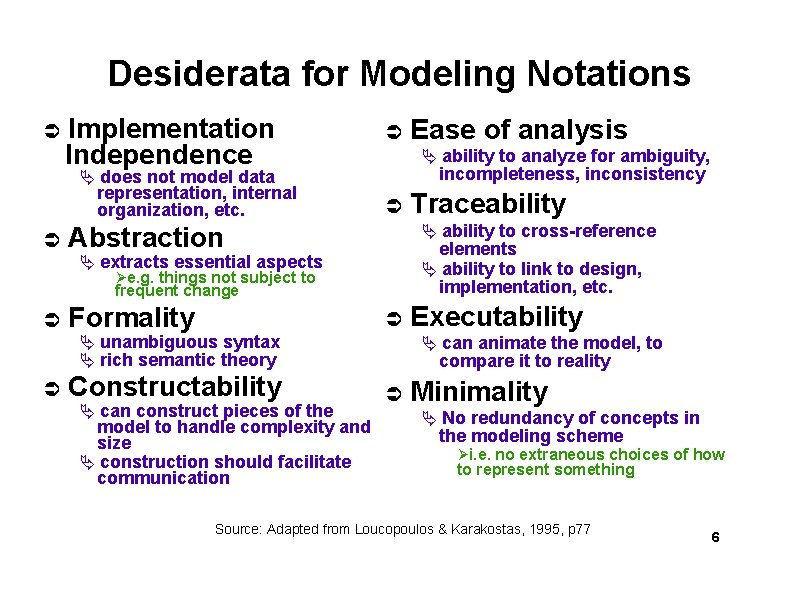
Desiderata for Modeling Notations Implementation Independence does not model data representation, internal organization, etc. ability to analyze for ambiguity, incompleteness, inconsistency e. g. things not subject to frequent change Formality Constructability unambiguous syntax rich semantic theory can construct pieces of the model to handle complexity and size construction should facilitate communication Traceability to cross-reference elements ability to link to design, implementation, etc. Abstraction extracts essential aspects Ease of analysis Executability can animate the model, to compare it to reality Minimality No redundancy of concepts in the modeling scheme i. e. no extraneous choices of how to represent something Source: Adapted from Loucopoulos & Karakostas, 1995, p 77 6
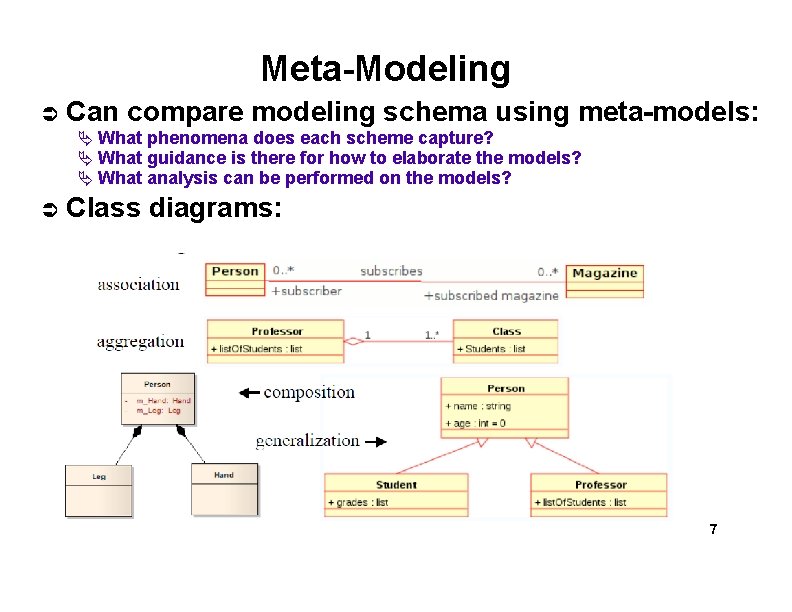
Meta-Modeling Can compare modeling schema using meta-models: What phenomena does each scheme capture? What guidance is there for how to elaborate the models? What analysis can be performed on the models? Class diagrams: 7
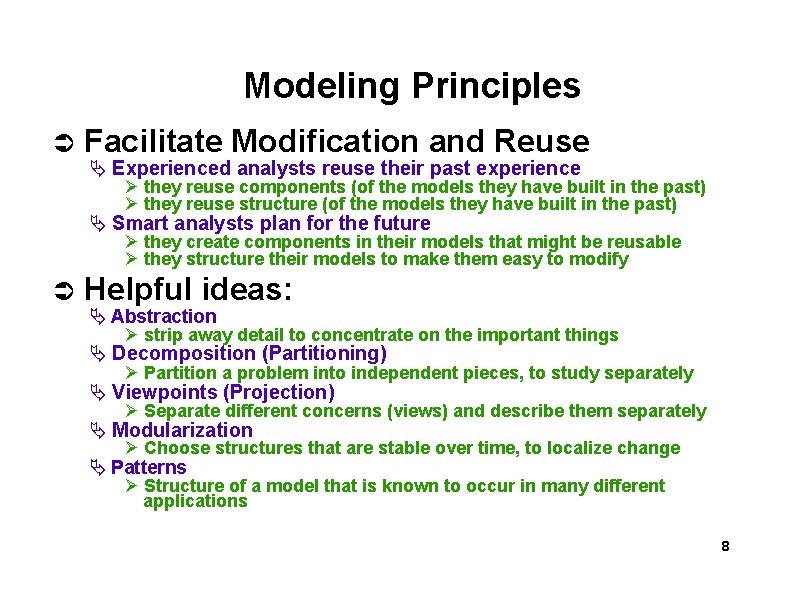
Modeling Principles Facilitate Modification and Reuse Experienced analysts reuse their past experience they reuse components (of the models they have built in the past) they reuse structure (of the models they have built in the past) Smart analysts plan for the future they create components in their models that might be reusable they structure their models to make them easy to modify Helpful ideas: Abstraction strip away detail to concentrate on the important things Decomposition (Partitioning) Partition a problem into independent pieces, to study separately Viewpoints (Projection) Separate different concerns (views) and describe them separately Modularization Choose structures that are stable over time, to localize change Patterns Structure of a model that is known to occur in many different applications 8
Modeling Principle 1: Partitioning captures aggregation/part-of relationship Example: goal is to develop a spacecraft partition the problem into parts: guidance and navigation; data handling; command control; environmental control; instrumentation; etc Note: this is not a design, it is a problem decomposition actual design might have any number of components, with no relation to these sub-problems However, the choice of problem decomposition will probably be reflected in the design 9
Modeling Principle 2: Abstraction A way of finding similarities between concepts by ignoring some details Focuses on the general/specific relationship between phenomena Classification groups entities with a similar role as members of a single class Generalization expresses similarities between different classes in an ‘is_a’ association Example: requirement is to handle faults on the spacecraft might group different faults into fault classes based on location: instrumentation fault, communication fault, processor fault, etc based on symptoms: no response from device; incorrect response; self-test failure; etc. . . 10 Source: Adapted from Davis, 1990, p 48 and Loucopoulos & Karakostas, 1995, p 78
Modeling Principle 3: Projection: separates aspects of the model into multiple viewpoints similar to projections used by architects for buildings Example: Need to model the requirements for a spacecraft Model separately: safety commandability fault tolerance timing and sequencing Etc… Note: Projection and Partitioning are similar: Partitioning defines a ‘part of’ relationship Projection defines a ‘view of’ relationship Partitioning assumes a the parts are relatively independent Source: Adapted from Davis, 1990, p 48 -51 11
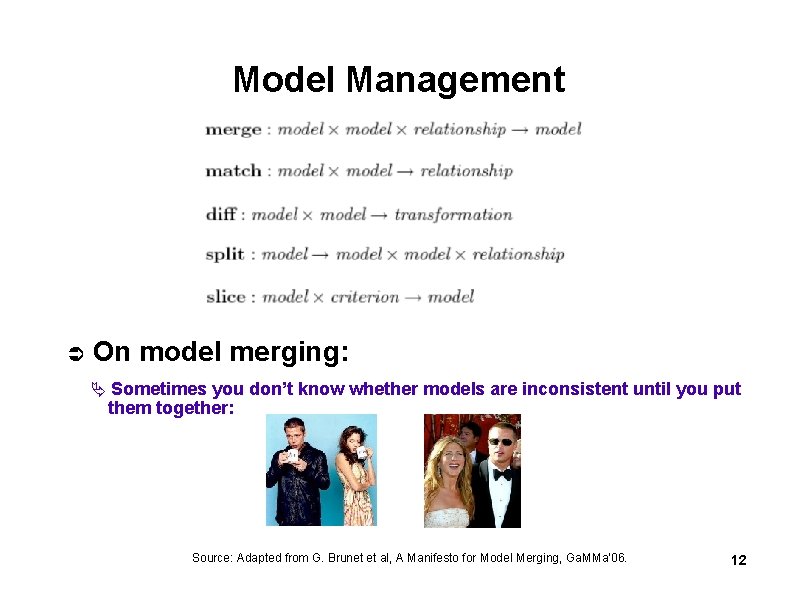
Model Management On model merging: Sometimes you don’t know whether models are inconsistent until you put them together: Source: Adapted from G. Brunet et al, A Manifesto for Model Merging, Ga. MMa’ 06. 12
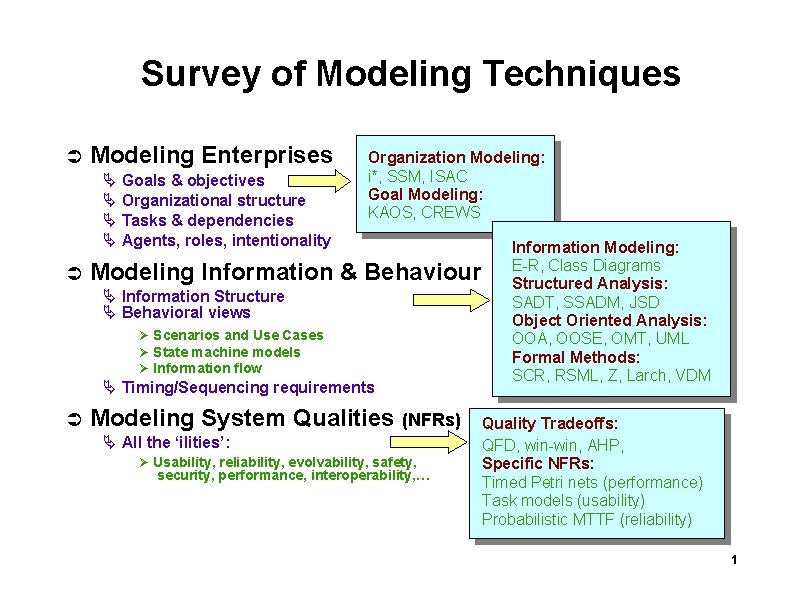
Survey of Modeling Techniques Modeling Enterprises Goals & objectives Organizational structure Tasks & dependencies Agents, roles, intentionality Organization Modeling: i*, SSM, ISAC Goal Modeling: KAOS, CREWS Modeling Information & Behaviour Information Structure Behavioral views Scenarios and Use Cases State machine models Information flow Timing/Sequencing requirements Modeling System Qualities (NFRs) All the ‘ilities’: Usability, reliability, evolvability, safety, security, performance, interoperability, … Information Modeling: E-R, Class Diagrams Structured Analysis: SADT, SSADM, JSD Object Oriented Analysis: OOA, OOSE, OMT, UML Formal Methods: SCR, RSML, Z, Larch, VDM Quality Tradeoffs: QFD, win-win, AHP, Specific NFRs: Timed Petri nets (performance) Task models (usability) Probabilistic MTTF (reliability) 1
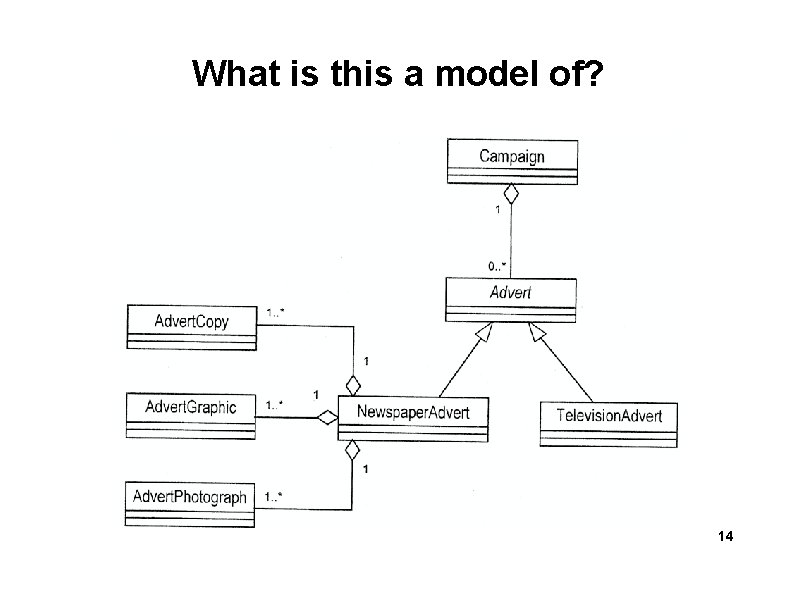
What is this a model of? 14
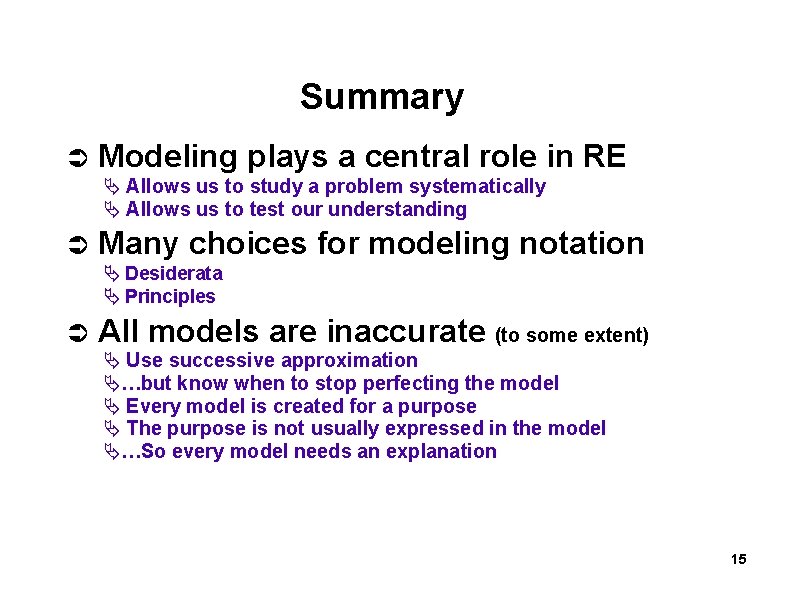
Summary Modeling plays a central role in RE Allows us to study a problem systematically Allows us to test our understanding Many choices for modeling notation Desiderata Principles All models are inaccurate (to some extent) Use successive approximation …but know when to stop perfecting the model Every model is created for a purpose The purpose is not usually expressed in the model …So every model needs an explanation 15
GOAL ORIENTATED MODELING
Motivation Facilitate common understanding of the system Support requirements elicitation with goals Identify and evaluate alternative realisations Detect irrelevant requirements Justification of requriements with rationales Proof of completeness for requirements specifications • Goals have greater stability than requirements • • •
The Term ”Goal” An intention with regard to the objectives, properties or use of the system
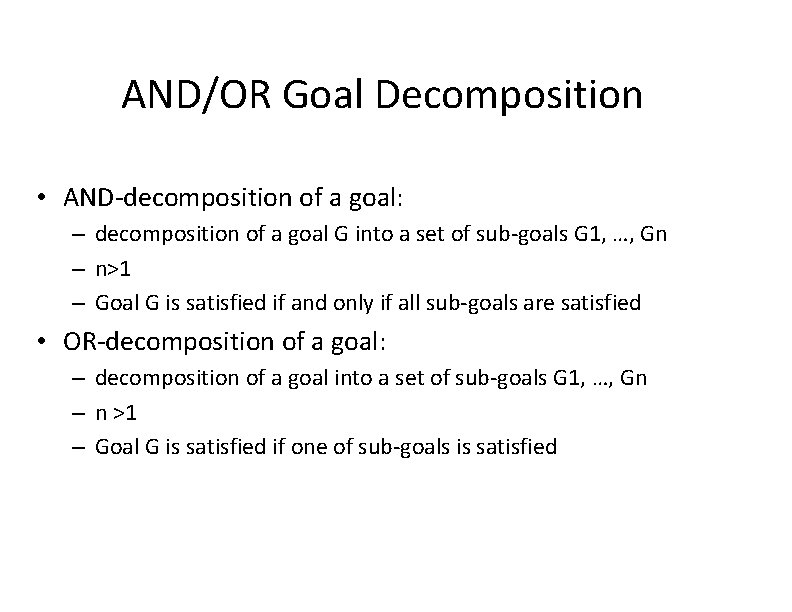
AND/OR Goal Decomposition • AND-decomposition of a goal: – decomposition of a goal G into a set of sub-goals G 1, …, Gn – n>1 – Goal G is satisfied if and only if all sub-goals are satisfied • OR-decomposition of a goal: – decomposition of a goal into a set of sub-goals G 1, …, Gn – n >1 – Goal G is satisfied if one of sub-goals is satisfied
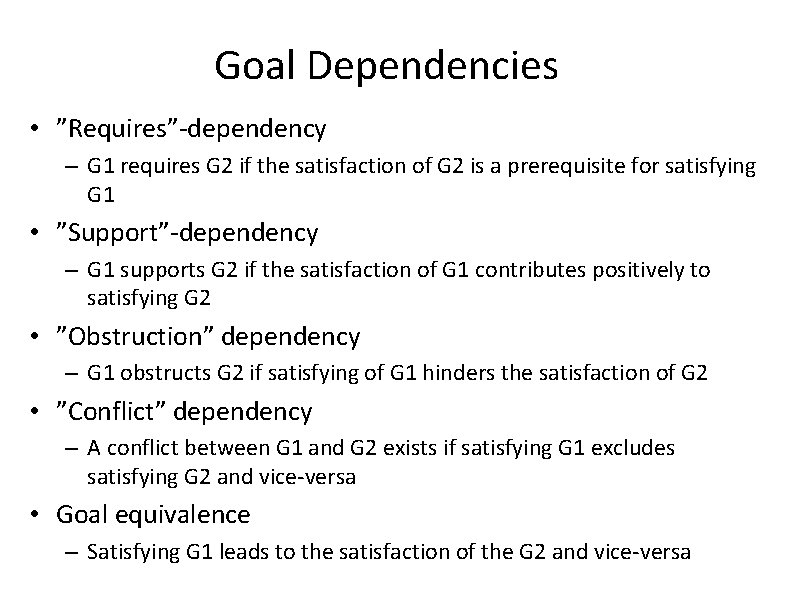
Goal Dependencies • ”Requires”-dependency – G 1 requires G 2 if the satisfaction of G 2 is a prerequisite for satisfying G 1 • ”Support”-dependency – G 1 supports G 2 if the satisfaction of G 1 contributes positively to satisfying G 2 • ”Obstruction” dependency – G 1 obstructs G 2 if satisfying of G 1 hinders the satisfaction of G 2 • ”Conflict” dependency – A conflict between G 1 and G 2 exists if satisfying G 1 excludes satisfying G 2 and vice-versa • Goal equivalence – Satisfying G 1 leads to the satisfaction of the G 2 and vice-versa
Identifying Goal Dependencies • Context changes affect goal dependencies • Example: change of a data protection law in a country may prohibit the electronic localisation of a car • Stakeholders must be aware of such changes and constantly analyse their influences!
DOCUMENTING GOALS A Template for Documenting Goals • Possible: goal documentation using unstructured natural language • Better: using templates with attributes – Unique identifiers for goals – Management attributes – References to the context – Specific goal attributes – Possibility to include additional information
Seven Rules for Documenting Goals 1. 2. 3. 4. 5. 6. 7. Document goals concisely (but not to briefly) Use the active voice Document stakeholder's intention precisely Decompose high-level goals Clearly define the value of the goal Document rationales for a goal Avoid unnecessary restrictions; try to weaken existing restrictions Apply these rules already during requirements elicitation to avoid the elicitation of inappropriate requirements!
Goal Modeling Languages and Methods • Model-based goal documentation – helps understanding and communicating goals – complements template-based documentation (each technique provides a different level of abstraction) • Common goal modeling languages include Goal-oriented Requirements Language (GRL), i* and KAOS • Goal modeling method consists of language, rules, guidelines and management practices – Common goal modelling methods include Goal-Based Requirements Analysis Method (GBRAM), Goal-Driven Change method (GDC), the i* framework, the KAOS framework, the Non. Functional Rquirements (NFR) framework
Documenting Goals Using AND/OR Trees and AND/OR Graphs • • AND/OR trees – Consist of nodes representing goal decompositions – Hierarchical, each node has exactly one super-goal – Graphical notation indicates type of decomposition (AND/OR) – Feature models provide a similar approach • AND/OR graphs – Some sub-goals contribute to the satisfaction of more than one super goal – AND/OR graphs are acyclic
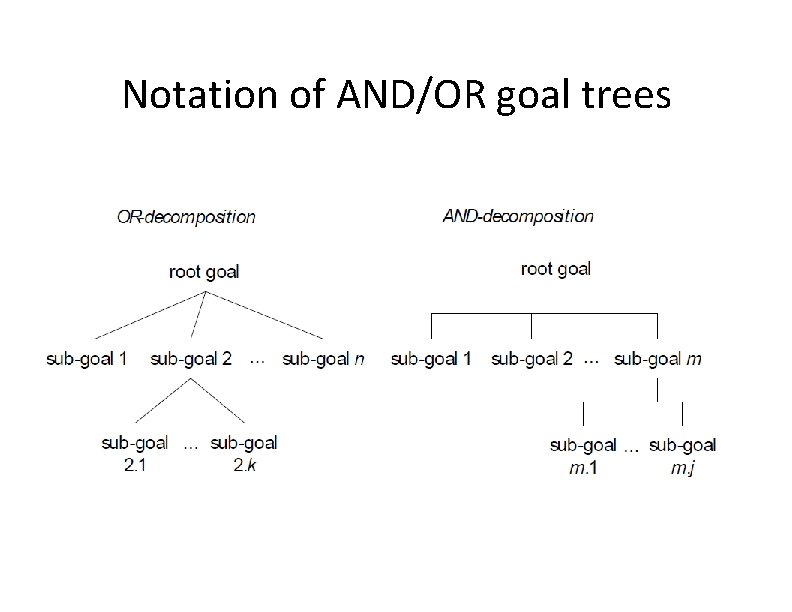
Notation of AND/OR goal trees
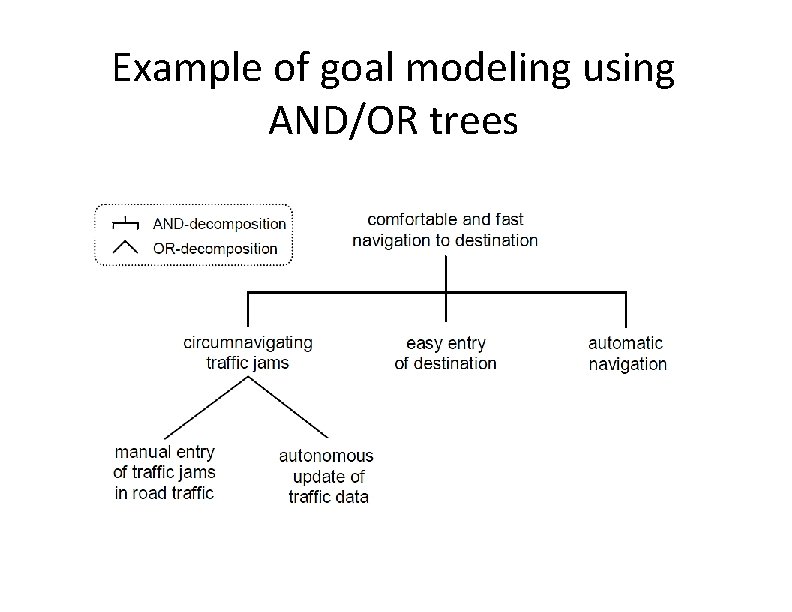
Example of goal modeling using AND/OR trees
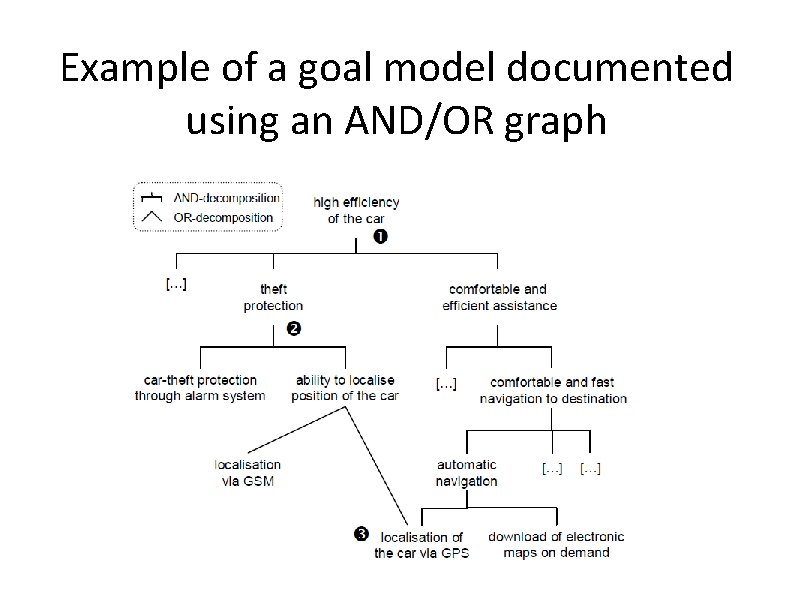
Example of a goal model documented using an AND/OR graph
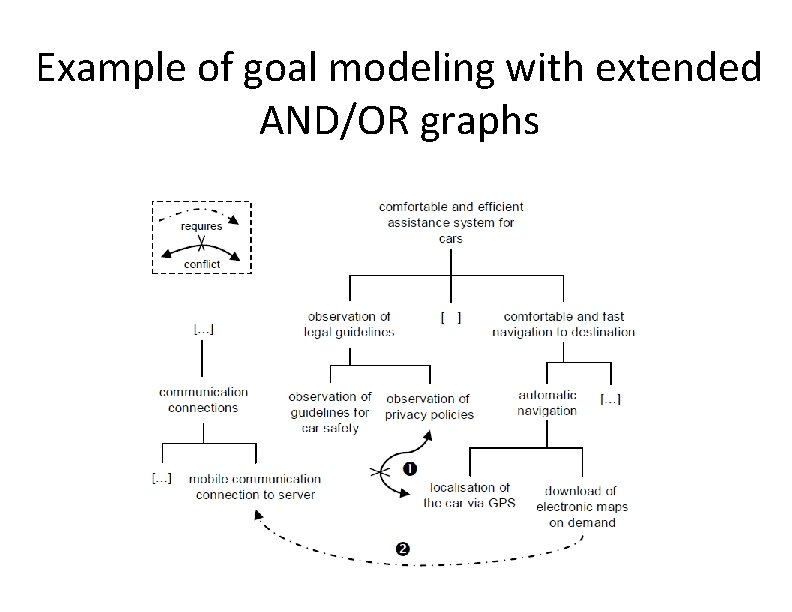
Example of goal modeling with extended AND/OR graphs
i* (i-Star) • Based on the modeling language GRL • AND/OR trees for documenting goal decompositions • Modeling constructs for quality aspects • Basic concepts – Objects – Dependencies – Relationships
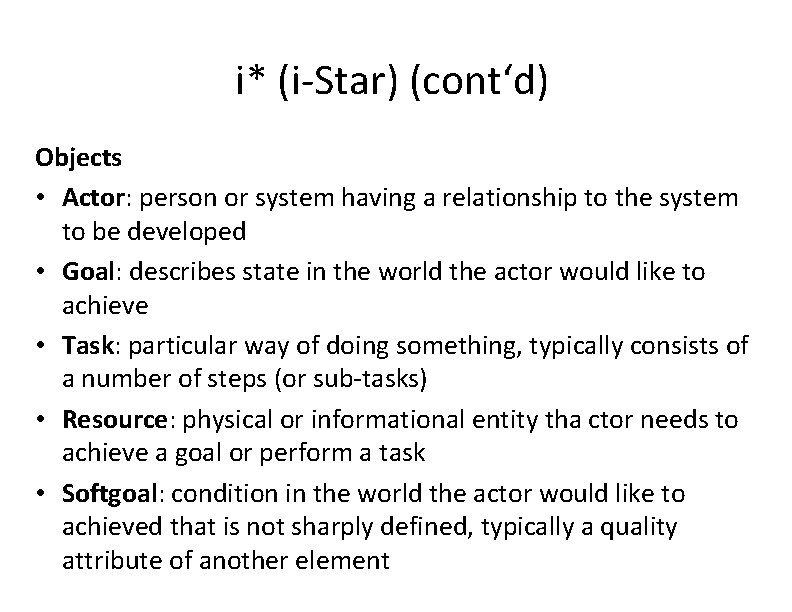
i* (i-Star) (cont‘d) Objects • Actor: person or system having a relationship to the system to be developed • Goal: describes state in the world the actor would like to achieve • Task: particular way of doing something, typically consists of a number of steps (or sub-tasks) • Resource: physical or informational entity tha ctor needs to achieve a goal or perform a task • Softgoal: condition in the world the actor would like to achieved that is not sharply defined, typically a quality attribute of another element
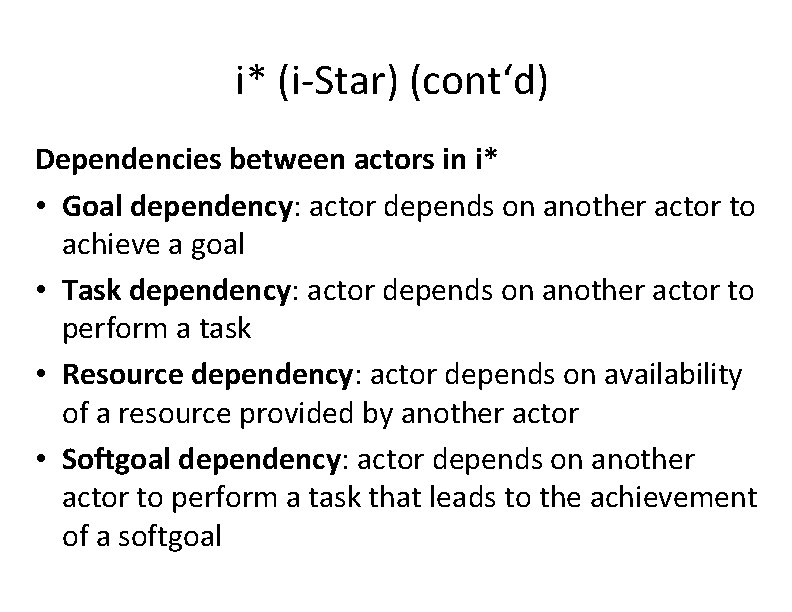
i* (i-Star) (cont‘d) Dependencies between actors in i* • Goal dependency: actor depends on another actor to achieve a goal • Task dependency: actor depends on another actor to perform a task • Resource dependency: actor depends on availability of a resource provided by another actor • Softgoal dependency: actor depends on another actor to perform a task that leads to the achievement of a softgoal
i* (i-Star) (cont‘d) Relationships between Objects in i* • Means-end link: documents which elements (softgoals, tasks and/or resources) contribute to achieving a goal • Contribution link: documents positive or negative influence on softgoals by tasks or other softgoals • Task decomposition link: documents the essential elements (sub-tasks) of a task
i* (i-Star) (cont‘d) • Two kinds of goal models • Strategic Dependency Model (SDM) – Documents dependencies between actors – Documents on which tasks, goals, softgoals and resources they depend • Strategic Rationale Model (SRM) – Details each actor by defining the actor‘s internal structure – Provides rationales for the external dependencies
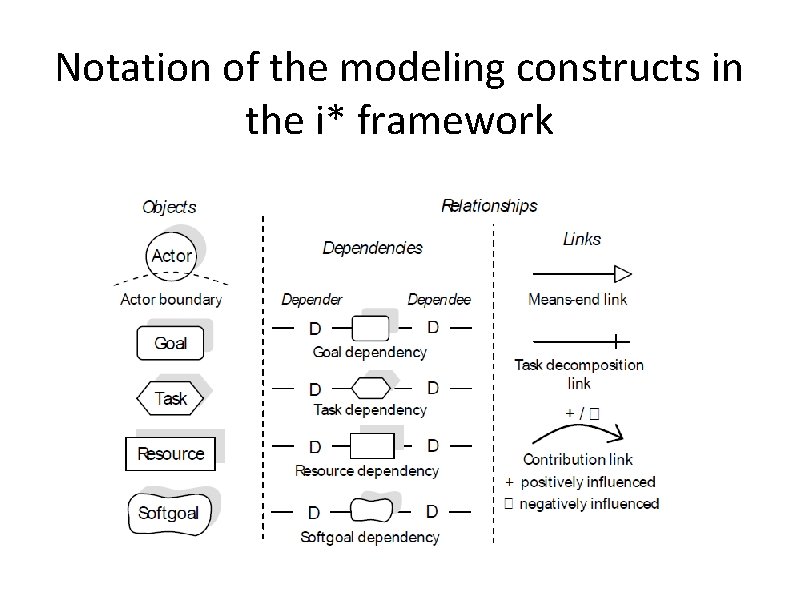
Notation of the modeling constructs in the i* framework
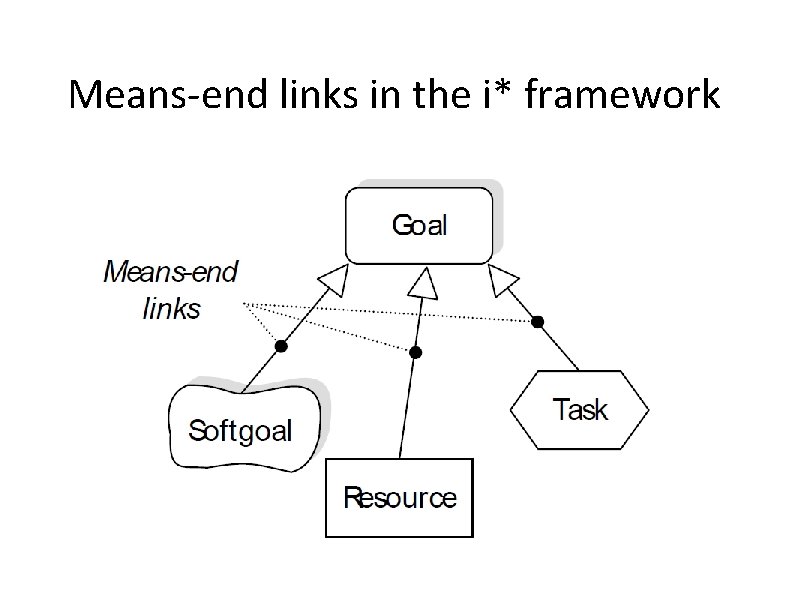
Means-end links in the i* framework
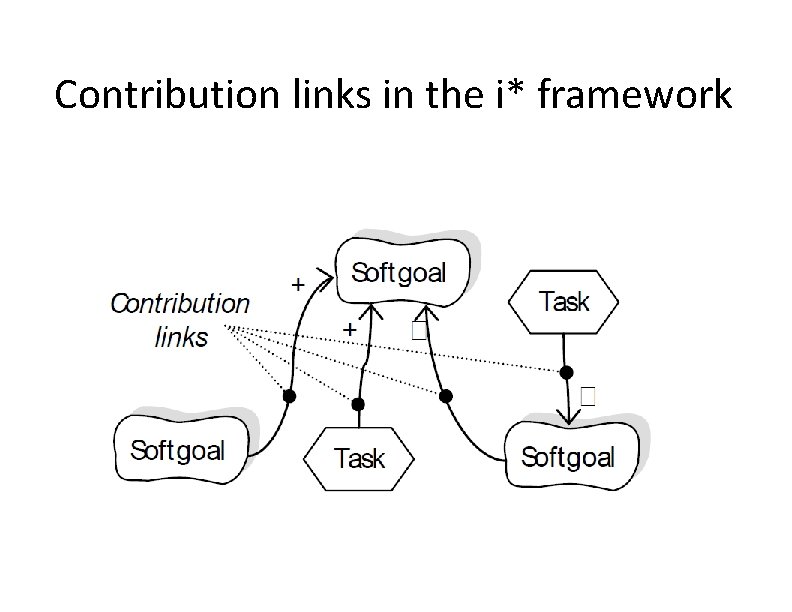
Contribution links in the i* framework
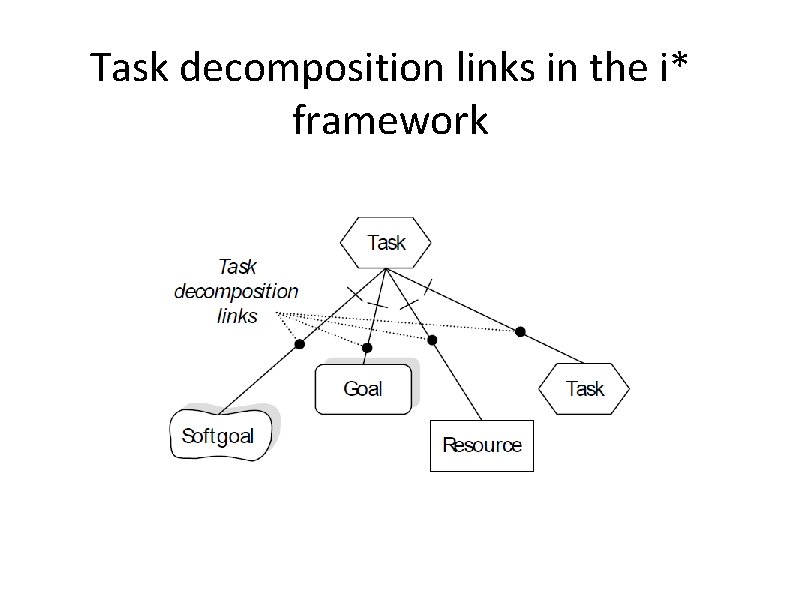
Task decomposition links in the i* framework
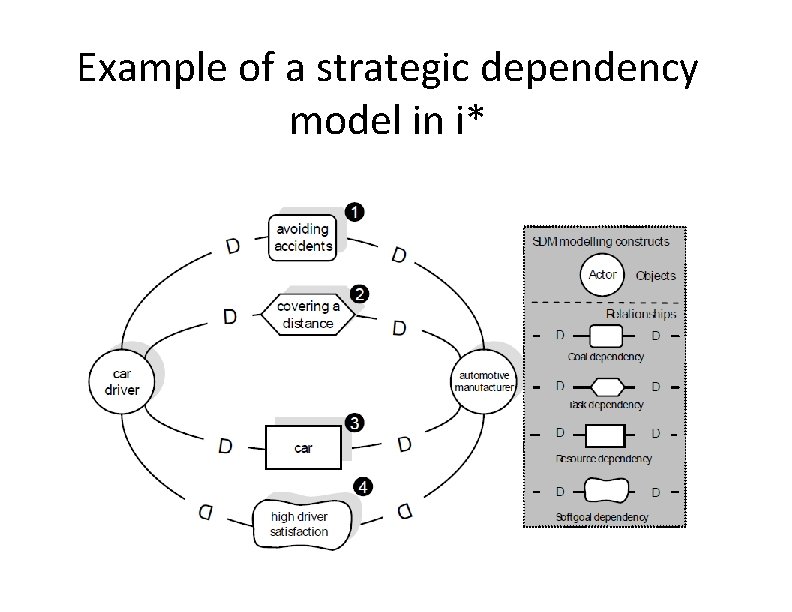
Example of a strategic dependency model in i*
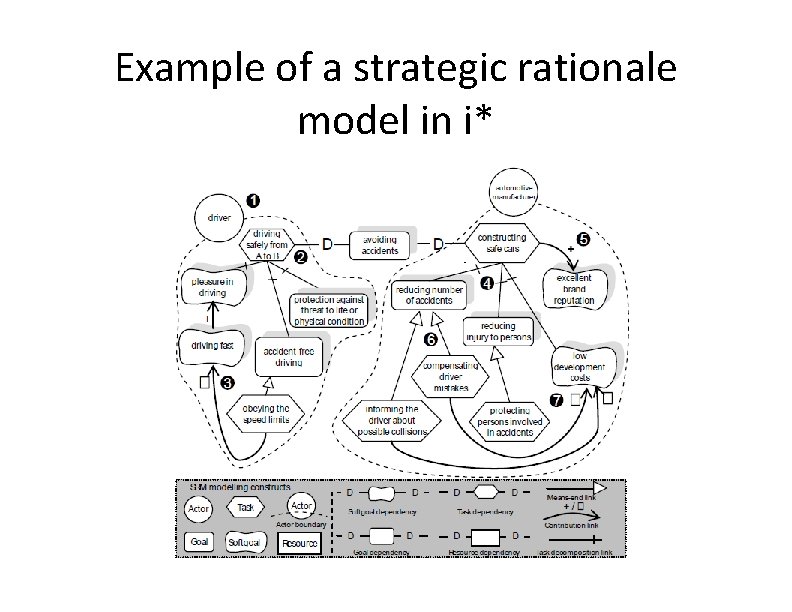
Example of a strategic rationale model in i*
Agent Orientation and Information Systems Eric Yu University of Toronto Presentation at Tsinghua University, Beijing, China July 8, 1999
From GORE (Goal- Oriented Requirements Engineering) to AORE (Agent-Oriented Requirements Engineering)
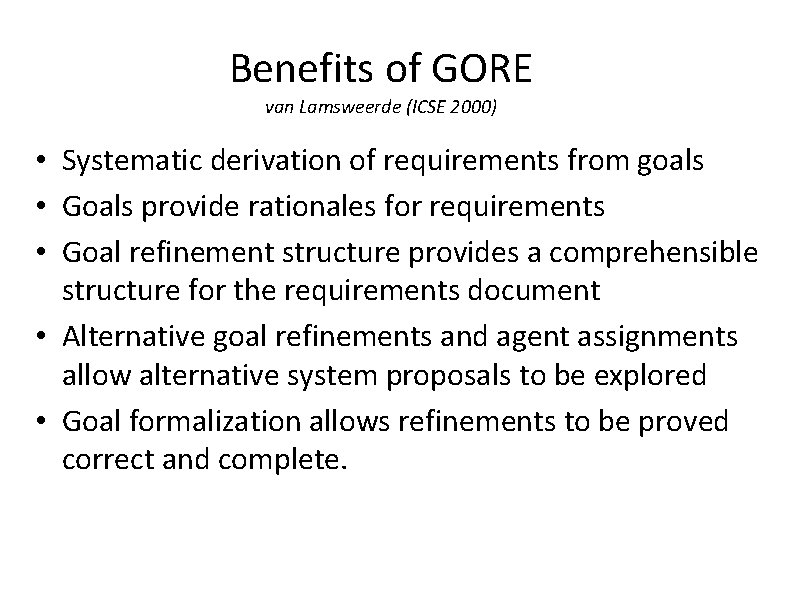
Benefits of GORE van Lamsweerde (ICSE 2000) • Systematic derivation of requirements from goals • Goals provide rationales for requirements • Goal refinement structure provides a comprehensible structure for the requirements document • Alternative goal refinements and agent assignments allow alternative system proposals to be explored • Goal formalization allows refinements to be proved correct and complete.
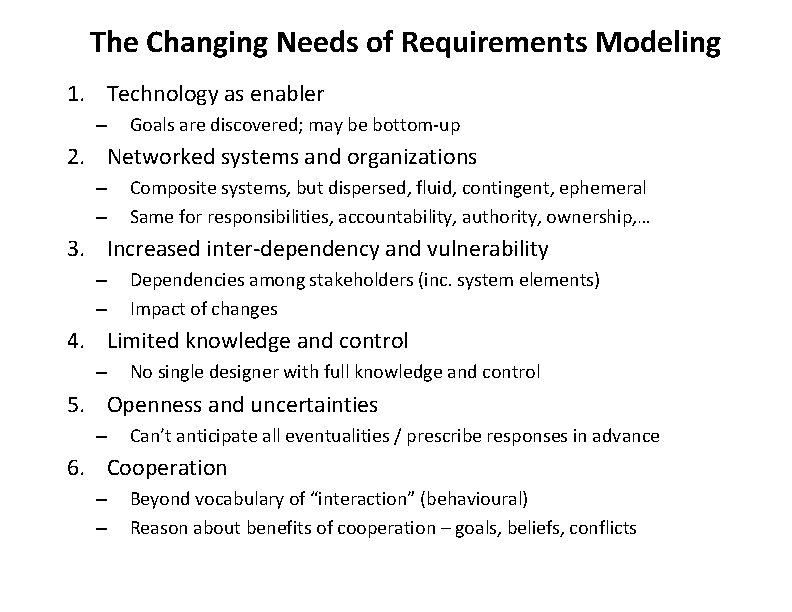
The Changing Needs of Requirements Modeling 1. Technology as enabler – Goals are discovered; may be bottom-up 2. Networked systems and organizations – – Composite systems, but dispersed, fluid, contingent, ephemeral Same for responsibilities, accountability, authority, ownership, … 3. Increased inter-dependency and vulnerability – – Dependencies among stakeholders (inc. system elements) Impact of changes 4. Limited knowledge and control – No single designer with full knowledge and control 5. Openness and uncertainties – Can’t anticipate all eventualities / prescribe responses in advance 6. Cooperation – – Beyond vocabulary of “interaction” (behavioural) Reason about benefits of cooperation – goals, beliefs, conflicts
The Changing Needs of Requirements Modeling (cont’d) 7. Boundaries, Locality, and Identity – Can transcend physical boundaries – Want “logical” criteria for locality, identity – e. g. , authority, autonomy, reach of control, knowledge – Negotiated boundaries – Reasoning about boundary re-alignment and implications
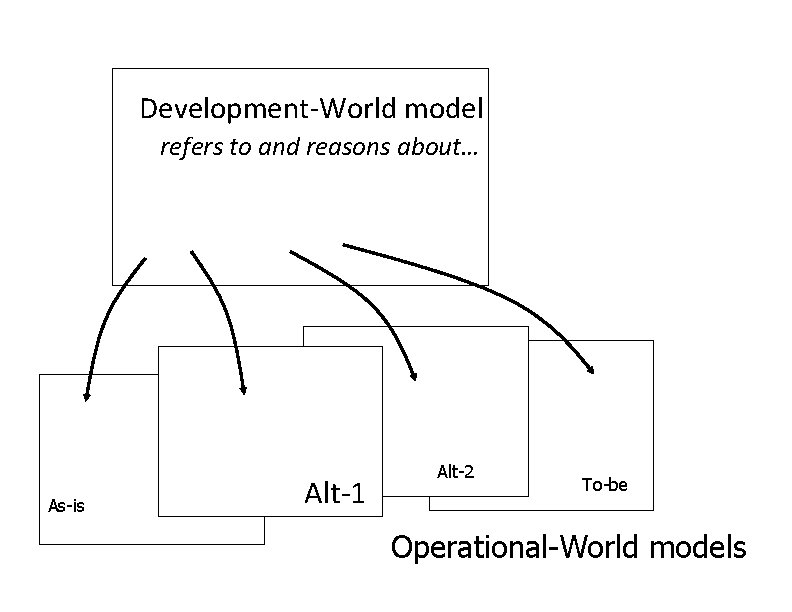
Development-World model refers to and reasons about… As-is Alt-1 Alt-2 To-be Operational-World models
GORE & AORE research challenges (framework components) • • • Ontology Formalization Analysis and reasoning Methodologies Knowledge Based Support – Generic knowledge, e. g. , common NFR goals, refinements, solution techniques (e. g. , for security, safety, …) – Larger patterns • Tools • Evaluation, Validation, Empirical studies • Heterogeneous modelling frameworks
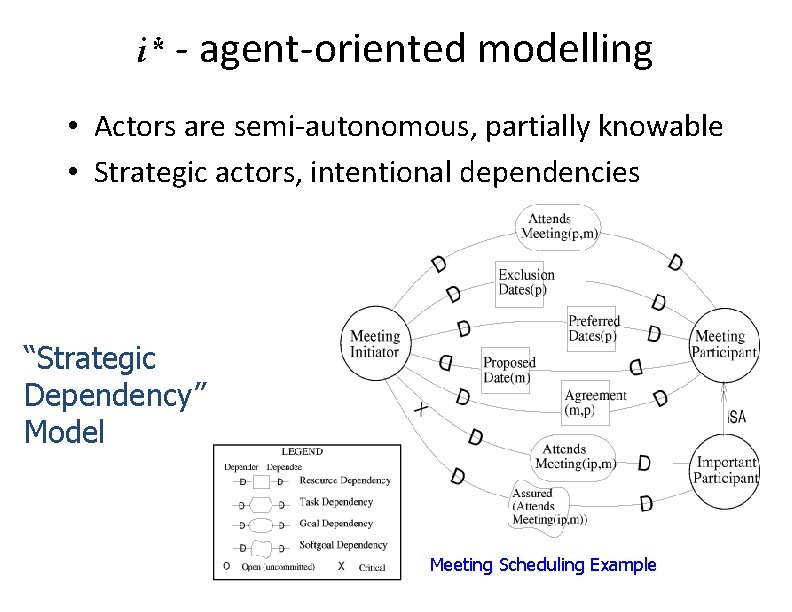
i* - agent-oriented modelling • Actors are semi-autonomous, partially knowable • Strategic actors, intentional dependencies “Strategic Dependency” Model Meeting Scheduling Example
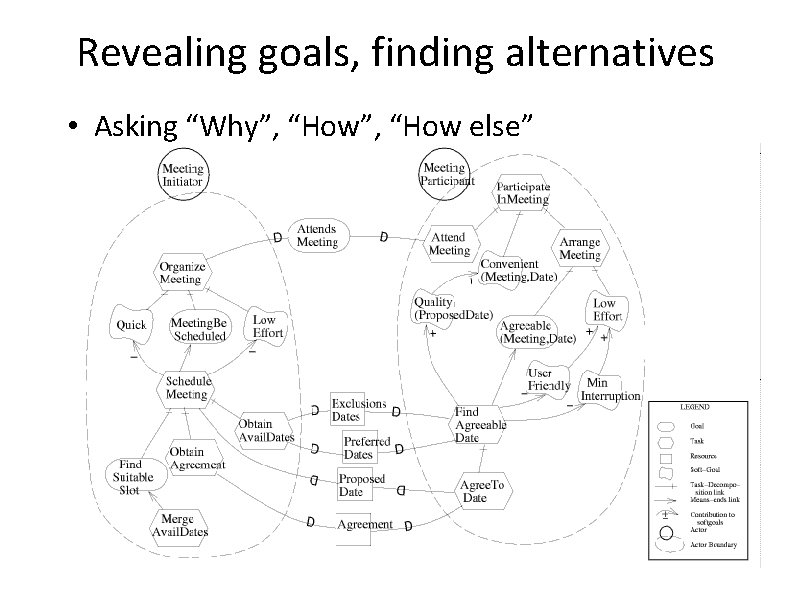
Revealing goals, finding alternatives • Asking “Why”, “How else”
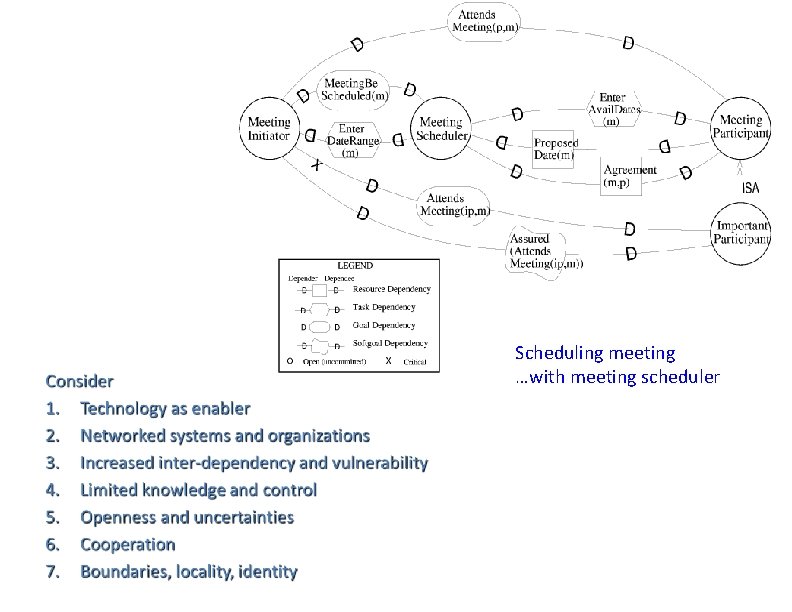
Scheduling meeting …with meeting scheduler
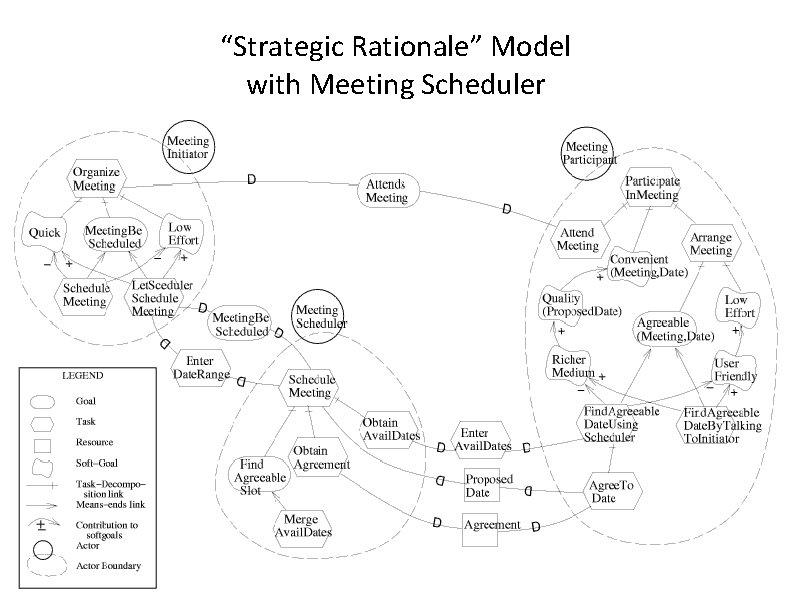
“Strategic Rationale” Model with Meeting Scheduler
Agent Orientation as a Software Paradigm • Situated – sense the environment and perform actions that change the environment • Autonomous – have control over their own actions and internal states – can act without direct intervention from humans • Flexible – responsive to changes in environment, goal-oriented, opportunistic, take initiatives • Social – interact with other artificial agents and humans to complete their tasks and help others Jennings, Sycara, Wooldridge (1998)
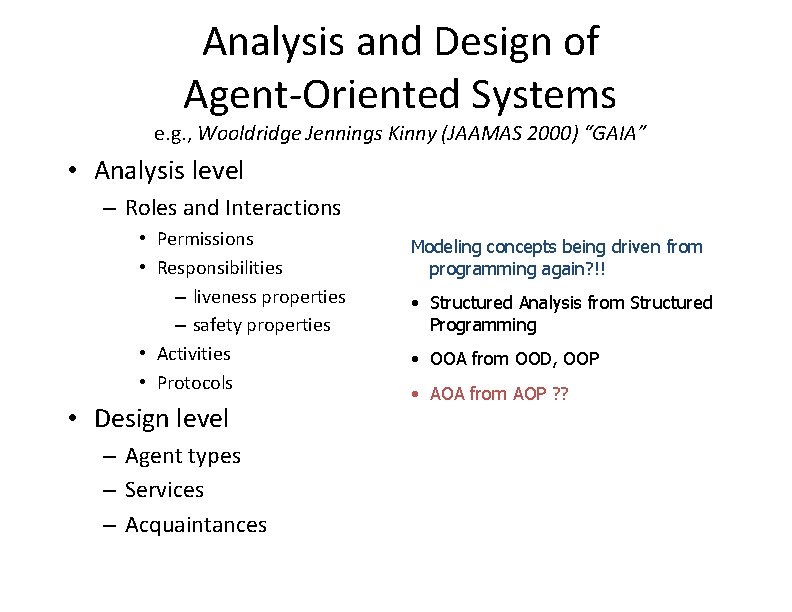
Analysis and Design of Agent-Oriented Systems e. g. , Wooldridge Jennings Kinny (JAAMAS 2000) “GAIA” • Analysis level – Roles and Interactions • Permissions • Responsibilities – liveness properties – safety properties • Activities • Protocols • Design level – Agent types – Services – Acquaintances Modeling concepts being driven from programming again? !! • Structured Analysis from Structured Programming • OOA from OOD, OOP • AOA from AOP ? ?
What are the important concepts for Agent Orientation as a Modeling Paradigm ? • Intentionality • Autonomy • Sociality • Identity & Boundaries • Strategic Reflectivity • Rational Self-Interest
Agent Orientation as a Modeling Paradigm • Intentionality – – Agents are intentional. Agent intentionality is externally attributed by the modeller. Agency provides localization of intentionality. Agents can relate to each other at an intentional level. • Autonomy • Sociality • Identity & Boundaries • Strategic Reflectivity • Rational Self-Interest
Agent Orientation as a Modeling Paradigm • Intentionality • Autonomy – An agent has its own initiative, and can act independently. Consequently, for a modeler and from the viewpoint of other agents: • its behavior is not fully predictable. • It is not fully knowable, • nor fully controllable. – The behavior of an agent can be partially characterized, despite autonomy, using intentional concepts. • • Sociality Identity & Boundaries Strategic Reflectivity Rational Self-Interest
Agent Orientation as a Modeling Paradigm • Intentionality • Autonomy • Sociality – An agent is characterized by its relationships with other agents, and not by its intrinsic properties alone. – Relationships among agents are complex and generally not reducible. – Conflicts among many of the relationships that an agent participates in are not easily resolvable. – Agents tend to have multi-lateral relationships, rather than one-way relationships. – Agent relationships form an unbounded network – Cooperation among agents cannot be taken for granted. – Autonomy is tempered by sociality. • Identity & Boundaries • Strategic Reflectivity • Rational Self-Interest
Agent Orientation as a Modeling Paradigm • • Intentionality Autonomy Sociality Identity & Boundaries – Agents can be abstract, or physical. – The boundaries, and thus the identity, of an agent are contingent and changeable. – Agent, both physical and abstract, may be created and terminated. – Agent behavior may be classified, and generalized. • Strategic Reflectivity • Rational Self-Interest
Agent Orientation as a Modeling Paradigm • Intentionality • Autonomy • Sociality • Identity & Boundaries • Strategic Reflectivity – Agents can reflect upon their own operations. – Development world deliberations and decisions are usually strategic with respect to the operational world. – The scope of reflectivity is contingent. • Rational Self-Interest
Agent Orientation as a Modeling Paradigm • Intentionality • Autonomy • Sociality • Identity & Boundaries • Strategic Reflectivity • Rational Self-Interest – An agent strives to meet its goals. – Self-interest is in a context of social relations. – Rationality is bounded and partial.
Beyond RE • Agent-Oriented Software Development – Tropos – a full-fledge development framework driven by AORE concepts • Agent-Oriented Software Engineering – Goal and agent modelling support for SE activities – e. g. , traceability for maintenance, AO as scoping, limiting propagation of change, assigning responsibilities in software eng. organizations, software processes, … • Business Goals/Arch. <-> System Goals/Arch. – Business strategy modelling & analysis • Intellectual Property management – Security and Trust
Agent Abstractions • Agent abstractions are mentalistic • • • beliefs: agent’s representation of the world knowledge: (usually) true beliefs desires: preferred states of the world goals: consistent desires intentions: goals adopted for action • Multi-agent abstractions involve interactions • • social: about collections of agents organizational: about teams and groups ethical: about right and wrong actions legal: about contracts and compliance [Huhns AOIS’ 99]
Why Do These Abstractions Matter? • Because modern applications go beyond traditional metaphors and models in terms of their dynamism, openness, and trustworthiness – virtual enterprises: manufacturing supply chains, autonomous logistics – electronic commerce: utility management – communityware: social user interfaces – problem-solving by teams [Huhns AOIS’ 99]
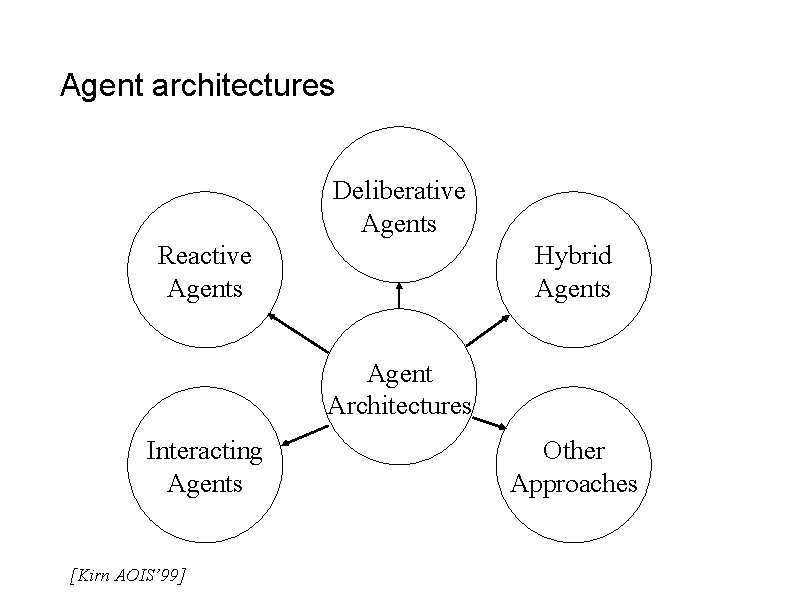
Agent architectures Deliberative Agents Reactive Agents Hybrid Agents Agent Architectures Interacting Agents [Kirn AOIS’ 99] Other Approaches
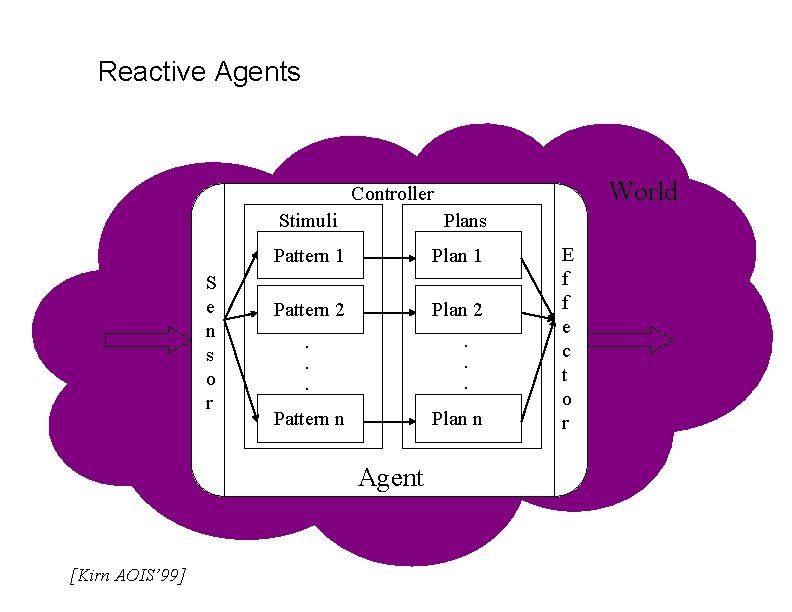
Reactive Agents World Controller Stimuli S e n s o r Plans Pattern 1 Plan 1 Pattern 2 Plan 2 . . . Pattern n Plan n Agent [Kirn AOIS’ 99] E f f e c t o r
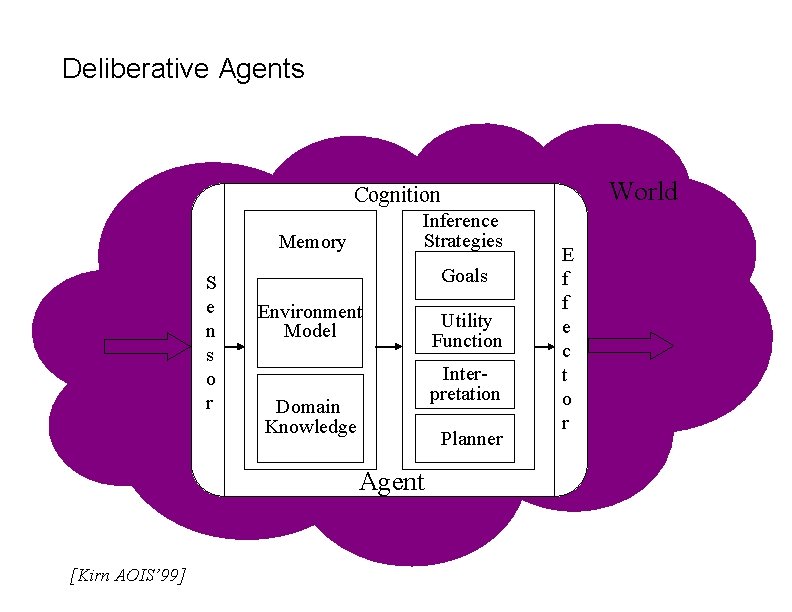
Deliberative Agents World Cognition Inference Strategies Memory S e n s o r Goals Environment Model Interpretation Domain Knowledge Planner Agent [Kirn AOIS’ 99] Utility Function E f f e c t o r
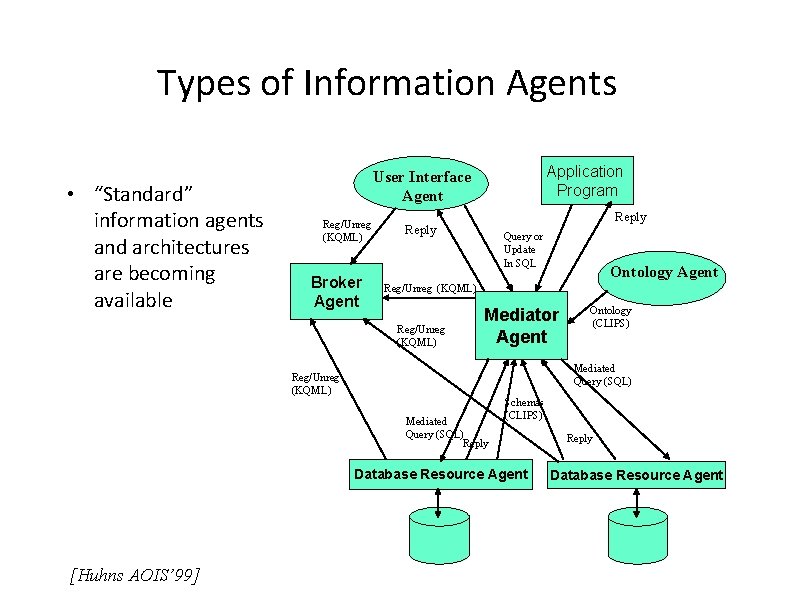
Types of Information Agents • “Standard” information agents and architectures are becoming available Application Program User Interface Agent Reg/Unreg (KQML) Broker Agent Reply Query or Update In SQL Reg/Unreg (KQML) Mediator Agent Ontology (CLIPS) Mediated Query (SQL) Reg/Unreg (KQML) Mediated Query (SQL) Reply Schemas (CLIPS) Database Resource Agent [Huhns AOIS’ 99] Ontology Agent Reply Database Resource Agent
Agent-Orientation for Enterprise Information Systems • The Changing Nature of Enterprise • The Challenge for Enterprise Systems • Why Agent-Orientation for Enterprise Systems
The Changing Nature of Enterprise • distributed and networked – people, organization, and work practices, not just the technology! • diversity, local autonomy, open-endedness – much uncertainty, incomplete knowledge & control – need flexibility • change and evolution – constantly and rapid
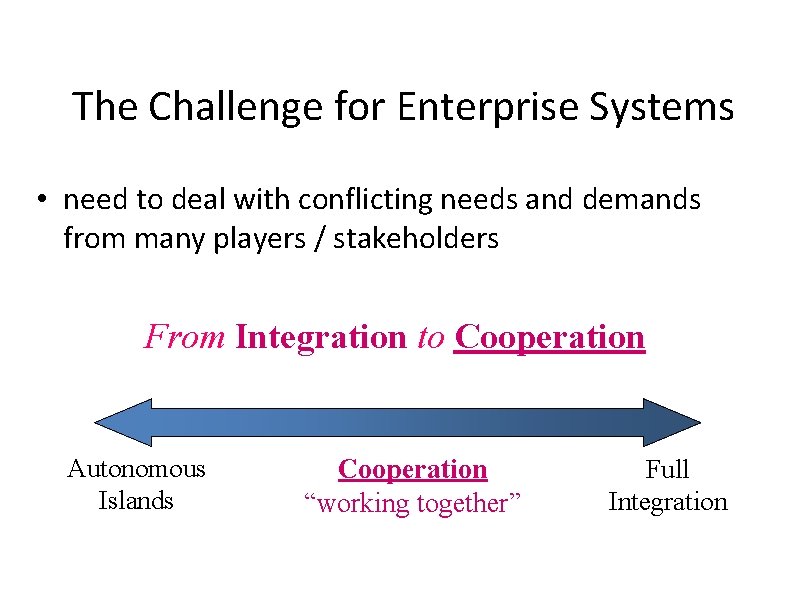
The Challenge for Enterprise Systems • need to deal with conflicting needs and demands from many players / stakeholders From Integration to Cooperation Autonomous Islands Cooperation “working together” Full Integration
Why Agent-Orientation for Enterprise Information Systems • Agent orientation addresses the demands and challenges of new enterprise environments and systems • What would it mean? We should develop Agent-Oriented. . . – requirements engineering techniques, models – design and architectural approaches – implementation methods and technologies – run-time and evolution support
Modeling for Enterprise Systems It is well-recognized that many types of modeling are required to deal with the various aspects of enterprise, e. g. , • activity modeling • function modeling • resource modeling • information modeling • organization modeling
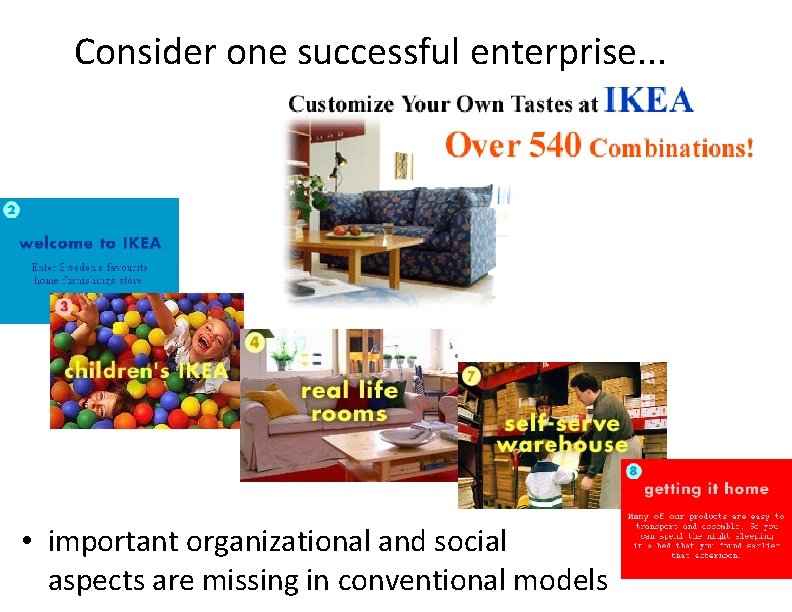
Consider one successful enterprise. . . • important organizational and social aspects are missing in conventional models
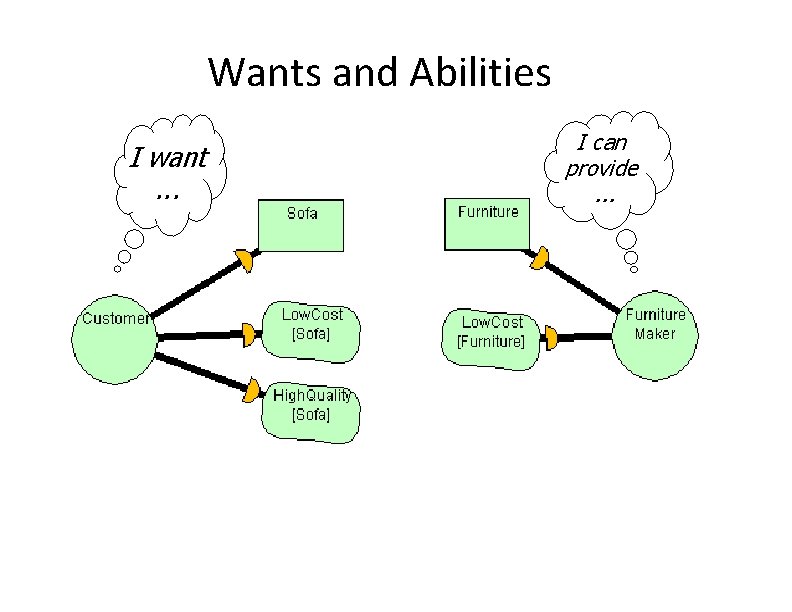
Wants and Abilities I want. . . I can provide. . .
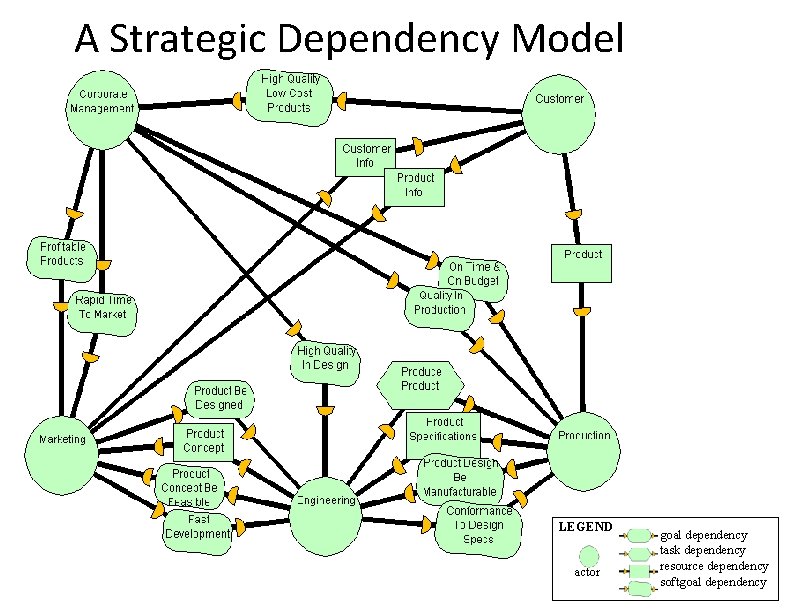
A Strategic Dependency Model LEGEND actor goal dependency task dependency resource dependency softgoal dependency
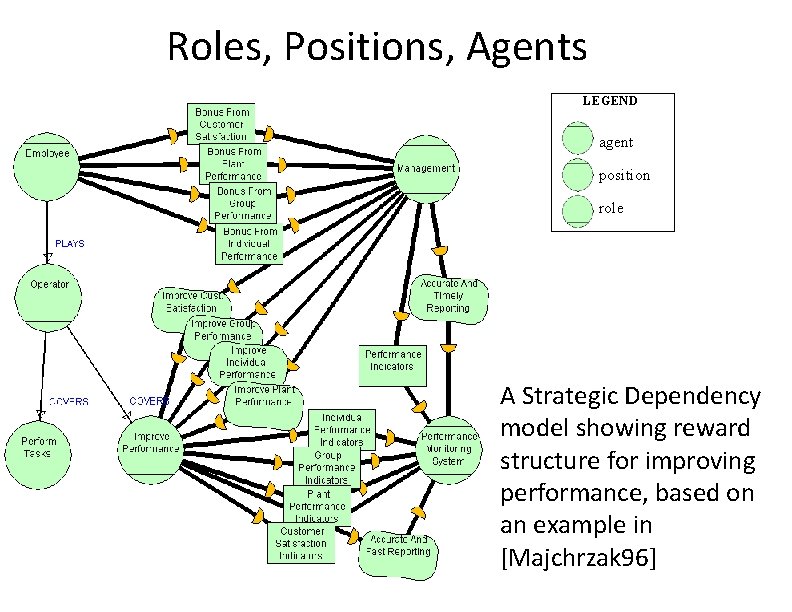
Roles, Positions, Agents LEGEND agent position role • A Strategic Dependency model showing reward structure for improving performance, based on an example in [Majchrzak 96]
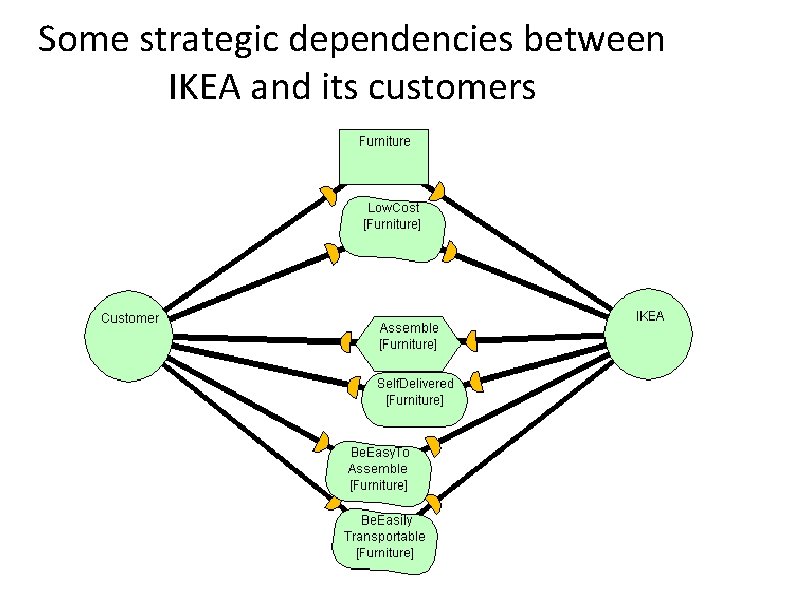
Some strategic dependencies between IKEA and its customers
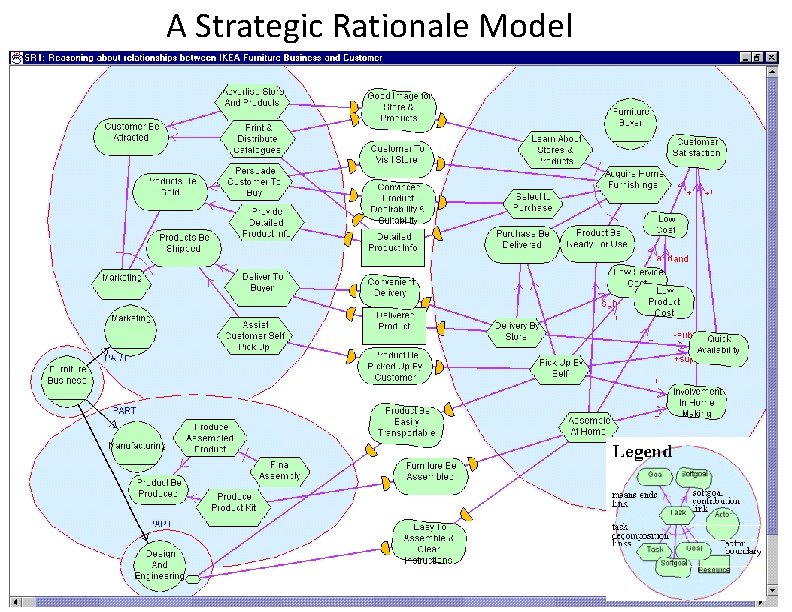
A Strategic Rationale Model
Analysis and Design Support • opportunities and vulnerabilities – ability, workability, viability, believability – insurance, assurance, enforceability – node and loop analysis [Yu ICEIMT’ 97] • design issues – raising, evaluating, justifying, settling – based on qualitative reasoning
- Slides: 79