
Modeling Heterogeneous Systems Design for Understanding Design for
- Slides: 35
Modeling Heterogeneous Systems - Design for Understanding Design for Safety Workshop NASA Ames Research Center Mountain View, CA 11 October, 2000 Edward Lee UC Berkeley
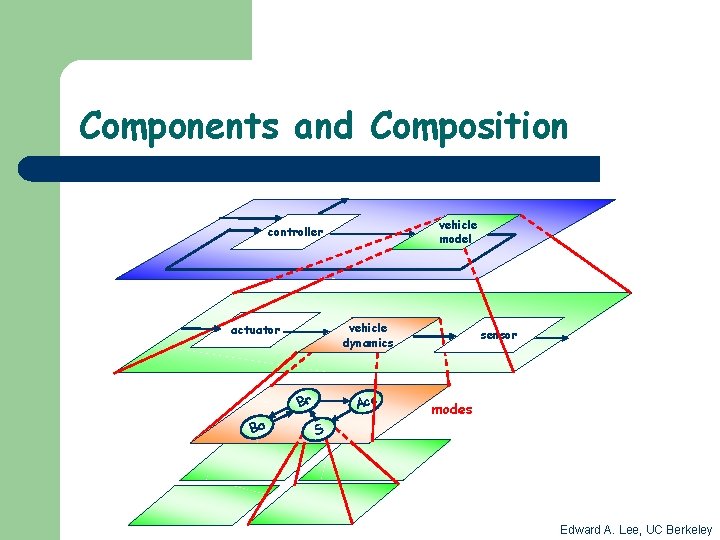
Components and Composition vehicle model controller vehicle dynamics actuator Br Ba Acc sensor modes S Edward A. Lee, UC Berkeley
Common Approaches l Threads or processes – Sun says in the on-line Java tutorial: “The first rule of using threads is this: avoid them if you can. Threads can be difficult to use, and they tend to make programs harder to debug. ” l Semaphores, monitors, mutex – l Deadlock, liveness – hard to understand Priorities, deadlines – Plug and pray Edward A. Lee, UC Berkeley
Understanding Component Interactions - Frameworks l What is a component (ontology)? – l l l States? Processes? Threads? Differential equations? Constraints? Objects (data + methods)? What knowledge do components share (epistemology)? – Time? Name spaces? Signals? State? – Rendezvous? Message passing? Continuous-time signals? Streams? Method calls? How do components communicate (protocols)? What do components communicate (lexicon)? – Objects? Transfer of control? Data structures? ASCII text? Edward A. Lee, UC Berkeley
A Laboratory for Exploring Component Frameworks Ptolemy II – – Java based, network integrated Several frameworks implemented A realization of a framework is called a “domain. ” Multiple domains can be mixed hierarchically in the same model. http: //ptolemy. eecs. berkeley. edu Edward A. Lee, UC Berkeley
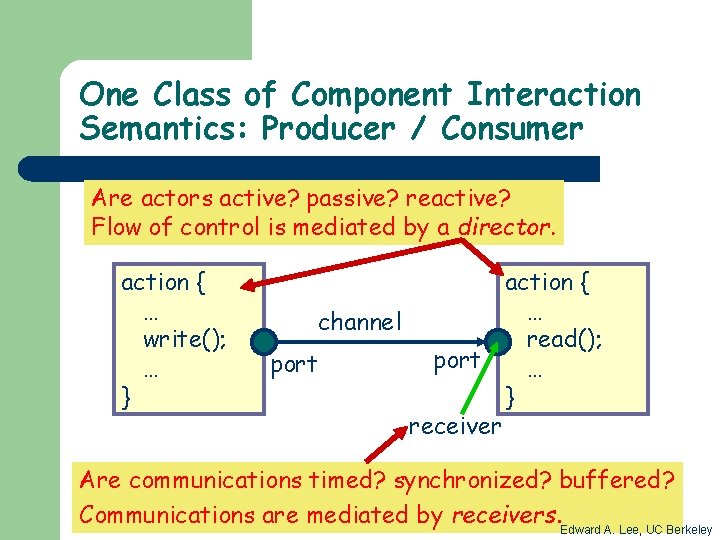
One Class of Component Interaction Semantics: Producer / Consumer Are actors active? passive? reactive? Flow of control is mediated by a director. action { … write(); … } action { … channel read(); port … } receiver Are communications timed? synchronized? buffered? Communications are mediated by receivers. Edward A. Lee, UC Berkeley
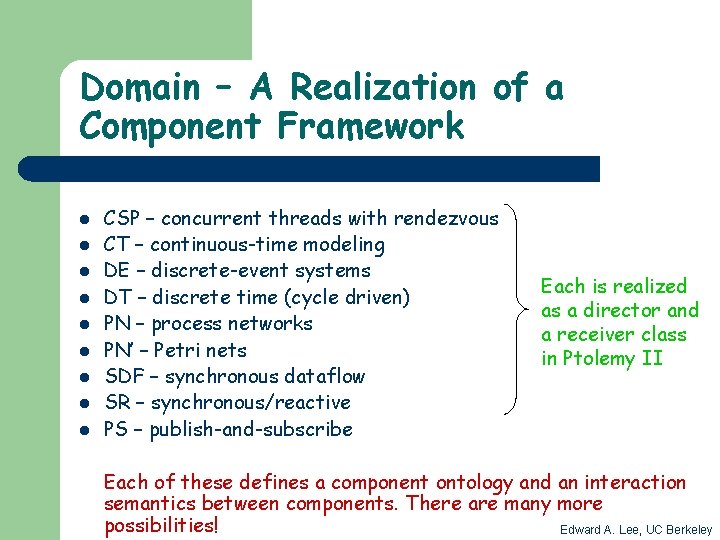
Domain – A Realization of a Component Framework l l l l l CSP – concurrent threads with rendezvous CT – continuous-time modeling DE – discrete-event systems DT – discrete time (cycle driven) PN – process networks PN’ – Petri nets SDF – synchronous dataflow SR – synchronous/reactive PS – publish-and-subscribe Each is realized as a director and a receiver class in Ptolemy II Each of these defines a component ontology and an interaction semantics between components. There are many more possibilities! Edward A. Lee, UC Berkeley
1. Continuous Time (Coupled ODEs) Semantics: – actors define relations between functions of time (ODEs or algebraic equations) – a behavior is a set of signals satisfying these relations Examples: • Spice, • HP ADS, • Simulink, • Saber, • Matrix X, • … Edward A. Lee, UC Berkeley
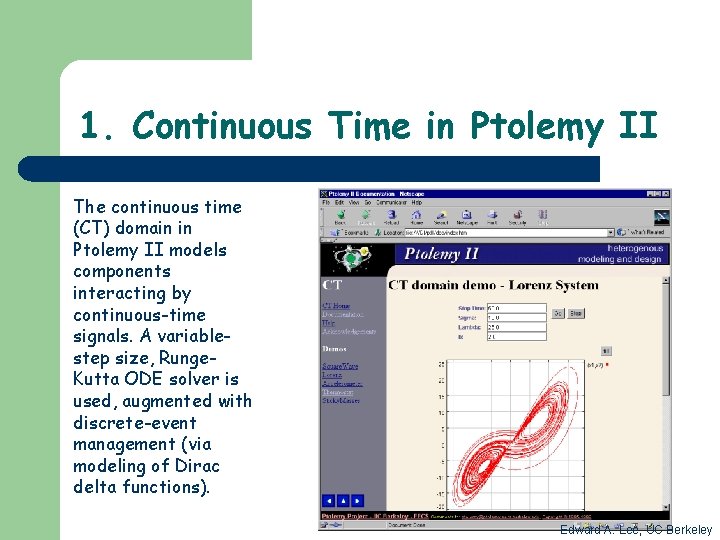
1. Continuous Time in Ptolemy II The continuous time (CT) domain in Ptolemy II models components interacting by continuous-time signals. A variablestep size, Runge. Kutta ODE solver is used, augmented with discrete-event management (via modeling of Dirac delta functions). Edward A. Lee, UC Berkeley
1. CT: Strengths and Weaknesses Strengths: – – – Accurate model for many physical systems Determinate under simple conditions Established and mature (approximate) simulation techniques Weaknesses: – – Covers a narrow application domain Tightly bound to an implementation Relatively expensive to simulate Difficult to implement in software Edward A. Lee, UC Berkeley
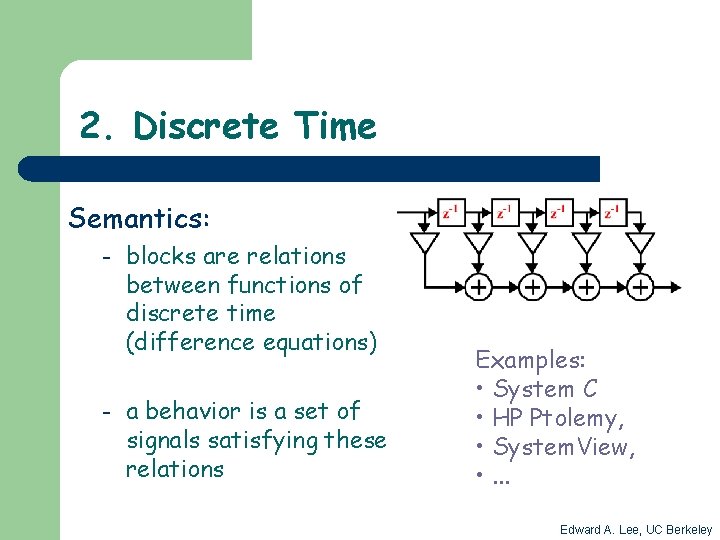
2. Discrete Time Semantics: – – blocks are relations between functions of discrete time (difference equations) a behavior is a set of signals satisfying these relations Examples: • System C • HP Ptolemy, • System. View, • . . . Edward A. Lee, UC Berkeley
2. DT: Strengths and Weaknesses Strengths: – – Useful model for embedded DSP Determinate under simple conditions Easy simulation (cycle-based) Easy implementation (circuits or software) Weaknesses: – – Covers a narrow application domain Global synchrony may overspecify some systems Edward A. Lee, UC Berkeley
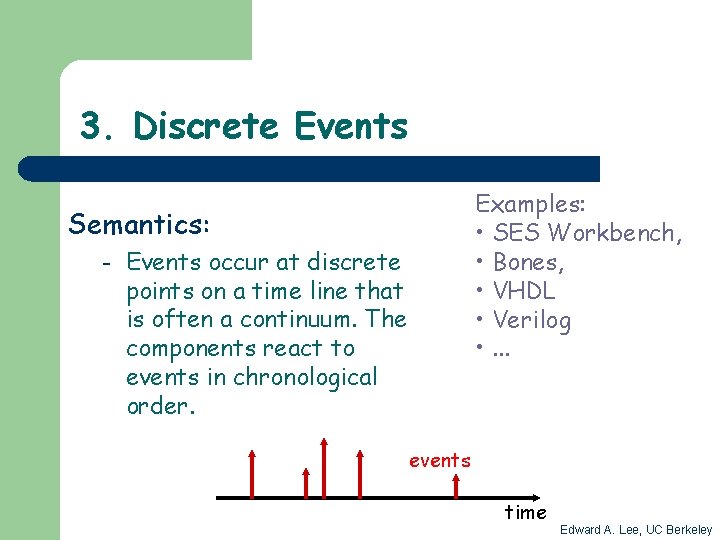
3. Discrete Events Examples: • SES Workbench, • Bones, • VHDL • Verilog • . . . Semantics: – Events occur at discrete points on a time line that is often a continuum. The components react to events in chronological order. events time Edward A. Lee, UC Berkeley
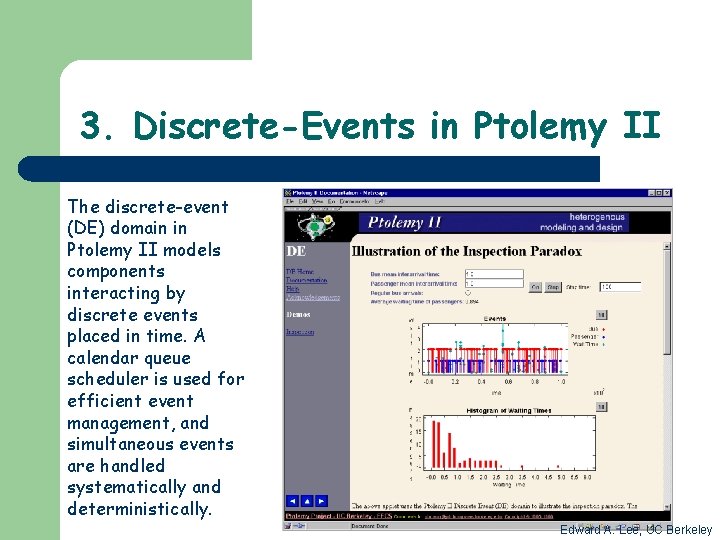
3. Discrete-Events in Ptolemy II The discrete-event (DE) domain in Ptolemy II models components interacting by discrete events placed in time. A calendar queue scheduler is used for efficient event management, and simultaneous events are handled systematically and deterministically. Edward A. Lee, UC Berkeley
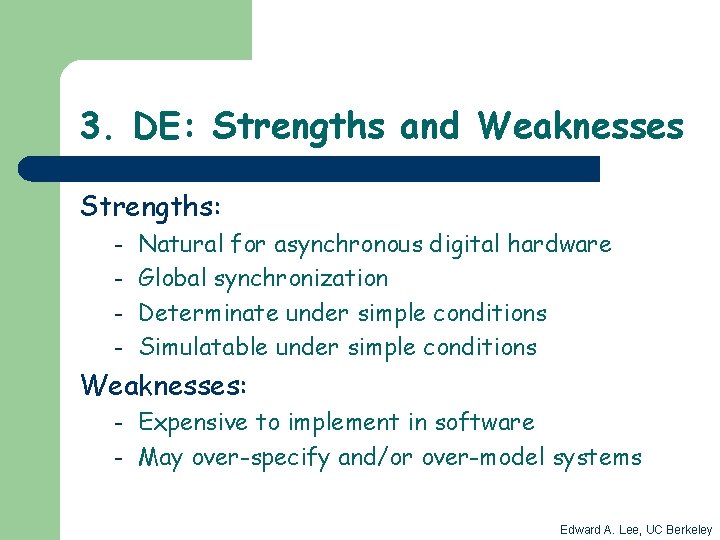
3. DE: Strengths and Weaknesses Strengths: – – Natural for asynchronous digital hardware Global synchronization Determinate under simple conditions Simulatable under simple conditions Weaknesses: – – Expensive to implement in software May over-specify and/or over-model systems Edward A. Lee, UC Berkeley
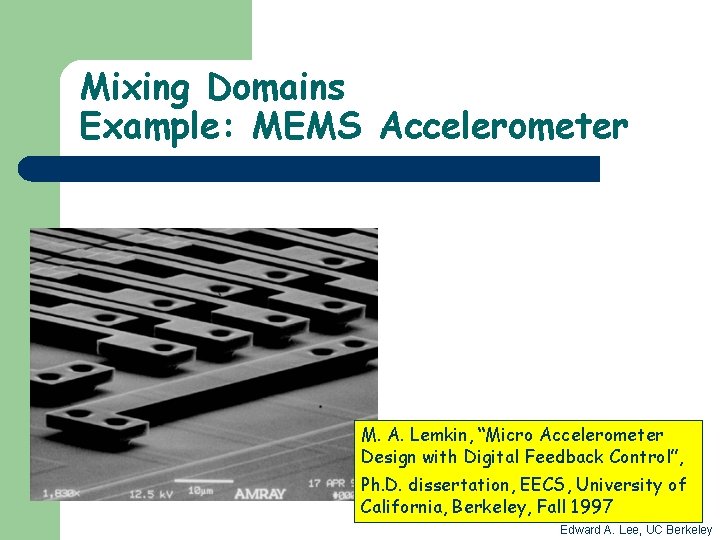
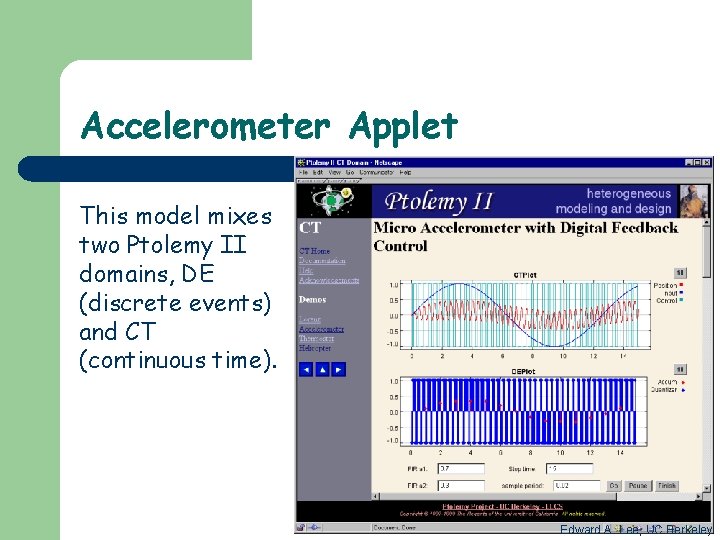
Mixing Domains Example: MEMS Accelerometer M. A. Lemkin, “Micro Accelerometer Design with Digital Feedback Control”, Ph. D. dissertation, EECS, University of California, Berkeley, Fall 1997 Edward A. Lee, UC Berkeley
Accelerometer Applet This model mixes two Ptolemy II domains, DE (discrete events) and CT (continuous time). Edward A. Lee, UC Berkeley
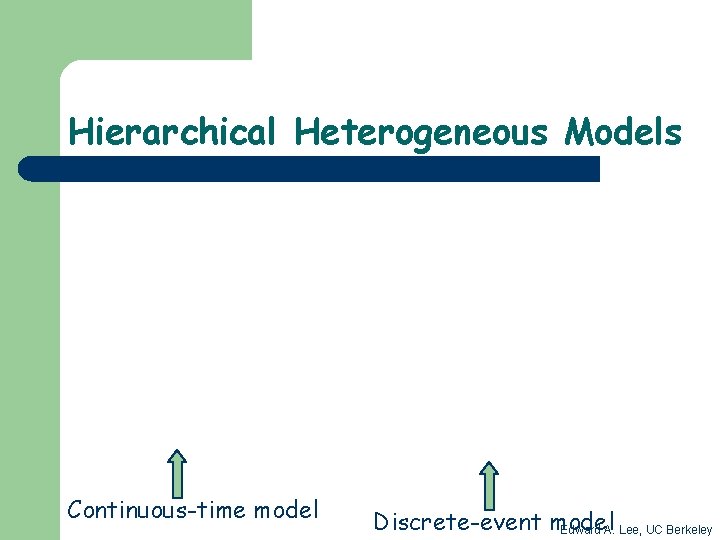
Hierarchical Heterogeneous Models Continuous-time model Discrete-event model Edward A. Lee, UC Berkeley
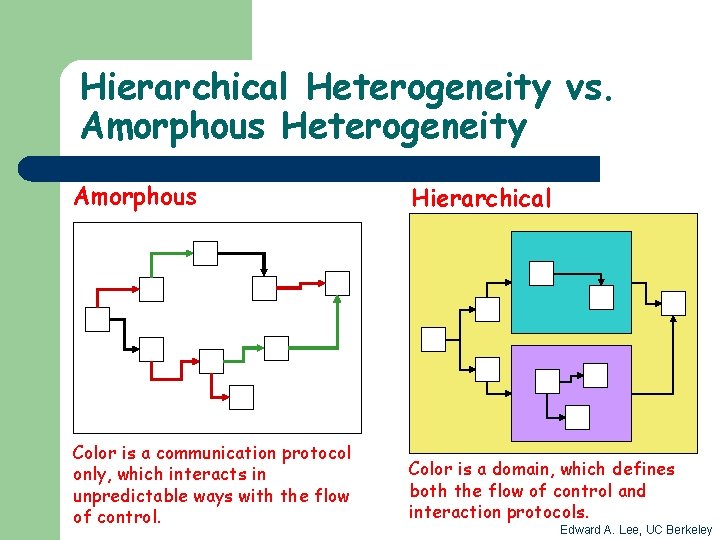
Hierarchical Heterogeneity vs. Amorphous Heterogeneity Amorphous Hierarchical Color is a communication protocol only, which interacts in unpredictable ways with the flow of control. Color is a domain, which defines both the flow of control and interaction protocols. Edward A. Lee, UC Berkeley
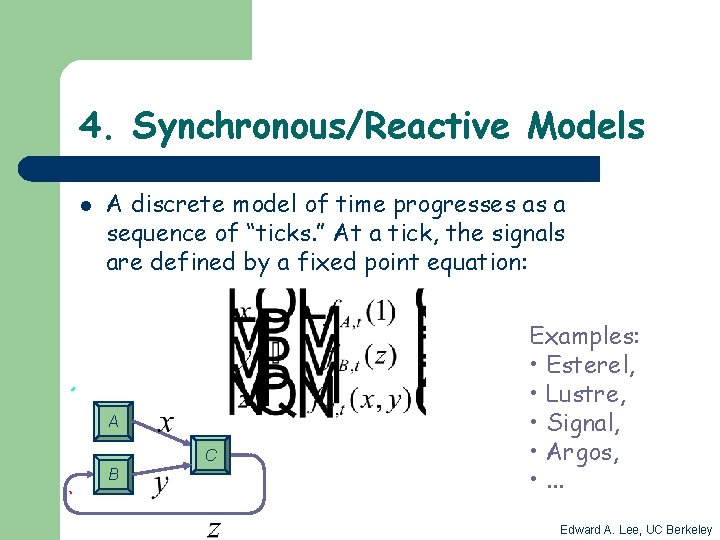
4. Synchronous/Reactive Models l A discrete model of time progresses as a sequence of “ticks. ” At a tick, the signals are defined by a fixed point equation: A C B Examples: • Esterel, • Lustre, • Signal, • Argos, • . . . Edward A. Lee, UC Berkeley
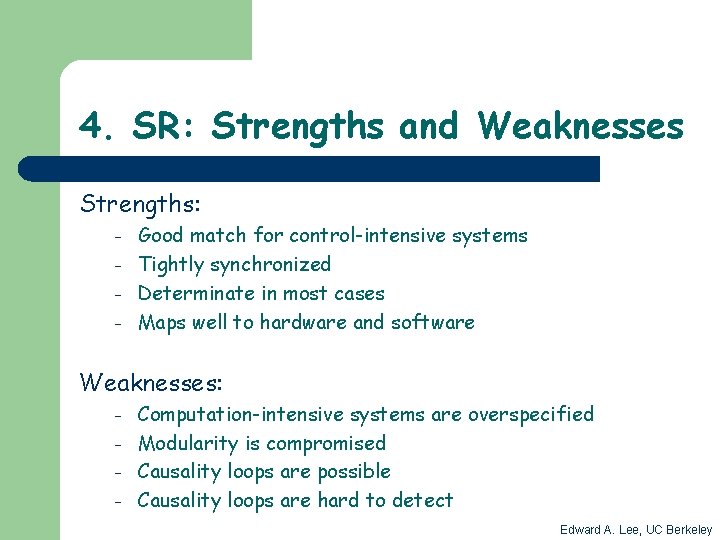
4. SR: Strengths and Weaknesses Strengths: – – Good match for control-intensive systems Tightly synchronized Determinate in most cases Maps well to hardware and software Weaknesses: – – Computation-intensive systems are overspecified Modularity is compromised Causality loops are possible Causality loops are hard to detect Edward A. Lee, UC Berkeley
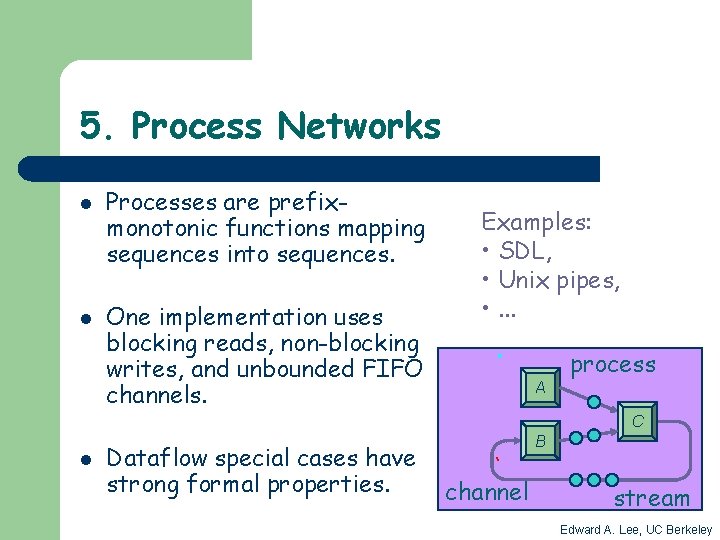
5. Process Networks l l Processes are prefixmonotonic functions mapping sequences into sequences. One implementation uses blocking reads, non-blocking writes, and unbounded FIFO channels. Examples: • SDL, • Unix pipes, • . . . A process C l Dataflow special cases have strong formal properties. B channel stream Edward A. Lee, UC Berkeley
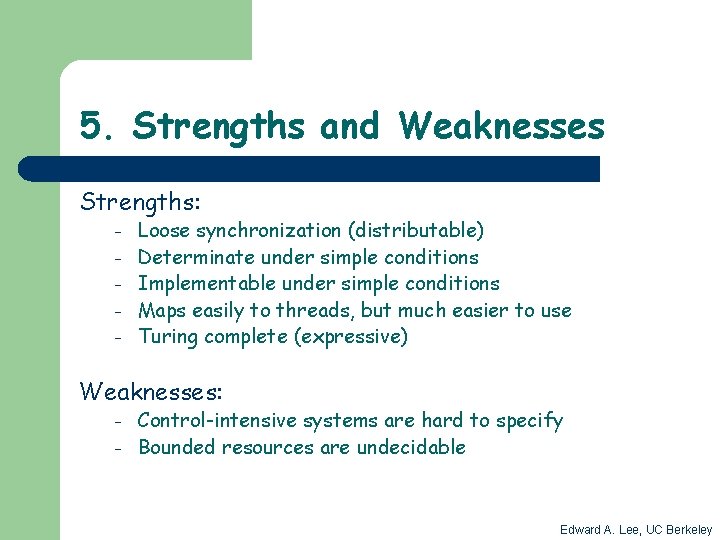
5. Strengths and Weaknesses Strengths: – – – Loose synchronization (distributable) Determinate under simple conditions Implementable under simple conditions Maps easily to threads, but much easier to use Turing complete (expressive) Weaknesses: – – Control-intensive systems are hard to specify Bounded resources are undecidable Edward A. Lee, UC Berkeley
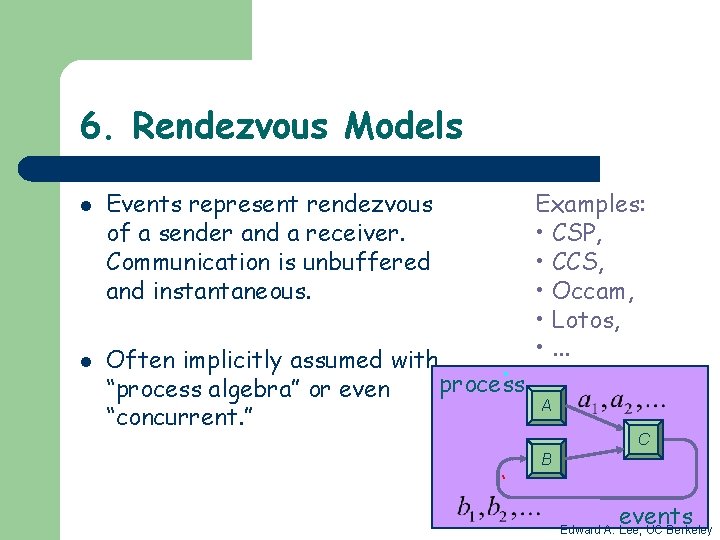
6. Rendezvous Models l l Events represent rendezvous of a sender and a receiver. Communication is unbuffered and instantaneous. Often implicitly assumed with process “process algebra” or even “concurrent. ” Examples: • CSP, • CCS, • Occam, • Lotos, • . . . A C B events Edward A. Lee, UC Berkeley
6. Strengths and Weaknesses Strengths: – – – Models resource sharing well Partial-order synchronization (distributable) Supports naturally nondeterminate interactions Weaknesses: – – Oversynchronizes some systems Difficult to make determinate (and useful) Edward A. Lee, UC Berkeley
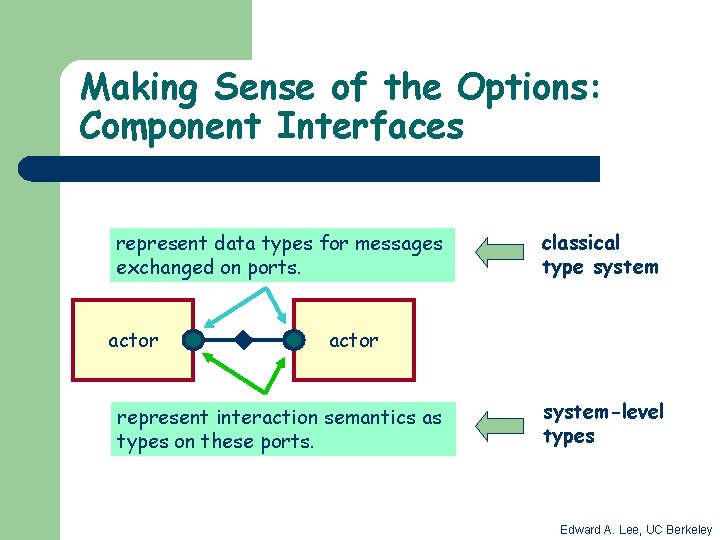
Making Sense of the Options: Component Interfaces represent data types for messages exchanged on ports. actor classical type system actor represent interaction semantics as types on these ports. system-level types Edward A. Lee, UC Berkeley
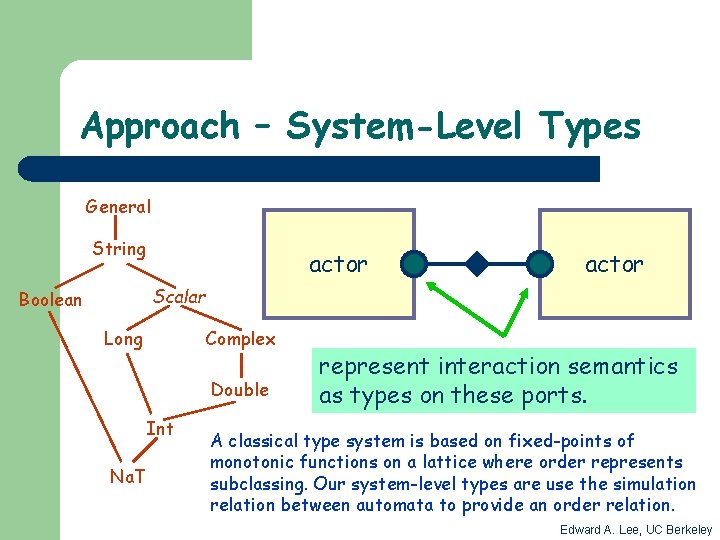
Approach – System-Level Types General String actor Scalar Boolean Long Complex Double Int Na. T represent interaction semantics as types on these ports. A classical type system is based on fixed-points of monotonic functions on a lattice where order represents subclassing. Our system-level types are use the simulation relation between automata to provide an order relation. Edward A. Lee, UC Berkeley
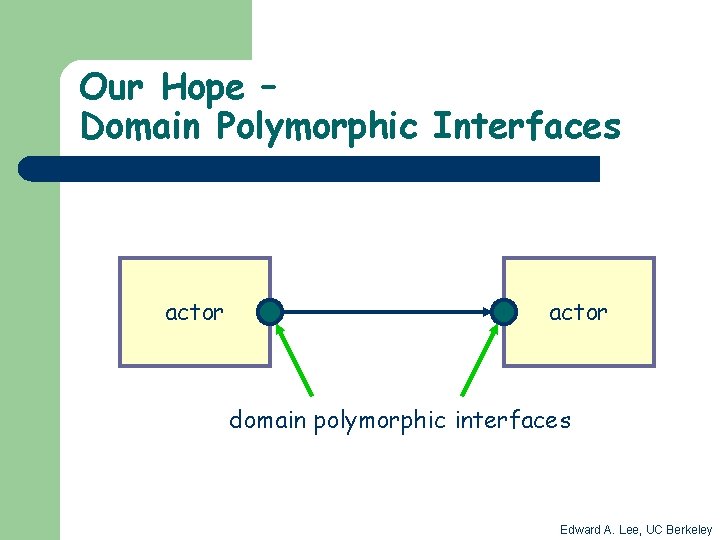
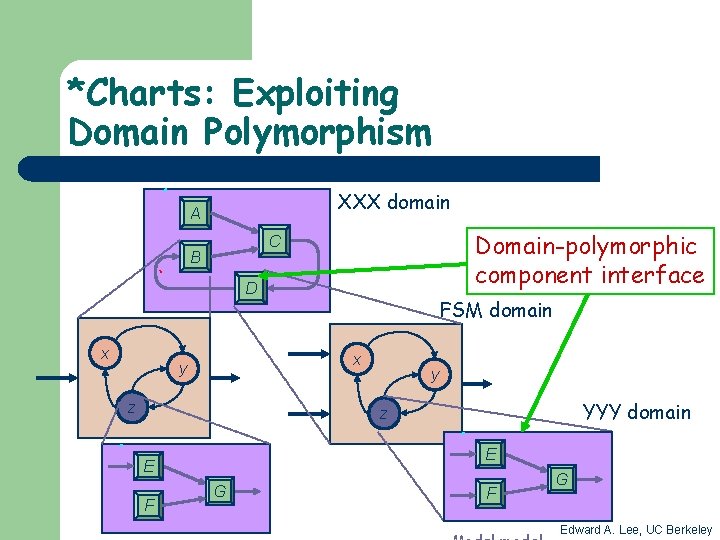
Our Hope – Domain Polymorphic Interfaces actor domain polymorphic interfaces Edward A. Lee, UC Berkeley
Benefits of System-Level Types l l l Clarify assumptions of components Understandable component composition Data polymorphic component libraries Domain polymorphic component libraries More efficient synthesis (? ) Edward A. Lee, UC Berkeley
*Charts: Exploiting Domain Polymorphism XXX domain A Domain-polymorphic component interface C B D x FSM domain x y z y YYY domain z E E F G Edward A. Lee, UC Berkeley
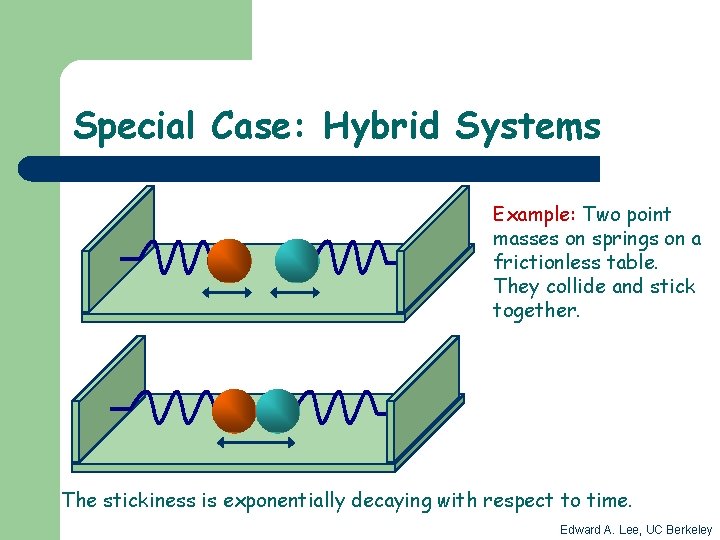
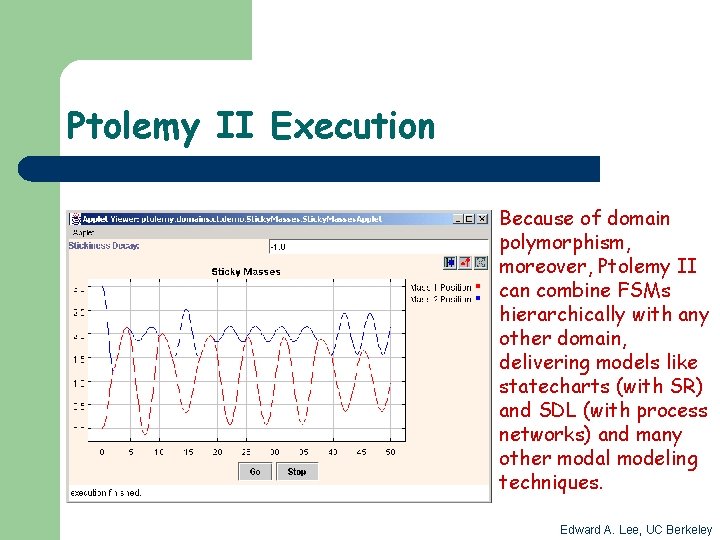
Special Case: Hybrid Systems Example: Two point masses on springs on a frictionless table. They collide and stick together. The stickiness is exponentially decaying with respect to time. Edward A. Lee, UC Berkeley
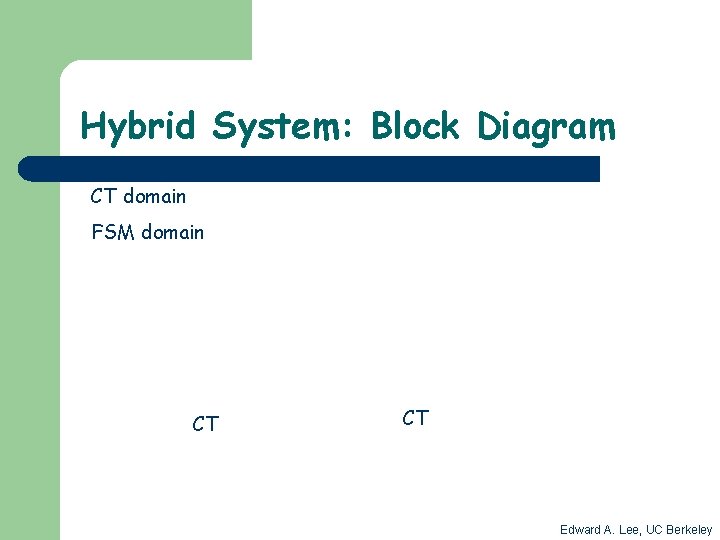
Hybrid System: Block Diagram CT domain FSM domain CT CT Edward A. Lee, UC Berkeley
Ptolemy II Execution Because of domain polymorphism, moreover, Ptolemy II can combine FSMs hierarchically with any other domain, delivering models like statecharts (with SR) and SDL (with process networks) and many other modal modeling techniques. Edward A. Lee, UC Berkeley
Summary l There is a rich set of component interaction models – – l Hierarchical heterogeneity – l l models of computation domains yields more understandable designs than amorphous heterogeneity System-level types – Define the dynamics of a component interface – More flexible component libraries A very powerful approach to heterogeneous modeling Domain polymorphism – Edward A. Lee, UC Berkeley
Acknowledgements The entire Ptolemy project team contributed immensely to this work, but particularly – – – John Davis Chamberlain Fong Tom Henzinger Christopher Hylands Jie Liu Xiaojun Liu Steve Neuendorffer Sonia Sachs Neil Smyth Kees Vissers Yuhong Xiong Edward A. Lee, UC Berkeley