
MODELING FOR THE CASE STUDY OF THE MEUSE

- Slides: 12
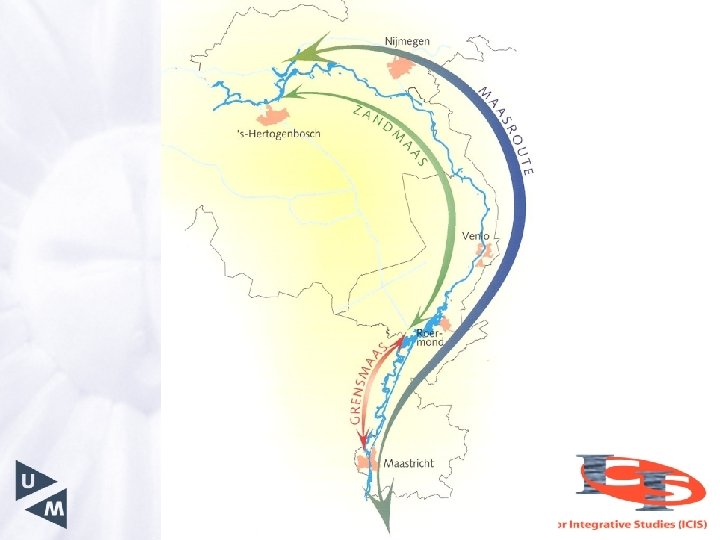
MODELING FOR THE CASE STUDY OF THE MEUSE IN LIMBURG
Traditional river management World view • The river can be controlled • Living in the flood plain is safe as long as the proper measures are taken Confidence in the water authorities Management style • Goals: safety and navigation • Canalization • Widening • Building dikes • Water level control through sluices
New perspective on river management World view • Changing risk perception • Probability of higher discharges due to climate change, landuse change. . Management style • Policy line “Room for rivers” • Water management 21 st century • Water as a guiding principle • Integrated river management, but ……. safety first ! • River widening for summer bed and floodplain
De Maaswerken Visie Maasdal: • Room for the Meuse safety to a level of 1: 250 for all • High quality shipping route • Nature a prominent role At the cost of: • No new housing • Reduction of the agricultural sector
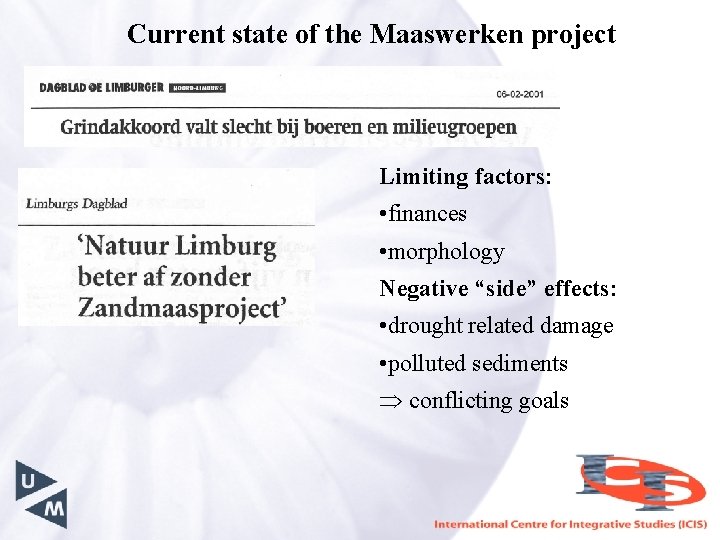
Current state of the Maaswerken project Limiting factors: • finances • morphology Negative “side” effects: • drought related damage • polluted sediments conflicting goals
Research questions • Is the vision of the Maaswerken a good one? • Is it realistic? • Don’t the negative side-effects outweigh the goals that have been set? • Is the approach sufficiently far sighted? • How do the proposed measures impact on the interests of stakeholders? • How might they interact on the basis of these measures and how might this influence the project? • How may changing insights affect stakeholder behaviour? • Is Maaswerken on the right track ?
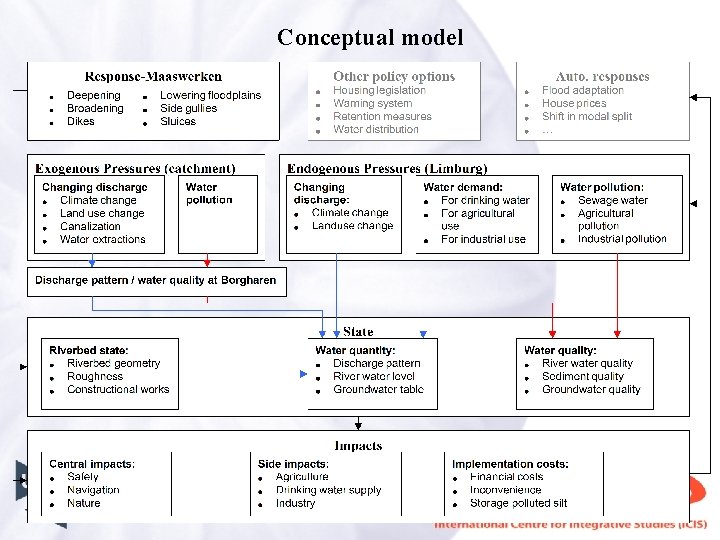
Conceptual model
Impact of climate change on flood risk Meuseflow approach Model set up ·Ten day averages of rainfal and temperature ·Spatial aggregation towards a “lumped” model (min. three zones) ·For each lump the water balance is described Output: Ten day averages of discharge at Borgharen Climate change ·Climate change simulated by: d. P = + x %, d. T = + y °C Extreme discharges ·P(Qp > Qc ) is deduced using a statistical relation between the observed ten day averages of discharge and corresponding monthly peak values.
Impact of climate change on flood risk 2 Advantages ·An ideal approach to calculate ten day averages of discharges ·Can be used to estimate the impact of climate change on droughts as well ·Relatively straight forward and “well defined” Disadvantages ·Climate change only incorporated as a change in average or in ten daily variability. ·Impact of land use changes on the frequency of occurrence of extreme events omitted from the analysis. Comparison to other, more detailed, approaches
Model of the Limburg Meuse spatial aggregation A top down approach: • Modelling aggregated entities • Illustrating results by modelling characteristic sites along the river.
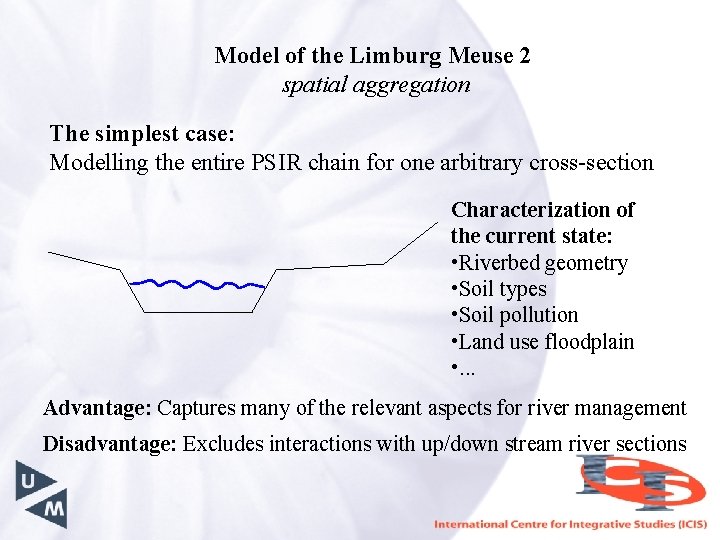
Model of the Limburg Meuse 2 spatial aggregation The simplest case: Modelling the entire PSIR chain for one arbitrary cross-section Characterization of the current state: • Riverbed geometry • Soil types • Soil pollution • Land use floodplain • . . . Advantage: Captures many of the relevant aspects for river management Disadvantage: Excludes interactions with up/down stream river sections