
Modeling Emotion Frameworks Useful In Computation and Speech
- Slides: 14
Modeling Emotion Frameworks Useful In Computation and Speech Frank Enos
Overview l General Questions l Approaches to Describing Emotion l Theoretical Models of Emotion l Some Computational Frameworks
General Questions l What makes E. relevant to Computation? l What makes E. relevant to the study of speech? l How can a subjective process be understood in computational terms? l How do we operationalize our model? l Caveat: emotions vs. linguistic labels
Describing Emotions l Taxonomic descriptions* (Izzard) l Discreet descriptions* w “Basic” emotions (Frijda, Plutchick) l Dimensional (continuous) descriptions (Arnold, Schlosberg) l Raw “empirical” observations, anecdotal reports l Evidence w Langugage, self reports, behavioral, physiological *not an exhaustive list
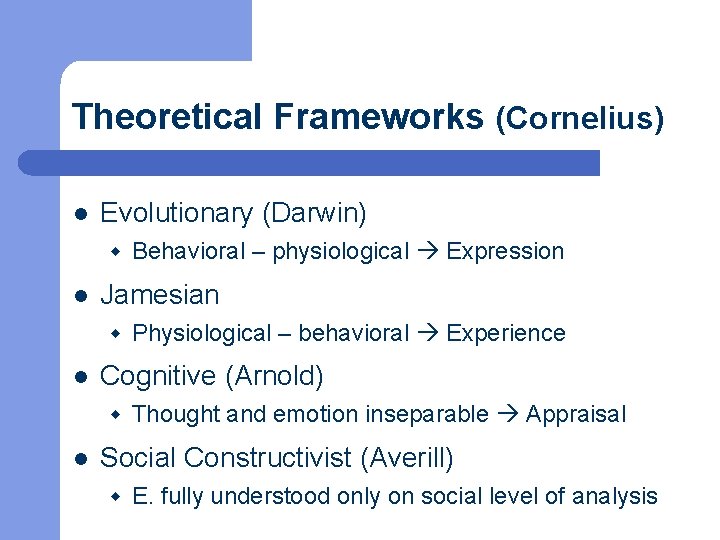
Theoretical Frameworks (Cornelius) l Evolutionary (Darwin) w Behavioral – physiological Expression l Jamesian w Physiological – behavioral Experience l Cognitive (Arnold) w Thought and emotion inseparable Appraisal l Social Constructivist (Averill) w E. fully understood only on social level of analysis
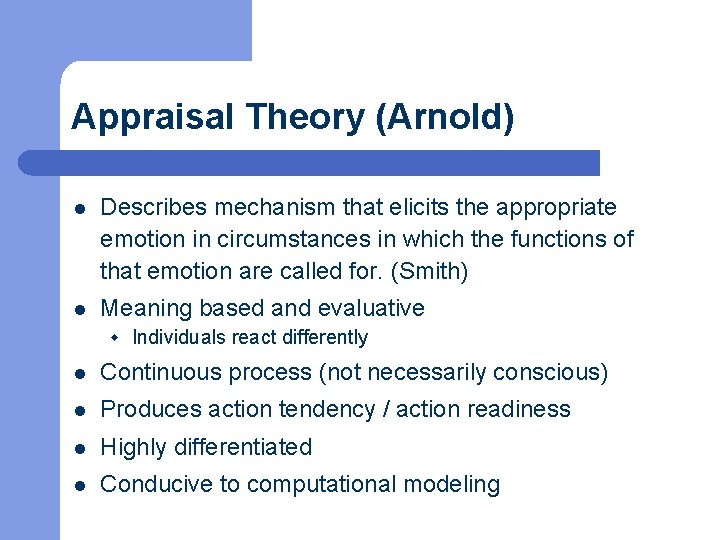
Appraisal Theory (Arnold) l Describes mechanism that elicits the appropriate emotion in circumstances in which the functions of that emotion are called for. (Smith) l Meaning based and evaluative w Individuals react differently l Continuous process (not necessarily conscious) l Produces action tendency / action readiness l Highly differentiated l Conducive to computational modeling
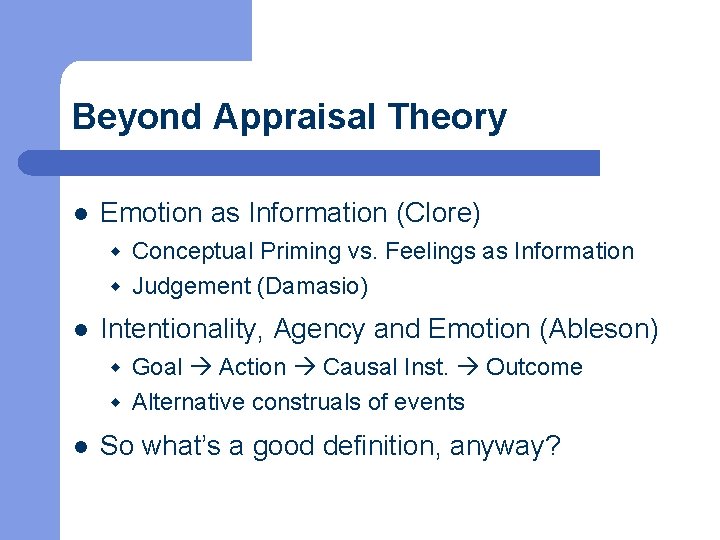
Beyond Appraisal Theory l Emotion as Information (Clore) w Conceptual Priming vs. Feelings as Information w Judgement (Damasio) l Intentionality, Agency and Emotion (Ableson) w Goal Action Causal Inst. Outcome w Alternative construals of events l So what’s a good definition, anyway?
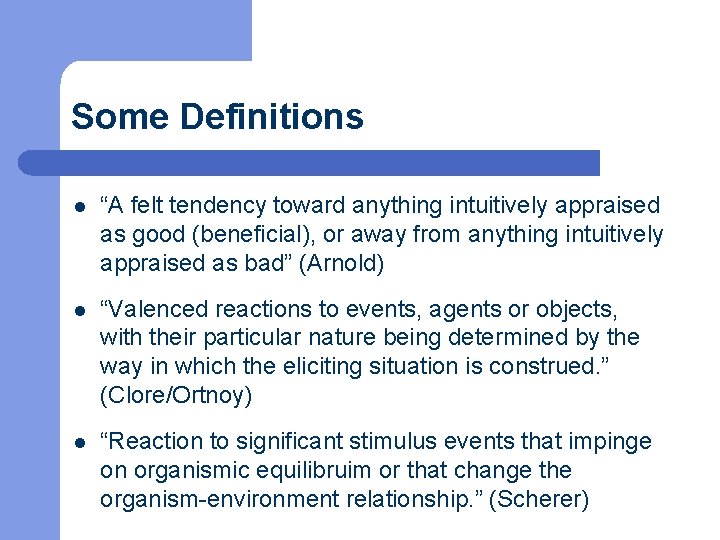
Some Definitions l “A felt tendency toward anything intuitively appraised as good (beneficial), or away from anything intuitively appraised as bad” (Arnold) l “Valenced reactions to events, agents or objects, with their particular nature being determined by the way in which the eliciting situation is construed. ” (Clore/Ortnoy) l “Reaction to significant stimulus events that impinge on organismic equilibruim or that change the organism-environment relationship. ” (Scherer)
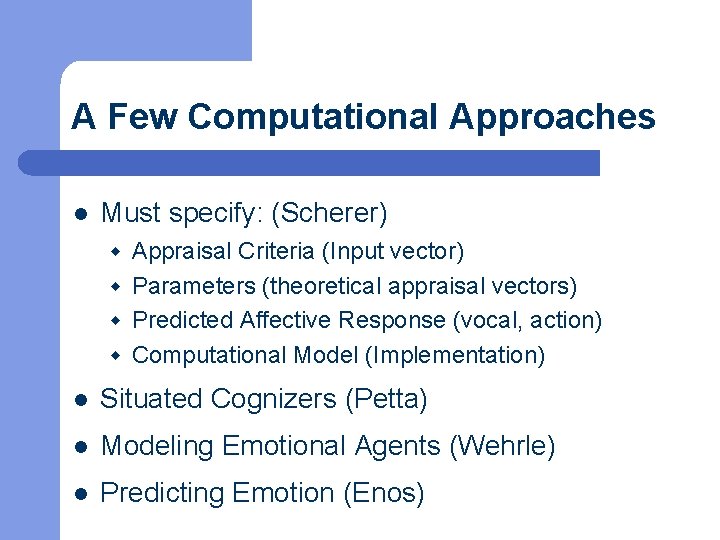
A Few Computational Approaches l Must specify: (Scherer) w Appraisal Criteria (Input vector) w Parameters (theoretical appraisal vectors) w Predicted Affective Response (vocal, action) w Computational Model (Implementation) l Situated Cognizers (Petta) l Modeling Emotional Agents (Wehrle) l Predicting Emotion (Enos)
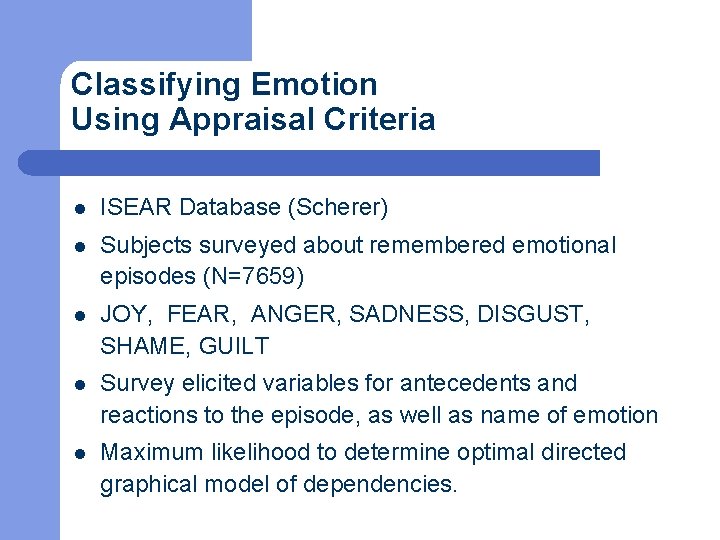
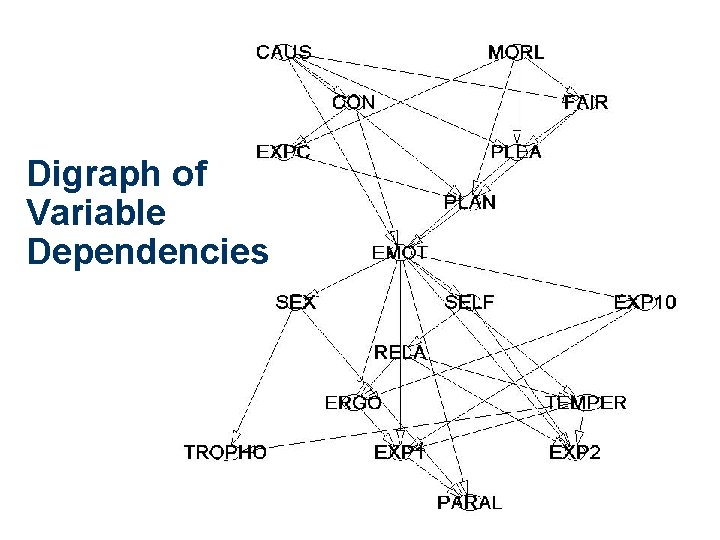
Classifying Emotion Using Appraisal Criteria l ISEAR Database (Scherer) l Subjects surveyed about remembered emotional episodes (N=7659) l JOY, FEAR, ANGER, SADNESS, DISGUST, SHAME, GUILT l Survey elicited variables for antecedents and reactions to the episode, as well as name of emotion l Maximum likelihood to determine optimal directed graphical model of dependencies.
Digraph of Variable Dependencies
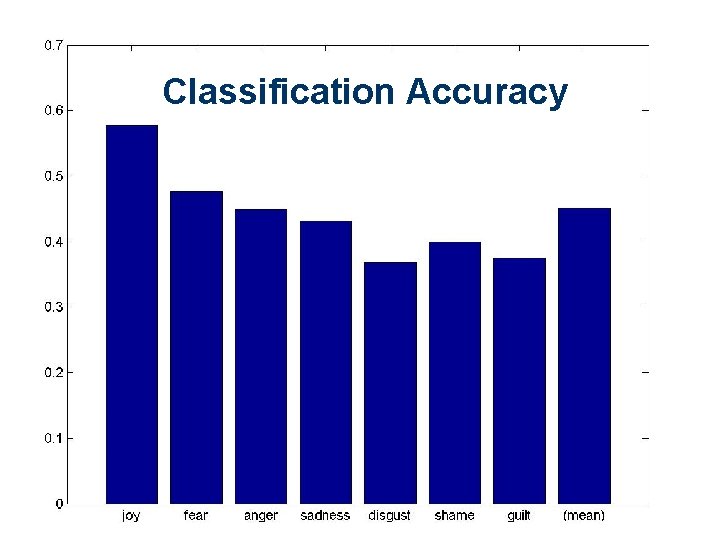
Classification Accuracy
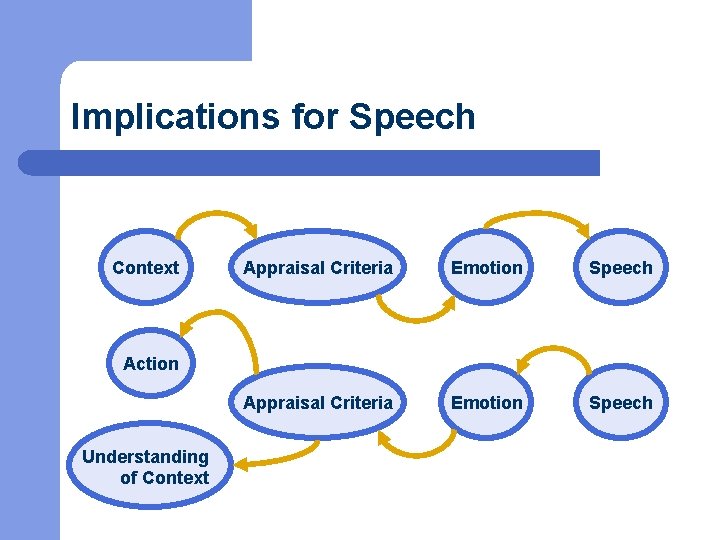
Implications for Speech Context Appraisal Criteria Emotion Speech Action Understanding of Context
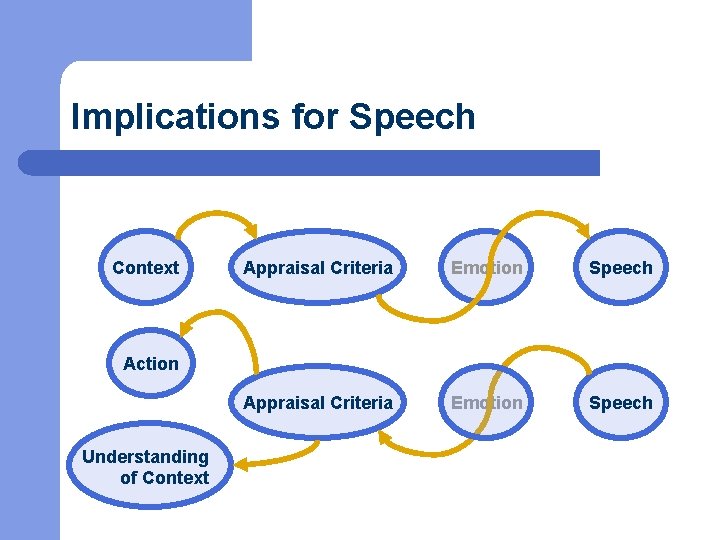
Implications for Speech Context Appraisal Criteria Emotion Speech Action Understanding of Context