
Modeling DustEnvironment Interactions Using Dust Regional Atmospheric Model


![DREAM #IN parameterization Immersion ice nucleation [-35 o. C <T<-20 o. C] (extended to](https://slidetodoc.com/presentation_image_h2/ef60eae45f572ae8139038f6b9b8e562/image-5.jpg "DREAM #IN parameterization Immersion ice nucleation [-35 o. C <T<-20 o. C] (extended to")

- Slides: 9
Modeling Dust-Environment Interactions Using Dust Regional Atmospheric Model (DREAM) Luka Ilic, Ph. D student Environmental Physics Laboratory, Institute of Physics Belgrade IHPCSS 2017 www. envpl. ipb. ac. rs
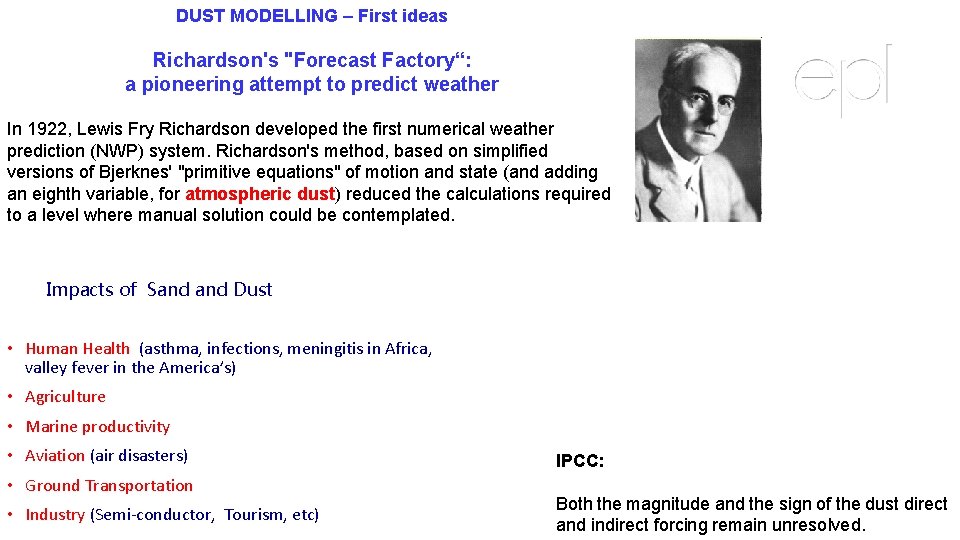
DUST MODELLING – First ideas Richardson's "Forecast Factory“: a pioneering attempt to predict weather In 1922, Lewis Fry Richardson developed the first numerical weather prediction (NWP) system. Richardson's method, based on simplified versions of Bjerknes' "primitive equations" of motion and state (and adding an eighth variable, for atmospheric dust) reduced the calculations required to a level where manual solution could be contemplated. Impacts of Sand Dust • Human Health (asthma, infections, meningitis in Africa, valley fever in the America’s) • Agriculture • Marine productivity • Aviation (air disasters) • Ground Transportation • Industry (Semi-conductor, Tourism, etc) IPCC: Both the magnitude and the sign of the dust direct and indirect forcing remain unresolved.
Dust Regional Atmospheric Model (DREAM) Nickovic et al. , 2001, Nickovic et al, 2012 • DREAM model is developed as add-on component of an atmospheric model and is designed to simulate and/or predict the atmospheric cycle of mineral dust aerosol. • It solves the Euler-type partial differential nonlinear equation for dust mass continuity. • Dust concentration is one of the governing prognostic equations in an atmospheric numerical prediction model. -Parameterization of all major atmospheric dust processes § Emission § Turbulent mixing § Long-range transport § Wet/dry deposition
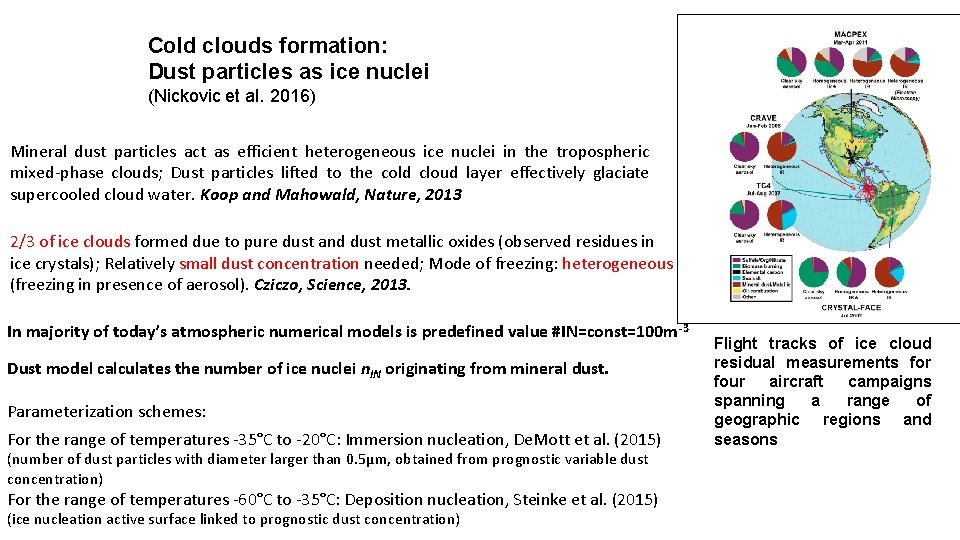
Cold clouds formation: Dust particles as ice nuclei (Nickovic et al. 2016) Mineral dust particles act as efficient heterogeneous ice nuclei in the tropospheric mixed-phase clouds; Dust particles lifted to the cold cloud layer effectively glaciate supercooled cloud water. Koop and Mahowald, Nature, 2013 2/3 of ice clouds formed due to pure dust and dust metallic oxides (observed residues in ice crystals); Relatively small dust concentration needed; Mode of freezing: heterogeneous (freezing in presence of aerosol). Cziczo, Science, 2013. In majority of today’s atmospheric numerical models is predefined value #IN=const=100 m -3 Dust model calculates the number of ice nuclei n. IN originating from mineral dust. Parameterization schemes: For the range of temperatures -35°C to -20°C: Immersion nucleation, De. Mott et al. (2015) (number of dust particles with diameter larger than 0. 5μm, obtained from prognostic variable dust concentration) For the range of temperatures -60°C to -35°C: Deposition nucleation, Steinke et al. (2015) (ice nucleation active surface linked to prognostic dust concentration) Flight tracks of ice cloud residual measurements for four aircraft campaigns spanning a range of geographic regions and seasons
DREAM #IN parameterization Immersion ice nucleation [-35 o. C <T<-20 o. C] (extended to -5 o. C) De. Mott et al (2015) > 100% Deposition ice nucleation [-60 o. C <T<-35 o. C] Steinke al (2014) is ice nucleation active surface Both schemes are developed specifically for dust aerosol!
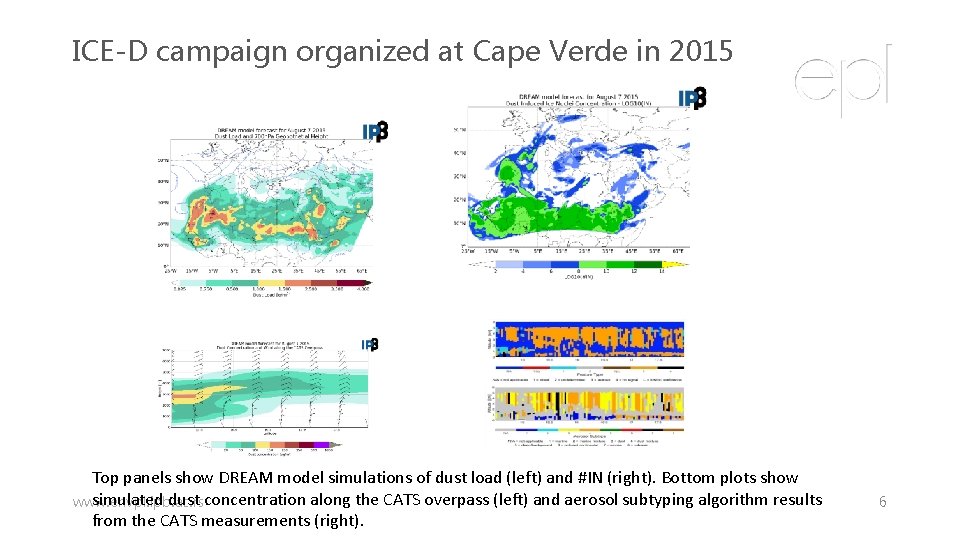
ICE-D campaign organized at Cape Verde in 2015 Top panels show DREAM model simulations of dust load (left) and #IN (right). Bottom plots show simulated dust concentration along the CATS overpass (left) and aerosol subtyping algorithm results www. envpl. ipb. ac. rs from the CATS measurements (right). 6
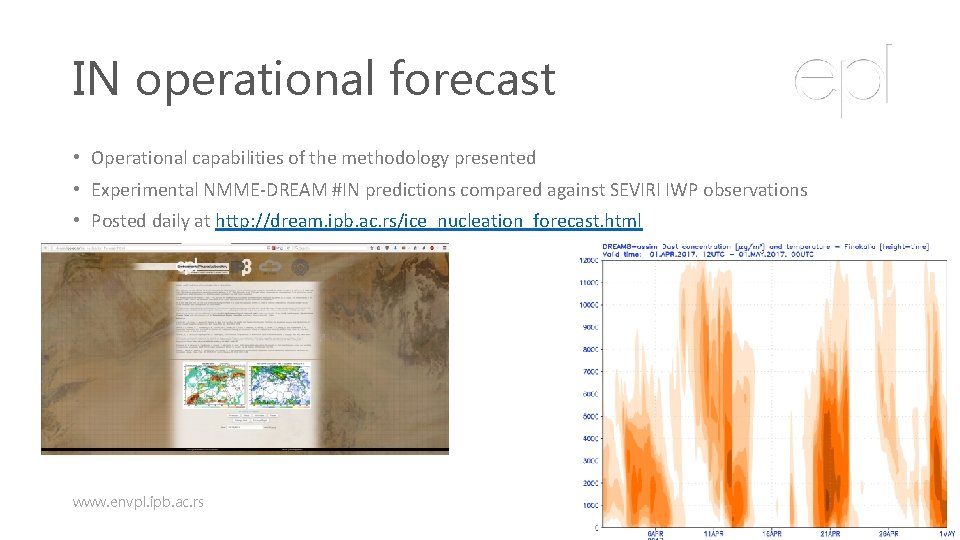
IN operational forecast • Operational capabilities of the methodology presented • Experimental NMME-DREAM #IN predictions compared against SEVIRI IWP observations • Posted daily at http: //dream. ipb. ac. rs/ice_nucleation_forecast. html www. envpl. ipb. ac. rs 7
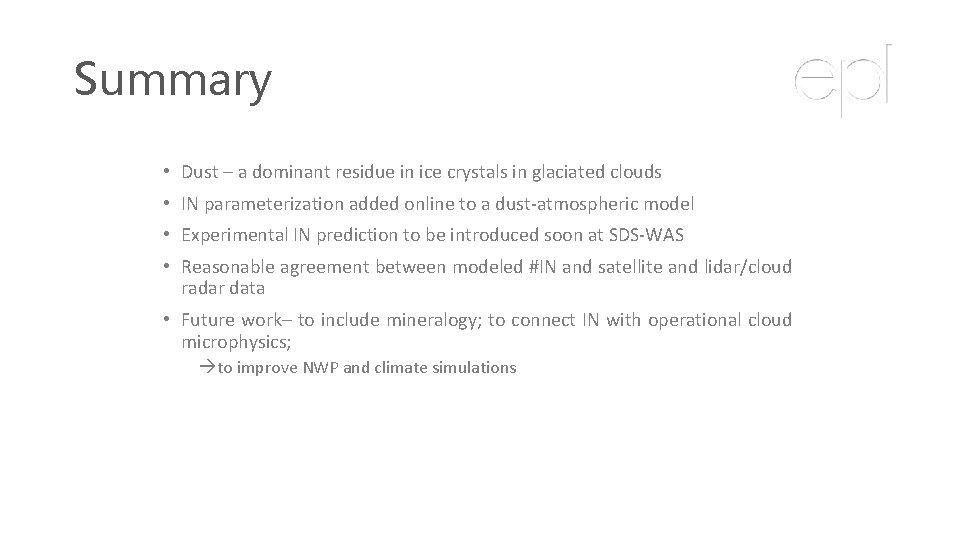
Summary • Dust – a dominant residue in ice crystals in glaciated clouds • IN parameterization added online to a dust-atmospheric model • Experimental IN prediction to be introduced soon at SDS-WAS • Reasonable agreement between modeled #IN and satellite and lidar/cloud radar data • Future work– to include mineralogy; to connect IN with operational cloud microphysics; àto improve NWP and climate simulations
Thank you! www. envpl. ipb. ac. rs 9