
Modeling debris flow initiation and runout in recently
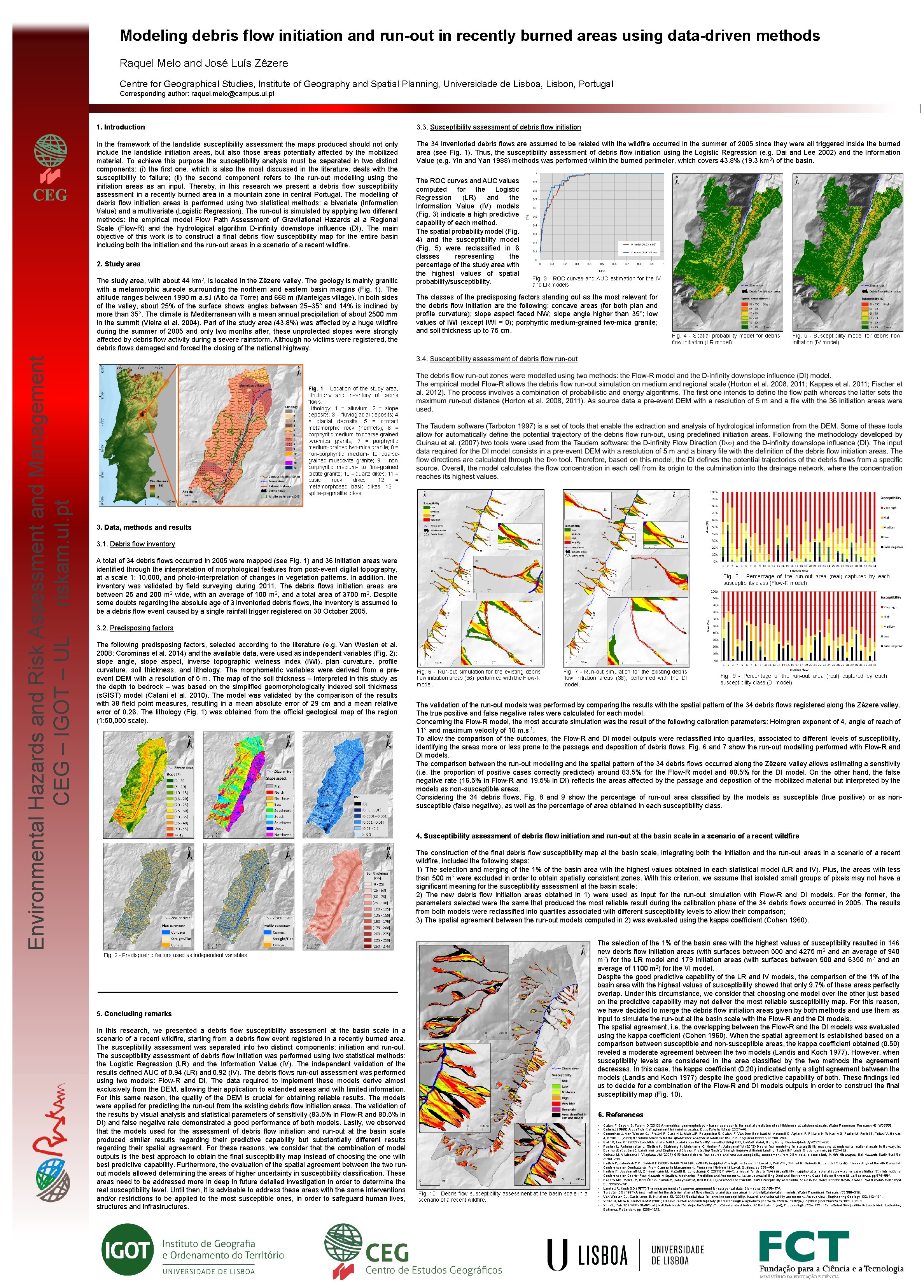
Modeling debris flow initiation and run-out in recently burned areas using data-driven methods Raquel Melo and José Luís Zêzere Centre for Geographical Studies, Institute of Geography and Spatial Planning, Universidade de Lisboa, Lisbon, Portugal Corresponding author: raquel. melo@campus. ul. pt 1. Introduction In the framework of the landslide susceptibility assessment the maps produced should not only include the landslide initiation areas, but also those areas potentially affected by the mobilized material. To achieve this purpose the susceptibility analysis must be separated in two distinct components: (i) the first one, which is also the most discussed in the literature, deals with the susceptibility to failure; (ii) the second component refers to the run-out modelling using the initiation areas as an input. Thereby, in this research we present a debris flow susceptibility assessment in a recently burned area in a mountain zone in central Portugal. The modelling of debris flow initiation areas is performed using two statistical methods: a bivariate (Information Value) and a multivariate (Logistic Regression). The run-out is simulated by applying two different methods: the empirical model Flow Path Assessment of Gravitational Hazards at a Regional Scale (Flow-R) and the hydrological algorithm D-infinity downslope influence (DI). The main objective of this work is to construct a final debris flow susceptibility map for the entire basin including both the initiation and the run-out areas in a scenario of a recent wildfire. 2. Study area Environmental Hazards and Risk Assessment and Management CEG – IGOT – UL riskam. ul. pt The study area, with about 44 km 2, is located in the Zêzere valley. The geology is mainly granitic with a metamorphic aureole surrounding the northern and eastern basin margins (Fig. 1). The altitude ranges between 1990 m a. s. l (Alto da Torre) and 668 m (Manteigas village). In both sides of the valley, about 25% of the surface shows angles between 25– 35° and 14% is inclined by more than 35°. The climate is Mediterranean with a mean annual precipitation of about 2500 mm in the summit (Vieira et al. 2004). Part of the study area (43. 8%) was affected by a huge wildfire during the summer of 2005 and only two months after, these unprotected slopes were strongly affected by debris flow activity during a severe rainstorm. Although no victims were registered, the debris flows damaged and forced the closing of the national highway. Fig. 1 - Location of the study area, lithologhy and inventory of debris flows. Lithology: 1 = alluvium; 2 = slope deposits; 3 = fluvioglacial deposits; 4 = glacial deposits; 5 = contact metamorphic rock (hornfels); 6 = porphyritic medium- to coarse-grained two-mica granite; 7 = porphyritic medium-grained two-mica granite; 8 = non-porphyritic medium- to coarsegrained muscovite granite; 9 = nonporphyritic medium- to fine-grained biotite granite; 10 = quartz dikes; 11 = basic rock dikes; 12 = metamorphosed basic dikes; 13 = aplite-pegmatite dikes. 3. Data, methods and results 3. 1. Debris flow inventory A total of 34 debris flows occurred in 2005 were mapped (see Fig. 1) and 36 initiation areas were identified through the interpretation of morphological features from post-event digital topography, at a scale 1: 10, 000, and photo-interpretation of changes in vegetation patterns. In addition, the inventory was validated by field surveying during 2011. The debris flows initiation areas are between 25 and 200 m 2 wide, with an average of 100 m 2, and a total area of 3700 m 2. Despite some doubts regarding the absolute age of 3 inventoried debris flows, the inventory is assumed to be a debris flow event caused by a single rainfall trigger registered on 30 October 2005. 3. 2. Predisposing factors The following predisposing factors, selected according to the literature (e. g. Van Westen et al. 2008; Corominas et al. 2014) and the available data, were used as independent variables (Fig. 2): slope angle, slope aspect, inverse topographic wetness index (IWI), plan curvature, profile curvature, soil thickness, and lithology. The morphometric variables were derived from a preevent DEM with a resolution of 5 m. The map of the soil thickness – interpreted in this study as the depth to bedrock – was based on the simplified geomorphologically indexed soil thickness (s. GIST) model (Catani et al. 2010). The model was validated by the comparison of the results with 38 field point measures, resulting in a mean absolute error of 29 cm and a mean relative error of 0. 26. The lithology (Fig. 1) was obtained from the official geological map of the region (1: 50, 000 scale). 3. 3. Susceptibility assessment of debris flow initiation The 34 inventoried debris flows are assumed to be related with the wildfire occurred in the summer of 2005 since they were all triggered inside the burned area (see Fig. 1). Thus, the susceptibility assessment of debris flow initiation using the Logistic Regression (e. g. Dai and Lee 2002) and the Information Value (e. g. Yin and Yan 1988) methods was performed within the burned perimeter, which covers 43. 8% (19. 3 km 2) of the basin. The ROC curves and AUC values computed for the Logistic Regression (LR) and the Information Value (IV) models (Fig. 3) indicate a high predictive capability of each method. The spatial probability model (Fig. 4) and the susceptibility model (Fig. 5) were reclassified in 6 classes representing the percentage of the study area with the highest values of spatial probability/susceptibility. Fig. 3 - ROC curves and AUC estimation for the IV and LR models. The classes of the predisposing factors standing out as the most relevant for the debris flow initiation are the following: concave areas (for both plan and profile curvature); slope aspect faced NW; slope angle higher than 35°; low values of IWI (except IWI = 0); porphyritic medium-grained two-mica granite; and soil thickness up to 75 cm. Fig. 4 - Spatial probability model for debris flow initiation (LR model). Fig. 5 - Susceptibility model for debris flow initiation (IV model). Fig. 8 - Percentage of the run-out area (real) captured by each susceptibility class (Flow-R model). Fig. 6 - Run-out simulation for the existing debris flow initiation areas (36), performed with the Flow-R model. Fig. 7 - Run-out simulation for the existing debris flow initiation areas (36), performed with the DI model. Fig. 9 - Percentage of the run-out area (real) captured by each susceptibility class (DI model). The validation of the run-out models was performed by comparing the results with the spatial pattern of the 34 debris flows registered along the Zêzere valley. The true positive and false negative rates were calculated for each model. Concerning the Flow-R model, the most accurate simulation was the result of the following calibration parameters: Holmgren exponent of 4, angle of reach of 11° and maximum velocity of 10 m. s-1. To allow the comparison of the outcomes, the Flow-R and DI model outputs were reclassified into quartiles, associated to different levels of susceptibility, identifying the areas more or less prone to the passage and deposition of debris flows. Fig. 6 and 7 show the run-out modelling performed with Flow-R and DI models. The comparison between the run-out modelling and the spatial pattern of the 34 debris flows occurred along the Zêzere valley allows estimating a sensitivity (i. e. the proportion of positive cases correctly predicted) around 83. 5% for the Flow-R model and 80. 5% for the DI model. On the other hand, the false negative rate (16. 5% in Flow-R and 19. 5% in DI) reflects the areas affected by the passage and deposition of the mobilized material but interpreted by the models as non-susceptible areas. Considering the 34 debris flows, Fig. 8 and 9 show the percentage of run-out area classified by the models as susceptible (true positive) or as nonsusceptible (false negative), as well as the percentage of area obtained in each susceptibility class. 4. Susceptibility assessment of debris flow initiation and run-out at the basin scale in a scenario of a recent wildfire The construction of the final debris flow susceptibility map at the basin scale, integrating both the initiation and the run-out areas in a scenario of a recent wildfire, included the following steps: 1) The selection and merging of the 1% of the basin area with the highest values obtained in each statistical model (LR and IV). Plus, the areas with less than 500 m 2 were excluded in order to obtain spatially consistent zones. With this criterion, we assume that isolated small groups of pixels may not have a significant meaning for the susceptibility assessment at the basin scale; 2) The new debris flow initiation areas obtained in 1) were used as input for the run-out simulation with Flow-R and DI models. For the former, the parameters selected were the same that produced the most reliable result during the calibration phase of the 34 debris flows occurred in 2005. The results from both models were reclassified into quartiles associated with different susceptibility levels to allow their comparison; 3) The spatial agreement between the run-out models computed in 2) was evaluated using the kappa coefficient (Cohen 1960). The selection of the 1% of the basin area with the highest values of susceptibility resulted in 146 new debris flow initiation areas (with surfaces between 500 and 4275 m 2 and an average of 940 m 2) for the LR model and 179 initiation areas (with surfaces between 500 and 6350 m 2 and an average of 1100 m 2) for the VI model. Despite the good predictive capability of the LR and IV models, the comparison of the 1% of the basin area with the highest values of susceptibility showed that only 9. 7% of these areas perfectly overlap. Under this circumstance, we consider that choosing one model over the other just based on the predictive capability may not deliver the most reliable susceptibility map. For this reason, we have decided to merge the debris flow initiation areas given by both methods and use them as input to simulate the run-out at the basin scale with the Flow-R and the DI models. The spatial agreement, i. e. the overlapping between the Flow-R and the DI models was evaluated using the kappa coefficient (Cohen 1960). When the spatial agreement is established based on a comparison between susceptible and non-susceptible areas, the kappa coefficient obtained (0. 50) reveled a moderate agreement between the two models (Landis and Koch 1977). However, when susceptibility levels are considered in the area classified by the two methods the agreement decreases. In this case, the kappa coefficient (0. 20) indicated only a slight agreement between the models (Landis and Koch 1977) despite the good predictive capability of both. These findings led us to decide for a combination of the Flow-R and DI models outputs in order to construct the final susceptibility map (Fig. 10). Fig. 2 - Predisposing factors used as independent variables. 5. Concluding remarks In this research, we presented a debris flow susceptibility assessment at the basin scale in a scenario of a recent wildfire, starting from a debris flow event registered in a recently burned area. The susceptibility assessment was separated into two distinct components: initiation and run-out. The susceptibility assessment of debris flow initiation was performed using two statistical methods: the Logistic Regression (LR) and the Information Value (IV). The independent validation of the results defined AUC of 0. 94 (LR) and 0. 92 (IV). The debris flows run-out assessment was performed using two models: Flow-R and DI. The data required to implement these models derive almost exclusively from the DEM, allowing their application to extended areas and with limited information. For this same reason, the quality of the DEM is crucial for obtaining reliable results. The models were applied for predicting the run-out from the existing debris flow initiation areas. The validation of the results by visual analysis and statistical parameters of sensitivity (83. 5% in Flow-R and 80. 5% in DI) and false negative rate demonstrated a good performance of both models. Lastly, we observed that the models used for the assessment of debris flow initiation and run-out at the basin scale produced similar results regarding their predictive capability but substantially different results regarding their spatial agreement. For these reasons, we consider that the combination of model outputs is the best approach to obtain the final susceptibility map instead of choosing the one with best predictive capability. Furthermore, the evaluation of the spatial agreement between the two runout models allowed determining the areas of higher uncertainty in susceptibility classification. These areas need to be addressed more in deep in future detailed investigation in order to determine the real susceptibility level. Until then, it is advisable to address these areas with the same interventions and/or restrictions to be applied to the most susceptible ones, in order to safeguard human lives, structures and infrastructures. 6. References • • • Fig. 10 - Debris flow susceptibility assessment at the basin scale in a scenario of a recent wildfire. • • • Catani F, Segoni S, Falorni G (2010) An empirical geomorphology‐based approach to the spatial prediction of soil thickness at catchment scale. Water Resources Research 46, W 05508. Cohen J (1960) A coefficient of agreement for nominal scales. Educ Psychol Meas 20: 37– 46. Corominas J, Van Westen CJ, Frattini P, Cascini L, Malet JP, Fotopoulou S, Catani F, Van Den Eeckhaut M, Mavrouli O, Agliardi F, Pitilakis K, Winter MG, Pastor M, Ferlisi S, Tofani V, Hervás J, Smith JT (2014) Recommendations for the quantitative analysis of landslide risk. Bull Eng Geol Environ 73: 209– 263. Dai FC, Lee CF (2002) Landslide characteristics and slope instability modeling using GIS, Lantau Island, Hong Kong. Geomorphology 42: 213– 228. Fischer L, Rubensdotter L, Sletten K, Stalsberg K, Melchiorre C, Horton P, Jaboyedoff M (2012) Debris flow modeling for susceptibility mapping at regional to national scale in Norway. In: Eberhardt et al. (eds), Landslides and Engineered Slopes: Protecting Society through Improved Understanding, Taylor & Francis Group, London, pp 723– 729. Guinau M, Vilajosana I, Vilaplana JM (2007) GIS–based debris flow source and runout susceptibility assessment from DEM data: a case study in NW Nicaragua. Nat Hazards Earth Syst Sci 7: 703– 716. Horton P, Jaboyedoff M, Bardou E (2008) Debris flow susceptibility mapping at a regional scale. In: Locat J, Perret D, Turmel D, Demers D, Leroueil S (eds), Proceedings of the 4 th Canadian Conference on Geohazards: From Causes to Management, Presse de l’Université Laval, Québec, pp 339– 406. Horton P, Jaboyedoff M, Zimmermann M, Mazotti B, Longchamp C (2011) Flow–R, a model for debris flow susceptibility mapping at a regional scale – some case studies. 5 th International Conference on Debris–Flow Hazards Mitigation: Mechanics, Prediction and Assessment. Italian Journal of Eng Geol and Environment, Casa Editrice Università La Sapienza, pp 875– 884. Kappes MS, Malet JP, Remaître A, Horton P, Jaboyedoff M, Bell R (2011) Assessment of debris–flow susceptibility at medium–scale in the Barcelonnette Basin, France. Nat Hazards Earth Syst Sci 11: 627– 641. Landis JR, Koch GG (1977) The measurement of observer agreement for categorical data. Biometrics 33: 159– 174. Tarboton DG (1997) A new method for the determination of flow directions and upslope areas in grid digital elevation models. Water Resources Research 33: 309– 319. Van Westen CJ, Castellanos E, Kuriakose SL (2008) Spatial data for landslide susceptibility, hazard, and vulnerability assessment: An overview. Engineering Geology 102: 112– 131. Vieira G, Mora C, Gouveia MM (2004) Oblique rainfall and contemporary geomorphological dynamics (Serra da Estrela, Portugal). Hydrological Processes 18: 807– 824. Yin KL, Yan TZ (1988) Statistical prediction model for slope instability of metamorphosed rocks. In: Bonnard C (ed), Proceedings of the Fifth International Symposium in Landslides, Lausanne, Balkema, Rotterdam, pp 1269– 1272.
- Slides: 1