
Modeling Critical Reflection Network of Educational Action Research
- Slides: 14
Modeling Critical Reflection Network of Educational Action Research Ireland (NEARI) April 17 th, 2021 Stephen Brookfield Distinguished Scholar, Antioch University To retrieve these slides later or follow along now go to my open access website & click on the ‘Resources’ link at top left of the home page (next to ‘Home’). This presentation is the first one listed. www. stephenbrookfield. com
Who I am • I am from… • the sound of seagulls crying over the north sea and merseybeat blasting at the Cavern club, • the smell of fish & chips, factory waste and coal burning fires, • the taste of grease, sour milk tea and dust at the back of my throat • the idea of community pride & the triumph of humor over pretentiousness • Born in Bootle, Liverpool, 1949 • Moved to the soft south as a teenager (mum hated Liverpool) cultural genocide to rid me of Scouse accent • All education in UK, after graduation worked in FE & adult ed. (Lewisham, Slough, Devon, Worcestershire) • Lost my lecturer/organizer job in 1980 & fled (temporarily) to New York – a Thatcher political refugee • Met my partner there & moved to her home state – Minnesota – in 1992, raising 2 kids there • Left my university after dispute over antiracist efforts & lack of attention to white supremacy • Now the part time “Distinguished Scholar” at Antioch University • Leader of The 99 ers – pop punk band w/ 6 albums on Spinout Records (listen to us on Spotify, I Tunes, etc. ) • * Adapted from the poem Where I’m From by George Ella Lyon
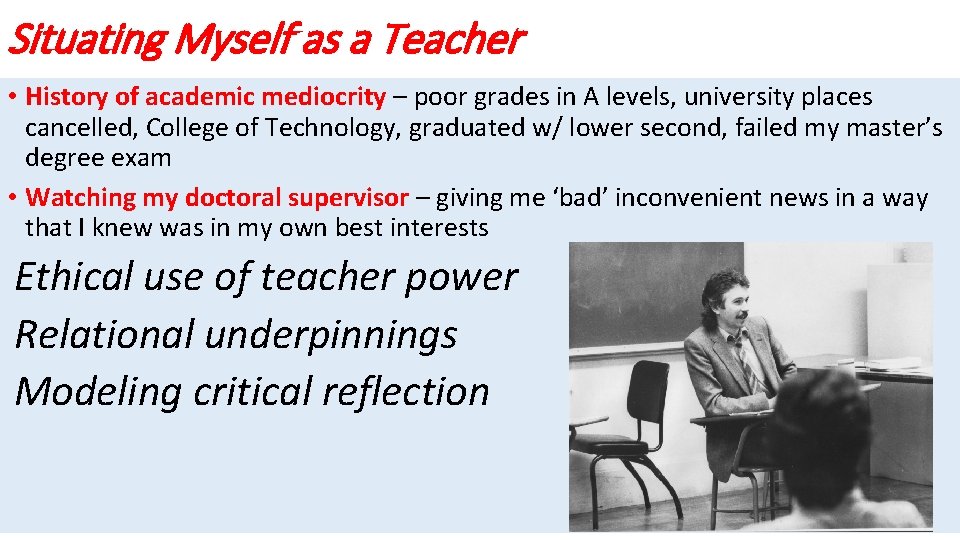
Situating Myself as a Teacher • History of academic mediocrity – poor grades in A levels, university places cancelled, College of Technology, graduated w/ lower second, failed my master’s degree exam • Watching my doctoral supervisor – giving me ‘bad’ inconvenient news in a way that I knew was in my own best interests Ethical use of teacher power Relational underpinnings Modeling critical reflection
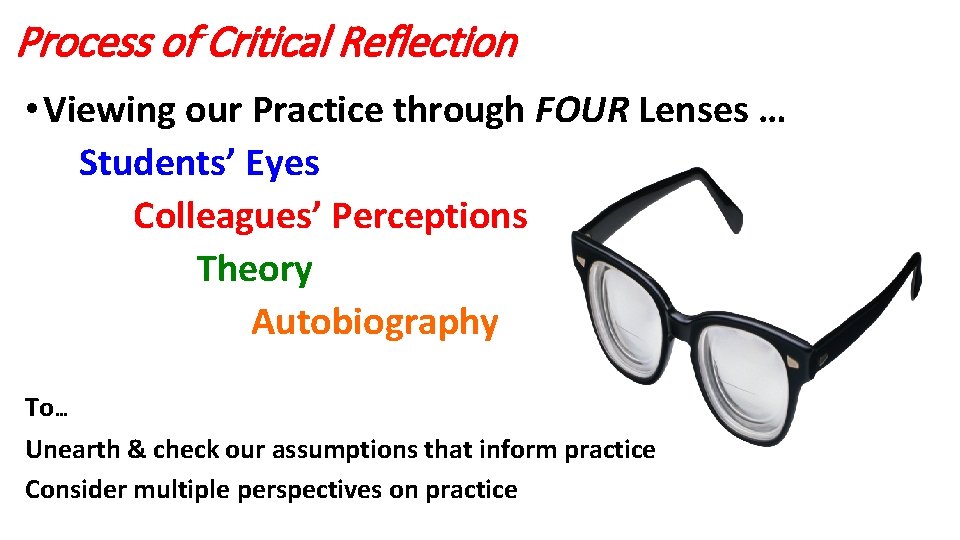
Process of Critical Reflection • Viewing our Practice through FOUR Lenses … Students’ Eyes Colleagues’ Perceptions Theory Autobiography To… Unearth & check our assumptions that inform practice Consider multiple perspectives on practice
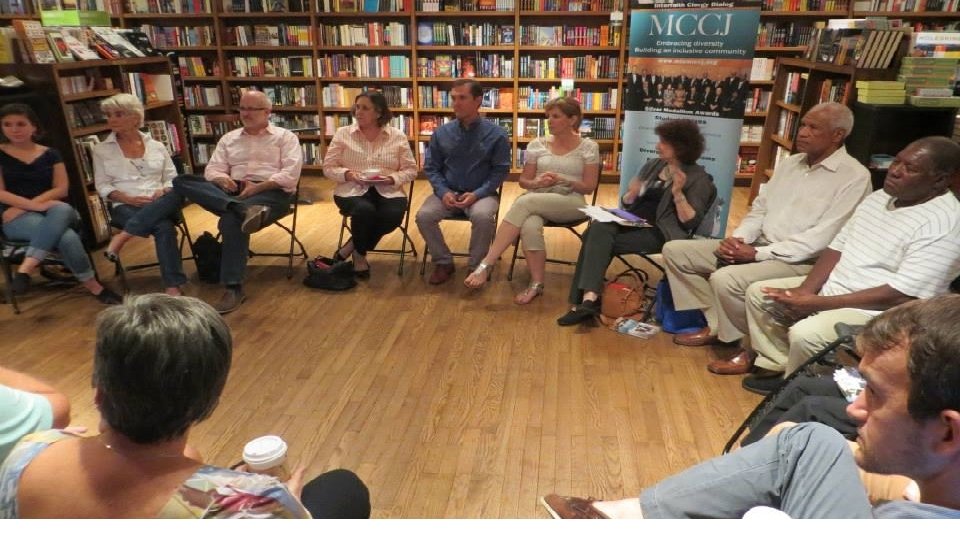
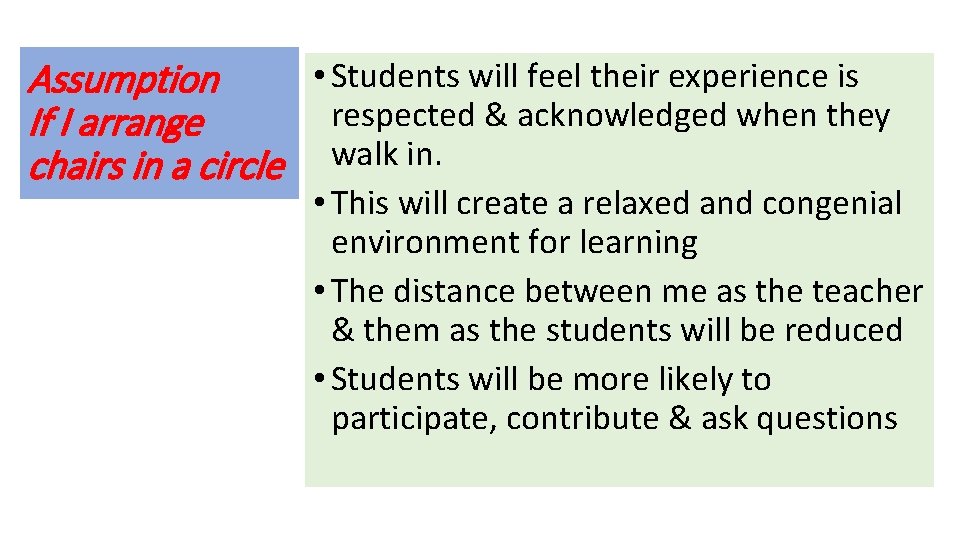
• Students will feel their experience is Assumption respected & acknowledged when they If I arrange chairs in a circle walk in. • This will create a relaxed and congenial environment for learning • The distance between me as the teacher & them as the students will be reduced • Students will be more likely to participate, contribute & ask questions
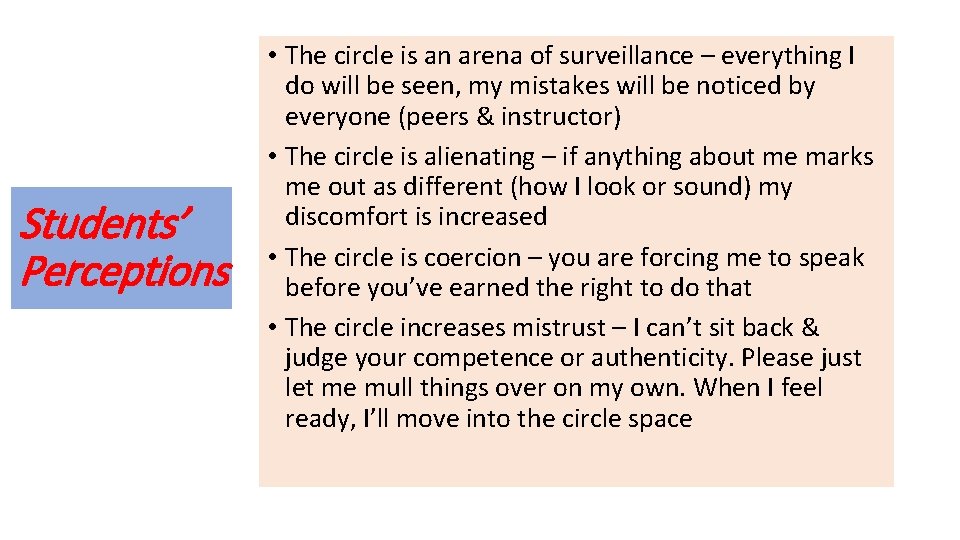
Students’ Perceptions • The circle is an arena of surveillance – everything I do will be seen, my mistakes will be noticed by everyone (peers & instructor) • The circle is alienating – if anything about me marks me out as different (how I look or sound) my discomfort is increased • The circle is coercion – you are forcing me to speak before you’ve earned the right to do that • The circle increases mistrust – I can’t sit back & judge your competence or authenticity. Please just let me mull things over on my own. When I feel ready, I’ll move into the circle space
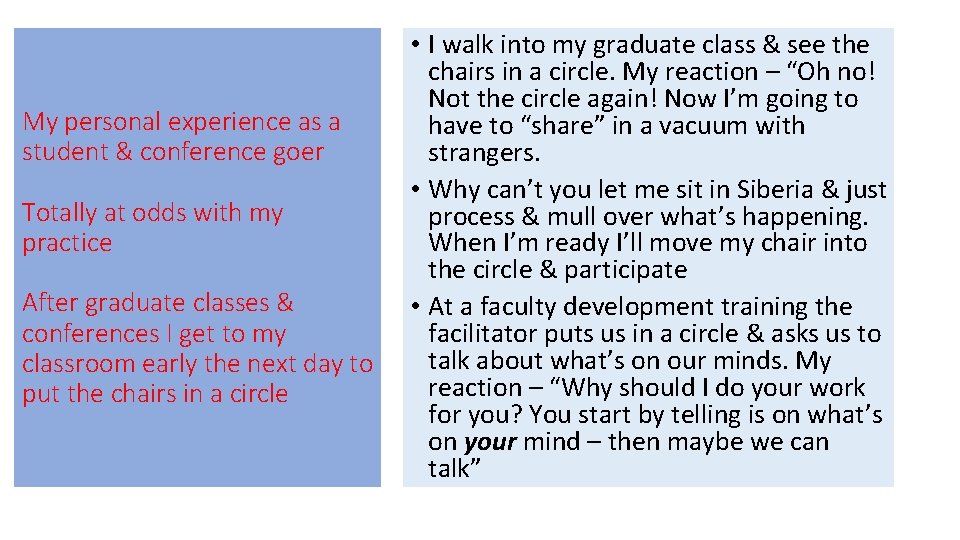
My personal experience as a student & conference goer Totally at odds with my practice After graduate classes & conferences I get to my classroom early the next day to put the chairs in a circle • I walk into my graduate class & see the chairs in a circle. My reaction – “Oh no! Not the circle again! Now I’m going to have to “share” in a vacuum with strangers. • Why can’t you let me sit in Siberia & just process & mull over what’s happening. When I’m ready I’ll move my chair into the circle & participate • At a faculty development training the facilitator puts us in a circle & asks us to talk about what’s on our minds. My reaction – “Why should I do your work for you? You start by telling is on what’s on your mind – then maybe we can talk”
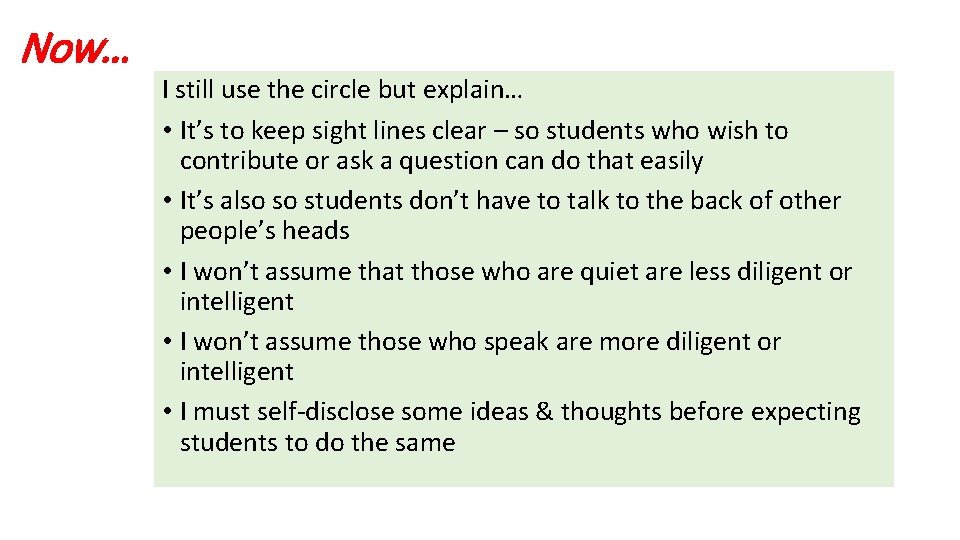
Now… I still use the circle but explain… • It’s to keep sight lines clear – so students who wish to contribute or ask a question can do that easily • It’s also so students don’t have to talk to the back of other people’s heads • I won’t assume that those who are quiet are less diligent or intelligent • I won’t assume those who speak are more diligent or intelligent • I must self disclose some ideas & thoughts before expecting students to do the same
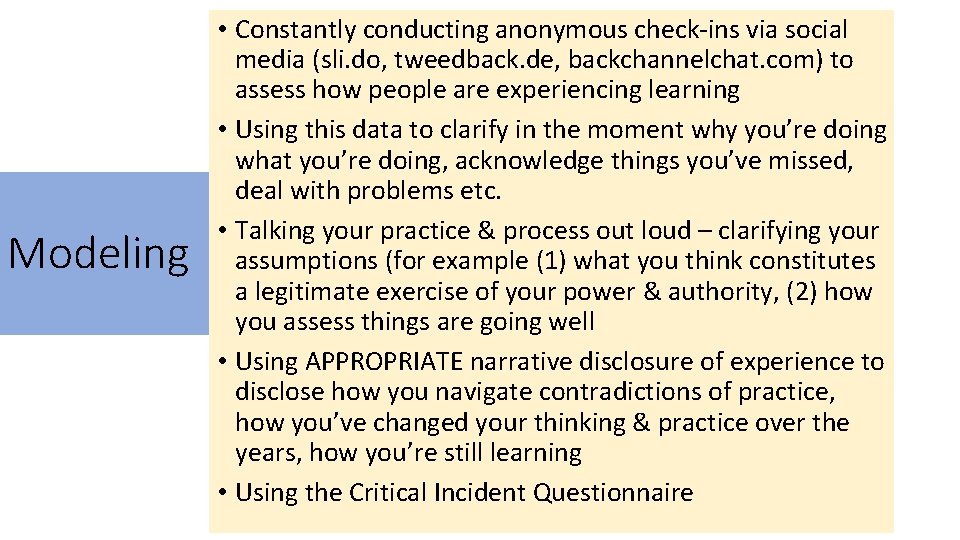
Modeling • Constantly conducting anonymous check ins via social media (sli. do, tweedback. de, backchannelchat. com) to assess how people are experiencing learning • Using this data to clarify in the moment why you’re doing what you’re doing, acknowledge things you’ve missed, deal with problems etc. • Talking your practice & process out loud – clarifying your assumptions (for example (1) what you think constitutes a legitimate exercise of your power & authority, (2) how you assess things are going well • Using APPROPRIATE narrative disclosure of experience to disclose how you navigate contradictions of practice, how you’ve changed your thinking & practice over the years, how you’re still learning • Using the Critical Incident Questionnaire
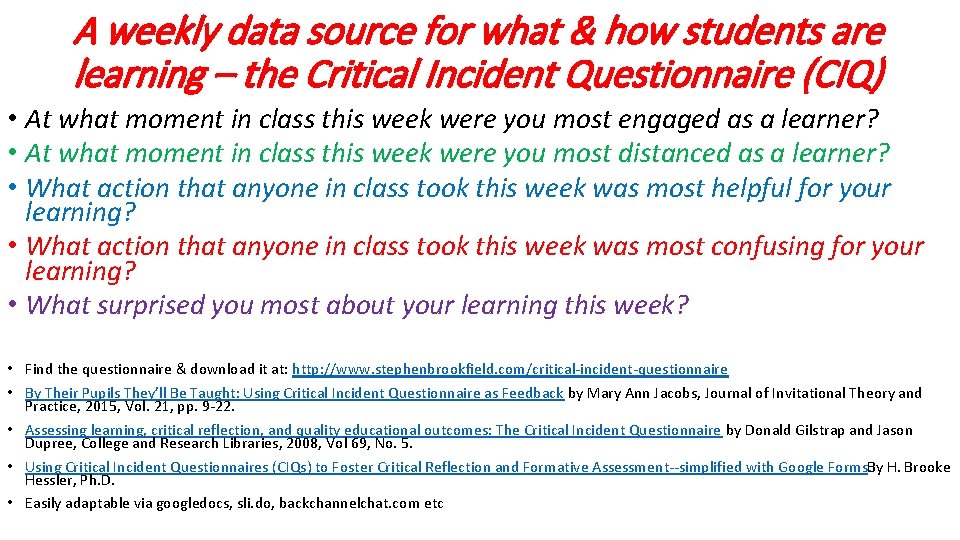
A weekly data source for what & how students are learning – the Critical Incident Questionnaire (CIQ) • At what moment in class this week were you most engaged as a learner? • At what moment in class this week were you most distanced as a learner? • What action that anyone in class took this week was most helpful for your learning? • What action that anyone in class took this week was most confusing for your learning? • What surprised you most about your learning this week? • Find the questionnaire & download it at: http: //www. stephenbrookfield. com/critical incident questionnaire • By Their Pupils They’ll Be Taught: Using Critical Incident Questionnaire as Feedback by Mary Ann Jacobs, Journal of Invitational Theory and Practice, 2015, Vol. 21, pp. 9 22. • Assessing learning, critical reflection, and quality educational outcomes: The Critical Incident Questionnaire by Donald Gilstrap and Jason Dupree, College and Research Libraries, 2008, Vol 69, No. 5. • Using Critical Incident Questionnaires (CIQs) to Foster Critical Reflection and Formative Assessment simplified with Google Forms. By H. Brooke Hessler, Ph. D. • Easily adaptable via googledocs, sli. do, backchannelchat. com etc
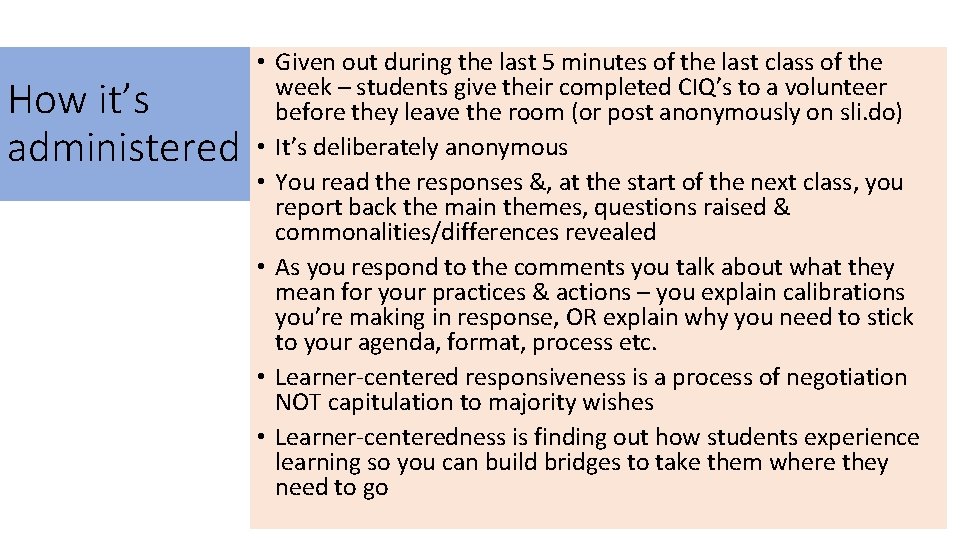
How it’s administered • Given out during the last 5 minutes of the last class of the week – students give their completed CIQ’s to a volunteer before they leave the room (or post anonymously on sli. do) • It’s deliberately anonymous • You read the responses &, at the start of the next class, you report back the main themes, questions raised & commonalities/differences revealed • As you respond to the comments you talk about what they mean for your practices & actions – you explain calibrations you’re making in response, OR explain why you need to stick to your agenda, format, process etc. • Learner centered responsiveness is a process of negotiation NOT capitulation to majority wishes • Learner centeredness is finding out how students experience learning so you can build bridges to take them where they need to go
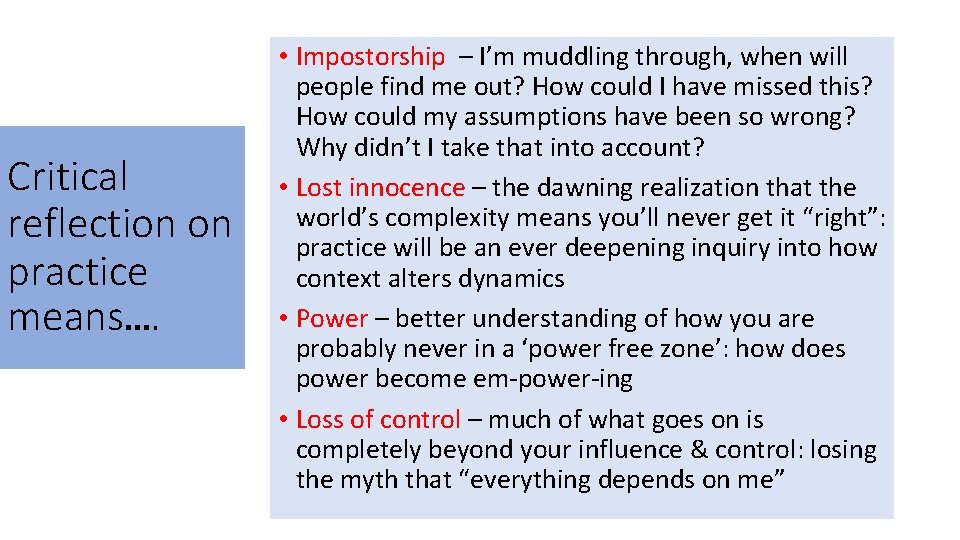
Critical reflection on practice means…. • Impostorship – I’m muddling through, when will people find me out? How could I have missed this? How could my assumptions have been so wrong? Why didn’t I take that into account? • Lost innocence – the dawning realization that the world’s complexity means you’ll never get it “right”: practice will be an ever deepening inquiry into how context alters dynamics • Power – better understanding of how you are probably never in a ‘power free zone’: how does power become em power ing • Loss of control – much of what goes on is completely beyond your influence & control: losing the myth that “everything depends on me”
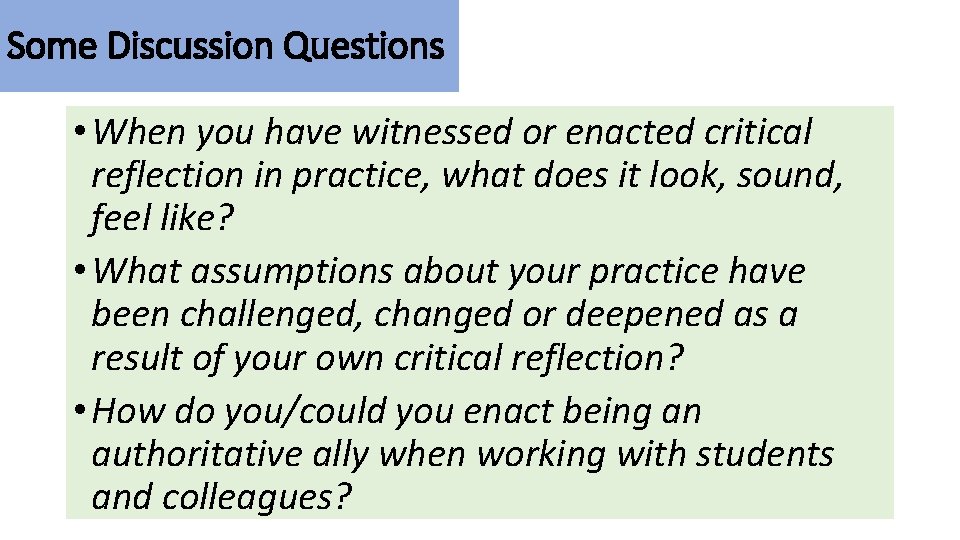
Some Discussion Questions • When you have witnessed or enacted critical reflection in practice, what does it look, sound, feel like? • What assumptions about your practice have been challenged, changed or deepened as a result of your own critical reflection? • How do you/could you enact being an authoritative ally when working with students and colleagues?