
Modeling Complex Diffusion Mechanisms in L 12 Structured
![Comparison of diffusion models – part 2 simple vacancy divacancy with ([V]=0. 04) T=900](https://slidetodoc.com/presentation_image_h2/e51866c8de7d37bd54cde44eb8407067/image-21.jpg "Comparison of diffusion models – part 2 simple vacancy divacancy with ([V]=0. 04) T=900")
![Comparison of diffusion models – part 2 simple vacancy divacancy with ([V]=0. 04) T=900](https://slidetodoc.com/presentation_image_h2/e51866c8de7d37bd54cde44eb8407067/image-22.jpg "Comparison of diffusion models – part 2 simple vacancy divacancy with ([V]=0. 04) T=900")
- Slides: 23
Modeling Complex Diffusion Mechanisms in L 12 -Structured Compounds Matthew O. Zacate William E. Evenson Mike Lape Michael Stufflebeam Supported by and NSF grant DMR 06 -06006 (Metals Program) KY EPSCo. R grant RSF-012 -03 with and Gary S. Collins at Washington State University James Castle at NKU
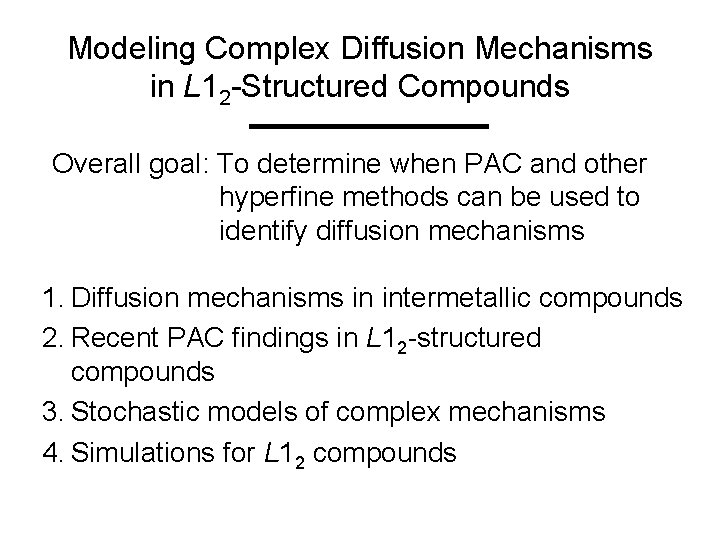
Modeling Complex Diffusion Mechanisms in L 12 -Structured Compounds Overall goal: To determine when PAC and other hyperfine methods can be used to identify diffusion mechanisms 1. Diffusion mechanisms in intermetallic compounds 2. Recent PAC findings in L 12 -structured compounds 3. Stochastic models of complex mechanisms 4. Simulations for L 12 compounds
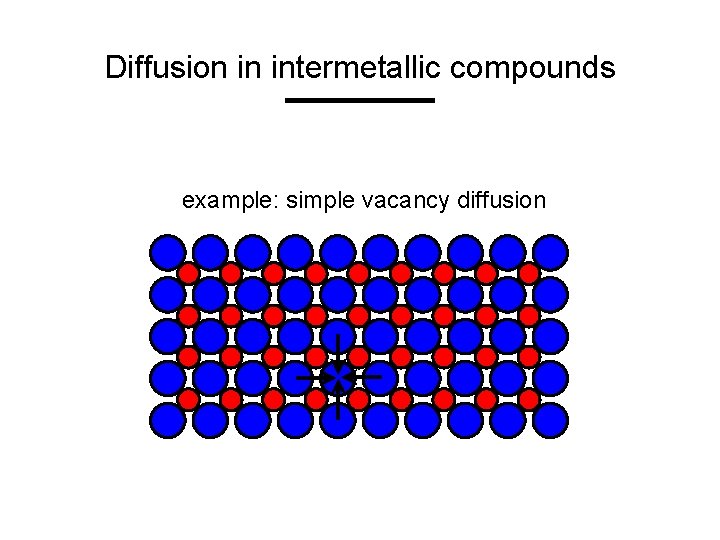
Diffusion in intermetallic compounds example: simple vacancy diffusion
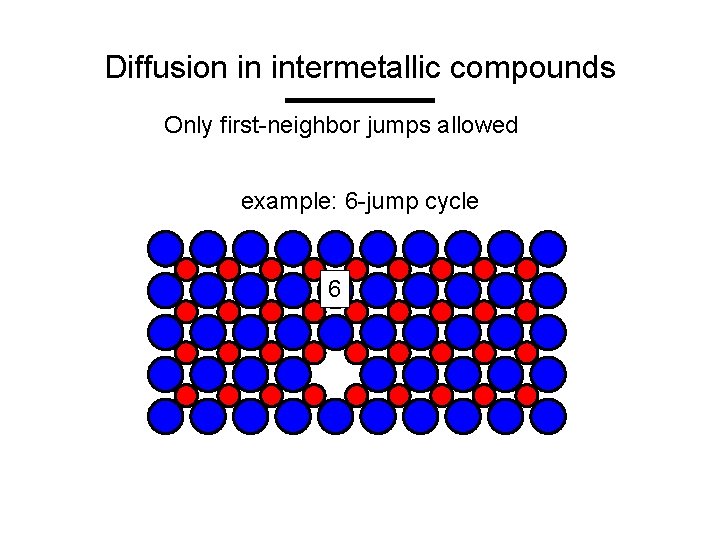
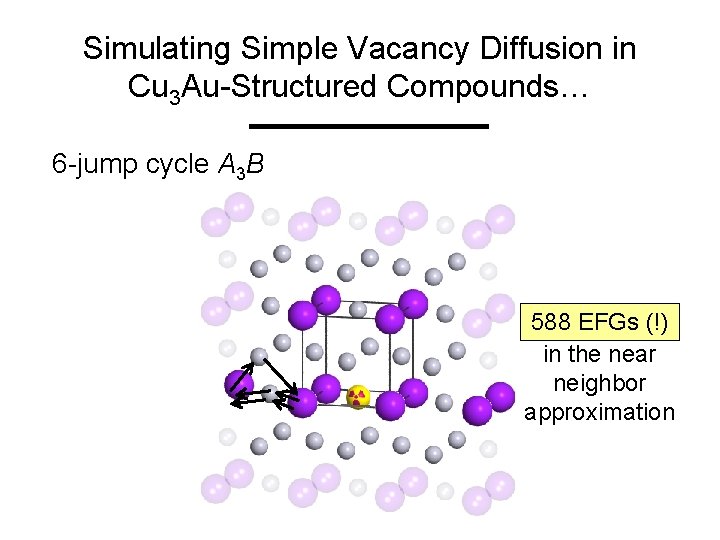
Diffusion in intermetallic compounds Only first-neighbor jumps allowed example: 6 -jump cycle 6 5 4 3 2 1
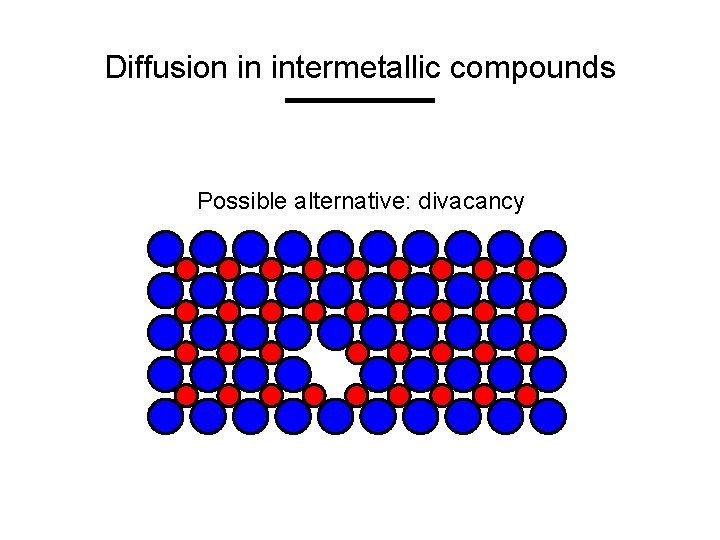
Diffusion in intermetallic compounds Possible alternative: divacancy
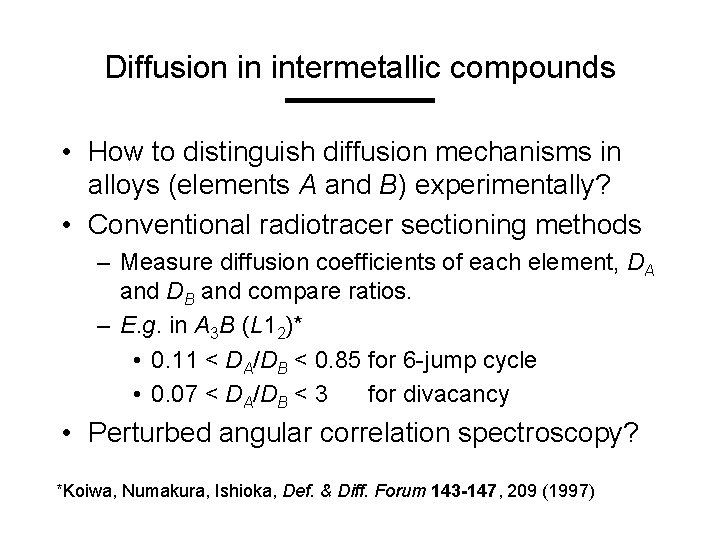
Diffusion in intermetallic compounds • How to distinguish diffusion mechanisms in alloys (elements A and B) experimentally? • Conventional radiotracer sectioning methods – Measure diffusion coefficients of each element, DA and DB and compare ratios. – E. g. in A 3 B (L 12)* • 0. 11 < DA/DB < 0. 85 for 6 -jump cycle • 0. 07 < DA/DB < 3 for divacancy • Perturbed angular correlation spectroscopy? *Koiwa, Numakura, Ishioka, Def. & Diff. Forum 143 -147, 209 (1997)
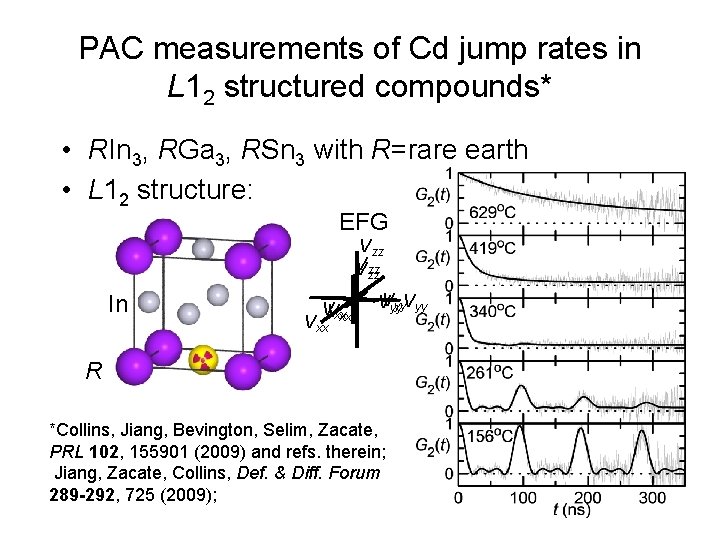
PAC measurements of Cd jump rates in L 12 structured compounds* • RIn 3, RGa 3, RSn 3 with R=rare earth • L 12 structure: EFG Vzz V Vzz zz In VVxxxx VVyyyy. Vyy R *Collins, Jiang, Bevington, Selim, Zacate, PRL 102, 155901 (2009) and refs. therein; Jiang, Zacate, Collins, Def. & Diff. Forum 289 -292, 725 (2009);
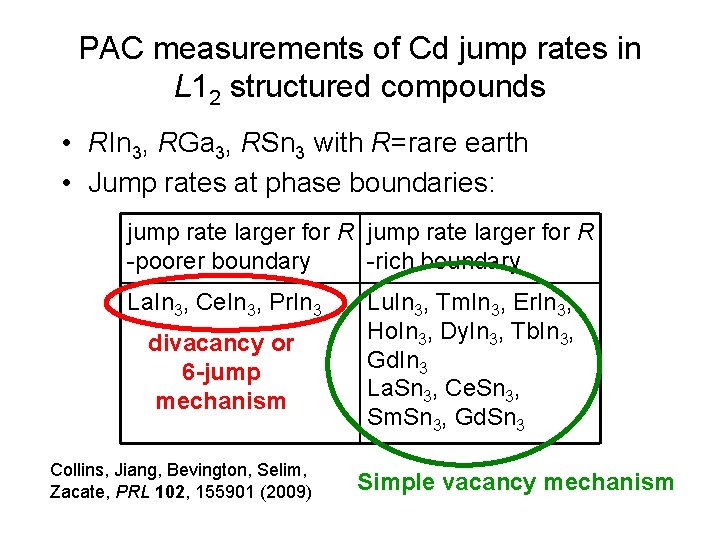
PAC measurements of Cd jump rates in L 12 structured compounds • RIn 3, RGa 3, RSn 3 with R=rare earth • Jump rates at phase boundaries: jump rate larger for R -poorer boundary -rich boundary La. In 3, Ce. In 3, Pr. In 3 divacancy or 6 -jump mechanism Collins, Jiang, Bevington, Selim, Zacate, PRL 102, 155901 (2009) Lu. In 3, Tm. In 3, Er. In 3, Ho. In 3, Dy. In 3, Tb. In 3, Gd. In 3 La. Sn 3, Ce. Sn 3, Sm. Sn 3, Gd. Sn 3 Simple vacancy mechanism
PAC measurements of Cd jump rates in L 12 structured compounds • RIn 3, RGa 3, RSn 3 with R=rare earth • Jump rates at phase boundaries indicate complex diffusion mechanism in light rare earth tri-indides • No defects observed in spectra • Is it possible to observe direct evidence? 436 different binary compounds with L 12 structure
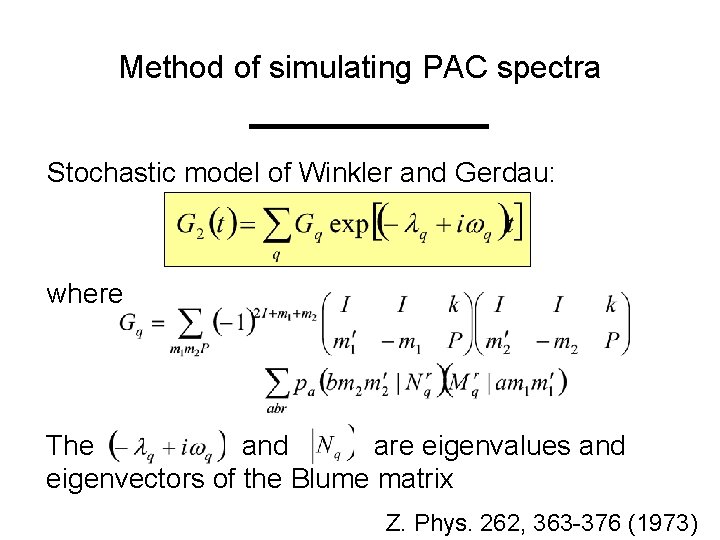
Method of simulating PAC spectra Stochastic model of Winkler and Gerdau: where The and are eigenvalues and eigenvectors of the Blume matrix Z. Phys. 262, 363 -376 (1973)
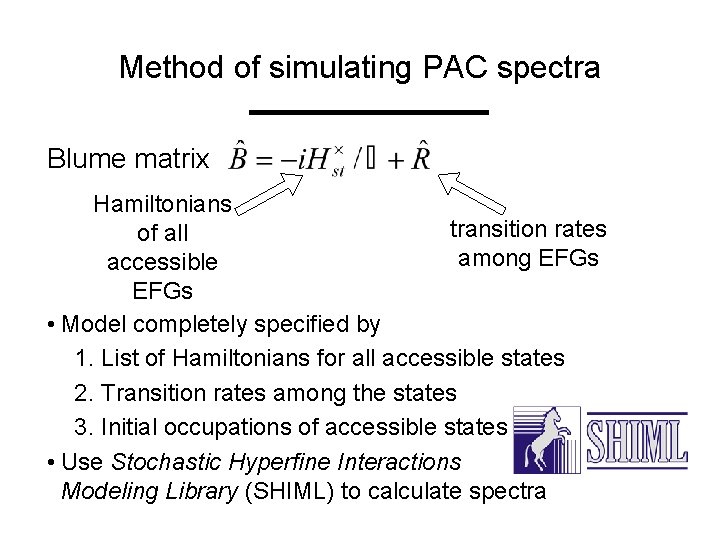
Method of simulating PAC spectra Blume matrix Hamiltonians transition rates of all among EFGs accessible EFGs • Model completely specified by 1. List of Hamiltonians for all accessible states 2. Transition rates among the states 3. Initial occupations of accessible states • Use Stochastic Hyperfine Interactions Modeling Library (SHIML) to calculate spectra
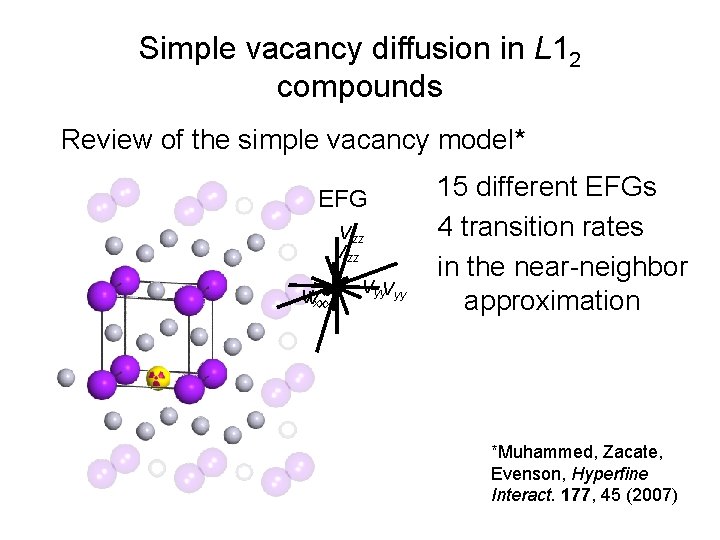
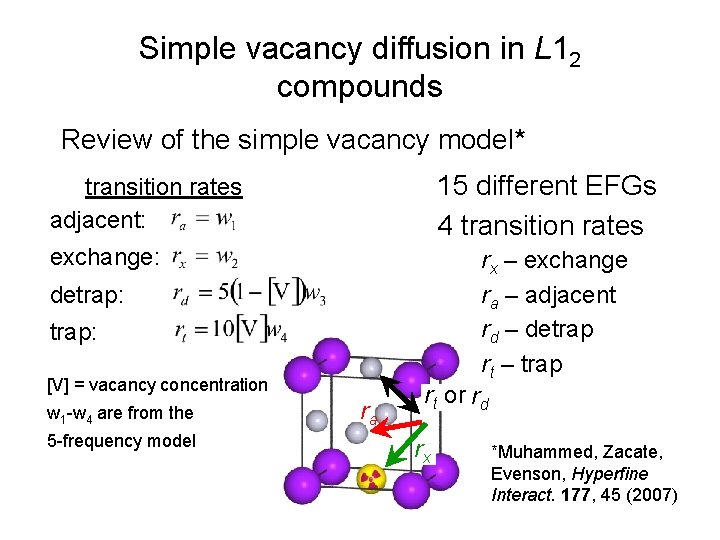
Simple vacancy diffusion in L 12 compounds Review of the simple vacancy model* EFG Vzz VVxxxx Vyy 15 different EFGs 4 transition rates in the near-neighbor approximation *Muhammed, Zacate, Evenson, Hyperfine Interact. 177, 45 (2007)
Simple vacancy diffusion in L 12 compounds Review of the simple vacancy model* 15 different EFGs 4 transition rates adjacent: exchange: rx – exchange ra – adjacent rd – detrap rt – trap detrap: [V] = vacancy concentration w 1 -w 4 are from the 5 -frequency model ra rt or rd rx *Muhammed, Zacate, Evenson, Hyperfine Interact. 177, 45 (2007)
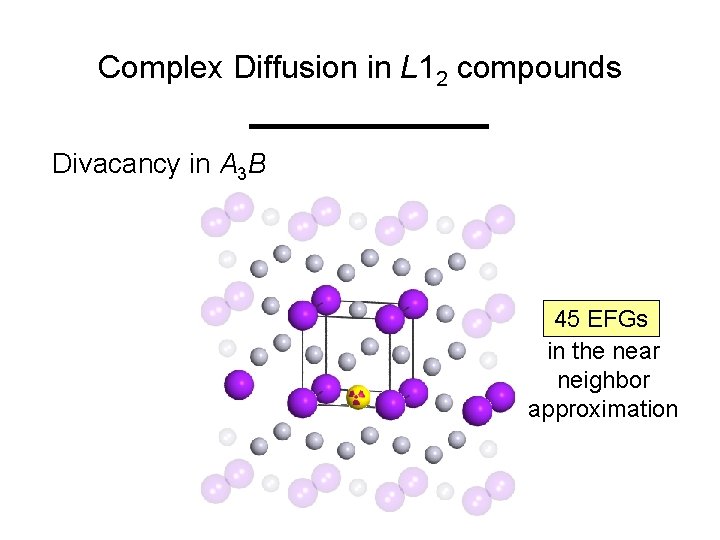
Complex Diffusion in L 12 compounds Divacancy in A 3 B 45 EFGs 6 EFGs in the near neighbor approximation
Simulating Simple Vacancy Diffusion in Cu 3 Au-Structured Compounds… 6 -jump cycle A 3 B 588 10 EFGs(!) in the near neighbor approximation
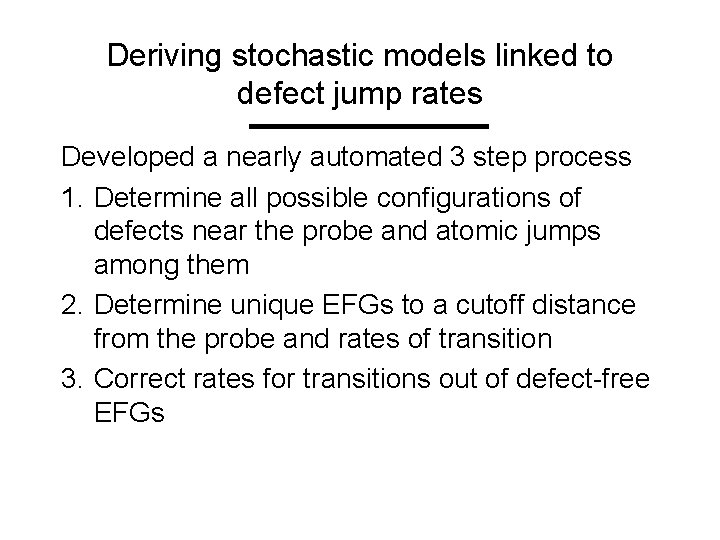
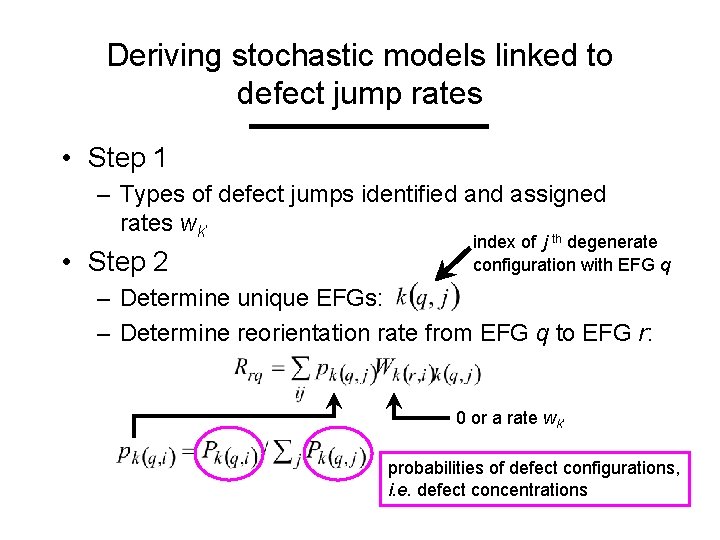
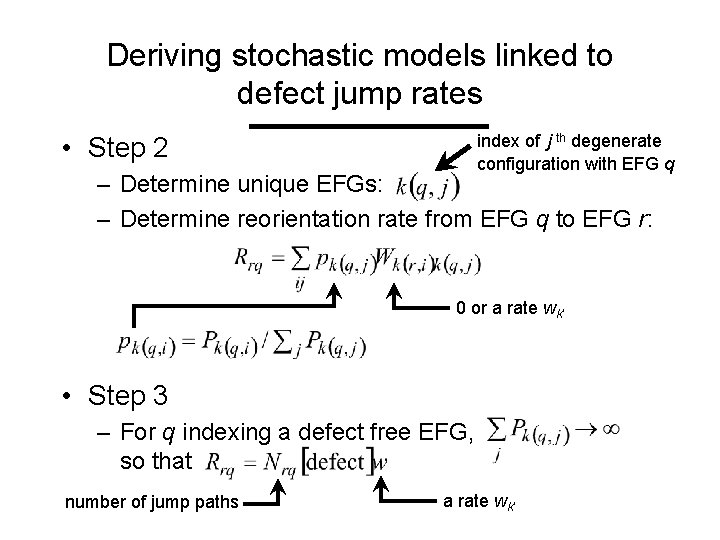
Deriving stochastic models linked to defect jump rates Developed a nearly automated 3 step process 1. Determine all possible configurations of defects near the probe and atomic jumps among them 2. Determine unique EFGs to a cutoff distance from the probe and rates of transition 3. Correct rates for transitions out of defect-free EFGs
Deriving stochastic models linked to defect jump rates • Step 1 – Types of defect jumps identified and assigned rates wk’ th • Step 2 index of j degenerate configuration with EFG q – Determine unique EFGs: – Determine reorientation rate from EFG q to EFG r: 0 or a rate wk’ probabilities of defect configurations, i. e. defect concentrations
Deriving stochastic models linked to defect jump rates index of j th degenerate configuration with EFG q • Step 2 – Determine unique EFGs: – Determine reorientation rate from EFG q to EFG r: 0 or a rate wk’ • Step 3 – For q indexing a defect free EFG, so that number of jump paths a rate wk’
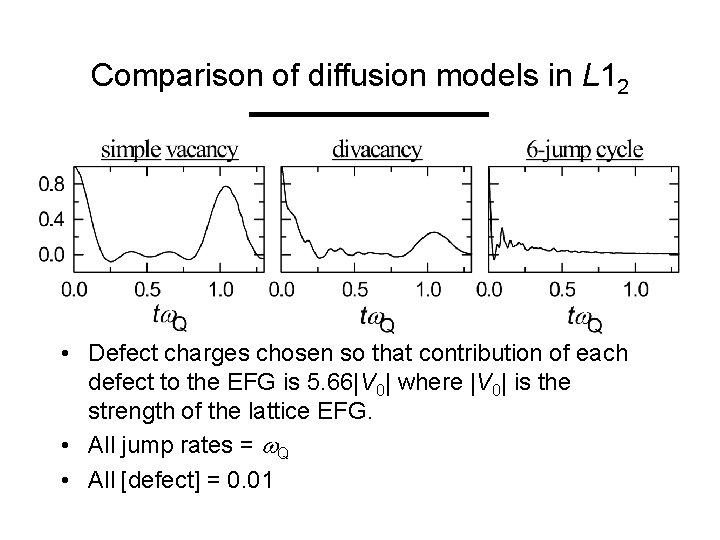
Comparison of diffusion models in L 12 • Defect charges chosen so that contribution of each defect to the EFG is 5. 66|V 0| where |V 0| is the strength of the lattice EFG. • All jump rates = w. Q • All [defect] = 0. 01
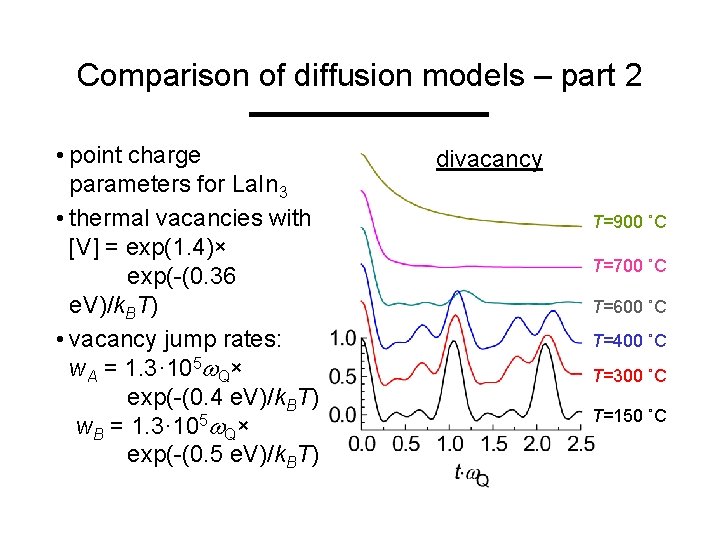
Comparison of diffusion models – part 2 • point charge parameters for La. In 3 • thermal vacancies with [V] = exp(1. 4)× exp(-(0. 36 e. V)/k. BT) • vacancy jump rates: w. A = 1. 3· 105 w. Q× exp(-(0. 4 e. V)/k. BT) w. B = 1. 3· 105 w. Q× exp(-(0. 5 e. V)/k. BT) divacancy T=900 ˚C T=700 ˚C T=600 ˚C T=400 ˚C T=300 ˚C T=150 ˚C
Comparison of diffusion models – part 2 simple vacancy divacancy with ([V]=0. 04) T=900 ˚C T=700 ˚C T=600 ˚C T=400 ˚C T=300 ˚C T=150 ˚C
Comparison of diffusion models – part 2 simple vacancy divacancy with ([V]=0. 04) T=900 ˚C T=700 ˚C T=600 ˚C T=400 ˚C T=300 ˚C T=150 ˚C
Summary: Modeling Complex Diffusion Mechanisms… 1. Developed a 3 step process to develop a stochastic model of fluctuating hyperfine interactions for diffusion mechanisms – applicable to any structure 2. Demonstrated that simulations of PAC spectra for simple vacancy, divacancy, and 6 -jump cycle diffusion mechanisms can look different 3. Showed for a physically reasonable set of parameters that one can obtain a signal due to defects in the divacancy mechanism Work continues to determine conditions under which one can unambiguously identify diffusion mechanisms