
Modeling and UML UML Unified Modeling Language Graphical
- Slides: 59
Modeling and UML ¨ ¨ ¨ UML = Unified Modeling Language Graphical Notation Topics w Modeling w Basics of UML w Deeper view of UML COP 3331 Object-Oriented Analysis and Design 1
What is modeling? ¨ ¨ Modeling consists of building an abstraction of reality. Abstractions are simplifications because: w They ignore irrelevant details and w They only represent the relevant details. ¨ What is relevant or irrelevant depends on the purpose of the model. COP 3331 Object-Oriented Analysis and Design 2
Why model software? ¨ Software is getting increasingly more complex w Windows XP > 40 million lines of code w A single programmer cannot manage this amount of code in its entirety. ¨ ¨ Code is not easily understandable by developers who did not write it We need simpler representations for complex systems w Modeling is a mean for dealing with complexity COP 3331 Object-Oriented Analysis and Design 3
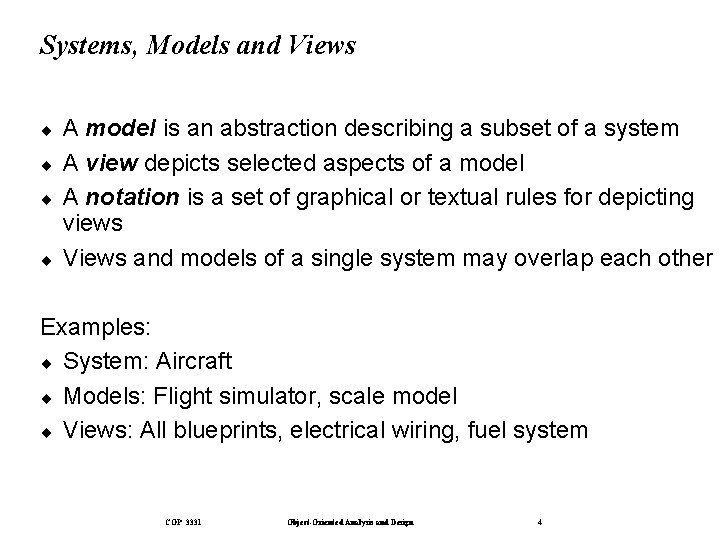
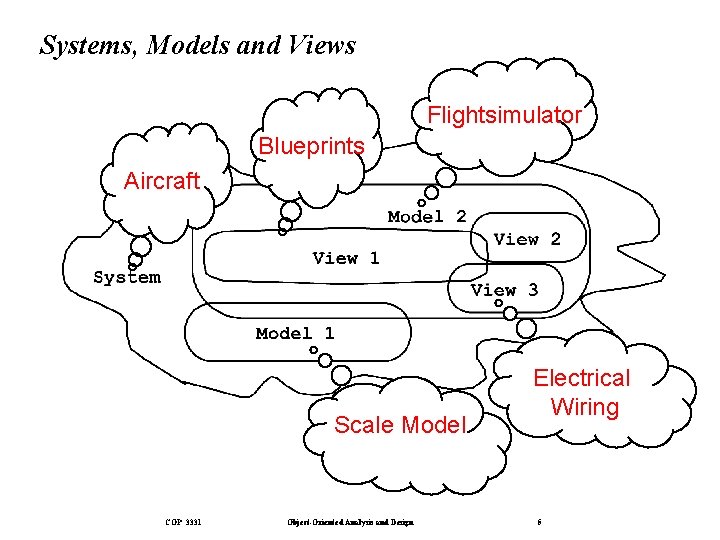
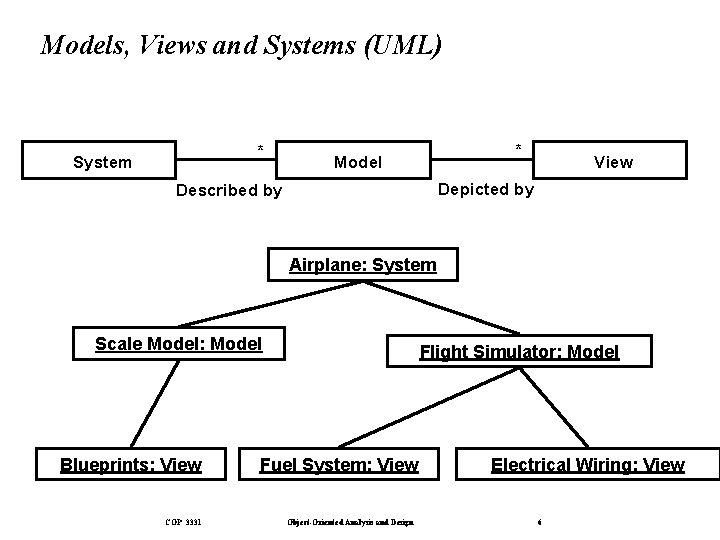
Systems, Models and Views ¨ ¨ A model is an abstraction describing a subset of a system A view depicts selected aspects of a model A notation is a set of graphical or textual rules for depicting views Views and models of a single system may overlap each other Examples: ¨ System: Aircraft ¨ Models: Flight simulator, scale model ¨ Views: All blueprints, electrical wiring, fuel system COP 3331 Object-Oriented Analysis and Design 4
Systems, Models and Views Flightsimulator Blueprints Aircraft Scale Model COP 3331 Object-Oriented Analysis and Design Electrical Wiring 5
Models, Views and Systems (UML) * System * Model View Depicted by Described by Airplane: System Scale Model: Model Blueprints: View COP 3331 Flight Simulator: Model Fuel System: View Object-Oriented Analysis and Design Electrical Wiring: View 6
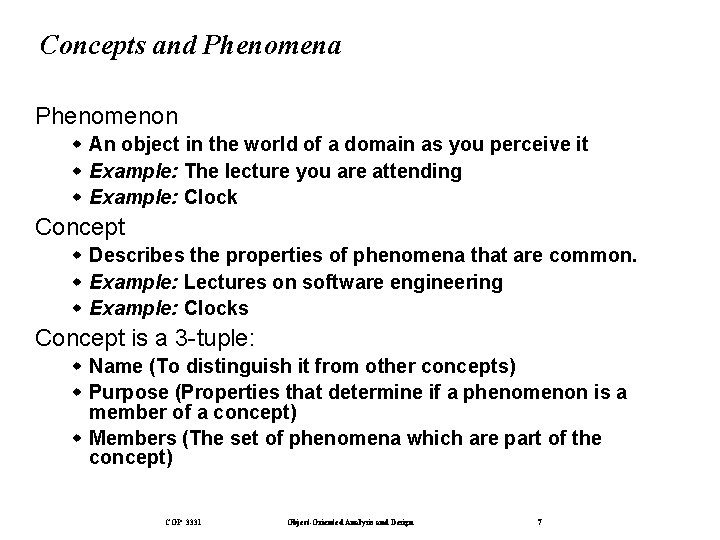
Concepts and Phenomena Phenomenon w An object in the world of a domain as you perceive it w Example: The lecture you are attending w Example: Clock Concept w Describes the properties of phenomena that are common. w Example: Lectures on software engineering w Example: Clocks Concept is a 3 -tuple: w Name (To distinguish it from other concepts) w Purpose (Properties that determine if a phenomenon is a member of a concept) w Members (The set of phenomena which are part of the concept) COP 3331 Object-Oriented Analysis and Design 7
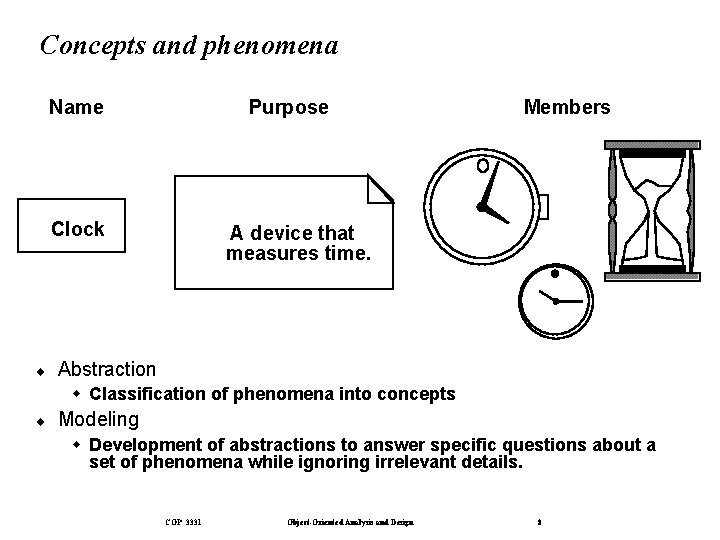
Concepts and phenomena Name Purpose Clock ¨ Members A device that measures time. Abstraction w Classification of phenomena into concepts ¨ Modeling w Development of abstractions to answer specific questions about a set of phenomena while ignoring irrelevant details. COP 3331 Object-Oriented Analysis and Design 8
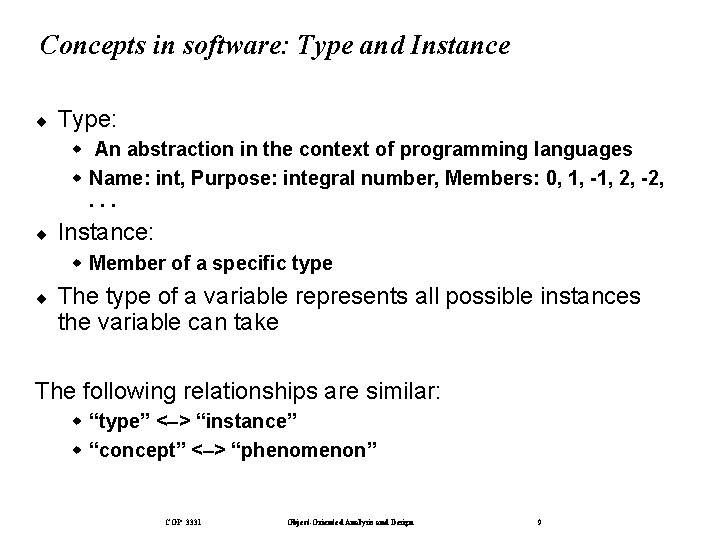
Concepts in software: Type and Instance ¨ Type: w An abstraction in the context of programming languages w Name: int, Purpose: integral number, Members: 0, 1, -1, 2, -2, . . . ¨ Instance: w Member of a specific type ¨ The type of a variable represents all possible instances the variable can take The following relationships are similar: w “type” <–> “instance” w “concept” <–> “phenomenon” COP 3331 Object-Oriented Analysis and Design 9
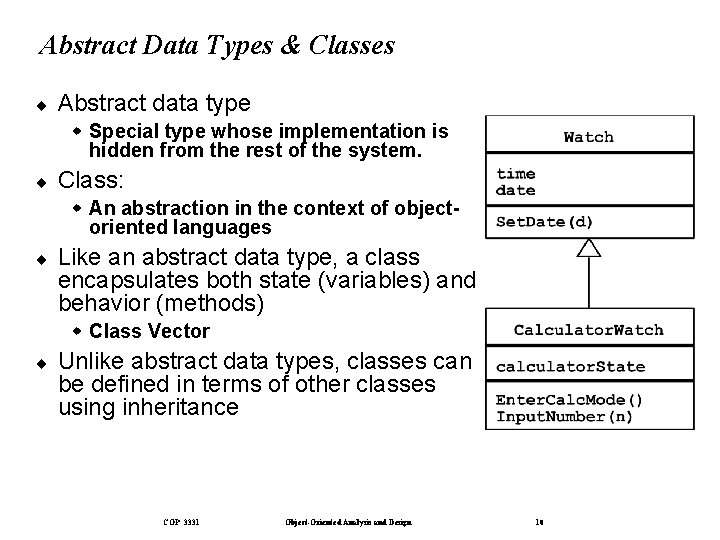
Abstract Data Types & Classes ¨ Abstract data type w Special type whose implementation is hidden from the rest of the system. ¨ Class: w An abstraction in the context of objectoriented languages ¨ Like an abstract data type, a class encapsulates both state (variables) and behavior (methods) w Class Vector ¨ Unlike abstract data types, classes can be defined in terms of other classes using inheritance COP 3331 Object-Oriented Analysis and Design 10
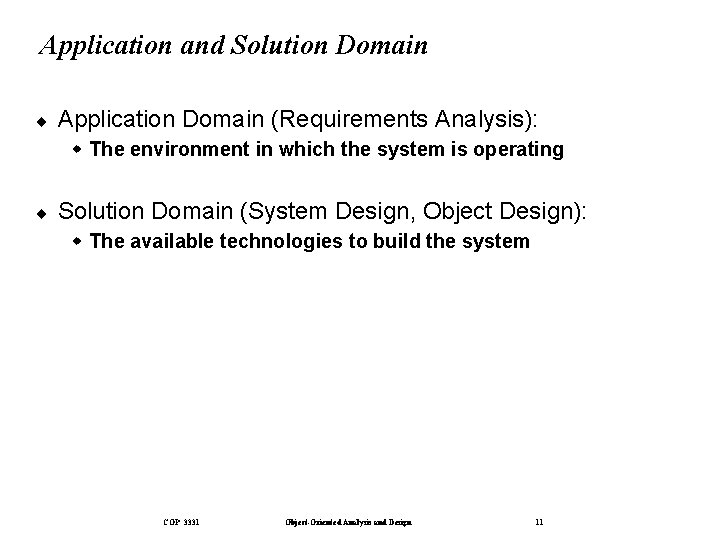
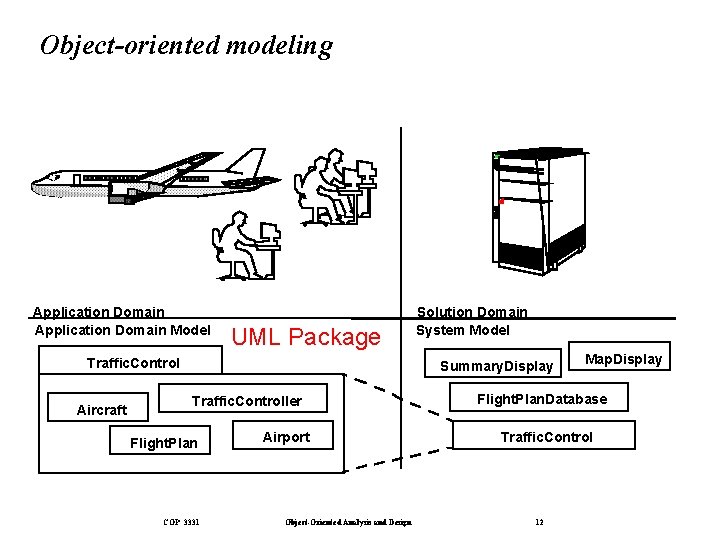
Application and Solution Domain ¨ Application Domain (Requirements Analysis): w The environment in which the system is operating ¨ Solution Domain (System Design, Object Design): w The available technologies to build the system COP 3331 Object-Oriented Analysis and Design 11
Object-oriented modeling Application Domain Model UML Package Traffic. Control Aircraft Solution Domain System Model Summary. Display Traffic. Controller Flight. Plan COP 3331 Airport Object-Oriented Analysis and Design Map. Display Flight. Plan. Database Traffic. Control 12
What is UML? ¨ UML (Unified Modeling Language) w An emerging standard for modeling object-oriented software. w Resulted from the convergence of notations from three leading object-oriented methods: t t t ¨ ¨ OMT (James Rumbaugh) OOSE (Ivar Jacobson) Booch (Grady Booch) Reference: “The Unified Modeling Language User Guide”, Addison Wesley, 1999. Supported by several CASE tools w Rational ROSE w Together. J COP 3331 Object-Oriented Analysis and Design 13
UML: First Pass ¨ ¨ You can model 80% of most problems by using about 20 % UML This 20% discussed here COP 3331 Object-Oriented Analysis and Design 14
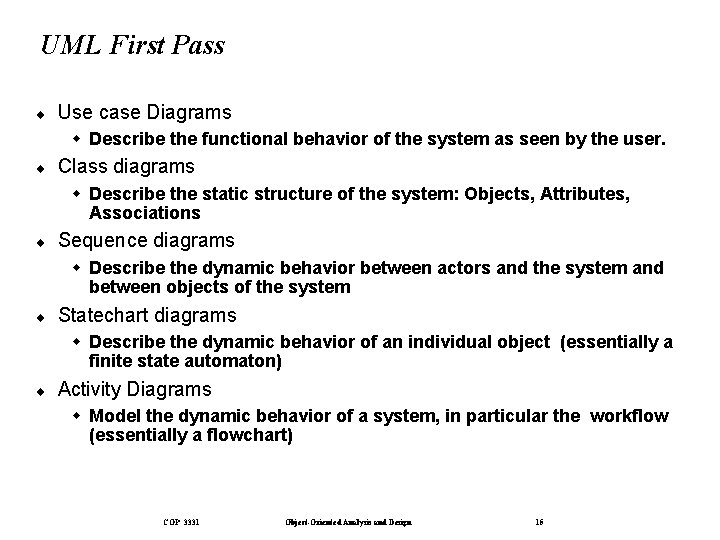
UML First Pass ¨ Use case Diagrams w Describe the functional behavior of the system as seen by the user. ¨ Class diagrams w Describe the static structure of the system: Objects, Attributes, Associations ¨ Sequence diagrams w Describe the dynamic behavior between actors and the system and between objects of the system ¨ Statechart diagrams w Describe the dynamic behavior of an individual object (essentially a finite state automaton) ¨ Activity Diagrams w Model the dynamic behavior of a system, in particular the workflow (essentially a flowchart) COP 3331 Object-Oriented Analysis and Design 15
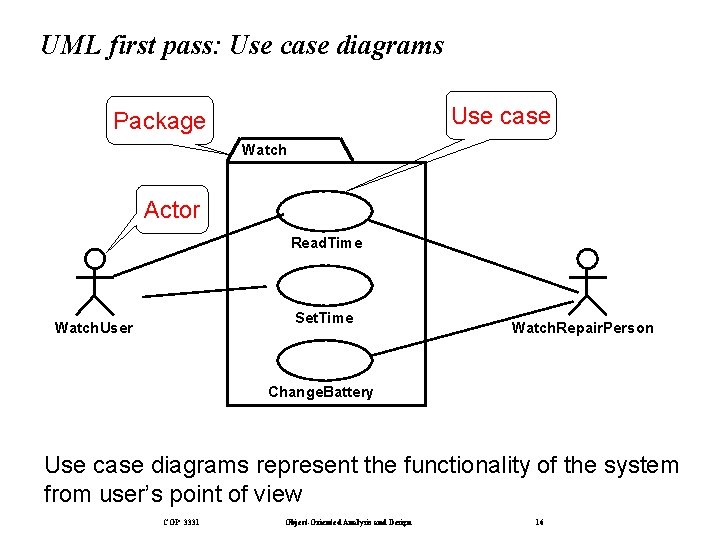
UML first pass: Use case diagrams Use case Package Watch Actor Read. Time Set. Time Watch. User Watch. Repair. Person Change. Battery Use case diagrams represent the functionality of the system from user’s point of view COP 3331 Object-Oriented Analysis and Design 16
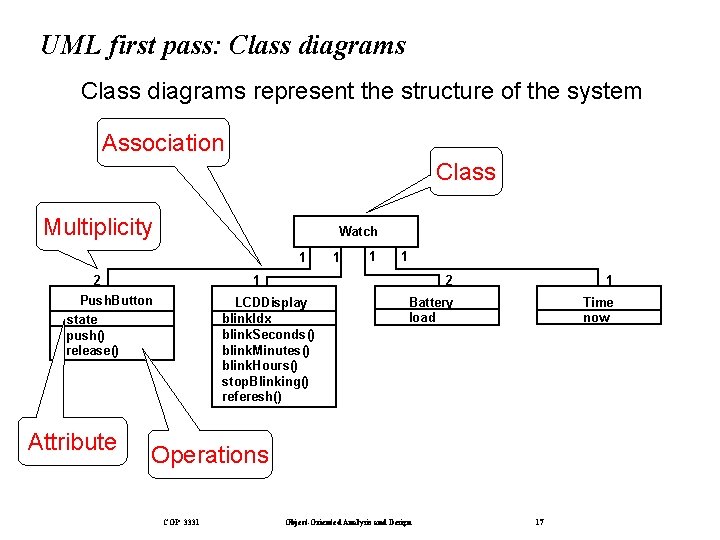
UML first pass: Class diagrams represent the structure of the system Association Class Multiplicity Watch 1 2 Push. Button state push() release() Attribute 1 1 1 2 1 Battery load Time now 1 LCDDisplay blink. Idx blink. Seconds() blink. Minutes() blink. Hours() stop. Blinking() referesh() Operations COP 3331 Object-Oriented Analysis and Design 17
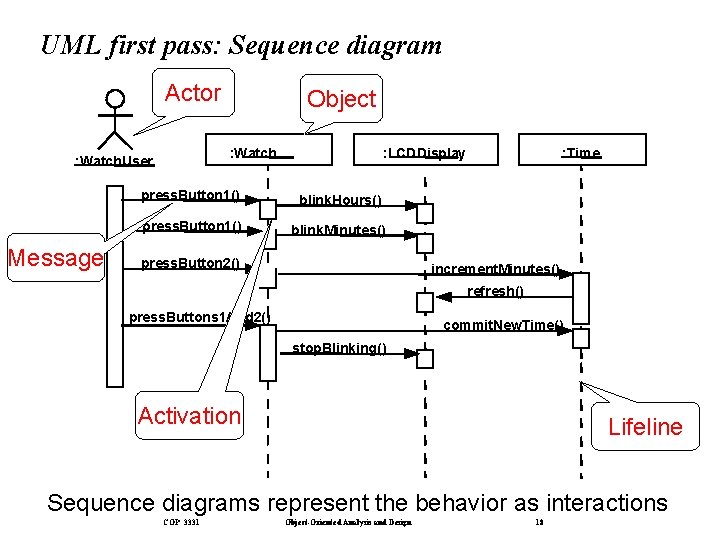
UML first pass: Sequence diagram Actor : Watch. User Message Object : LCDDisplay press. Button 1() blink. Hours() press. Button 1() blink. Minutes() press. Button 2() : Time increment. Minutes() refresh() press. Buttons 1 And 2() commit. New. Time() stop. Blinking() Activation Lifeline Sequence diagrams represent the behavior as interactions COP 3331 Object-Oriented Analysis and Design 18
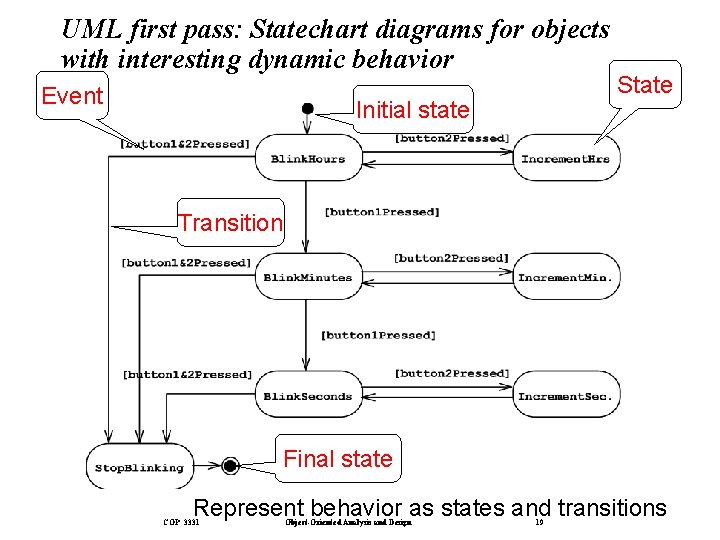
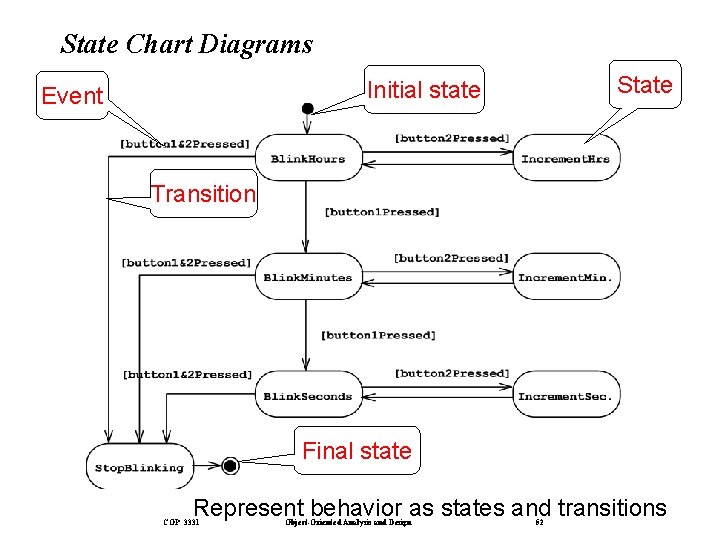
UML first pass: Statechart diagrams for objects with interesting dynamic behavior Event Initial state State Transition Final state Represent behavior as states and transitions COP 3331 Object-Oriented Analysis and Design 19
Other UML Notations Other UML concepts and notations will be introduced later, as needed. ¨ Implementation diagrams (System Design) w Component diagrams w Deployment diagrams ¨ Object constraint language (Object Design) COP 3331 Object-Oriented Analysis and Design 20
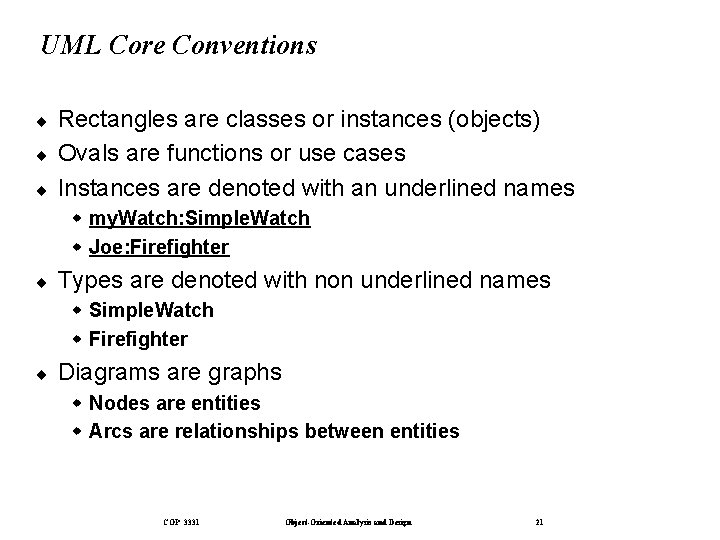
UML Core Conventions ¨ ¨ ¨ Rectangles are classes or instances (objects) Ovals are functions or use cases Instances are denoted with an underlined names w my. Watch: Simple. Watch w Joe: Firefighter ¨ Types are denoted with non underlined names w Simple. Watch w Firefighter ¨ Diagrams are graphs w Nodes are entities w Arcs are relationships between entities COP 3331 Object-Oriented Analysis and Design 21
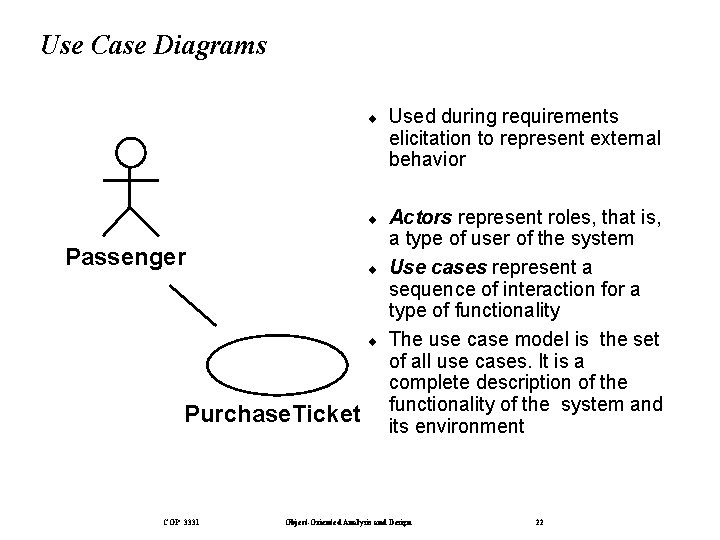
Use Case Diagrams Passenger ¨ Used during requirements elicitation to represent external behavior ¨ Actors represent roles, that is, a type of user of the system Use cases represent a sequence of interaction for a type of functionality The use case model is the set of all use cases. It is a complete description of the functionality of the system and its environment ¨ ¨ Purchase. Ticket COP 3331 Object-Oriented Analysis and Design 22
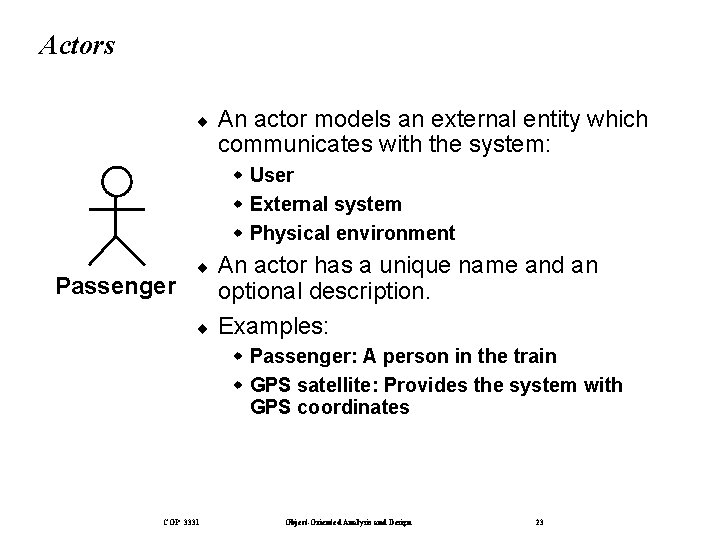
Actors ¨ An actor models an external entity which communicates with the system: w User w External system w Physical environment Passenger ¨ ¨ An actor has a unique name and an optional description. Examples: w Passenger: A person in the train w GPS satellite: Provides the system with GPS coordinates COP 3331 Object-Oriented Analysis and Design 23
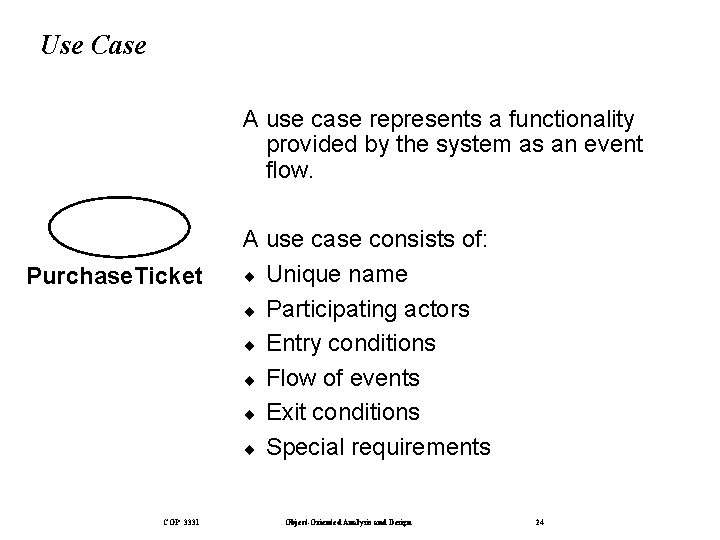
Use Case A use case represents a functionality provided by the system as an event flow. Purchase. Ticket COP 3331 A use case consists of: ¨ Unique name ¨ Participating actors ¨ Entry conditions ¨ Flow of events ¨ Exit conditions ¨ Special requirements Object-Oriented Analysis and Design 24
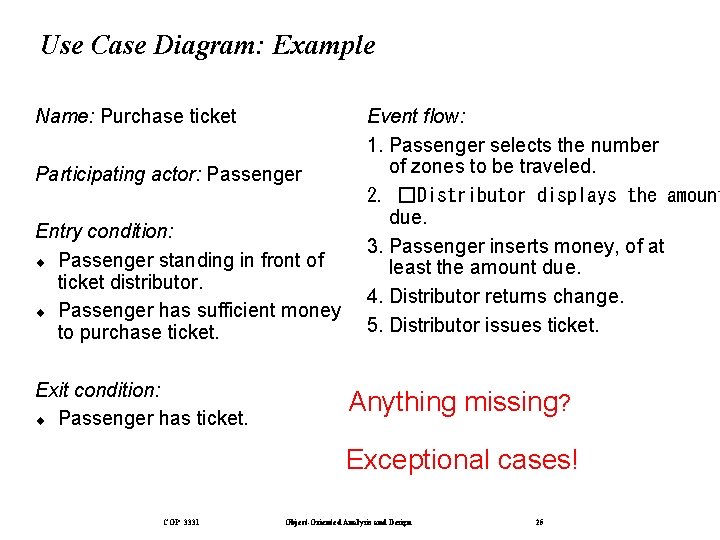
Use Case Diagram: Example Name: Purchase ticket Participating actor: Passenger Entry condition: ¨ Passenger standing in front of ticket distributor. ¨ Passenger has sufficient money to purchase ticket. Exit condition: ¨ Passenger has ticket. Event flow: 1. Passenger selects the number of zones to be traveled. 2. �Distributor displays the amount due. 3. Passenger inserts money, of at least the amount due. 4. Distributor returns change. 5. Distributor issues ticket. Anything missing? Exceptional cases! COP 3331 Object-Oriented Analysis and Design 25
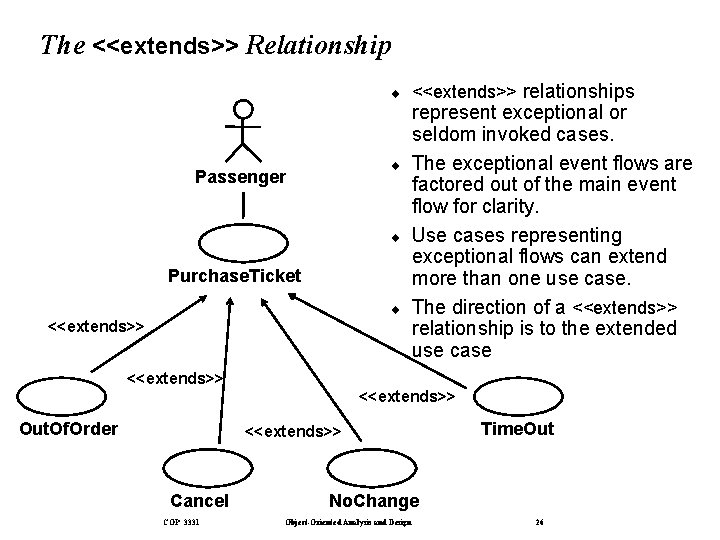
The <<extends>> Relationship ¨ ¨ Passenger ¨ Purchase. Ticket ¨ <<extends>> relationships represent exceptional or seldom invoked cases. The exceptional event flows are factored out of the main event flow for clarity. Use cases representing exceptional flows can extend more than one use case. The direction of a <<extends>> relationship is to the extended use case <<extends>> Out. Of. Order <<extends>> Cancel COP 3331 Time. Out No. Change Object-Oriented Analysis and Design 26
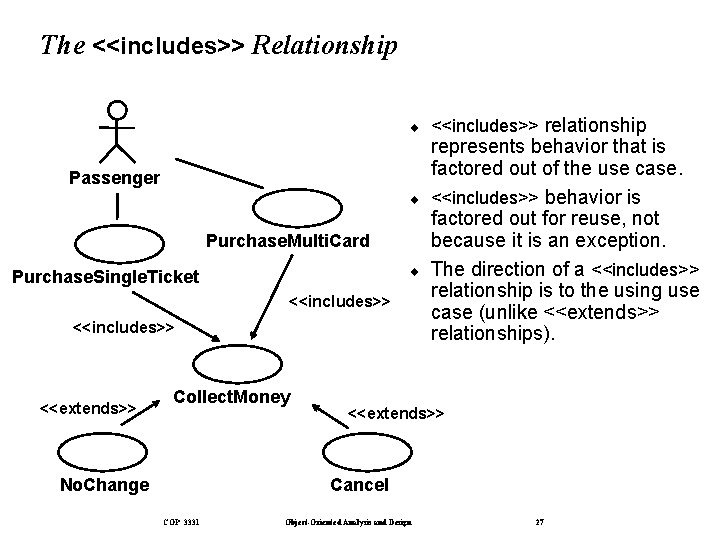
The <<includes>> Relationship ¨ Passenger ¨ Purchase. Multi. Card ¨ Purchase. Single. Ticket <<includes>> <<extends>> Collect. Money <<includes>> relationship represents behavior that is factored out of the use case. <<includes>> behavior is factored out for reuse, not because it is an exception. The direction of a <<includes>> relationship is to the using use case (unlike <<extends>> relationships). <<extends>> Cancel No. Change COP 3331 Object-Oriented Analysis and Design 27
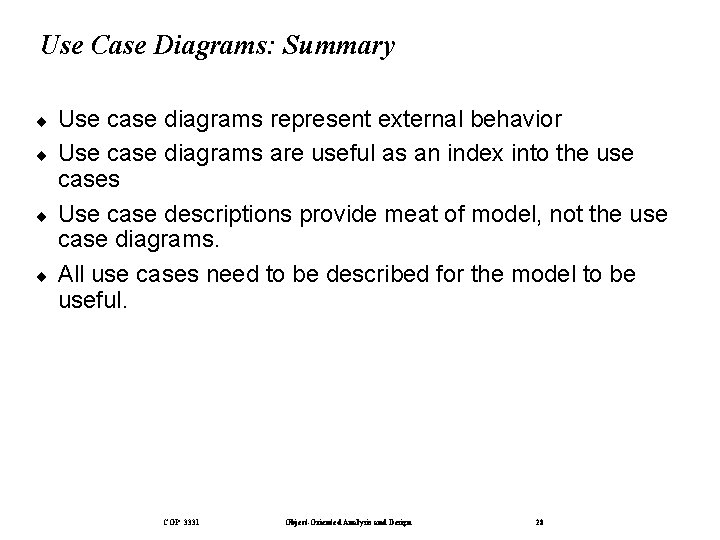
Use Case Diagrams: Summary ¨ ¨ Use case diagrams represent external behavior Use case diagrams are useful as an index into the use cases Use case descriptions provide meat of model, not the use case diagrams. All use cases need to be described for the model to be useful. COP 3331 Object-Oriented Analysis and Design 28
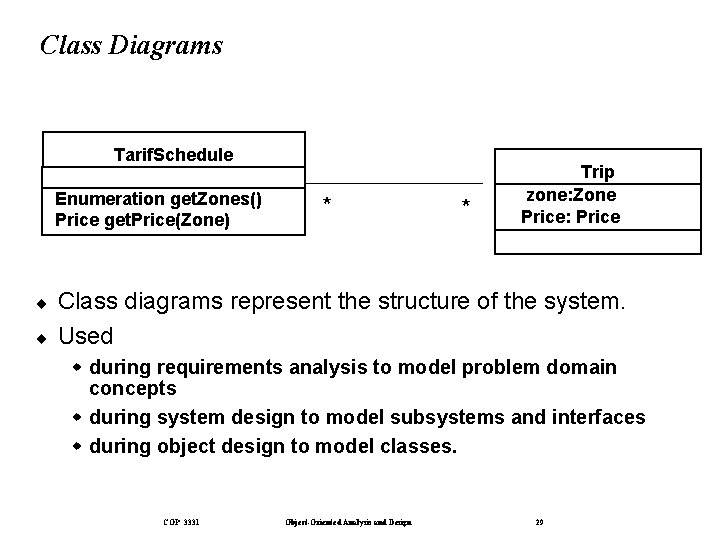
Class Diagrams Tarif. Schedule Enumeration get. Zones() Price get. Price(Zone) ¨ ¨ * * Trip zone: Zone Price: Price Class diagrams represent the structure of the system. Used w during requirements analysis to model problem domain concepts w during system design to model subsystems and interfaces w during object design to model classes. COP 3331 Object-Oriented Analysis and Design 29
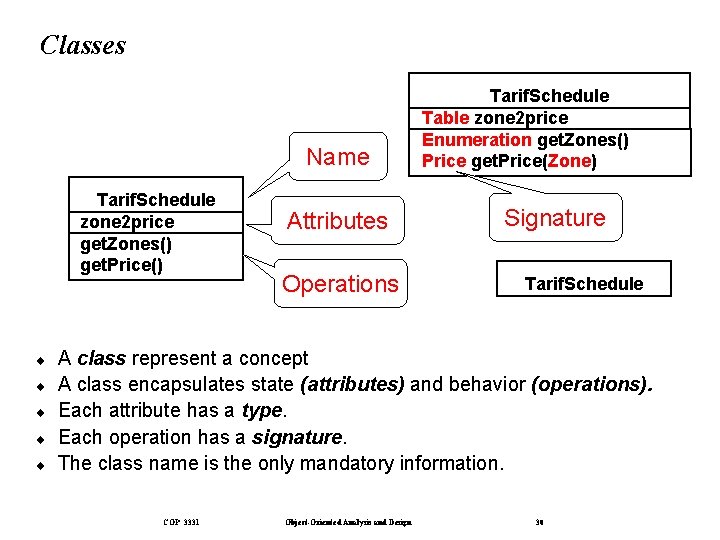
Classes Name Tarif. Schedule zone 2 price get. Zones() get. Price() ¨ ¨ ¨ Attributes Operations Tarif. Schedule Table zone 2 price Enumeration get. Zones() Price get. Price(Zone) Signature Tarif. Schedule A class represent a concept A class encapsulates state (attributes) and behavior (operations). Each attribute has a type. Each operation has a signature. The class name is the only mandatory information. COP 3331 Object-Oriented Analysis and Design 30
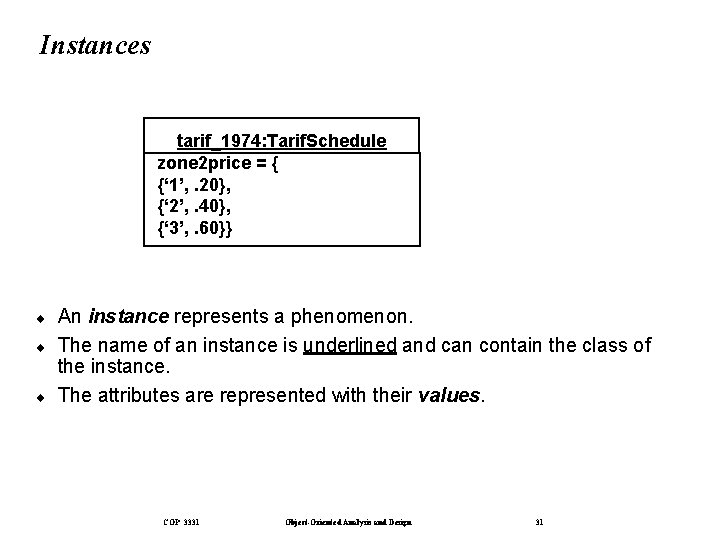
Instances tarif_1974: Tarif. Schedule zone 2 price = { {‘ 1’, . 20}, {‘ 2’, . 40}, {‘ 3’, . 60}} ¨ ¨ ¨ An instance represents a phenomenon. The name of an instance is underlined and can contain the class of the instance. The attributes are represented with their values. COP 3331 Object-Oriented Analysis and Design 31
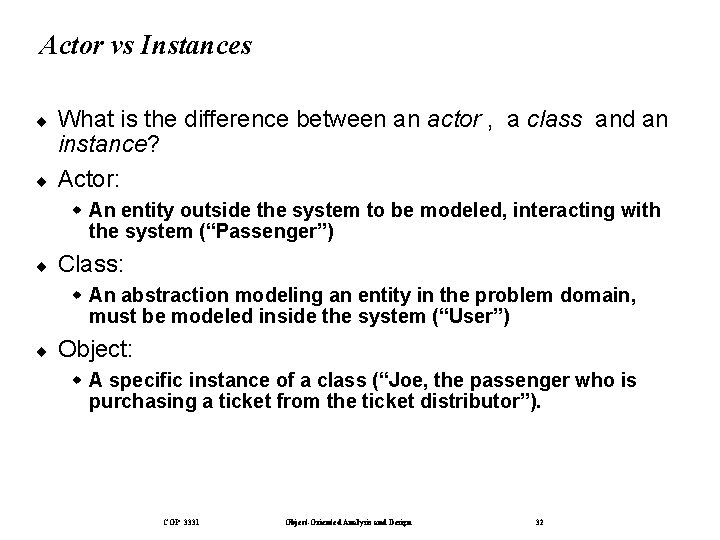
Actor vs Instances ¨ ¨ What is the difference between an actor , a class and an instance? Actor: w An entity outside the system to be modeled, interacting with the system (“Passenger”) ¨ Class: w An abstraction modeling an entity in the problem domain, must be modeled inside the system (“User”) ¨ Object: w A specific instance of a class (“Joe, the passenger who is purchasing a ticket from the ticket distributor”). COP 3331 Object-Oriented Analysis and Design 32
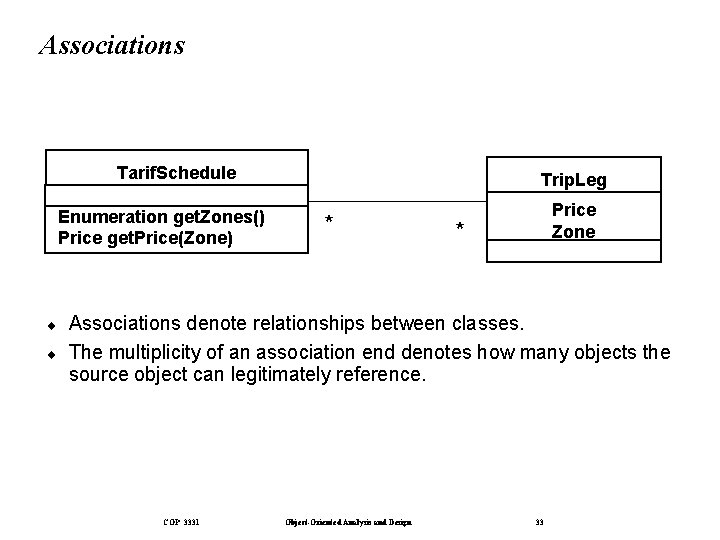
Associations Tarif. Schedule Enumeration get. Zones() Price get. Price(Zone) ¨ ¨ Trip. Leg * Price Zone * Associations denote relationships between classes. The multiplicity of an association end denotes how many objects the source object can legitimately reference. COP 3331 Object-Oriented Analysis and Design 33
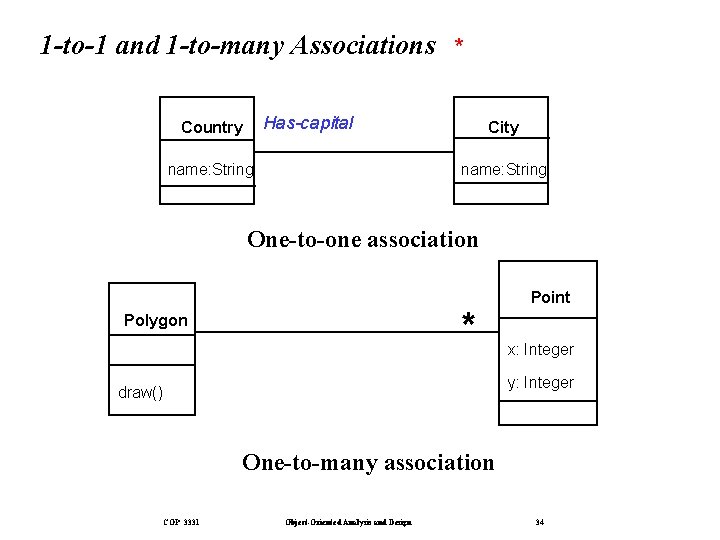
1 -to-1 and 1 -to-many Associations * Has-capital Country name: String City name: String One-to-one association * Polygon Point x: Integer y: Integer draw() One-to-many association COP 3331 Object-Oriented Analysis and Design 34
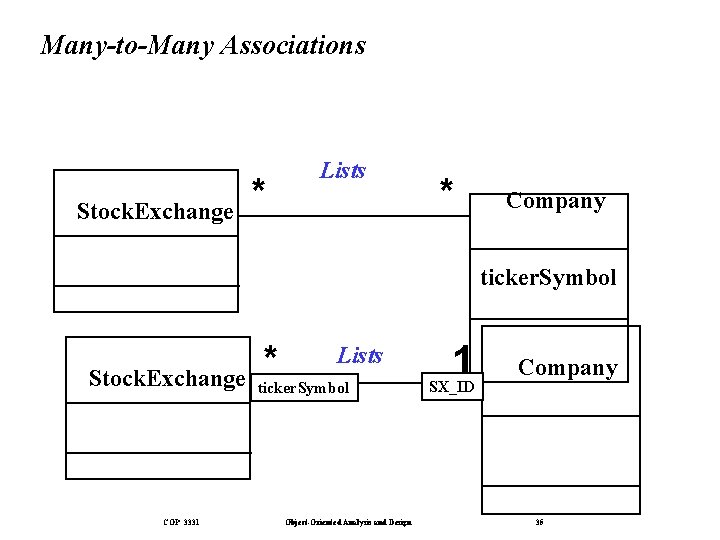
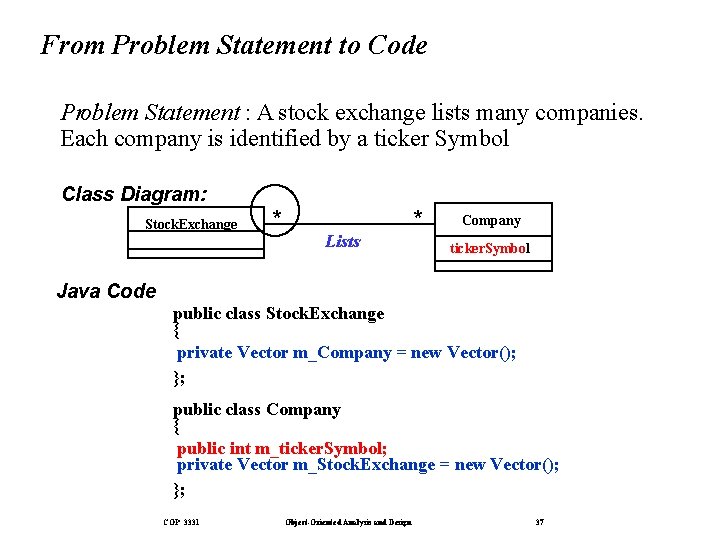
Many-to-Many Associations Stock. Exchange * Lists * Company ticker. Symbol Stock. Exchange COP 3331 * Lists ticker. Symbol Object-Oriented Analysis and Design 1 SX_ID Company 35
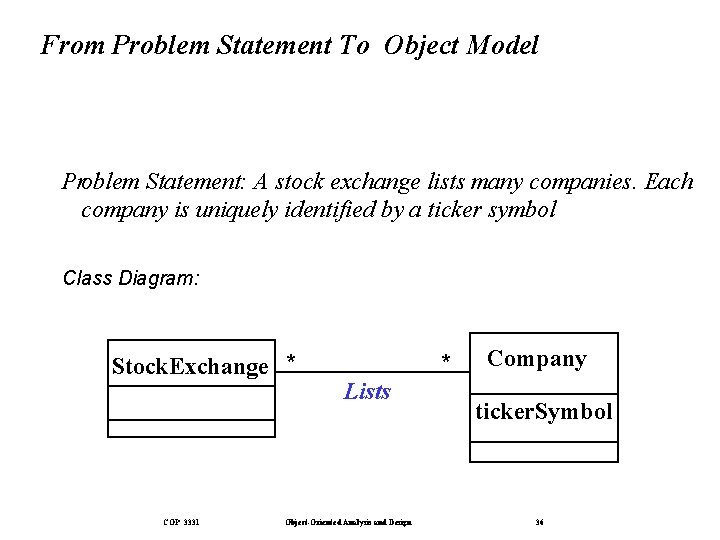
From Problem Statement To Object Model Problem Statement: A stock exchange lists many companies. Each company is uniquely identified by a ticker symbol Class Diagram: Stock. Exchange * COP 3331 * Lists Object-Oriented Analysis and Design Company ticker. Symbol 36
From Problem Statement to Code Problem Statement : A stock exchange lists many companies. Each company is identified by a ticker Symbol Class Diagram: Stock. Exchange * Lists * Company ticker. Symbol Java Code public class Stock. Exchange { private Vector m_Company = new Vector(); }; public class Company { public int m_ticker. Symbol; private Vector m_Stock. Exchange = new Vector(); }; COP 3331 Object-Oriented Analysis and Design 37
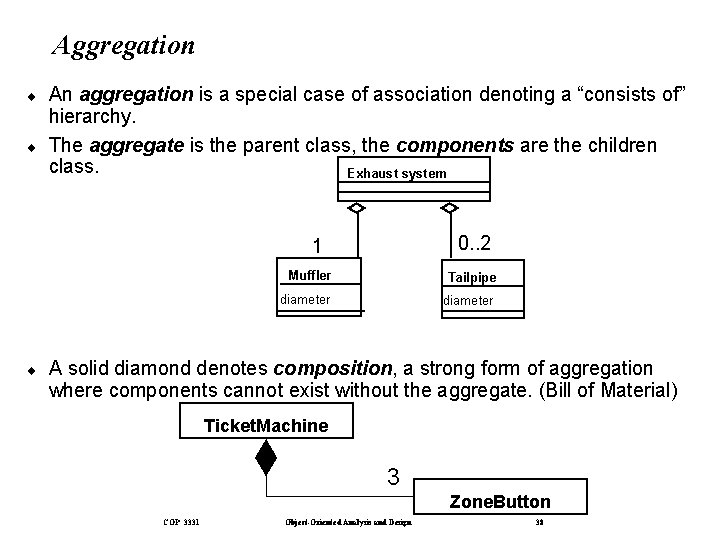
Aggregation ¨ ¨ An aggregation is a special case of association denoting a “consists of” hierarchy. The aggregate is the parent class, the components are the children class. Exhaust system 0. . 2 1 ¨ Muffler Tailpipe diameter A solid diamond denotes composition, a strong form of aggregation where components cannot exist without the aggregate. (Bill of Material) Ticket. Machine 3 Zone. Button COP 3331 Object-Oriented Analysis and Design 38
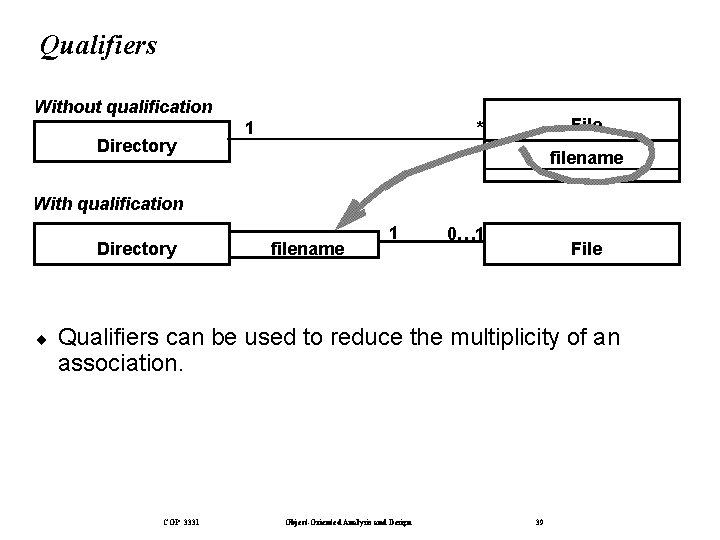
Qualifiers Without qualification Directory 1 File * filename With qualification Directory ¨ filename 1 0… 1 File Qualifiers can be used to reduce the multiplicity of an association. COP 3331 Object-Oriented Analysis and Design 39
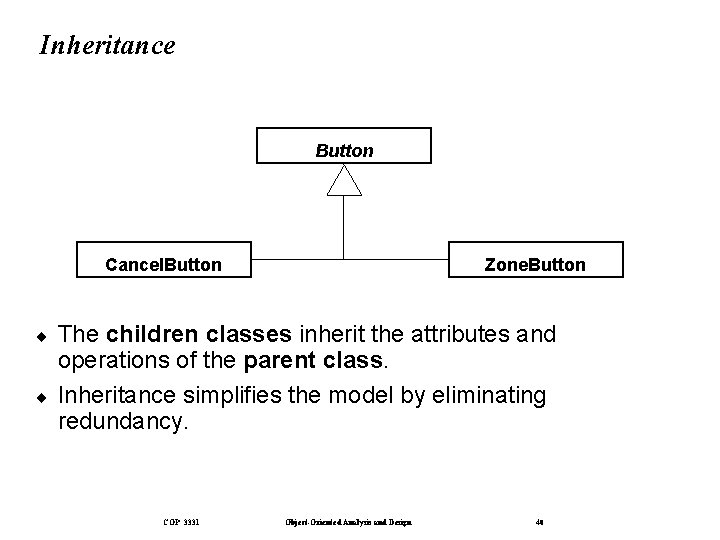
Inheritance Button Cancel. Button ¨ ¨ Zone. Button The children classes inherit the attributes and operations of the parent class. Inheritance simplifies the model by eliminating redundancy. COP 3331 Object-Oriented Analysis and Design 40
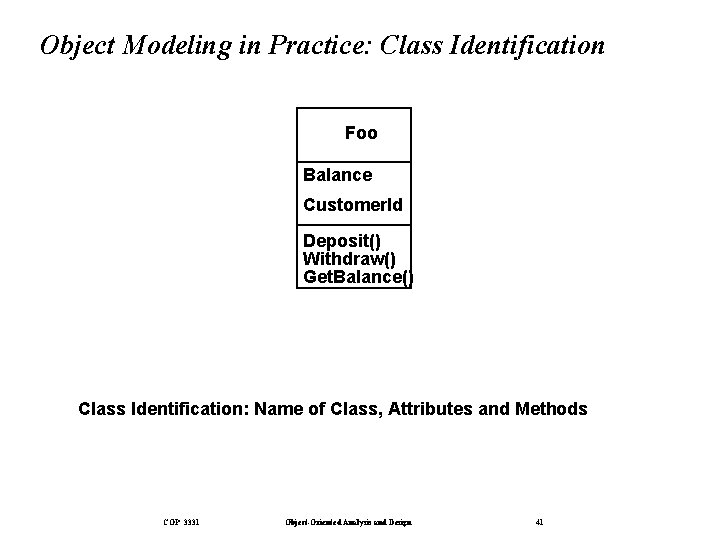
Object Modeling in Practice: Class Identification Foo Balance Customer. Id Deposit() Withdraw() Get. Balance() Class Identification: Name of Class, Attributes and Methods COP 3331 Object-Oriented Analysis and Design 41
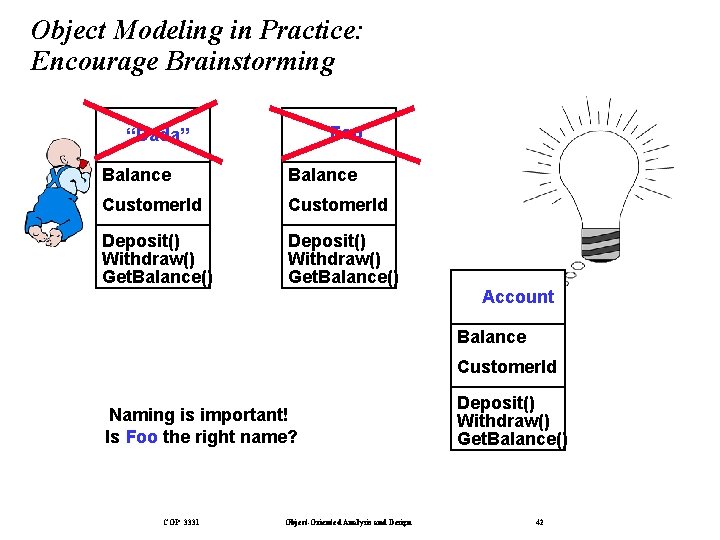
Object Modeling in Practice: Encourage Brainstorming Foo “Dada” Balance Customer. Id Deposit() Withdraw() Get. Balance() Account Balance Customer. Id Naming is important! Is Foo the right name? COP 3331 Object-Oriented Analysis and Design Deposit() Withdraw() Get. Balance() 42
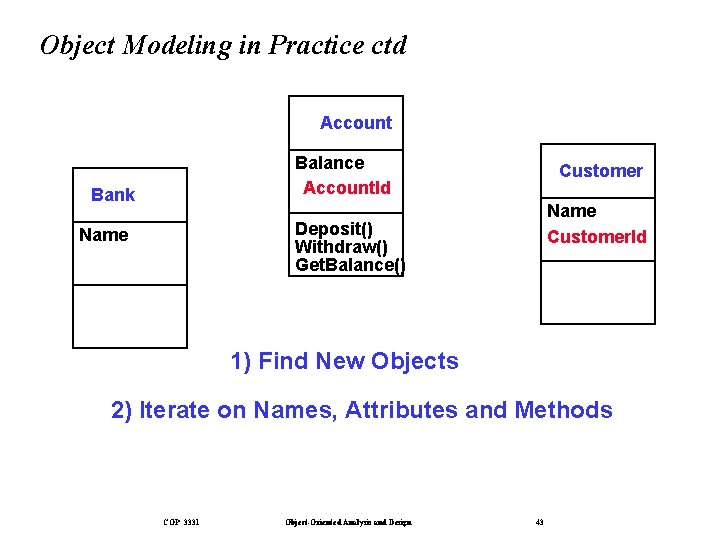
Object Modeling in Practice ctd Account Balance Account. Id Customer. Id Bank Customer Name Customer. Id Deposit() Withdraw() Get. Balance() Name 1) Find New Objects 2) Iterate on Names, Attributes and Methods COP 3331 Object-Oriented Analysis and Design 43
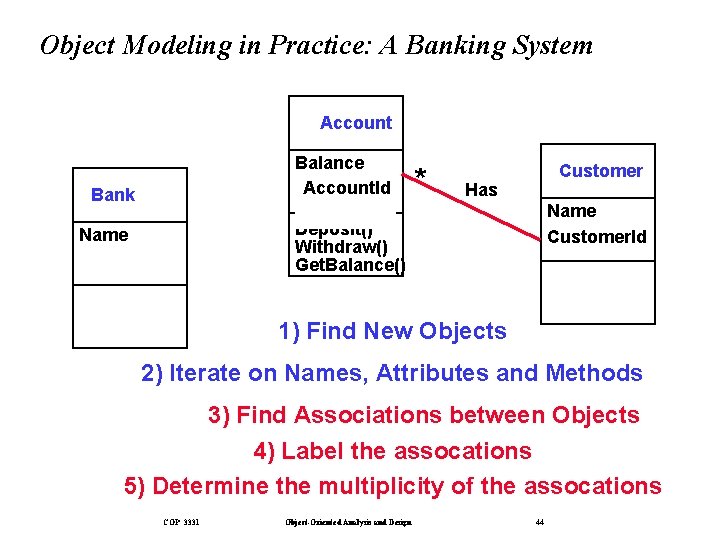
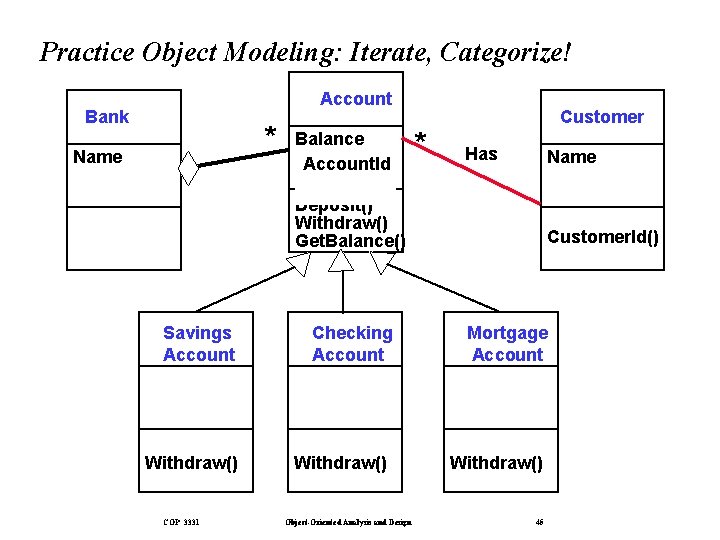
Object Modeling in Practice: A Banking System Account Balance Account. Id Customer. Id Account. I d Deposit() Withdraw() Get. Balance() Bank Name * Customer Has Name Customer. Id 1) Find New Objects 2) Iterate on Names, Attributes and Methods 3) Find Associations between Objects 4) Label the assocations 5) Determine the multiplicity of the assocations COP 3331 Object-Oriented Analysis and Design 44
Practice Object Modeling: Iterate, Categorize! Account Bank * Name Savings Account Withdraw() COP 3331 Balance Account. Id Customer. Id Account. I d Deposit() Withdraw() Get. Balance() Checking Account Withdraw() Object-Oriented Analysis and Design * Customer Has Name Customer. Id() Mortgage Account Withdraw() 45
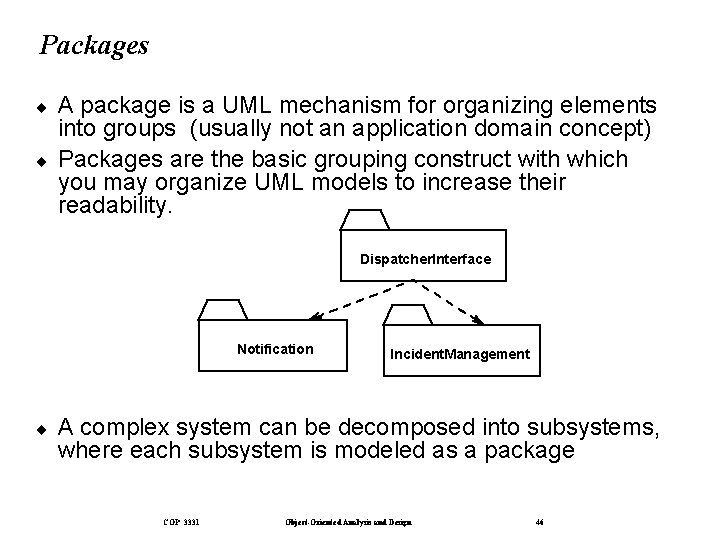
Packages ¨ ¨ A package is a UML mechanism for organizing elements into groups (usually not an application domain concept) Packages are the basic grouping construct with which you may organize UML models to increase their readability. Dispatcher. Interface Notification ¨ Incident. Management A complex system can be decomposed into subsystems, where each subsystem is modeled as a package COP 3331 Object-Oriented Analysis and Design 46
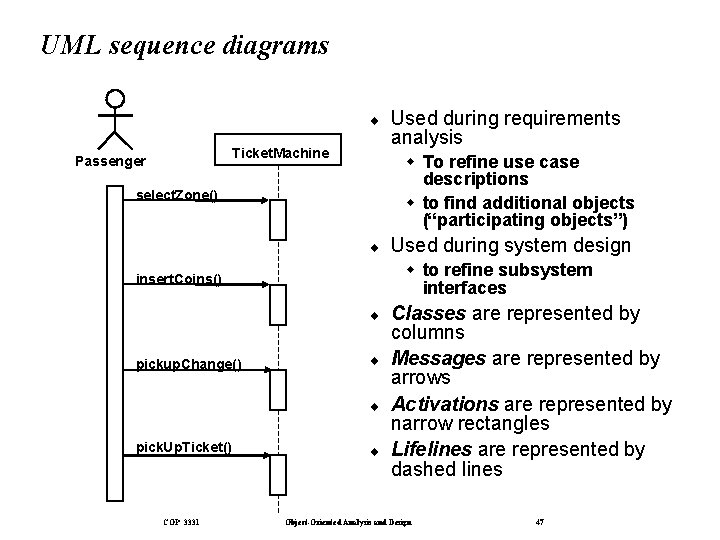
UML sequence diagrams ¨ Ticket. Machine Passenger w To refine use case descriptions w to find additional objects (“participating objects”) select. Zone() ¨ ¨ pick. Up. Ticket() COP 3331 Used during system design w to refine subsystem interfaces insert. Coins() pickup. Change() Used during requirements analysis ¨ Classes are represented by columns Messages are represented by arrows Activations are represented by narrow rectangles Lifelines are represented by dashed lines Object-Oriented Analysis and Design 47
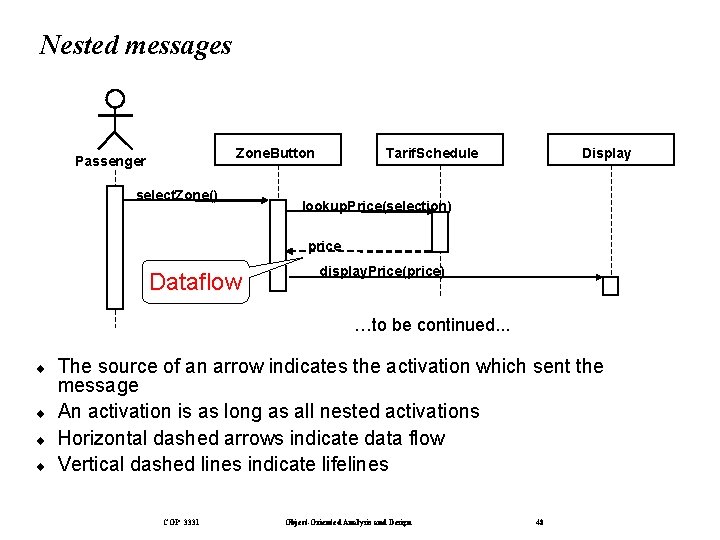
Nested messages Zone. Button Passenger select. Zone() Tarif. Schedule Display lookup. Price(selection) price Dataflow display. Price(price) …to be continued. . . ¨ ¨ The source of an arrow indicates the activation which sent the message An activation is as long as all nested activations Horizontal dashed arrows indicate data flow Vertical dashed lines indicate lifelines COP 3331 Object-Oriented Analysis and Design 48
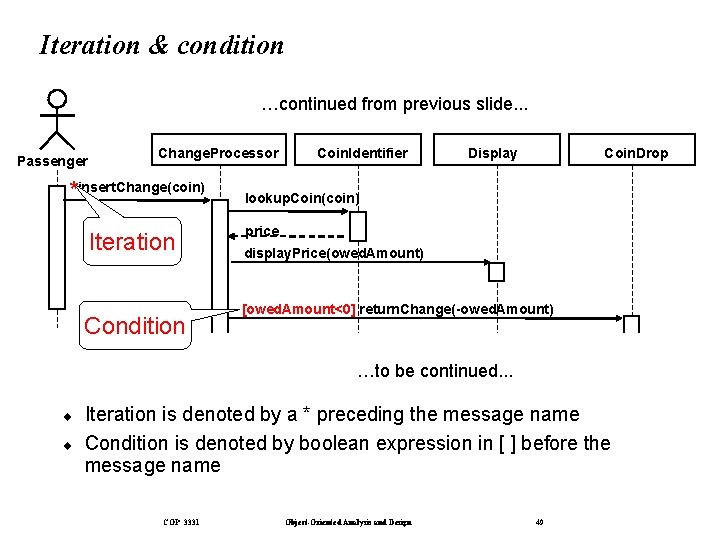
Iteration & condition …continued from previous slide. . . Passenger Change. Processor *insert. Change(coin) Iteration Condition Coin. Identifier Display Coin. Drop lookup. Coin(coin) price display. Price(owed. Amount) [owed. Amount<0] return. Change(-owed. Amount) …to be continued. . . ¨ ¨ Iteration is denoted by a * preceding the message name Condition is denoted by boolean expression in [ ] before the message name COP 3331 Object-Oriented Analysis and Design 49
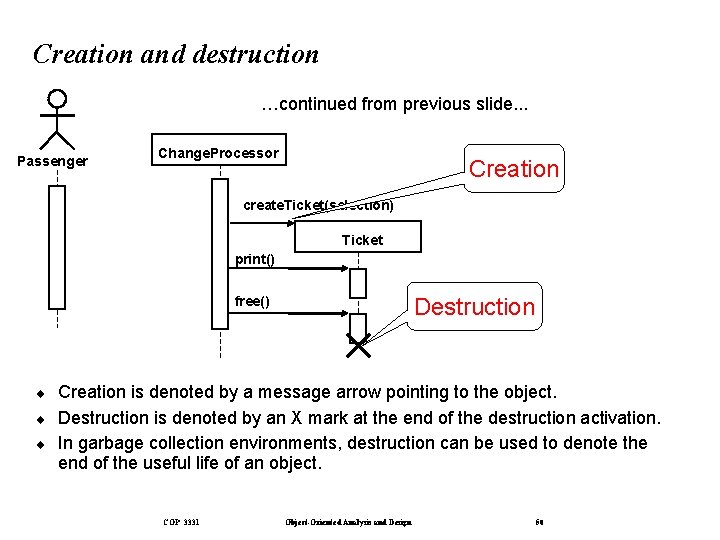
Creation and destruction …continued from previous slide. . . Passenger Change. Processor Creation create. Ticket(selection) Ticket print() free() ¨ ¨ ¨ Destruction Creation is denoted by a message arrow pointing to the object. Destruction is denoted by an X mark at the end of the destruction activation. In garbage collection environments, destruction can be used to denote the end of the useful life of an object. COP 3331 Object-Oriented Analysis and Design 50
Sequence Diagram Summary ¨ ¨ UML sequence diagram represent behavior in terms of interactions. Useful to find missing objects. Time consuming to build but worth the investment. Complement the class diagrams (which represent structure). COP 3331 Object-Oriented Analysis and Design 51
State Chart Diagrams State Initial state Event Transition Final state Represent behavior as states and transitions COP 3331 Object-Oriented Analysis and Design 52
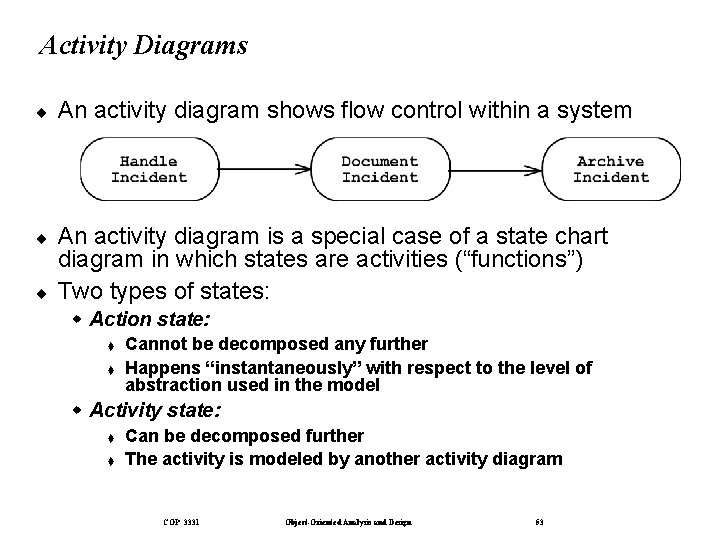
Activity Diagrams ¨ An activity diagram shows flow control within a system ¨ An activity diagram is a special case of a state chart diagram in which states are activities (“functions”) Two types of states: ¨ w Action state: t t Cannot be decomposed any further Happens “instantaneously” with respect to the level of abstraction used in the model w Activity state: t t Can be decomposed further The activity is modeled by another activity diagram COP 3331 Object-Oriented Analysis and Design 53
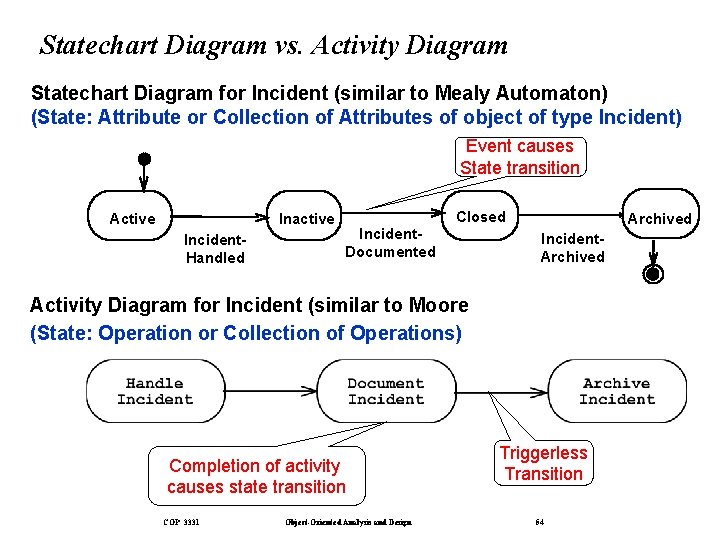
Statechart Diagram vs. Activity Diagram Statechart Diagram for Incident (similar to Mealy Automaton) (State: Attribute or Collection of Attributes of object of type Incident) Event causes State transition Active Inactive Incident. Handled Closed Incident. Documented Archived Incident. Archived Activity Diagram for Incident (similar to Moore (State: Operation or Collection of Operations) Completion of activity causes state transition COP 3331 Object-Oriented Analysis and Design Triggerless Transition 54
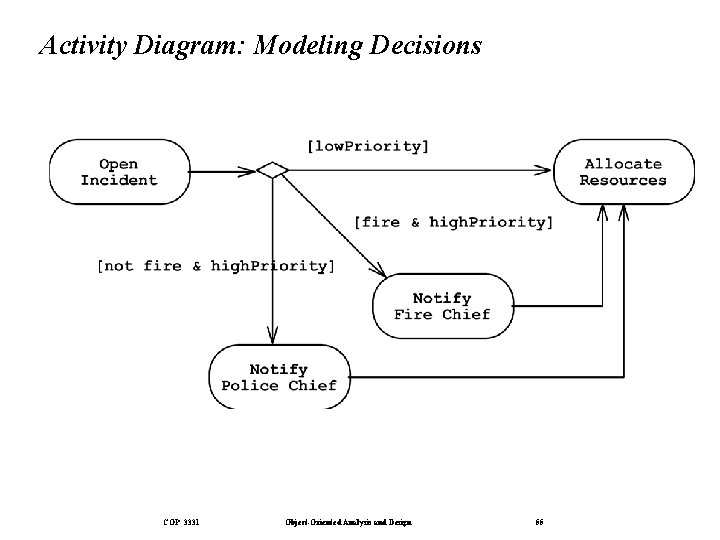
Activity Diagram: Modeling Decisions COP 3331 Object-Oriented Analysis and Design 55
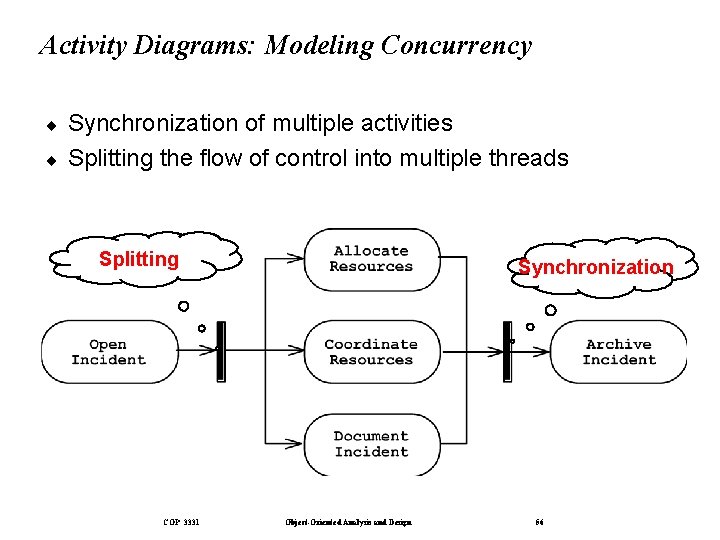
Activity Diagrams: Modeling Concurrency ¨ ¨ Synchronization of multiple activities Splitting the flow of control into multiple threads Splitting COP 3331 Synchronization Object-Oriented Analysis and Design 56
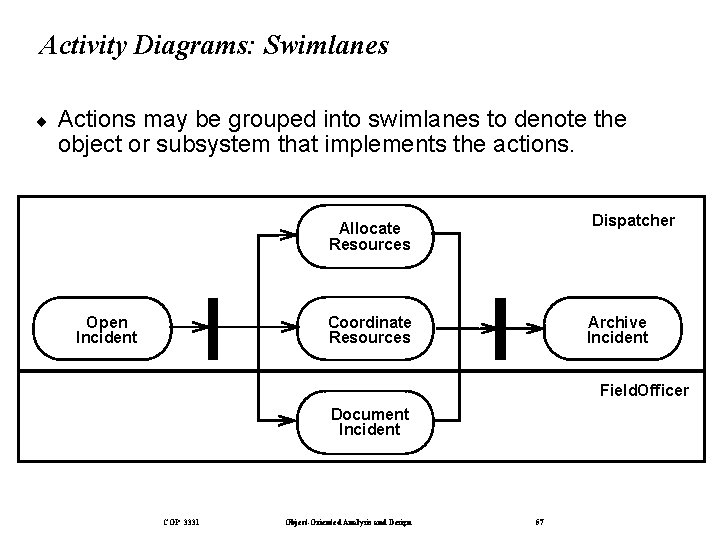
Activity Diagrams: Swimlanes ¨ Actions may be grouped into swimlanes to denote the object or subsystem that implements the actions. Dispatcher Allocate Resources Open Incident Coordinate Resources Archive Incident Field. Officer Document Incident COP 3331 Object-Oriented Analysis and Design 57
What should be done first? Coding or Modeling? ¨ It all depends…. ¨ Forward Engineering: w Creation of code from a model w Greenfield projects ¨ Reverse Engineering: w Creation of a model from code w Interface or reengineering projects ¨ Roundtrip Engineering: w Move constantly between forward and reverse engineering w Useful when requirements, technology and schedule are changing frequently COP 3331 Object-Oriented Analysis and Design 58
UML Summary ¨ UML provides a wide variety of notations for representing many aspects of software development w Powerful, but complex language w Can be misused to generate unreadable models w Can be misunderstood when using too many exotic features ¨ For now we concentrate on a few notations: w Functional model: Use case diagram w Object model: class diagram w Dynamic model: sequence diagrams, statechart and activity diagrams COP 3331 Object-Oriented Analysis and Design 59