
MODELING AND SIMULATION OF COMPUTER NETWORKS AND SYSTEMS
- Slides: 25
MODELING AND SIMULATION OF COMPUTER NETWORKS AND SYSTEMS: METHODOLOGIES AND APPLICATIONS Wireless Cognitive Networks Technologies and Protocols V. Loscrì, A. Maskooki, N. Mitton and A. M. Vegni
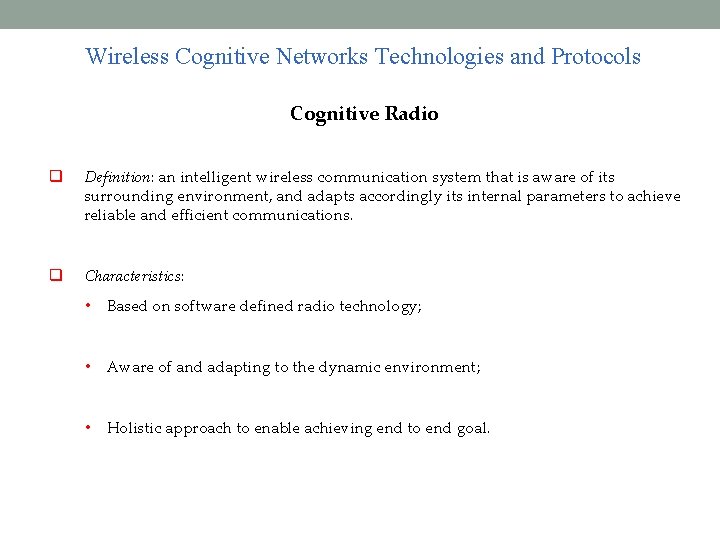
Wireless Cognitive Networks Technologies and Protocols Cognitive Radio Definition: an intelligent wireless communication system that is aware of its surrounding environment, and adapts accordingly its internal parameters to achieve reliable and efficient communications. Characteristics: • Based on software defined radio technology; • Aware of and adapting to the dynamic environment; • Holistic approach to enable achieving end to end goal.
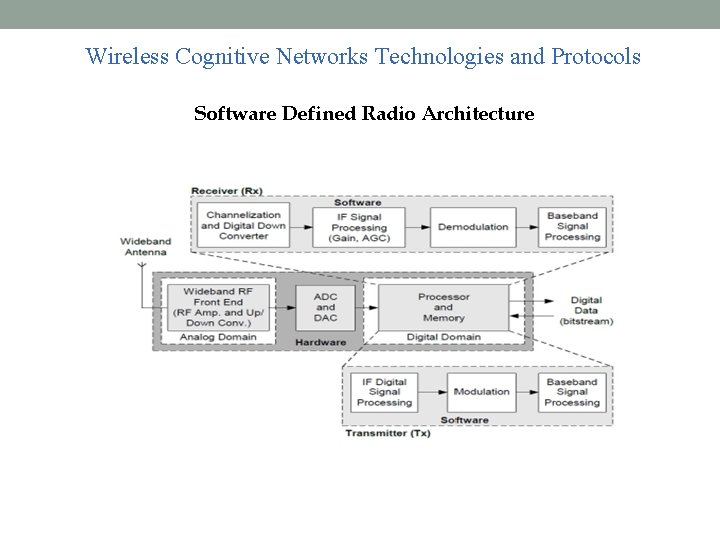
Wireless Cognitive Networks Technologies and Protocols Software Defined Radio Architecture
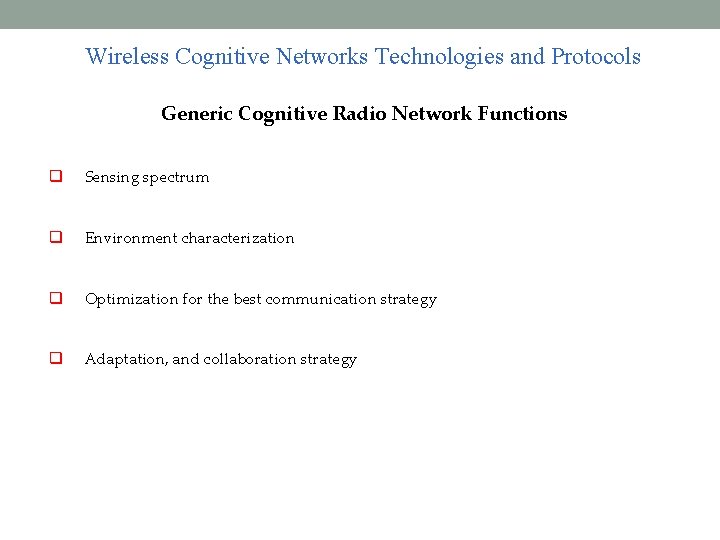
Wireless Cognitive Networks Technologies and Protocols Generic Cognitive Radio Network Functions Sensing spectrum Environment characterization Optimization for the best communication strategy Adaptation, and collaboration strategy
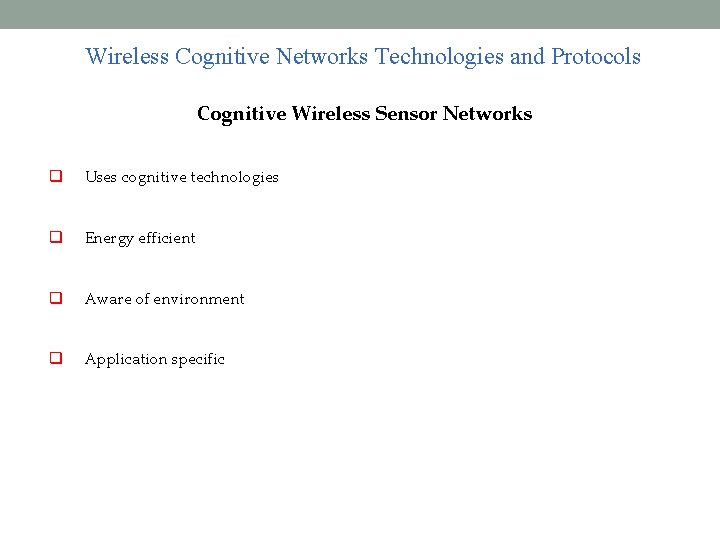
Wireless Cognitive Networks Technologies and Protocols Cognitive Wireless Sensor Networks Uses cognitive technologies Energy efficient Aware of environment Application specific
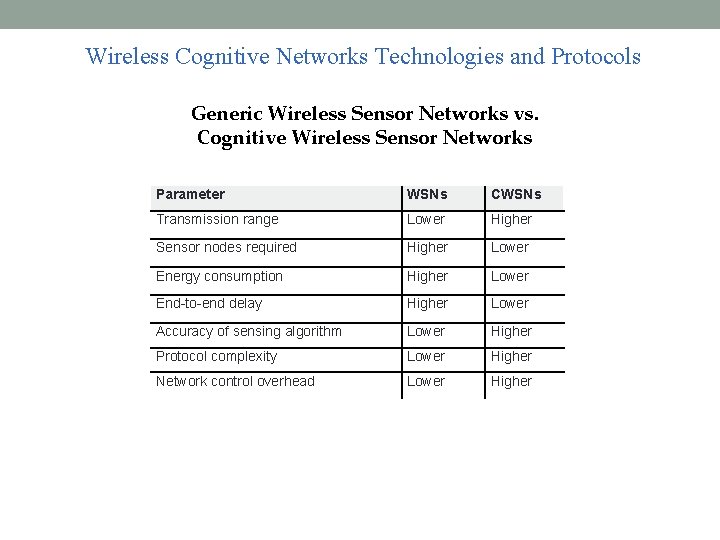
Wireless Cognitive Networks Technologies and Protocols Generic Wireless Sensor Networks vs. Cognitive Wireless Sensor Networks Parameter WSNs CWSNs Transmission range Lower Higher Sensor nodes required Higher Lower Energy consumption Higher Lower End-to-end delay Higher Lower Accuracy of sensing algorithm Lower Higher Protocol complexity Lower Higher Network control overhead Lower Higher
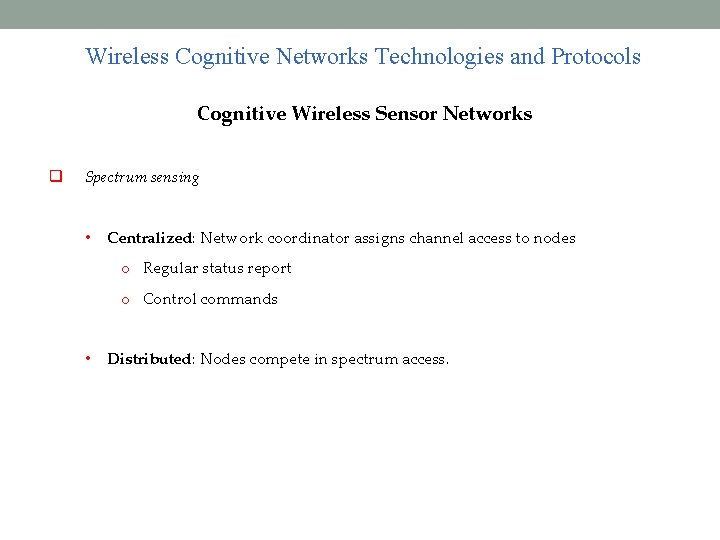
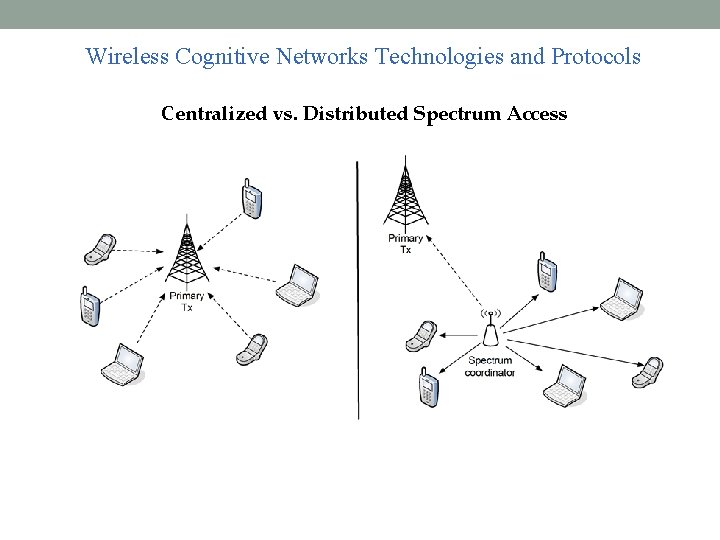
Wireless Cognitive Networks Technologies and Protocols Cognitive Wireless Sensor Networks Spectrum sensing • Centralized: Network coordinator assigns channel access to nodes o Regular status report o Control commands • Distributed: Nodes compete in spectrum access.
Wireless Cognitive Networks Technologies and Protocols Centralized vs. Distributed Spectrum Access
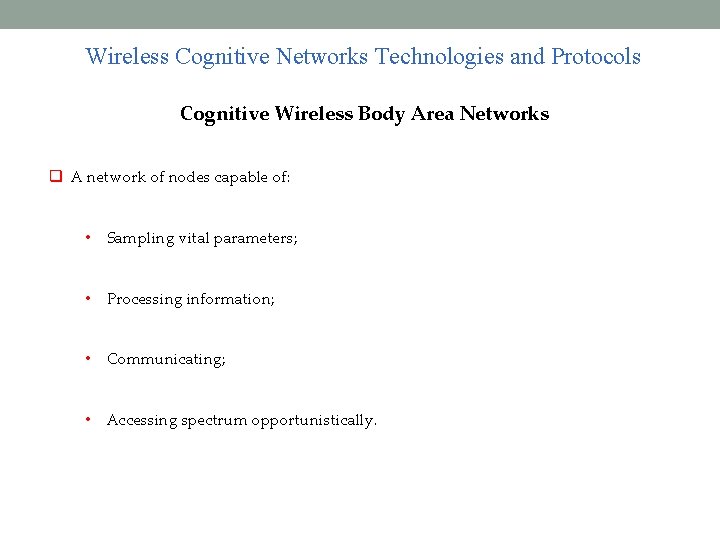
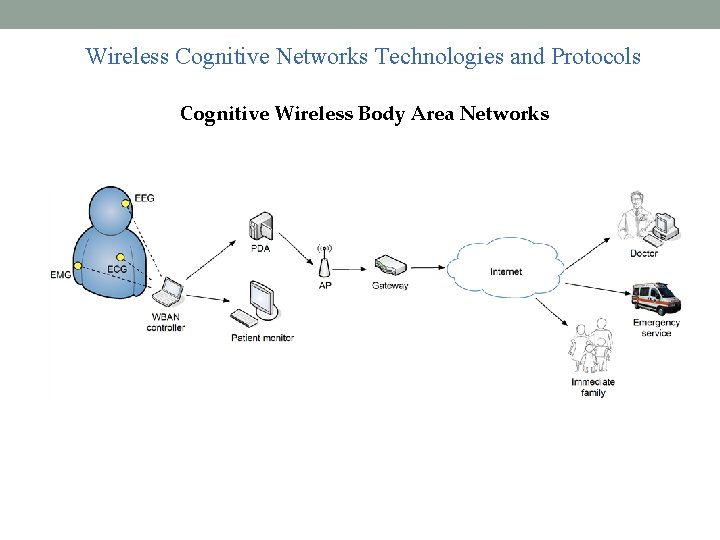
Wireless Cognitive Networks Technologies and Protocols Cognitive Wireless Body Area Networks A network of nodes capable of: • Sampling vital parameters; • Processing information; • Communicating; • Accessing spectrum opportunistically.
Wireless Cognitive Networks Technologies and Protocols Cognitive Wireless Body Area Networks
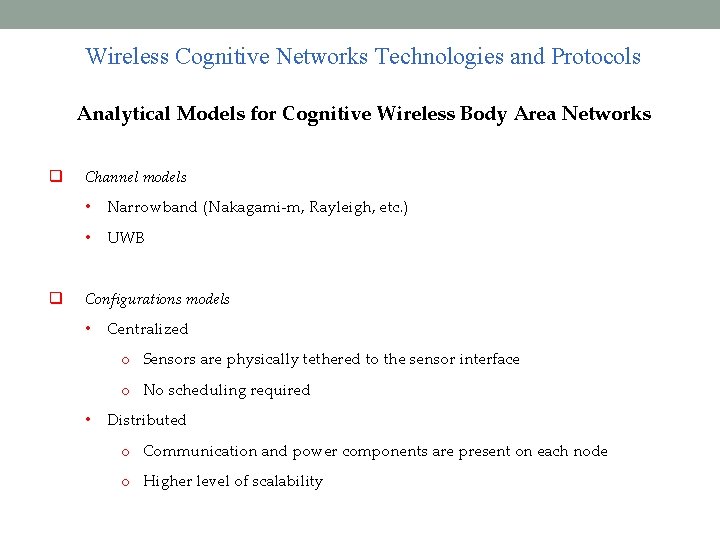
Wireless Cognitive Networks Technologies and Protocols Analytical Models for Cognitive Wireless Body Area Networks Channel models • Narrowband (Nakagami-m, Rayleigh, etc. ) • UWB Configurations models • Centralized o Sensors are physically tethered to the sensor interface o No scheduling required • Distributed o Communication and power components are present on each node o Higher level of scalability
Wireless Cognitive Networks Technologies and Protocols Simulations Tools for Cognitive Wireless Body Area Networks OPNET MATLAB
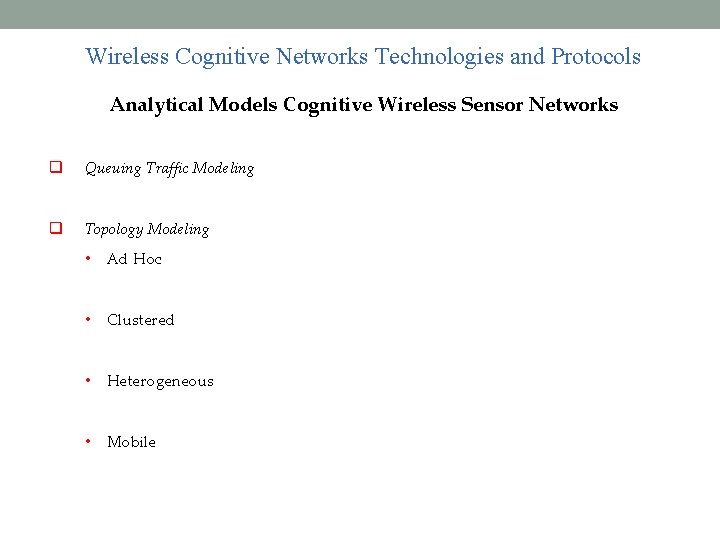
Wireless Cognitive Networks Technologies and Protocols Analytical Models Cognitive Wireless Sensor Networks Queuing Traffic Modeling Topology Modeling • Ad Hoc • Clustered • Heterogeneous • Mobile
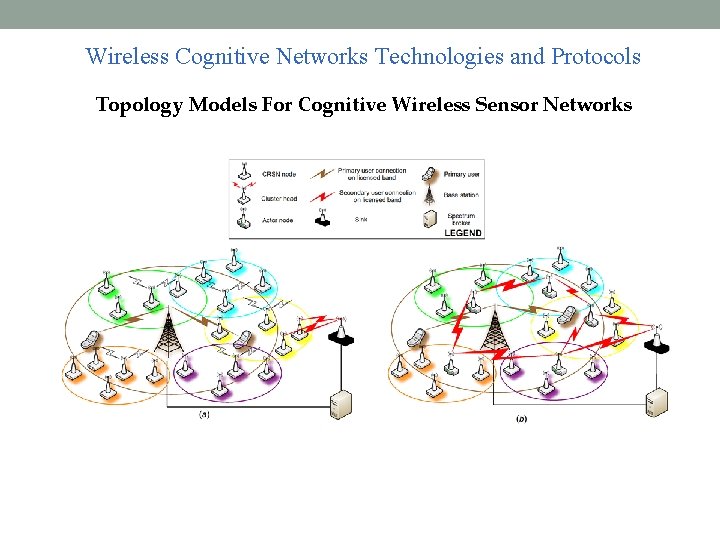
Wireless Cognitive Networks Technologies and Protocols Topology Models For Cognitive Wireless Sensor Networks
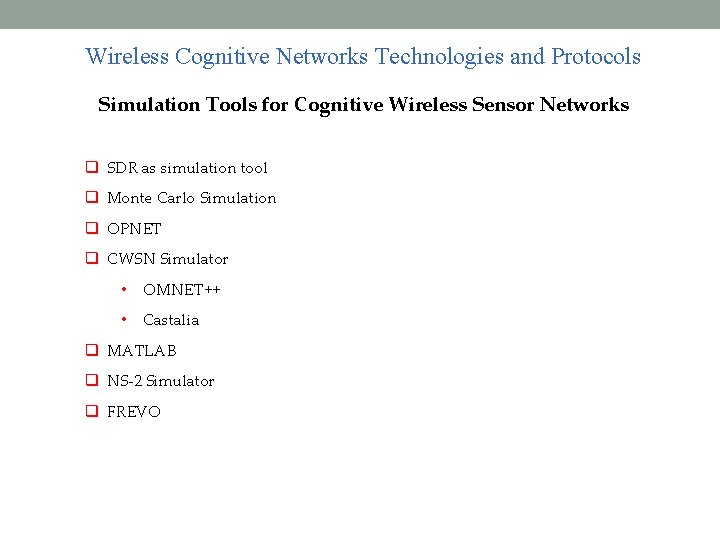
Wireless Cognitive Networks Technologies and Protocols Simulation Tools for Cognitive Wireless Sensor Networks SDR as simulation tool Monte Carlo Simulation OPNET CWSN Simulator • OMNET++ • Castalia MATLAB NS-2 Simulator FREVO
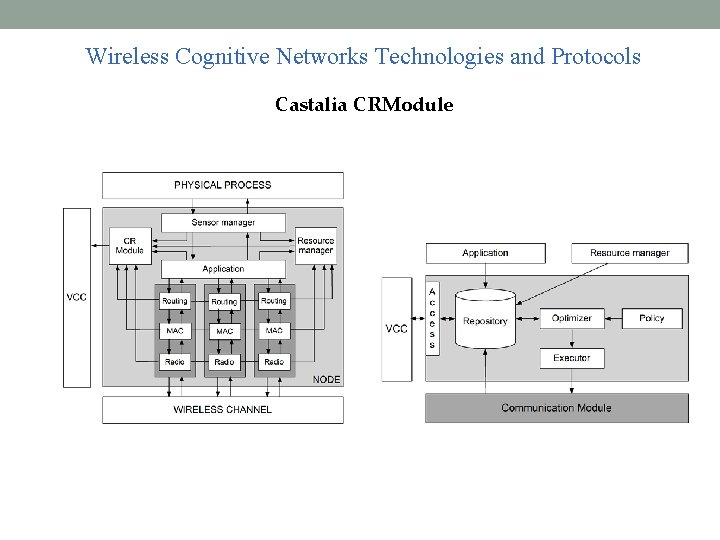
Wireless Cognitive Networks Technologies and Protocols Castalia CRModule
Wireless Cognitive Networks Technologies and Protocols Routing Approaches for Traditional Wireless Sensor Networks Data Centric: Query based, Use data labeling • Sensor Protocol for Information via Negotiation (SPIN); • Directed Diffusion; • Active Query Forwarding in Sensor Networks (ACQUIRE).
Wireless Cognitive Networks Technologies and Protocols Routing Approaches for Traditional Wireless Sensor Networks Hierarchical: cluster based • Low-Energy Adaptive Clustering Hierarchy (LEACH); • Power-Efficient Gathering in Sensor Information Systems (PEGASIS); • Threshold sensitive Energy Efficient sensor Network protocol (TEEN).
Wireless Cognitive Networks Technologies and Protocols Routing Approaches for Traditional Wireless Sensor Networks Geographical routing: exploit the location information of the nodes for a more efficient routing of data • Minimum Energy Communication Network (MECN); • Geographic Adaptive Fidelity (GAF); • Geographic and Energy Aware Routing (GEAR).
Wireless Cognitive Networks Technologies and Protocols Routing Approaches for Wireless Cognitive Sensor Networks Partially Observable Markov Decision Process (POMDP): Optimum strategy obtained by maximizing the reward of a POMDP. Spectrum Aware Routing Protocol for Cognitive ad-Hoc networks (SEARCH): jointly selects path and channel to minimize end-to-end delivery time.
Wireless Cognitive Networks Technologies and Protocols Traditional Routing Approaches for Wireless Body Area Networks Single hop • Star topology: All nodes communicate with network coordinator directly. Cooperative: Nodes cooperate to route data to the network coordinator • Stochastic route selection; • Opportunistic routing.
Wireless Cognitive Networks Technologies and Protocols Intelligent and Cognitive Routing Approaches for Wireless Body Area Networks Adaptive routing • Decides on the routing strategy based on the channel condition; • Energy efficient.
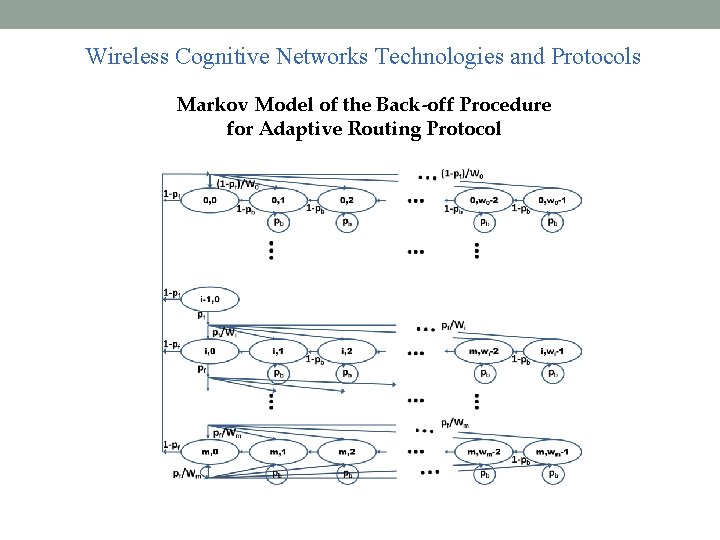
Wireless Cognitive Networks Technologies and Protocols Markov Model of the Back-off Procedure for Adaptive Routing Protocol
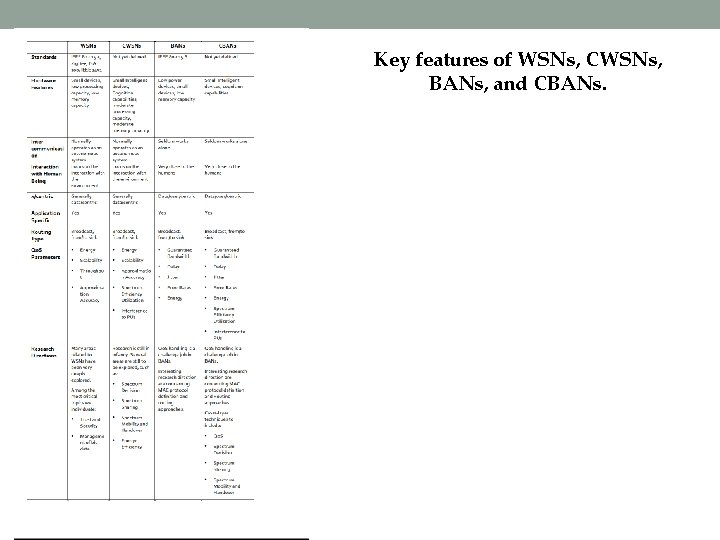
Key features of WSNs, CWSNs, BANs, and CBANs.
Wireless Cognitive Networks Technologies and Protocols Conclusions This chapter focuses on the new notion of Software Defined and Cognitive Radio for wireless sensor networks, and wireless body area networks. Specifically, we discussed: • Analytical modeling of capacity, energy consumption and congestion for Cognitive Wireless Sensor Networks and Cognitive Wireless Body Area Networks; • Routing approaches and modeling techniques to evaluate the performance of routing for both generic wireless sensor networks and wireless body sensor networks; • Cognitive approaches as the most promising approaches to target higher capacity demand lower energy consumption for wireless networks; • Mathematical models for the MAC protocol and the energy cost per bit are analyzed.