
MODELING AND SIMULATION OF COMPUTER NETWORKS AND SYSTEMS
![22 References [1] IEEE 802. 11 aa document standard, http: //standards. ieee. org/getieee 802/download/802.](https://slidetodoc.com/presentation_image_h2/b1cac77f89c43a5afefe881b4c871059/image-22.jpg "22 References [1] IEEE 802. 11 aa document standard, http: //standards. ieee. org/getieee 802/download/802.")
- Slides: 22
MODELING AND SIMULATION OF COMPUTER NETWORKS AND SYSTEMS: METHODOLOGIES AND APPLICATIONS Rate Adaptation Algorithms for Reliable Multicast Transmissions in Wireless LAN Stefano Paris Nicolò Facchi Francesco Gringoli
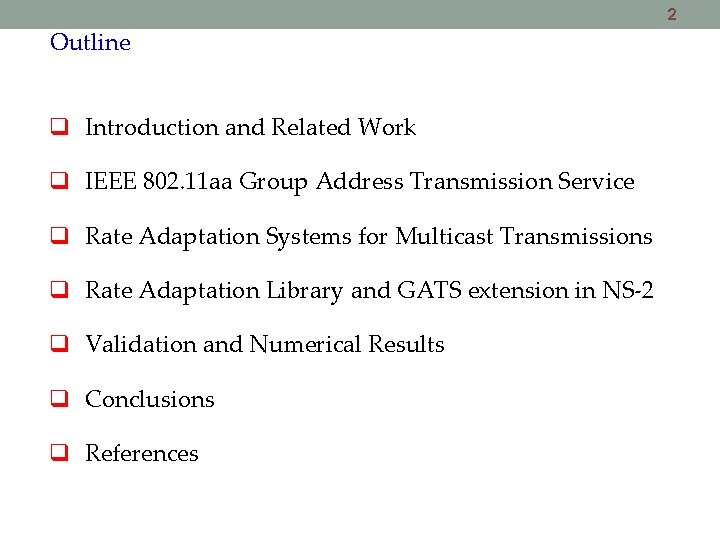
2 Outline Introduction and Related Work IEEE 802. 11 aa Group Address Transmission Service Rate Adaptation Systems for Multicast Transmissions Rate Adaptation Library and GATS extension in NS-2 Validation and Numerical Results Conclusions References
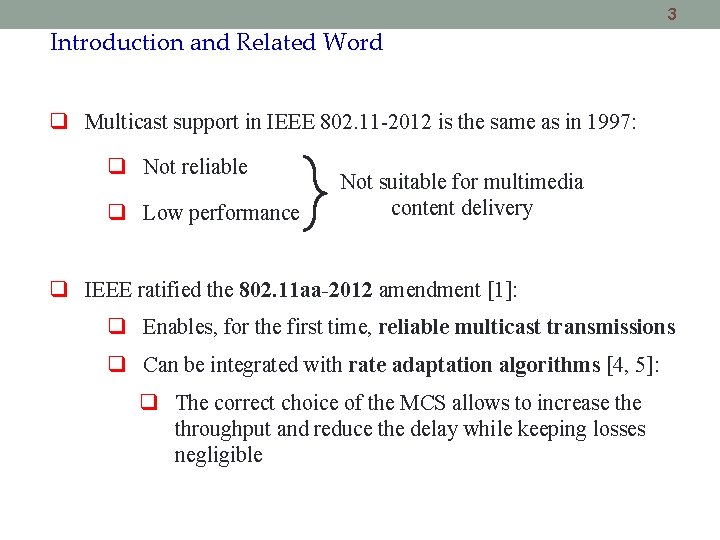
3 Introduction and Related Word Multicast support in IEEE 802. 11 -2012 is the same as in 1997: Not reliable Low performance Not suitable for multimedia content delivery IEEE ratified the 802. 11 aa-2012 amendment [1]: Enables, for the first time, reliable multicast transmissions Can be integrated with rate adaptation algorithms [4, 5]: The correct choice of the MCS allows to increase throughput and reduce the delay while keeping losses negligible
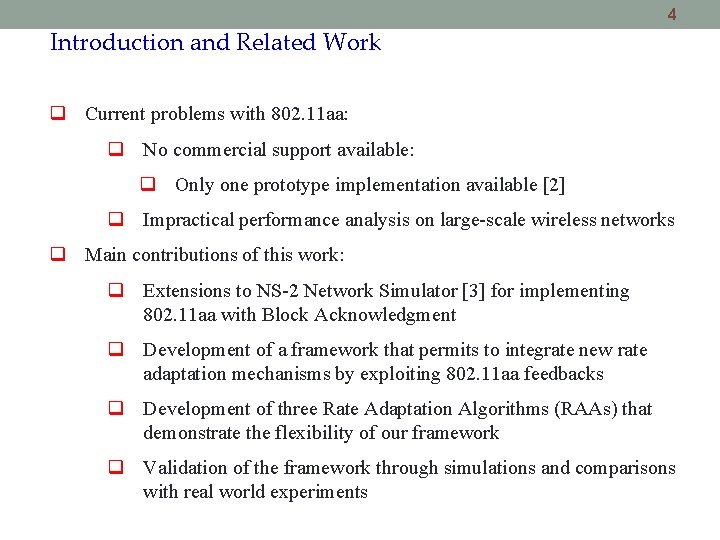
4 Introduction and Related Work Current problems with 802. 11 aa: No commercial support available: Only one prototype implementation available [2] Impractical performance analysis on large-scale wireless networks Main contributions of this work: Extensions to NS-2 Network Simulator [3] for implementing 802. 11 aa with Block Acknowledgment Development of a framework that permits to integrate new rate adaptation mechanisms by exploiting 802. 11 aa feedbacks Development of three Rate Adaptation Algorithms (RAAs) that demonstrate the flexibility of our framework Validation of the framework through simulations and comparisons with real world experiments
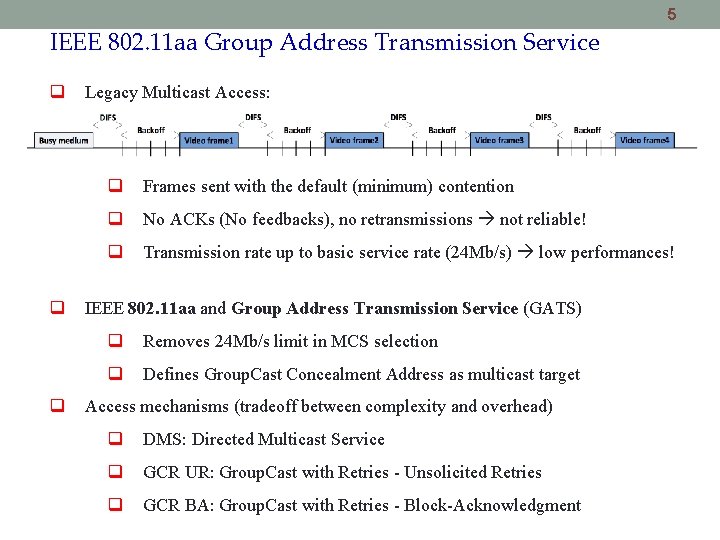
5 IEEE 802. 11 aa Group Address Transmission Service Legacy Multicast Access: Frames sent with the default (minimum) contention No ACKs (No feedbacks), no retransmissions not reliable! Transmission rate up to basic service rate (24 Mb/s) low performances! IEEE 802. 11 aa and Group Address Transmission Service (GATS) Removes 24 Mb/s limit in MCS selection Defines Group. Cast Concealment Address as multicast target Access mechanisms (tradeoff between complexity and overhead) DMS: Directed Multicast Service GCR UR: Group. Cast with Retries - Unsolicited Retries GCR BA: Group. Cast with Retries - Block-Acknowledgment
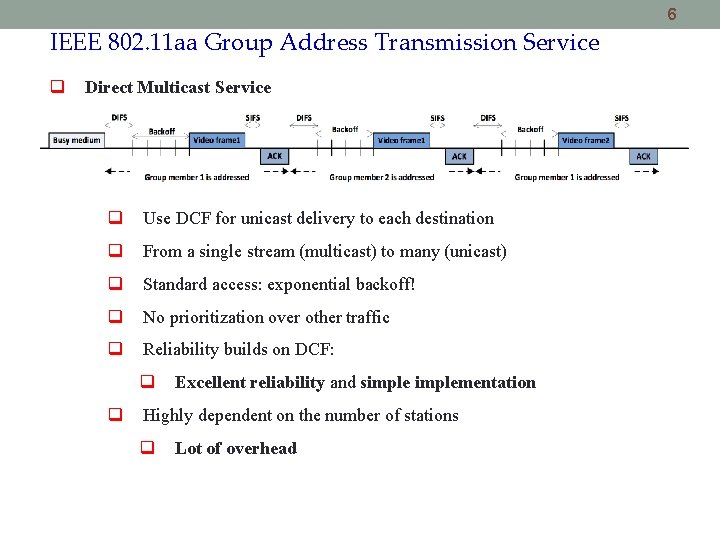
6 IEEE 802. 11 aa Group Address Transmission Service Direct Multicast Service Use DCF for unicast delivery to each destination From a single stream (multicast) to many (unicast) Standard access: exponential backoff! No prioritization over other traffic Reliability builds on DCF: Excellent reliability and simplementation Highly dependent on the number of stations Lot of overhead
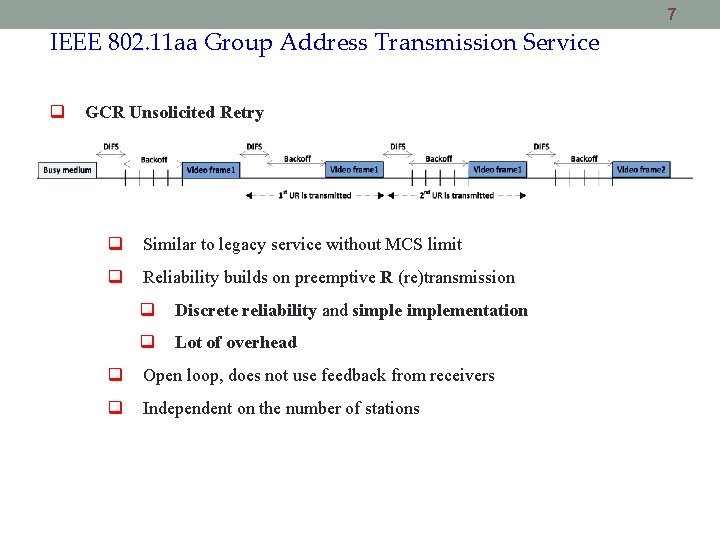
7 IEEE 802. 11 aa Group Address Transmission Service GCR Unsolicited Retry Similar to legacy service without MCS limit Reliability builds on preemptive R (re)transmission Discrete reliability and simplementation Lot of overhead Open loop, does not use feedback from receivers Independent on the number of stations
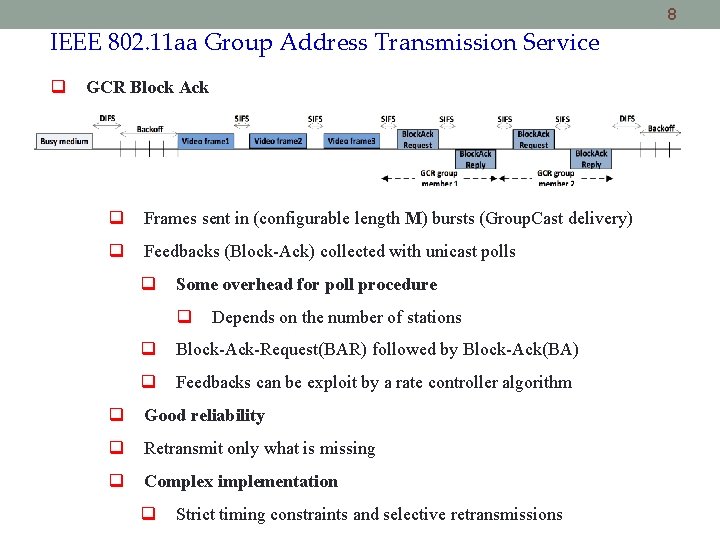
8 IEEE 802. 11 aa Group Address Transmission Service GCR Block Ack Frames sent in (configurable length M) bursts (Group. Cast delivery) Feedbacks (Block-Ack) collected with unicast polls Some overhead for poll procedure Depends on the number of stations Block-Ack-Request(BAR) followed by Block-Ack(BA) Feedbacks can be exploit by a rate controller algorithm Good reliability Retransmit only what is missing Complex implementation Strict timing constraints and selective retransmissions
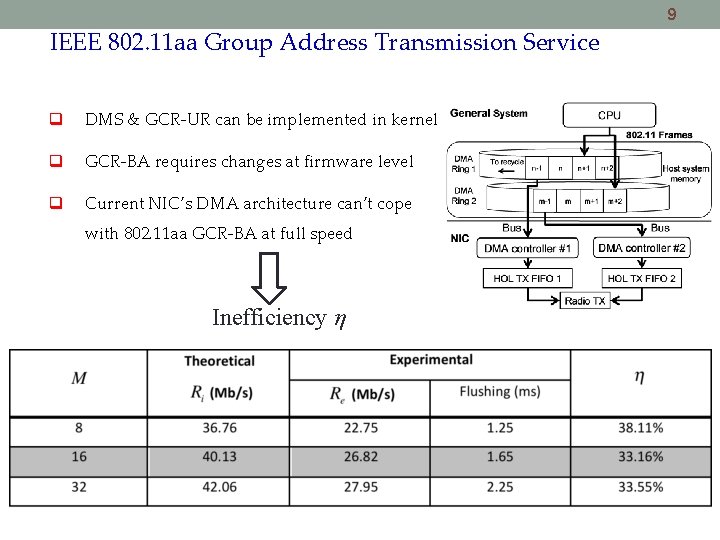
9 IEEE 802. 11 aa Group Address Transmission Service DMS & GCR-UR can be implemented in kernel GCR-BA requires changes at firmware level Current NIC’s DMA architecture can’t cope with 802. 11 aa GCR-BA at full speed Inefficiency η
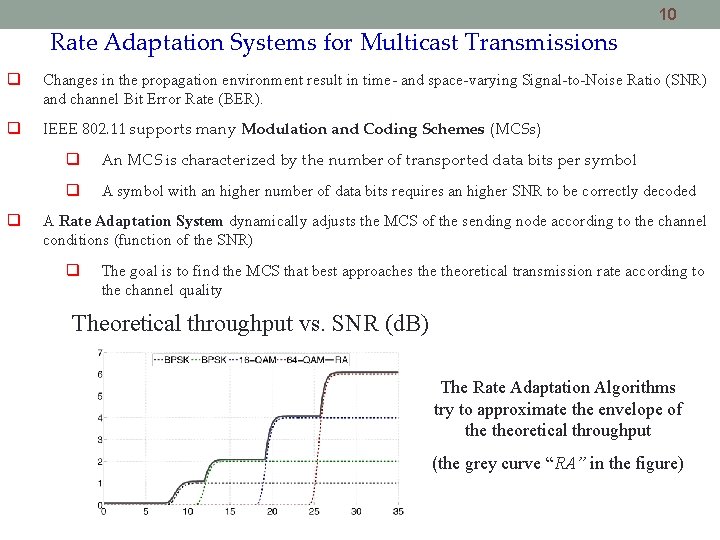
10 Rate Adaptation Systems for Multicast Transmissions Changes in the propagation environment result in time- and space-varying Signal-to-Noise Ratio (SNR) and channel Bit Error Rate (BER). IEEE 802. 11 supports many Modulation and Coding Schemes (MCSs) An MCS is characterized by the number of transported data bits per symbol A symbol with an higher number of data bits requires an higher SNR to be correctly decoded A Rate Adaptation System dynamically adjusts the MCS of the sending node according to the channel conditions (function of the SNR) The goal is to find the MCS that best approaches theoretical transmission rate according to the channel quality Theoretical throughput vs. SNR (d. B) The Rate Adaptation Algorithms try to approximate the envelope of theoretical throughput (the grey curve “RA” in the figure)
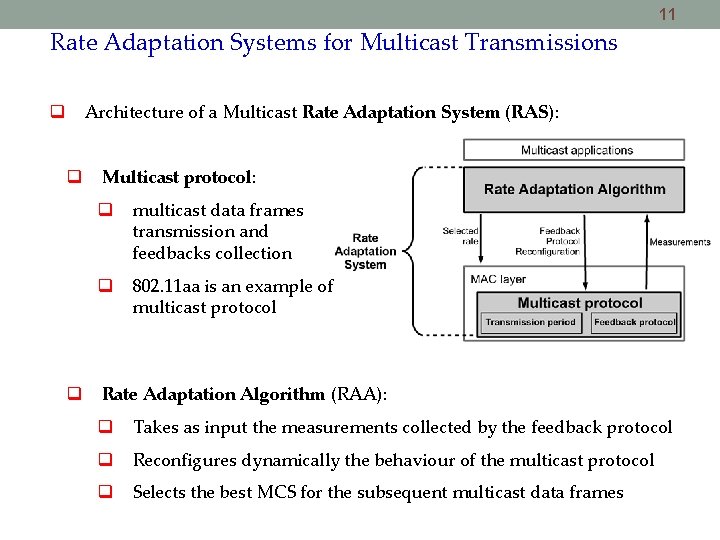
11 Rate Adaptation Systems for Multicast Transmissions Architecture of a Multicast Rate Adaptation System (RAS): Multicast protocol: multicast data frames transmission and feedbacks collection 802. 11 aa is an example of multicast protocol Rate Adaptation Algorithm (RAA): Takes as input the measurements collected by the feedback protocol Reconfigures dynamically the behaviour of the multicast protocol Selects the best MCS for the subsequent multicast data frames
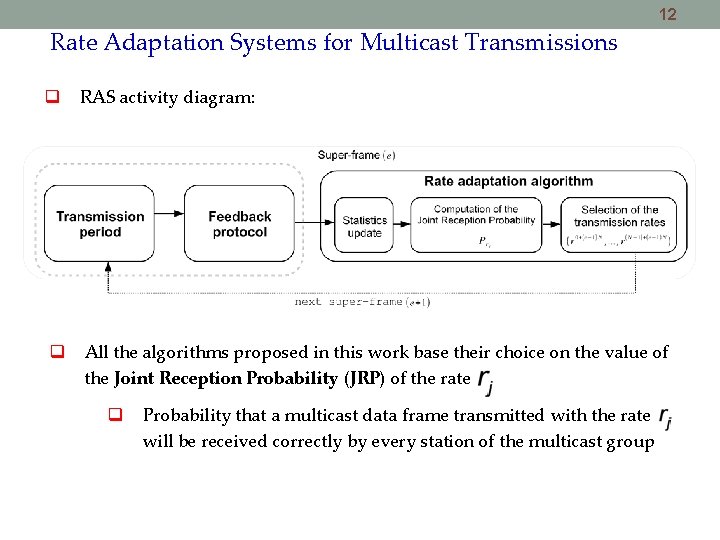
12 Rate Adaptation Systems for Multicast Transmissions RAS activity diagram: All the algorithms proposed in this work base their choice on the value of the Joint Reception Probability (JRP) of the rate Probability that a multicast data frame transmitted with the rate will be received correctly by every station of the multicast group
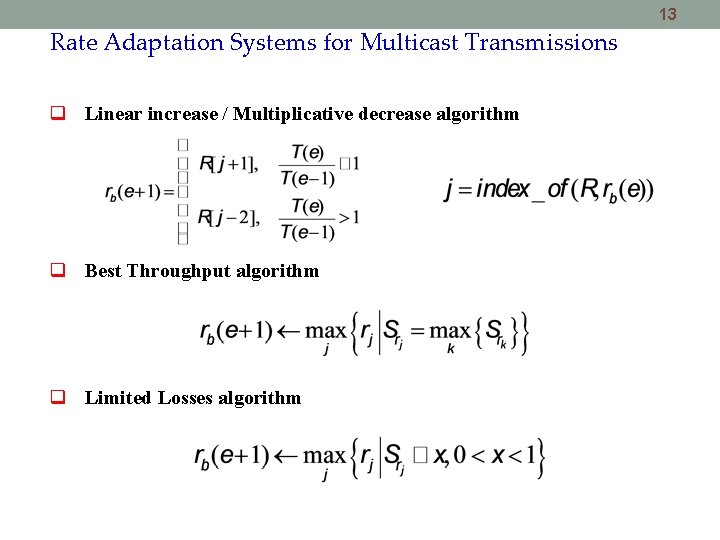
13 Rate Adaptation Systems for Multicast Transmissions Linear increase / Multiplicative decrease algorithm Best Throughput algorithm Limited Losses algorithm
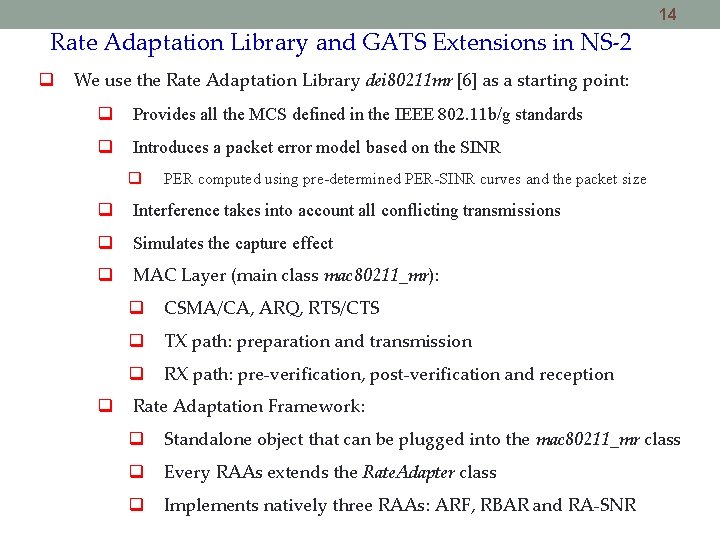
14 Rate Adaptation Library and GATS Extensions in NS-2 We use the Rate Adaptation Library dei 80211 mr [6] as a starting point: Provides all the MCS defined in the IEEE 802. 11 b/g standards Introduces a packet error model based on the SINR PER computed using pre-determined PER-SINR curves and the packet size Interference takes into account all conflicting transmissions Simulates the capture effect MAC Layer (main class mac 80211_mr): CSMA/CA, ARQ, RTS/CTS TX path: preparation and transmission RX path: pre-verification, post-verification and reception Rate Adaptation Framework: Standalone object that can be plugged into the mac 80211_mr class Every RAAs extends the Rate. Adapter class Implements natively three RAAs: ARF, RBAR and RA-SNR
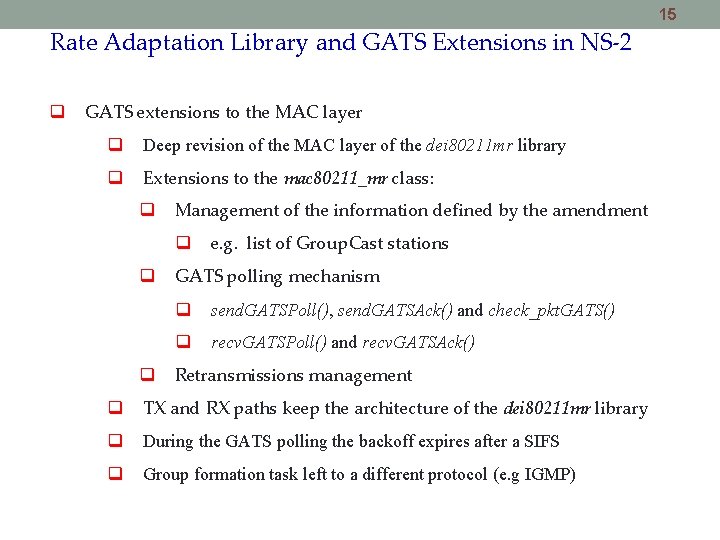
15 Rate Adaptation Library and GATS Extensions in NS-2 GATS extensions to the MAC layer Deep revision of the MAC layer of the dei 80211 mr library Extensions to the mac 80211_mr class: Management of the information defined by the amendment e. g. list of Group. Cast stations GATS polling mechanism send. GATSPoll(), send. GATSAck() and check_pkt. GATS() recv. GATSPoll() and recv. GATSAck() Retransmissions management TX and RX paths keep the architecture of the dei 80211 mr library During the GATS polling the backoff expires after a SIFS Group formation task left to a different protocol (e. g IGMP)
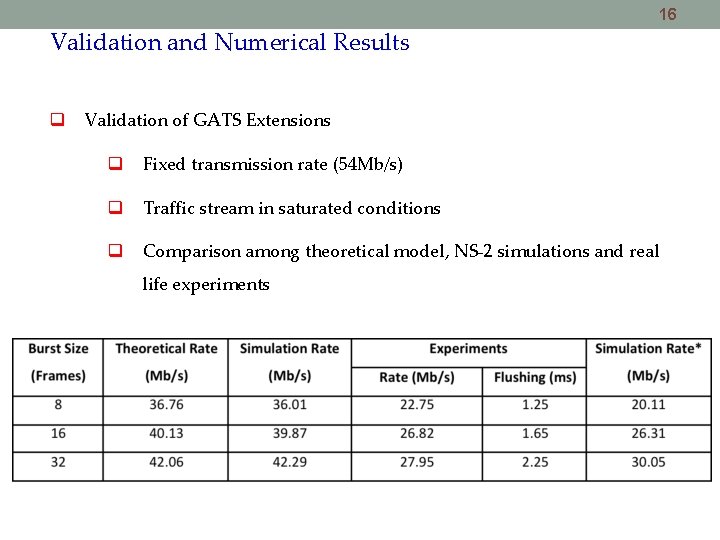
16 Validation and Numerical Results Validation of GATS Extensions Fixed transmission rate (54 Mb/s) Traffic stream in saturated conditions Comparison among theoretical model, NS-2 simulations and real life experiments
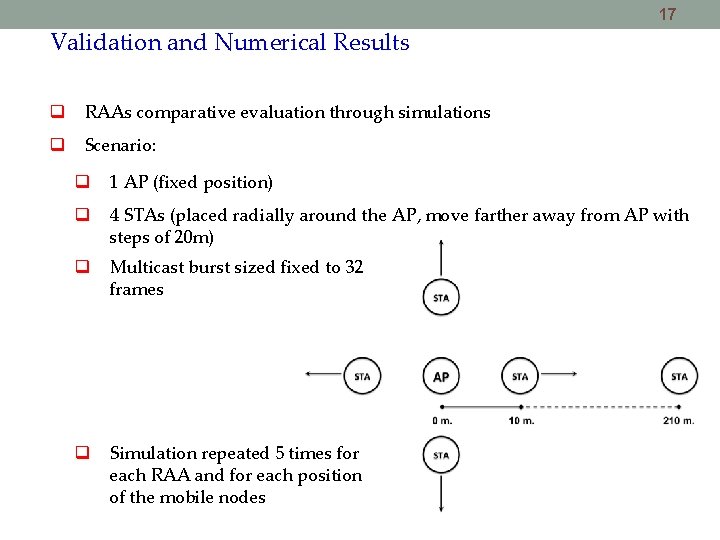
17 Validation and Numerical Results RAAs comparative evaluation through simulations Scenario: 1 AP (fixed position) 4 STAs (placed radially around the AP, move farther away from AP with steps of 20 m) Multicast burst sized fixed to 32 frames Simulation repeated 5 times for each RAA and for each position of the mobile nodes
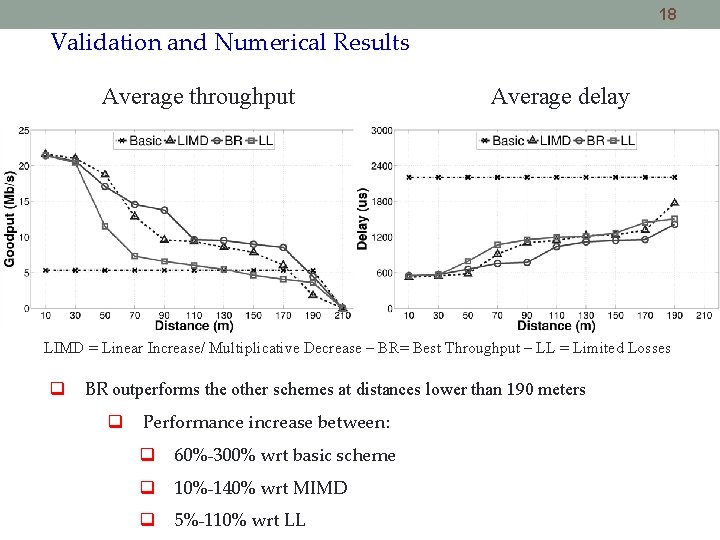
18 Validation and Numerical Results Average throughput Average delay LIMD = Linear Increase/ Multiplicative Decrease – BR= Best Throughput – LL = Limited Losses BR outperforms the other schemes at distances lower than 190 meters Performance increase between: 60%-300% wrt basic scheme 10%-140% wrt MIMD 5%-110% wrt LL
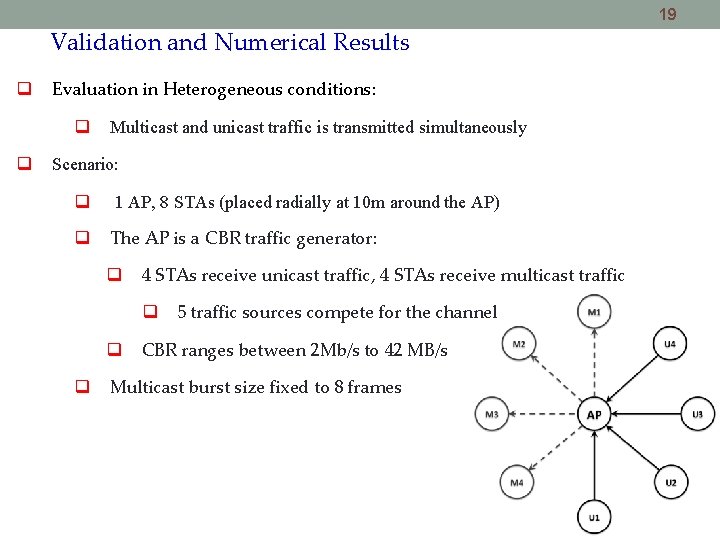
19 Validation and Numerical Results Evaluation in Heterogeneous conditions: Multicast and unicast traffic is transmitted simultaneously Scenario: 1 AP, 8 STAs (placed radially at 10 m around the AP) The AP is a CBR traffic generator: 4 STAs receive unicast traffic, 4 STAs receive multicast traffic 5 traffic sources compete for the channel CBR ranges between 2 Mb/s to 42 MB/s Multicast burst size fixed to 8 frames
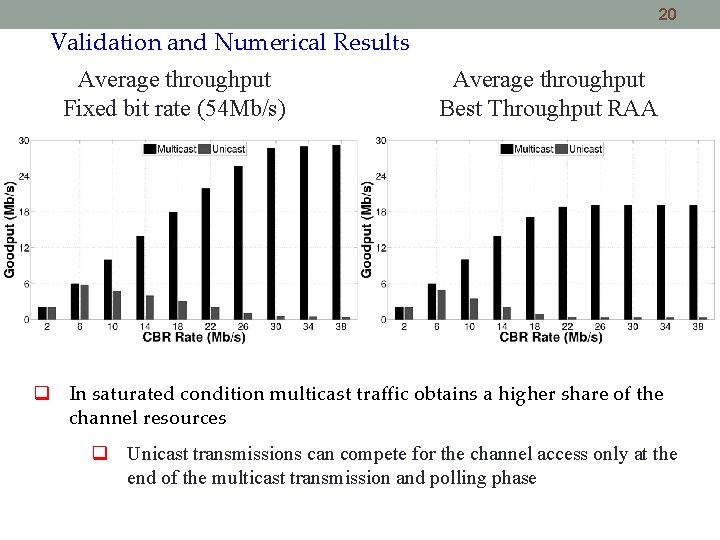
20 Validation and Numerical Results Average throughput Fixed bit rate (54 Mb/s) Average throughput Best Throughput RAA In saturated condition multicast traffic obtains a higher share of the channel resources Unicast transmissions can compete for the channel access only at the end of the multicast transmission and polling phase
21 Conclusions In 2012 IEEE introduced the 802. 11 aa protocol that enables reliable multicast We introduced a framework for the simulation of the IEEE 802. 11 aa protocol inside the NS-2 simulator Lack of commercial NICs compliant with the new protocol makes experiments extremely complex Allows to study the dynamics of the mechanisms that support reliable multicast delivery services in wireless networks The availability of feedbacks collected from receivers permits also to design a new generation of RAAs We added a set of APIs for easily integration of new RAAs with the 802. 11 aa protocol We present three working examples of possible RAAs based on the computation of the Joint Reception Probability We validated our framework by comparing results of simulations with that obtained from preliminary experiments on a real-life testbed where a prototypal firmware was used
22 References [1] IEEE 802. 11 aa document standard, http: //standards. ieee. org/getieee 802/download/802. 11 aa-2012. pdf [2] P. Salvador, L. Cominardi, F. Gringoli, P. Serrano. A first implementation and evaluation of the IEEE 802. 11 aa group addressed transmission service. ACM Computer Communication Review, 44(1), 2014. [3] The Network Simulator - NS-2, http: //www. isi. edu/nsnam/ns/ [4] N. Facchi, P. Gallo, F. Gringoli, S. Paris, I. Tinnirello, A. Capone. Flexible and Modular Support for Multicast Rate Adaptation in WLANs. Proceedings of the Future Network and Mobile Summit, Lisbon, Portugal, 3 -5 July, 2013. [5] S. Paris, N. Facchi, F. Gringoli, A. Capone. An Innovative Rate Adaptation Algorithm for Multicast Transmissions in Wireless LANs, Proceedings of the Vehicular Technology Conference, VTC 2013 Spring, Dresden, Germany, 2 -5 June, 2013. [6] The dei 80211 mr library, https: //github. com/paultsr/ns-allinone 2. 35/tree/master/dei 80211 mr-1. 1. 4