
MODELING AND SIMULATION OF COMPUTER NETWORKS AND SYSTEMS
- Slides: 30
MODELING AND SIMULATION OF COMPUTER NETWORKS AND SYSTEMS: METHODOLOGIES AND APPLICATIONS Modeling and Performance Evaluation of Resource Allocation for LTE Femtocell Networks Ying Loong Lee, Jonathan Loo and Teong Chee Chuah
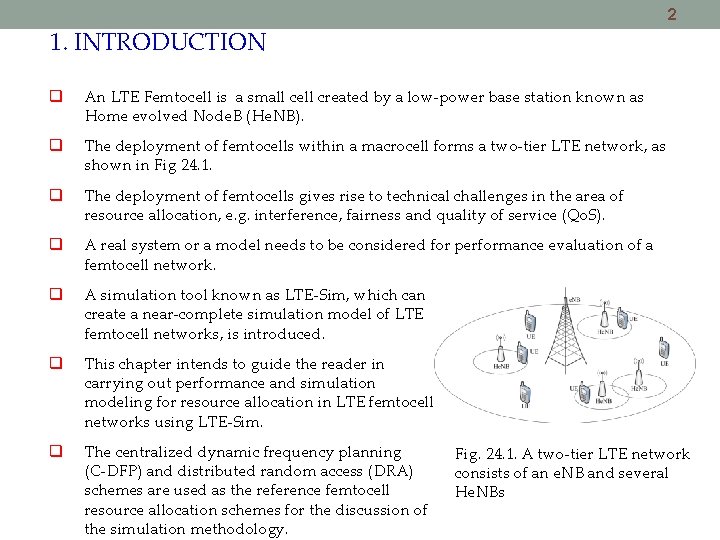
2 1. INTRODUCTION An LTE Femtocell is a small cell created by a low-power base station known as Home evolved Node. B (He. NB). The deployment of femtocells within a macrocell forms a two-tier LTE network, as shown in Fig 24. 1. The deployment of femtocells gives rise to technical challenges in the area of resource allocation, e. g. interference, fairness and quality of service (Qo. S). A real system or a model needs to be considered for performance evaluation of a femtocell network. A simulation tool known as LTE-Sim, which can create a near-complete simulation model of LTE femtocell networks, is introduced. This chapter intends to guide the reader in carrying out performance and simulation modeling for resource allocation in LTE femtocell networks using LTE-Sim. The centralized dynamic frequency planning (C-DFP) and distributed random access (DRA) schemes are used as the reference femtocell resource allocation schemes for the discussion of the simulation methodology. Fig. 24. 1. A two-tier LTE network consists of an e. NB and several He. NBs
3 2. LTE SYSTEM OVERVIEW In LTE systems, radio resource management is decentralized to e. NBs. LTE radio resources are called physical resource blocks (PRBs) which are assigned to user equipment (UE) every one transmission time interval (TTI) of 1 ms. Each PRBs consists of 7 OFDM symbols, which lasts a 0. 5 ms duration, and is a subchannel composed of 12 OFDMA subcarriers each with a 15 k. Hz bandwidth. The smallest resource unit for allocation is a PRB pair, which is referred as a resource tile. The LTE standard defines radio bearers as the logical connections or data flows established between LTE core network and the UEs. Each radio bearer carries a single type of data traffic and corresponds to a set of Qo. S parameters. The Qo. S parameters include delay budget, packet loss rate (PLR) and guaranteed bit rate (GBR).
4 3. RESOURCE ALLOCATION AMONG FEMTOCELLS There are two channel allocation methods: orthogonal and shared channel allocation. Orthogonal channel allocation split the channel bandwidth into portions with one serving the macrocell and the other serving the femtocell. Shared channel allocation allows the macrocell and femtocell to share the whole bandwidth. Unlike shared channel allocation, split channel allocation is simpler and it preserves the original advantage of resource reuse among femtocells. Femtocell resource allocation schemes can be classified into centralized and distributed approaches. The centralized approach employs a central entity to decide the resource allocation among femtocells. The distributed approach allows femtocells to individually identify the resources available based on a mechansim that allows each femtocell to share the channel. The C-DFP and DRA schemes are commonly used as the benchmark centralized and distributed schemes for performance evaluation. Both schemes assume that each PRB experiences flat and slow fading; the network is perfectly synchronized.
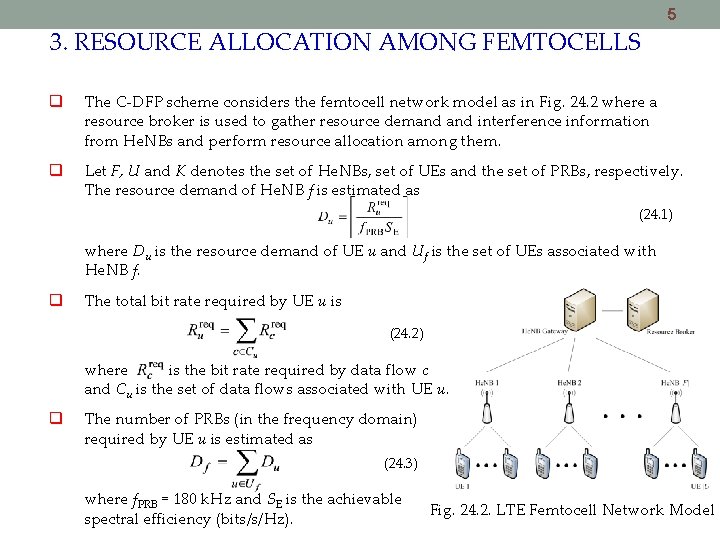
5 3. RESOURCE ALLOCATION AMONG FEMTOCELLS The C-DFP scheme considers the femtocell network model as in Fig. 24. 2 where a resource broker is used to gather resource demand interference information from He. NBs and perform resource allocation among them. Let F, U and K denotes the set of He. NBs, set of UEs and the set of PRBs, respectively. The resource demand of He. NB f is estimated as (24. 1) where Du is the resource demand of UE u and Uf is the set of UEs associated with He. NB f. The total bit rate required by UE u is (24. 2) where is the bit rate required by data flow c and Cu is the set of data flows associated with UE u. The number of PRBs (in the frequency domain) required by UE u is estimated as (24. 3) where f. PRB = 180 k. Hz and SE is the achievable spectral efficiency (bits/s/Hz). Fig. 24. 2. LTE Femtocell Network Model
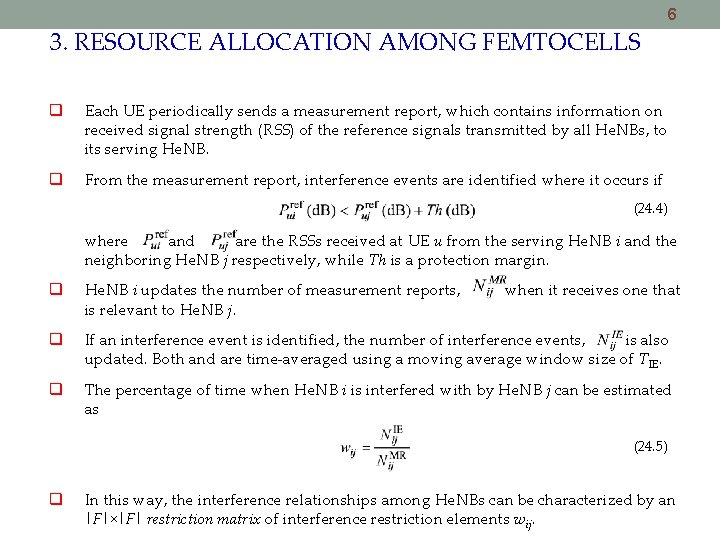
6 3. RESOURCE ALLOCATION AMONG FEMTOCELLS Each UE periodically sends a measurement report, which contains information on received signal strength (RSS) of the reference signals transmitted by all He. NBs, to its serving He. NB. From the measurement report, interference events are identified where it occurs if (24. 4) where and are the RSSs received at UE u from the serving He. NB i and the neighboring He. NB j respectively, while Th is a protection margin. He. NB i updates the number of measurement reports, is relevant to He. NB j. when it receives one that If an interference event is identified, the number of interference events, is also updated. Both and are time-averaged using a moving average window size of TIE. The percentage of time when He. NB i is interfered with by He. NB j can be estimated as (24. 5) In this way, the interference relationships among He. NBs can be characterized by an |F|×|F| restriction matrix of interference restriction elements wij.
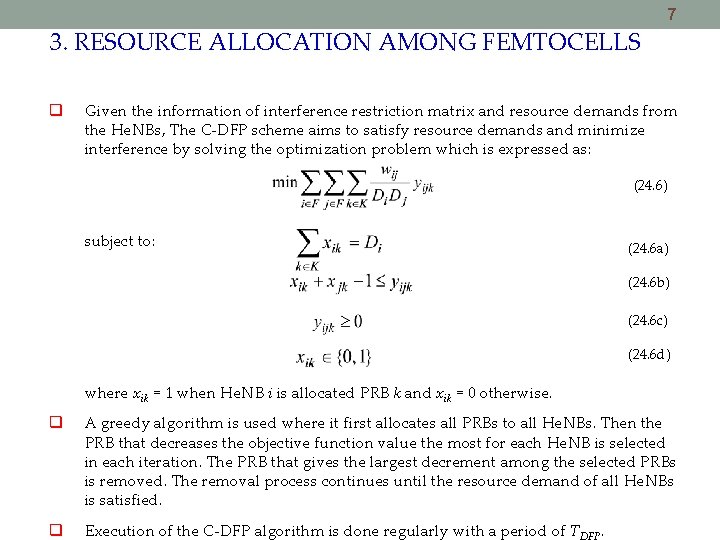
7 3. RESOURCE ALLOCATION AMONG FEMTOCELLS Given the information of interference restriction matrix and resource demands from the He. NBs, The C-DFP scheme aims to satisfy resource demands and minimize interference by solving the optimization problem which is expressed as: (24. 6) subject to: (24. 6 a) (24. 6 b) (24. 6 c) (24. 6 d) where xik = 1 when He. NB i is allocated PRB k and xik = 0 otherwise. A greedy algorithm is used where it first allocates all PRBs to all He. NBs. Then the PRB that decreases the objective function value the most for each He. NB is selected in each iteration. The PRB that gives the largest decrement among the selected PRBs is removed. The removal process continues until the resource demand of all He. NBs is satisfied. Execution of the C-DFP algorithm is done regularly with a period of TDFP.
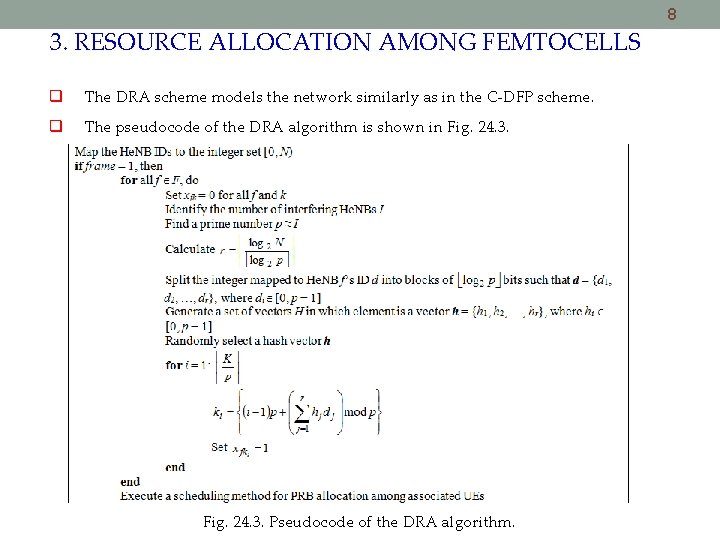
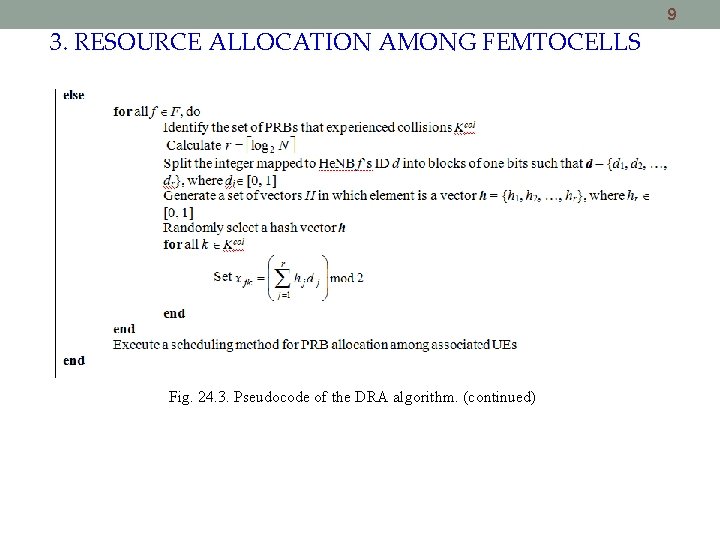
8 3. RESOURCE ALLOCATION AMONG FEMTOCELLS The DRA scheme models the network similarly as in the C-DFP scheme. The pseudocode of the DRA algorithm is shown in Fig. 24. 3. Pseudocode of the DRA algorithm.
9 3. RESOURCE ALLOCATION AMONG FEMTOCELLS Fig. 24. 3. Pseudocode of the DRA algorithm. (continued)
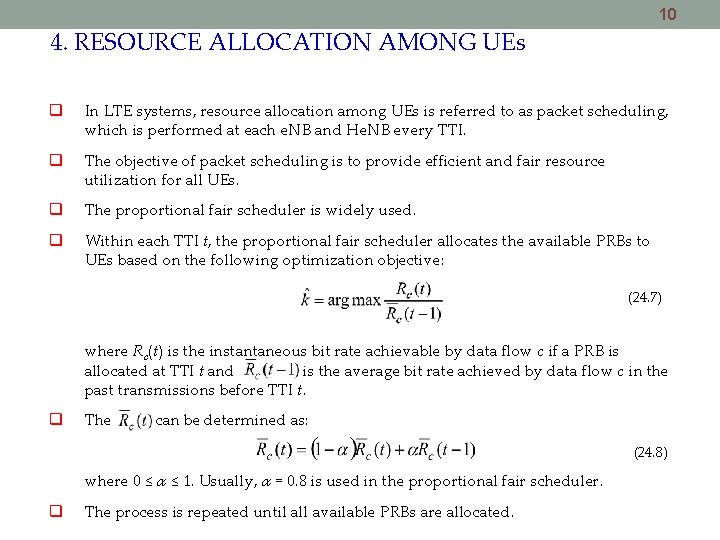
10 4. RESOURCE ALLOCATION AMONG UEs In LTE systems, resource allocation among UEs is referred to as packet scheduling, which is performed at each e. NB and He. NB every TTI. The objective of packet scheduling is to provide efficient and fair resource utilization for all UEs. The proportional fair scheduler is widely used. Within each TTI t, the proportional fair scheduler allocates the available PRBs to UEs based on the following optimization objective: (24. 7) where Rc(t) is the instantaneous bit rate achievable by data flow c if a PRB is allocated at TTI t and is the average bit rate achieved by data flow c in the past transmissions before TTI t. The can be determined as: (24. 8) where 0 ≤ α ≤ 1. Usually, α = 0. 8 is used in the proportional fair scheduler. The process is repeated until all available PRBs are allocated.
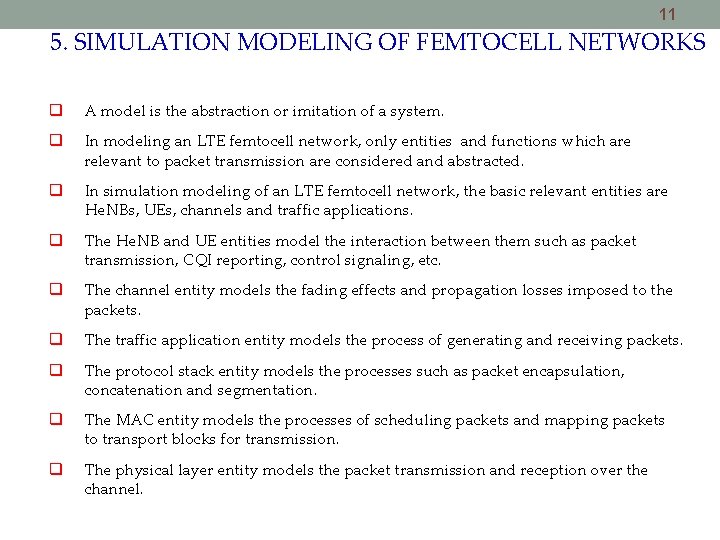
11 5. SIMULATION MODELING OF FEMTOCELL NETWORKS A model is the abstraction or imitation of a system. In modeling an LTE femtocell network, only entities and functions which are relevant to packet transmission are considered and abstracted. In simulation modeling of an LTE femtocell network, the basic relevant entities are He. NBs, UEs, channels and traffic applications. The He. NB and UE entities model the interaction between them such as packet transmission, CQI reporting, control signaling, etc. The channel entity models the fading effects and propagation losses imposed to the packets. The traffic application entity models the process of generating and receiving packets. The protocol stack entity models the processes such as packet encapsulation, concatenation and segmentation. The MAC entity models the processes of scheduling packets and mapping packets to transport blocks for transmission. The physical layer entity models the packet transmission and reception over the channel.
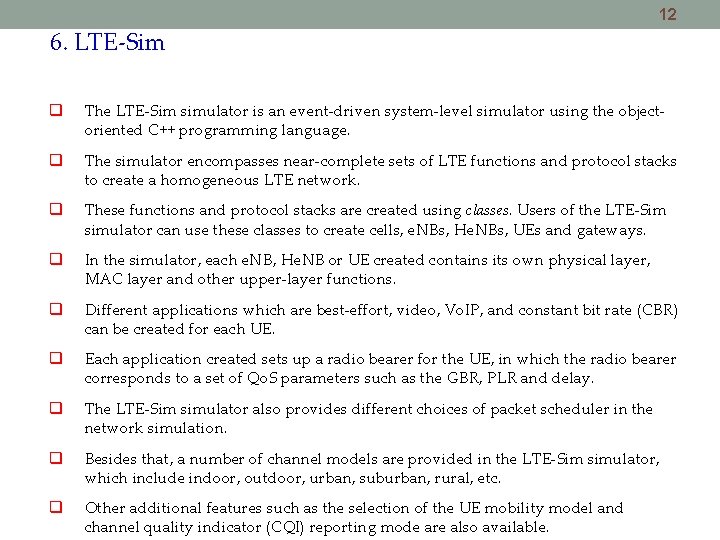
12 6. LTE-Sim The LTE-Sim simulator is an event-driven system-level simulator using the objectoriented C++ programming language. The simulator encompasses near-complete sets of LTE functions and protocol stacks to create a homogeneous LTE network. These functions and protocol stacks are created using classes. Users of the LTE-Sim simulator can use these classes to create cells, e. NBs, He. NBs, UEs and gateways. In the simulator, each e. NB, He. NB or UE created contains its own physical layer, MAC layer and other upper-layer functions. Different applications which are best-effort, video, Vo. IP, and constant bit rate (CBR) can be created for each UE. Each application created sets up a radio bearer for the UE, in which the radio bearer corresponds to a set of Qo. S parameters such as the GBR, PLR and delay. The LTE-Sim simulator also provides different choices of packet scheduler in the network simulation. Besides that, a number of channel models are provided in the LTE-Sim simulator, which include indoor, outdoor, urban, suburban, rural, etc. Other additional features such as the selection of the UE mobility model and channel quality indicator (CQI) reporting mode are also available.
13 6. SIMULATION MODELING USING LTE-Sim has defined a number of classes for modeling LTE networks. Ø The Cell and Femtocell classes are defined to create macrocell and femtocell objects. Ø Create. Building. For. Femtocells() in the Network. Manager class creates buildings and femtocells within the buildings. Ø The Bandwidth. Manager class determines the bandwidth available to the LTE network. Ø The Lte. Channel class that handles channel effects. Ø The Network. Node class contains several common functions such as packet queuing, packet transmission and packet reception. Ø The Gateway class models the traffic flows. Ø The ENode. B and He. Node. B classes store information of UEs and perform packet scheduling. Ø The User. Equipment class performs channel measurement and feedback, as well as position tracking of UEs. Ø The Lte. Phy objects associates with the channel objects. Ø The Mac. Entity class associates with the Protocol. Stack object. Ø The Application classes create Vo. IP, video, best-effort and CBR traffic. Ø The Simulator class controls the simulation. Ø the Frame. Manager class keeps count of the frame number and simulation time.
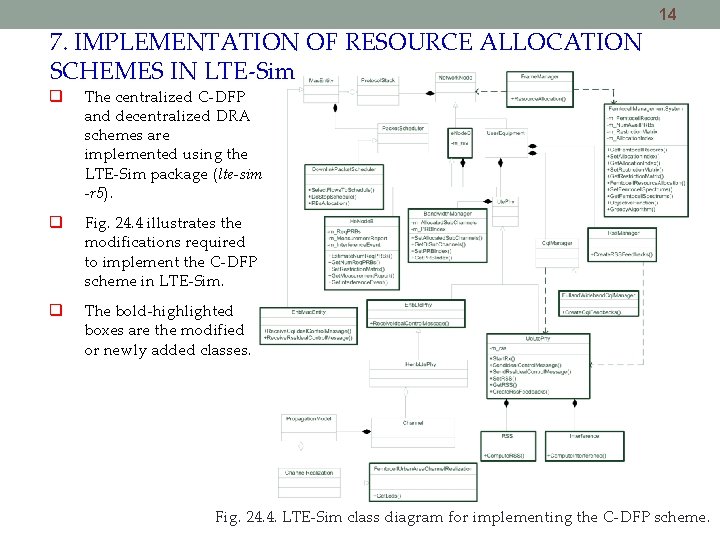
14 7. IMPLEMENTATION OF RESOURCE ALLOCATION SCHEMES IN LTE-Sim The centralized C-DFP and decentralized DRA schemes are implemented using the LTE-Sim package (lte-sim -r 5). Fig. 24. 4 illustrates the modifications required to implement the C-DFP scheme in LTE-Sim. The bold-highlighted boxes are the modified or newly added classes. Fig. 24. 4. LTE-Sim class diagram for implementing the C-DFP scheme.
15 7. IMPLEMENTATION OF RESOURCE ALLOCATION SCHEMES IN LTE-Sim Modifications for creating He. NB objects: Ø Set. Restriction. Matrix() is defined in the He. Node. B class to collect measurement reports, identify interference events and establish the restriction matrix. Ø Estimate. Num. Req. PRBs() is defined in the He. Node. B class for each He. NB to estimate the total resource demand of all of its associated UEs. Ø Bandwidth. Manager: : Set. Allocated. Sub. Channels() is used to assign the PRBs’ frequencies into m_Allocateddl. Sub. Channels. Ø Bandwidth. Manager: : Get. PRBIndex() is defined to access m_PRBIndex that stores PRBs’ indices. Ø Femtocell. Urban. Area. Channel. Realization: : Get. Loss() is modified according to the changes made in the Bandwidth. Manager class Ø Enb. Lte. Phy: : Receive. Ideal. Control. Message() is modified to recognize and forward the RSS control message and to the Enb. Mac. Entity object. Ø Enb. Mac. Entity: : Receive. Rss. Ideal. Control. Message() is added for storing the RSS information into a vector variable in the ENode. B class. Ø Enb. Mac. Entity: : Receive. Cqi. Ideal. Control. Message() is modified for receiving the subband wideband CQI values. Ø The variables that store the subband wideband CQI values, RSS values, and functions that assign these variables are added into the ENode. B class.
16 7. IMPLEMENTATION OF RESOURCE ALLOCATION SCHEMES IN LTE-Sim Modifications for creating UE objects: Ø The Fulland. Wideband. Cqi. Manager class is defined by inheriting the Cqi. Manager class to estimate subband wideband CQIs. Ø The Rss. Manager class is defined to report the RSS information to its serving He. Node. B object. Ø The Received. Signal. Strength class is created to calculate RSSs. Ø The Rss. Ideal. Control. Message class is defined for RSS signaling. Ø The Interference class is modified based on the changes made in the Bandwidth. Manager class. Modifications for creating a resource broker object: Ø The Femtocell. Management. System class is added in LTE-Sim, which contains: § Objective. Function() – To evaluate the objective function in the C-DFP scheme § Greedy. Algorithm() – Runs the greedy algorithm in the C-DFP scheme. § Set. Restriction. Matrix() – Used in calculating the objective function value. § Set. Femtocell. Spectrums() – Allocate PRBs to each associated He. NB. The Downlink. Packet. Scheduler class is modified such that it uses the subband CQI values for PRB allocation among UEs. A modification is done on Frame. Manager: : Resource. Allocation() to periodically performs the C-DFP scheme.
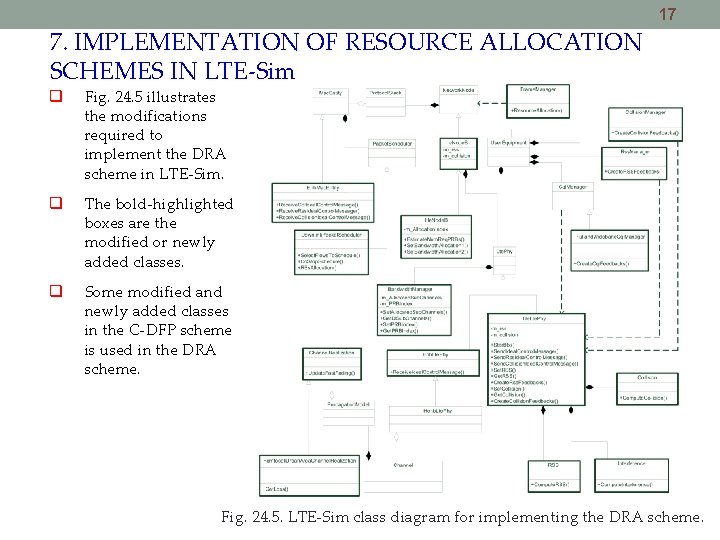
17 7. IMPLEMENTATION OF RESOURCE ALLOCATION SCHEMES IN LTE-Sim Fig. 24. 5 illustrates the modifications required to implement the DRA scheme in LTE-Sim. The bold-highlighted boxes are the modified or newly added classes. Some modified and newly added classes in the C-DFP scheme is used in the DRA scheme. Fig. 24. 5. LTE-Sim class diagram for implementing the DRA scheme.
18 7. IMPLEMENTATION OF RESOURCE ALLOCATION SCHEMES IN LTE-Sim Modifications for creating He. NB objects: Ø The m_collision variable is declared in the ENode. B class to store the collision information obtained from UEs. Ø Enb. Lte. Phy: : Receive. Ideal. Control. Message() is modified to receive the collision information from UEs, which is forwarded to the Enb. Mac. Entity object. Ø . He. Node. B: : Set. Bandwidth. Allocation() – Perform the resource allocation algorithm in the first frame. Ø He. Node. B: : Set. Bandwidth. Allocation 2() – Performs the resource allocation algorithm to avoid collisions. Modifications for creating UE objects Ø The Collision class is created to identify packet collisions. Ø The Collision. Manager class is created to report PRBs that suffer from collisions. Ø The Collision. Ideal. Control. Message class is defined for sending control signals carrying the collision information. Modifications in the Frame Manager class: Ø the Frame. Manager: : Resource. Allocation() function is modified such that it calls § He. Node. B: : Set. Bandwidth. Allocation 1() during the first LTE frame. § He. Node. B: : Set. Bandwidth. Allocation 2() after the first LTE frame to avoid packet collisions.
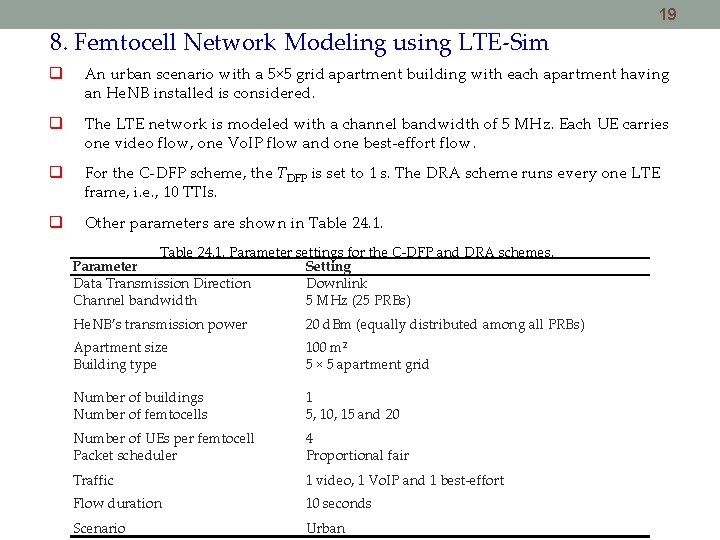
19 8. Femtocell Network Modeling using LTE-Sim An urban scenario with a 5× 5 grid apartment building with each apartment having an He. NB installed is considered. The LTE network is modeled with a channel bandwidth of 5 MHz. Each UE carries one video flow, one Vo. IP flow and one best-effort flow. For the C-DFP scheme, the TDFP is set to 1 s. The DRA scheme runs every one LTE frame, i. e. , 10 TTIs. Other parameters are shown in Table 24. 1. Parameter settings for the C-DFP and DRA schemes. Parameter Setting Data Transmission Direction Downlink Channel bandwidth 5 MHz (25 PRBs) He. NB’s transmission power 20 d. Bm (equally distributed among all PRBs) Apartment size Building type 100 m 2 5 × 5 apartment grid Number of buildings Number of femtocells 1 5, 10, 15 and 20 Number of UEs per femtocell Packet scheduler 4 Proportional fair Traffic 1 video, 1 Vo. IP and 1 best-effort Flow duration 10 seconds Scenario Urban
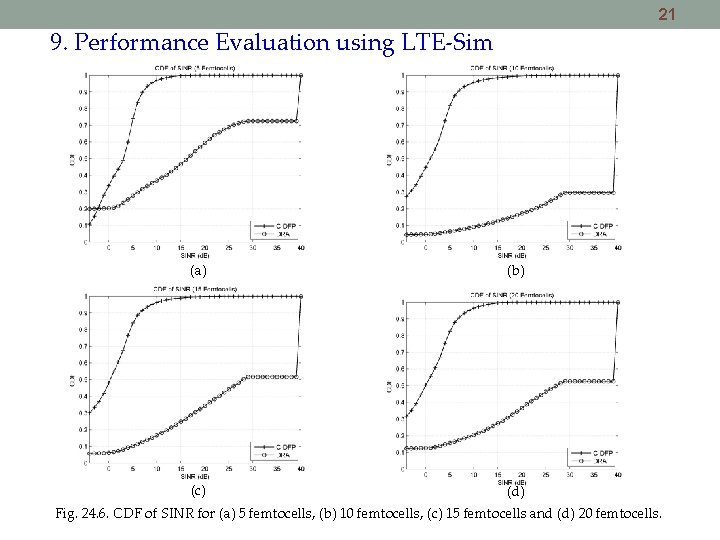
20 9. Performance Evaluation using LTE-Sim For each LTE-Sim simulation, an output trace file that contains transmission information such as packet ID, type of packet, packet size, source ID, destination ID, packet head of line delay, etc. is generated. Four main evaluation tools are available to evaluate throughput, PLR, delay and Jain’s fairness index of a simulated LTE network. The downlink SINRs is used as the performance metric for representing the channel condition. The downlink SINR can be obtained in the LTE-Sim simulator by uncommenting the line, i. e. , “#define TEST_DL_SINR” in the global_config file in the LTE-Sim folder. The SINR values can be collected as a cumulative distribution function (CDF) graph, as shown in Fig. 24. 6 shows the CDFs of SINR achieved by both the C-DFP and DRA schemes for 5, 10, 15 and 20 femtocells. The DRA scheme demonstrates a better SINR performance than the C-DFP scheme. As the DRA scheme has a feature that stops a He. NB from transmitting on the PRB that encounters packet collisions, interference is greatly reduced.
21 9. Performance Evaluation using LTE-Sim (a) (b) (c) (d) Fig. 24. 6. CDF of SINR for (a) 5 femtocells, (b) 10 femtocells, (c) 15 femtocells and (d) 20 femtocells.
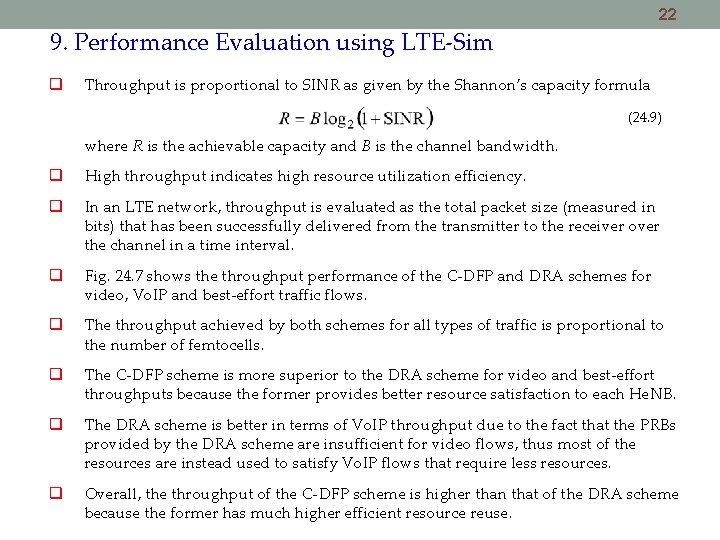
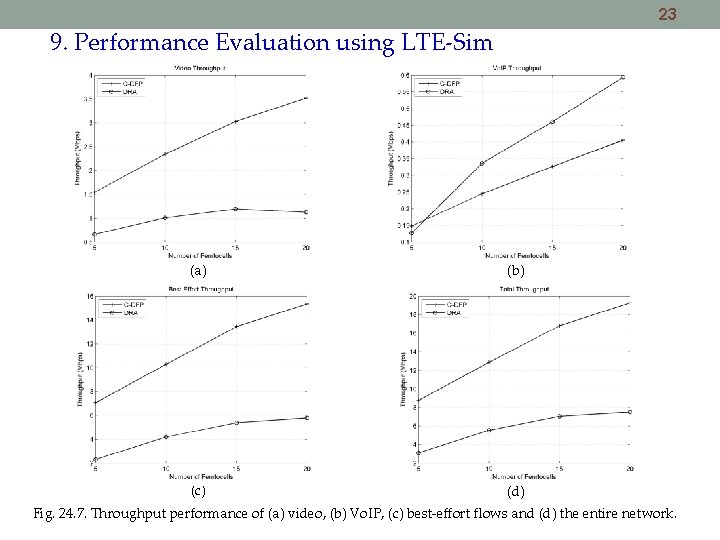
22 9. Performance Evaluation using LTE-Sim Throughput is proportional to SINR as given by the Shannon’s capacity formula (24. 9) where R is the achievable capacity and B is the channel bandwidth. High throughput indicates high resource utilization efficiency. In an LTE network, throughput is evaluated as the total packet size (measured in bits) that has been successfully delivered from the transmitter to the receiver over the channel in a time interval. Fig. 24. 7 shows the throughput performance of the C-DFP and DRA schemes for video, Vo. IP and best-effort traffic flows. The throughput achieved by both schemes for all types of traffic is proportional to the number of femtocells. The C-DFP scheme is more superior to the DRA scheme for video and best-effort throughputs because the former provides better resource satisfaction to each He. NB. The DRA scheme is better in terms of Vo. IP throughput due to the fact that the PRBs provided by the DRA scheme are insufficient for video flows, thus most of the resources are instead used to satisfy Vo. IP flows that require less resources. Overall, the throughput of the C-DFP scheme is higher than that of the DRA scheme because the former has much higher efficient resource reuse.
23 9. Performance Evaluation using LTE-Sim (a) (b) (c) (d) Fig. 24. 7. Throughput performance of (a) video, (b) Vo. IP, (c) best-effort flows and (d) the entire network.
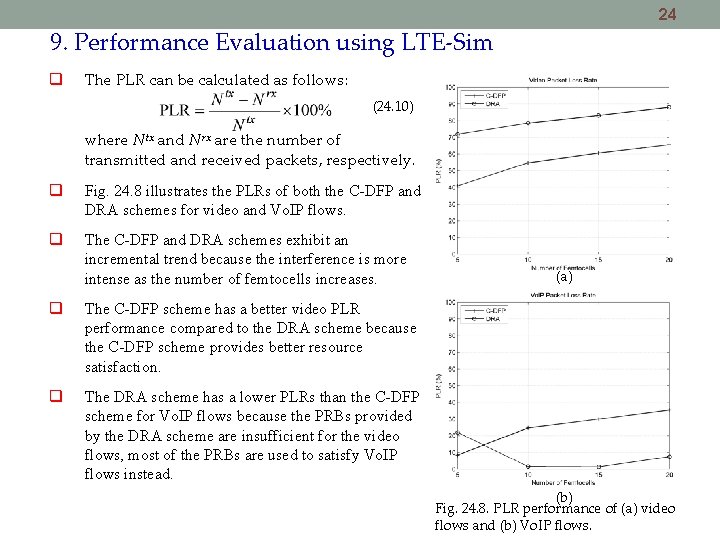
24 9. Performance Evaluation using LTE-Sim The PLR can be calculated as follows: (24. 10) where Ntx and Nrx are the number of transmitted and received packets, respectively. Fig. 24. 8 illustrates the PLRs of both the C-DFP and DRA schemes for video and Vo. IP flows. The C-DFP and DRA schemes exhibit an incremental trend because the interference is more intense as the number of femtocells increases. The C-DFP scheme has a better video PLR performance compared to the DRA scheme because the C-DFP scheme provides better resource satisfaction. The DRA scheme has a lower PLRs than the C-DFP scheme for Vo. IP flows because the PRBs provided by the DRA scheme are insufficient for the video flows, most of the PRBs are used to satisfy Vo. IP flows instead. (a) (b) Fig. 24. 8. PLR performance of (a) video flows and (b) Vo. IP flows.
25 9. Performance Evaluation using LTE-Sim The head of line (HOL) delay refers to the interval between the time the first packet to be transmitted pending at the packet transmission queue and the time it is received by the UE. To quantify the overall delay performance of a resource allocation scheme, all packet delays can be collected and plotted as a CDF. Fig. 24. 9 illustrates the CDFs of packet delay achieved by both the C-DFP and DRA schemes for video and Vo. IP flows. The C-DFP scheme has a higher CDF curve compared to that of the DRA scheme for video flows, which implies that more video packets received suffer from higher delays under the DRA scheme. In terms of Vo. IP packet delay, the DRA scheme outperforms the C-DFP scheme. The packet delay performance of the DRA scheme gradually deteriorates as the number of femtocells increases due to the fact that the contention of getting PRBs among large numbers of UEs (as a result of large numbers of femtocells) is more intense. The C-DFP scheme can maintain a relatively constant delay performance mainly due to its feature whereby each He. NB receives sufficient PRBs according to its demand.
26 9. Performance Evaluation using LTE-Sim (a) (b) (c) (d) Fig. 24. 9. CDF of packet delay for (a) 5, (b) 10, (c) 15 and (d) 20 femtocells.
27 9. Performance Evaluation using LTE-Sim Jain’s fairness index is a widely known metric used for evaluating the fairness of resource allocation among traffic flows, which is defined as (24. 11) where C is the set of all data flows, i. e. , C = {1, 2, …, |C|}. The fairness performance of both the C-DFP and DRA schemes for video, Vo. IP and best-effort flows are illustrated in Fig. 24. 10. The C-DFP scheme outperforms the DRA scheme for video flows because the CDFP scheme works by satisfying the resource demands of all He. NBs, allowing each He. NB to obtain sufficient PRBs for video packet transmission whereas the DRA scheme aims to avoid interference only. The DRA scheme has better fairness performance for Vo. IP and best-effort flows compared to the C-DFP scheme because the PRBs provided by the DRA scheme are insufficient to satisfy the video flows since video packets are more resource demanding. Thus, most of the PRBs are used to satisfy Vo. IP and best-effort flows that require less resources. The fairness performance of the C-DFP scheme deteriorates as the number of femtocells increases due to the increased interference among the He. NBs. Similar trends are observed in the fairness performance of video and best-effort flows under the DRA scheme.
28 9. Performance Evaluation using LTE-Sim (a) (b) (c) Fig. 24. 10. Fairness performance of (a) video, (b) Vo. IP and (c) best-effort flows.
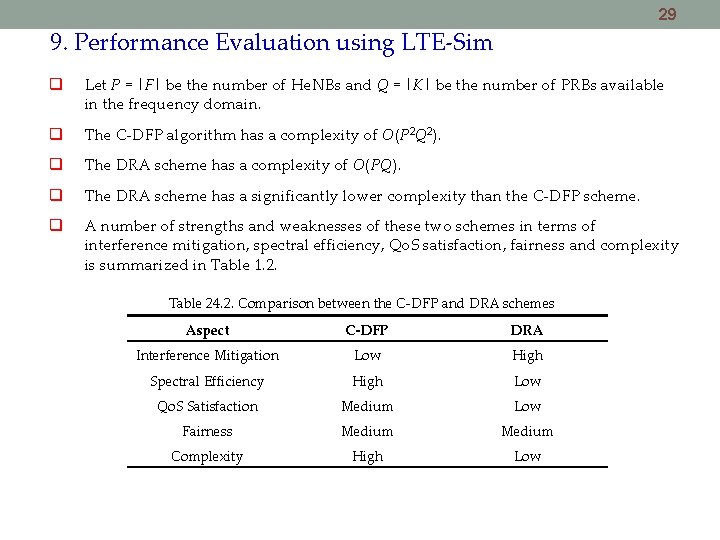
29 9. Performance Evaluation using LTE-Sim Let P = |F| be the number of He. NBs and Q = |K| be the number of PRBs available in the frequency domain. The C-DFP algorithm has a complexity of O(P 2 Q 2). The DRA scheme has a complexity of O(PQ). The DRA scheme has a significantly lower complexity than the C-DFP scheme. A number of strengths and weaknesses of these two schemes in terms of interference mitigation, spectral efficiency, Qo. S satisfaction, fairness and complexity is summarized in Table 1. 2. Table 24. 2. Comparison between the C-DFP and DRA schemes Aspect C-DFP DRA Interference Mitigation Low High Spectral Efficiency High Low Qo. S Satisfaction Medium Low Fairness Medium Complexity High Low
30 10. Conclusion The complexity of advanced wireless communication systems is a driving force behind the widespread use of simulation modeling. This chapter illustrates the use of a modern simulation tool to conduct simulation modeling and performance evaluation for resource allocation schemes in LTE femtocell networks. An overview of LTE systems, a centralized and a distributed femtocell resource allocation schemes are provided. LTE-Sim is introduced. Performance evaluation of the two schemes in terms of some performance metrics such as interference, throughput, packet loss, delay and fairness are demonstrated. Acomplexity analysis on the resource allocation schemes has been made. The strengths and weaknesses of the resource allocation schemes are interpreted from the computer simulation results obtained.