
Modeling and Predictive Control Strategies in Buildings with

Modeling and Predictive Control Strategies in Buildings with Mixed-Mode Cooling Jianjun Hu, Panagiota Karava School of Civil Engineering (Architectural Engineering Group) Purdue University
Background - Mixed-Mode Cooling Ø Hybrid approach for space conditioning; Ø Combination of natural ventilation, driven by wind or thermal buoyancy forces, and mechanical systems; Ø “Intelligent” controls to optimize mode switching q minimize building energy use and maintain occupant thermal comfort. 2
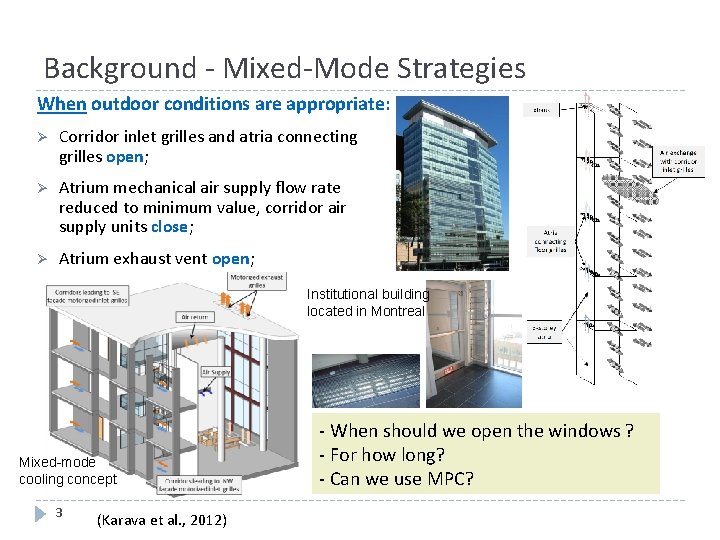
Background - Mixed-Mode Strategies When outdoor conditions are appropriate: Ø Corridor inlet grilles and atria connecting grilles open; Ø Atrium mechanical air supply flow rate reduced to minimum value, corridor air supply units close; Ø Atrium exhaust vent open; Institutional building located in Montreal Mixed-mode cooling concept 3 (Karava et al. , 2012) - When should we open the windows ? - For how long? - Can we use MPC?
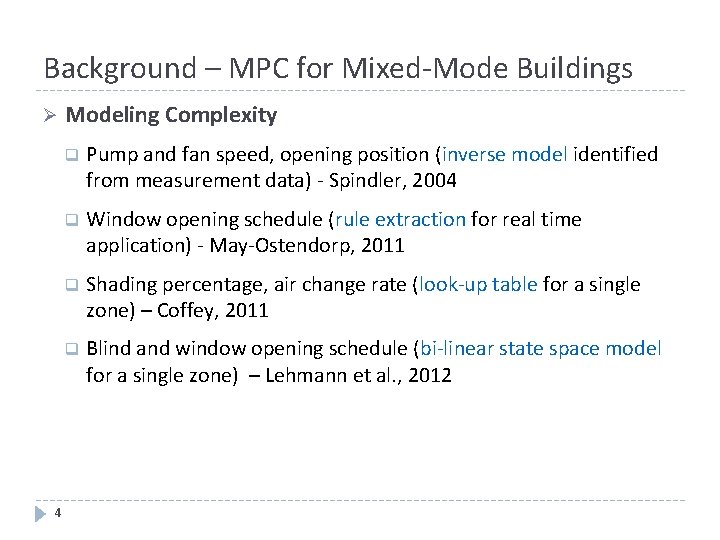
Background – MPC for Mixed-Mode Buildings Ø 4 Modeling Complexity q Pump and fan speed, opening position (inverse model identified from measurement data) - Spindler, 2004 q Window opening schedule (rule extraction for real time application) - May-Ostendorp, 2011 q Shading percentage, air change rate (look-up table for a single zone) – Coffey, 2011 q Blind and window opening schedule (bi-linear state space model for a single zone) – Lehmann et al. , 2012
Objectives Ø Develop model-predictive control strategies for multi-zone buildings with mixed-mode cooling, high solar gains, and exposed thermal mass. q Switching modes of operation for space cooling (window schedule, fan assist, night cooling, HVAC) q Coordinated shading control 5

MPC: Problem Formulation Thermal Dynamic Model: Nonlinear Discrete Control Variables: Open/Close (1/0) Offline MPC (deterministic); baseline simulation study for a mixed-mode building Linearized prediction models (state-space) Algorithms for discrete optimization On-line MPC (implementation, identification, uncertainty) 6 Operable vents
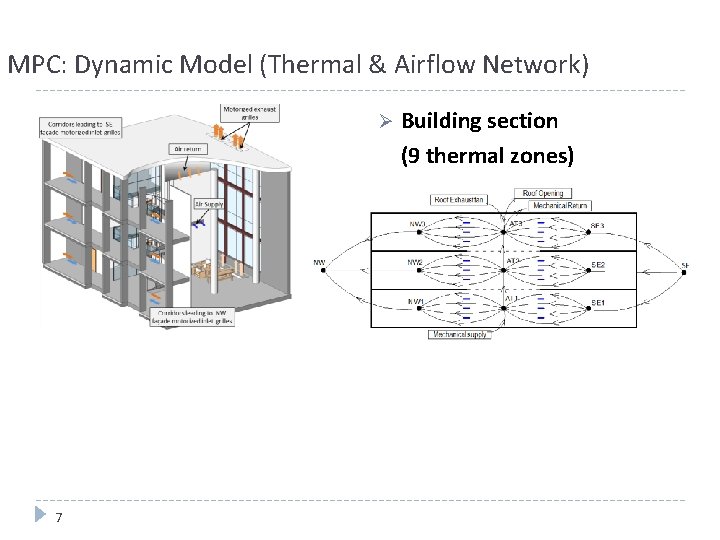
MPC: Dynamic Model (Thermal & Airflow Network) Ø 7 Building section (9 thermal zones)
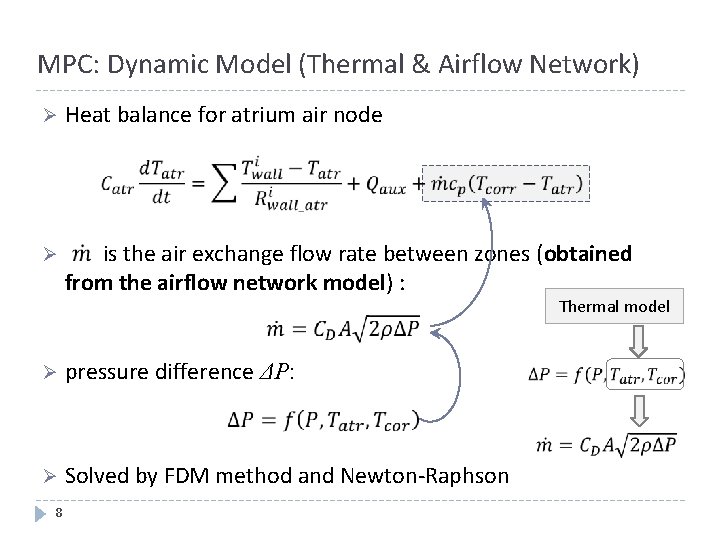
MPC: Dynamic Model (Thermal & Airflow Network) Ø Heat balance for atrium air node is the air exchange flow rate between zones (obtained from the airflow network model) : Ø Thermal model Ø pressure difference ΔP: Ø 8 Solved by FDM method and Newton-Raphson
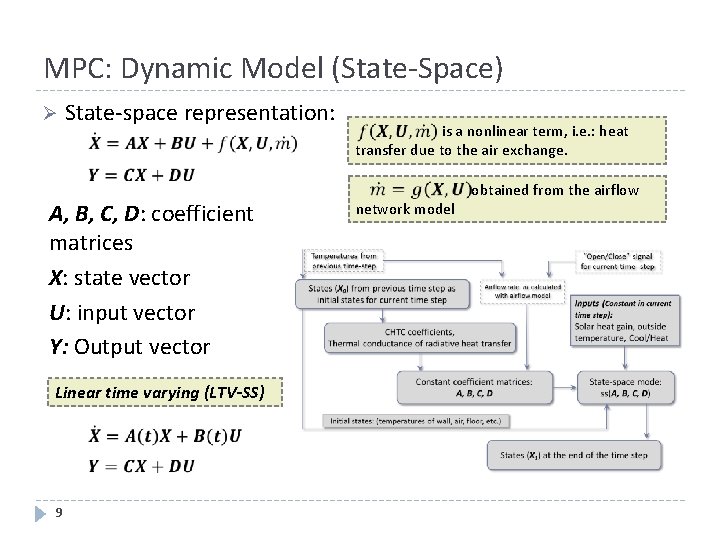
MPC: Dynamic Model (State-Space) Ø State-space representation: A, B, C, D: coefficient matrices X: state vector U: input vector Y: Output vector Linear time varying (LTV-SS) 9 is a nonlinear term, i. e. : heat transfer due to the air exchange. network model obtained from the airflow
![MPC: Dynamic Model (State-Space) States (X): X = [Ti , Tij, k]T q i](http://slidetodoc.com/presentation_image/2999c4dae5e6d66ea9b49efa275ed277/image-10.jpg "MPC: Dynamic Model (State-Space) States (X): X = [Ti , Tij, k]T q i")
MPC: Dynamic Model (State-Space) States (X): X = [Ti , Tij, k]T q i – zone index q j – wall index q k – mass node index Inputs (U): U = [Tout, Sij, Load]T q Tout – outside air temperature; q Sij – solar radiation on surfaces ij; q Load – heating/cooling load; Outputs (Y): Y= [Ti , Tij, k]T q Zone air temperature; q Wall temperature; q ………… 10
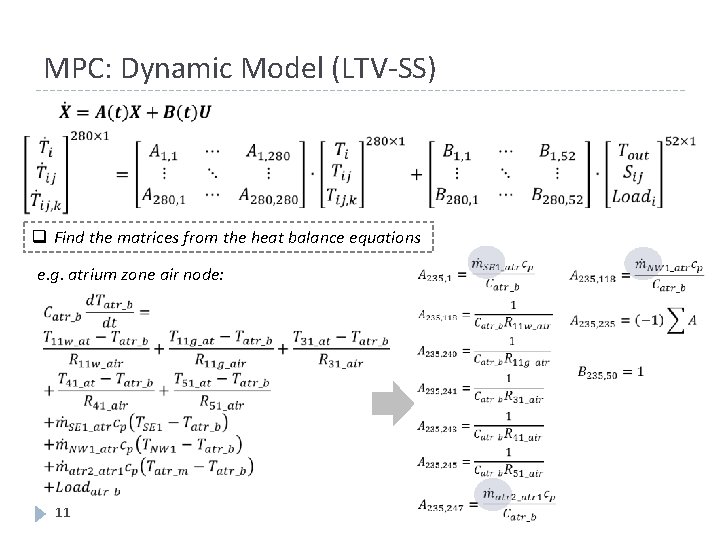
MPC: Dynamic Model (LTV-SS) q Find the matrices from the heat balance equations e. g. atrium zone air node: 11

MPC: Control Variable, Cost Function, and Constraints Ø Control variable: operation schedule Ø Cost function: Min: where: E is the energy consumption; IOt is vector of binary (open/close) decisions for the motorized envelope openings Ø Constraints: q q 12 Operative temperature within comfort range (23 -27. 6 °C, which corresponds to PPD of 10%) during occupancy hours; Use minimal amount of energy: cooling/heating (set point during occupancy hours 8: 00 -18: 00 is 21 -23 ˚C, during unoccupied hours is 13 -30 °C); Dew point temperature should be lower than 13. 5 °C (ASHRAE 90. 1); Wind speed should be lower than 7. 5 m/s.
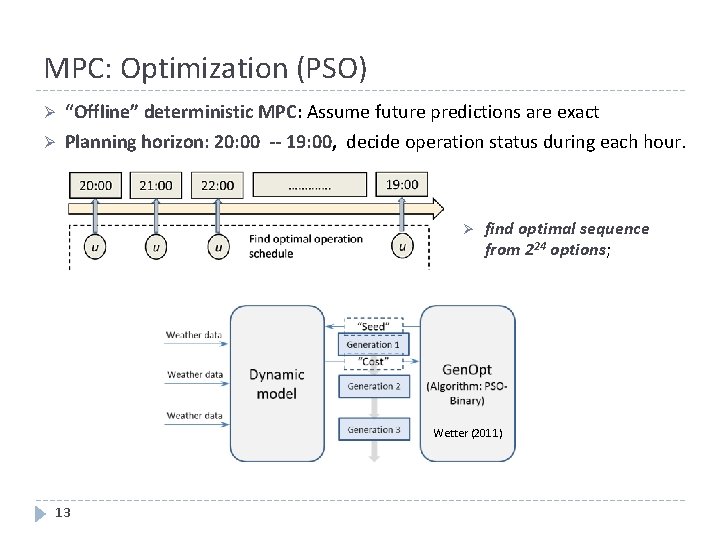
MPC: Optimization (PSO) Ø “Offline” deterministic MPC: Assume future predictions are exact Ø Planning horizon: 20: 00 -- 19: 00, decide operation status during each hour. Ø find optimal sequence from 224 options; Wetter (2011) 13
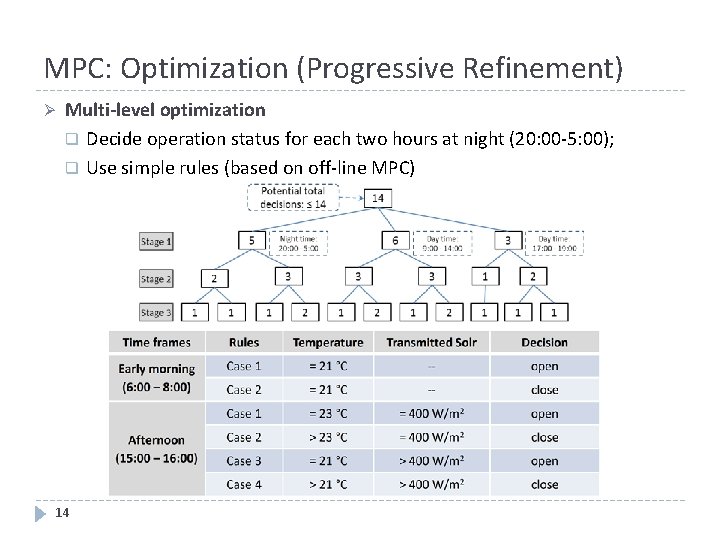
MPC: Optimization (Progressive Refinement) Ø Multi-level optimization q Decide operation status for each two hours at night (20: 00 -5: 00); q Use simple rules (based on off-line MPC) 14
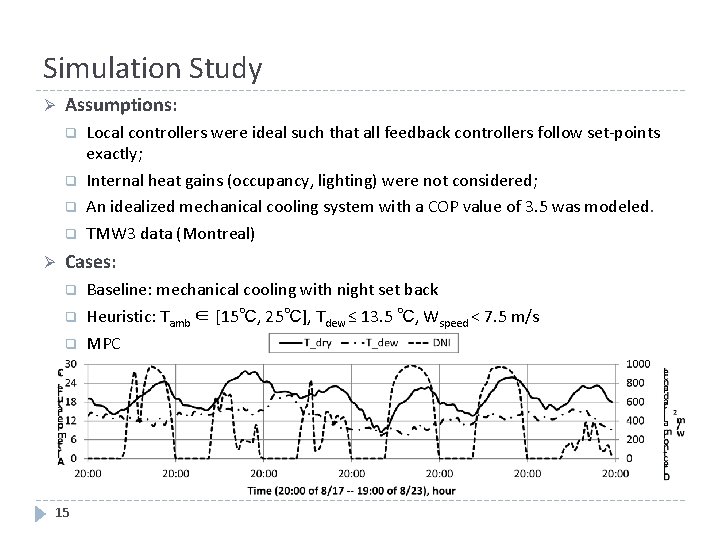
Simulation Study Ø Assumptions: q q Ø Local controllers were ideal such that all feedback controllers follow set-points exactly; Internal heat gains (occupancy, lighting) were not considered; An idealized mechanical cooling system with a COP value of 3. 5 was modeled. TMW 3 data (Montreal) Cases: q q q 15 Baseline: mechanical cooling with night set back Heuristic: Tamb ∈ [15℃, 25℃], Tdew ≤ 13. 5 ℃, Wspeed < 7. 5 m/s MPC
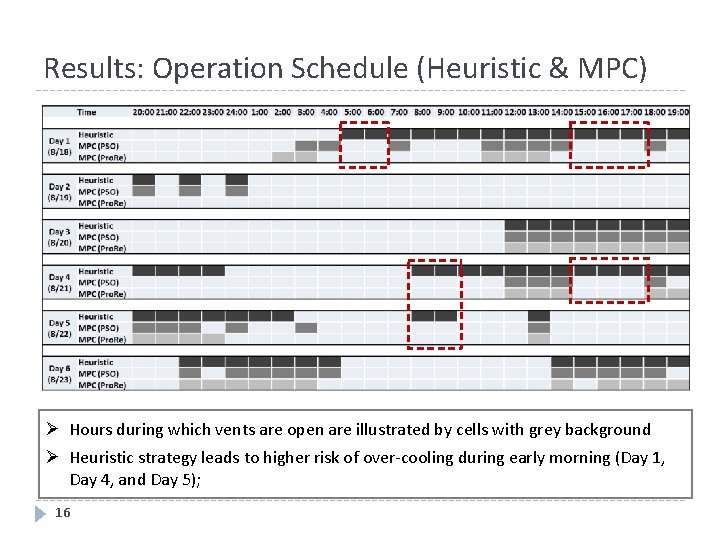
Results: Operation Schedule (Heuristic & MPC) Ø Hours during which vents are open are illustrated by cells with grey background Ø Heuristic strategy leads to higher risk of over-cooling during early morning (Day 1, Day 4, and Day 5); 16
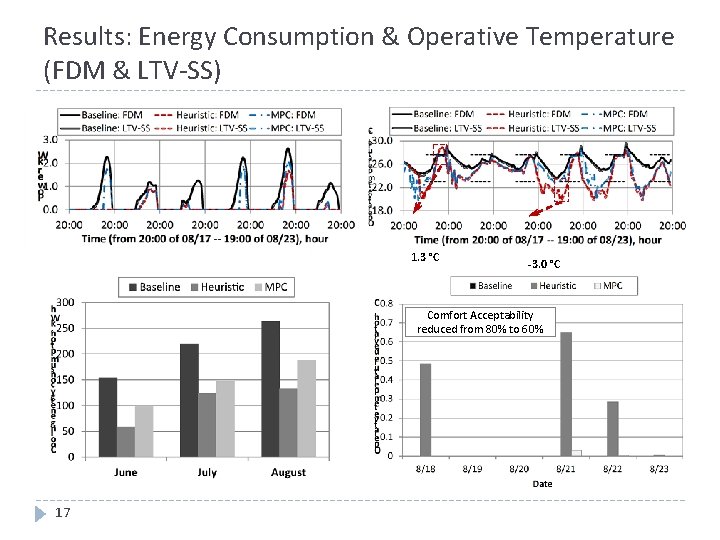
Results: Energy Consumption & Operative Temperature (FDM & LTV-SS) 1. 3 °C -3. 0 °C Comfort Acceptability reduced from 80% to 60% 17
Results: MPC with PSO and Progressive Refinement (Pro. Re) Ø Similar energy consumption and operative temperature; Ø Much faster calculation with Pro. Re; 3 Days 3 Hours 18
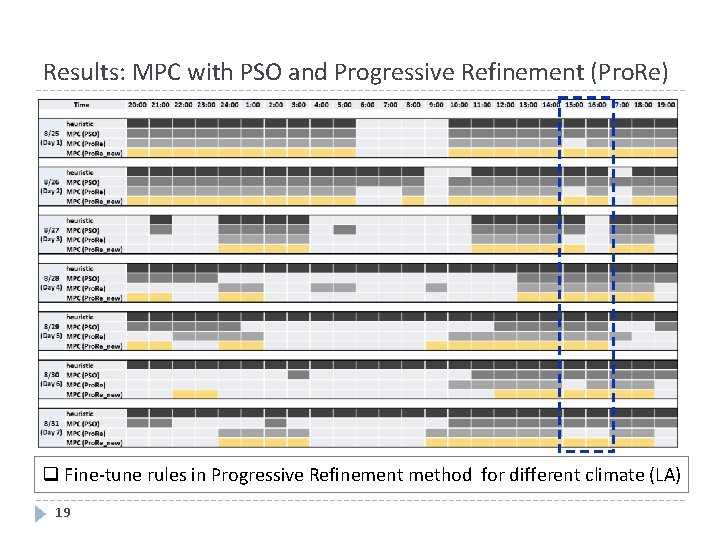
Results: MPC with PSO and Progressive Refinement (Pro. Re) q Fine-tune rules in Progressive Refinement method for different climate (LA) 19
Conclusions Ø For the simulation period considered in the present study, mixed-mode cooling strategies (MPC and heuristic) effectively reduced building energy consumption. Ø The heuristic strategy can lead to a mean operative temperature deviation up to 0. 7 °C, which may decrease the comfort acceptability from 80% to 60%. The predictive control strategy maintained the operative temperature in desired range. Ø The linear time-variant state-space model can predict thermal dynamics of the mixed-mode building with good accuracy. Ø The progressive refinement optimization method can find similar optimal decisions with the PSO algorithm but with significantly lower computational effort. 20
Acknowledgement Ø This work is funded by the Purdue Research Foundation and the Energy Efficient Buildings Hub, an energy innovation HUB sponsored by the Department of Energy under Award Number DEEE 0004261. Ø In kind support is provided from Kawneer/Alcoa, FFI Inc. , and Automated Logic Corporation 21
- Slides: 21