
MODELING AND AGGREGATION OF COMPLEX ANNOTATIONS Alex Braylan
MODELING AND AGGREGATION OF COMPLEX ANNOTATIONS Alex Braylan University of Texas at Austin 1

OUTLINE BACKGROUND MY WORK • Annotation aggregation • Contributions • Probabilistic models of annotation • Motivation: complex annotations • Problem statement • Annotation distances • Probabilistic Model • Simple Methods • Existing approaches • Experiments • Challenges • Results • Discussion 2

BACKGROUND 3
ANNOTATION AGGREGATION DATA SPECIFICATION QUALITY CONTROL • Workers (Users, Annotators) • Measuring consensus • Items • Unobserved truth (gold value) • Assumed to be objective not subjective • Annotations (Labels) • At least one per item • At most #workers per item • Majority vote • Measuring worker reliability • “Honeypot” questions • Aggregation Models • Dawid-Skene (1979): consensus and reliability • Zen. Crowd (Demartini et al 2012) • GLAD: consensus, reliability, and difficulty (Whitehill et al 2009) 4
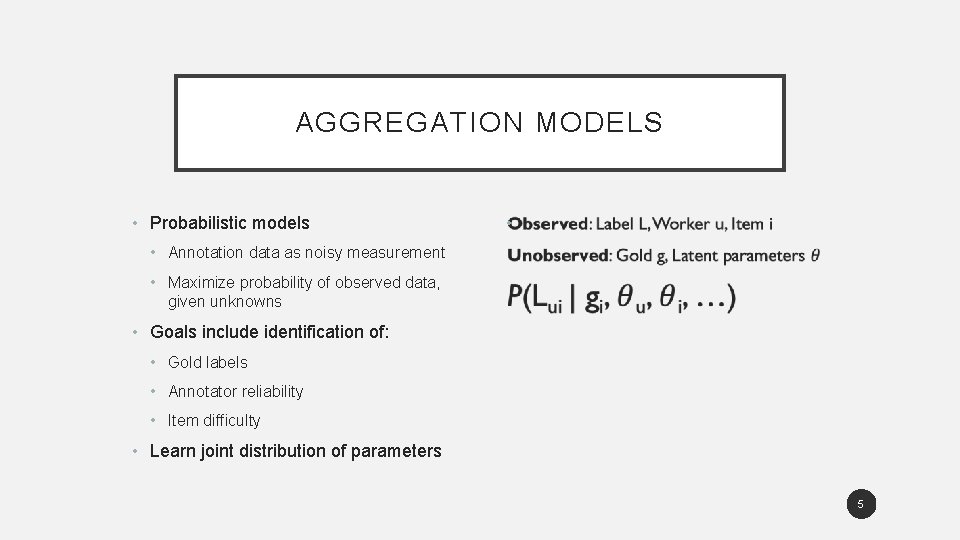
AGGREGATION MODELS • Probabilistic models • • Annotation data as noisy measurement • Maximize probability of observed data, given unknowns • Goals include identification of: • Gold labels • Annotator reliability • Item difficulty • Learn joint distribution of parameters 5
FROM SIMPLE TO COMPLEX LABELS SIMPLE LABELS EXAMPLES MORE COMPLEX ANNOTATIONS? • Label sentiment of text • Classify object in image • Label spam email • Judge relevance of search results • Categorize medical conditions 6
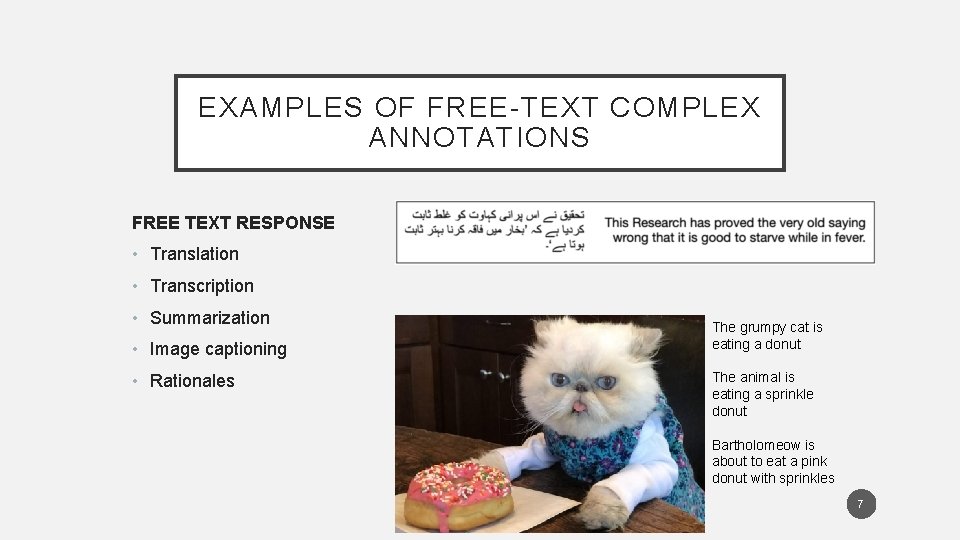
EXAMPLES OF FREE-TEXT COMPLEX ANNOTATIONS FREE TEXT RESPONSE • Translation • Transcription • Summarization • Image captioning • Rationales The grumpy cat is eating a donut The animal is eating a sprinkle donut Bartholomeow is about to eat a pink donut with sprinkles 7
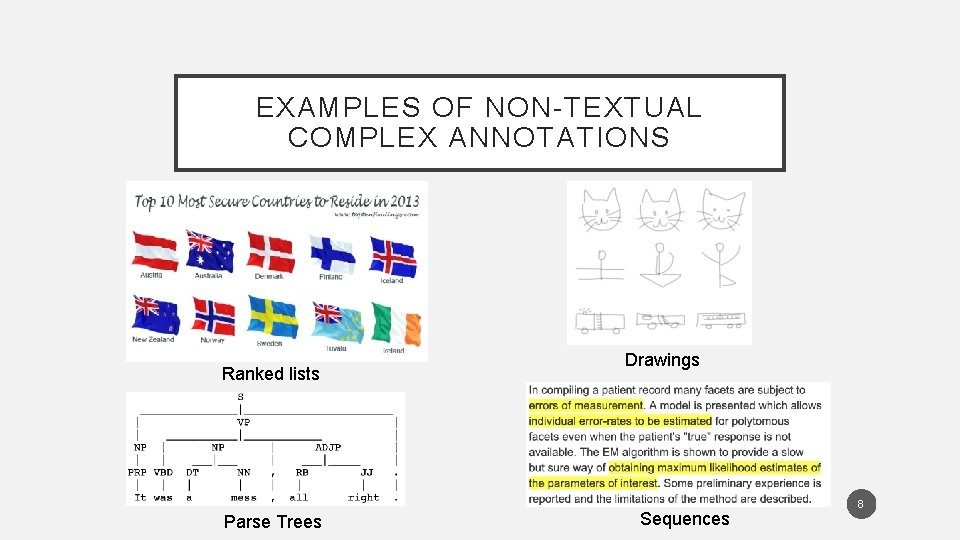
EXAMPLES OF NON-TEXTUAL COMPLEX ANNOTATIONS Ranked lists Parse Trees Drawings Sequences 8
EXISTING PROBABILISTIC MODELS FOR COMPLEX ANNOTATIONS? • Arbitrarily complex data type • Usually cannot be decomposed into simpler ones • Often involve very large or infinite space of possible values • # of workers is usually << size of annotation space • Therefore, less likely to get identical annotations • Aggregation models for simple labels require exact consensus between labels • Bespoke, task-specific models such as: • Sequence modeling (Nguyen et al 2017) • Math problems (Lin, Mausam, and Weld 2012) 9
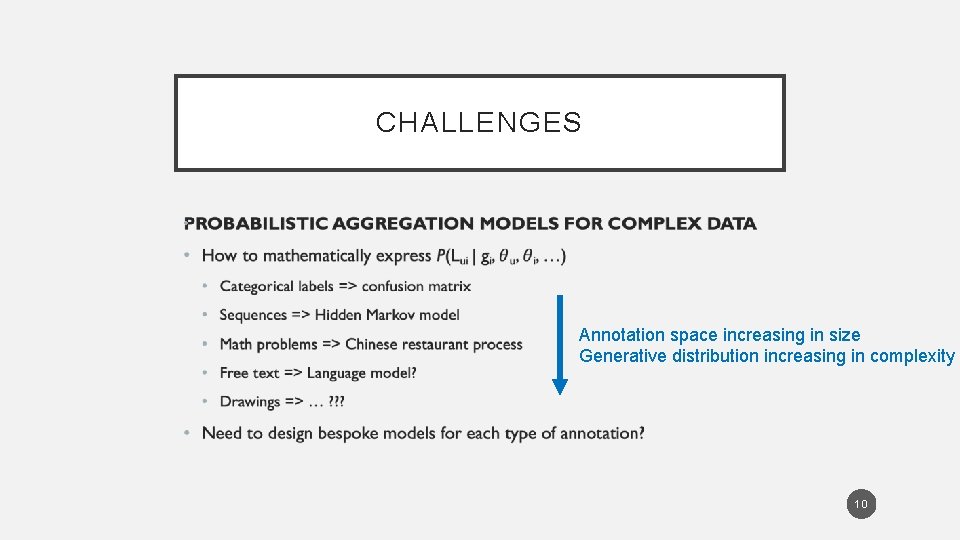
CHALLENGES • Annotation space increasing in size Generative distribution increasing in complexity 10

MY WORK SO FAR 11
GOALS FOR MODELING COMPLEX ANNOTATIONS • We want aggregation models for complex data types • Not just for crowd but anyone who might make mistakes – including experts • Probabilistic models of complex data types are difficult to formulate • Prefer to work with models whose inputs, outputs, and parameters are basic data types like integers, floats, and vectors • Models should be applicable generally across many kinds of tasks • Need method for converting problem to common state space 12
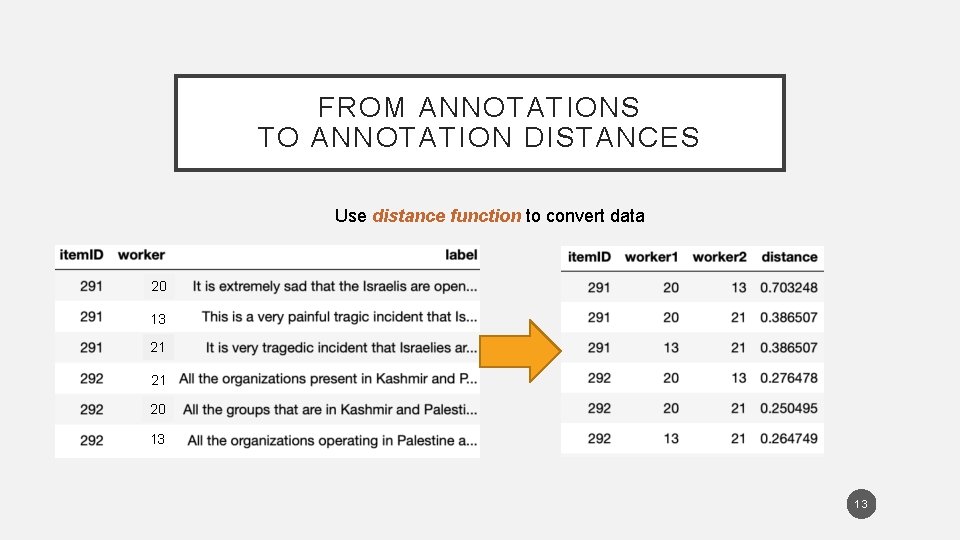
FROM ANNOTATIONS TO ANNOTATION DISTANCES Use distance function to convert data 20 13 21 21 20 13 13
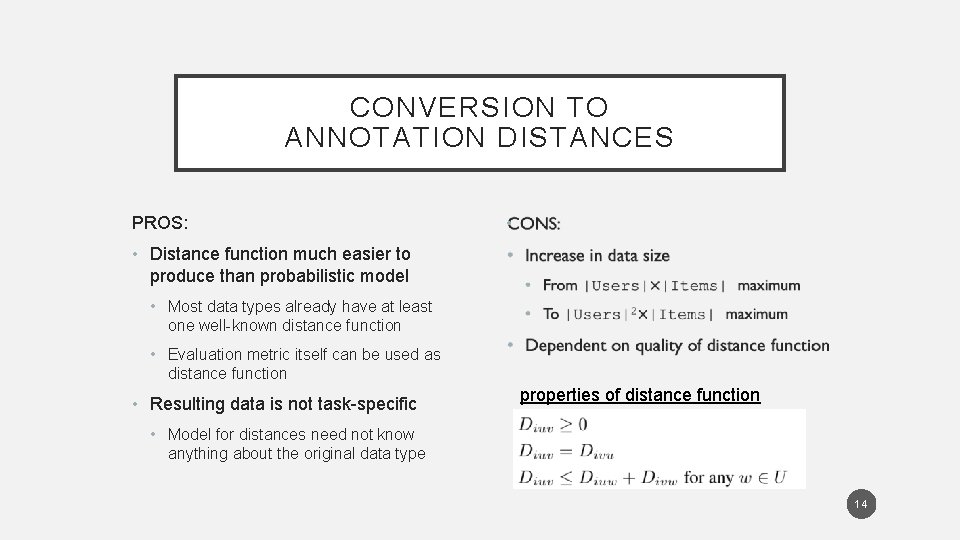
CONVERSION TO ANNOTATION DISTANCES PROS: • • Distance function much easier to produce than probabilistic model • Most data types already have at least one well-known distance function • Evaluation metric itself can be used as distance function • Resulting data is not task-specific properties of distance function • Model for distances need not know anything about the original data type 14
HOW TO USE DISTANCE MATRICES FOR ANNOTATION MODELING • Need a principled framework for modeling annotation distances • Goal is to do the things we do with annotation models (e. g. Dawid-Skene), but with annotation distance data • Natural starting point is Multidimensional Scaling (Kruskal & Wish 1978) • Model for distance matrix data 15
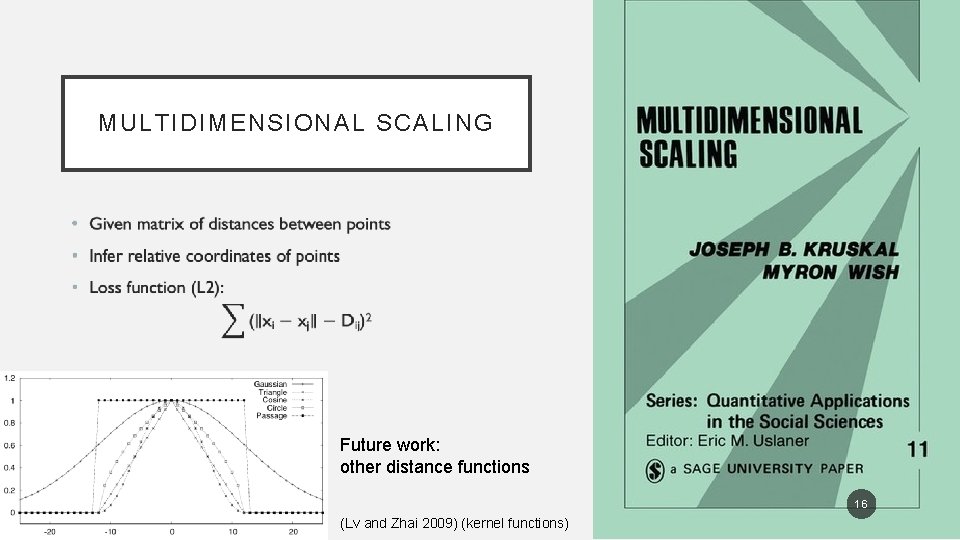
MULTIDIMENSIONAL SCALING • Future work: other distance functions 16 (Lv and Zhai 2009) (kernel functions)

MULTIDIMENSIONAL SCALING EXAMPLE True Coordinates (unobserved) Distance Matrix (observed) Inferred Coordinates 17
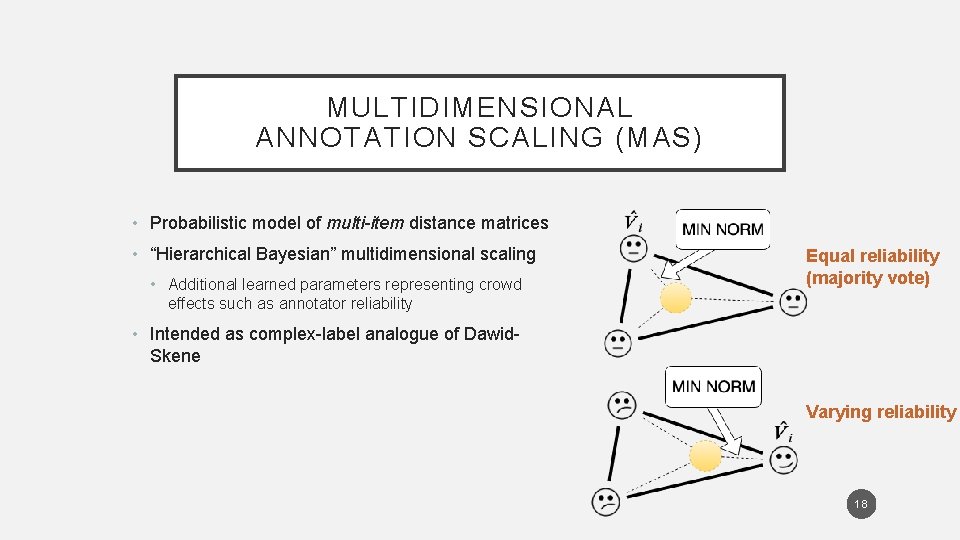
MULTIDIMENSIONAL ANNOTATION SCALING (MAS) • Probabilistic model of multi-item distance matrices • “Hierarchical Bayesian” multidimensional scaling • Additional learned parameters representing crowd effects such as annotator reliability Equal reliability (majority vote) • Intended as complex-label analogue of Dawid. Skene Varying reliability 18
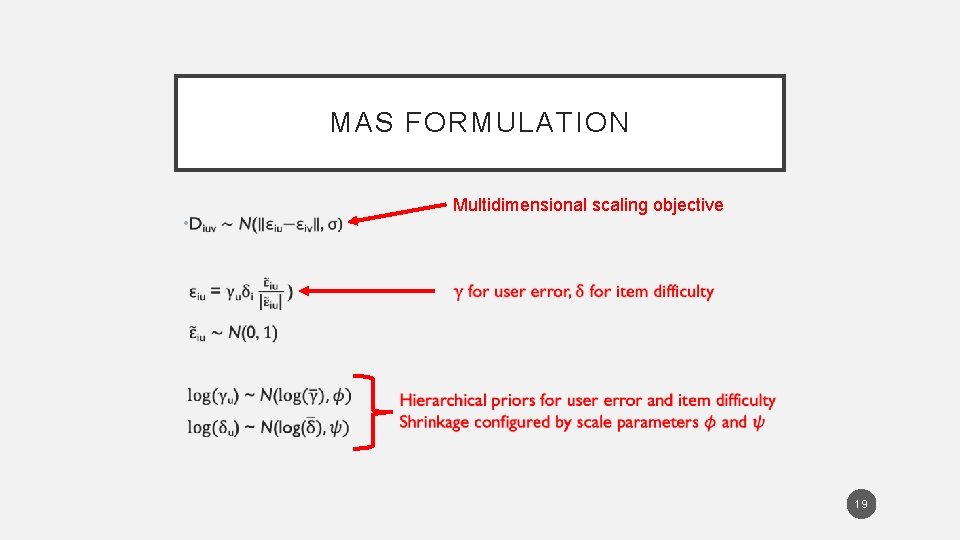
MAS FORMULATION • Multidimensional scaling objective 19
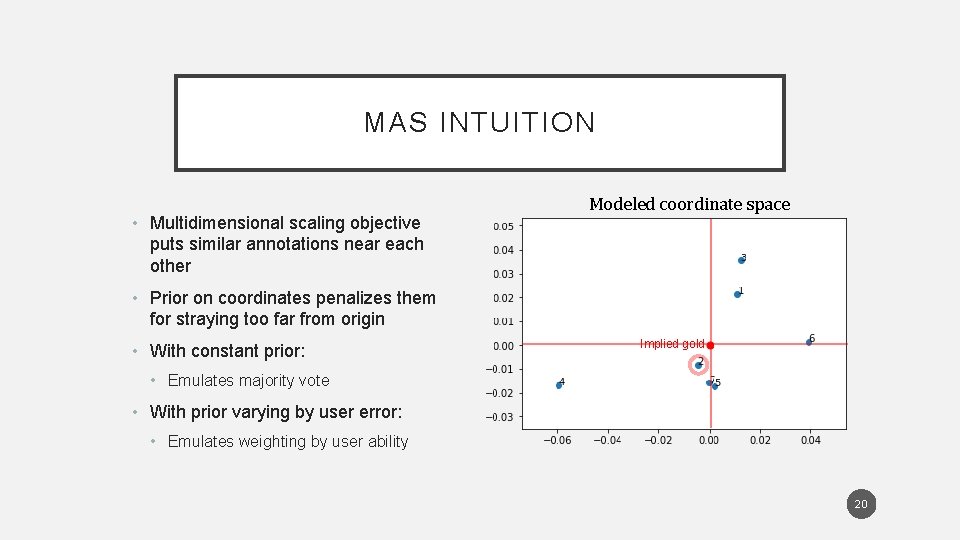
MAS INTUITION • Multidimensional scaling objective puts similar annotations near each other Modeled coordinate space • Prior on coordinates penalizes them for straying too far from origin • With constant prior: Implied gold • Emulates majority vote • With prior varying by user error: • Emulates weighting by user ability 20
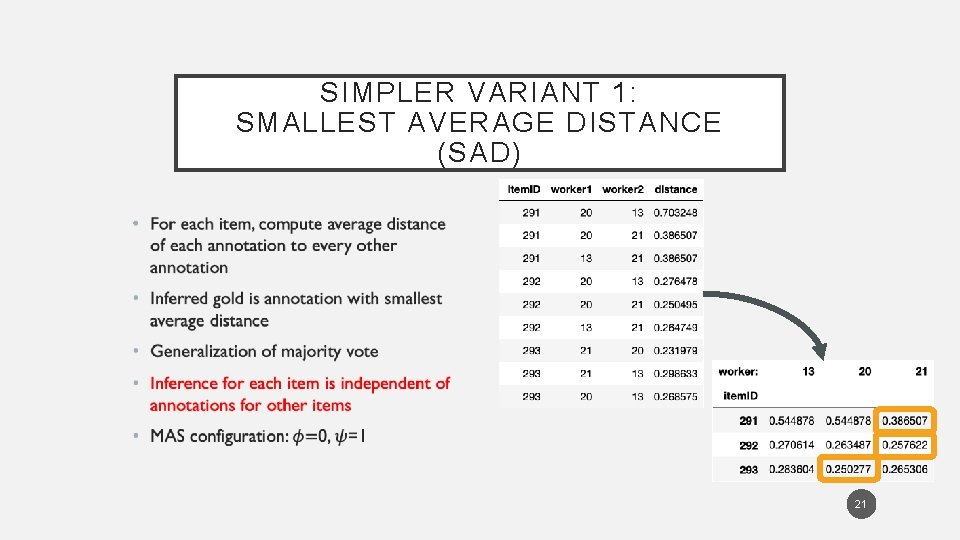
SIMPLER VARIANT 1: SMALLEST AVERAGE DISTANCE (SAD) • 21
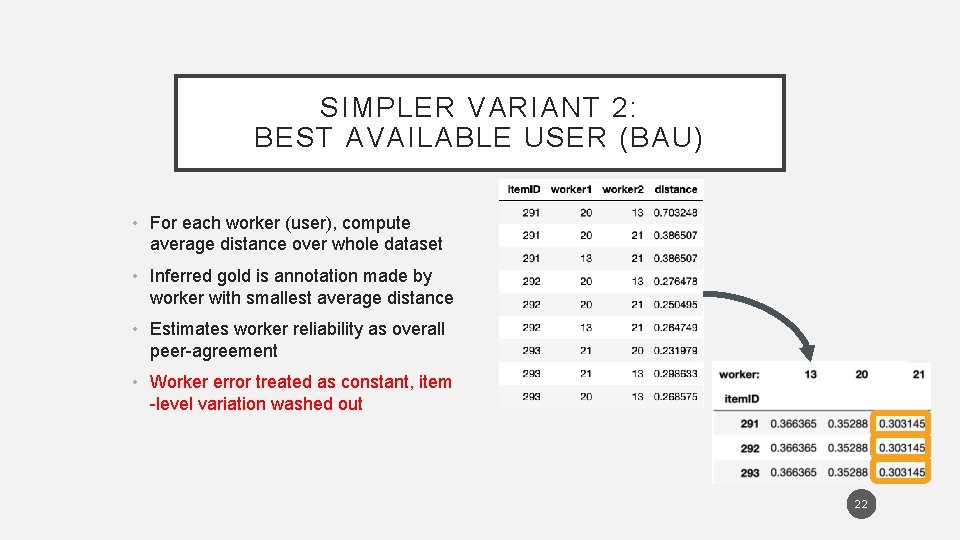
SIMPLER VARIANT 2: BEST AVAILABLE USER (BAU) • For each worker (user), compute average distance over whole dataset • Inferred gold is annotation made by worker with smallest average distance • Estimates worker reliability as overall peer-agreement • Worker error treated as constant, item -level variation washed out 22
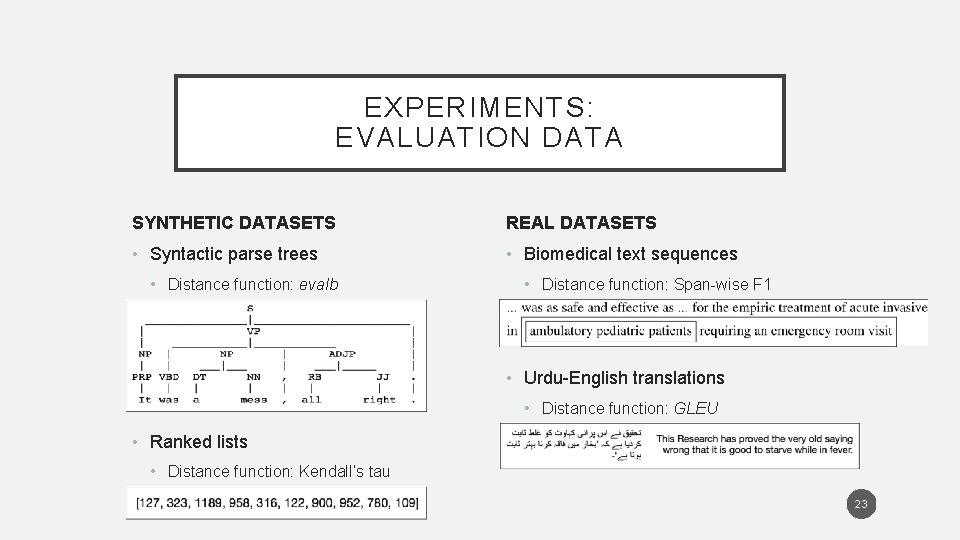
EXPERIMENTS: EVALUATION DATA SYNTHETIC DATASETS REAL DATASETS • Syntactic parse trees • Biomedical text sequences • Distance function: evalb • Distance function: Span-wise F 1 • Urdu-English translations • Distance function: GLEU • Ranked lists • Distance function: Kendall’s tau 23
METHODS COMPARED • Baselines: • Random User (RU) • Oracle (OR) • Ours: • Best Available User (BAU) • Smallest Annotation Distance (SAD) • Multidimensional Annotation Scaling (MAS) • Sequences only (Nguyen et al 2017): • Token-wise Majority Vote (MV) • Hidden Markov Model Crowd (HMM) 24
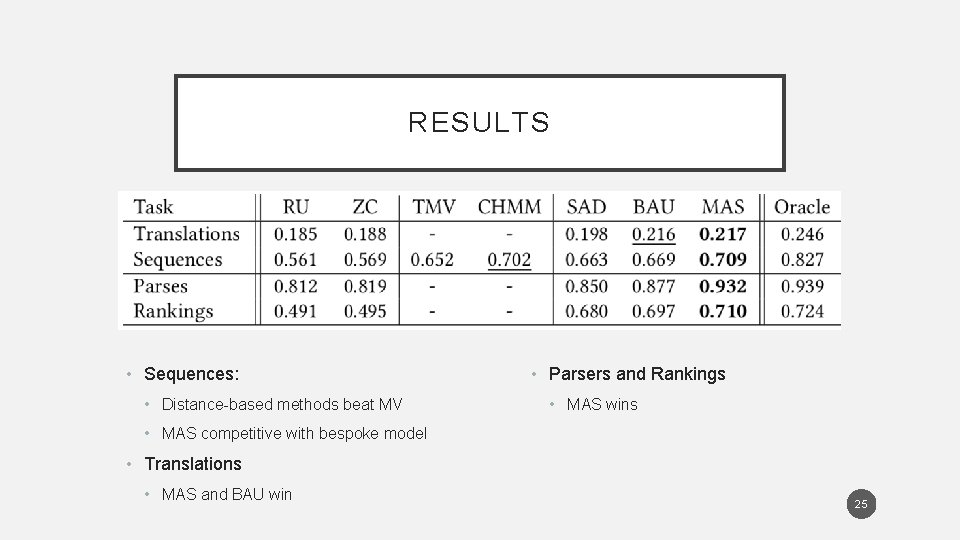
RESULTS • Sequences: • Distance-based methods beat MV • Parsers and Rankings • MAS wins • MAS competitive with bespoke model • Translations • MAS and BAU win 25
CONCLUSION • Goal: general-purpose probabilistic model to aggregate complex annotations • Categorical-based methods insufficient • Bespoke models difficult to design for new annotation types • Solution: Model annotation distances via task-specific distance functions • Transforms problem into general-purpose variable space • Multi-dimensional Annotation Scaling allows Dawid-Skene-like aggregation • Weighted voting with inferred annotator reliability 26
FUTURE AND ONGOING WORK • Big picture: what is everything needed to support complex crowdsourcing? • Integration with other quality-control mechanisms • Semi-supervised learning • Dynamic (online) collection – how to measure value of uncertainty reduction • Complex merge functions (not just winner take all) • Learning difficult tasks over time • Extend proposed model from distances to similarities • Partial-credit scoring of annotations 27
- Slides: 27