
Modeling Airbags in LSDYNA Airbag Simulation Two Approaches
Modeling Airbags in LS-DYNA
Airbag Simulation Two Approaches § Control volume approach • Gas is not directly modeled with elements. A spatially uniform pressure is applied within the closed control volume. There are several control volume airbag models in LS-DYNA (*AIRBAG_). Bag porosity, venting, and 1 st order jetting effects are optional. Method is inexpensive and approximate but sufficiently accurate in most applications. § Euler/ALE approach • The gas in the airbag is modeled using solid ALE elements. Gas flow is modeled and so pressure varies spatially (and temporally) within the airbag. Method is very accurate but expensive. Added expense is warranted in some applications, e. g. , prediciting out-of-position occupant/airbag interaction.

*AIRBAG Applications § Occupant airbags • Driver Side • Passenger Side • Side Curtain Airbag § Tires or other closed volume of gas § Any Inflatable Membrane • Emergency exit slides for airplanes • Bags to cushion landing of spacecraft
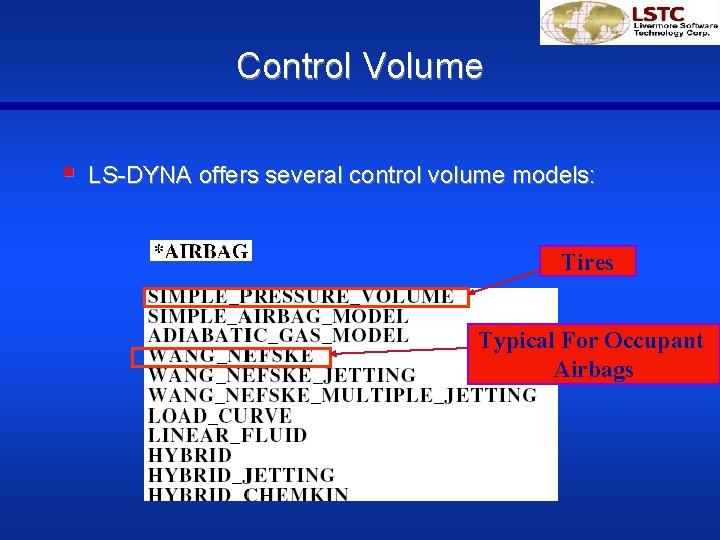
Control Volume § LS-DYNA offers several control volume models: Tires Typical For Occupant Airbags
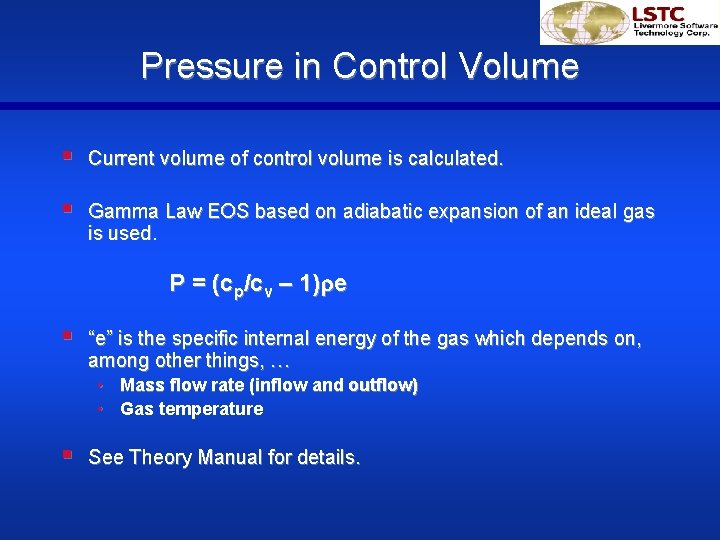
Pressure in Control Volume § Current volume of control volume is calculated. § Gamma Law EOS based on adiabatic expansion of an ideal gas is used. P = (cp/cv – 1)re § “e” is the specific internal energy of the gas which depends on, among other things, … • Mass flow rate (inflow and outflow) • Gas temperature § See Theory Manual for details.
Folded Airbags § LS-PREPOST can ‘fold’ a closed airbag mesh • Folds are aligned with mesh lines • Fold types: • Thin fold • Thick fold • Tuck fold • Spiral fold § Elements may become nonphysically ‘stretched’ due to folding • To eliminate nonphysical stresses brought on by a folded initial geometry, use *AIRBAG_REFERENCE_GEOMETRY defines nodal coordinates of the unstressed airbag
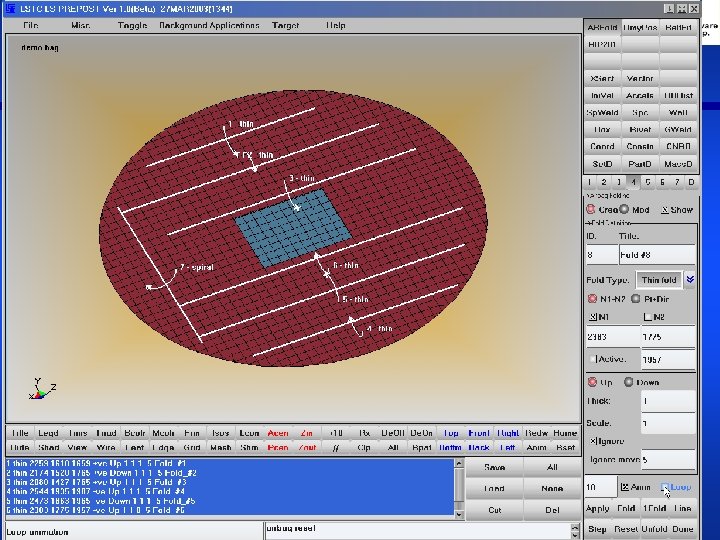
Airbag Folding via LS-Prepost
*MAT_FABRIC § Airbag material is best modeled using *MAT_FABRIC § Can be Isotropic or Anisotropic • depends on test data § Automatically invokes robust, fully-integrated membrane formulation § Flag to turn off compressive stress in fabric • Thin elastic liner can be automatically added to take small amount of compression and keep things stable § Optional parameters that affect porous venting of airbag material
AIRBAG_WANG_NEFSKE § Segment or part list that forms closed control volume § Optional sensor to activate inflation of airbag (based on acceleration, velocity, or displacement of a rigid body) § Optional mass-weighted damping § Gas properties • • § Heat Capacity at constant volume Heat Capacity at constant pressure Temperature of input gas etc Mass inflow rate vs. time

AIRBAG_WANG_NEFSKE § Venting • Vent orifice area can be a constant, A 23, or pressure dependent, LCA 23 § Fabric Porosity • Leakage area can be a constant, AP 23, or pressure dependent, LCAP 23 • Optionally, leakage due to unblocked fabric area can be controlled by parameters in *MAT_FABRIC § Many other parameters affecting control volume pressure

Airbag Self-Contact § Additional logic is needed to treat self-contact of the thin fabric in airbags. § Segment-based (SOFT=2) form of *contact_airbag_single_surface is recommended for fabric selfcontact. • Initial penetrations, sometimes unavoidable in folded airbags, are ignored • The contact stiffness is based on mass and time step (stability criterion) • Additional logic is used to more accurately treat warped elements and edge-to-edge contact. • Very expensive.

Airbag-to-Structure Contact § ‘Structure’ includes vehicle parts (IP, steering wheel, etc. ) as well as dummy/occupant. § Since the airbag thickness is small (<0. 4 mm), set the contact thickness to 2 -4 mm § Invoke soft constraint option (SOFT=1) § Use a two-way, automatic contact

‘ASCII’ Output for Control Volumes § Airbag Statistics • • • *DATABASE_ABSTAT Volume Pressure Internal energy Mass inflow rate Mass outflow rate Total mass Density = Total mass/Volume Temperature Surface area
Example Flat Airbag versus Rigid Cylinder $ Unfolded airbag between rigid cylinder and fixed, planar rigidwall $ Airbag is approximately 19 x 25 inches, with 0. 015 in thickness $ Units: lbf-s^2/in, s, lbf, psi, lbf-in

Airbag and Cylinder Example

Airbag (Section Plane)

Airbag Part $ *PART Airbag - Fabric $ pid sid mid 3 2 3 $ *SET_PART_LIST $ sid 1 $ pid 1 3 $ eosid hgid adpopt

Fabric Material (mat_034) *MAT_FABRIC $ mid ro ea eb $$ Ec, prca, prcb not used for fabric 3, 1. 00 e-4, 2. 00 e+6, $ gab gbc gca cse $$ Gbc, Gca not used for fabric 1. 53 e+6 $$ aopt 0. 0 $ xp yp zp a 1 a 2 a 3 $ d 3 $ v 1 v 2 v 3 d 1 d 2 ec , el prba prca 0. 35 prl lratio prcb damp

Airbag Section *SECTION_SHELL $ sid - section id number $ elform - fully integrated B-T membrane $ nip - number of through shell thickness integration points $ t 1 - t 4 - shell thickness at corner nodes $ sid elform shrf nip propt qr/irid icomp $$ fully-integrated membrane is inferred from *mat_fabric 2, 9, , 1 $ t 1 t 2 t 3 t 4 nloc 0. 015, 0. 015

Control Volume *AIRBAG_SIMPLE_AIRBAG_MODEL $ Uses gamma law EOS to calculate pressure in control volume $ sidtyp rbid vsca psca vini mwd spsf 1 1 $ sid - set ID defining closed surface of control volume $ sidtyp = 1 sid refers to a part list (*SET_PART) $ rbid - airbag activation (default is airbag activated at t=0) $ vsca - volume scale factor (def. =1. 0) $ psca - pressure scale factor (def. =1. 0) $ vini - initial filled volume $ mwd - mass weighted damping factor $ spsf - stagnation pressure scale factor (0 (def. ) < spsf < 1. 0) $ for alternate form of damping

*AIRBAG_SIMPLE_AIRBAG_MODEL (continued) $ $ $ $ $ cv 1736 cp t 2430 1200 lcid 1 mu 0. 0 cv - heat capacity at constant pressure cp - heat capacity at constant volume t - temperature of input gas lcid - input mass flow rate load curve ID mu - shape factor for exit hole a - exit area pe - ambient pressure ro - ambient density a 0. 0 pe 14. 7 ro 3. 821 E-06
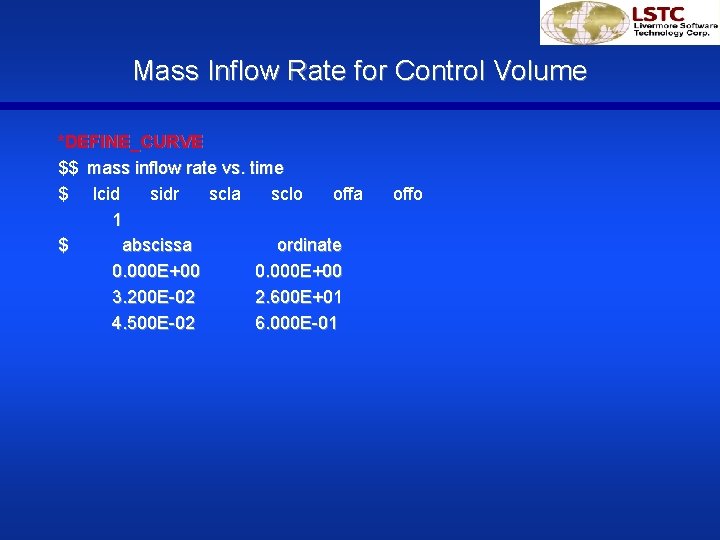
Mass Inflow Rate for Control Volume *DEFINE_CURVE $$ mass inflow rate vs. time $ lcid sidr scla sclo offa 1 $ abscissa ordinate 0. 000 E+00 3. 200 E-02 2. 600 E+01 4. 500 E-02 6. 000 E-01 offo

Rigid Wall $$ Ground *RIGIDWALL_PLANAR $ nsidex boxid 0 $ xt yt zt 0. 0 $ xh 0. 0 yh 1. 0 zh 0. 0 fric 0. 5

Contact (Airbag vs. Cylinder) $$ Contact between airbag and cylinder *CONTACT_AUTOMATIC_SURFACE_TO_SURFACE $ ssid msid sstyp mstyp sboxid mboxid spr 3 2 3 3 $ friction coefficient 0. 5 $ Increase contact thickness to 0. 1 inch $ sfs sfm sst mst sfmt fsf , , 0. 05 $ soft 1 $ mpr vsf

Results - Forces rwforc file rcforc file
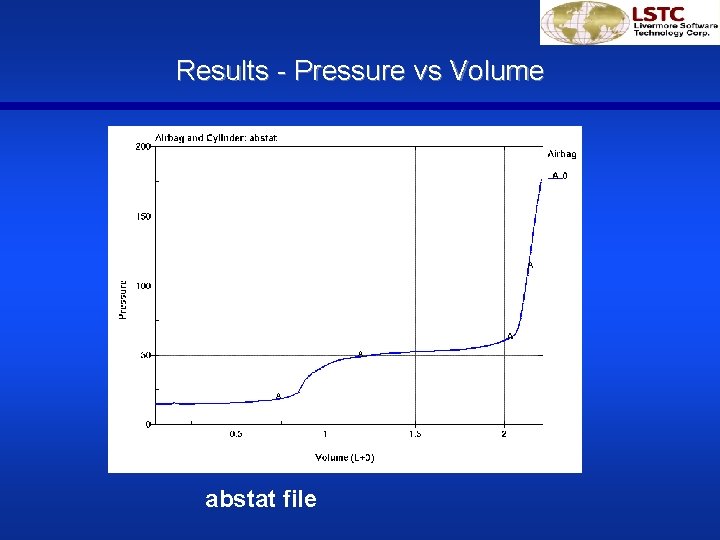
Results - Pressure vs Volume abstat file
- Slides: 26