
Modelindependent solutions to model management problems Francesca Bugiotti
Model-independent solutions to model management problems Francesca Bugiotti Università Roma Tre 17/12/2009 1
Model management �What is – A systematic approach to metadata management, which handles schemas by means of a set of predefined operators. �Its goals – Enhance the productivity of software developers, by offering them techniques that allow for high-level specifications and abstraction over recurring tasks involving the manipulation of schemas. 17/12/2009 Università Roma Tre 2
Model management �Model management systems – Handle schemas and mappings and support a wide variety of operations on them. �MIDST – We propose MIDST[1, 2, 3], a platform originally conceived for model-independent schema and data translation, as the basis to build a model management system. – The so built model management system aims at being model-independent and model-aware. 17/12/2009 Università Roma Tre 3
What model management addresses �Concrete needs: they are a formalization of concrete and frequent database maintenance problems – data integration over heterogeneous databases – data exchange between independent databases – ETL – wrapper generation for the access to relational databases from object-oriented applications – web site generation from databases. 17/12/2009 Università Roma Tre 4
What model management addresses �Model management solutions to formalized problems: - schema integration - schema evolution - forward engineering round-trip engineering -… 17/12/2009 Università Roma Tre 5
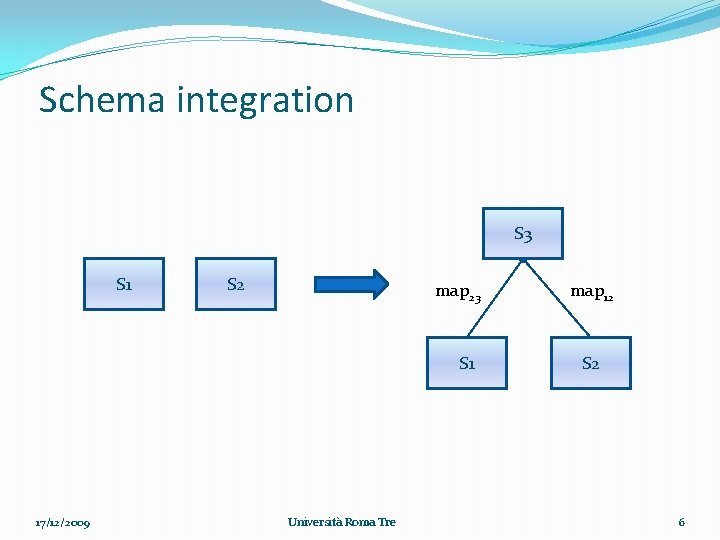
Schema integration S 3 S 1 S 2 map 23 S 1 17/12/2009 Università Roma Tre map 12 S 2 6
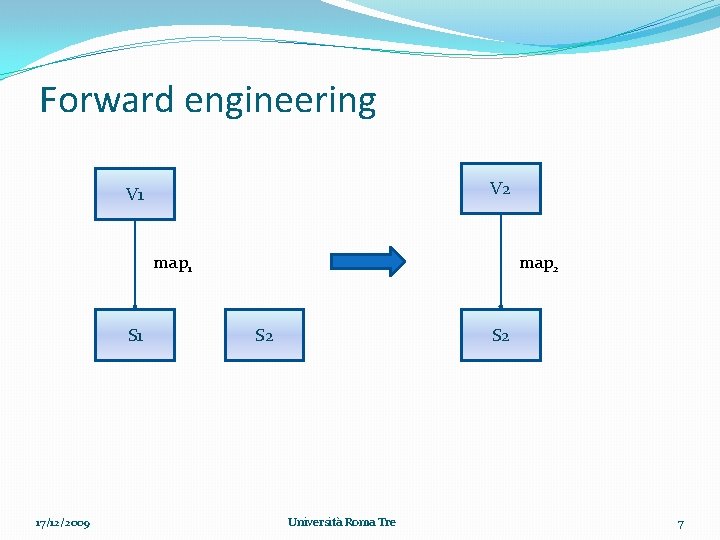
Forward engineering V 2 V 1 map 1 S 1 17/12/2009 map 2 S 2 Università Roma Tre 7
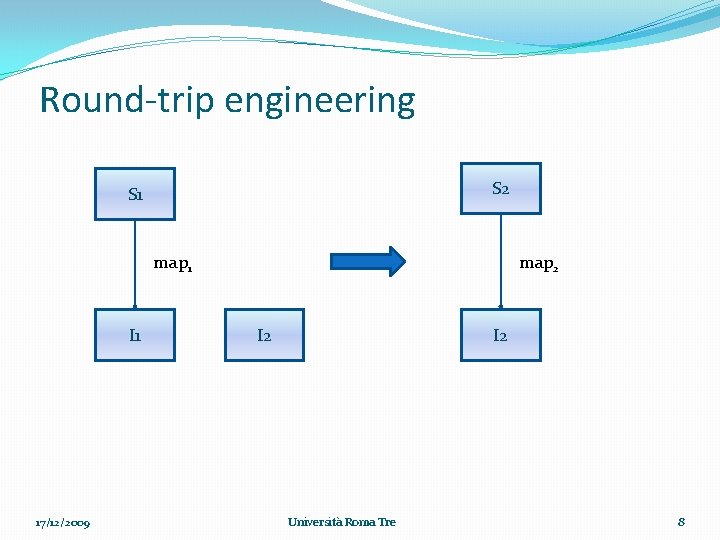
Round-trip engineering S 2 S 1 map 1 I 1 17/12/2009 map 2 I 2 Università Roma Tre 8
Model management problems solution �Solutions to model management problems are given in terms of scripts. �A script is a set of model management operators which are executed according to a specific control flow. 17/12/2009 Università Roma Tre 9
Operators �The operators involved in the script specifications are: 17/12/2009 Match Diff Merge Compose Modelgen Copy … Università Roma Tre 10
Match �Given two schemas S 1 and S 2, we define map 12 = MATCH(S 1, S 2) where MATCH is the operator identifying correspondences between the two schemas and hence yielding a possible mapping. �There are several algorithms implementing MATCH operators. 17/12/2009 Università Roma Tre 11
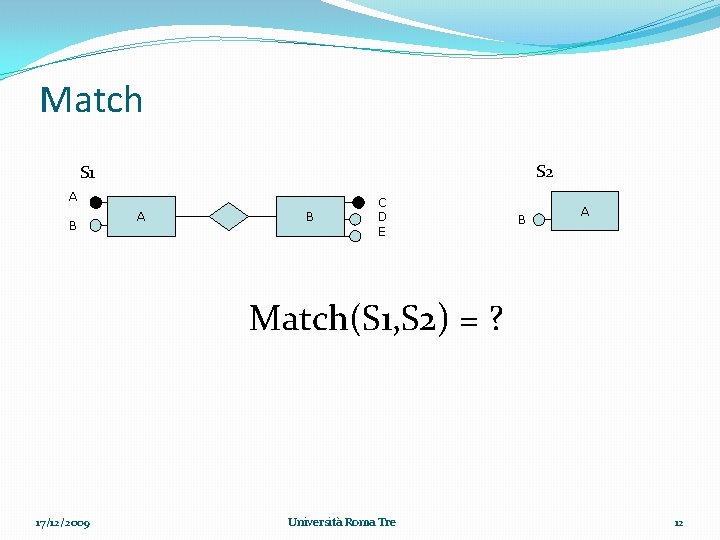
Match S 2 S 1 A B C D E B A Match(S 1, S 2) = ? 17/12/2009 Università Roma Tre 12
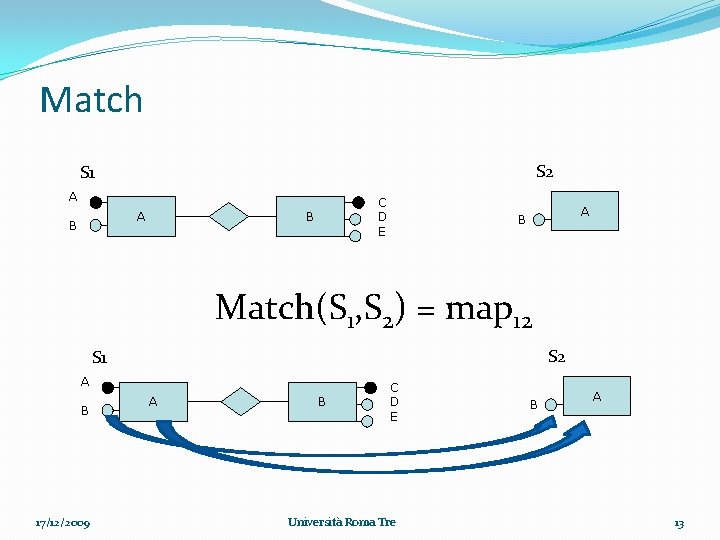
Match S 2 S 1 A A B C D E B A B Match(S 1, S 2) = map 12 S 1 A B 17/12/2009 A B C D E Università Roma Tre B A 13
Diff �Given two schemas S and S 1 the difference diff(S, S 1) is a schema S 2 that contains all the schema elements of S that do not appear in S 1. �It can be interpreted as a set-oriented difference. 17/12/2009 Università Roma Tre 14
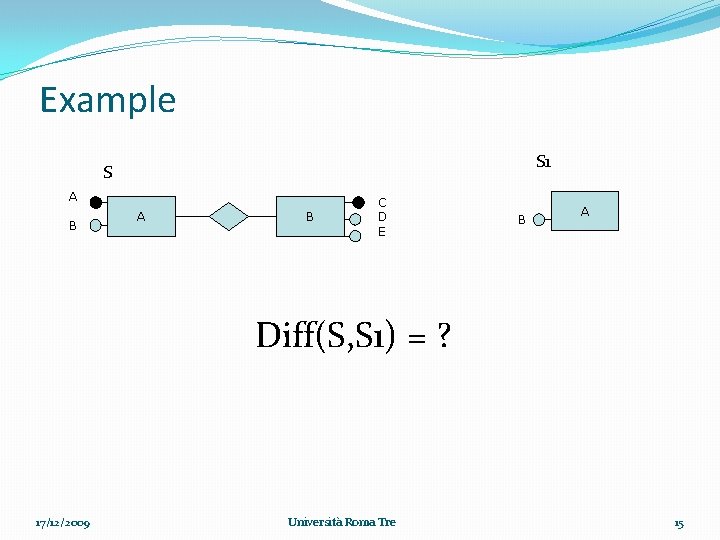
Example S 1 S A B C D E B A Diff(S, S 1) = ? 17/12/2009 Università Roma Tre 15
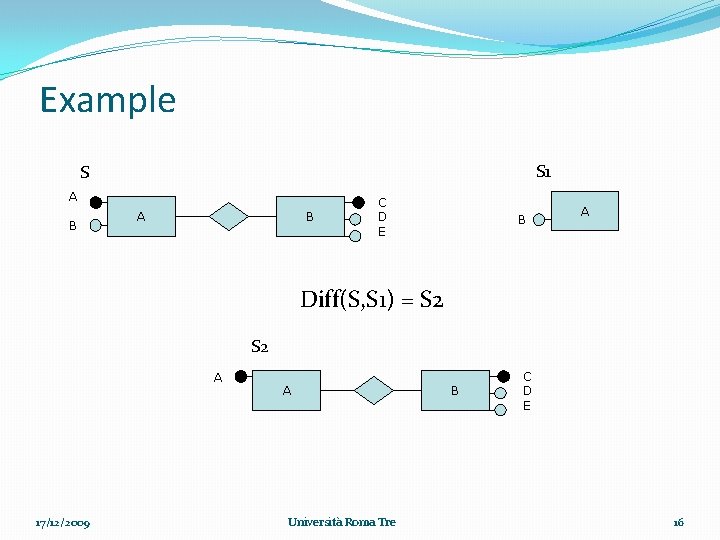
Example S 1 S A B C D E B A Diff(S, S 1) = S 2 A 17/12/2009 A Università Roma Tre B C D E 16
Merge �Given S and S 1, their merge(S, S 1) is a schema S 2 that contains the schema elements that appear in at least one of S or S 1, modulo equivalence. �It can be interpreted as a set-oriented union. 17/12/2009 Università Roma Tre 17
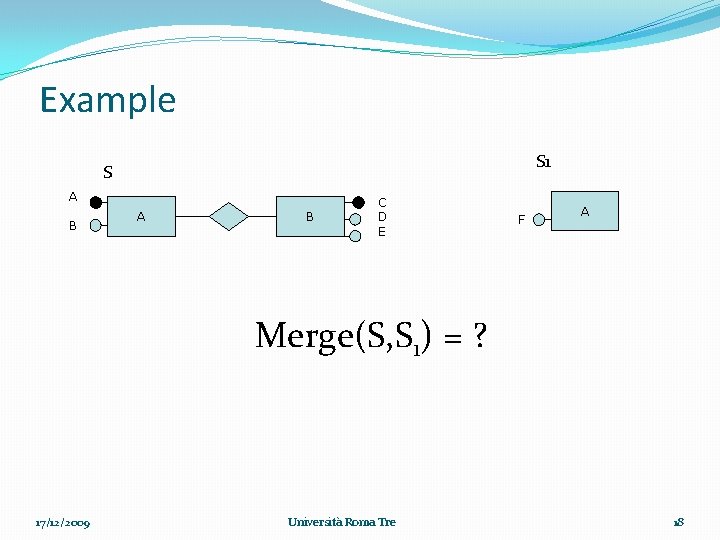
Example S 1 S A B C D E F A Merge(S, S 1) = ? 17/12/2009 Università Roma Tre 18
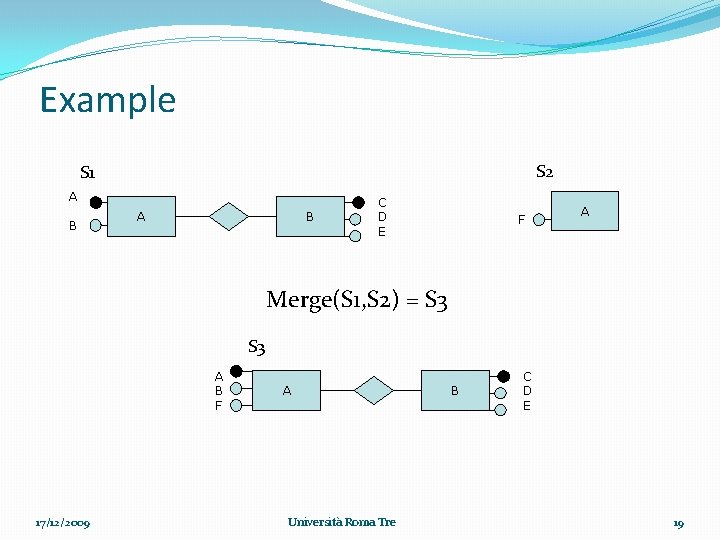
Example S 2 S 1 A B C D E F A Merge(S 1, S 2) = S 3 A B F 17/12/2009 A Università Roma Tre B C D E 19
Compose �Given three schemas: S 1, S 2, S 3 and two mappings, map 12 between S 1 and S 2 and map 23 between S 2 and S 3, we define map 13 as the composition of map 12 and map 23 as the mapping between S 1 and S 3. Compose(S 1, S 2, S 3, map 12, map 23) = map 13 17/12/2009 Università Roma Tre 20
Modelgen �Given a schema S of a source model M and a target model M 1 , the translation modelgen(S, M 1 ) is a schema S 1 of M 1 that corresponds to S. 17/12/2009 Università Roma Tre 21
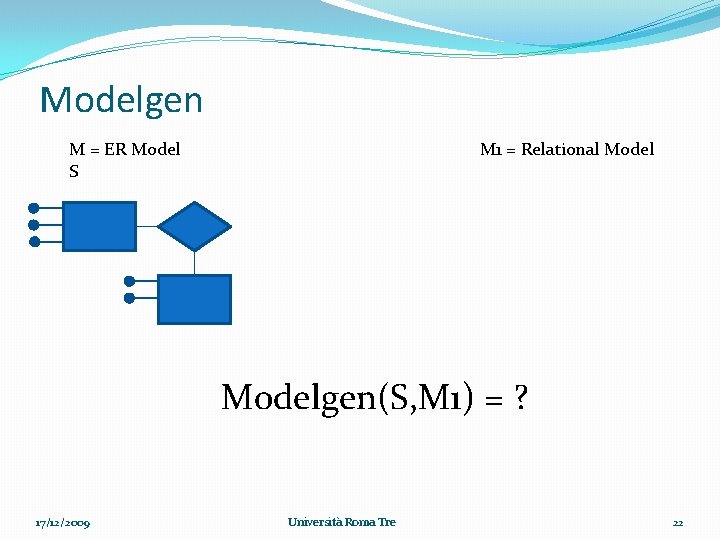
Modelgen M = ER Model S M 1 = Relational Modelgen(S, M 1) = ? 17/12/2009 Università Roma Tre 22
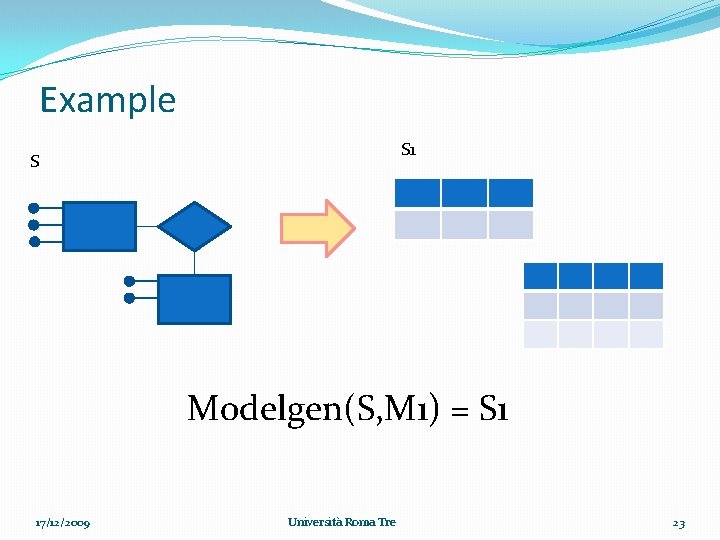
Example S 1 S Modelgen(S, M 1) = S 1 17/12/2009 Università Roma Tre 23
Operators �A major goal is to provide model-independent operators, which guarantee some kind of model closure property. �Here we move from a simplified version of Bernstein’s solving procedure for the round-trip engineering problem [4], in order to introduce the needed operators and explain how they are implemented in a model-independent fashion. 17/12/2009 Università Roma Tre 24
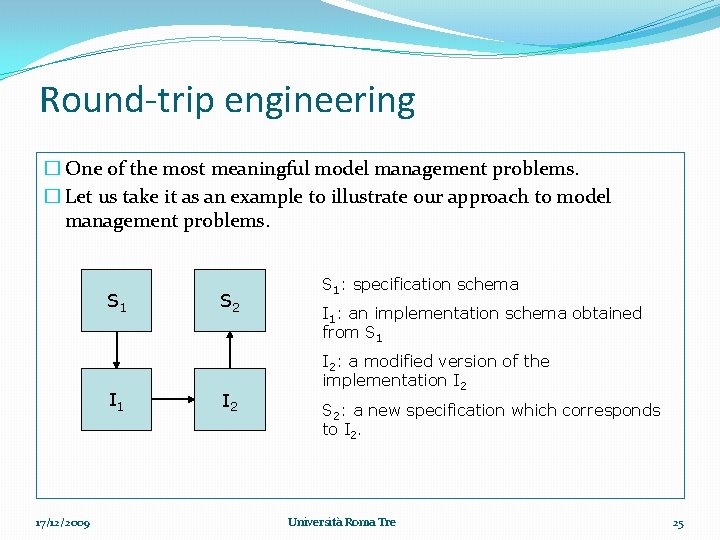
Round-trip engineering � One of the most meaningful model management problems. � Let us take it as an example to illustrate our approach to model management problems. S 1 I 1 17/12/2009 S 2 I 2 S 1: specification schema I 1: an implementation schema obtained from S 1 I 2: a modified version of the implementation I 2 S 2: a new specification which corresponds to I 2. Università Roma Tre 25
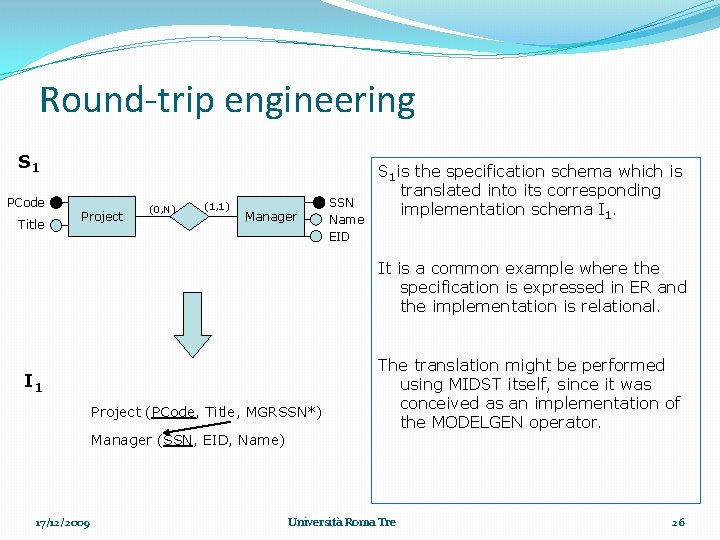
Round-trip engineering S 1 PCode Title Project (0, N) (1, 1) Manager SSN Name EID S 1 is the specification schema which is translated into its corresponding implementation schema I 1. It is a common example where the specification is expressed in ER and the implementation is relational. I 1 Project (PCode, Title, MGRSSN*) Manager (SSN, EID, Name) 17/12/2009 The translation might be performed using MIDST itself, since it was conceived as an implementation of the MODELGEN operator. Università Roma Tre 26
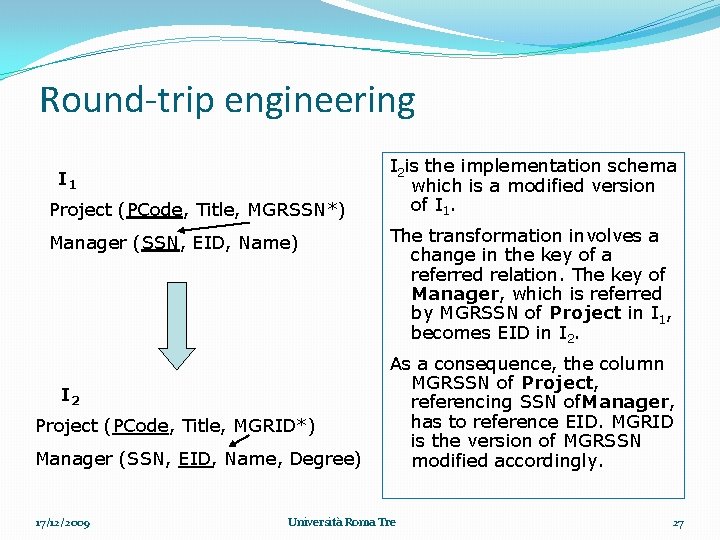
Round-trip engineering I 1 Project (PCode, Title, MGRSSN*) Manager (SSN, EID, Name) I 2 Project (PCode, Title, MGRID*) Manager (SSN, EID, Name, Degree) 17/12/2009 I 2 is the implementation schema which is a modified version of I 1. The transformation involves a change in the key of a referred relation. The key of Manager, which is referred by MGRSSN of Project in I 1, becomes EID in I 2. As a consequence, the column MGRSSN of Project, referencing SSN of. Manager, has to reference EID. MGRID is the version of MGRSSN modified accordingly. Università Roma Tre 27
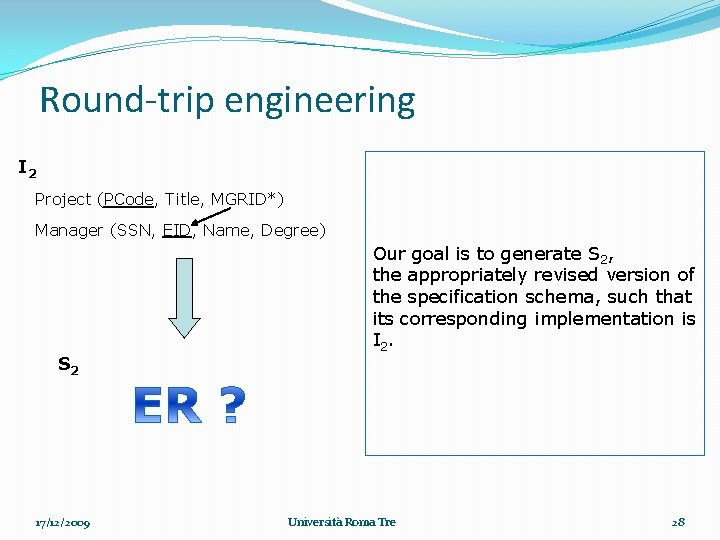
Round-trip engineering I 2 Project (PCode, Title, MGRID*) Manager (SSN, EID, Name, Degree) S 2 17/12/2009 Our goal is to generate S 2, the appropriately revised version of the specification schema, such that its corresponding implementation is I 2. Università Roma Tre 28
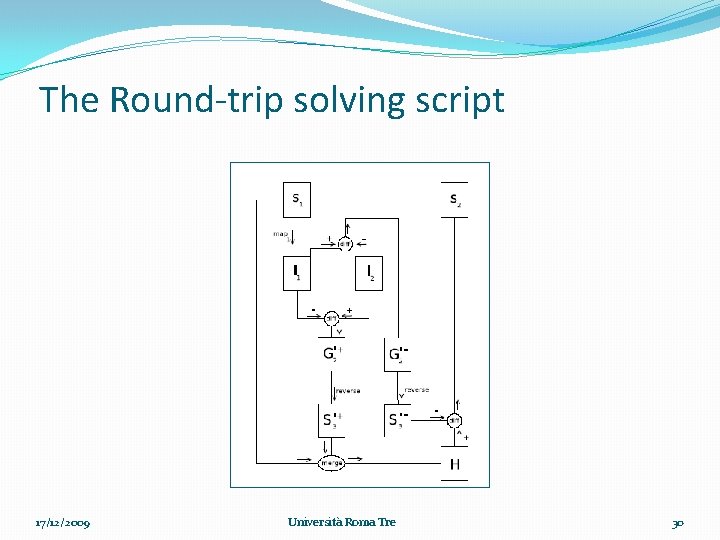
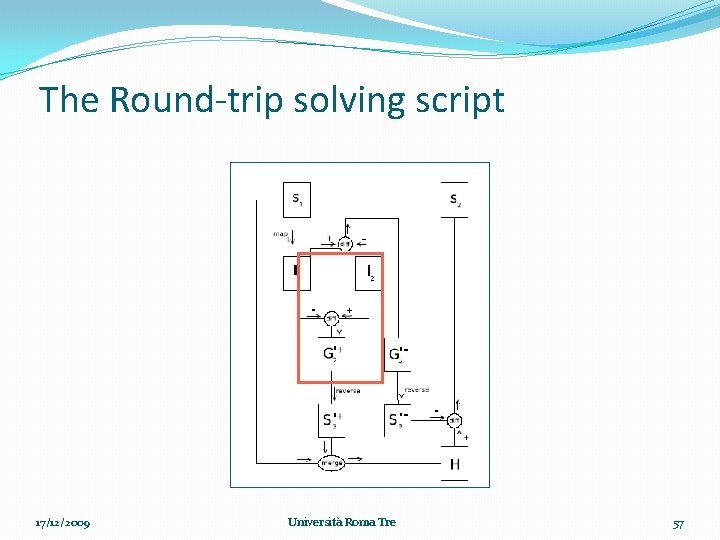
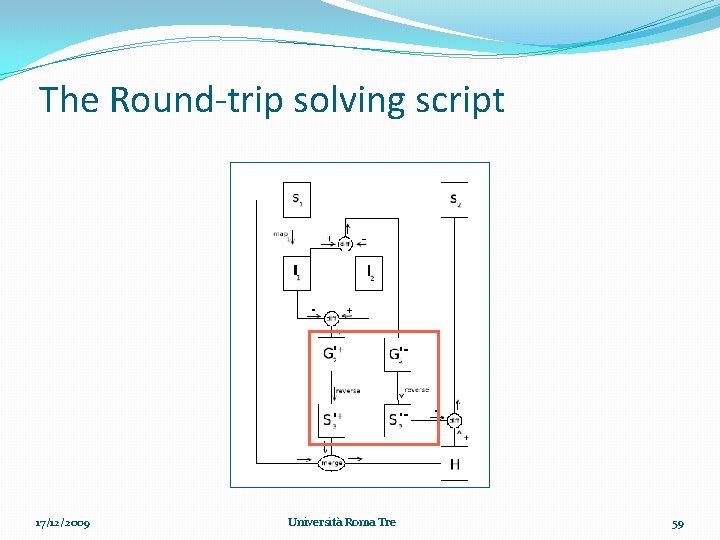
Operators in scripts � The solution which has been provided for the round-trip engineering is based on a set of model management operators: DIFF, MERGE and MODELGEN. � DIFF and MERGE have been used to compute the difference and the union of schemas. � MODELGEN has been used as a solution to translate the specification schema into the implementation and to compute the reversed differences. 17/12/2009 Università Roma Tre 29
The Round-trip solving script 17/12/2009 Università Roma Tre 30
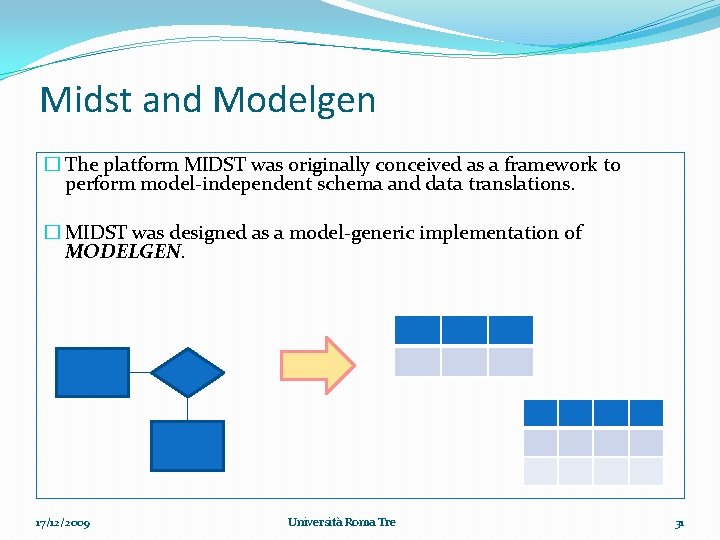
Midst and Modelgen � The platform MIDST was originally conceived as a framework to perform model-independent schema and data translations. � MIDST was designed as a model-generic implementation of MODELGEN. 17/12/2009 Università Roma Tre 31
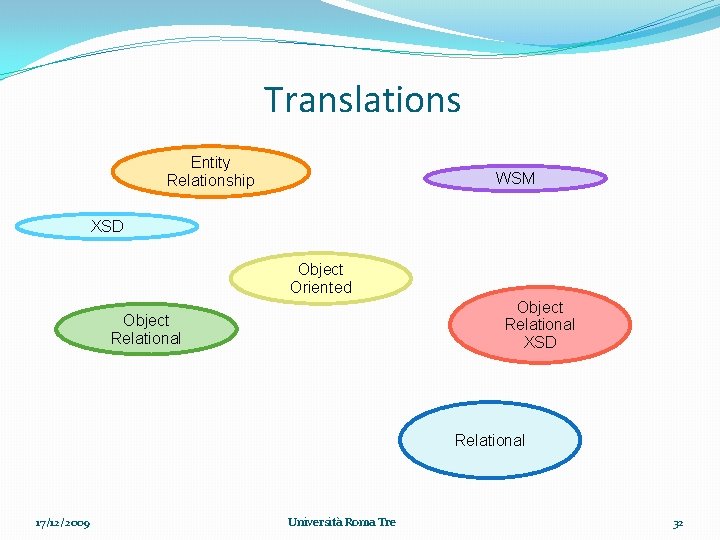
Translations Entity Relationship WSM XSD Object Oriented Object Relational XSD Object Relational 17/12/2009 Università Roma Tre 32
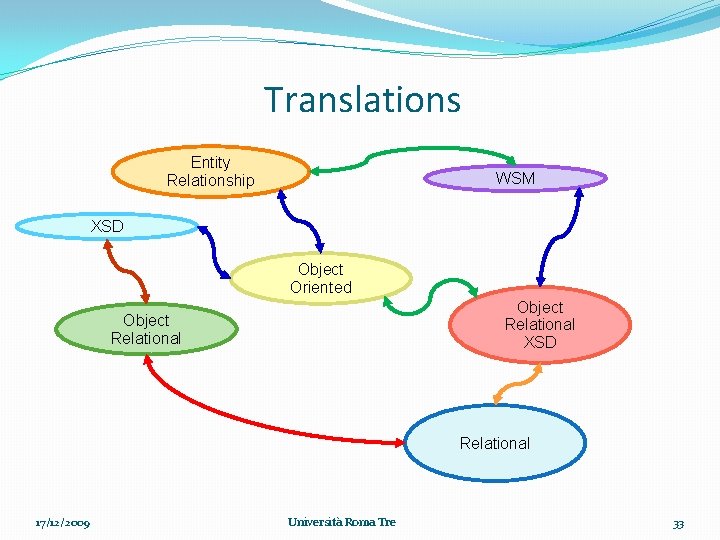
Translations Entity Relationship WSM XSD Object Oriented Object Relational XSD Object Relational 17/12/2009 Università Roma Tre 33
The metamodel approach �The constructs in the various model are rather similar: – Can be classified into a few categories (“metaconstructs”) IE: the entity of the ER, the Object of the OO can be reconduct to the same abstract concept, the “Abstract” of our supermodel. 17/12/2009 Università Roma Tre 34
The supermodel �A model that includes all the meta-constructs (in their most general forms) – Each model is subsumed by the supermodel (modulo construct renaming) – Each schema for any model is also schema for the supermodel (modulo construct renaming). 17/12/2009 Università Roma Tre 35
Translations specification �Translations can be defined on metaconstructs � And there are standard accepted ways to deal with translation of metaconstructs � They can be performed within the supermodel �Each translation from the supermodel SM to a target model M is also a translation from any other model to M. 17/12/2009 Università Roma Tre 36
Translation specification �The Datalog is used to specify the translation A translation script in our tool is a set of datalog rules. 17/12/2009 Università Roma Tre 37
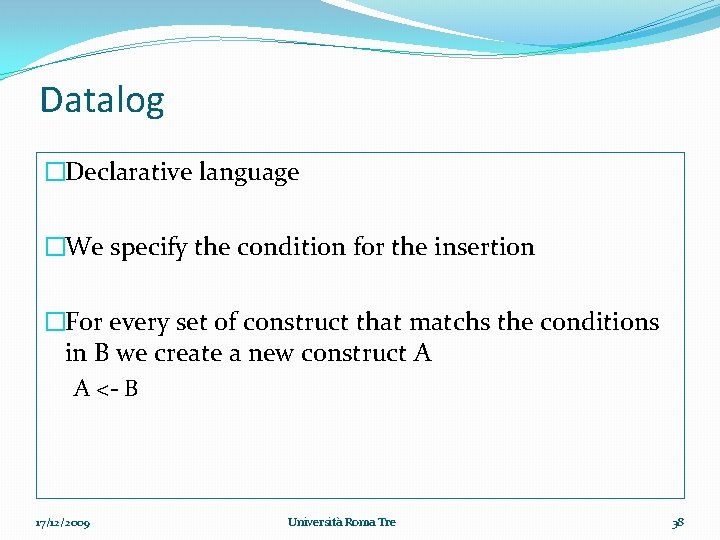
Datalog �Declarative language �We specify the condition for the insertion �For every set of construct that matchs the conditions in B we create a new construct A A <- B 17/12/2009 Università Roma Tre 38
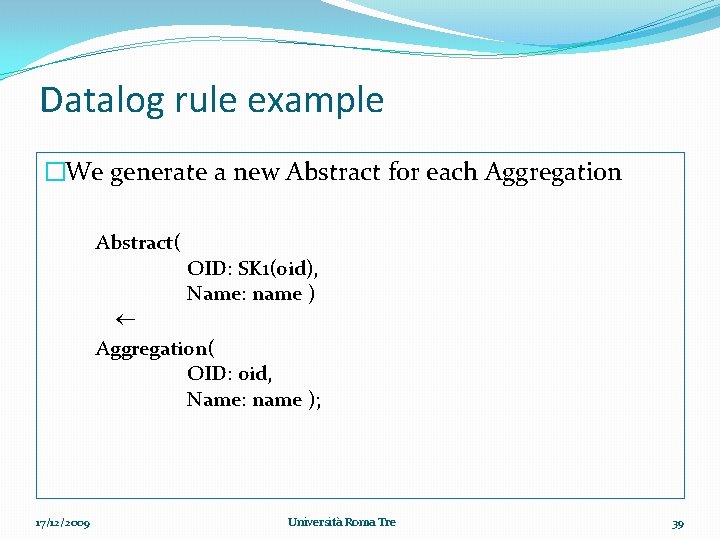
Datalog rule example �We generate a new Abstract for each Aggregation Abstract( OID: SK 1(oid), Name: name ) Aggregation( OID: oid, Name: name ); 17/12/2009 Università Roma Tre 39
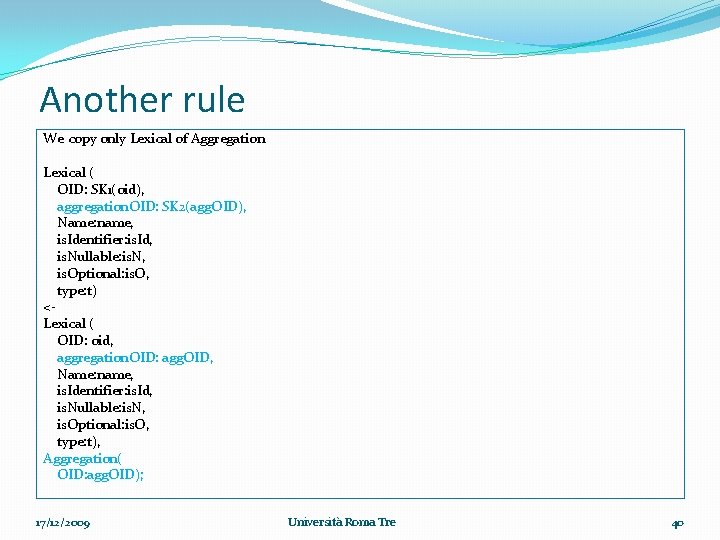
Another rule We copy only Lexical of Aggregation Lexical ( OID: SK 1(oid), aggregation. OID: SK 2(agg. OID), Name: name, is. Identifier: is. Id, is. Nullable: is. N, is. Optional: is. O, type: t) <Lexical ( OID: oid, aggregation. OID: agg. OID, Name: name, is. Identifier: is. Id, is. Nullable: is. N, is. Optional: is. O, type: t), Aggregation( OID: agg. OID); 17/12/2009 Università Roma Tre 40
Approach �It is possible to apply the same approach to other model management operators? �How can we define other operators with respect to our supermodel? 17/12/2009 Università Roma Tre 41
Construct characteristics �Every costruct has: – An identification OID – A name – A set of properties – A set of references 17/12/2009 Università Roma Tre 42
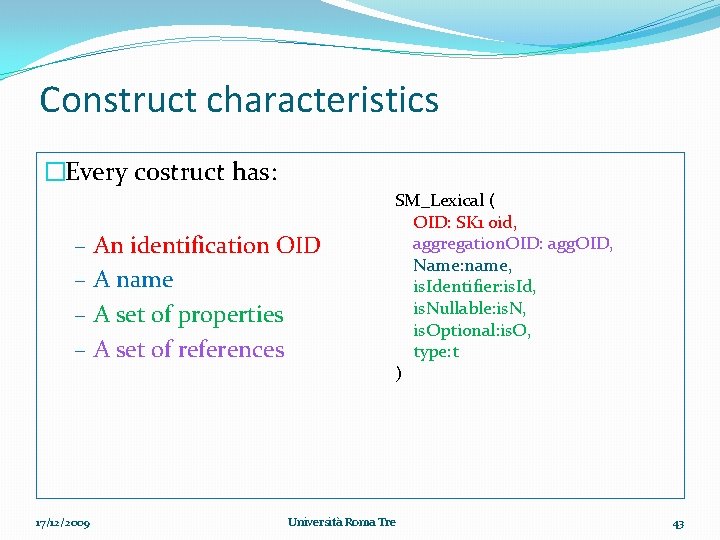
Construct characteristics �Every costruct has: – An identification OID – A name – A set of properties – A set of references 17/12/2009 SM_Lexical ( OID: SK 1 oid, aggregation. OID: agg. OID, Name: name, is. Identifier: is. Id, is. Nullable: is. N, is. Optional: is. O, type: t ) Università Roma Tre 43
Construct equivalence �Two constructs are equivalent if they have: – The same name – The same set of properties – And refer to equivalent costructs 17/12/2009 Università Roma Tre 44
Comparison �There is a recursive definition of equivalence. �We can order the construct and start the matching from the constructs without references. 17/12/2009 Università Roma Tre 45
Construct characteristics �Those can be found also in the rules – An identification OID – A name – A set of properties – A set of references 17/12/2009 SM_Lexical ( OID: SK 1(oid), aggregation. OID: SK 2(agg. OID), Name: name, is. Identifier: is. Id, is. Nullable: is. N, is. Optional: is. O, type: t ) <SM_Lexical ( OID: oid, aggregation. OID: agg. OID, Name: name, is. Identifier: is. Id, is. Nullable: is. N, is. Optional: is. O, ), SM_Aggregation( OID: agg. OID ); Università Roma Tre 46
Example �An equivalence comparison may work as follows: � 1. comparison of the aggregations or abstracts without any references; � 2. comparison of constructs which may refer to them 17/12/2009 Università Roma Tre 47
Model management operators by examples An Example of a possible implementation of model management operators follow. The adopted language is Datalog. The tool is MIDST. 17/12/2009 Università Roma Tre 48
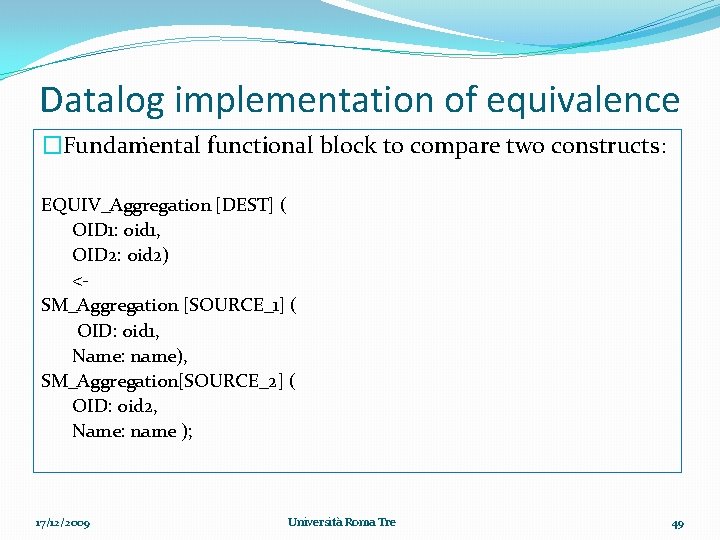
Datalog implementation of equivalence. �Fundamental functional block to compare two constructs: EQUIV_Aggregation [DEST] ( OID 1: oid 1, OID 2: oid 2) <SM_Aggregation [SOURCE_1] ( OID: oid 1, Name: name), SM_Aggregation[SOURCE_2] ( OID: oid 2, Name: name ); 17/12/2009 Università Roma Tre 49
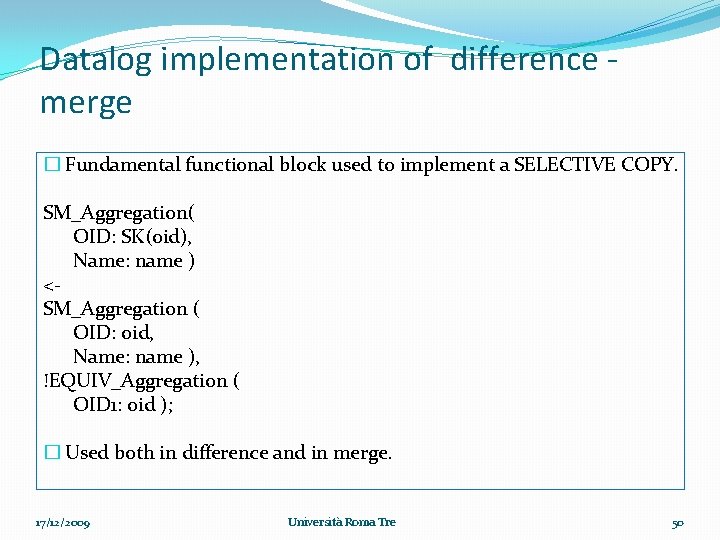
Datalog implementation of difference merge � Fundamental functional block used to implement a SELECTIVE COPY. SM_Aggregation( OID: SK(oid), Name: name ) <SM_Aggregation ( OID: oid, Name: name ), !EQUIV_Aggregation ( OID 1: oid ); � Used both in difference and in merge. 17/12/2009 Università Roma Tre 50
Automatic generation �These operators can be automatically generated by the MIDST application framework. �The construct of the supermodel are used to generate the rules used for the matching. �The order of the application is important. 17/12/2009 Università Roma Tre 51
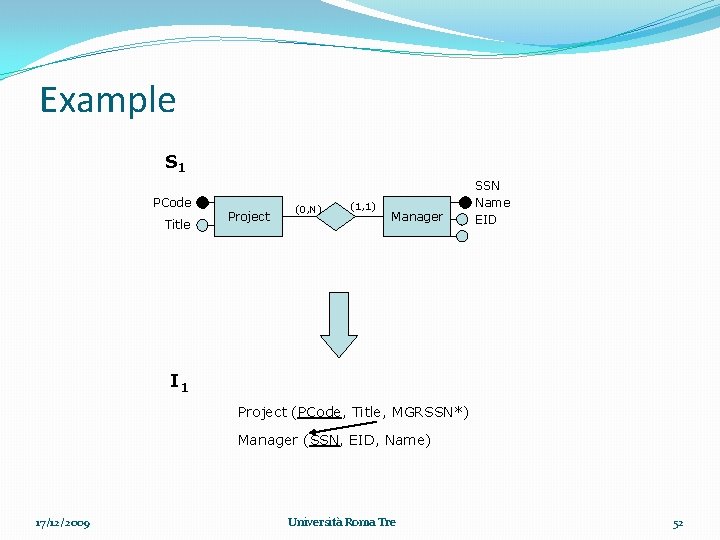
Example S 1 PCode Title Project (0, N) (1, 1) Manager SSN Name EID I 1 Project (PCode, Title, MGRSSN*) Manager (SSN, EID, Name) 17/12/2009 Università Roma Tre 52
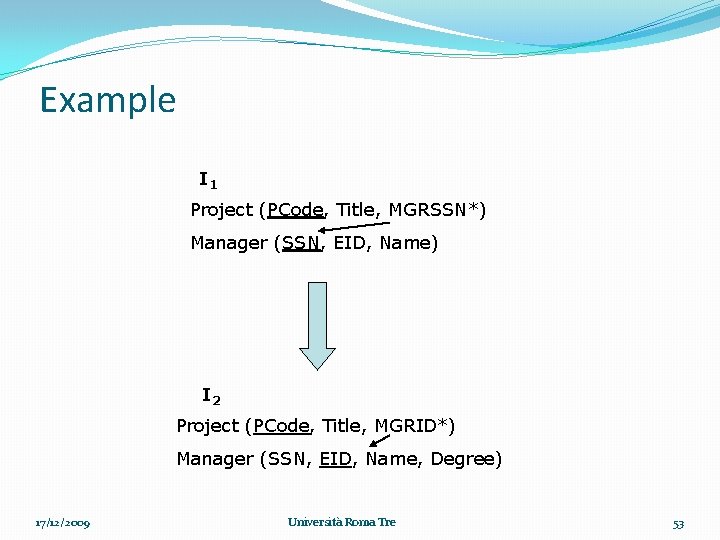
Example I 1 Project (PCode, Title, MGRSSN*) Manager (SSN, EID, Name) I 2 Project (PCode, Title, MGRID*) Manager (SSN, EID, Name, Degree) 17/12/2009 Università Roma Tre 53
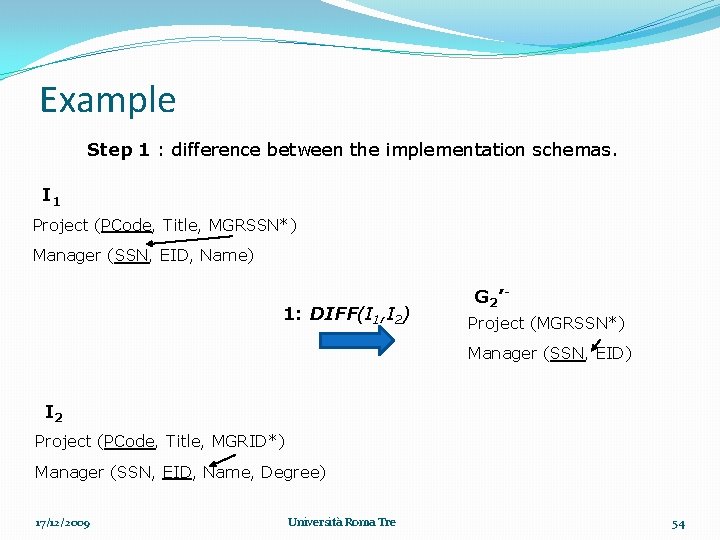
Example Step 1 : difference between the implementation schemas. I 1 Project (PCode, Title, MGRSSN*) Manager (SSN, EID, Name) 1: DIFF(I 1, I 2) G 2 ’Project (MGRSSN*) Manager (SSN, EID) I 2 Project (PCode, Title, MGRID*) Manager (SSN, EID, Name, Degree) 17/12/2009 Università Roma Tre 54
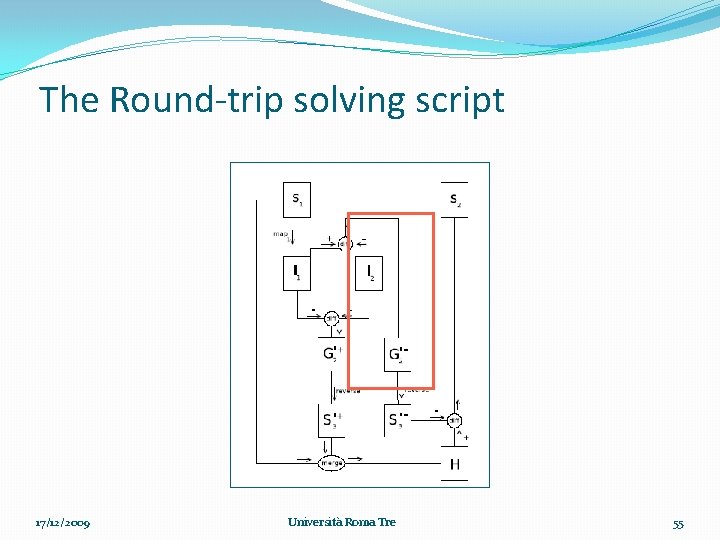
The Round-trip solving script 17/12/2009 Università Roma Tre 55
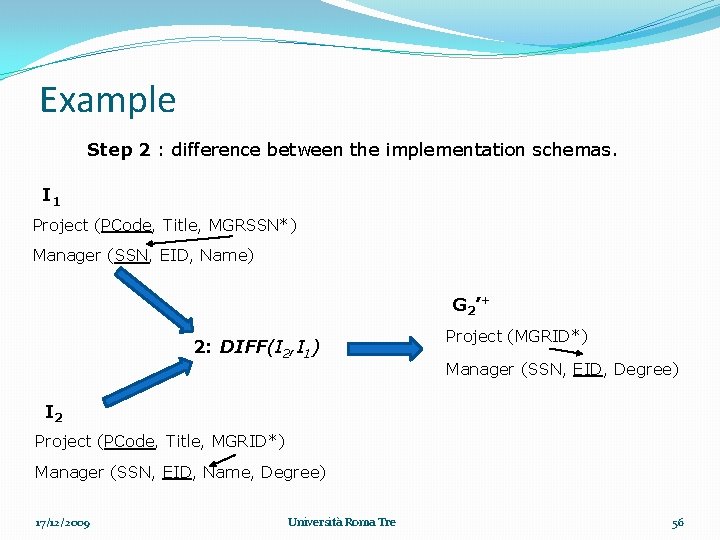
Example Step 2 : difference between the implementation schemas. I 1 Project (PCode, Title, MGRSSN*) Manager (SSN, EID, Name) G 2 ’+ 2: DIFF(I 2, I 1) Project (MGRID*) Manager (SSN, EID, Degree) I 2 Project (PCode, Title, MGRID*) Manager (SSN, EID, Name, Degree) 17/12/2009 Università Roma Tre 56
The Round-trip solving script 17/12/2009 Università Roma Tre 57
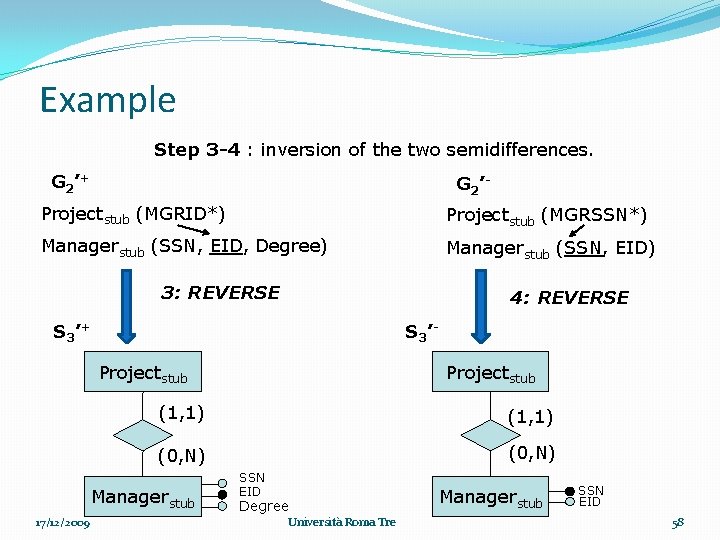
Example Step 3 -4 : inversion of the two semidifferences. G 2 ’+ G 2 ’- Projectstub (MGRID*) Projectstub (MGRSSN*) Managerstub (SSN, EID, Degree) Managerstub (SSN, EID) 3: REVERSE 4: REVERSE S 3 ’+ S 3 ’Projectstub (1, 1) (0, N) Managerstub 17/12/2009 Projectstub SSN EID Degree Università Roma Tre Managerstub SSN EID 58
The Round-trip solving script 17/12/2009 Università Roma Tre 59
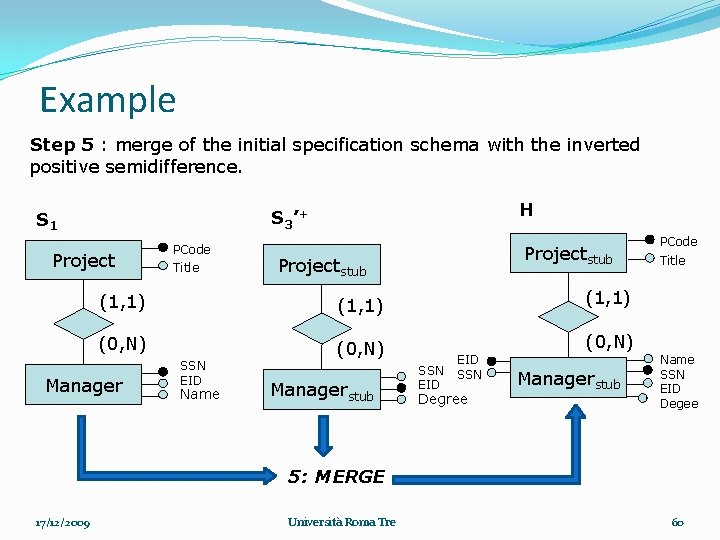
Example Step 5 : merge of the initial specification schema with the inverted positive semidifference. H S 3 ’+ S 1 Project PCode Title Projectstub (1, 1) (0, N) Manager SSN EID Name Managerstub SSN EID SSN Degree Managerstub PCode Title Name SSN EID Degee 5: MERGE 17/12/2009 Università Roma Tre 60
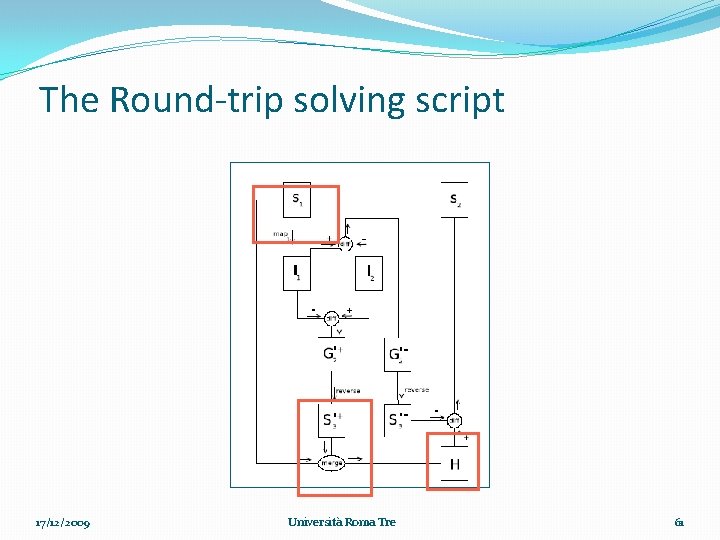
The Round-trip solving script 17/12/2009 Università Roma Tre 61
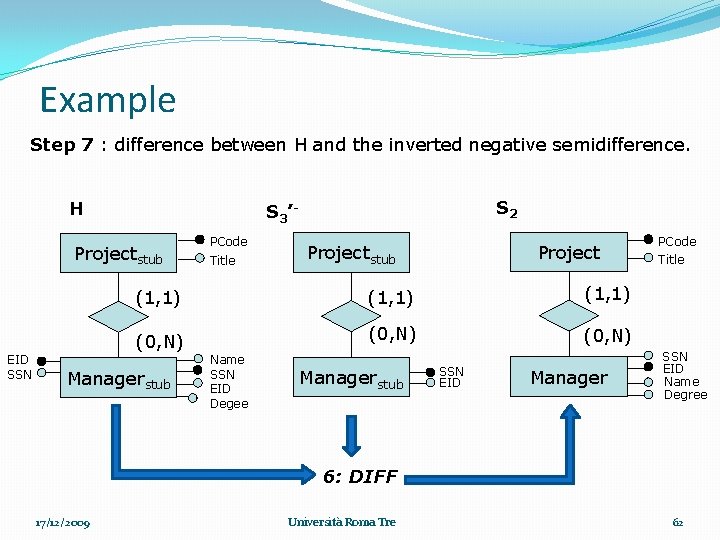
Example Step 7 : difference between H and the inverted negative semidifference. H Projectstub EID SSN S 2 S 3 ’PCode Title Projectstub (1, 1) (0, N) Managerstub Name SSN EID Degee Managerstub SSN EID Manager PCode Title SSN EID Name Degree 6: DIFF 17/12/2009 Università Roma Tre 62
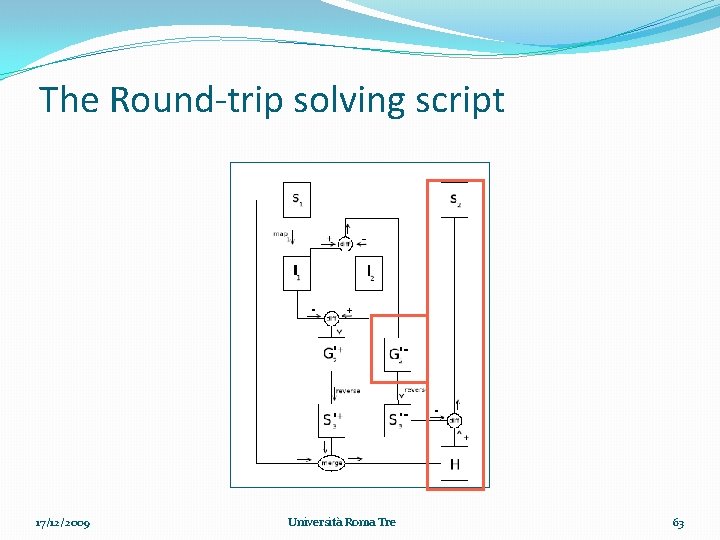
The Round-trip solving script 17/12/2009 Università Roma Tre 63
Demo 17/12/2009 Università Roma Tre 64/49
Properties �Model independence – MIDST handles schemas as instances of subsets of the available metaconstructs. – The operators are defined as datalog rules declaring transformations in terms of the supermodel metaconstructs. – The operators are defined in such a way that they are valid for any model by specifying comparisons between every available construct. 17/12/2009 Università Roma Tre 65
Properties �Model closure – A model management operator (except MODELGEN) applied to a set of input schemas of a model M yields output schemas of the same model M. �Model awareness – Operators can be defined in such a way that they do not add metaconstructs which are not present in the source schemas (model awareness). 17/12/2009 Università Roma Tre 66
References � [1] P. Atzeni, P. Cappellari and P. A. Bernstein. Modelgen: Modelindependent schema translation. In ICDE Conference, pages 1111 -1112, 2005. � [2] P. Atzeni, P. Cappellari and G. Gianforme. MIDST: modelindependent schema and data translation. In SIGMOD, pages 11341136, ACM, 2007. � [3] P. Atzeni, P. Cappellari, R. Torlone, P. A. Bernstein and G. Gianforme. Model-independent schema translation. In VLDB Journal. � [4] P. A. Bernstein. Applying model management to classical meta data problems. In CIDR, pages 209 -220, 2003. 17/12/2009 Università Roma Tre 67
Summary �Model management �Operators �Model generic operators �Operators in MIDST �Example 17/12/2009 Università Roma Tre 68
- Slides: 68