
ModelDriven Risk Analysis The CORAS Approach Ketil Stlen
- Slides: 30
Model-Driven Risk Analysis The CORAS Approach Ketil Stølen, SINTEF & Ui. O FOSAD 2011 CORAS 1
Acknowledgments § The research for the contents of this tutorial has partly been funded by the European Commission through the FP 7 project Secure. Change and the FP 7 network of excellence NESSo. S CORAS 2
Overview § Part I Introduction – Risk management and the CORAS approach § Part II Example-driven walkthrough of the CORAS method § Part III Change Management CORAS 3
Part I: Introduction Risk Management and the CORAS Approach CORAS 4
Overview of Part I § § § What is risk? What is risk management? Central terms What is CORAS? Main concepts The CORAS process Risk modeling Semantics Likelihood reasoning The CORAS tool Further reading CORAS 5
What is Risk? § Many kinds of risk § § § § Contractual risk Economic risk Operational risk Environmental risk Health risk Political risk Legal risk Security risk CORAS 6
Definition of risk from ISO 31000 § Risk: Effect of uncertainty on objectives § NOTE 1 An effect is a deviation from the expected — positive and/or negative § NOTE 2 Objectives can have different aspects (such as financial, health and safety, and environmental goals) and can apply at different levels (such as strategic, organization-wide, project, product and process) § NOTE 3 Risk is often characterized by reference to potential events and consequences, or a combination of these § NOTE 4 Risk is often expressed in terms of a combination of the consequences of an event (including changes in circumstances) and the associated likelihood of occurrence § NOTE 5 Uncertainty is the state, even partial, of deficiency of information related to, understanding or knowledge of an event, its consequence, or likelihood CORAS 7
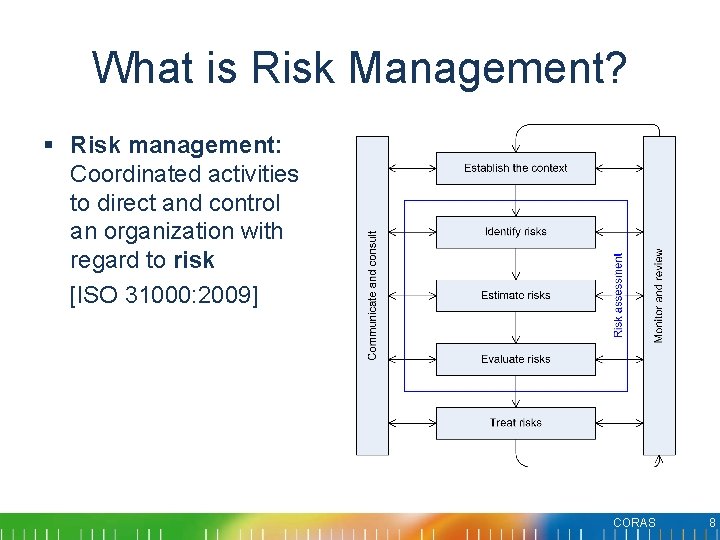
What is Risk Management? § Risk management: Coordinated activities to direct and control an organization with regard to risk [ISO 31000: 2009] CORAS 8
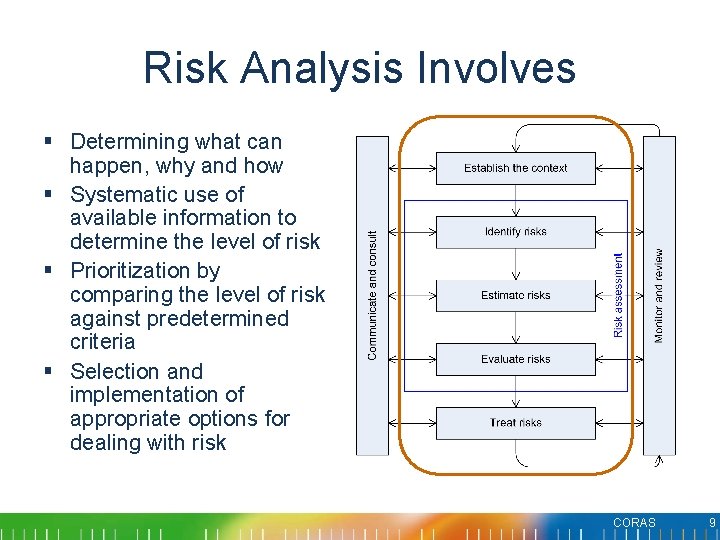
Risk Analysis Involves § Determining what can happen, why and how § Systematic use of available information to determine the level of risk § Prioritization by comparing the level of risk against predetermined criteria § Selection and implementation of appropriate options for dealing with risk CORAS 9
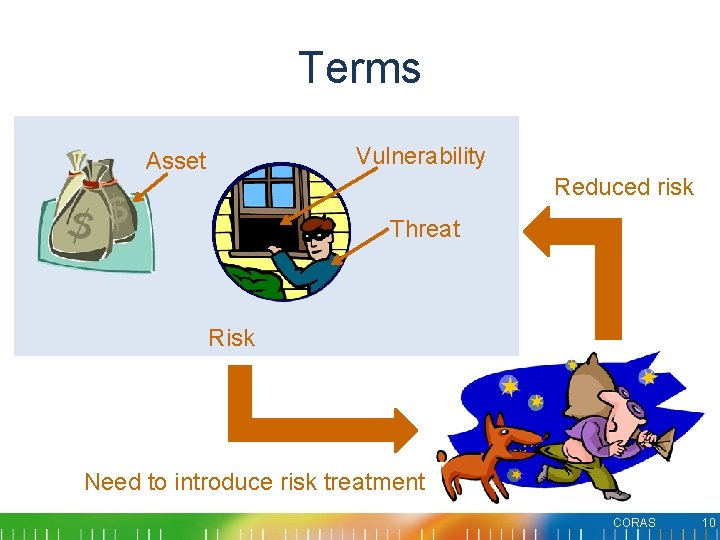
Terms Vulnerability Asset Reduced risk Threat Risk Need to introduce risk treatment CORAS 10
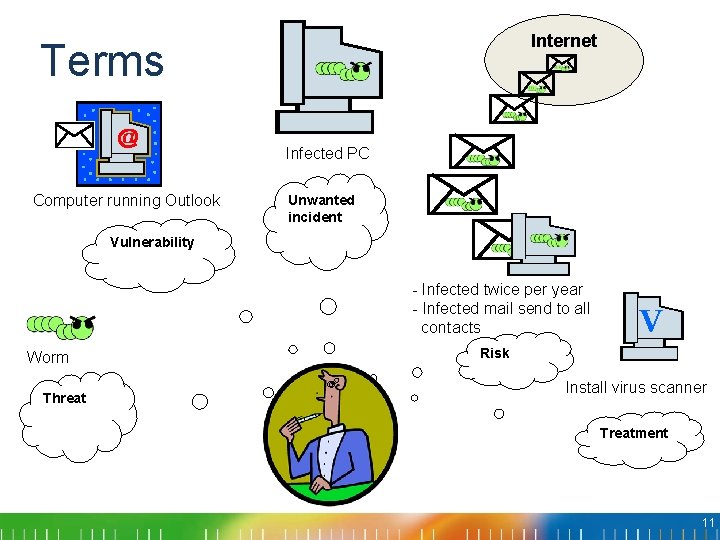
Internet Terms Infected PC Computer running Outlook Unwanted incident Vulnerability - Infected twice per year - Infected mail send to all contacts Worm Threat V Risk Install virus scanner Treatment 11
Risk Analysis Using CORAS 12
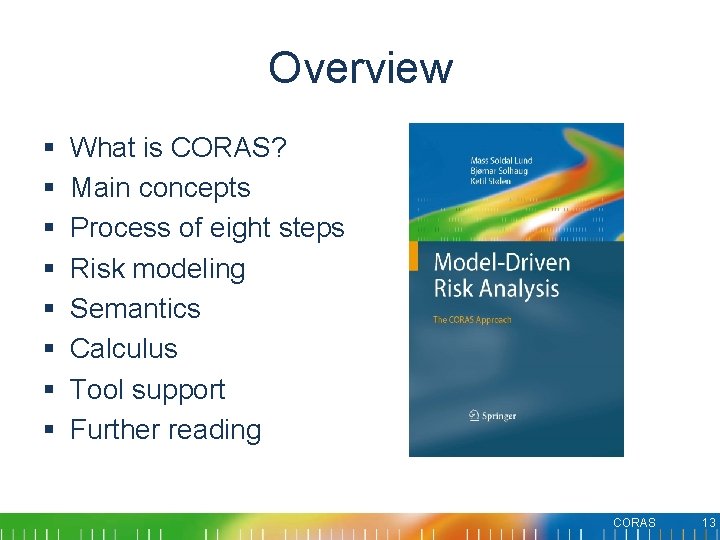
Overview § § § § What is CORAS? Main concepts Process of eight steps Risk modeling Semantics Calculus Tool support Further reading CORAS 13
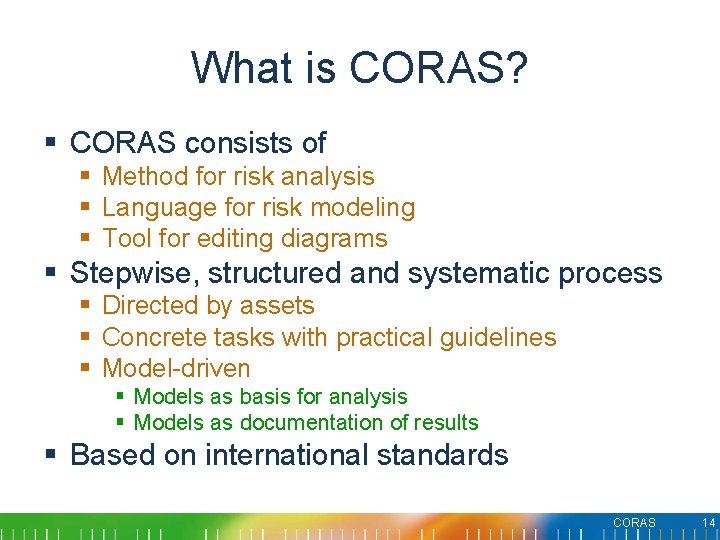
What is CORAS? § CORAS consists of § Method for risk analysis § Language for risk modeling § Tool for editing diagrams § Stepwise, structured and systematic process § Directed by assets § Concrete tasks with practical guidelines § Model-driven § Models as basis for analysis § Models as documentation of results § Based on international standards CORAS 14
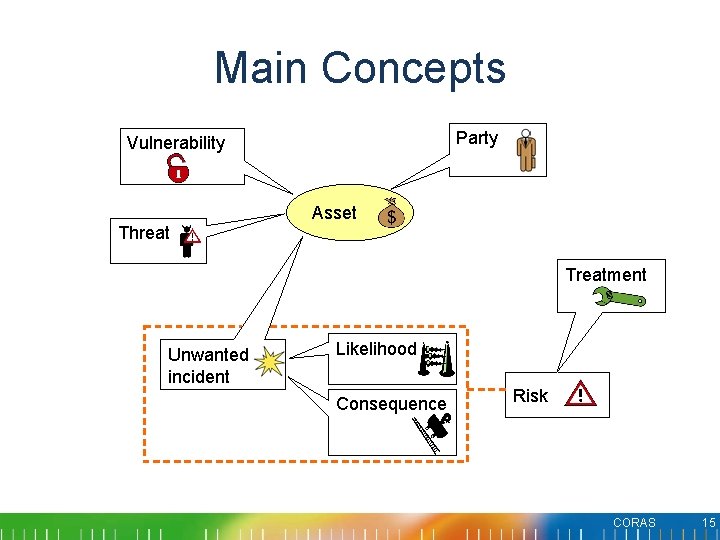
Main Concepts Party Vulnerability Threat Asset Treatment Unwanted incident Likelihood Consequence Risk CORAS 15
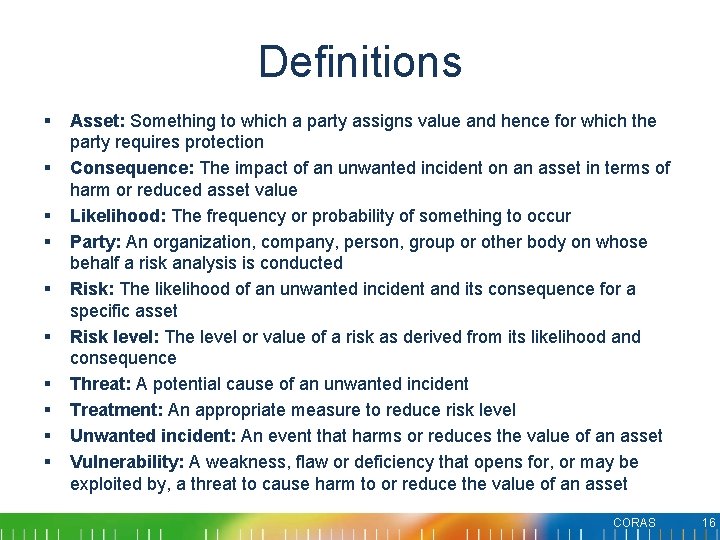
Definitions § § § § § Asset: Something to which a party assigns value and hence for which the party requires protection Consequence: The impact of an unwanted incident on an asset in terms of harm or reduced asset value Likelihood: The frequency or probability of something to occur Party: An organization, company, person, group or other body on whose behalf a risk analysis is conducted Risk: The likelihood of an unwanted incident and its consequence for a specific asset Risk level: The level or value of a risk as derived from its likelihood and consequence Threat: A potential cause of an unwanted incident Treatment: An appropriate measure to reduce risk level Unwanted incident: An event that harms or reduces the value of an asset Vulnerability: A weakness, flaw or deficiency that opens for, or may be exploited by, a threat to cause harm to or reduce the value of an asset CORAS 16
Exercise I § How would you represent risk in your favorite modelling language/formal notation/approach? CORAS 17
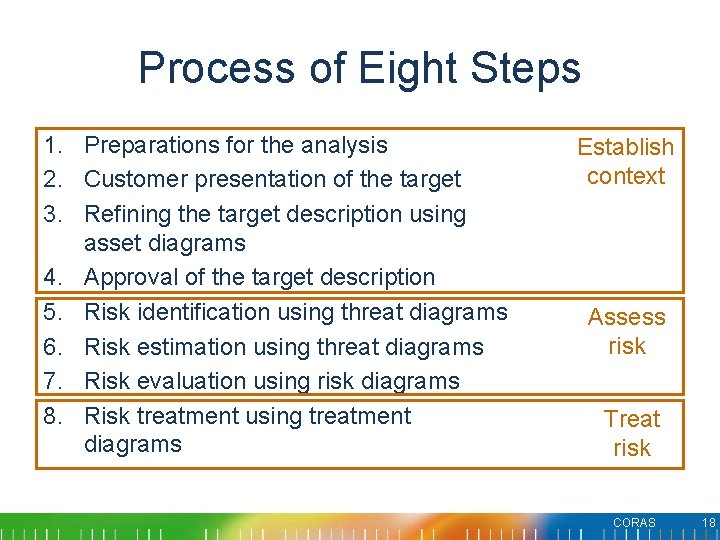
Process of Eight Steps 1. Preparations for the analysis 2. Customer presentation of the target 3. Refining the target description using asset diagrams 4. Approval of the target description 5. Risk identification using threat diagrams 6. Risk estimation using threat diagrams 7. Risk evaluation using risk diagrams 8. Risk treatment using treatment diagrams Establish context Assess risk Treat risk CORAS 18
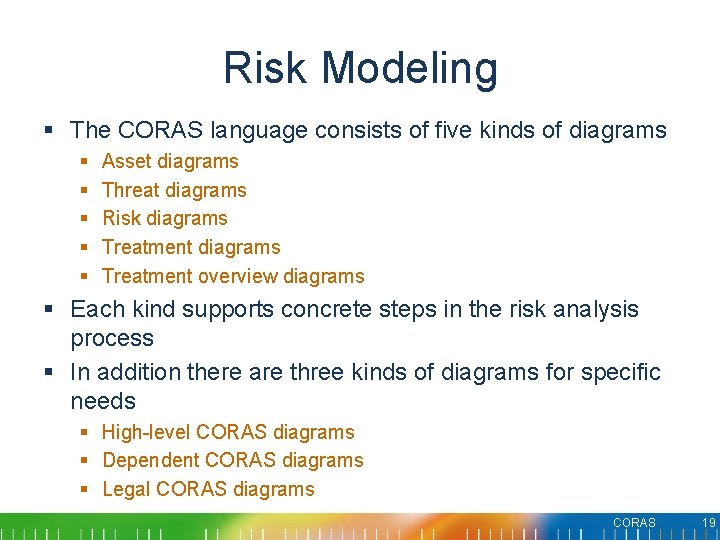
Risk Modeling § The CORAS language consists of five kinds of diagrams § § § Asset diagrams Threat diagrams Risk diagrams Treatment overview diagrams § Each kind supports concrete steps in the risk analysis process § In addition there are three kinds of diagrams for specific needs § High-level CORAS diagrams § Dependent CORAS diagrams § Legal CORAS diagrams CORAS 19
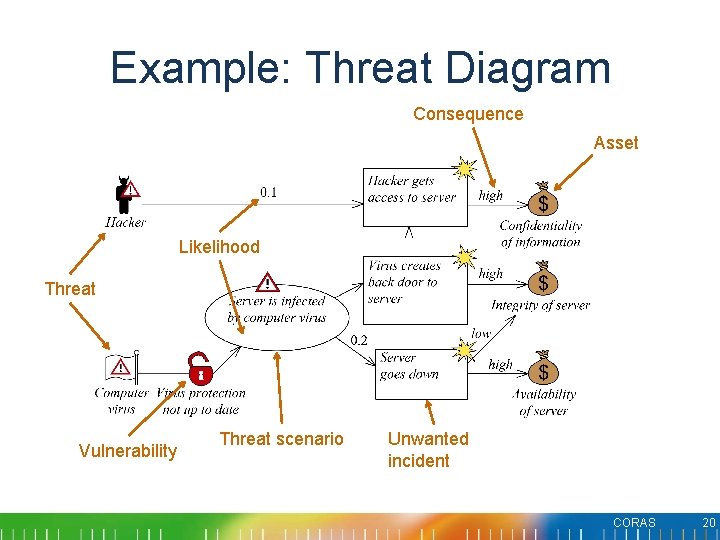
Example: Threat Diagram Consequence Asset Likelihood Threat Vulnerability Threat scenario Unwanted incident CORAS 20
Semantics § How to interpret and understand a CORAS diagram? § Users need a precise and unambiguous explanation of the meaning of a given diagram § Natural language semantics § CORAS comes with rules for systematic translation of any diagram into sentences in English § Formal semantics § Semantics in terms of a probability space on traces CORAS 21
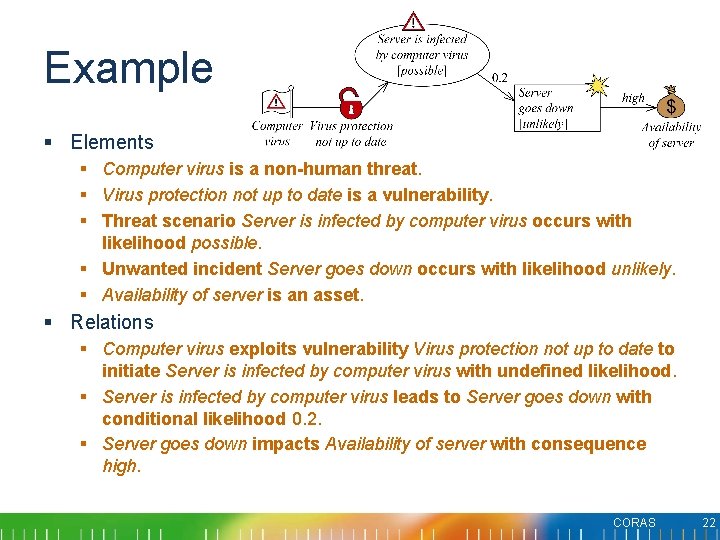
Example § Elements § Computer virus is a non-human threat. § Virus protection not up to date is a vulnerability. § Threat scenario Server is infected by computer virus occurs with likelihood possible. § Unwanted incident Server goes down occurs with likelihood unlikely. § Availability of server is an asset. § Relations § Computer virus exploits vulnerability Virus protection not up to date to initiate Server is infected by computer virus with undefined likelihood. § Server is infected by computer virus leads to Server goes down with conditional likelihood 0. 2. § Server goes down impacts Availability of server with consequence high. CORAS 22
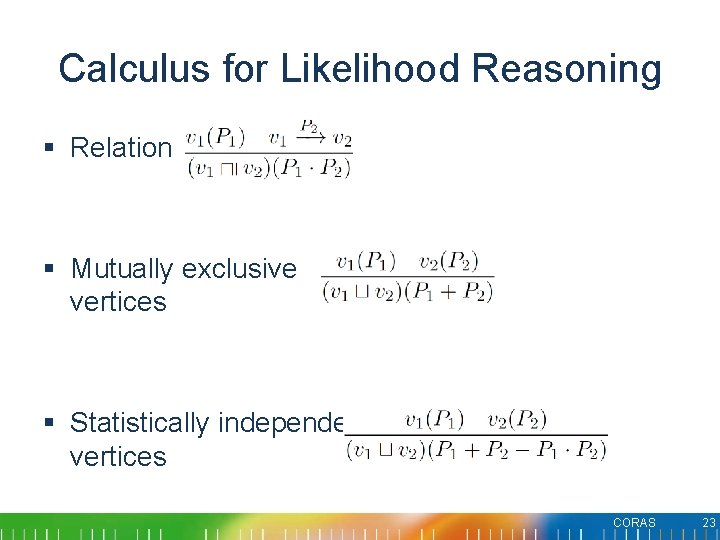
Calculus for Likelihood Reasoning § Relation § Mutually exclusive vertices § Statistically independent vertices CORAS 23
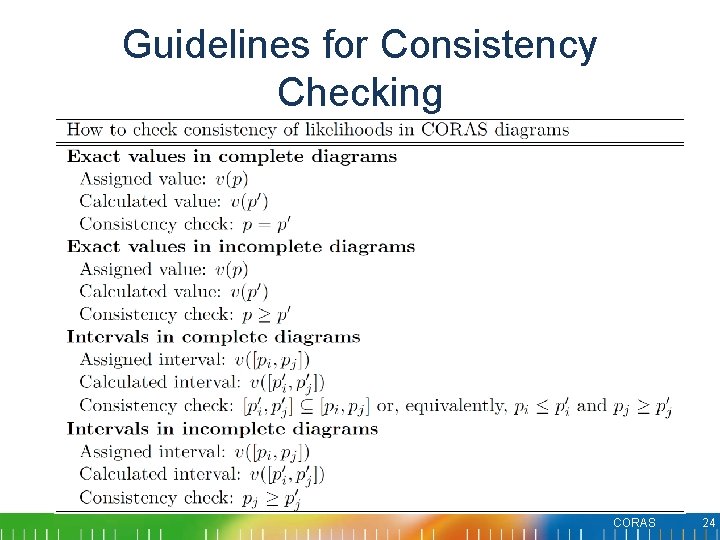
Guidelines for Consistency Checking CORAS 24
Tool Support § § § The CORAS tool is a diagram editor Supports all kinds of CORAS diagrams Suited for on-the-fly modeling during workshops Ensures syntactic correctness May be used during all the steps of a risk analysis § Documents input to the various tasks § Selection and structuring of information during tasks § Documentation of analysis results § Download: http: //coras. sourceforge. net/ CORAS 25
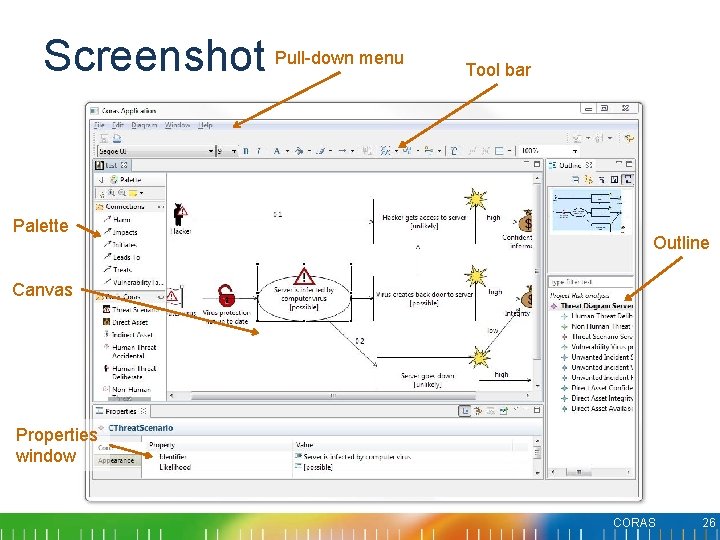
Screenshot Pull-down menu Palette Tool bar Outline Canvas Properties window CORAS 26
Criticism from system developers § The CORAS language is too simplistic § It is too cumbersome to use graphical icons CORAS 27
Criticism from risk analysts § What’s new with the CORAS language? § We have been using something similar for years, namely VISIO! CORAS 28
Exercise II § Discuss the statements made by the critics? § Argue why the critics are wrong. CORAS 29
Further Reading § Book: § www. springer. com/computer/swe/book/978 -3 -642 -12322 -1 § Some chapters may be downloaded for free, including Chapter 3 which gives a Guided Tour of CORAS § Tool: § http: //coras. sourceforge. net/ § Open source § Formal semantics: § Gyrd Brændeland, Atle Refsdal, Ketil Stølen. Modular analysis and modelling of risk scenarios with dependencies. Journal of Systems and Software, volume 83, pages 19952013, Elsevier, 2010. CORAS 30