
ModelDriven Development From ObjectOriented Design to ActorOriented Design
Model-Driven Development From Object-Oriented Design to Actor-Oriented Design Edward A. Lee Professor UC Berkeley Invited Talk Workshop on Software Engineering for Embedded Systems From Requirements to Implementation a. k. a. : The Monterey Workshop Chicago, Sept. 24, 2003 Chess: Center for Hybrid and Embedded Software Systems
Abstract Most current software engineering is deeply rooted in procedural abstractions. Objects in object-oriented design present interfaces consisting principally of methods with type signatures. A method represents a transfer of the locus of control. Much of the talk of "models" in software engineering is about the static structure of object-oriented designs. However, essential properties of real-time systems, embedded systems, and distributed systems-of-systems are poorly defined by such interfaces and by static structure. These say little about concurrency, temporal properties, and assumptions and guarantees in the face of dynamic invocation. Actor-oriented design contrasts with (and complements) object-oriented design by emphasizing concurrency and communication between components. Components called actors execute and communicate with other actors. While interfaces in object -oriented design (methods, principally) mediate transfer of the locus of control, interfaces in actor-oriented design (which we call ports) mediate communication. But the communication is not assumed to involve a transfer of control. By focusing on the actor-oriented architecture of systems, we can leverage structure that is poorly described and expressed in procedural abstractions. Managing concurrency, for instance, is notoriously difficult using threads, mutexes and semaphores, and yet even these primitive mechanisms are extensions of procedural abstractions. In actor-oriented abstractions, these low-level mechanisms do not even rise to consciousness, forming instead the "assembly-level" mechanisms used to deliver much more sophisticated models of computation. In this talk, I will outline the models of computation for actor-oriented design that look the most promising for embedded systems. UC Berkeley, Edward Lee 2
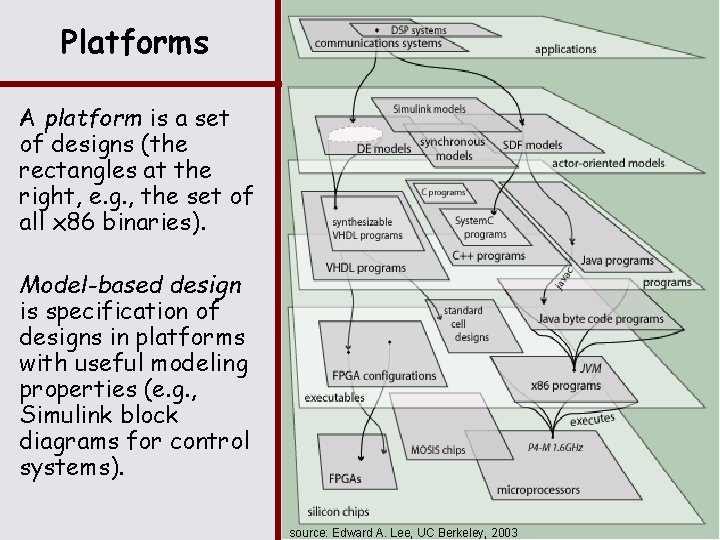
Platforms A platform is a set of designs (the rectangles at the right, e. g. , the set of all x 86 binaries). Model-based design is specification of designs in platforms with useful modeling properties (e. g. , Simulink block diagrams for control systems). source: Edward A. Lee, UC Berkeley, 2003 UC Berkeley, Edward Lee 3
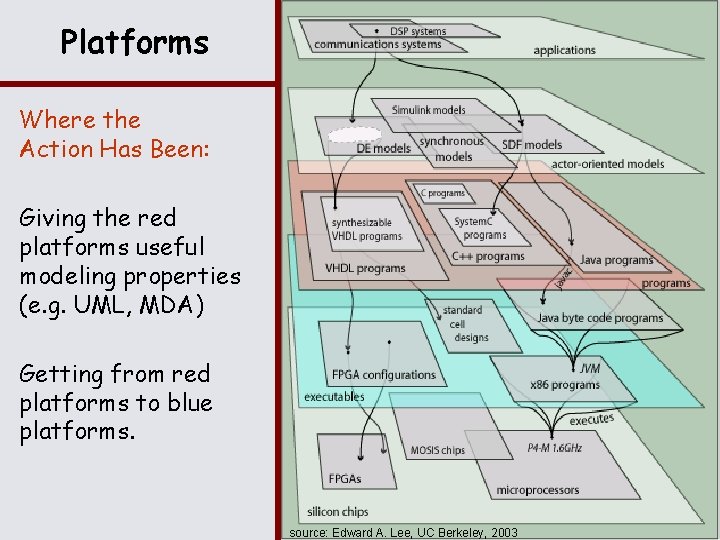
Platforms Where the Action Has Been: Giving the red platforms useful modeling properties (e. g. UML, MDA) Getting from red platforms to blue platforms. source: Edward A. Lee, UC Berkeley, 2003 UC Berkeley, Edward Lee 4
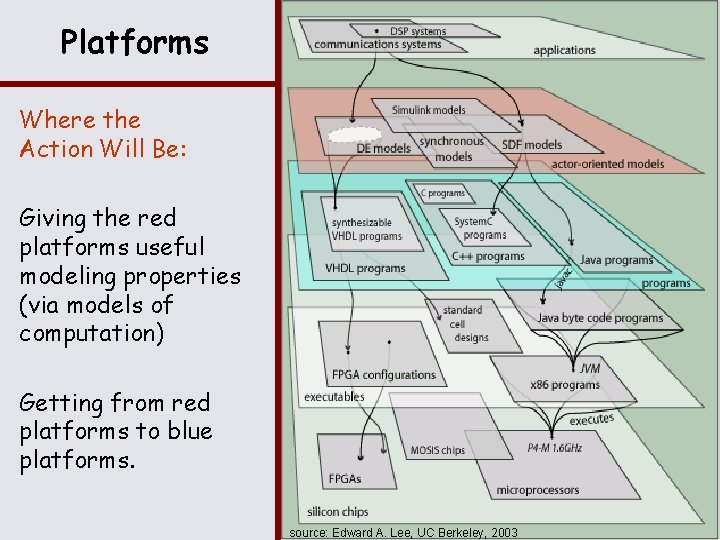
Platforms Where the Action Will Be: Giving the red platforms useful modeling properties (via models of computation) Getting from red platforms to blue platforms. source: Edward A. Lee, UC Berkeley, 2003 UC Berkeley, Edward Lee 5

Abstraction How abstract a design is depends on how many refinement relations separate the design from one that is physically realizable. Three paintings by Piet Mondrian UC Berkeley, Edward Lee 6
Design Framework A design framework is a collection of platforms and realizable relations between platforms where at least one of the platforms is a set of physically realizable designs, and for any design in any platform, the transitive closure of the relations from that design includes at least one physically realizable design. In model-based design, a specification is a point in a platform with useful modeling properties. UC Berkeley, Edward Lee 7

UML and MDA Trying to Give Useful Modeling Properties to Object-Oriented Designs Interface is a collection of methods and their type signatures. UML static structure diagram Inheritance Implementation UC Berkeley, Edward Lee 8
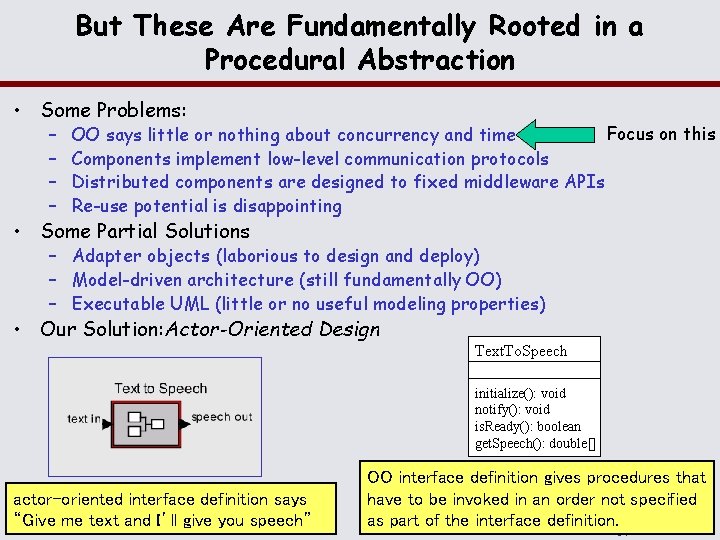
But These Are Fundamentally Rooted in a Procedural Abstraction • Some Problems: – – Focus on this OO says little or nothing about concurrency and time Components implement low-level communication protocols Distributed components are designed to fixed middleware APIs Re-use potential is disappointing • Some Partial Solutions – Adapter objects (laborious to design and deploy) – Model-driven architecture (still fundamentally OO) – Executable UML (little or no useful modeling properties) • Our Solution: Actor-Oriented Design Text. To. Speech initialize(): void notify(): void is. Ready(): boolean get. Speech(): double[] actor-oriented interface definition says “Give me text and I’ll give you speech” OO interface definition gives procedures that have to be invoked in an order not specified as part of the interface definition. UC Berkeley, Edward Lee 9
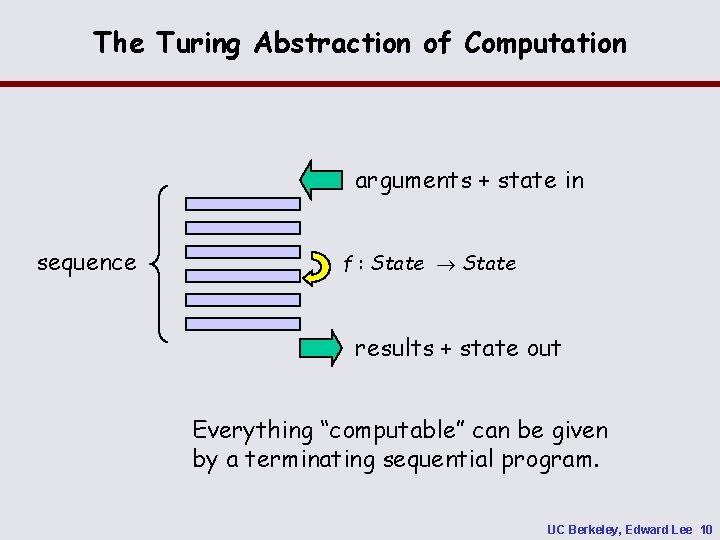
The Turing Abstraction of Computation arguments + state in sequence f : State results + state out Everything “computable” can be given by a terminating sequential program. UC Berkeley, Edward Lee 10
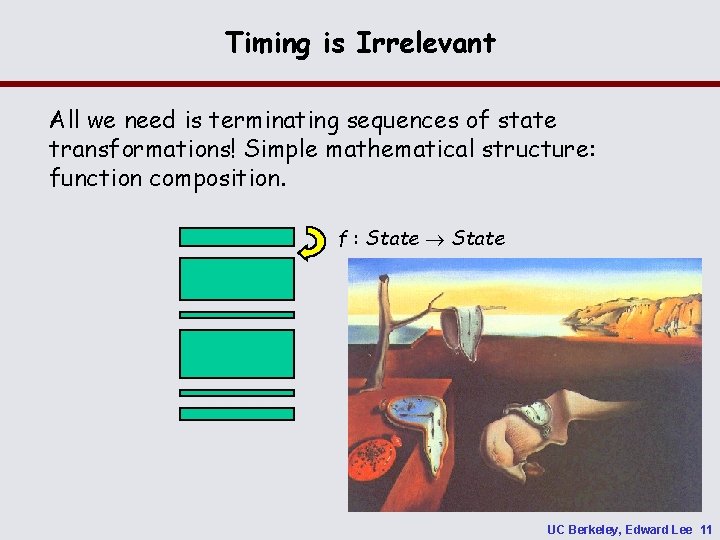
Timing is Irrelevant All we need is terminating sequences of state transformations! Simple mathematical structure: function composition. f : State UC Berkeley, Edward Lee 11
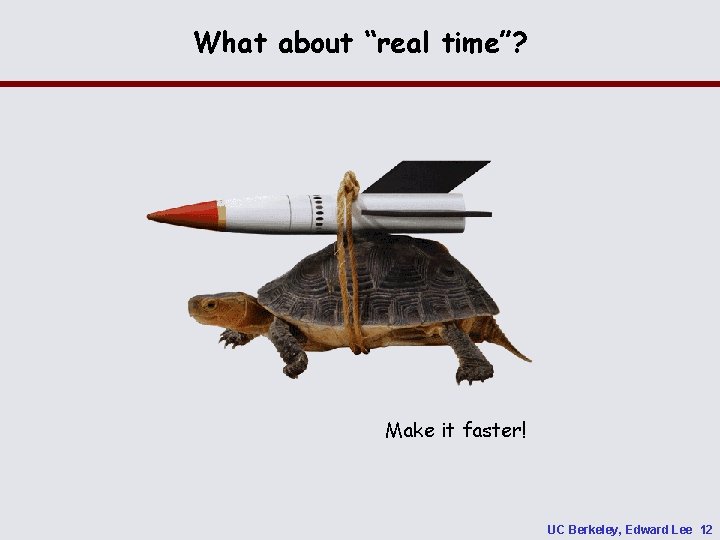
What about “real time”? Make it faster! UC Berkeley, Edward Lee 12
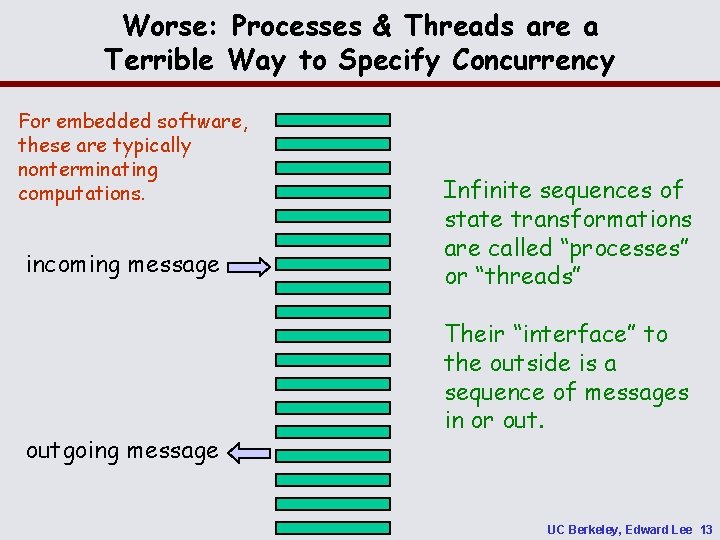
Worse: Processes & Threads are a Terrible Way to Specify Concurrency For embedded software, these are typically nonterminating computations. incoming message outgoing message Infinite sequences of state transformations are called “processes” or “threads” Their “interface” to the outside is a sequence of messages in or out. UC Berkeley, Edward Lee 13
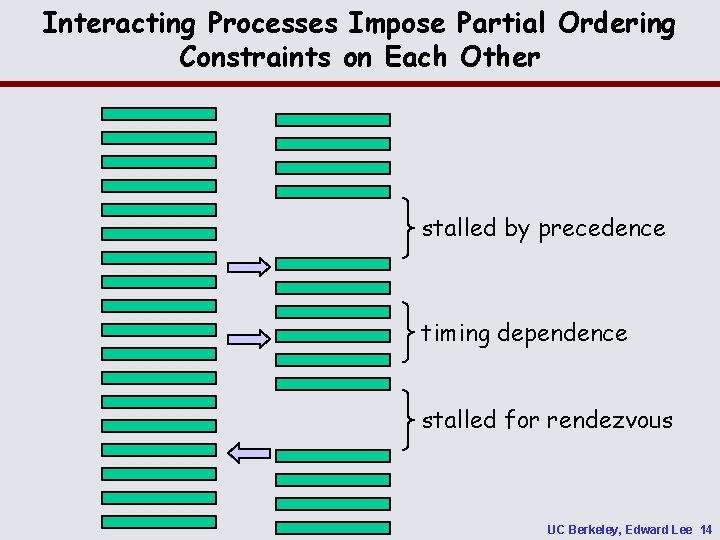
Interacting Processes Impose Partial Ordering Constraints on Each Other stalled by precedence timing dependence stalled for rendezvous UC Berkeley, Edward Lee 14

Interacting Processes Impose Partial Ordering Constraints on External Interactions After composition: External interactions are no longer ordered. An aggregation of processes is not a process. What is it? UC Berkeley, Edward Lee 15
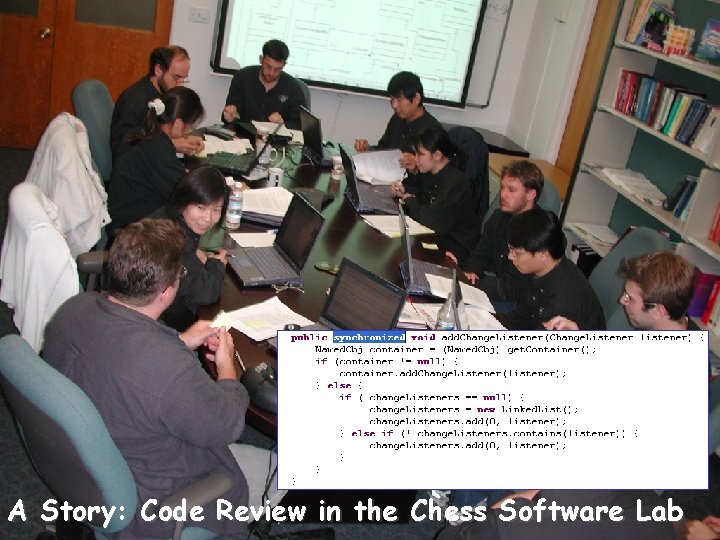
A Story: Code Review in the Chess Software Lab UC Berkeley, Edward Lee 16
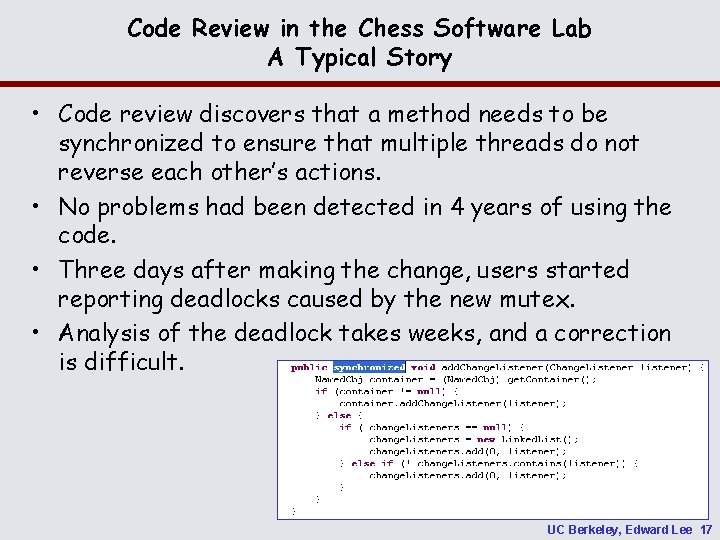
Code Review in the Chess Software Lab A Typical Story • Code review discovers that a method needs to be synchronized to ensure that multiple threads do not reverse each other’s actions. • No problems had been detected in 4 years of using the code. • Three days after making the change, users started reporting deadlocks caused by the new mutex. • Analysis of the deadlock takes weeks, and a correction is difficult. UC Berkeley, Edward Lee 17
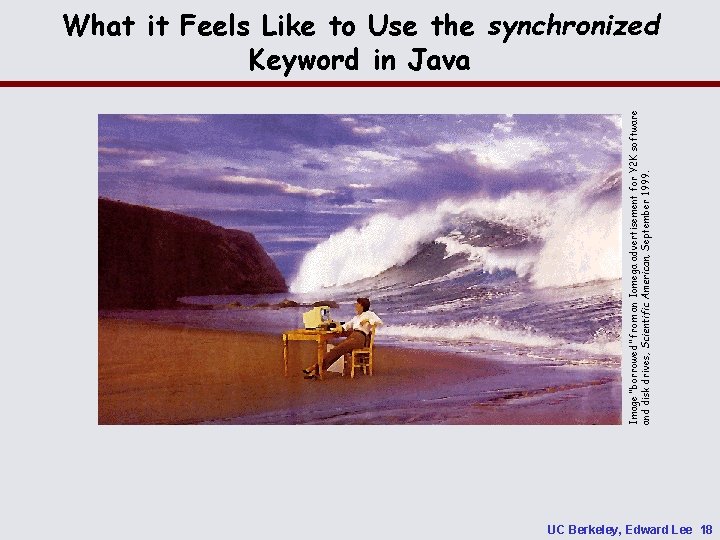
Image “borrowed” from an Iomega advertisement for Y 2 K software and disk drives, Scientific American, September 1999. What it Feels Like to Use the synchronized Keyword in Java UC Berkeley, Edward Lee 18
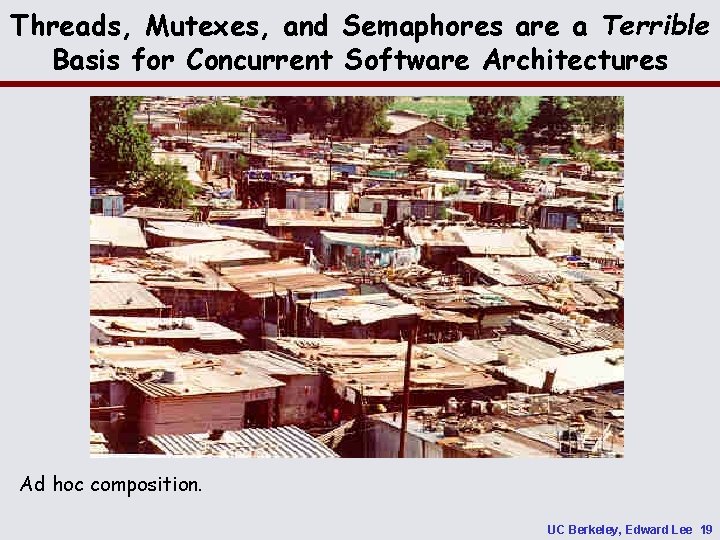
Threads, Mutexes, and Semaphores are a Terrible Basis for Concurrent Software Architectures Ad hoc composition. UC Berkeley, Edward Lee 19
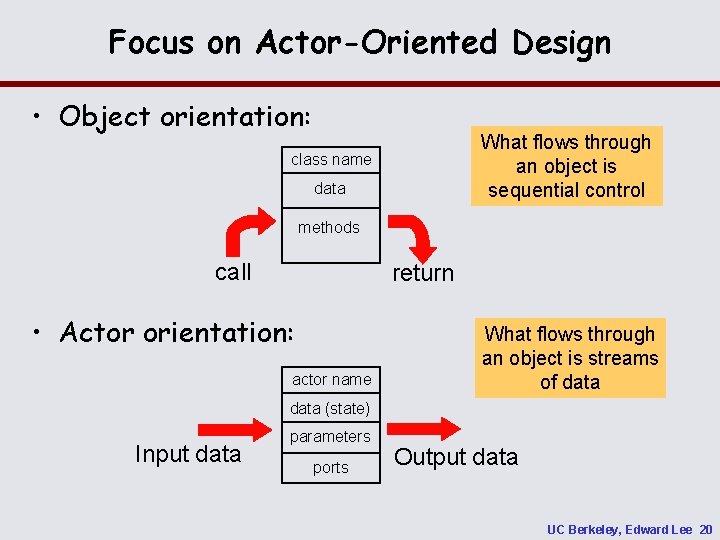
Focus on Actor-Oriented Design • Object orientation: What flows through an object is sequential control class name data methods call return • Actor orientation: actor name What flows through an object is streams of data (state) Input data parameters ports Output data UC Berkeley, Edward Lee 20
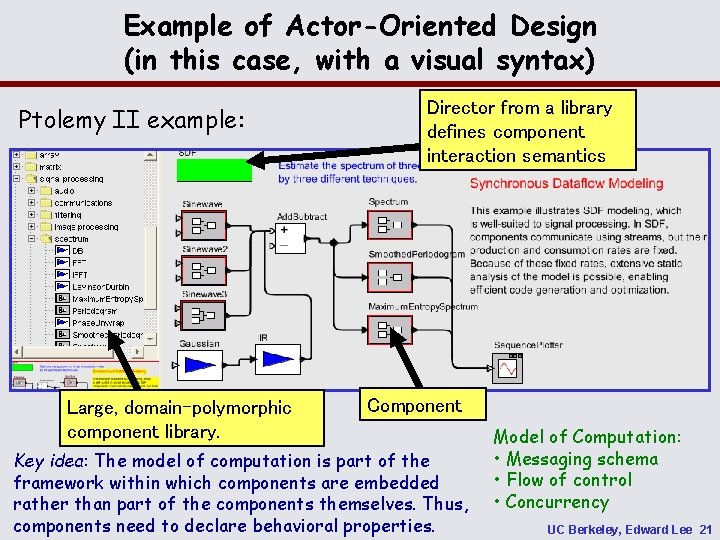
Example of Actor-Oriented Design (in this case, with a visual syntax) Ptolemy II example: Large, domain-polymorphic component library. Director from a library defines component interaction semantics Component Key idea: The model of computation is part of the framework within which components are embedded rather than part of the components themselves. Thus, components need to declare behavioral properties. Model of Computation: • Messaging schema • Flow of control • Concurrency UC Berkeley, Edward Lee 21
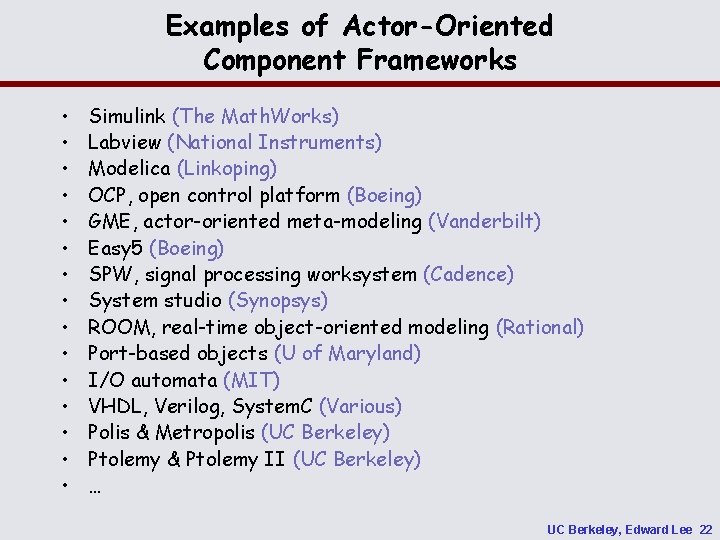
Examples of Actor-Oriented Component Frameworks • • • • Simulink (The Math. Works) Labview (National Instruments) Modelica (Linkoping) OCP, open control platform (Boeing) GME, actor-oriented meta-modeling (Vanderbilt) Easy 5 (Boeing) SPW, signal processing worksystem (Cadence) System studio (Synopsys) ROOM, real-time object-oriented modeling (Rational) Port-based objects (U of Maryland) I/O automata (MIT) VHDL, Verilog, System. C (Various) Polis & Metropolis (UC Berkeley) Ptolemy & Ptolemy II (UC Berkeley) … UC Berkeley, Edward Lee 22
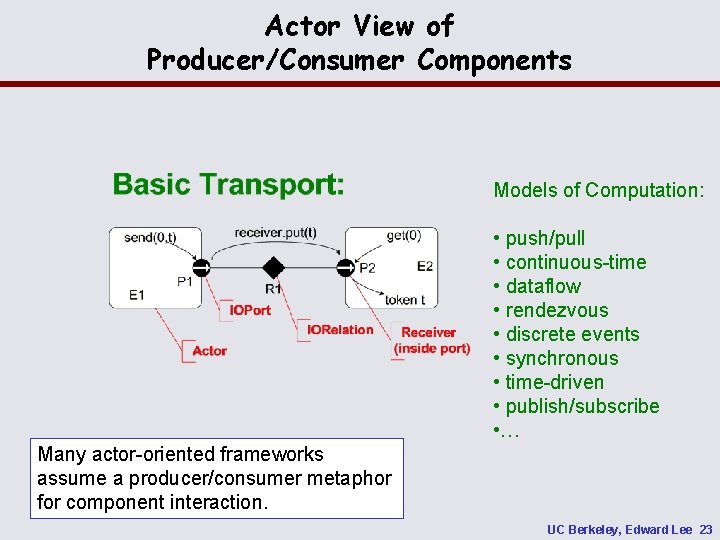
Actor View of Producer/Consumer Components Models of Computation: • push/pull • continuous-time • dataflow • rendezvous • discrete events • synchronous • time-driven • publish/subscribe • … Many actor-oriented frameworks assume a producer/consumer metaphor for component interaction. UC Berkeley, Edward Lee 23
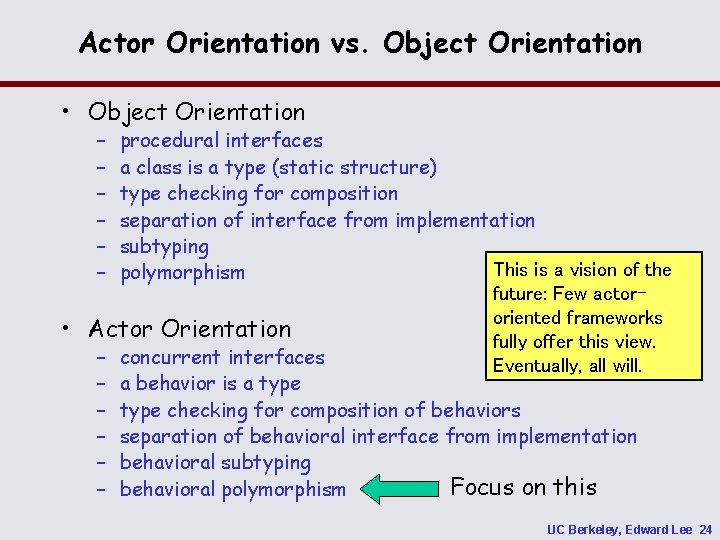
Actor Orientation vs. Object Orientation • Object Orientation – – – • procedural interfaces a class is a type (static structure) type checking for composition separation of interface from implementation subtyping This is a vision of the polymorphism future: Few actororiented frameworks Actor Orientation fully offer this view. – concurrent interfaces Eventually, all will. – a behavior is a type – type checking for composition of behaviors – separation of behavioral interface from implementation – behavioral subtyping Focus on this – behavioral polymorphism UC Berkeley, Edward Lee 24
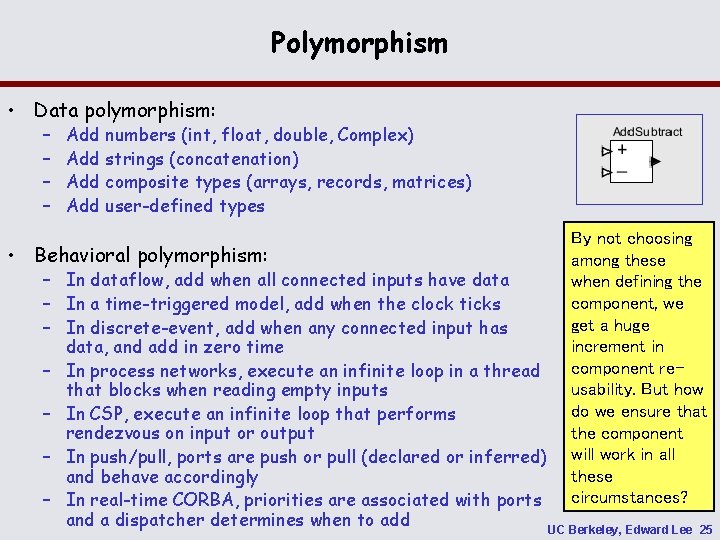
Polymorphism • Data polymorphism: – – Add numbers (int, float, double, Complex) Add strings (concatenation) Add composite types (arrays, records, matrices) Add user-defined types • Behavioral polymorphism: By not choosing among these when defining the component, we get a huge increment in component reusability. But how do we ensure that the component will work in all these circumstances? – In dataflow, add when all connected inputs have data – In a time-triggered model, add when the clock ticks – In discrete-event, add when any connected input has data, and add in zero time – In process networks, execute an infinite loop in a thread that blocks when reading empty inputs – In CSP, execute an infinite loop that performs rendezvous on input or output – In push/pull, ports are push or pull (declared or inferred) and behave accordingly – In real-time CORBA, priorities are associated with ports and a dispatcher determines when to add UC Berkeley, Edward Lee 25
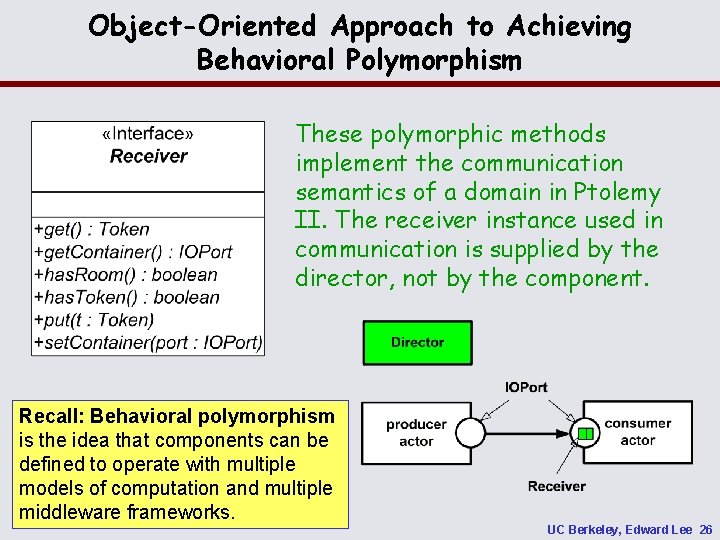
Object-Oriented Approach to Achieving Behavioral Polymorphism These polymorphic methods implement the communication semantics of a domain in Ptolemy II. The receiver instance used in communication is supplied by the director, not by the component. Recall: Behavioral polymorphism is the idea that components can be defined to operate with multiple models of computation and multiple middleware frameworks. UC Berkeley, Edward Lee 26
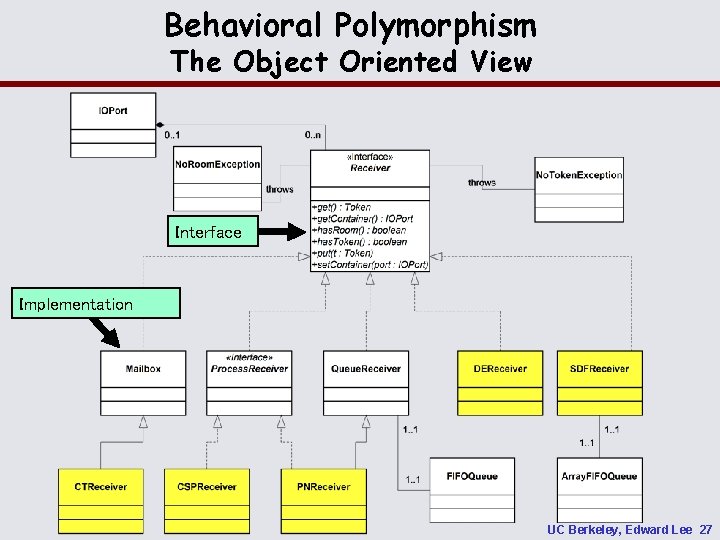
Behavioral Polymorphism The Object Oriented View Interface Implementation UC Berkeley, Edward Lee 27
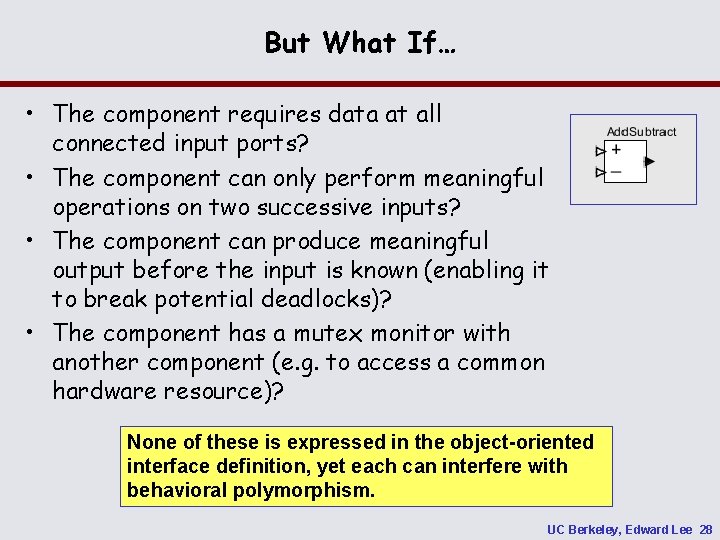
But What If… • The component requires data at all connected input ports? • The component can only perform meaningful operations on two successive inputs? • The component can produce meaningful output before the input is known (enabling it to break potential deadlocks)? • The component has a mutex monitor with another component (e. g. to access a common hardware resource)? None of these is expressed in the object-oriented interface definition, yet each can interfere with behavioral polymorphism. UC Berkeley, Edward Lee 28
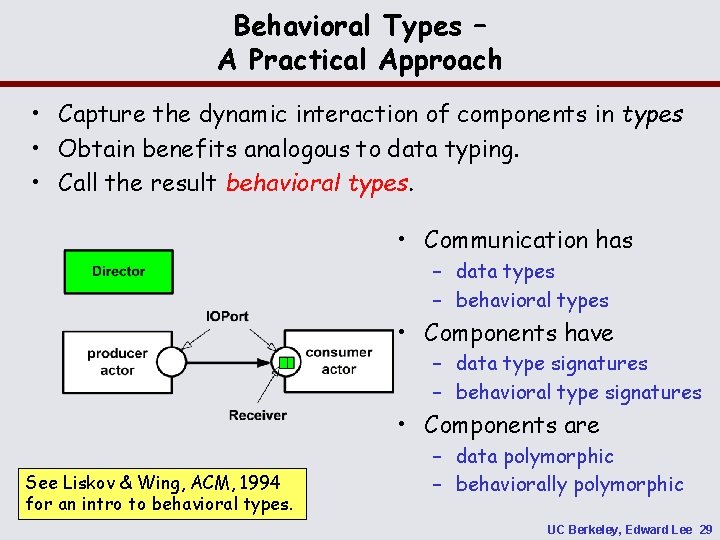
Behavioral Types – A Practical Approach • Capture the dynamic interaction of components in types • Obtain benefits analogous to data typing. • Call the result behavioral types. • Communication has – data types – behavioral types • Components have – data type signatures – behavioral type signatures • Components are See Liskov & Wing, ACM, 1994 for an intro to behavioral types. – data polymorphic – behaviorally polymorphic UC Berkeley, Edward Lee 29
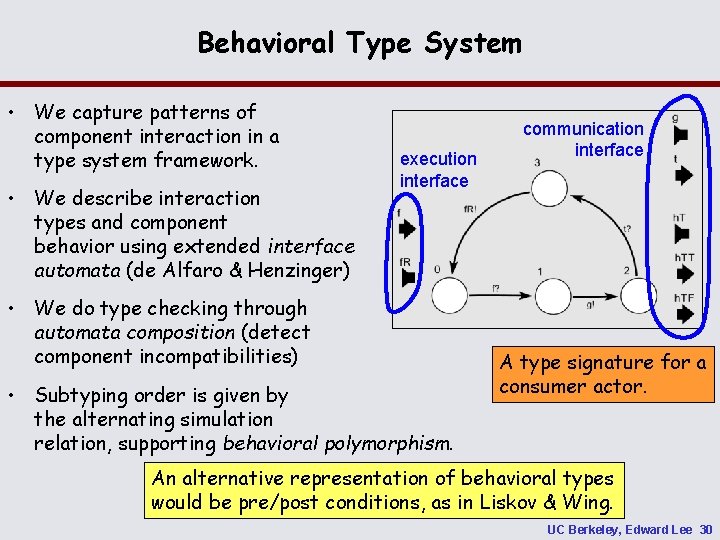
Behavioral Type System • We capture patterns of component interaction in a type system framework. • We describe interaction types and component behavior using extended interface automata (de Alfaro & Henzinger) execution interface • We do type checking through automata composition (detect component incompatibilities) • Subtyping order is given by the alternating simulation relation, supporting behavioral polymorphism. communication interface A type signature for a consumer actor. An alternative representation of behavioral types would be pre/post conditions, as in Liskov & Wing. UC Berkeley, Edward Lee 30
Enabled by a Behavioral Type System • Checking behavioral compatibility of components that are composed. • Checking behavioral compatibility of components and their frameworks. • Behavioral subclassing enables interface/implementation separation. • Helps with the definition of behaviorallypolymorphic components. UC Berkeley, Edward Lee 31
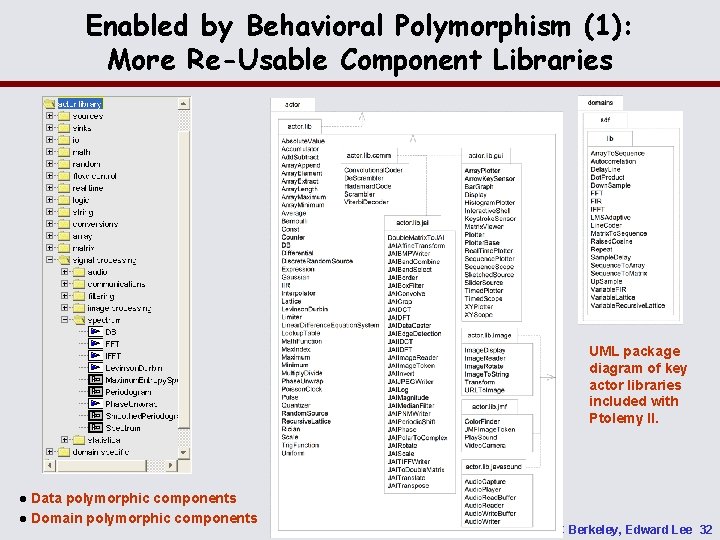
Enabled by Behavioral Polymorphism (1): More Re-Usable Component Libraries UML package diagram of key actor libraries included with Ptolemy II. Data polymorphic components l Domain polymorphic components l UC Berkeley, Edward Lee 32
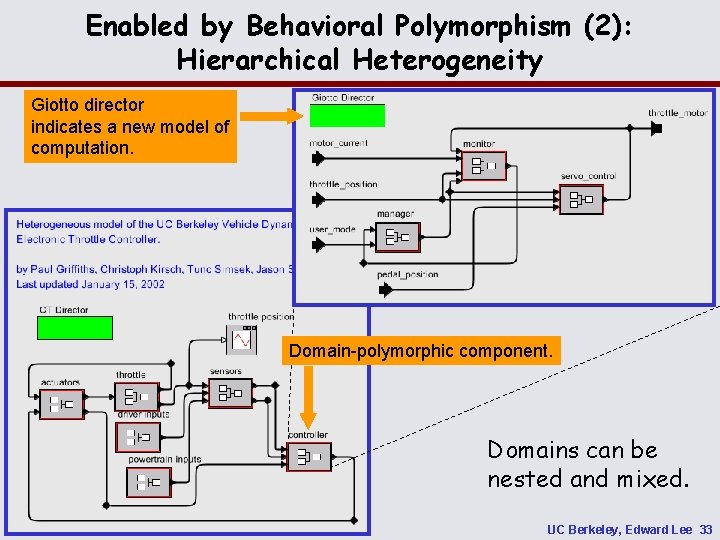
Enabled by Behavioral Polymorphism (2): Hierarchical Heterogeneity Giotto director indicates a new model of computation. Domain-polymorphic component. Domains can be nested and mixed. UC Berkeley, Edward Lee 33
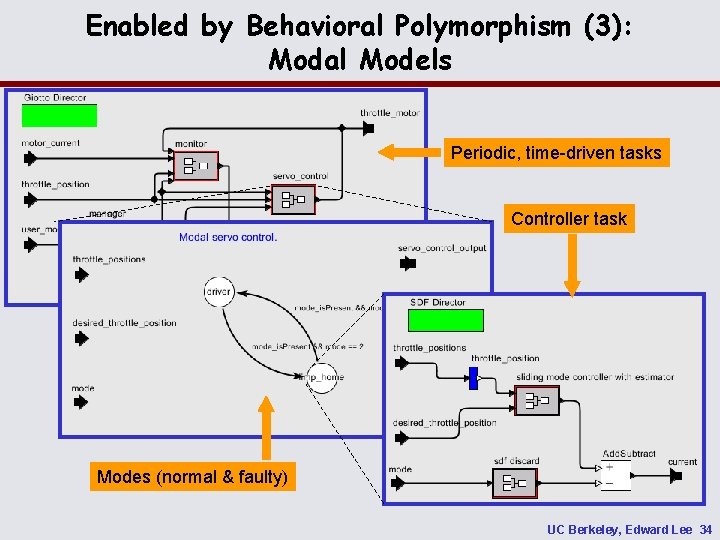
Enabled by Behavioral Polymorphism (3): Modal Models Periodic, time-driven tasks Controller task Modes (normal & faulty) UC Berkeley, Edward Lee 34
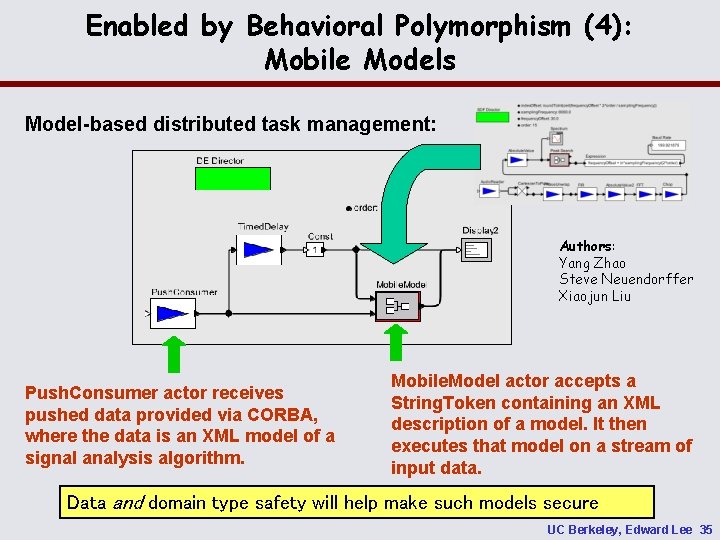
Enabled by Behavioral Polymorphism (4): Mobile Models Model-based distributed task management: Authors: Yang Zhao Steve Neuendorffer Xiaojun Liu Push. Consumer actor receives pushed data provided via CORBA, where the data is an XML model of a signal analysis algorithm. Mobile. Model actor accepts a String. Token containing an XML description of a model. It then executes that model on a stream of input data. Data and domain type safety will help make such models secure UC Berkeley, Edward Lee 35
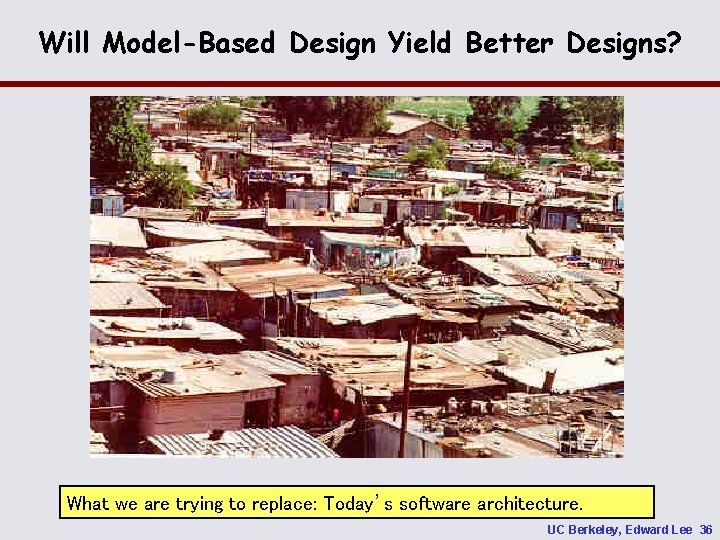
Will Model-Based Design Yield Better Designs? What we are trying to replace: Today’s software architecture. UC Berkeley, Edward Lee 36
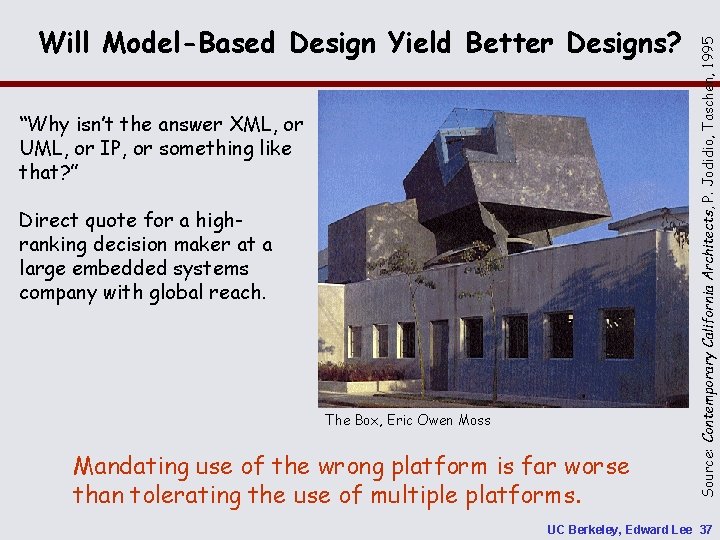
“Why isn’t the answer XML, or UML, or IP, or something like that? ” Direct quote for a highranking decision maker at a large embedded systems company with global reach. The Box, Eric Owen Moss Mandating use of the wrong platform is far worse than tolerating the use of multiple platforms. Source: Contemporary California Architects, P. Jodidio, Taschen, 1995 Will Model-Based Design Yield Better Designs? UC Berkeley, Edward Lee 37
Source: Kaplan Mc. Laughlin Diaz, R. Rappaport, Rockport, 1998 Better Architecture is Enabled but not Guaranteed by Actor-Oriented Design Two Rodeo Drive, Kaplan, Mc. Laughlin, Diaz • Understandable concurrency • Systematic heterogeneity (enabled by behavioral polymorphism) • More re-usable component libraries UC Berkeley, Edward Lee 38
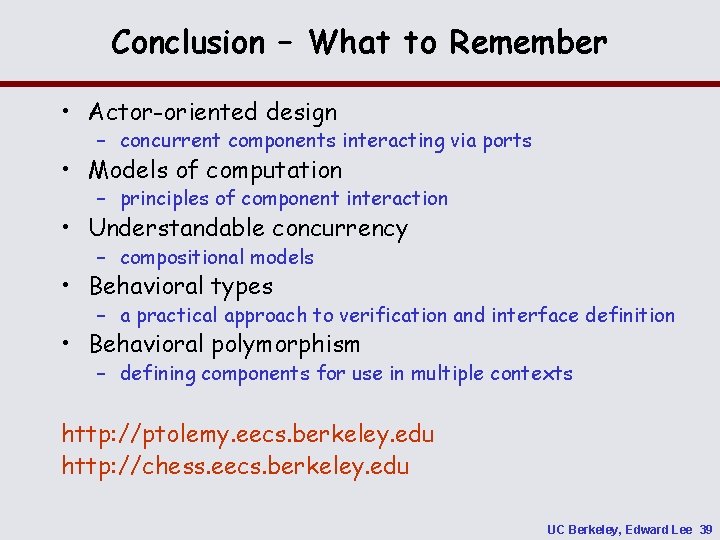
Conclusion – What to Remember • Actor-oriented design – concurrent components interacting via ports • Models of computation – principles of component interaction • Understandable concurrency – compositional models • Behavioral types – a practical approach to verification and interface definition • Behavioral polymorphism – defining components for use in multiple contexts http: //ptolemy. eecs. berkeley. edu http: //chess. eecs. berkeley. edu UC Berkeley, Edward Lee 39
- Slides: 39