
ModelDriven Development From Frontend to Code ModelDriven Development
- Slides: 48
Model-Driven Development – From Frontend to Code Model-Driven Development From Frontend to Code Sven Efftinge Bernd Kolb Markus Völter sven@efftinge. de www. efftinge. de © 2 0 0 6 Völter, Efftinge, Kolb bernd@kolbware. de www. kolbware. de 1 voelter@acm. org www. voelter. de w w w. openarchitectureware. org
Model-Driven Development – From Frontend to Code Model Driven Development • Model Driven Development is about making software development more domain-related as opposed to computing related. It is also about making software development in a certain domain more efficient. © 2 0 0 6 Völter, Efftinge, Kolb 2 w w w. openarchitectureware. org
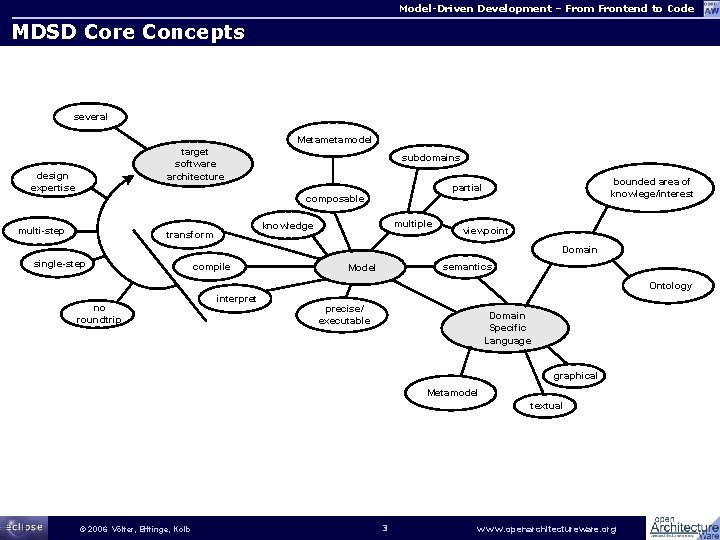
Model-Driven Development – From Frontend to Code MDSD Core Concepts several Metamodel target software architecture design expertise subdomains composable multi-step multiple knowledge transform bounded area of knowlege/interest partial viewpoint Domain single-step compile semantics Model Ontology no roundtrip interpret precise/ executable Domain Specific Language graphical Metamodel textual © 2 0 0 6 Völter, Efftinge, Kolb 3 w w w. openarchitectureware. org
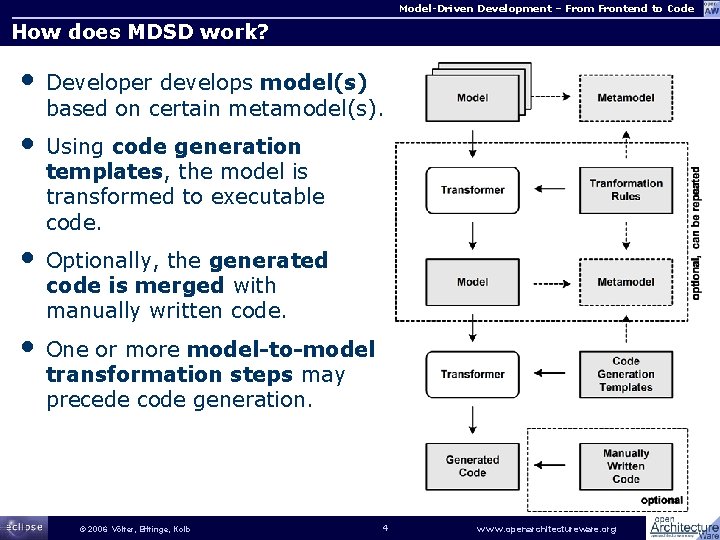
Model-Driven Development – From Frontend to Code How does MDSD work? • Developer develops model(s) based on certain metamodel(s). • Using code generation templates, the model is transformed to executable code. • Optionally, the generated code is merged with manually written code. • One or more model-to-model transformation steps may precede code generation. © 2 0 0 6 Völter, Efftinge, Kolb 4 w w w. openarchitectureware. org
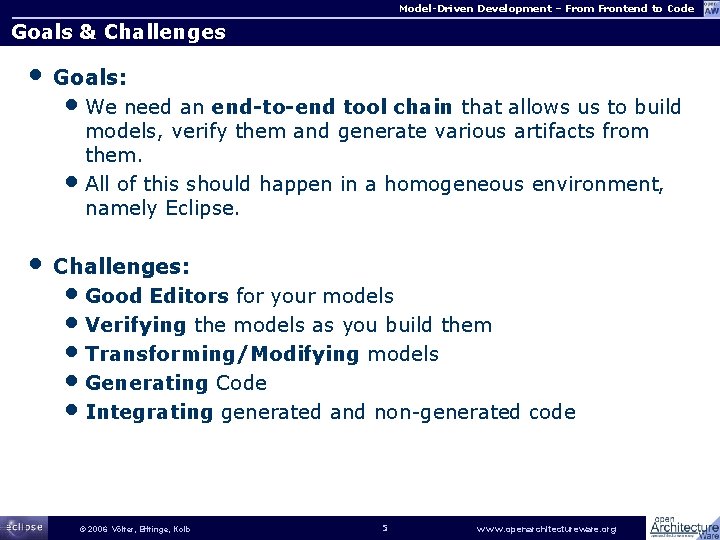
Model-Driven Development – From Frontend to Code Goals & Challenges • Goals: • We need an end-to-end tool chain that allows us to build models, verify them and generate various artifacts from them. • All of this should happen in a homogeneous environment, namely Eclipse. • Challenges: • Good Editors for your models • Verifying the models as you build them • Transforming/Modifying models • Generating Code • Integrating generated and non-generated code © 2 0 0 6 Völter, Efftinge, Kolb 5 w w w. openarchitectureware. org
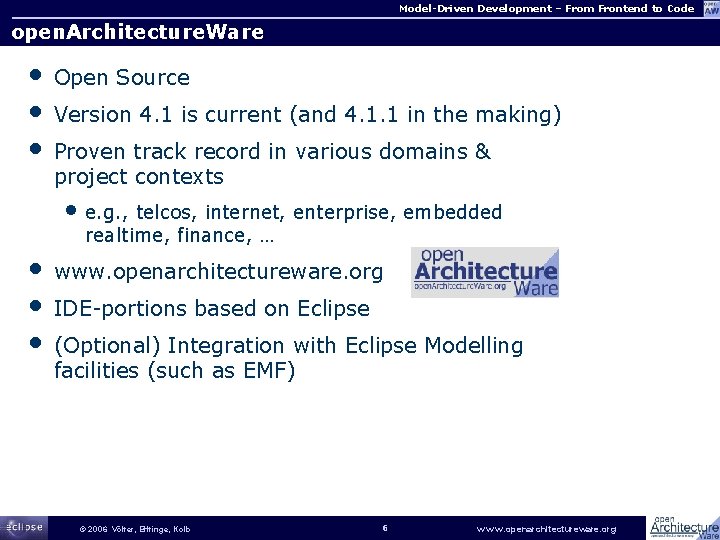
Model-Driven Development – From Frontend to Code open. Architecture. Ware • • • Open Source Version 4. 1 is current (and 4. 1. 1 in the making) Proven track record in various domains & project contexts • e. g. , telcos, internet, enterprise, embedded realtime, finance, … • • • www. openarchitectureware. org IDE-portions based on Eclipse (Optional) Integration with Eclipse Modelling facilities (such as EMF) © 2 0 0 6 Völter, Efftinge, Kolb 6 w w w. openarchitectureware. org
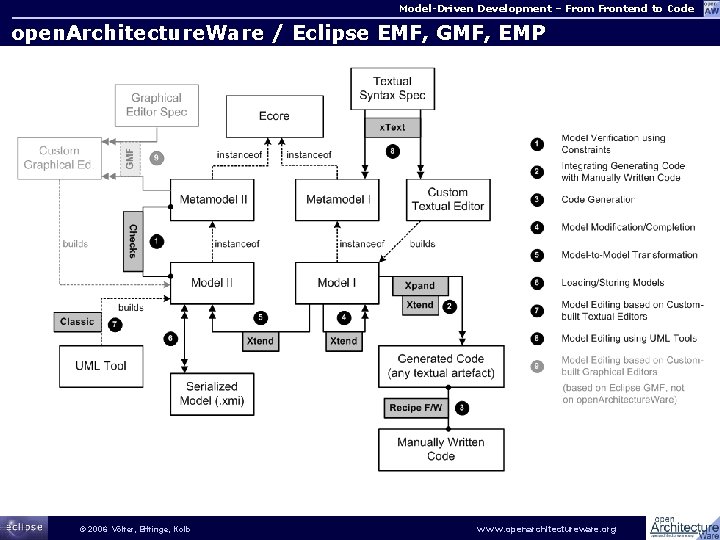
Model-Driven Development – From Frontend to Code open. Architecture. Ware / Eclipse EMF, GMF, EMP © 2 0 0 6 Völter, Efftinge, Kolb w w w. openarchitectureware. org
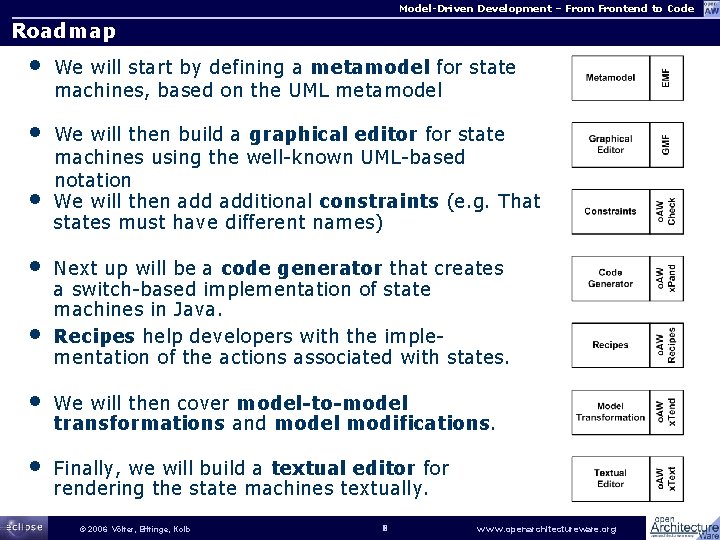
Model-Driven Development – From Frontend to Code Roadmap • We will start by defining a metamodel for state machines, based on the UML metamodel • We will then build a graphical editor for state machines using the well-known UML-based notation We will then additional constraints (e. g. That states must have different names) • • • Next up will be a code generator that creates a switch-based implementation of state machines in Java. Recipes help developers with the implementation of the actions associated with states. • We will then cover model-to-model transformations and model modifications. • Finally, we will build a textual editor for rendering the state machines textually. © 2 0 0 6 Völter, Efftinge, Kolb 8 w w w. openarchitectureware. org
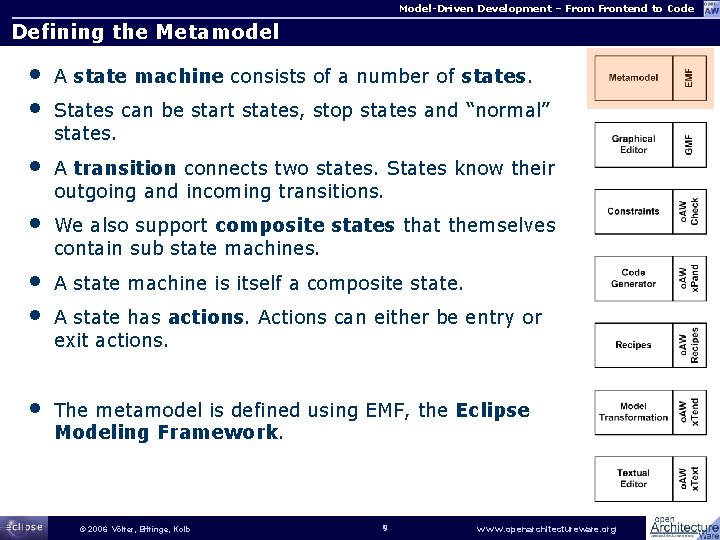
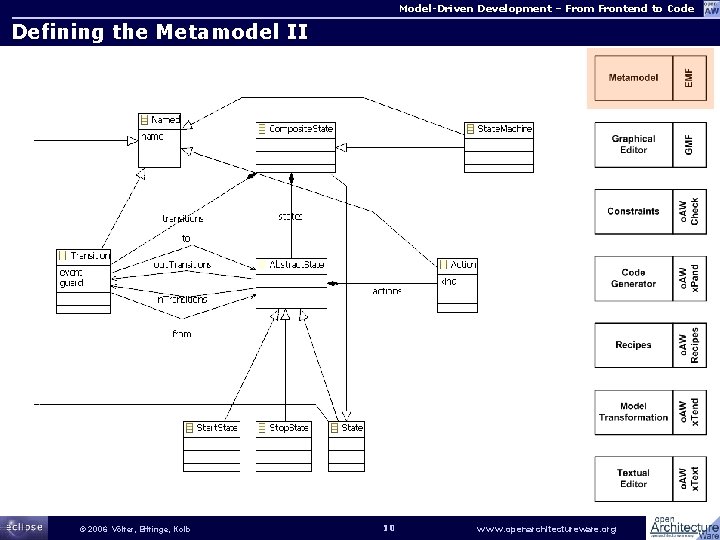
Model-Driven Development – From Frontend to Code Defining the Metamodel • • A state machine consists of a number of states. • A transition connects two states. States know their outgoing and incoming transitions. • We also support composite states that themselves contain sub state machines. • • A state machine is itself a composite state. • The metamodel is defined using EMF, the Eclipse Modeling Framework. States can be start states, stop states and “normal” states. A state has actions. Actions can either be entry or exit actions. © 2 0 0 6 Völter, Efftinge, Kolb 9 w w w. openarchitectureware. org
Model-Driven Development – From Frontend to Code Defining the Metamodel II © 2 0 0 6 Völter, Efftinge, Kolb 10 w w w. openarchitectureware. org
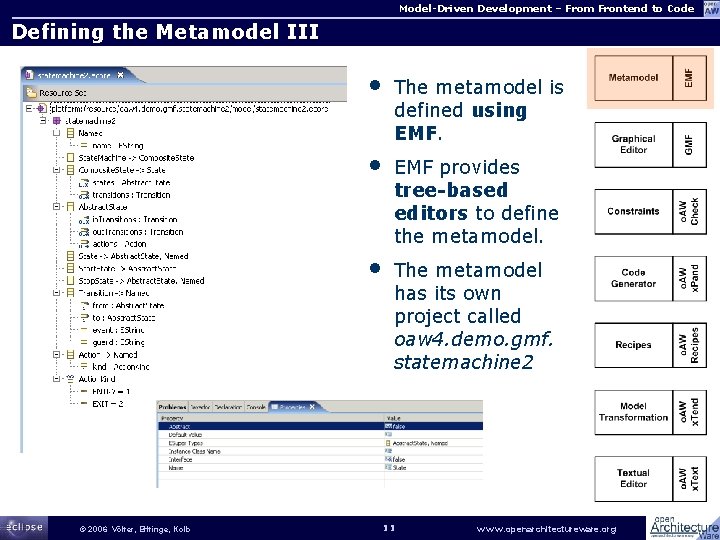
Model-Driven Development – From Frontend to Code Defining the Metamodel III © 2 0 0 6 Völter, Efftinge, Kolb • The metamodel is defined using EMF. • EMF provides tree-based editors to define the metamodel. • The metamodel has its own project called oaw 4. demo. gmf. statemachine 2 11 w w w. openarchitectureware. org
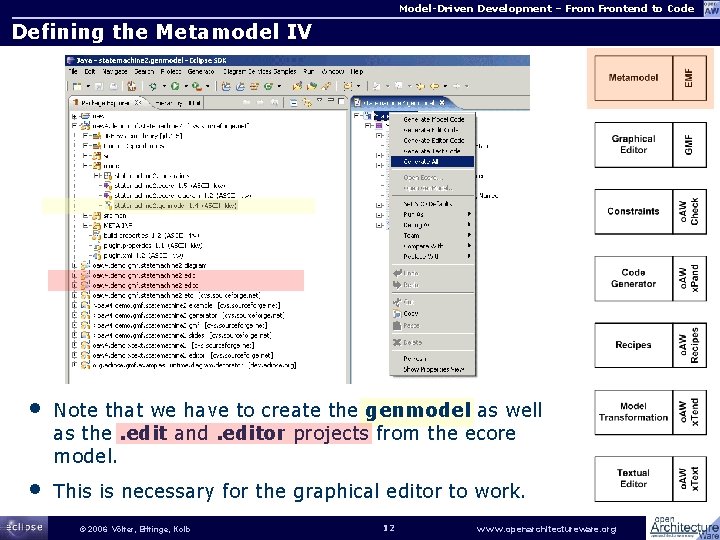
Model-Driven Development – From Frontend to Code Defining the Metamodel IV • Note that we have to create the genmodel as well as the. edit and. editor projects from the ecore model. • This is necessary for the graphical editor to work. © 2 0 0 6 Völter, Efftinge, Kolb 12 w w w. openarchitectureware. org
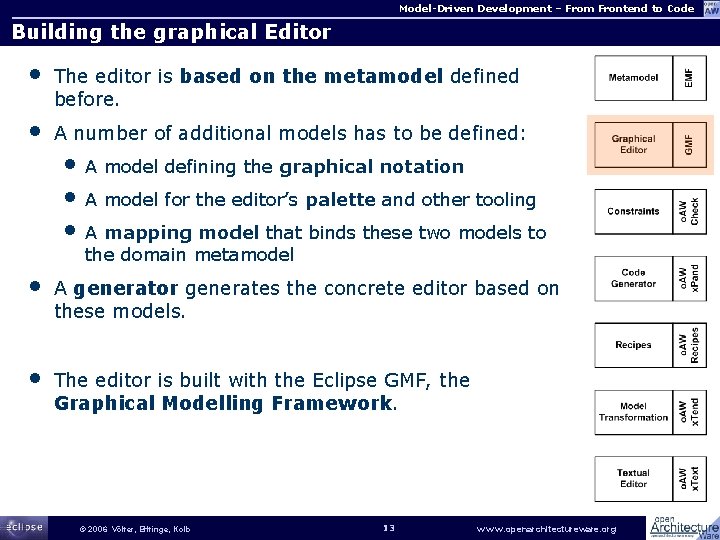
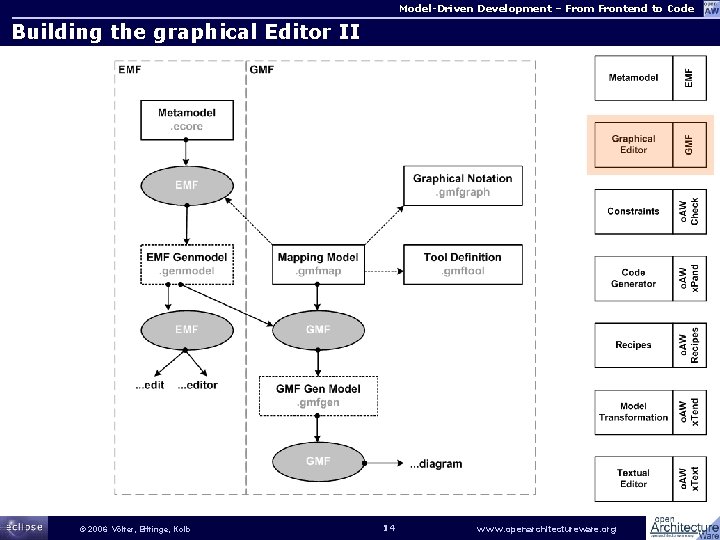
Model-Driven Development – From Frontend to Code Building the graphical Editor • The editor is based on the metamodel defined before. • A number of additional models has to be defined: • A model defining the graphical notation • A model for the editor’s palette and other tooling • A mapping model that binds these two models to the domain metamodel • A generator generates the concrete editor based on these models. • The editor is built with the Eclipse GMF, the Graphical Modelling Framework. © 2 0 0 6 Völter, Efftinge, Kolb 13 w w w. openarchitectureware. org
Model-Driven Development – From Frontend to Code Building the graphical Editor II © 2 0 0 6 Völter, Efftinge, Kolb 14 w w w. openarchitectureware. org
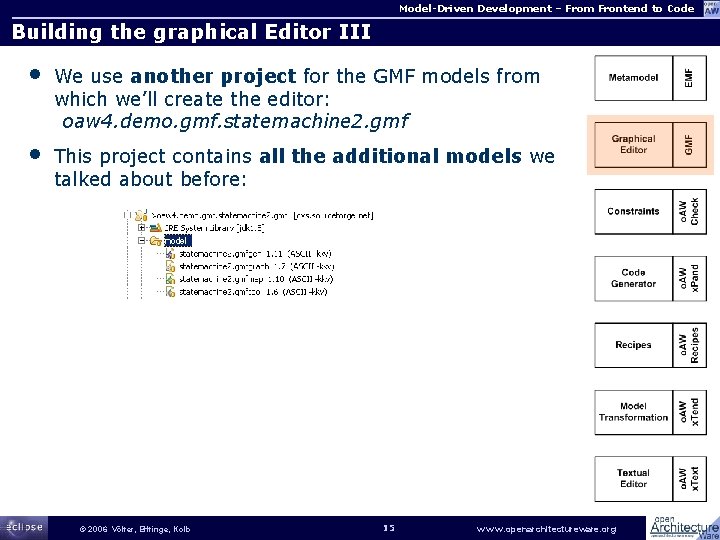
Model-Driven Development – From Frontend to Code Building the graphical Editor III • We use another project for the GMF models from which we’ll create the editor: oaw 4. demo. gmf. statemachine 2. gmf • This project contains all the additional models we talked about before: © 2 0 0 6 Völter, Efftinge, Kolb 15 w w w. openarchitectureware. org
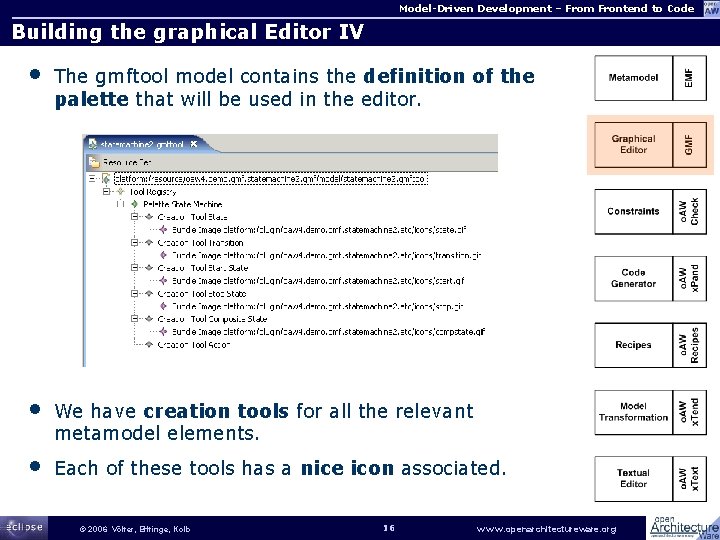
Model-Driven Development – From Frontend to Code Building the graphical Editor IV • The gmftool model contains the definition of the palette that will be used in the editor. • We have creation tools for all the relevant metamodel elements. • Each of these tools has a nice icon associated. © 2 0 0 6 Völter, Efftinge, Kolb 16 w w w. openarchitectureware. org
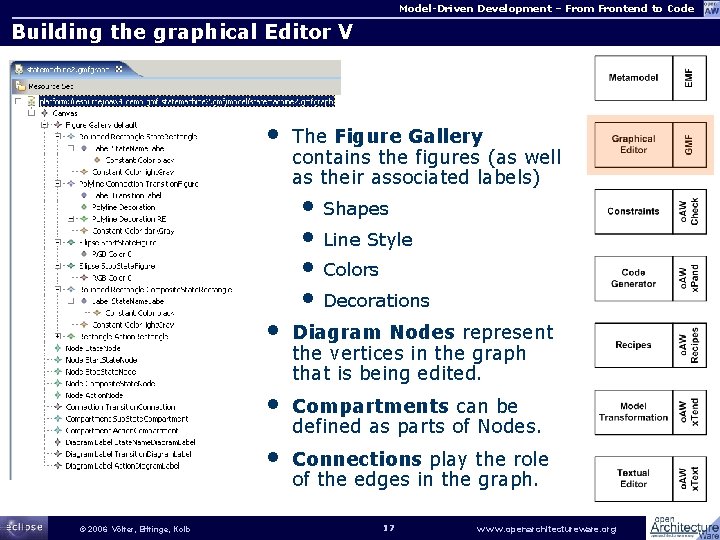
Model-Driven Development – From Frontend to Code Building the graphical Editor V • © 2 0 0 6 Völter, Efftinge, Kolb The Figure Gallery contains the figures (as well as their associated labels) • Shapes • Line Style • Colors • Decorations • Diagram Nodes represent the vertices in the graph that is being edited. • Compartments can be defined as parts of Nodes. • Connections play the role of the edges in the graph. 17 w w w. openarchitectureware. org
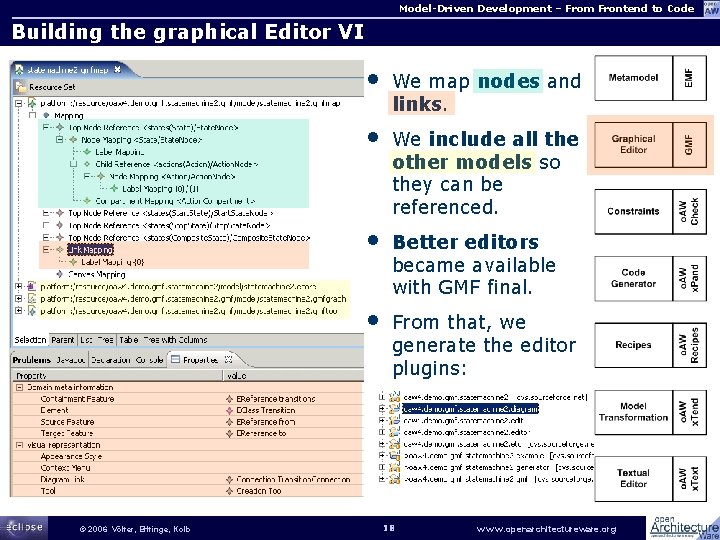
Model-Driven Development – From Frontend to Code Building the graphical Editor VI © 2 0 0 6 Völter, Efftinge, Kolb • We map nodes and links. • We include all the other models so they can be referenced. • Better editors became available with GMF final. • From that, we generate the editor plugins: 18 w w w. openarchitectureware. org
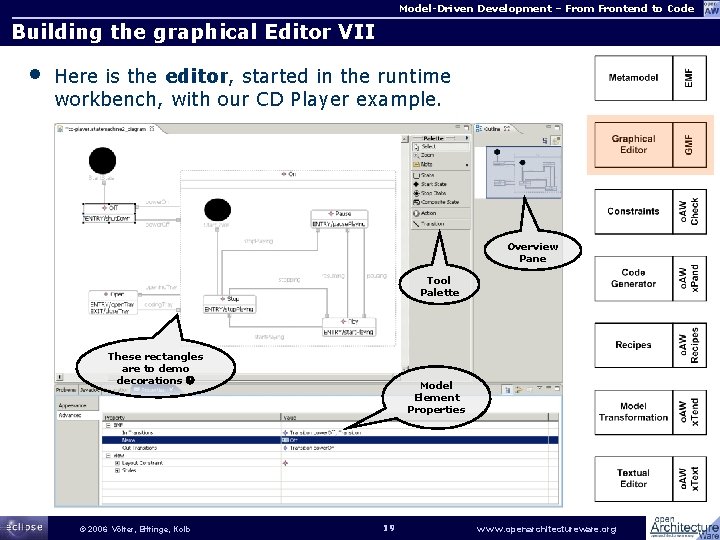
Model-Driven Development – From Frontend to Code Building the graphical Editor VII • Here is the editor, started in the runtime workbench, with our CD Player example. Overview Pane Tool Palette These rectangles are to demo decorations © 2 0 0 6 Völter, Efftinge, Kolb Model Element Properties 19 w w w. openarchitectureware. org
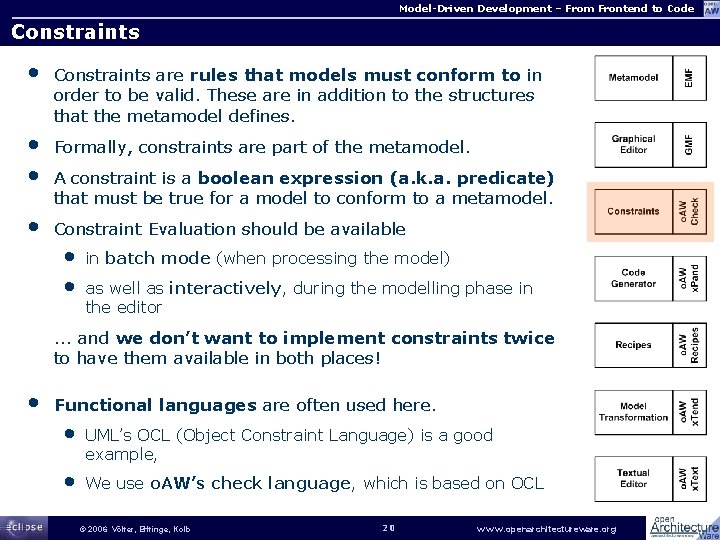
Model-Driven Development – From Frontend to Code Constraints • Constraints are rules that models must conform to in order to be valid. These are in addition to the structures that the metamodel defines. • • Formally, constraints are part of the metamodel. • Constraint Evaluation should be available A constraint is a boolean expression (a. k. a. predicate) that must be true for a model to conform to a metamodel. • • in batch mode (when processing the model) as well as interactively, during the modelling phase in the editor . . . and we don’t want to implement constraints twice to have them available in both places! • Functional languages are often used here. • UML’s OCL (Object Constraint Language) is a good example, • We use o. AW’s check language, which is based on OCL © 2 0 0 6 Völter, Efftinge, Kolb 20 w w w. openarchitectureware. org
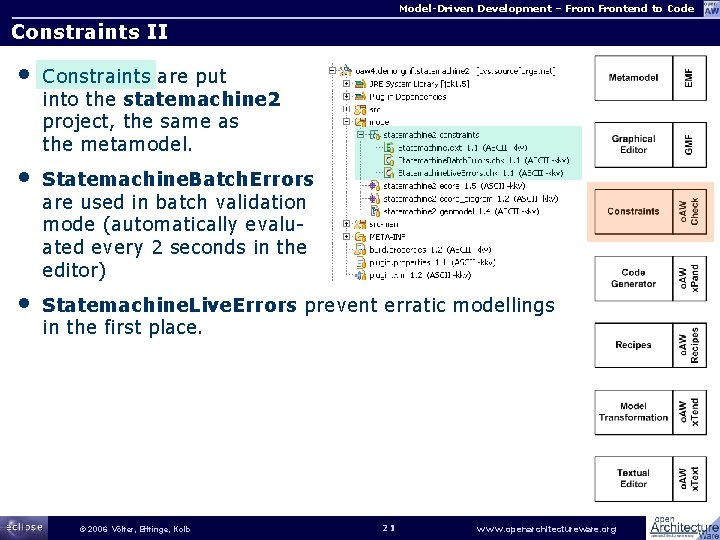
Model-Driven Development – From Frontend to Code Constraints II • Constraints are put into the statemachine 2 project, the same as the metamodel. • Statemachine. Batch. Errors are used in batch validation mode (automatically evaluated every 2 seconds in the editor) • Statemachine. Live. Errors prevent erratic modellings in the first place. © 2 0 0 6 Völter, Efftinge, Kolb 21 w w w. openarchitectureware. org
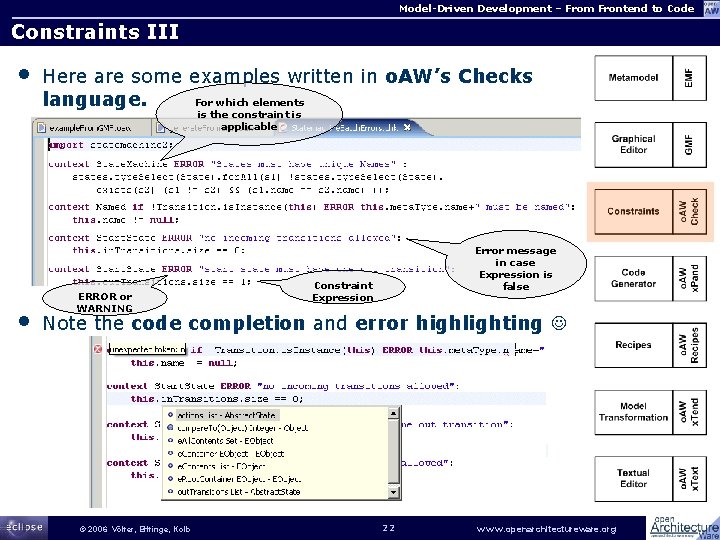
Model-Driven Development – From Frontend to Code Constraints III • Here are some examples written in o. AW’s Checks language. For which elements is the constraint is applicable • ERROR or WARNING Error message in case Expression is false Constraint Expression Note the code completion and error highlighting © 2 0 0 6 Völter, Efftinge, Kolb 22 w w w. openarchitectureware. org
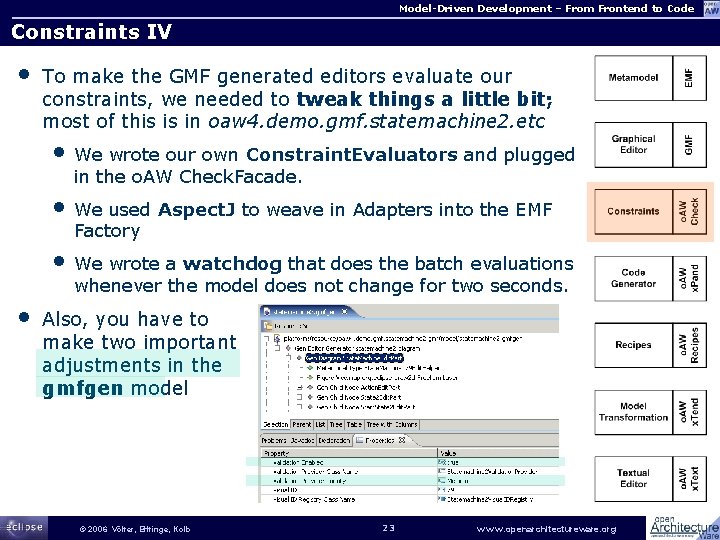
Model-Driven Development – From Frontend to Code Constraints IV • To make the GMF generated editors evaluate our constraints, we needed to tweak things a little bit; most of this is in oaw 4. demo. gmf. statemachine 2. etc • We wrote our own Constraint. Evaluators and plugged in the o. AW Check. Facade. • We used Aspect. J to weave in Adapters into the EMF Factory • We wrote a watchdog that does the batch evaluations whenever the model does not change for two seconds. • Also, you have to make two important adjustments in the gmfgen model © 2 0 0 6 Völter, Efftinge, Kolb 23 w w w. openarchitectureware. org
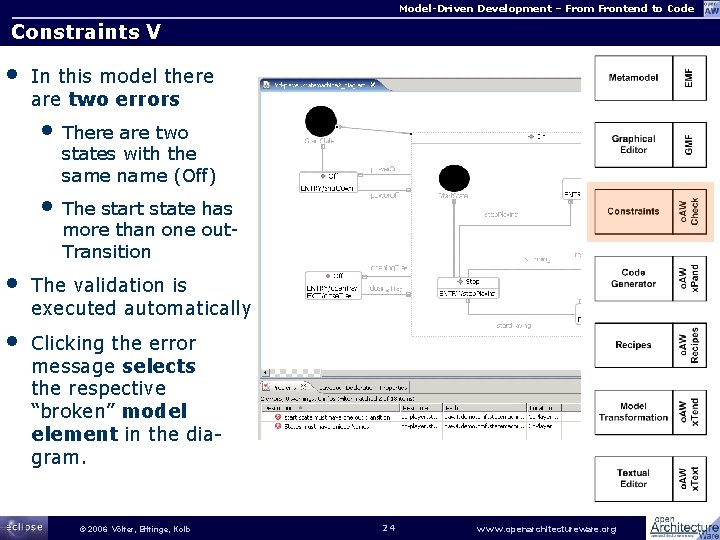
Model-Driven Development – From Frontend to Code Constraints V • In this model there are two errors • There are two states with the same name (Off) • The start state has more than one out. Transition • The validation is executed automatically • Clicking the error message selects the respective “broken” model element in the diagram. © 2 0 0 6 Völter, Efftinge, Kolb 24 w w w. openarchitectureware. org
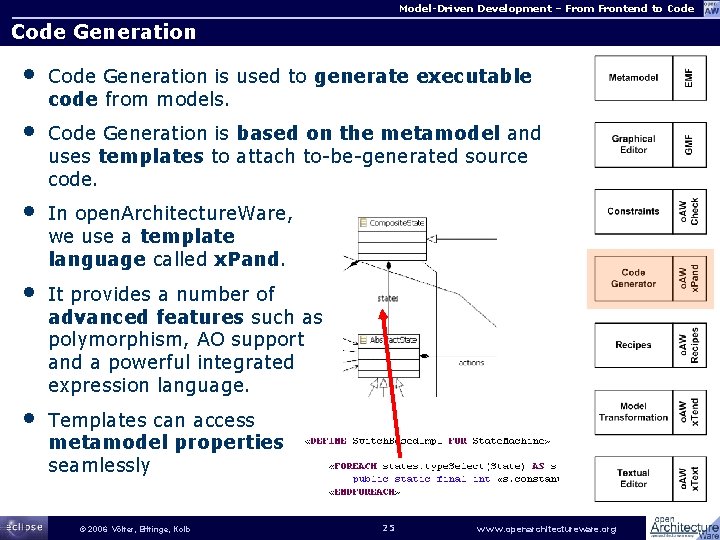
Model-Driven Development – From Frontend to Code Generation • Code Generation is used to generate executable code from models. • Code Generation is based on the metamodel and uses templates to attach to-be-generated source code. • In open. Architecture. Ware, we use a template language called x. Pand. • It provides a number of advanced features such as polymorphism, AO support and a powerful integrated expression language. • Templates can access metamodel properties seamlessly © 2 0 0 6 Völter, Efftinge, Kolb 25 w w w. openarchitectureware. org
Model-Driven Development – From Frontend to Code Generation II • What kind of code will be generated? How do you implement a state machine? • There are many ways of implementing a state machine: • Go. F’s State pattern • If/Switch-based • Decision Tables • Pointers/Indexed Arrays • We will use the switch-based alternative. It is neither the most efficient nor the most elegante alternative, but it’s simple. • For more discussion of this topic, see Practical State Charts in C/C++ by Miro Samek © 2 0 0 6 Völter, Efftinge, Kolb 26 w w w. openarchitectureware. org
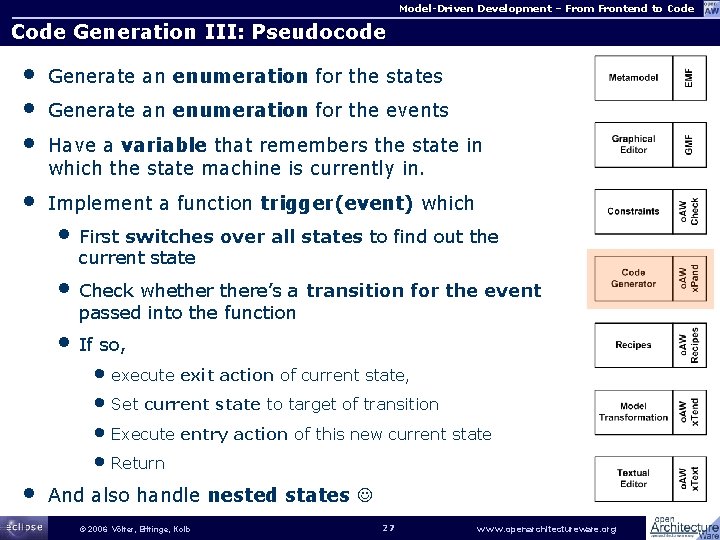
Model-Driven Development – From Frontend to Code Generation III: Pseudocode • • • Generate an enumeration for the states • Implement a function trigger(event) which Generate an enumeration for the events Have a variable that remembers the state in which the state machine is currently in. • First switches over all states to find out the current state • Check whethere’s a transition for the event passed into the function • If so, • execute exit action of current state, • Set current state to target of transition • Execute entry action of this new current state • Return • And also handle nested states © 2 0 0 6 Völter, Efftinge, Kolb 27 w w w. openarchitectureware. org
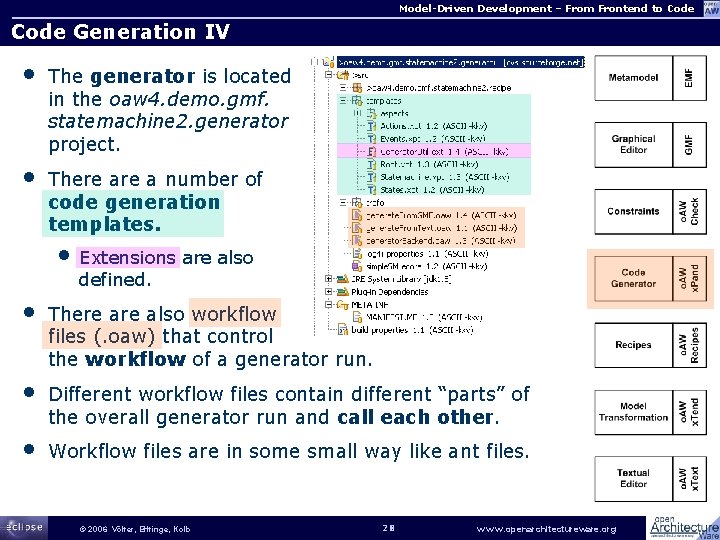
Model-Driven Development – From Frontend to Code Generation IV • The generator is located in the oaw 4. demo. gmf. statemachine 2. generator project. • There a number of code generation templates. • Extensions are also defined. • There also workflow files (. oaw) that control the workflow of a generator run. • Different workflow files contain different “parts” of the overall generator run and call each other. • Workflow files are in some small way like ant files. © 2 0 0 6 Völter, Efftinge, Kolb 28 w w w. openarchitectureware. org
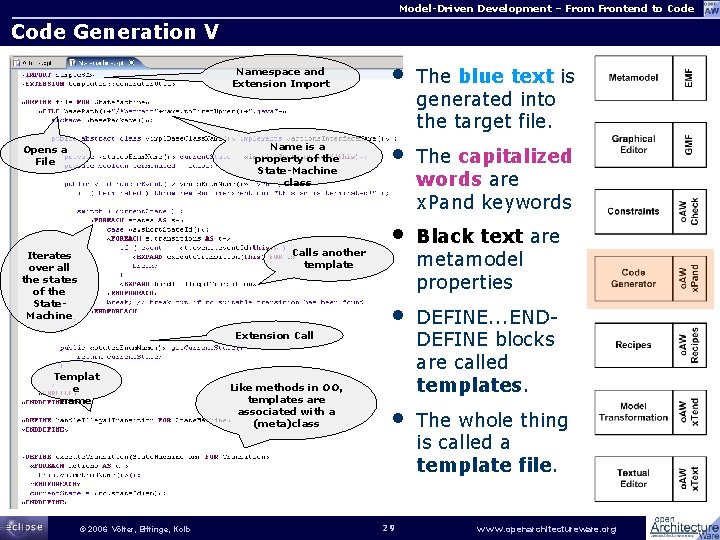
Model-Driven Development – From Frontend to Code Generation V Namespace and Extension Import Name is a property of the State-Machine class Opens a File Calls another template Iterates over all the states of the State. Machine Extension Call Templat e name © 2 0 0 6 Völter, Efftinge, Kolb Like methods in OO, templates are associated with a (meta)class • The blue text is generated into the target file. • The capitalized words are x. Pand keywords • Black text are metamodel properties • DEFINE. . . ENDDEFINE blocks are called templates. • The whole thing is called a template file. 29 w w w. openarchitectureware. org
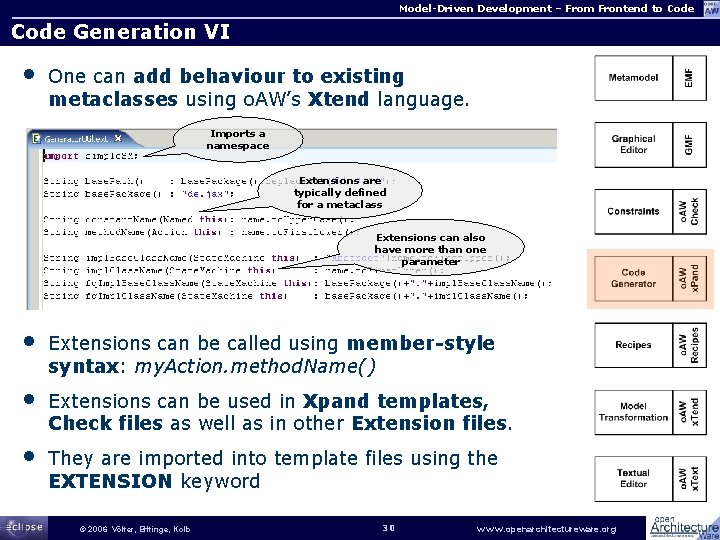
Model-Driven Development – From Frontend to Code Generation VI • One can add behaviour to existing metaclasses using o. AW’s Xtend language. Imports a namespace Extensions are typically defined for a metaclass Extensions can also have more than one parameter • Extensions can be called using member-style syntax: my. Action. method. Name() • Extensions can be used in Xpand templates, Check files as well as in other Extension files. • They are imported into template files using the EXTENSION keyword © 2 0 0 6 Völter, Efftinge, Kolb 30 w w w. openarchitectureware. org
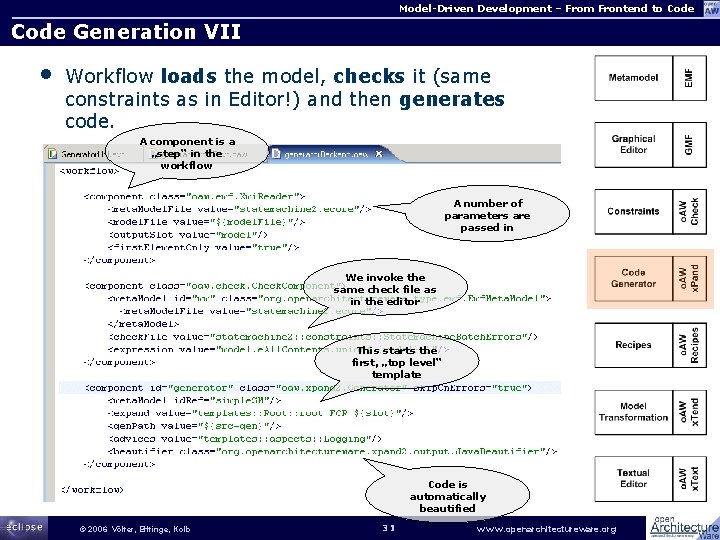
Model-Driven Development – From Frontend to Code Generation VII • Workflow loads the model, checks it (same constraints as in Editor!) and then generates code. A component is a „step“ in the workflow A number of parameters are passed in We invoke the same check file as in the editor This starts the first, „top level“ template Code is automatically beautified © 2 0 0 6 Völter, Efftinge, Kolb 31 w w w. openarchitectureware. org
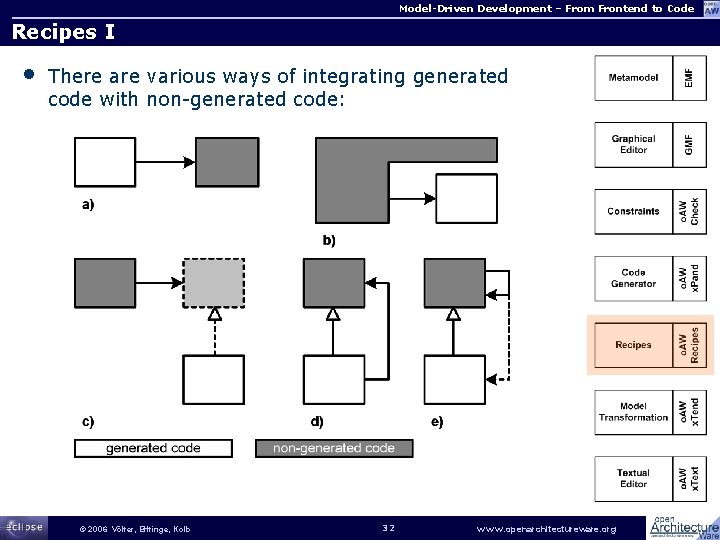
Model-Driven Development – From Frontend to Code Recipes I • There are various ways of integrating generated code with non-generated code: © 2 0 0 6 Völter, Efftinge, Kolb 32 w w w. openarchitectureware. org
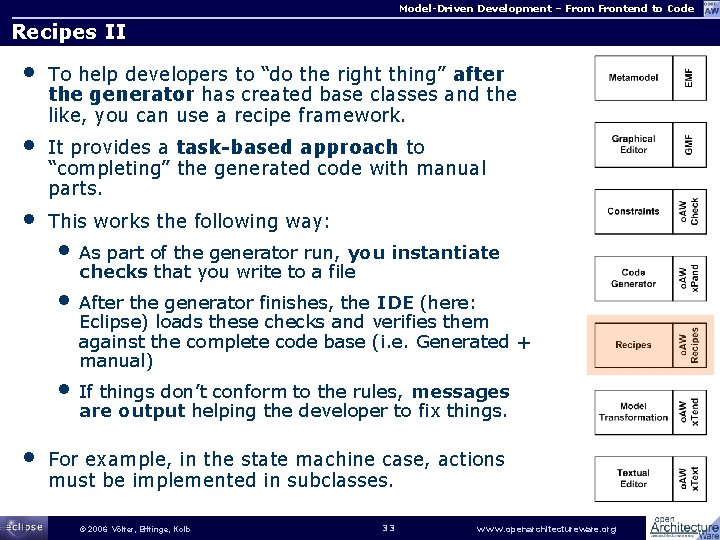
Model-Driven Development – From Frontend to Code Recipes II • To help developers to “do the right thing” after the generator has created base classes and the like, you can use a recipe framework. • It provides a task-based approach to “completing” the generated code with manual parts. • This works the following way: • As part of the generator run, you instantiate checks that you write to a file • After the generator finishes, the IDE (here: Eclipse) loads these checks and verifies them against the complete code base (i. e. Generated + manual) • If things don’t conform to the rules, messages are output helping the developer to fix things. • For example, in the state machine case, actions must be implemented in subclasses. © 2 0 0 6 Völter, Efftinge, Kolb 33 w w w. openarchitectureware. org
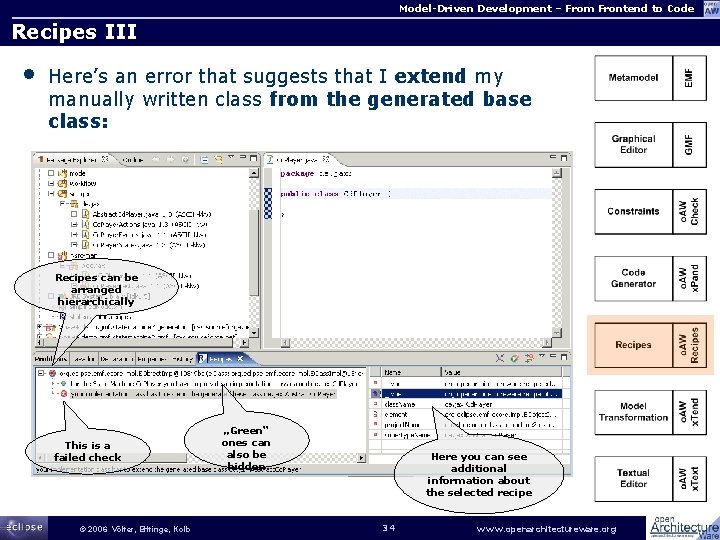
Model-Driven Development – From Frontend to Code Recipes III • Here’s an error that suggests that I extend my manually written class from the generated base class: Recipes can be arranged hierarchically This is a failed check © 2 0 0 6 Völter, Efftinge, Kolb „Green“ ones can also be hidden Here you can see additional information about the selected recipe 34 w w w. openarchitectureware. org
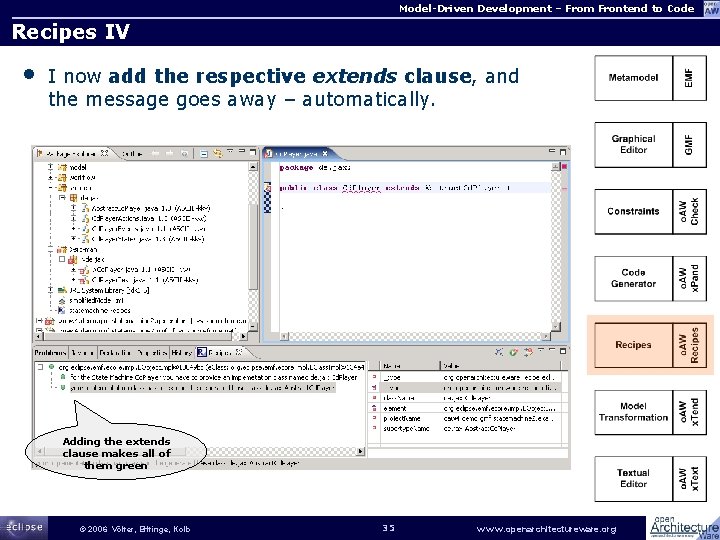
Model-Driven Development – From Frontend to Code Recipes IV • I now add the respective extends clause, and the message goes away – automatically. Adding the extends clause makes all of them green © 2 0 0 6 Völter, Efftinge, Kolb 35 w w w. openarchitectureware. org
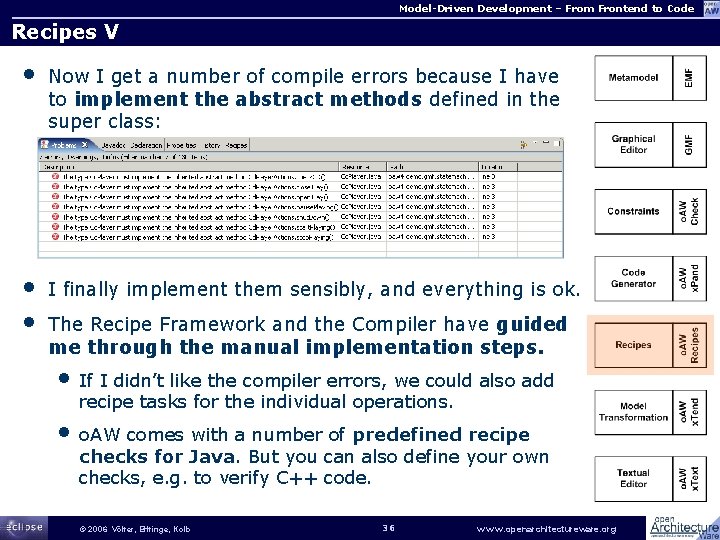
Model-Driven Development – From Frontend to Code Recipes V • Now I get a number of compile errors because I have to implement the abstract methods defined in the super class: • • I finally implement them sensibly, and everything is ok. The Recipe Framework and the Compiler have guided me through the manual implementation steps. • If I didn’t like the compiler errors, we could also add recipe tasks for the individual operations. • o. AW comes with a number of predefined recipe checks for Java. But you can also define your own checks, e. g. to verify C++ code. © 2 0 0 6 Völter, Efftinge, Kolb 36 w w w. openarchitectureware. org
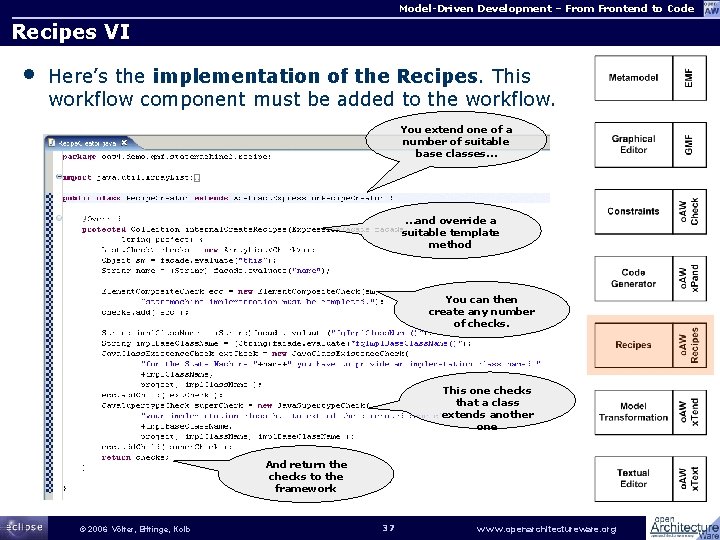
Model-Driven Development – From Frontend to Code Recipes VI • Here’s the implementation of the Recipes. This workflow component must be added to the workflow. You extend one of a number of suitable base classes… …and override a suitable template method You can then create any number of checks. This one checks that a class extends another one And return the checks to the framework © 2 0 0 6 Völter, Efftinge, Kolb 37 w w w. openarchitectureware. org
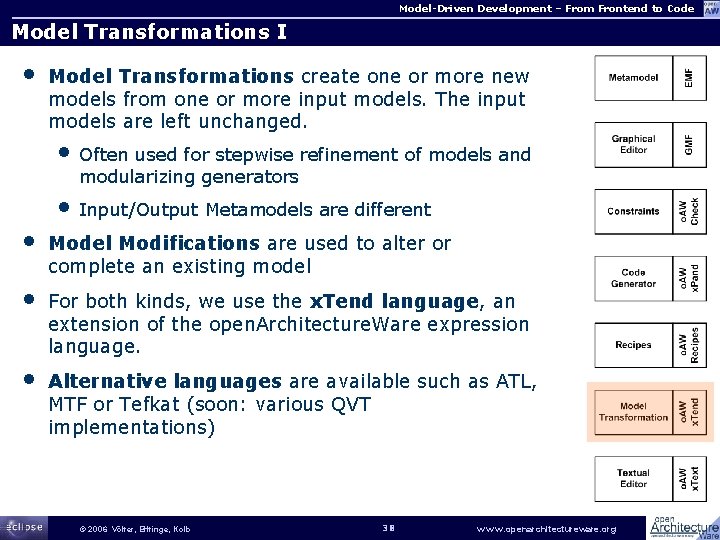
Model-Driven Development – From Frontend to Code Model Transformations I • Model Transformations create one or more new models from one or more input models. The input models are left unchanged. • Often used for stepwise refinement of models and modularizing generators • Input/Output Metamodels are different • Model Modifications are used to alter or complete an existing model • For both kinds, we use the x. Tend language, an extension of the open. Architecture. Ware expression language. • Alternative languages are available such as ATL, MTF or Tefkat (soon: various QVT implementations) © 2 0 0 6 Völter, Efftinge, Kolb 38 w w w. openarchitectureware. org
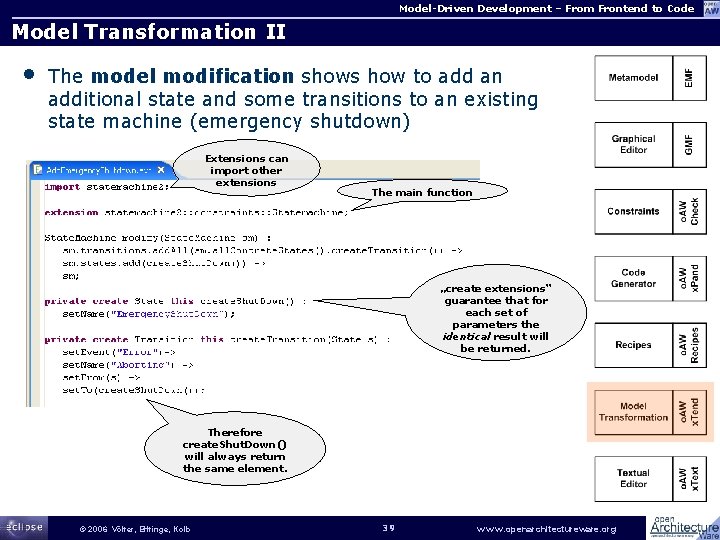
Model-Driven Development – From Frontend to Code Model Transformation II • The model modification shows how to add an additional state and some transitions to an existing state machine (emergency shutdown) Extensions can import other extensions The main function „create extensions“ guarantee that for each set of parameters the identical result will be returned. Therefore create. Shut. Down() will always return the same element. © 2 0 0 6 Völter, Efftinge, Kolb 39 w w w. openarchitectureware. org
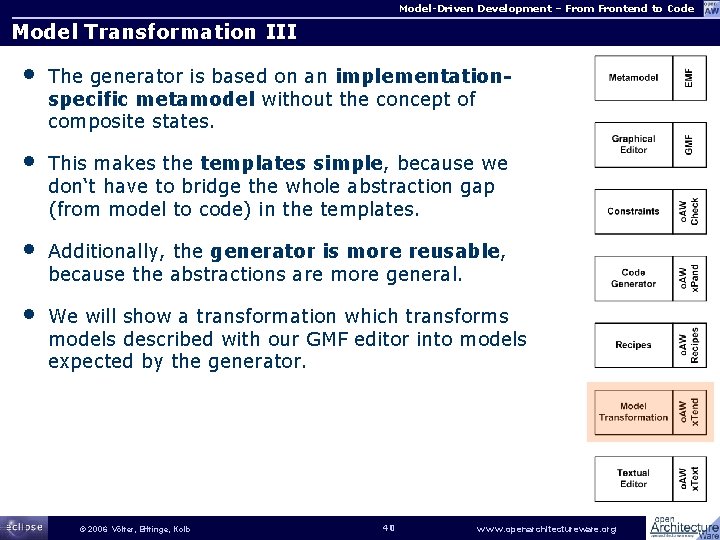
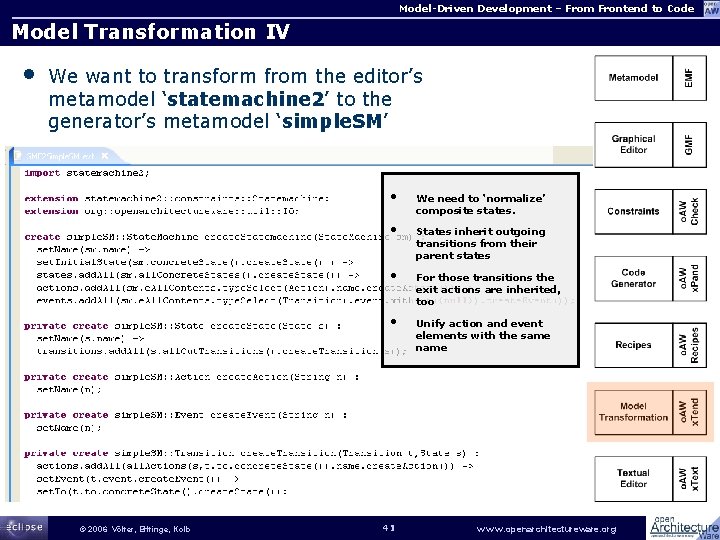
Model-Driven Development – From Frontend to Code Model Transformation III • The generator is based on an implementationspecific metamodel without the concept of composite states. • This makes the templates simple, because we don‘t have to bridge the whole abstraction gap (from model to code) in the templates. • Additionally, the generator is more reusable, because the abstractions are more general. • We will show a transformation which transforms models described with our GMF editor into models expected by the generator. © 2 0 0 6 Völter, Efftinge, Kolb 40 w w w. openarchitectureware. org
Model-Driven Development – From Frontend to Code Model Transformation IV • We want to transform from the editor’s metamodel ‘statemachine 2’ to the generator’s metamodel ‘simple. SM’ • • © 2 0 0 6 Völter, Efftinge, Kolb 41 We need to ‘normalize’ composite states. States inherit outgoing transitions from their parent states For those transitions the exit actions are inherited, too Unify action and event elements with the same name w w w. openarchitectureware. org
Model-Driven Development – From Frontend to Code Textual Editor I • A graphical notation is not always the best syntax for DSLs. • So, while GMF provides a means to generate editors for graphical notations, we also need to be able to come up with editors for textual syntaxes. • These editors need to include at least • Syntax hightlighting • Syntax error checking • Semantic constraint checking © 2 0 0 6 Völter, Efftinge, Kolb 42 w w w. openarchitectureware. org
Model-Driven Development – From Frontend to Code Textual Editor II • We use o. AW’s textual DSL generator framework x. Text • Based on a BNF-like language it provides: • An EMF-based metamodel (representing the AST) • An Antlr parser instantiating dynamic EMFmodels • An Eclipse text editor plugin providing • syntax highlighting • An outline view, • syntax checking • as well as constraints checking based on a Check file, as always o. AW © 2 0 0 6 Völter, Efftinge, Kolb 43 w w w. openarchitectureware. org
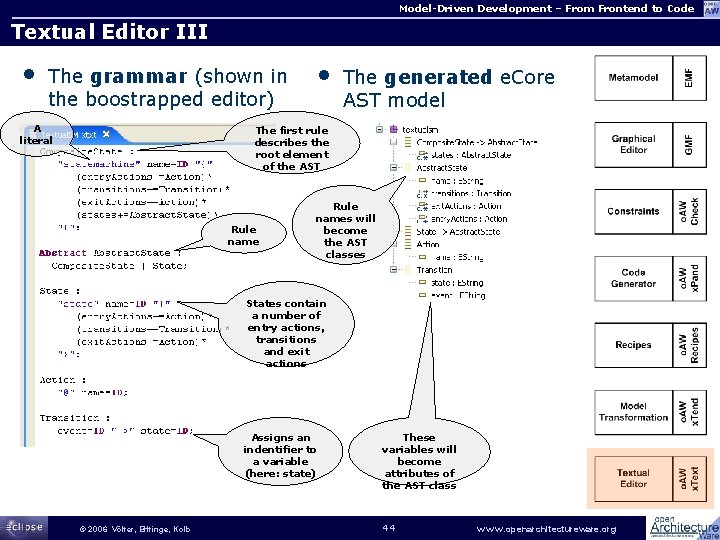
Model-Driven Development – From Frontend to Code Textual Editor III • The grammar (shown in the boostrapped editor) A literal • The generated e. Core AST model The first rule describes the root element of the AST Rule names will become the AST classes States contain a number of entry actions, transitions and exit actions Assigns an indentifier to a variable (here: state) © 2 0 0 6 Völter, Efftinge, Kolb These variables will become attributes of the AST class 44 w w w. openarchitectureware. org
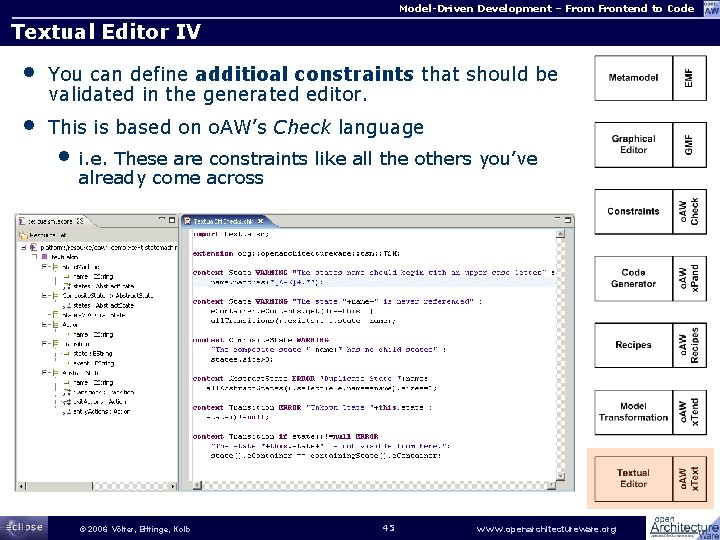
Model-Driven Development – From Frontend to Code Textual Editor IV • You can define additioal constraints that should be validated in the generated editor. • This is based on o. AW’s Check language • i. e. These are constraints like all the others you’ve already come across © 2 0 0 6 Völter, Efftinge, Kolb 45 w w w. openarchitectureware. org
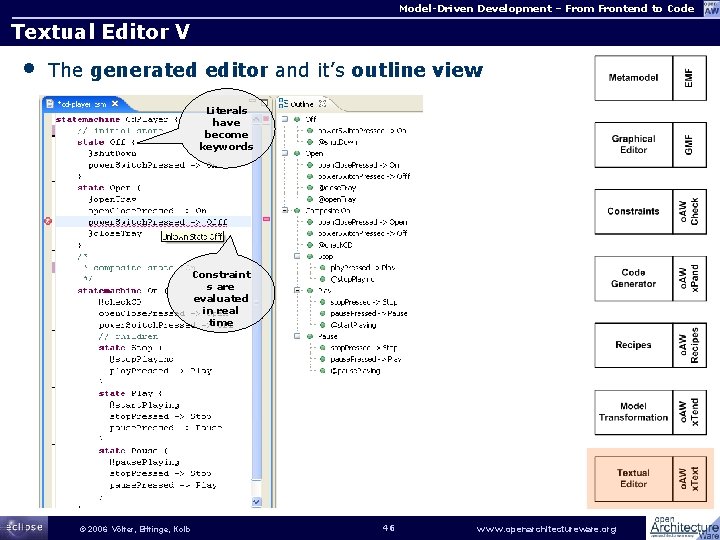
Model-Driven Development – From Frontend to Code Textual Editor V • The generated editor and it’s outline view Literals have become keywords Constraint s are evaluated in real time © 2 0 0 6 Völter, Efftinge, Kolb 46 w w w. openarchitectureware. org
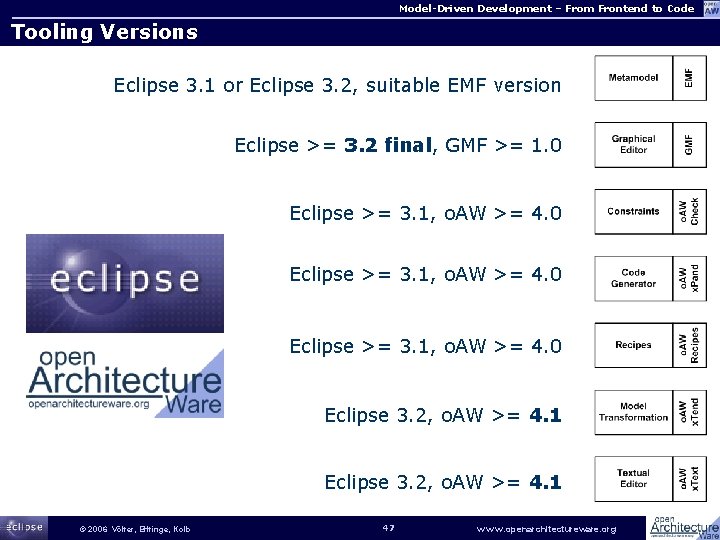
Model-Driven Development – From Frontend to Code Tooling Versions Eclipse 3. 1 or Eclipse 3. 2, suitable EMF version Eclipse >= 3. 2 final, GMF >= 1. 0 Eclipse >= 3. 1, o. AW >= 4. 0 Eclipse 3. 2, o. AW >= 4. 1 © 2 0 0 6 Völter, Efftinge, Kolb 47 w w w. openarchitectureware. org
Model-Driven Development – From Frontend to Code Summary • The tool chain we’ve just shown provides an endto-end solution for MDSD, • Completely Open Source • Using standards wherever worthwhile, • And pragmatic solutions wherever necessary. • To get the tools, go to • www. eclipse. org/emf • www. eclipse. org/gmf • www. openarchitectureware. org, www. eclipse. org/gmt/oaw • THANK YOU. © 2 0 0 6 Völter, Efftinge, Kolb 48 w w w. openarchitectureware. org