
ModelBased Systems Engineering in an Integrated Environment Christi
Model-Based Systems Engineering in an Integrated Environment Christi A. Gau Pagnanelli, Barbara J. Sheeley, Ronald S. Carson, Ph. D, INCOSE Fellow The Boeing Company Copyright © 2012 Boeing. All rights reserved. 22 nd Annual INCOSE International Symposium - Rome, Italy - July 9 -12, 2012
Boeing at a Glance § Customers and customer support in 150 countries § Total revenue in 2011: $68. 7 billion § 70 percent of commercial airplane revenue historically from customers outside the United States § Manufacturing, service & technology partnerships with companies around the world § Contracts with 22, 000 suppliers and partners globally § Research, design & technology-development centers & programs in multiple countries § More than 170, 000 Boeing employees in 50 states and 70 countries Copyright © 2012 Boeing. All rights reserved. 22 nd Annual INCOSE International Symposium - Rome, Italy - July 9 -12, 2012
Introduction § Model-Based Systems Engineering (MBSE) is key to development and sustainment of high quality integrated systems § MBSE can be accomplished in a variety of ways leveraging different modeling techniques, such as Sys. ML, IDEF 0 and Others § Organization and system development characteristics such as product type, lifecycle dependency and complexity, need different approaches to make MBSE attractive § The integration and management of product data is critical to MBSE This paper identifies the conditions under which different approaches may be most appropriate to realize the full potential of MBSE Copyright © 2012 Boeing. All rights reserved. 22 nd Annual INCOSE International Symposium - Rome, Italy - July 9 -12, 2012
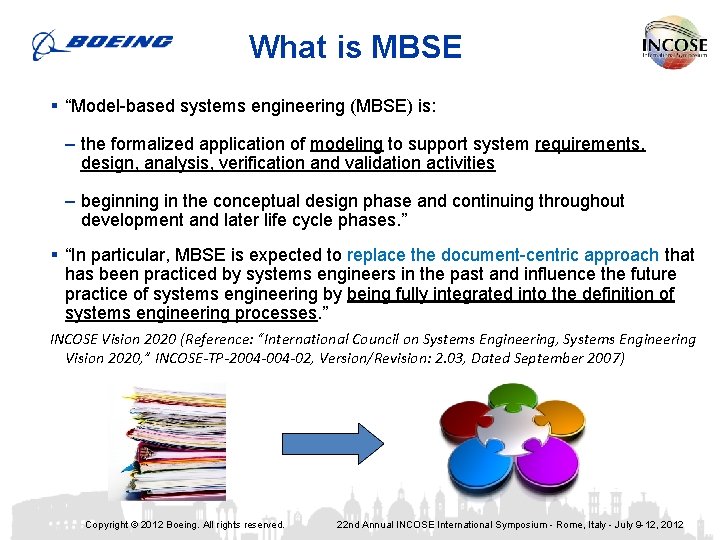
What is MBSE § “Model-based systems engineering (MBSE) is: – the formalized application of modeling to support system requirements, design, analysis, verification and validation activities – beginning in the conceptual design phase and continuing throughout development and later life cycle phases. ” § “In particular, MBSE is expected to replace the document-centric approach that has been practiced by systems engineers in the past and influence the future practice of systems engineering by being fully integrated into the definition of systems engineering processes. ” INCOSE Vision 2020 (Reference: “International Council on Systems Engineering, Systems Engineering Vision 2020, ” INCOSE-TP-2004 -02, Version/Revision: 2. 03, Dated September 2007) Copyright © 2012 Boeing. All rights reserved. 22 nd Annual INCOSE International Symposium - Rome, Italy - July 9 -12, 2012

MBSE Elements § Elements of MBSE include: § Operational and system models and simulations, from the concept development phase through disposal § The structure of requirements based on functional components § The organization of requirements into specifications for logical elements § A specification tree that organizes specifications for all logical elements § The definition and control of interfaces § The relationships of requirements and functional / logical elements to the verification and validation artifacts and activities § Integration of these elements with the system design and system performance analyses & trade studies
System Architecture § The framework that includes and links these MBSE elements is called a system architecture § When the system architecture data (e. g. , requirements architecture, functional architecture, logical architecture and their relationships) is contained in an integrated database environment, Boeing refers to this as an Integrated Product Architecture (IPA) § The use of an integrated database environment results in a single source of information, from which architecture artifacts can be generated as by-products § A single source of information contained in an architecture-based integrated database environment is a very effective Model-Based System Engineering approach Copyright © 2012 Boeing. All rights reserved. 22 nd Annual INCOSE International Symposium - Rome, Italy - July 9 -12, 2012

MBSE Across the Lifecycle § An integrated database approach to MBSE maintains information throughout the product lifecycle – Con. Ops to Requirements to design to production… Concept Development Engineering Development Production & Deployment Collaboration Operations & Sustainment Collaboration Integration Traceability Integrated Digital Environment § …This provides the ability for more effective downstream performance, logistics, and cost analyses Copyright © 2012 Boeing. All rights reserved. 22 nd Annual INCOSE International Symposium - Rome, Italy - July 9 -12, 2012
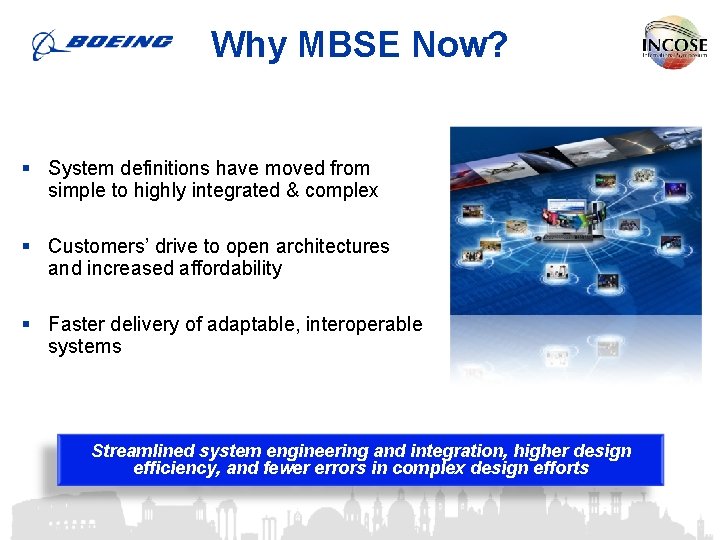
Why MBSE Now? § System definitions have moved from simple to highly integrated & complex § Customers’ drive to open architectures and increased affordability § Faster delivery of adaptable, interoperable systems Streamlined system engineering and integration, higher design efficiency, and fewer errors in complex design efforts
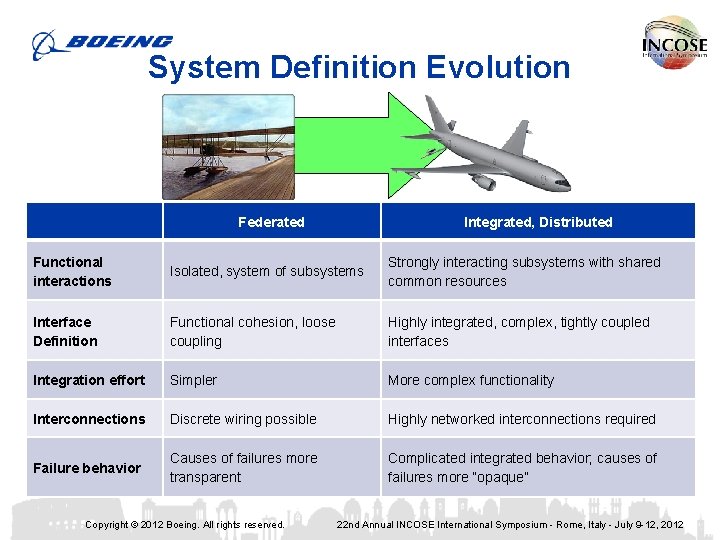
System Definition Evolution Federated Integrated, Distributed Functional interactions Isolated, system of subsystems Strongly interacting subsystems with shared common resources Interface Definition Functional cohesion, loose coupling Highly integrated, complex, tightly coupled interfaces Integration effort Simpler More complex functionality Interconnections Discrete wiring possible Highly networked interconnections required Failure behavior Causes of failures more transparent Complicated integrated behavior; causes of failures more “opaque” Copyright © 2012 Boeing. All rights reserved. 22 nd Annual INCOSE International Symposium - Rome, Italy - July 9 -12, 2012
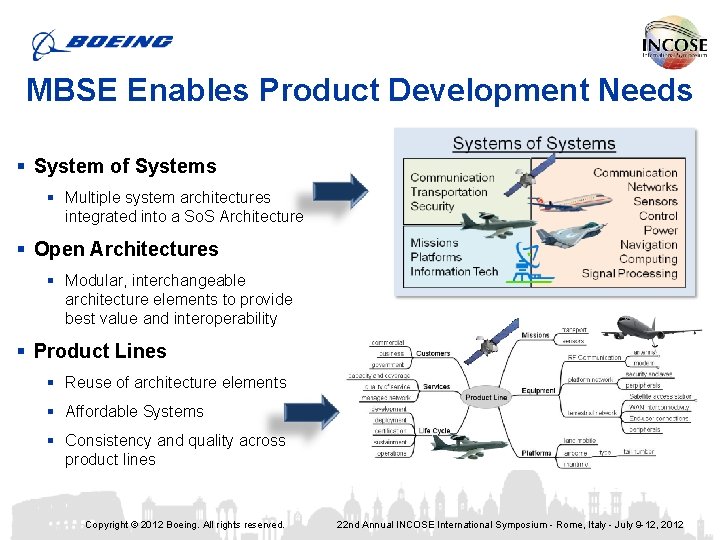
MBSE Enables Product Development Needs § System of Systems § Multiple system architectures integrated into a So. S Architecture § Open Architectures § Modular, interchangeable architecture elements to provide best value and interoperability § Product Lines § Reuse of architecture elements § Affordable Systems § Consistency and quality across product lines Copyright © 2012 Boeing. All rights reserved. 22 nd Annual INCOSE International Symposium - Rome, Italy - July 9 -12, 2012
Disciplines Required for MBSE Organize to support the use of MBSE § The model is the authority (i. e. , not the documents) § Ensure appropriate access to the data § Training, training Use the model (Architecture) to perform Systems Engineering § Use data elements for functional & operational analysis to derive requirements § Use data elements to determine system trade studies to meet evolving needs § Derive verification activities from data elements § Apply design features directly from the model § Generate customer artifacts directly from the model Use the data to ensure quality (i. e. , “the right design”) § Query the model early and continuously to identify missing design elements § Query the model to prevent overdesign and unnecessary costs Use the model throughout the entire lifecycle § Share across various development and support organizations Copyright © 2012 Boeing. All rights reserved. 22 nd Annual INCOSE International Symposium - Rome, Italy - July 9 -12, 2012
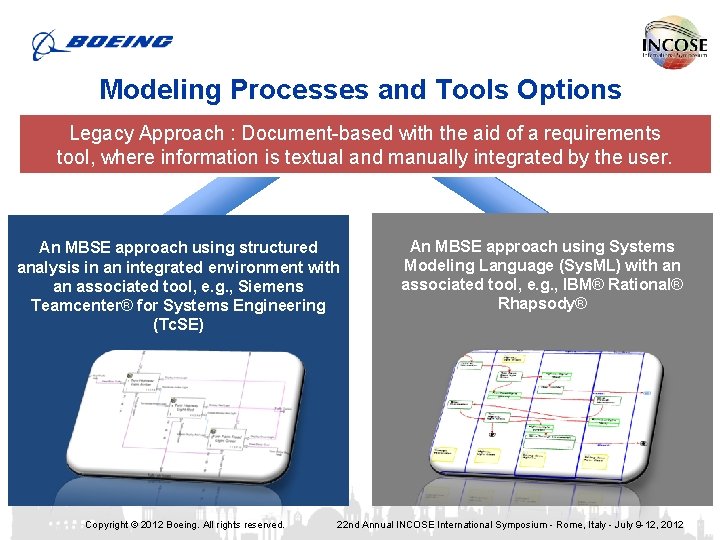
Modeling Processes and Tools Options Legacy Approach : Document-based with the aid of a requirements tool, where information is textual and manually integrated by the user. An MBSE approach using structured analysis in an integrated environment with an associated tool, e. g. , Siemens Teamcenter® for Systems Engineering (Tc. SE) Copyright © 2012 Boeing. All rights reserved. An MBSE approach using Systems Modeling Language (Sys. ML) with an associated tool, e. g. , IBM® Rational® Rhapsody® 22 nd Annual INCOSE International Symposium - Rome, Italy - July 9 -12, 2012
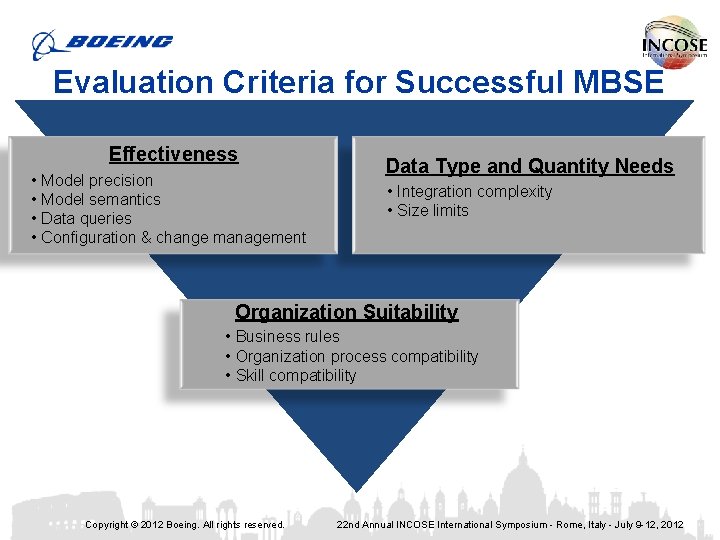
Evaluation Criteria for Successful MBSE Effectiveness • Model precision • Model semantics • Data queries • Configuration & change management Data Type and Quantity Needs • Integration complexity • Size limits Organization Suitability • Business rules • Organization process compatibility • Skill compatibility Copyright © 2012 Boeing. All rights reserved. 22 nd Annual INCOSE International Symposium - Rome, Italy - July 9 -12, 2012
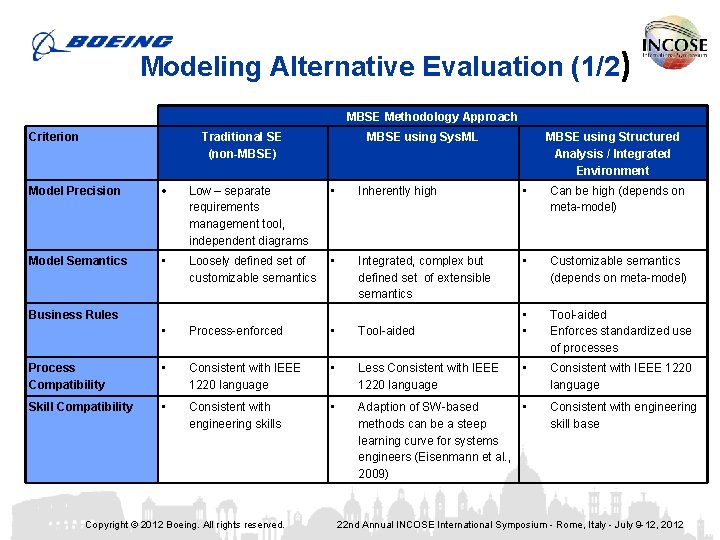
Modeling Alternative Evaluation (1/2) MBSE Methodology Approach Criterion Traditional SE (non-MBSE) MBSE using Sys. ML MBSE using Structured Analysis / Integrated Environment Model Precision Low – separate requirements management tool, independent diagrams • Inherently high • Can be high (depends on meta-model) Model Semantics • Loosely defined set of customizable semantics • Integrated, complex but defined set of extensible semantics • Customizable semantics (depends on meta-model) • • Tool-aided Enforces standardized use of processes • Consistent with IEEE 1220 language Business Rules • Process-enforced • Tool-aided Process Compatibility • Consistent with IEEE 1220 language • Less Consistent with IEEE 1220 language Skill Compatibility • Consistent with engineering skills • Adaption of SW-based • methods can be a steep learning curve for systems engineers (Eisenmann et al. , 2009) Copyright © 2012 Boeing. All rights reserved. Consistent with engineering skill base 22 nd Annual INCOSE International Symposium - Rome, Italy - July 9 -12, 2012
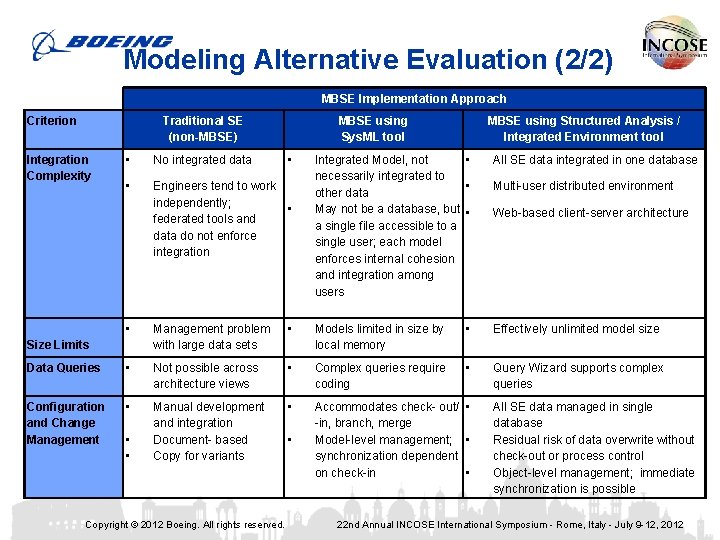
Modeling Alternative Evaluation (2/2) MBSE Implementation Approach Criterion Traditional SE (non-MBSE) Integration Complexity MBSE using Sys. ML tool • No integrated data • • Engineers tend to work independently; • federated tools and data do not enforce integration MBSE using Structured Analysis / Integrated Environment tool Integrated Model, not • necessarily integrated to • other data May not be a database, but • a single file accessible to a single user; each model enforces internal cohesion and integration among users All SE data integrated in one database Multi-user distributed environment Web-based client-server architecture • Management problem with large data sets • Models limited in size by local memory • Effectively unlimited model size Data Queries • Not possible across architecture views • Complex queries require coding • Query Wizard supports complex queries Configuration and Change Management • Manual development and integration Document- based Copy for variants • Accommodates check- out/ • -in, branch, merge Model-level management; • synchronization dependent on check-in • Size Limits • • Copyright © 2012 Boeing. All rights reserved. • All SE data managed in single database Residual risk of data overwrite without check-out or process control Object-level management; immediate synchronization is possible 22 nd Annual INCOSE International Symposium - Rome, Italy - July 9 -12, 2012
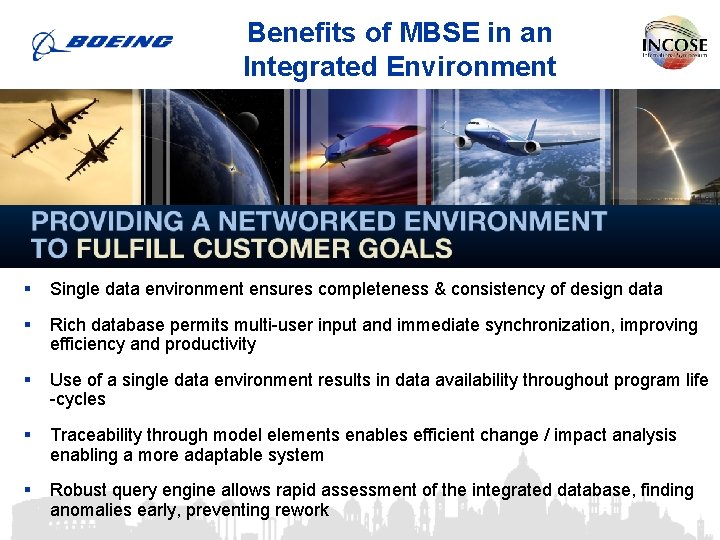
Benefits of MBSE in an Integrated Environment Copyright © 2012 Boeing. All rights reserved. 22 nd Annual INCOSE International Symposium - Rome, Italy - July 9 -12, 2012 § Single data environment ensures completeness & consistency of design data § Rich database permits multi-user input and immediate synchronization, improving efficiency and productivity § Use of a single data environment results in data availability throughout program life -cycles § Traceability through model elements enables efficient change / impact analysis enabling a more adaptable system § Robust query engine allows rapid assessment of the integrated database, finding anomalies early, preventing rework
Additional Thoughts when Applying MBSE in an Integrated Database Environment § Model semantics must be defined and controlled to align with organization processes § Multi-user effects and data configuration control must be managed § Various representation formats i. e. , Sys. ML and Do. DAF artifacts can be incorporated into the integrated environment Copyright © 2012 Boeing. All rights reserved. 22 nd Annual INCOSE International Symposium - Rome, Italy - July 9 -12, 2012
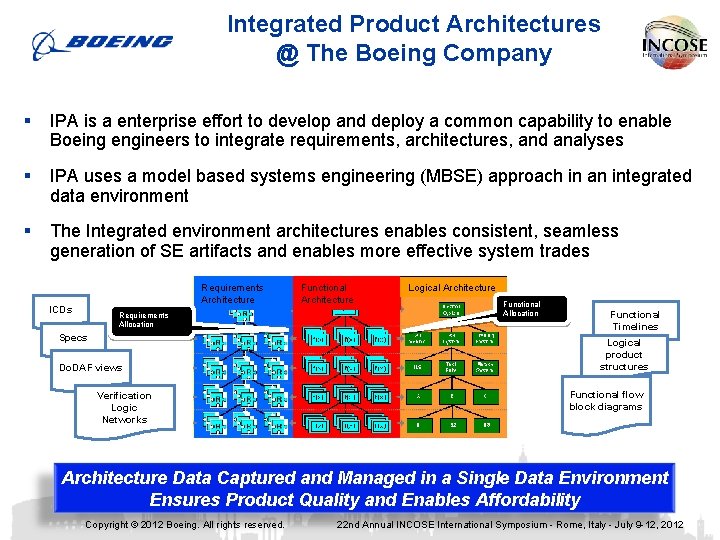
Integrated Product Architectures @ The Boeing Company § IPA is a enterprise effort to develop and deploy a common capability to enable Boeing engineers to integrate requirements, architectures, and analyses § IPA uses a model based systems engineering (MBSE) approach in an integrated data environment § The Integrated environment architectures enables consistent, seamless generation of SE artifacts and enables more effective system trades Requirements Architecture ICDs Requirements Allocation Specs Do. DAF views Verification Logic Networks Functional Architecture Logical Architecture Functional Allocation Functional Timelines Logical product structures Functional flow block diagrams Architecture Data Captured and Managed in a Single Data Environment Ensures Product Quality and Enables Affordability Copyright © 2012 Boeing. All rights reserved. 22 nd Annual INCOSE International Symposium - Rome, Italy - July 9 -12, 2012
MBSE at Boeing - Now and in the Future Boeing has had success in implementing Model Based Systems Engineering on a variety of product development efforts Success = improved program cost and schedule impacts § Comprehensive integrated architectures resulted in a significant reduction in interface definition changes after initial design § Detailed functional architectures resulted in reductions of actual program test hours § MBSE used for early identification of system performance impacts, resulting in a more effective network performance § Potential design issues were identified early in the lifecycle As we continue to evolve with more complex systems, Boeing is moving forward in the development and application of MBSE capabilities and approaches Copyright © 2012 Boeing. All rights reserved. 22 nd Annual INCOSE International Symposium - Rome, Italy - July 9 -12, 2012

Thank You! Copyright © 2012 Boeing. All rights reserved. 22 nd Annual INCOSE International Symposium - Rome, Italy - July 9 -12, 2012
- Slides: 20