
ModelBased Systems Engineering Conceptual modeling languages and their
Model-Based Systems Engineering: Conceptual modeling languages and their standardization efforts Dov Dori Technion, Israel Institute of Technology and Massachusetts Institute of Technology dori@mit. edu KENOTE SPEECH 2009 International Conference on Web Information Systems and Mining (WISM’ 09) and 2009 International Conference on Artificial Intelligence and Computational Intelligence (AICI'09) based on ISO TC 184/SC 5 Plenary Session Paris, April 23 -24, 2009 © Prof. Dov Dori – All rights reserved 2009
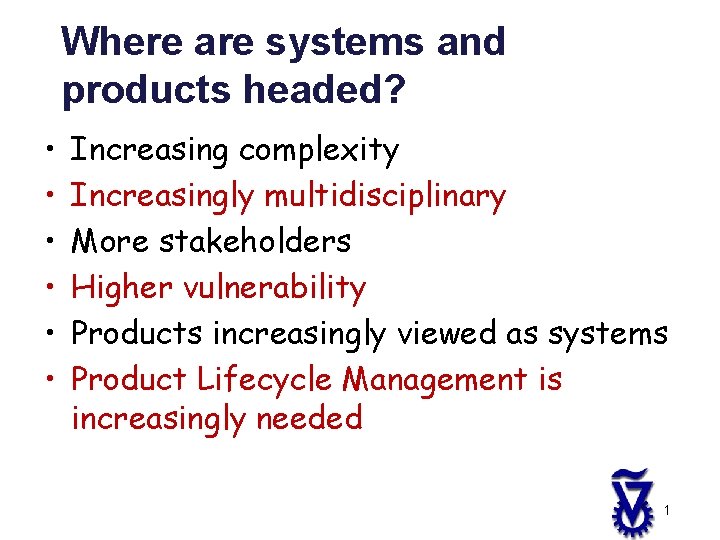
Where are systems and products headed? • • • Increasing complexity Increasingly multidisciplinary More stakeholders Higher vulnerability Products increasingly viewed as systems Product Lifecycle Management is increasingly needed 1
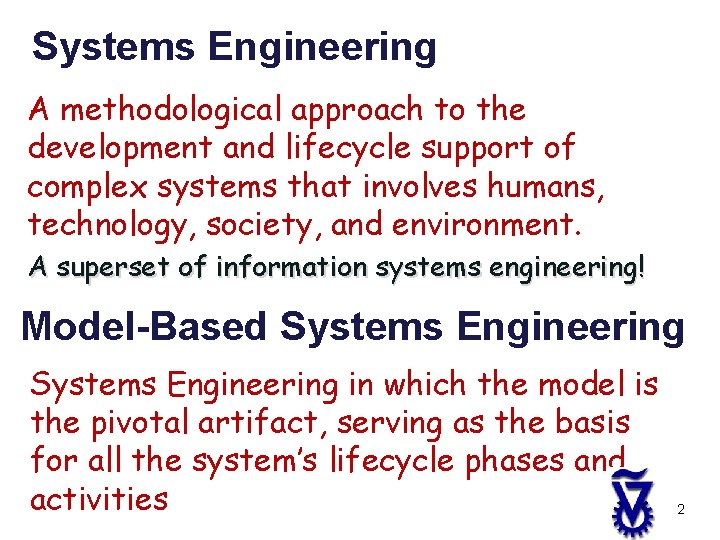
Systems Engineering A methodological approach to the development and lifecycle support of complex systems that involves humans, technology, society, and environment. A superset of information systems engineering! Model-Based Systems Engineering in which the model is the pivotal artifact, serving as the basis for all the system’s lifecycle phases and activities 2
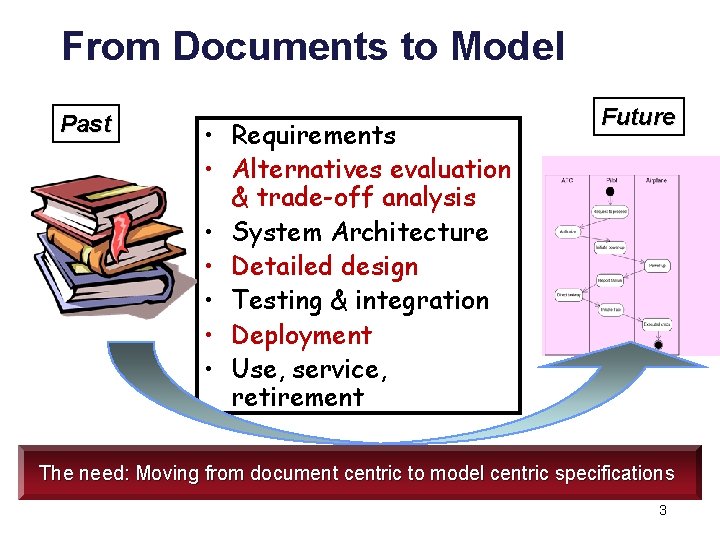
From Documents to Model Past • Requirements • Alternatives evaluation & trade-off analysis • System Architecture • Detailed design • Testing & integration • Deployment • Use, service, retirement Future The need: Moving from document centric to model centric specifications 3

Major SE Lifecycle Phases Needs Analysis Requirements Engineering Optimize & Evaluate Alternatives Concept Formulating Validate & Verify System Logical Architecture Physical Architecture A model must support all the stages Design, Build, Test, Deploy… 4
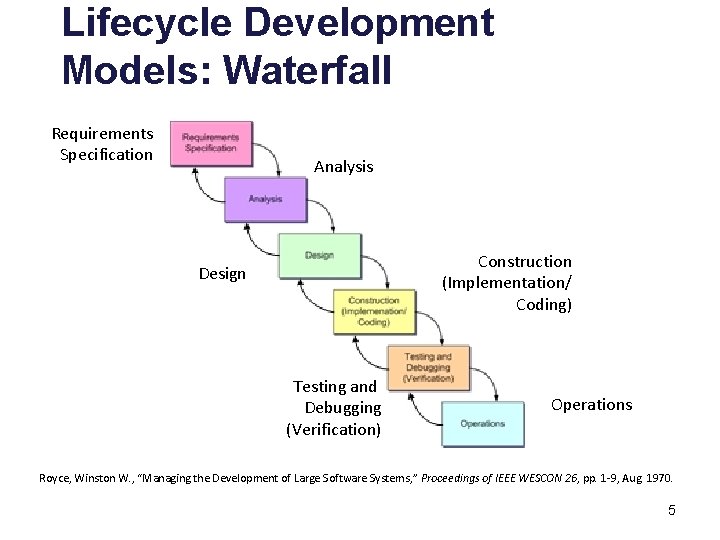
Lifecycle Development Models: Waterfall Requirements Specification Analysis Construction (Implementation/ Coding) Design Testing and Debugging (Verification) Operations Royce, Winston W. , “Managing the Development of Large Software Systems, ” Proceedings of IEEE WESCON 26, pp. 1 -9, Aug. 1970. 5
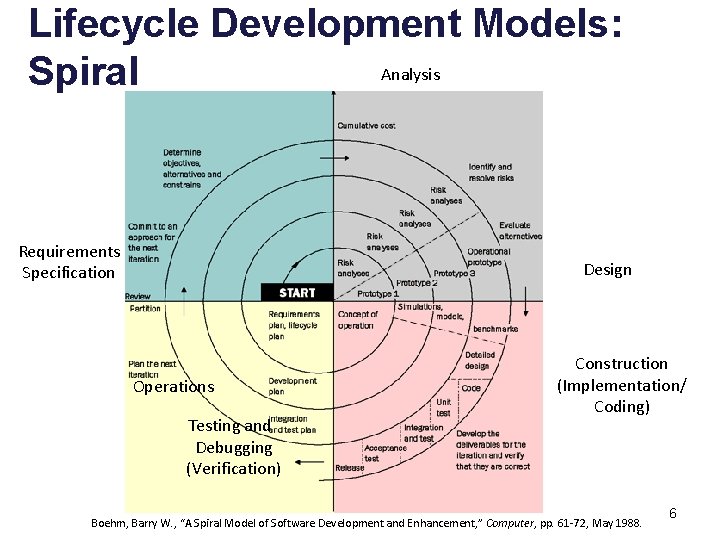
Lifecycle Development Models: Analysis Spiral Requirements Specification Design Operations Testing and Debugging (Verification) Construction (Implementation/ Coding) Boehm, Barry W. , “A Spiral Model of Software Development and Enhancement, ” Computer, pp. 61 -72, May 1988. 6
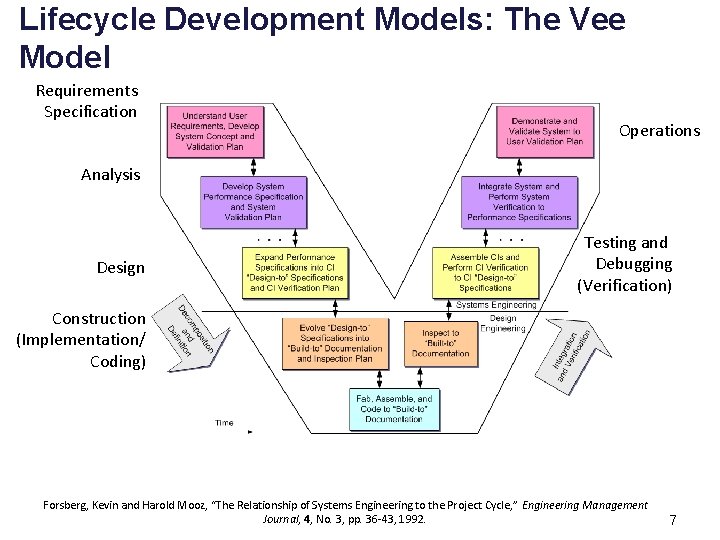
Lifecycle Development Models: The Vee Model Requirements Specification Operations Analysis Design Testing and Debugging (Verification) Construction (Implementation/ Coding) Forsberg, Kevin and Harold Mooz, “The Relationship of Systems Engineering to the Project Cycle, ” Engineering Management Journal, 4, No. 3, pp. 36 -43, 1992. 7
A Language for Systems Engineering • Systems engineering is the youngest engineering discipline • Like any field of engineering, systems engineering needs to have a language for accurately and unambiguously specifying the system of interest. • In this language, system engineers and other stakeholders should be able to express the design concepts of the system under development in a concise and easily communicable way. 8
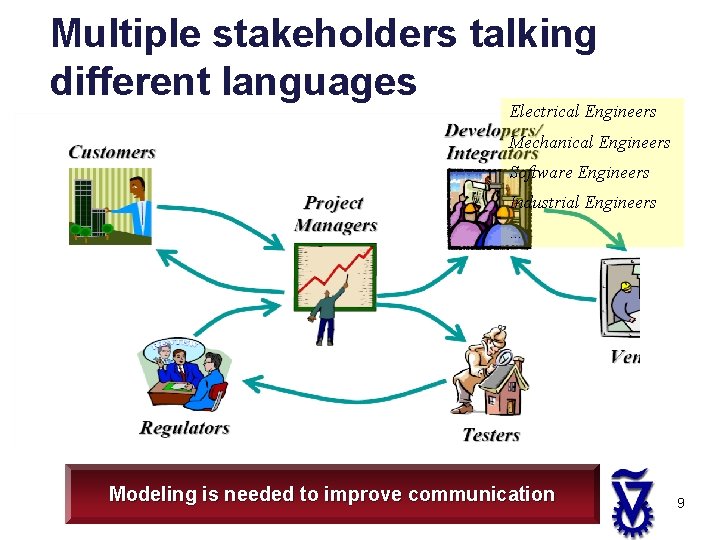
Multiple stakeholders talking different languages Electrical Engineers Mechanical Engineers Software Engineers Industrial Engineers … Modeling is needed to improve communication 9
Model and Modeling Paradigms • A model is an abstraction of a system, aimed at understanding, communicating, explaining, or designing aspects of interest of that system. • Modeling paradigms – Natural Language – Mathematics – Graphics-based - both informal and formal 10
The Emergence of Model-Based Systems Engineering - MBSE • Information Systems Engineering is a subset of Systems Engineering! • Systematic specification, analysis, design and implementation of new systems and products are becoming ever more challenging and demanding. • Contradicting requirements of shorter time-tomarket, higher quality, and lower cost are on the rise. • These trends have provided the basis for Model. Based Systems Engineering (MBSE) as a foundational field of study within systems engineering. 11
Model-Based Systems Engineering activities – 2007: Sys. ML 1. 0 as a profile of UML 2 – 2007, 2009, 2010: MBSE International Conferences: MBSE’ 07, MBSE’ 09, MBSE’ 10 (March 2010, Fairfax, VA, USA) – 2008: INCOSE MBSE Task Force – Sys. ML “challenges” e. g. , telescope modeling – 2009: RFI for Sys. ML 2 – 2009: ISO Study Group to adopt Object. Process Methodology (OPM) as a basis for enterprise standards 12
MBSE Methodology • MBSE calls for the development of a comprehensive methodology, capable of tackling the mounting challenges that projects of developing new systems and products pose. • An MBSE methodology is a language and a collection of related processes, methods, and tools that support systems engineering. • Modeling is a foundational process underlying any MBSE methodology • The resulting model is a central infrastructural entity that supports systems development, evolution, and lifecycle support. • Referred to as “model-based” systems engineering or “model-driven” architecture – MDA (Soley, 2002). 13
Leading MBSE Methodologies Motivation, vision Widget example (INCOSE Task Force, Estefan, 2008 p 43) • IBM ISO 62264 -1 Example Why is OPM ideal Telelogic Harmony-SE “Crash course” in OPM Modeling Example • INCOSE Object-Oriented Systems Engineering Ontology Method IEC/FDIS 62264 -1 Example (OOSEM) Summary, discussion • IBM Rational Unified Process for Systems Engineering (RUP SE) for Model-Driven Systems Development (MDSD) • Vitech Model-Based System Engineering (MBSE) Methodology • JPL State Analysis (SA) • Object-Process Methodology (OPM) 14
MBSE Benefits • Shared understanding of system requirements and design – – – Validation of requirements Common basis for analysis and design Communication with all stakeholders – – Separation of concerns via multiple views of integrated model Support for traceability through hierarchical system model Support for impact analysis of requirements and design changes Support for incremental development & evolutionary acquisition – – Reduced errors and ambiguity More complete representation • Basis for managing complex system development • Improved design quality • Support for early and on-going verification & validation to reduce risk • Value throughout the system’s lifecycle: documentation, testing, training… 15 © 2009 Prof. Dov Dori
Leading Modeling Languages Motivation, vision Widget example ISO 62264 -1 Example Why is OPM ideal “Crash course” in OPM • UML – Unified Modeling Language (1997) • Intended and designed for software systems Ontology Modeling Example IEC/FDIS 62264 -1 Example • 13 types of diagrams in UML 2. 0 (2005) Summary, discussion • OMG standard • Sys. ML – Systems Modeling Language (2007) • A profile of UML for modeling general systems • 9 types of diagrams • OMG standard • OPM - Object-Process Methodology (1995) – Language and methodology for conceptual modeling of systems • 1 type of diagram with equivalent textual representation • In the process of becoming ISO Standard 16
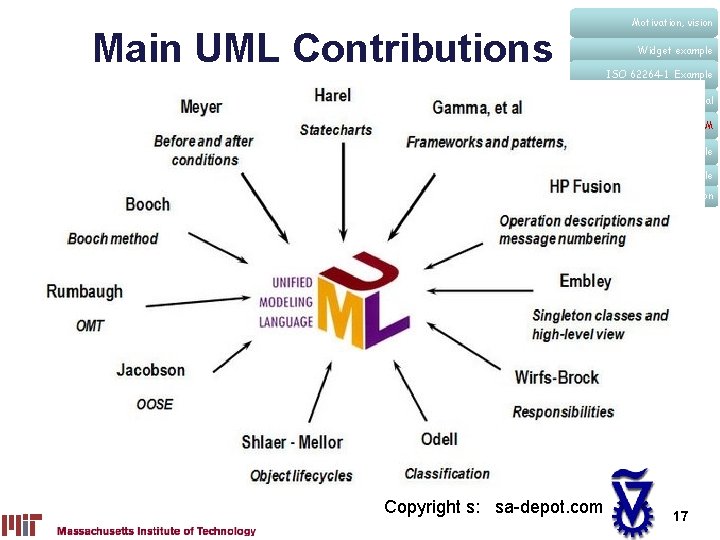
Main UML Contributions Motivation, vision Widget example ISO 62264 -1 Example Why is OPM ideal “Crash course” in OPM Ontology Modeling Example IEC/FDIS 62264 -1 Example Summary, discussion Copyright s: sa-depot. com 17
Motivation, vision Why Model Enterprise Standards? Widget example • An enterprise is a complex system. • As such, it must be modeled to get a full account of all its intricacies. • Text alone is insufficient – prone to ambiguities and misinterpretations (examples follow). • A model provides common ontology throughout a set of related standards, putting all stakeholders “on the same page”. • A model promotes consistency and significantly reduces “loose ends” and grey areas. • A model can be visually simulated for visualization validation, and communication purposes. ISO 62264 -1 Example Why is OPM ideal “Crash course” in OPM Ontology Modeling Example IEC/FDIS 62264 -1 Example Summary, discussion
OPM: A basis for ISO Enterprise Standards Motivation, vision Widget example ISO 62264 -1 Example Why is OPM ideal • Motivation, vision, value proposition • Widget Manufacturing Case Study • Standard Modeling Example 1: ISO/IEC 62264 -1 6. 4. 1. Maintenance Management • Why is OPM ideal for modeling enterprise standards? • “Crash course” in OPM • Ontology Modeling Example: How can OPM modeling enhance term/glossary definitions? • Standard Modeling Example 2: Integrating structure and behavior in i. SO/IEC 62264 -1 • Summary, discussion “Crash course” in OPM Ontology Modeling Example IEC/FDIS 62264 -1 Example Summary, discussion 19
In search for simplicity and accessibility: Mayer’s Cognitive Assumptions (2003) (1) Dual-channel processing – humans possess separate systems for processing visual and verbal representations (Clark & Paivio, 1991; Baddeley, 1992). (2) Limited capacity – the amount of processing that can take place within each information processing channel is extremely limited (Miller, 1956; Chandler & Sweller, 1991; Baddeley, 1992). (3) Active processing – meaningful learning occurs during active cognitive processing, paying attention to words and pictures. 20
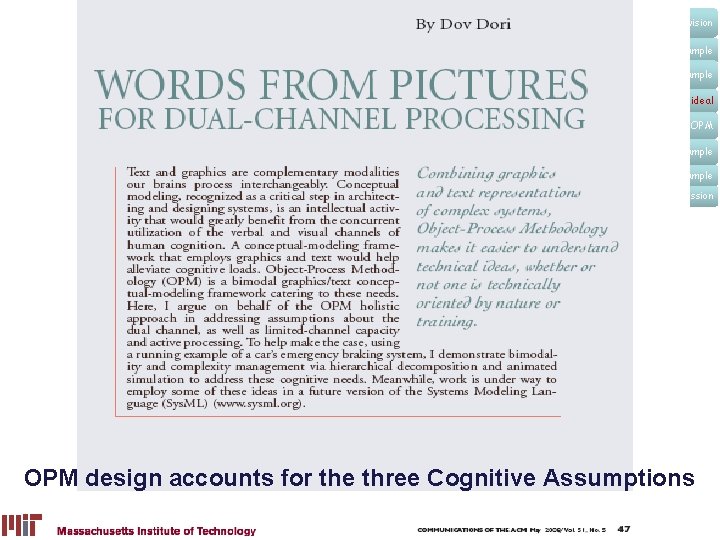
Motivation, vision Widget example ISO 62264 -1 Example Why is OPM ideal “Crash course” in OPM Ontology Modeling Example IEC/FDIS 62264 -1 Example Summary, discussion OPM design accounts for the three Cognitive Assumptions 21
Motivation, vision What is Object-Process Methodology (OPM)? • A simple comprehensive language backed by philosophy for – – – Modeling and knowledge capturing, Documenting, Communicating Engineering, and Lifecycle support Widget example ISO 62264 -1 Example Why is OPM ideal “Crash course” in OPM Ontology Modeling Example IEC/FDIS 62264 -1 Example Summary, discussion of complex, multi-disciplinary systems and standards • Based on simultaneous bimodal (graphics and text) representation of – structure (via stateful objects) and – behavior (via processes) 22
Motivation, vision What is in an OPM Model? Widget example ISO 62264 -1 Example • The OPM model consists of a set of Object-Process Diagrams (OPD) set and a corresponding Object-Process Language (OPL) paragraphs set. Why is OPM ideal “Crash course” in OPM Ontology Modeling Example IEC/FDIS 62264 -1 Example Summary, discussion OPL is a subset of English 23
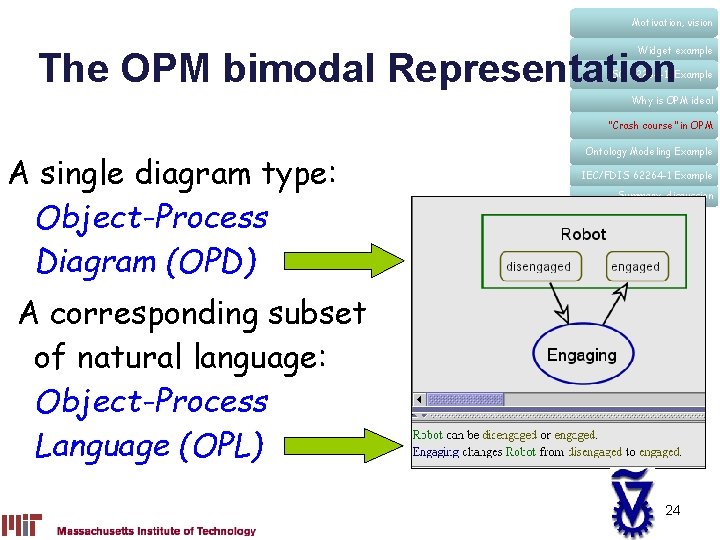
Motivation, vision Widget example The OPM bimodal Representation ISO 62264 -1 Example Why is OPM ideal “Crash course” in OPM A single diagram type: Object-Process Diagram (OPD) Ontology Modeling Example IEC/FDIS 62264 -1 Example Summary, discussion A corresponding subset of natural language: Object-Process Language (OPL) 24
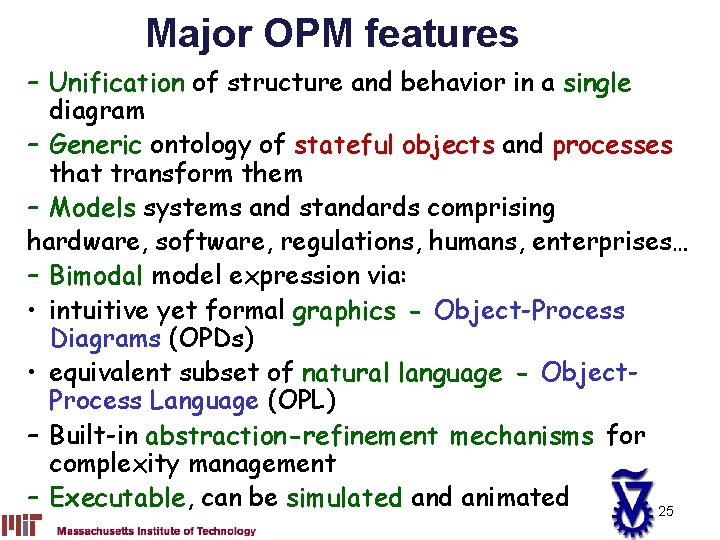
Major OPM features – Unification of structure and behavior in a single diagram – Generic ontology of stateful objects and processes that transform them – Models systems and standards comprising hardware, software, regulations, humans, enterprises… – Bimodal model expression via: • intuitive yet formal graphics - Object-Process Diagrams (OPDs) • equivalent subset of natural language - Object. Process Language (OPL) – Built-in abstraction-refinement mechanisms for complexity management – Executable, can be simulated animated 25
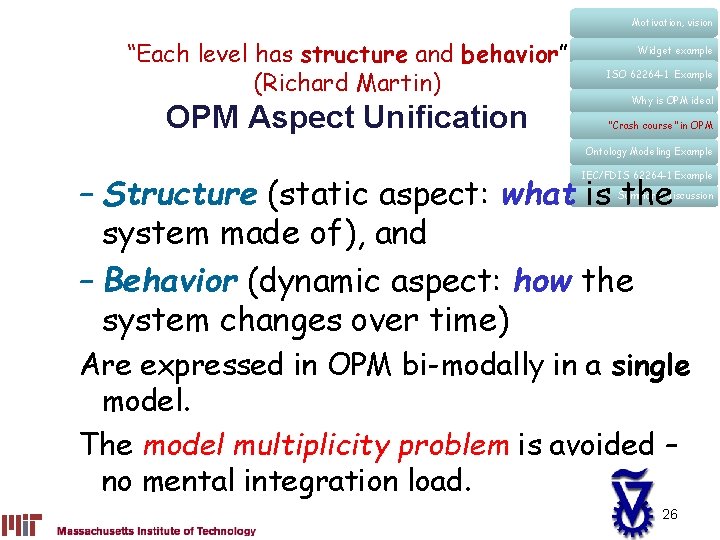
Motivation, vision “Each level has structure and behavior” (Richard Martin) OPM Aspect Unification Widget example ISO 62264 -1 Example Why is OPM ideal “Crash course” in OPM Ontology Modeling Example IEC/FDIS 62264 -1 Example – Structure (static aspect: what is the system made of), and – Behavior (dynamic aspect: how the system changes over time) Summary, discussion Are expressed in OPM bi-modally in a single model. The model multiplicity problem is avoided – no mental integration load. 26
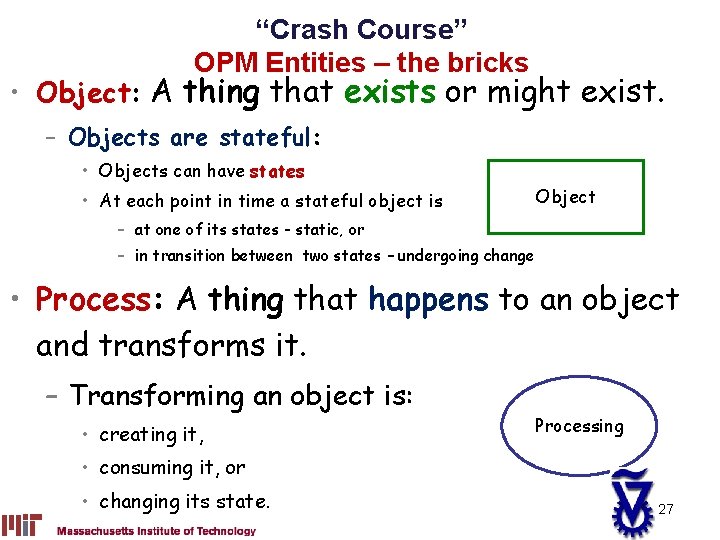
“Crash Course” OPM Entities – the bricks • Object: A thing that exists or might exist. – Objects are stateful: • Objects can have states Object • At each point in time a stateful object is – at one of its states - static, or – in transition between two states – undergoing change • Process: A thing that happens to an object and transforms it. – Transforming an object is: • creating it, Processing • consuming it, or • changing its state. 27
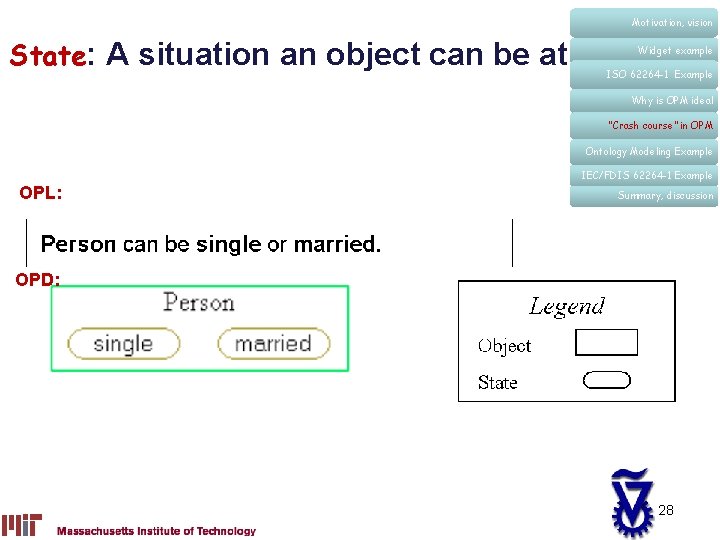
Motivation, vision State: A situation an object can be at Widget example ISO 62264 -1 Example Why is OPM ideal “Crash course” in OPM Ontology Modeling Example IEC/FDIS 62264 -1 Example OPL: Summary, discussion OPD: 28
OPM Links – the mortar connecting the entities • Link: A connection between two OPM entities (process, object, or object’s state). • Two link types: – structural link – a link specifying a static aspect of the system • Connects two objects or two processes • Examples: aggregation-participation (whole-part), generalization-specialization – procedural link – a link specifying a dynamic aspect of the system • Connects an object and a process • Examples: effect (state change), result, consumption 29
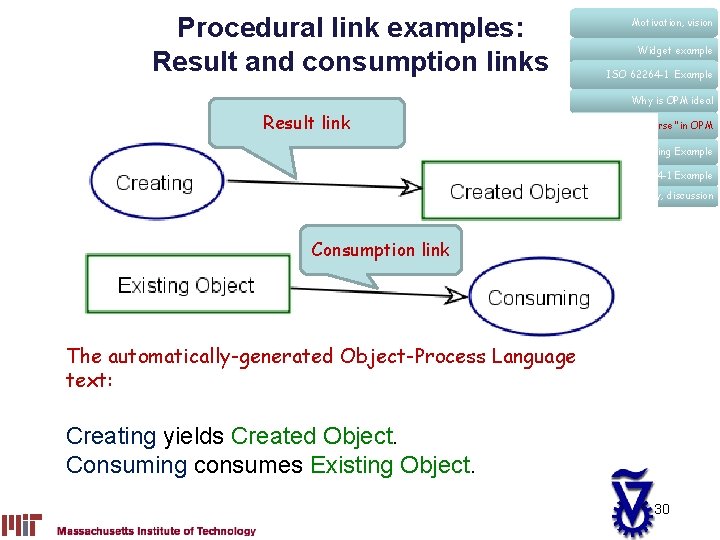
Procedural link examples: Result and consumption links Motivation, vision Widget example ISO 62264 -1 Example Why is OPM ideal creating it, consuming it, or changing its state Result link “Crash course” in OPM Ontology Modeling Example IEC/FDIS 62264 -1 Example Summary, discussion Consumption link The automatically-generated Object-Process Language text: Creating yields Created Object. Consuming consumes Existing Object. 30
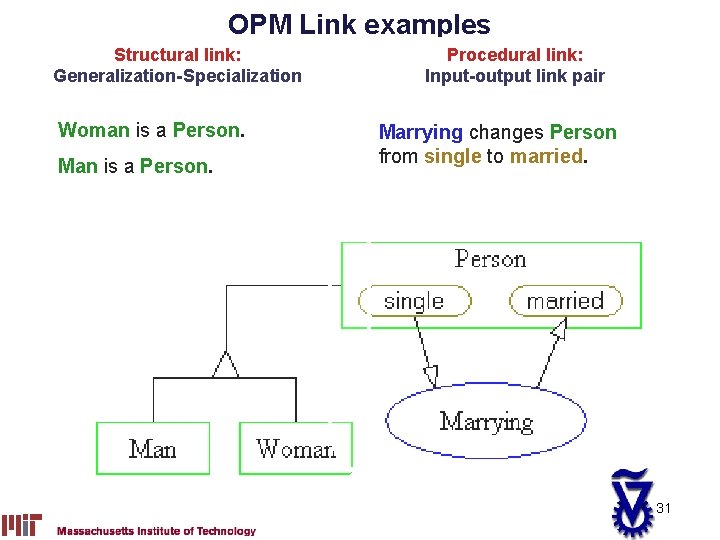
OPM Link examples Structural link: Generalization-Specialization Woman is a Person. Man is a Person. Procedural link: Input-output link pair Marrying changes Person from single to married. 31
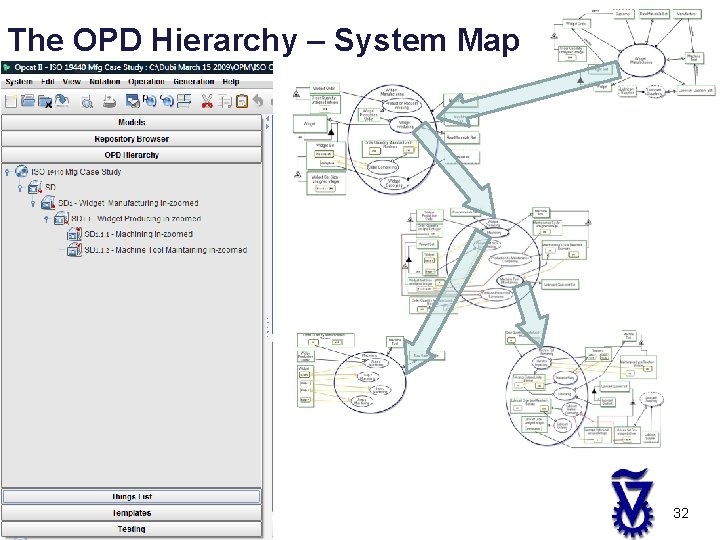
The OPD Hierarchy – System Map 32
Resources: OPM book Dov Dori, Object-Process Methodology - A Holistic Systems Paradigm, Springer Verlag, Berlin, Heidelberg, New York, 2002 (ISBN 3 -540 -65471 -2; Foreword by Edward Crawley. Hard cover, 453 pages, with CD-ROM). Motivation, vision Widget example ISO 62264 -1 Example Why is OPM ideal “Crash course” in OPM Ontology Modeling Example IEC/FDIS 62264 -1 Example Summary, discussion Publications: www. opcat. com 33
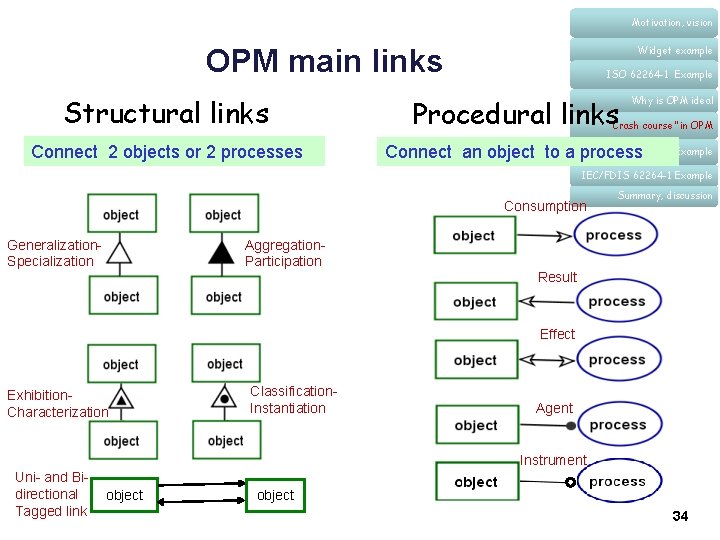
Motivation, vision Widget example OPM main links Structural links Connect 2 objects or 2 processes ISO 62264 -1 Example Procedural links Why is OPM ideal “Crash course” in OPM Ontology Modeling Example Connect an object to a process IEC/FDIS 62264 -1 Example Consumption Generalization. Specialization Summary, discussion Aggregation. Participation Result Effect Exhibition. Characterization Classification. Instantiation Agent Instrument Uni- and Bidirectional Tagged link object 34
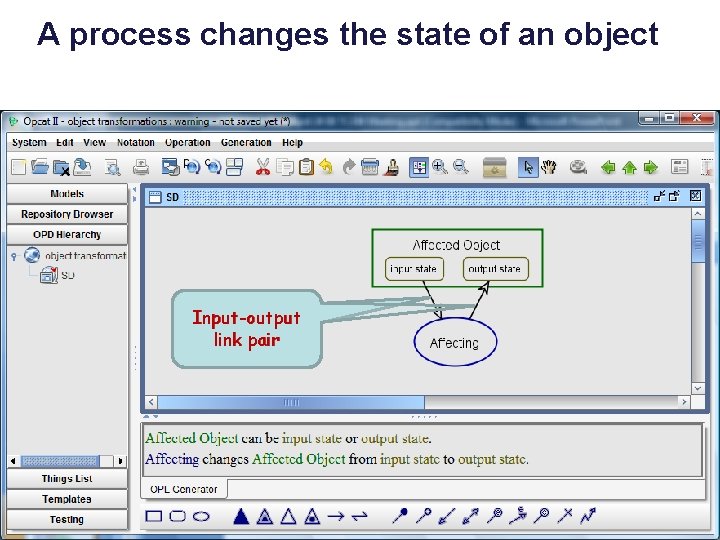
A process changes the state of an object Input-output The automatically-generated Objectlink pair Process Language text: Creating yields Created Object. Consuming consumes Existing Object. 35
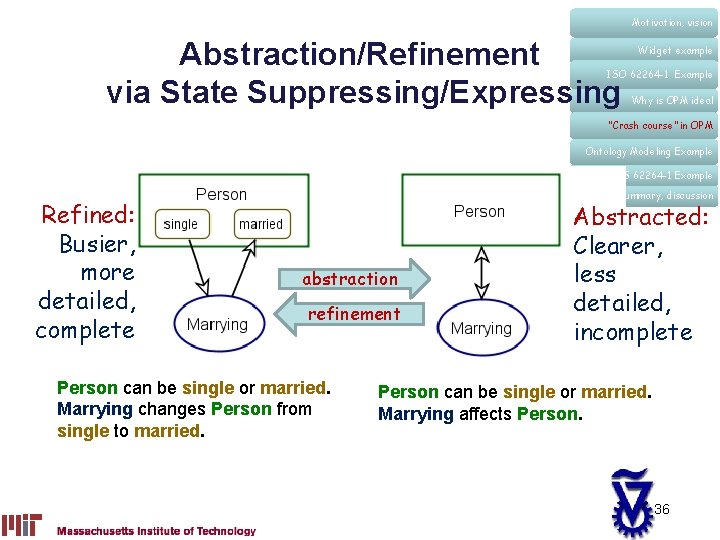
Motivation, vision Abstraction/Refinement via State Suppressing/Expressing Widget example ISO 62264 -1 Example Why is OPM ideal “Crash course” in OPM Ontology Modeling Example IEC/FDIS 62264 -1 Example Refined: Busier, more detailed, complete Summary, discussion abstraction refinement Person can be single or married. Marrying changes Person from single to married. Abstracted: Clearer, less detailed, incomplete Person can be single or married. Marrying affects Person. 36
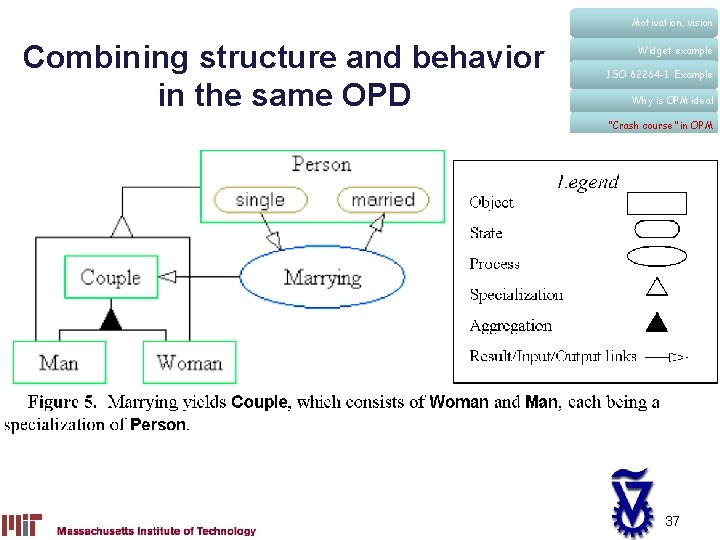
Motivation, vision Combining structure and behavior in the same OPD Widget example ISO 62264 -1 Example Why is OPM ideal “Crash course” in OPM Ontology Modeling Example IEC/FDIS 62264 -1 Example Summary, discussion 37
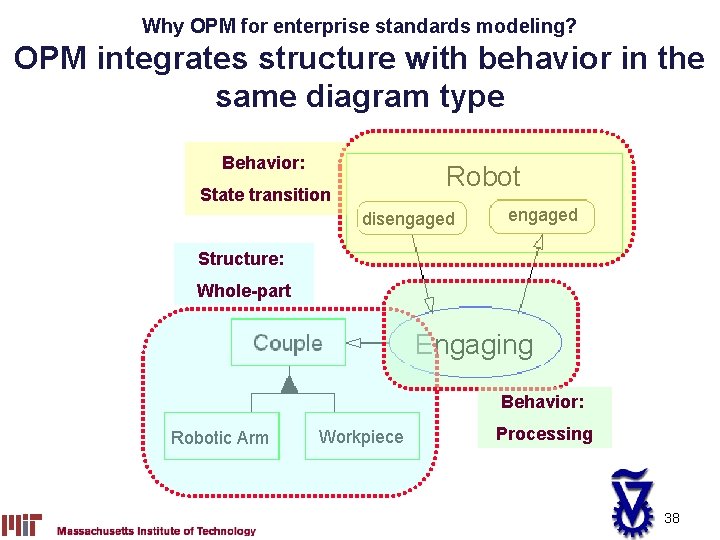
Why OPM for enterprise standards modeling? OPM integrates structure with behavior in the same diagram type Behavior: Robot State transition disengaged Structure: Whole-part Engaging Behavior: Robotic Arm Workpiece Processing 38
Why OPM for enterprise standards modeling? OPM is bimodal: combines graphics and text • OPM has a single type of diagram (“view”) – the OPD – Object-Process Diagram. • The graphic modality is translated on the fly into OPL – Object-Process Language – a simple English subset. • Each modality can be reconstructed from the other (text-to-graphics also possible). • This is in line with the human dual-channel processing principle. • Caters to preferences of both visual- and textual -oriented people. • Provides for engaging all the stakeholders. 39
About ISO http: //www. iso. org/iso/about. htm • ISO (International Organization for Standardization) is the world's largest developer and publisher of International Standards. • ISO is a network of the national standards institutes of 162 countries, one member per country, with a Central Secretariat in Geneva, Switzerland, that coordinates the system. • ISO is a non-governmental organization that forms a bridge between the public and private sectors. • ISO enables a consensus to be reached on solutions that meet both the requirements of business and the broader needs of society. 40
Motivation, vision Motivation • ISO TC 184 Mission: Streamline and enhance ISO enterprise-related models by adding a modeling dimension • OPM is in the process of becoming a common standard modeling language for standards with complex systems aspects, notably enterprises • Meta-standardization: A standard for authoring and maintaining standards • A “solution waiting for a problem” • Win-win Widget example ISO 62264 -1 Example Why is OPM ideal “Crash course” in OPM Ontology Modeling Example IEC/FDIS 62264 -1 Example Summary, discussion 41
Timeline of the metastandardization process Motivation, vision Widget example ISO 62264 -1 Example Why is OPM ideal “Crash course” in OPM • July 2008: INCOSE Symposium, Utrecht, The Netherlands: Richard Martin from ISO proposes to Dov Dori to consider OPM for standards modeling • April 2009: In the Plenary Meeting of TC 184/SC 5 in Paris, Dov Dori presents the case. • The Plenary Meeting unanimously resolved to establish a study group • March 2010: Presentation to TC 184 WG Plenary Meeting in Tokyo Ontology Modeling Example IEC/FDIS 62264 -1 Example Summary, discussion 42
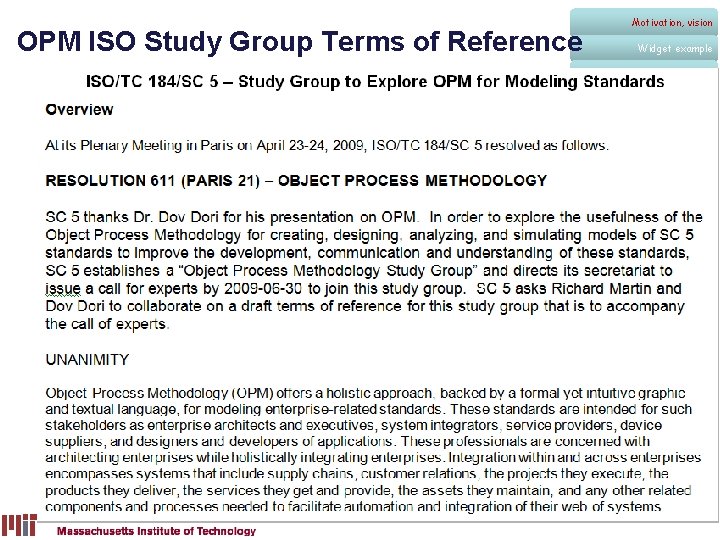
OPM ISO Study Group Terms of Reference Motivation, vision Widget example ISO 62264 -1 Example Why is OPM ideal “Crash course” in OPM Ontology Modeling Example IEC/FDIS 62264 -1 Example Summary, discussion 43
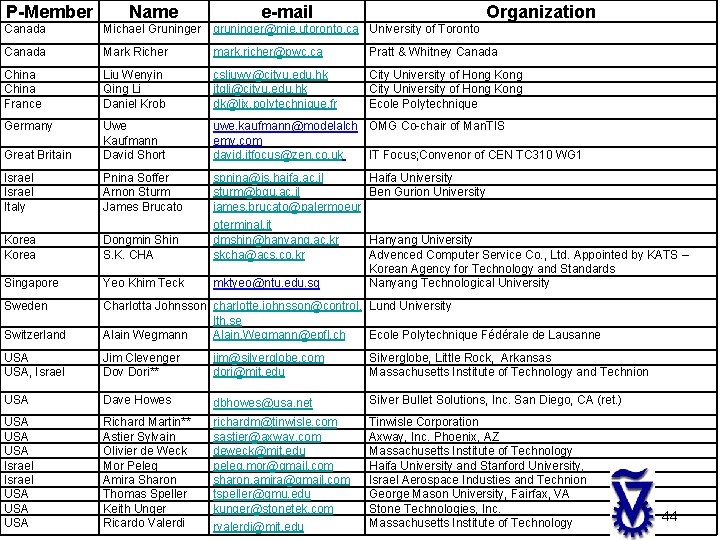
P-Member Name e-mail Organization Canada Michael Gruninger gruninger@mie. utoronto. ca University of Toronto Canada Mark Richer mark. richer@pwc. ca Pratt & Whitney Canada China France Liu Wenyin Qing Li Daniel Krob csliuwy@cityu. edu. hk itqli@cityu. edu. hk dk@lix. polytechnique. fr City University of Hong Kong Ecole Polytechnique Germany Great Britain Uwe Kaufmann David Short uwe. kaufmann@modelalch OMG Co-chair of Man. TIS emy. com david. itfocus@zen. co. uk IT Focus; Convenor of CEN TC 310 WG 1 Israel Italy Pnina Soffer Arnon Sturm James Brucato spnina@is. haifa. ac. il Haifa University sturm@bgu. ac. il Ben Gurion University james. brucato@palermoeur Korea Dongmin Shin S. K. CHA oterminal. it dmshin@hanyang. ac. kr skcha@acs. co. kr Singapore Yeo Khim Teck mktyeo@ntu. edu. sg Sweden Switzerland Charlotta Johnsson charlotte. johnsson@control. Lund University lth. se Alain Wegmann Alain. Wegmann@epfl. ch Ecole Polytechnique Fédérale de Lausanne USA, Israel Jim Clevenger Dov Dori** jim@silverglobe. com dori@mit. edu Silverglobe, Little Rock, Arkansas Massachusetts Institute of Technology and Technion USA Dave Howes dbhowes@usa. net Silver Bullet Solutions, Inc. San Diego, CA (ret. ) USA USA Israel USA USA Richard Martin** Astier Sylvain Olivier de Weck Mor Peleg Amira Sharon Thomas Speller Keith Unger Ricardo Valerdi richardm@tinwisle. com sastier@axway. com deweck@mit. edu peleg. mor@gmail. com sharon. amira@gmail. com tspeller@gmu. edu kunger@stonetek. com Tinwisle Corporation Axway, Inc. Phoenix, AZ Massachusetts Institute of Technology Haifa University and Stanford University, Israel Aerospace Industies and Technion George Mason University, Fairfax, VA Stone Technologies, Inc. Massachusetts Institute of Technology rvalerdi@mit. edu Hanyang University Advenced Computer Service Co. , Ltd. Appointed by KATS – Korean Agency for Technology and Standards Nanyang Technological University 44
The Vision Motivation, vision Widget example ISO 62264 -1 Example • In the future, standards for complex systems (enterprises as a case in point) shall be based on models rather than on free, unconstrained text. • This will increase standards’ • reliability, • consistency, • usability, • reuse, • compatibility, • ability of systems being developed to be checked for compliance with the pertinent standards • ability of being automated… Why is OPM ideal “Crash course” in OPM Ontology Modeling Example IEC/FDIS 62264 -1 Example Summary, discussion 45
Motivation, vision How Do We Get There? Widget example ISO 62264 -1 Example • Develop an OPM model-based standards authoring environment using advances in NLP • Construct a standard Web-based repository of OPM model modules – “snippets” – for enterprise architecture and design • Base and align the modules with existing and evolving ISO standards • Provide a Web-based platform for universal access and reuse of the model modules • Facilitate integration, coherence, and interoperability across all enterprise-related standards via shared common standard modelbased ontology Why is OPM ideal “Crash course” in OPM Ontology Modeling Example IEC/FDIS 62264 -1 Example Summary, discussion 46
Motivation, vision Why OPM for enterprise standards modeling? Widget example ISO 62264 -1 Example OPM is generic Why is OPM ideal • Building on the generic concepts of stateful objects and processes, OPM does not make any assumptions regarding the domain or nature of the system in question. “Crash course” in OPM Ontology Modeling Example IEC/FDIS 62264 -1 Example Summary, discussion • Applied in diverse areas as avionics, project management, banking, biology… • Can be applied in any domain of human study or endeavor, in particular standards for industrial automation. 47
Case Study: Widget Manufacturing specified by Richard Martin Motivation, vision Widget example ISO 62264 -1 Example Why is OPM ideal A customer order initiates a production request for 1000 units of widget A, for which all raw material is already on hand. The machine tool that makes widget A, by a four-step machining process, has a preventive maintenance cycle of 350 units, at which time it requires inspection to assure proper tolerance limits and lubrication before resuming production. After the first cycle, the reserve of lubricant is exhausted and must be replenished from a supplier. “Crash course” in OPM Ontology Modeling Example IEC/FDIS 62264 -1 Example Summary, discussion 48
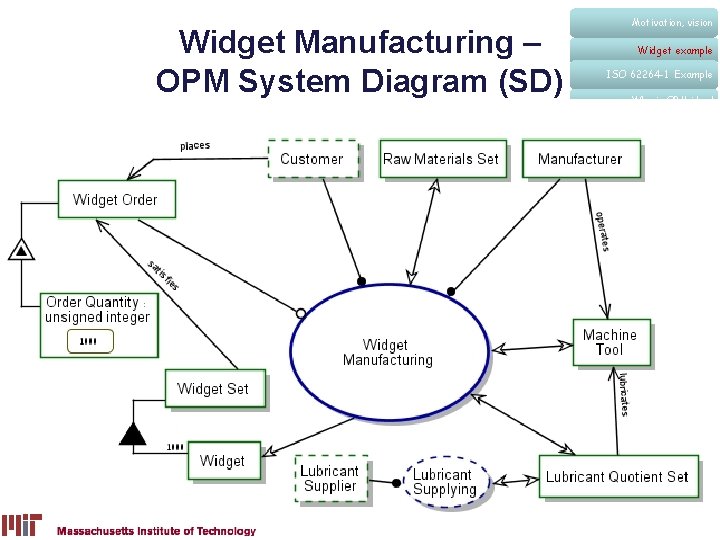
Widget Manufacturing – OPM System Diagram (SD) Motivation, vision Widget example ISO 62264 -1 Example Why is OPM ideal “Crash course” in OPM Ontology Modeling Example IEC/FDIS 62264 -1 Example Summary, discussion 49
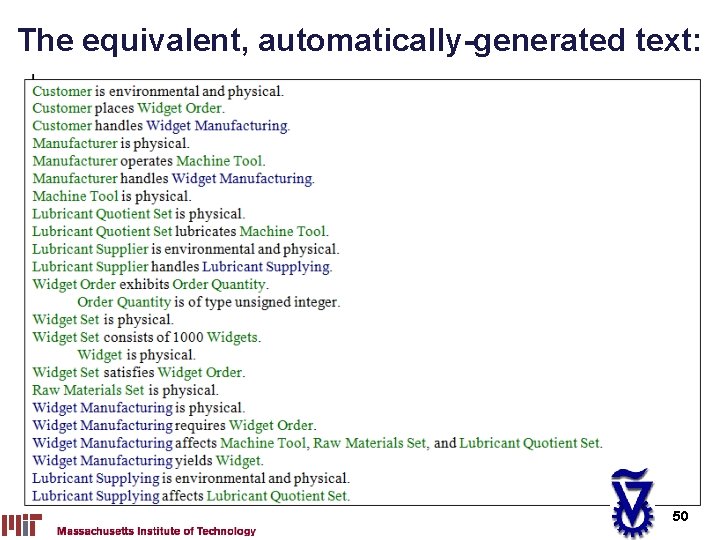
The equivalent, automatically-generated text: 50
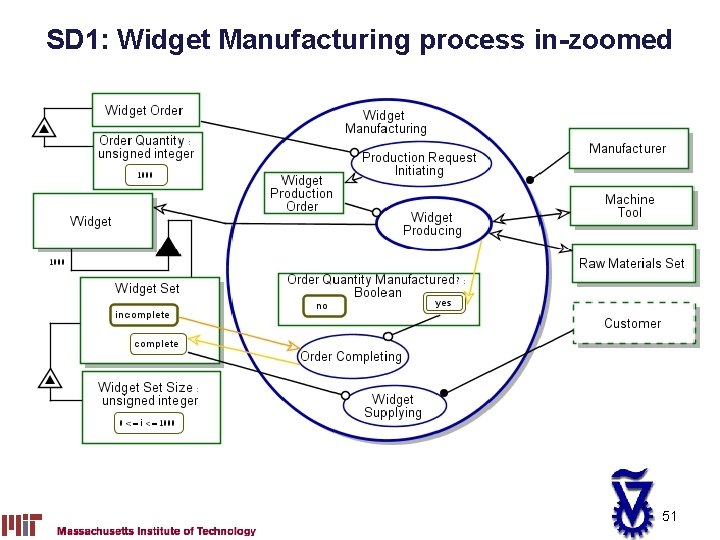
SD 1: Widget Manufacturing process in-zoomed 51
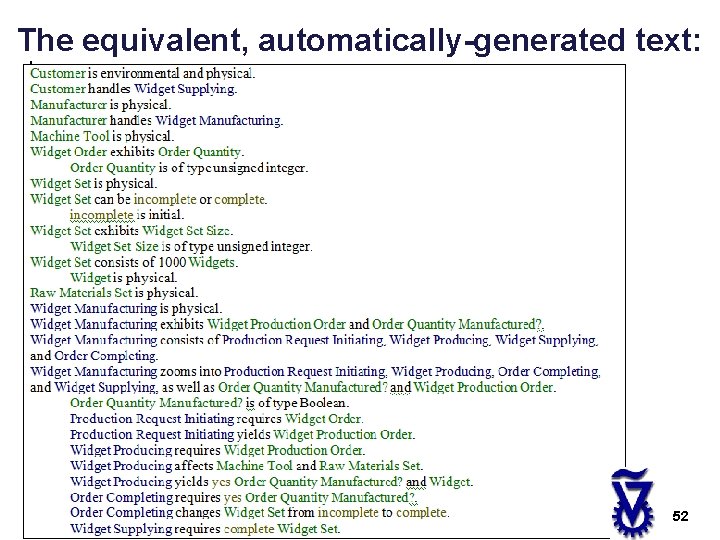
The equivalent, automatically-generated text: 52
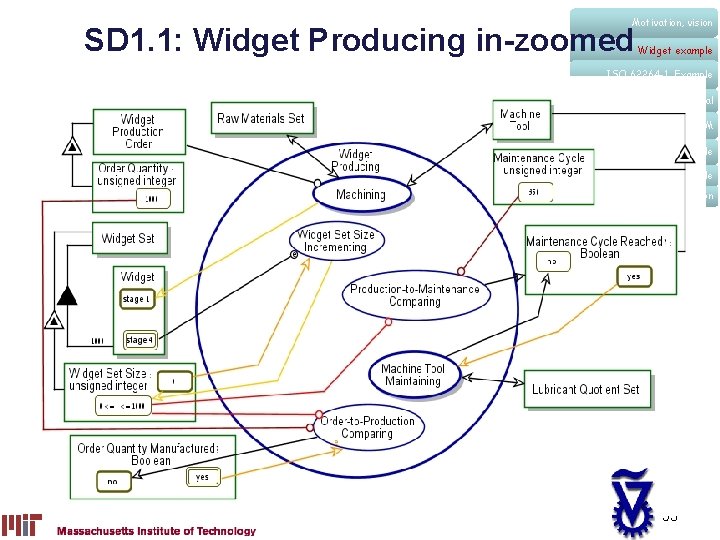
Motivation, vision SD 1. 1: Widget Producing in-zoomed Widget example ISO 62264 -1 Example Why is OPM ideal “Crash course” in OPM Ontology Modeling Example IEC/FDIS 62264 -1 Example Summary, discussion 53
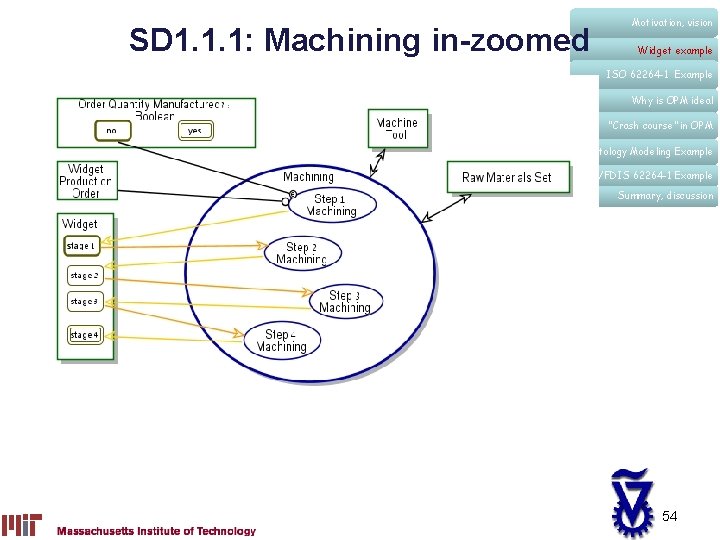
SD 1. 1. 1: Machining in-zoomed Motivation, vision Widget example ISO 62264 -1 Example Why is OPM ideal “Crash course” in OPM Ontology Modeling Example IEC/FDIS 62264 -1 Example Summary, discussion 54
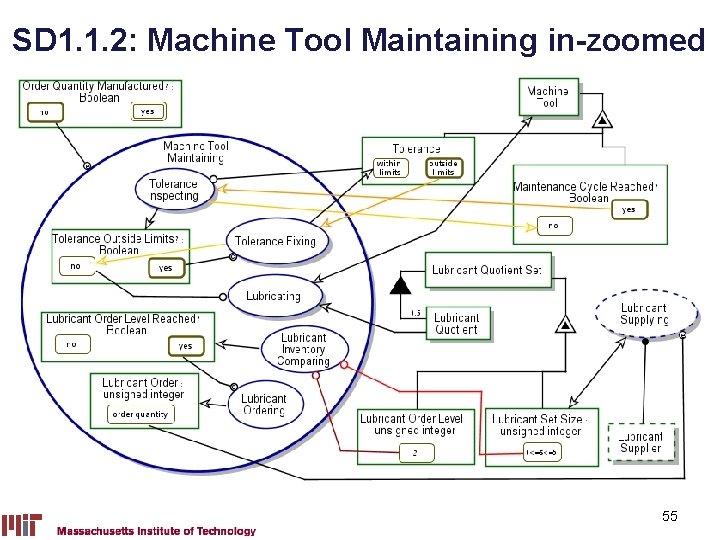
SD 1. 1. 2: Machine Tool Maintaining in-zoomed 55
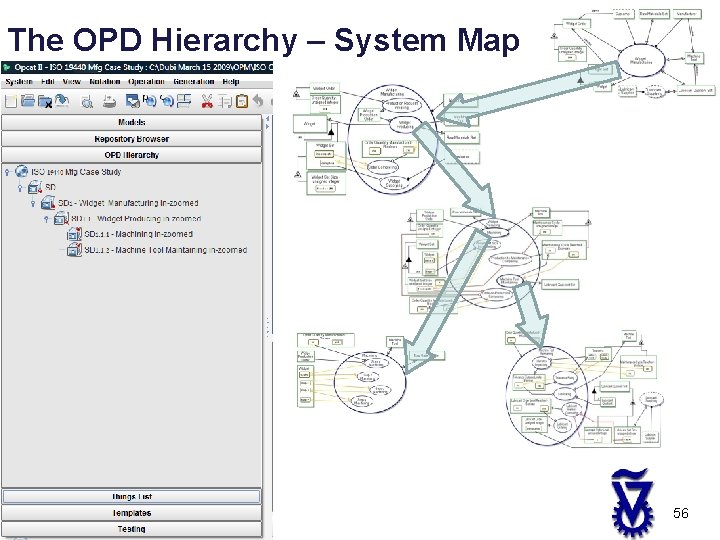
The OPD Hierarchy – System Map 56
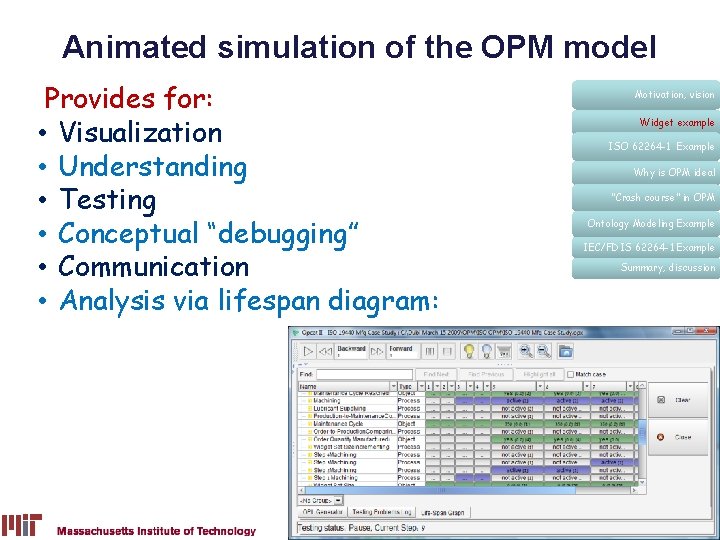
Animated simulation of the OPM model Provides for: • Visualization • Understanding • Testing • Conceptual “debugging” • Communication • Analysis via lifespan diagram: Motivation, vision Widget example ISO 62264 -1 Example Why is OPM ideal “Crash course” in OPM Ontology Modeling Example IEC/FDIS 62264 -1 Example Summary, discussion 57
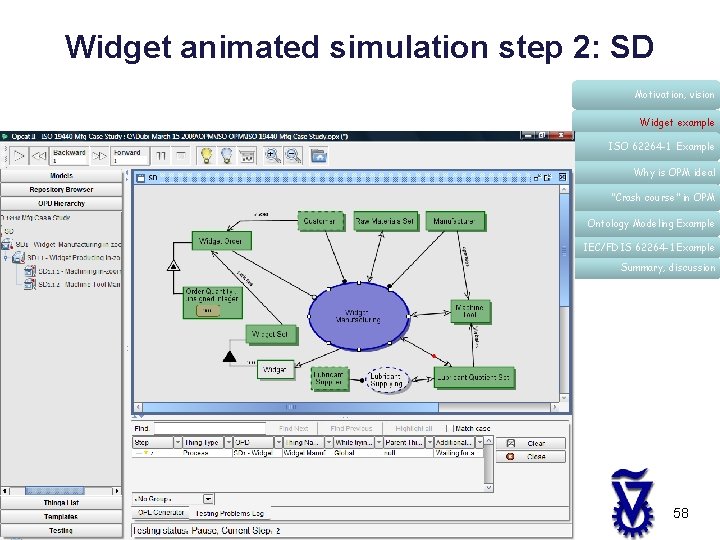
Widget animated simulation step 2: SD Motivation, vision Widget example ISO 62264 -1 Example Why is OPM ideal “Crash course” in OPM Ontology Modeling Example IEC/FDIS 62264 -1 Example Summary, discussion 58
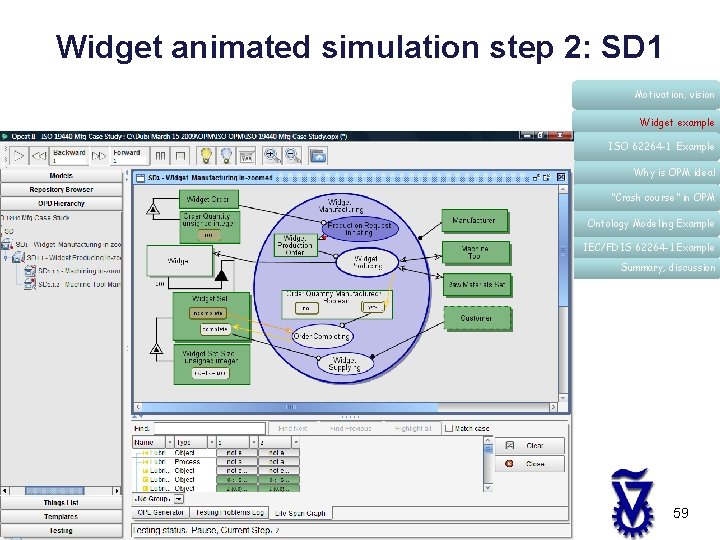
Widget animated simulation step 2: SD 1 Motivation, vision Widget example ISO 62264 -1 Example Why is OPM ideal “Crash course” in OPM Ontology Modeling Example IEC/FDIS 62264 -1 Example Summary, discussion 59
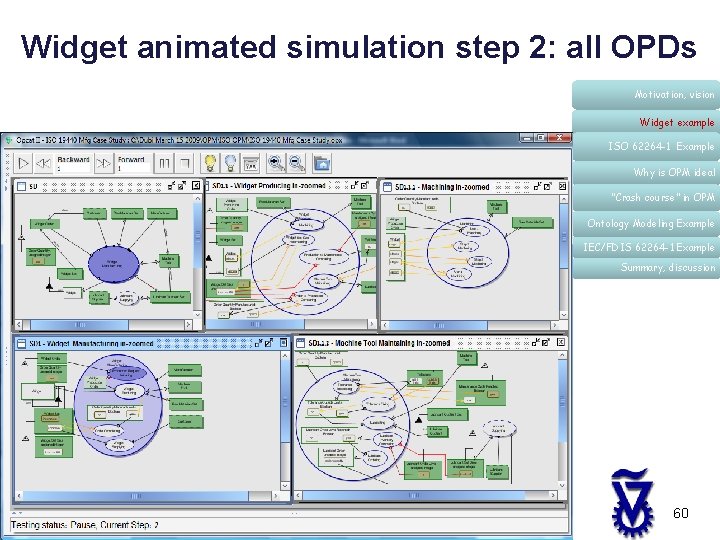
Widget animated simulation step 2: all OPDs Motivation, vision Widget example ISO 62264 -1 Example Why is OPM ideal “Crash course” in OPM Ontology Modeling Example IEC/FDIS 62264 -1 Example Summary, discussion 60
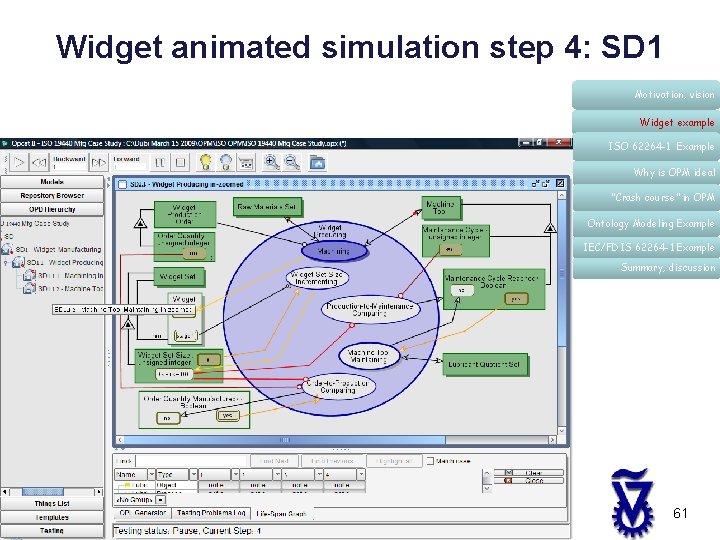
Widget animated simulation step 4: SD 1 Motivation, vision Widget example ISO 62264 -1 Example Why is OPM ideal “Crash course” in OPM Ontology Modeling Example IEC/FDIS 62264 -1 Example Summary, discussion 61
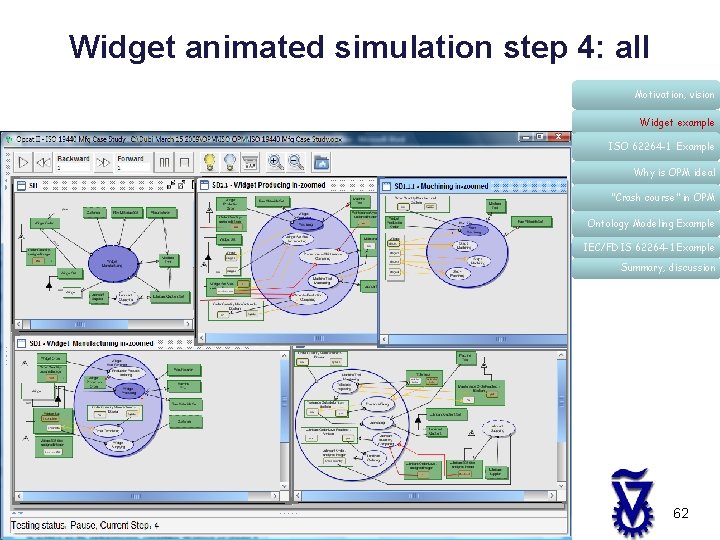
Widget animated simulation step 4: all Motivation, vision Widget example ISO 62264 -1 Example Why is OPM ideal “Crash course” in OPM Ontology Modeling Example IEC/FDIS 62264 -1 Example Summary, discussion 62
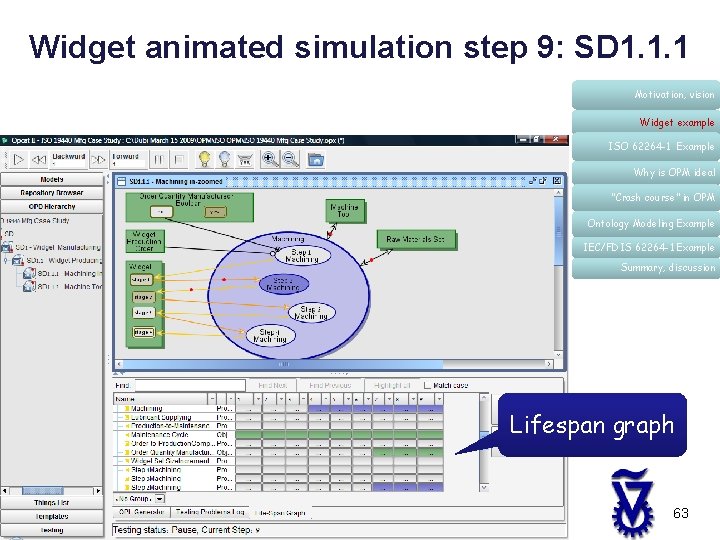
Widget animated simulation step 9: SD 1. 1. 1 Motivation, vision Widget example ISO 62264 -1 Example Why is OPM ideal “Crash course” in OPM Ontology Modeling Example IEC/FDIS 62264 -1 Example Summary, discussion Lifespan graph 63
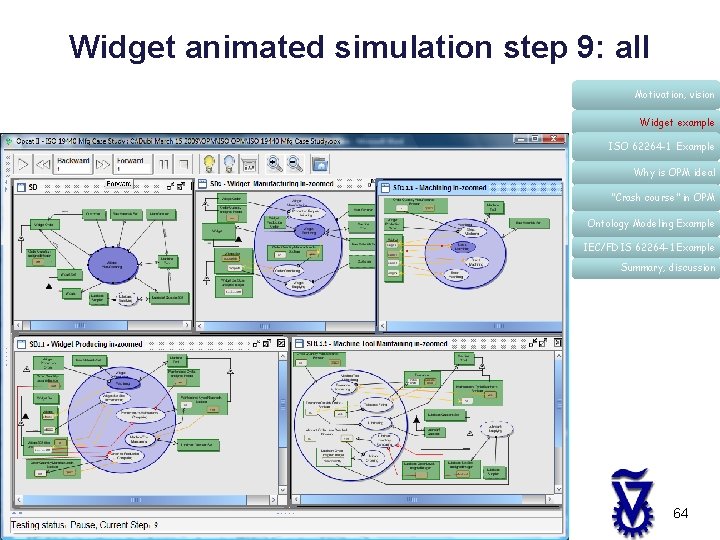
Widget animated simulation step 9: all Motivation, vision Widget example ISO 62264 -1 Example Why is OPM ideal “Crash course” in OPM Ontology Modeling Example IEC/FDIS 62264 -1 Example Summary, discussion 64
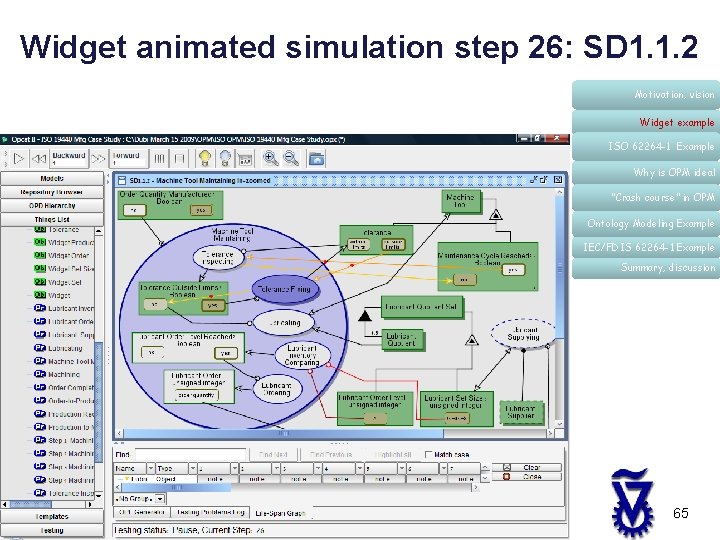
Widget animated simulation step 26: SD 1. 1. 2 Motivation, vision Widget example ISO 62264 -1 Example Why is OPM ideal “Crash course” in OPM Ontology Modeling Example IEC/FDIS 62264 -1 Example Summary, discussion 65
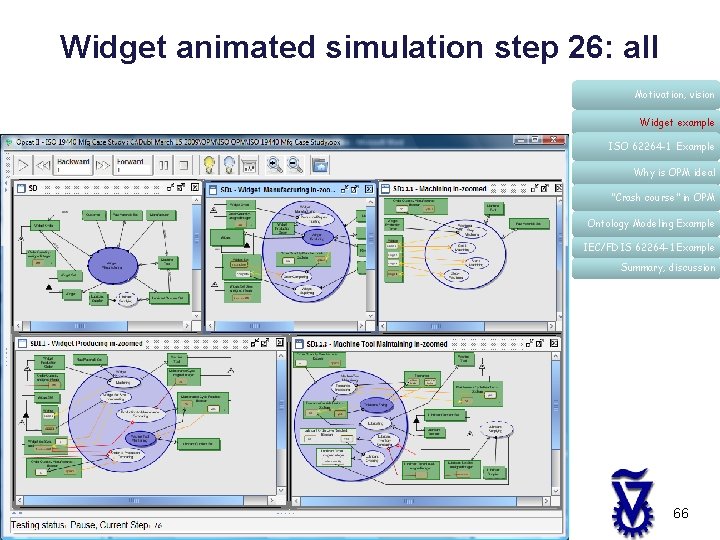
Widget animated simulation step 26: all Motivation, vision Widget example ISO 62264 -1 Example Why is OPM ideal “Crash course” in OPM Ontology Modeling Example IEC/FDIS 62264 -1 Example Summary, discussion 66
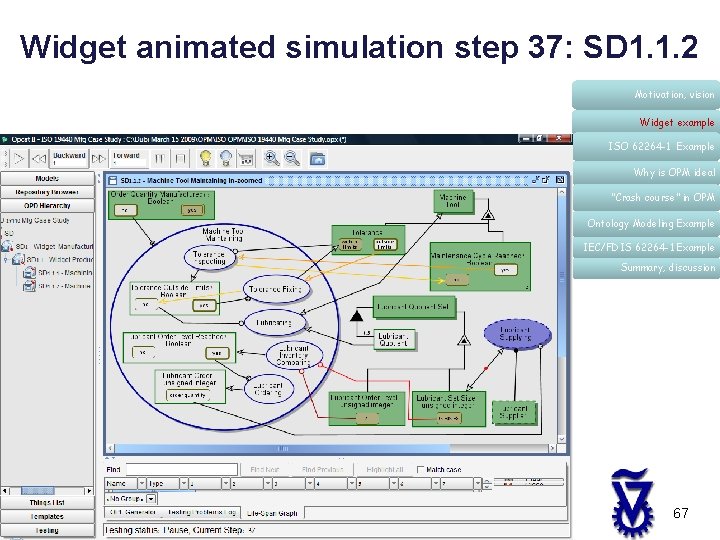
Widget animated simulation step 37: SD 1. 1. 2 Motivation, vision Widget example ISO 62264 -1 Example Why is OPM ideal “Crash course” in OPM Ontology Modeling Example IEC/FDIS 62264 -1 Example Summary, discussion 67
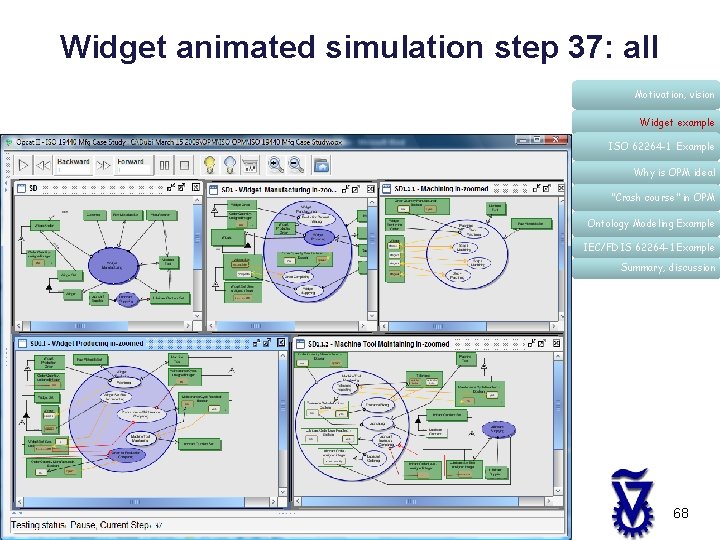
Widget animated simulation step 37: all Motivation, vision Widget example ISO 62264 -1 Example Why is OPM ideal “Crash course” in OPM Ontology Modeling Example IEC/FDIS 62264 -1 Example Summary, discussion 68
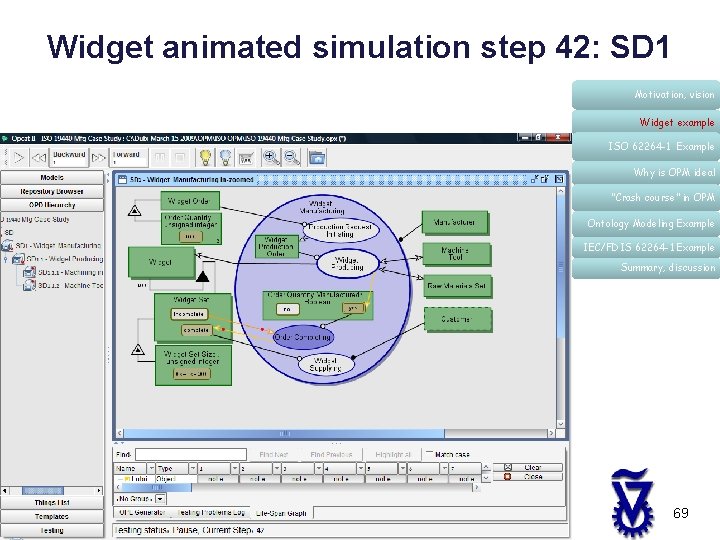
Widget animated simulation step 42: SD 1 Motivation, vision Widget example ISO 62264 -1 Example Why is OPM ideal “Crash course” in OPM Ontology Modeling Example IEC/FDIS 62264 -1 Example Summary, discussion 69
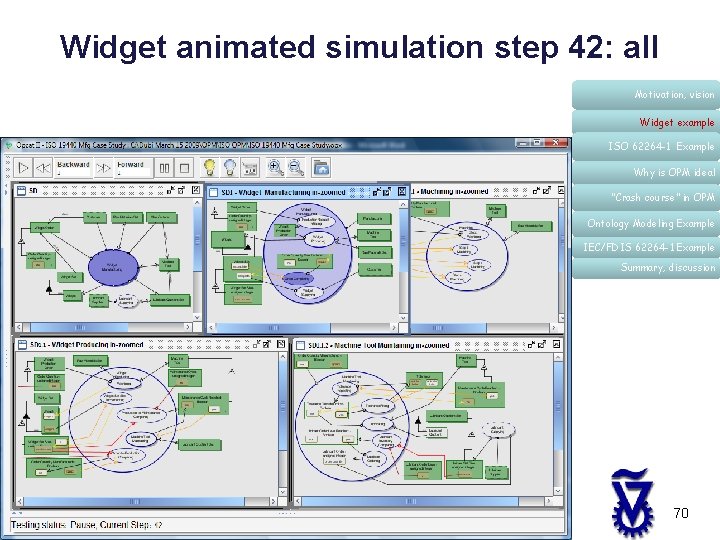
Widget animated simulation step 42: all Motivation, vision Widget example ISO 62264 -1 Example Why is OPM ideal “Crash course” in OPM Ontology Modeling Example IEC/FDIS 62264 -1 Example Summary, discussion 70
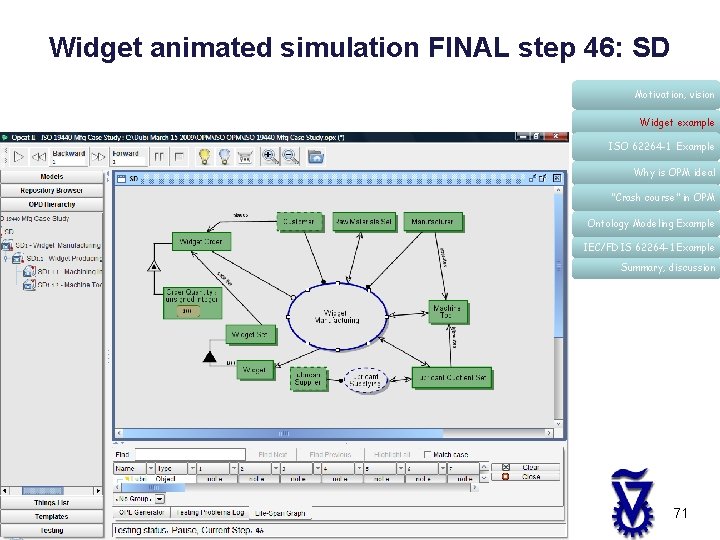
Widget animated simulation FINAL step 46: SD Motivation, vision Widget example ISO 62264 -1 Example Why is OPM ideal “Crash course” in OPM Ontology Modeling Example IEC/FDIS 62264 -1 Example Summary, discussion 71
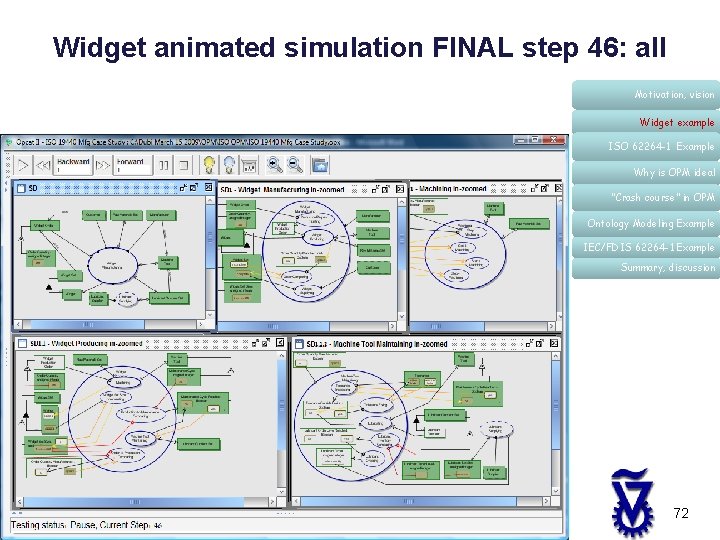
Widget animated simulation FINAL step 46: all Motivation, vision Widget example ISO 62264 -1 Example Why is OPM ideal “Crash course” in OPM Ontology Modeling Example IEC/FDIS 62264 -1 Example Summary, discussion 72
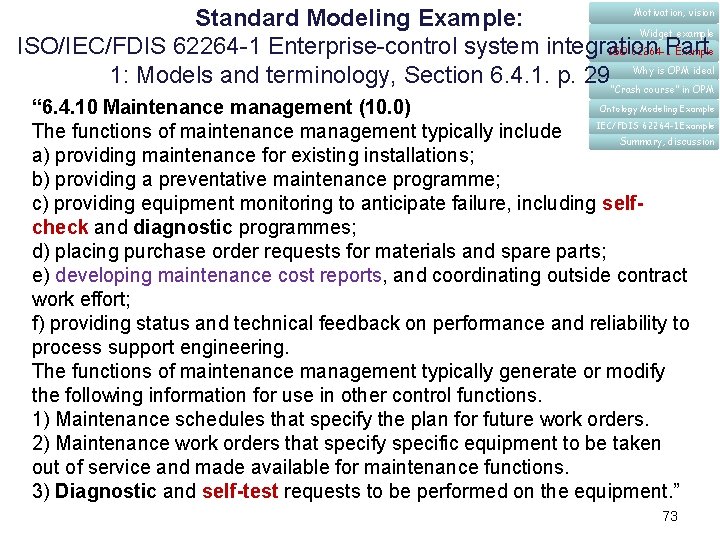
Motivation, vision Standard Modeling Example: Widget example ISO/IEC/FDIS 62264 -1 Enterprise-control system integration Part ISO 62264 -1 Example is OPM ideal 1: Models and terminology, Section 6. 4. 1. p. 29“Crash. Whycourse” in OPM Ontology Modeling Example “ 6. 4. 10 Maintenance management (10. 0) IEC/FDIS 62264 -1 Example The functions of maintenance management typically include Summary, discussion a) providing maintenance for existing installations; b) providing a preventative maintenance programme; c) providing equipment monitoring to anticipate failure, including selfcheck and diagnostic programmes; d) placing purchase order requests for materials and spare parts; e) developing maintenance cost reports, and coordinating outside contract work effort; f) providing status and technical feedback on performance and reliability to process support engineering. The functions of maintenance management typically generate or modify the following information for use in other control functions. 1) Maintenance schedules that specify the plan for future work orders. 2) Maintenance work orders that specify specific equipment to be taken out of service and made available for maintenance functions. 3) Diagnostic and self-test requests to be performed on the equipment. ” 73
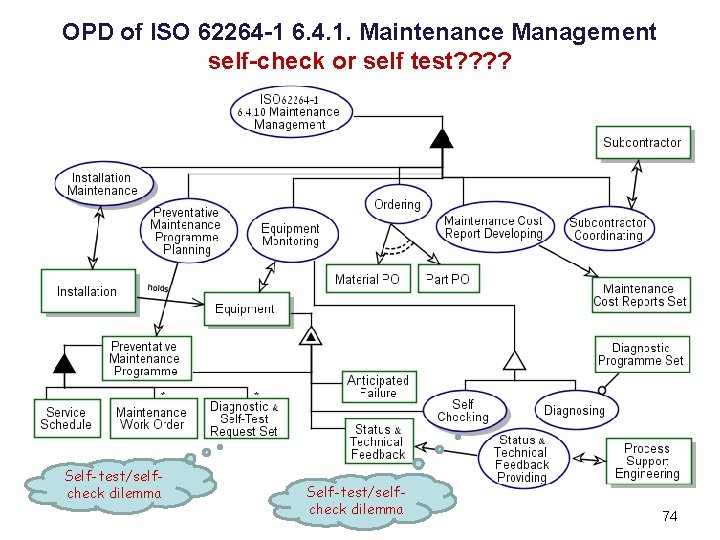
OPD of ISO 62264 -1 6. 4. 1. Maintenance Management self-check or self test? ? Self-test/selfcheck dilemma 74
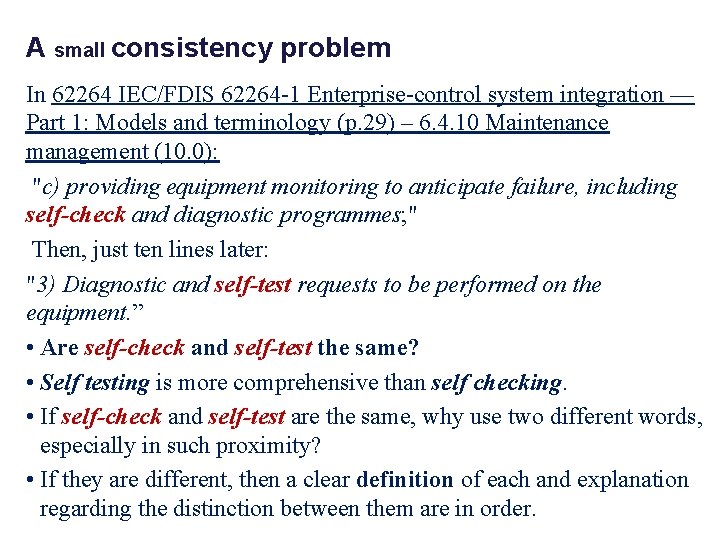
A small consistency problem In 62264 IEC/FDIS 62264 -1 Enterprise-control system integration — Part 1: Models and terminology (p. 29) – 6. 4. 10 Maintenance management (10. 0): "c) providing equipment monitoring to anticipate failure, including self-check and diagnostic programmes; " Then, just ten lines later: "3) Diagnostic and self-test requests to be performed on the equipment. ” • Are self-check and self-test the same? • Self testing is more comprehensive than self checking. • If self-check and self-test are the same, why use two different words, especially in such proximity? • If they are different, then a clear definition of each and explanation regarding the distinction between them are in order.
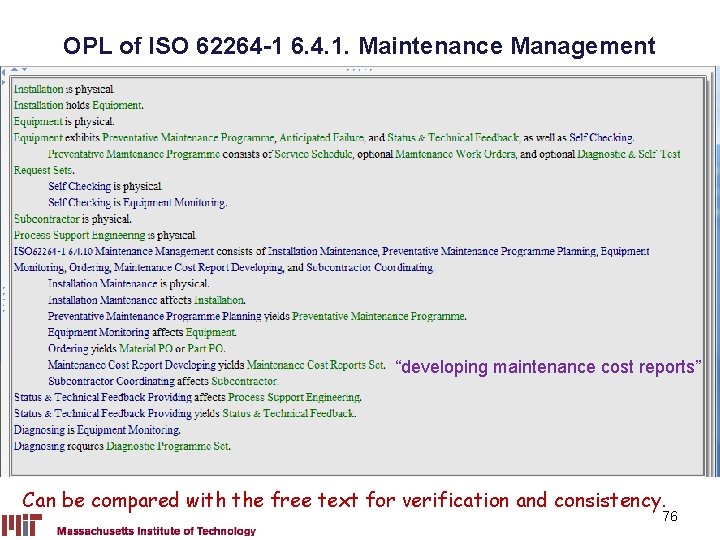
OPL of ISO 62264 -1 6. 4. 1. Maintenance Management “developing maintenance cost reports” Can be compared with the free text for verification and consistency. 76
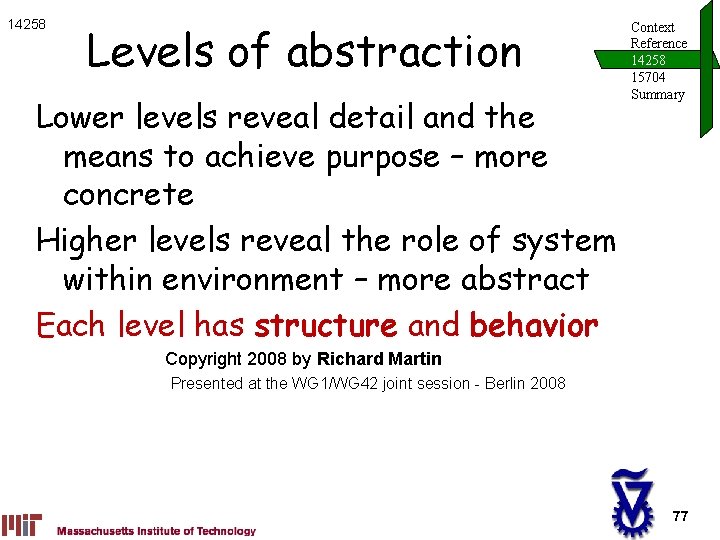
14258 Levels of abstraction Lower levels reveal detail and the means to achieve purpose – more concrete Higher levels reveal the role of system within environment – more abstract Each level has structure and behavior Context Reference 14258 15704 Summary Copyright 2008 by Richard Martin Presented at the WG 1/WG 42 joint session - Berlin 2008 77
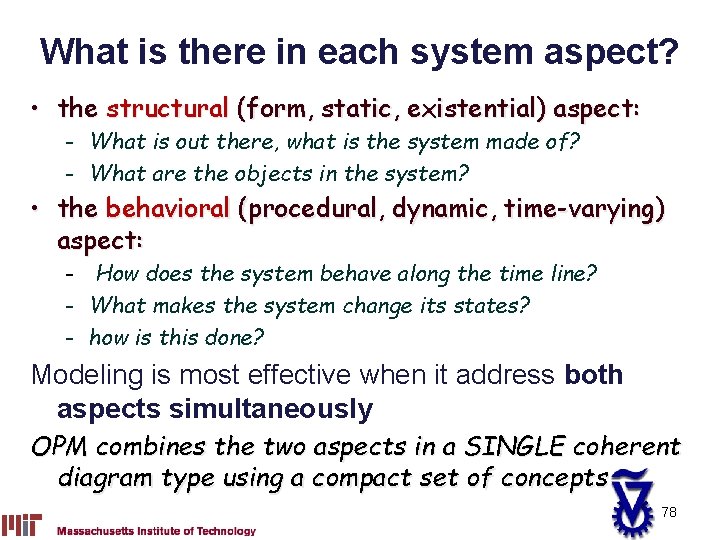
What is there in each system aspect? • the structural (form, static, existential) aspect: – – What is out there, what is the system made of? What are the objects in the system? • the behavioral (procedural, dynamic, time-varying) aspect: – – – How does the system behave along the time line? What makes the system change its states? how is this done? Modeling is most effective when it address both aspects simultaneously OPM combines the two aspects in a SINGLE coherent diagram type using a compact set of concepts 78
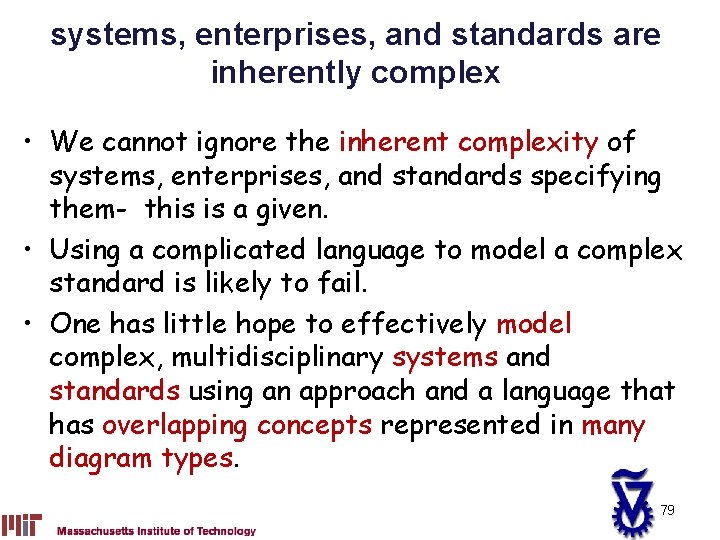
systems, enterprises, and standards are inherently complex • We cannot ignore the inherent complexity of systems, enterprises, and standards specifying them- this is a given. • Using a complicated language to model a complex standard is likely to fail. • One has little hope to effectively model complex, multidisciplinary systems and standards using an approach and a language that has overlapping concepts represented in many diagram types. 79
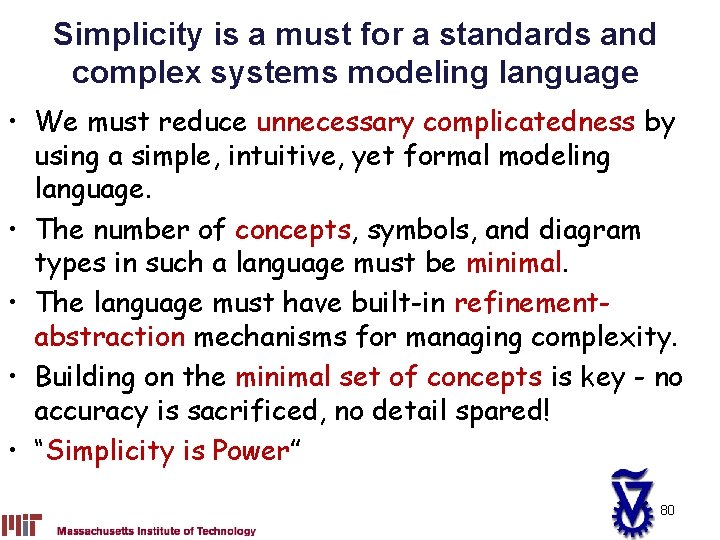
Simplicity is a must for a standards and complex systems modeling language • We must reduce unnecessary complicatedness by using a simple, intuitive, yet formal modeling language. • The number of concepts, symbols, and diagram types in such a language must be minimal. • The language must have built-in refinementabstraction mechanisms for managing complexity. • Building on the minimal set of concepts is key - no accuracy is sacrificed, no detail spared! • “Simplicity is Power” 80
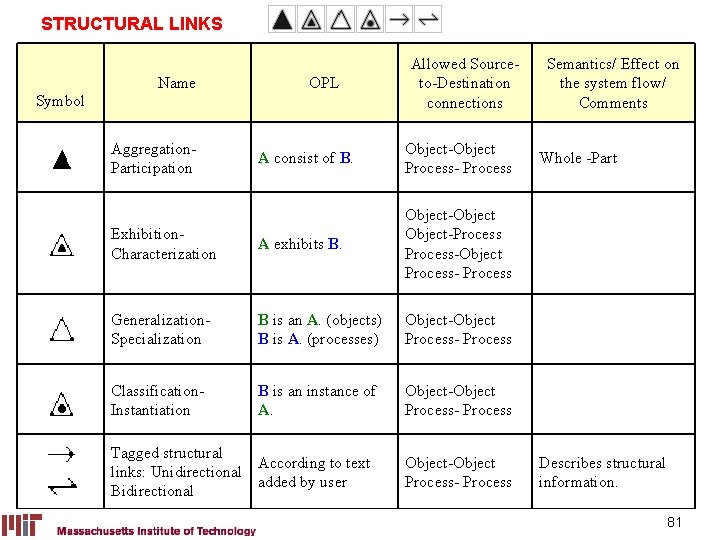
STRUCTURAL LINKS Name OPL Symbol Aggregation. Participation Allowed Sourceto-Destination connections A consist of B. Object-Object Process- Process Exhibition- Characterization A exhibits B. Object-Object-Process-Object Process- Process Generalization- Specialization B is an A. (objects) B is A. (processes) Object-Object Process- Process Classification. Instantiation B is an instance of A. Object-Object Process- Process Tagged structural According to text links: Unidirectional added by user Bidirectional Object-Object Process- Process Semantics/ Effect on the system flow/ Comments Whole -Part Describes structural information. 81
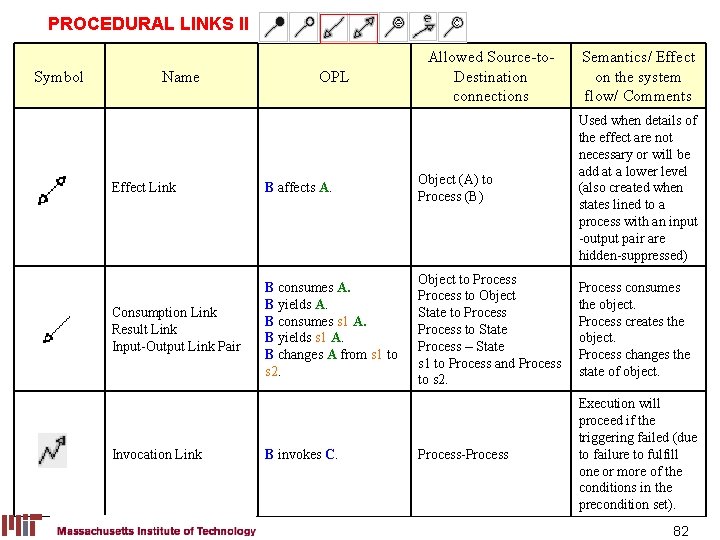
PROCEDURAL LINKS II Symbol Name OPL Allowed Source-to. Destination connections Semantics/ Effect on the system flow/ Comments Effect Link B affects A. Object (A) to Process (B) Used when details of the effect are not necessary or will be add at a lower level (also created when states lined to a process with an input -output pair are hidden-suppressed) Consumption Link Result Link Input-Output Link Pair B consumes A. B yields A. B consumes s 1 A. B yields s 1 A. B changes A from s 1 to s 2. Object to Process to Object State to Process to State Process – State s 1 to Process and Process to s 2. Process consumes the object. Process creates the object. Process changes the state of object. Process-Process Execution will proceed if the triggering failed (due to failure to fulfill one or more of the conditions in the precondition set). Invocation Link B invokes C. 82
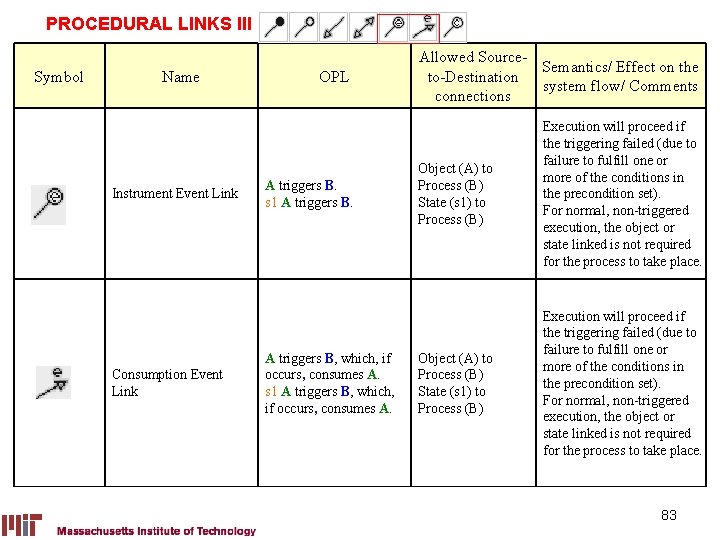
PROCEDURAL LINKS III Symbol Name Instrument Event Link Consumption Event Link OPL Allowed Source. Semantics/ Effect on the to-Destination system flow/ Comments connections A triggers B. s 1 A triggers B. Object (A) to Process (B) State (s 1) to Process (B) Execution will proceed if the triggering failed (due to failure to fulfill one or more of the conditions in the precondition set). For normal, non-triggered execution, the object or state linked is not required for the process to take place. A triggers B, which, if occurs, consumes A. s 1 A triggers B, which, if occurs, consumes A. 83
Motivation, vision Resources Widget example ISO 62264 -1 Example OPCAT site: www. opcat. com - Links to publications Why is OPM ideal OPCAT academic & trial free download: https: //www. opcat. com/downloads/trial/ “Crash course” in OPM Ontology Modeling Example IEC/FDIS 62264 -1 Example Summary, discussion 84
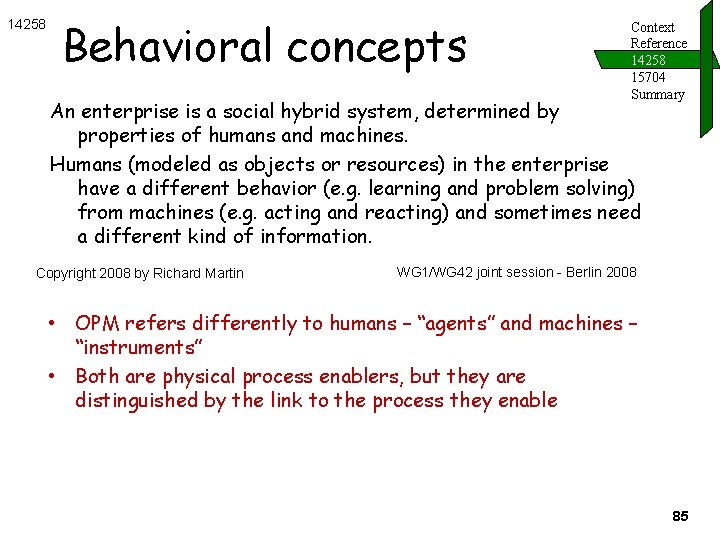
14258 Behavioral concepts Context Reference 14258 15704 Summary An enterprise is a social hybrid system, determined by properties of humans and machines. Humans (modeled as objects or resources) in the enterprise have a different behavior (e. g. learning and problem solving) from machines (e. g. acting and reacting) and sometimes need a different kind of information. Copyright 2008 by Richard Martin WG 1/WG 42 joint session - Berlin 2008 • OPM refers differently to humans – “agents” and machines – “instruments” • Both are physical process enablers, but they are distinguished by the link to the process they enable 85
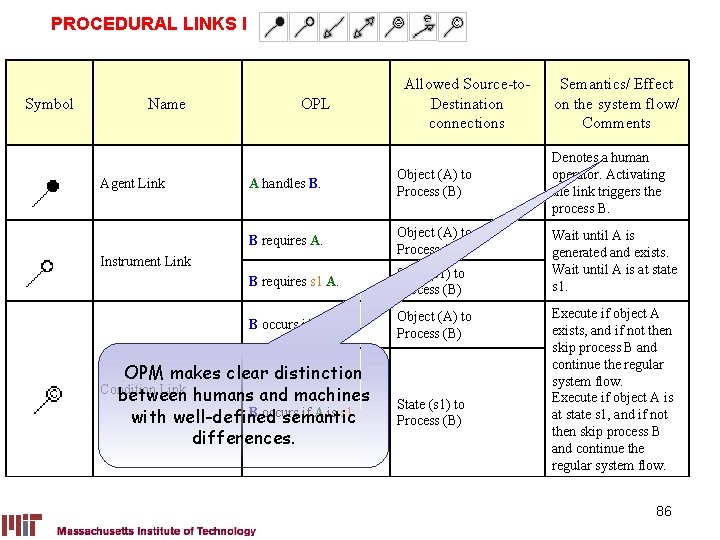
PROCEDURAL LINKS I Symbol Name Agent Link OPL Allowed Source-to. Destination connections A handles B. Object (A) to Process (B) B requires A. Object (A) to Process (B) B requires s 1 A. State (s 1) to Process (B) B occurs if A exists. Object (A) to Process (B) Instrument Link OPM makes clear distinction Condition Link between humans and machines B occurs if A is s 1. with well-defined semantic differences. State (s 1) to Process (B) Semantics/ Effect on the system flow/ Comments Denotes a human operator. Activating the link triggers the process B. Wait until A is generated and exists. Wait until A is at state s 1. Execute if object A exists, and if not then skip process B and continue the regular system flow. Execute if object A is at state s 1, and if not then skip process B and continue the regular system flow. 86
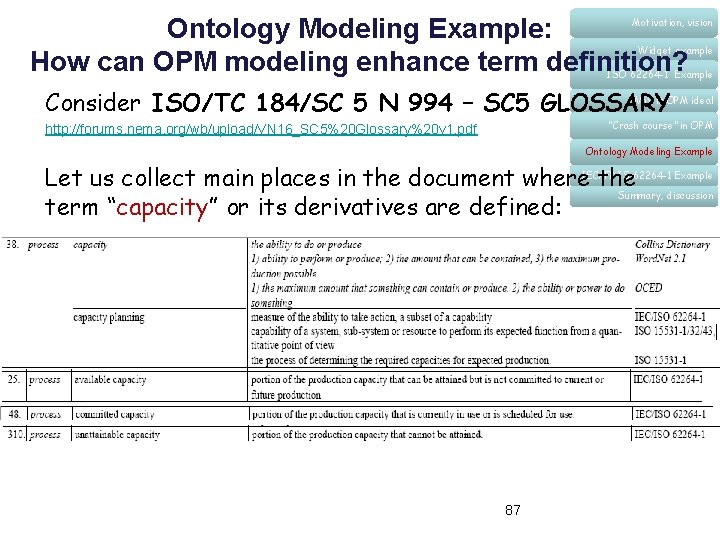
Ontology Modeling Example: How can OPM modeling enhance term definition? Motivation, vision Widget example ISO 62264 -1 Example Why is OPM ideal Consider ISO/TC 184/SC 5 N 994 – SC 5 GLOSSARY “Crash course” in OPM http: //forums. nema. org/wb/upload/VN 16_SC 5%20 Glossary%20 v 1. pdf Ontology Modeling Example Let us collect main places in the document where. IEC/FDIS the 62264 -1 Example Summary, discussion term “capacity” or its derivatives are defined: 87
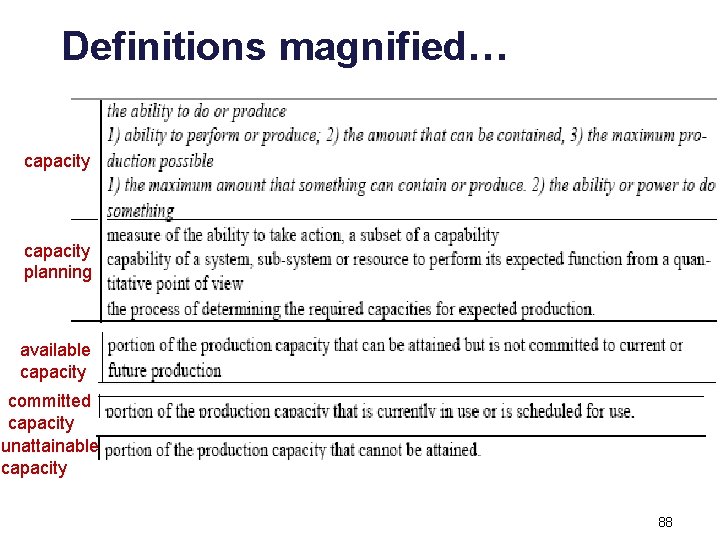
Definitions magnified… capacity planning available capacity committed capacity unattainable capacity 88
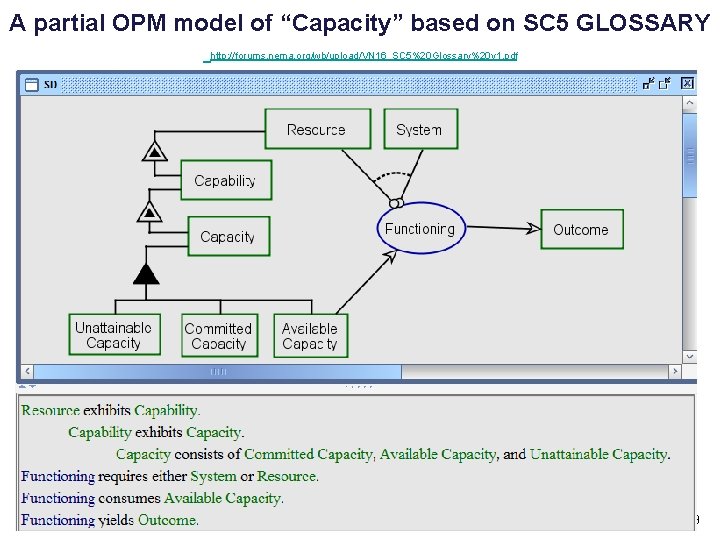
A partial OPM model of “Capacity” based on SC 5 GLOSSARY http: //forums. nema. org/wb/upload/VN 16_SC 5%20 Glossary%20 v 1. pdf 89

Capacity vs. Capacity Planning definition The definitions of Capacity and Capacity Planning: • ISO 15531 -1/32/43: “capability of a system or resource to perform its expected function” – this is the object Capacity • ISO 15531: “the process of determining the required capacities for expected production. ” – this is the process Capacity Planning • This becomes clear when we model Capacity Planning: 90
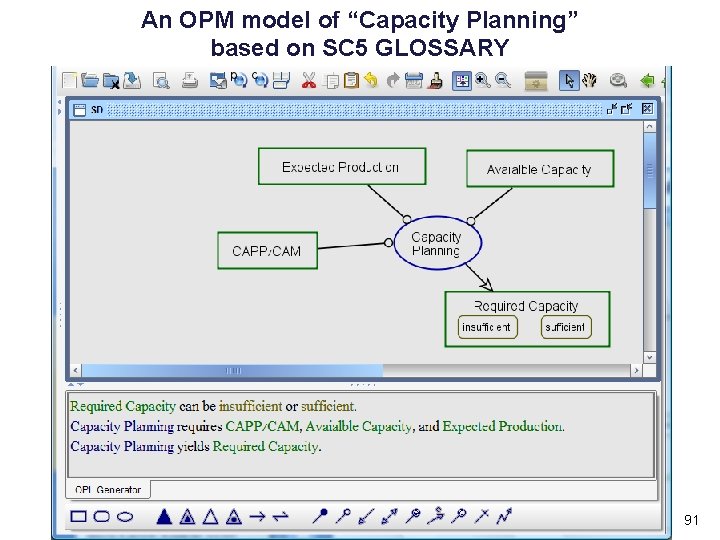
An OPM model of “Capacity Planning” based on SC 5 GLOSSARY 91
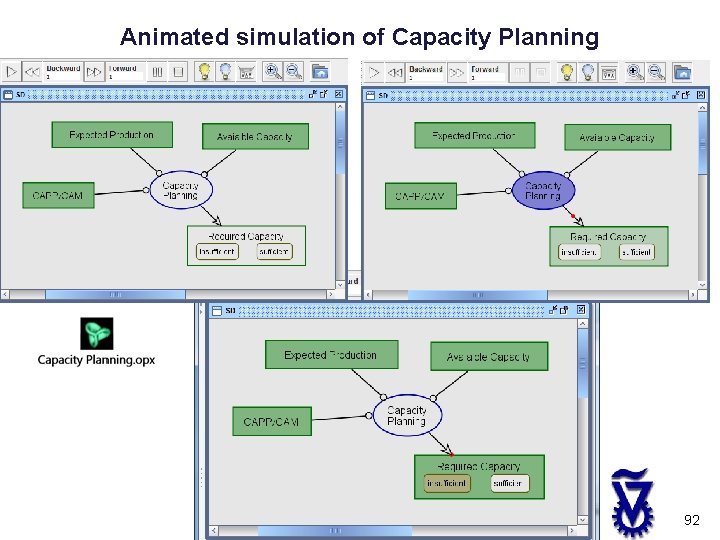
Animated simulation of Capacity Planning 92
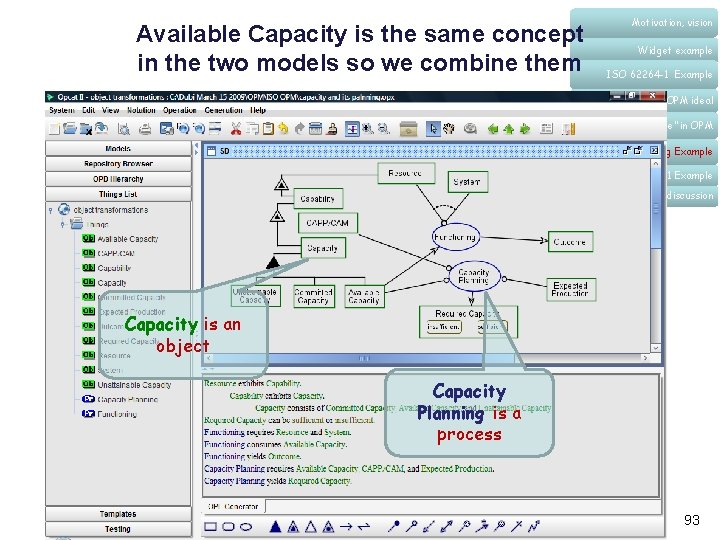
Available Capacity is the same concept in the two models so we combine them Motivation, vision Widget example ISO 62264 -1 Example Why is OPM ideal “Crash course” in OPM Ontology Modeling Example IEC/FDIS 62264 -1 Example Summary, discussion Capacity is an object Capacity Planning is a process 93
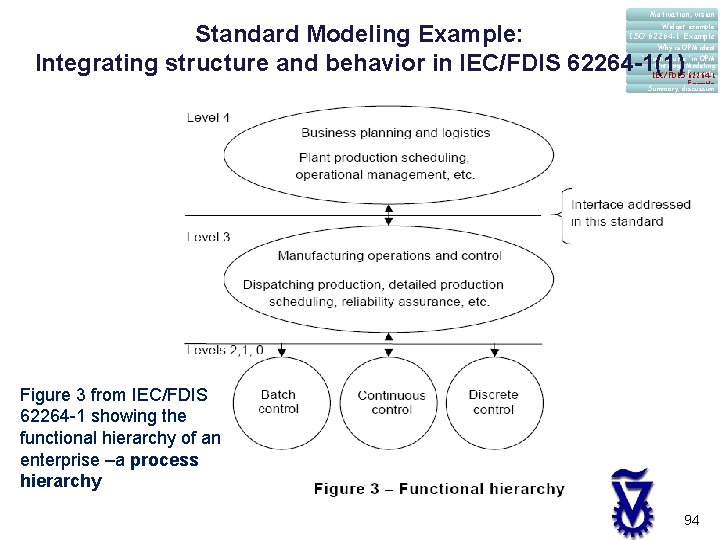
Motivation, vision Standard Modeling Example: Integrating structure and behavior in IEC/FDIS 62264 -1(1) Widget example ISO 62264 -1 Example Why is OPM ideal “Crash course” in OPM Ontology Modeling Example IEC/FDIS 62264 -1 Example Summary, discussion Figure 3 from IEC/FDIS 62264 -1 showing the functional hierarchy of an enterprise –a process hierarchy 94
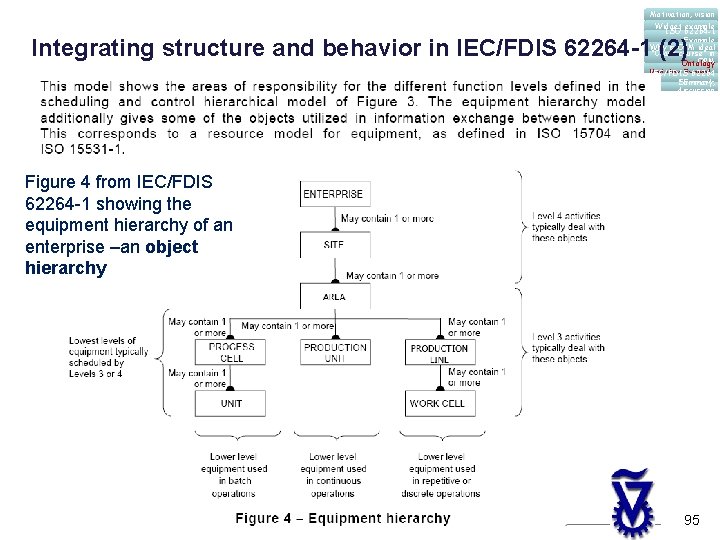
Motivation, vision Widget example ISO 62264 -1 Example Why is OPM ideal “Crash course” in OPM Ontology Modeling Example IEC/FDIS 62264 -1 Summary, Example discussion Integrating structure and behavior in IEC/FDIS 62264 -1 (2) Figure 4 from IEC/FDIS 62264 -1 showing the equipment hierarchy of an enterprise –an object hierarchy 95
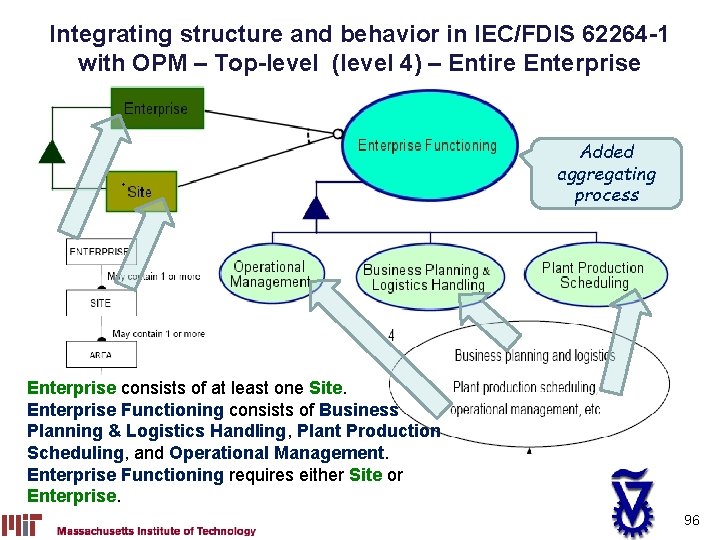
Integrating structure and behavior in IEC/FDIS 62264 -1 with OPM – Top-level (level 4) – Entire Enterprise Added aggregating process Enterprise consists of at least one Site. Enterprise Functioning consists of Business Planning & Logistics Handling, Plant Production Scheduling, and Operational Management. Enterprise Functioning requires either Site or Enterprise. 96
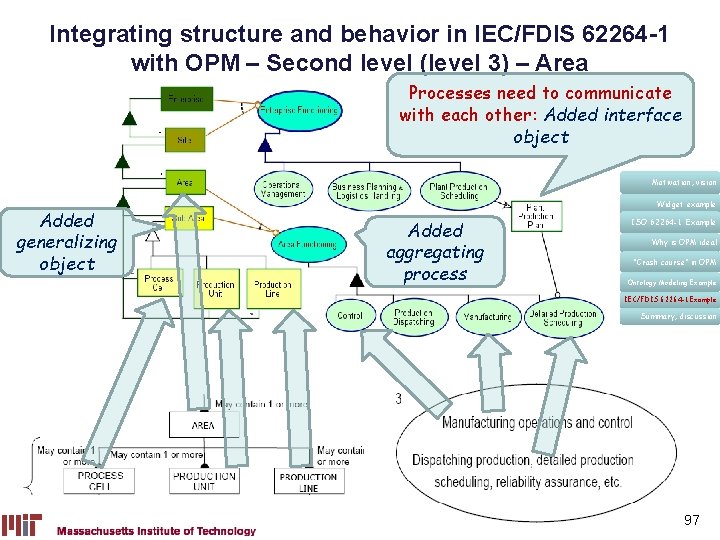
Integrating structure and behavior in IEC/FDIS 62264 -1 with OPM – Second level (level 3) – Area Processes need to communicate with each other: Added interface object Motivation, vision Added generalizing object Widget example Added aggregating process ISO 62264 -1 Example Why is OPM ideal “Crash course” in OPM Ontology Modeling Example IEC/FDIS 62264 -1 Example Summary, discussion 97
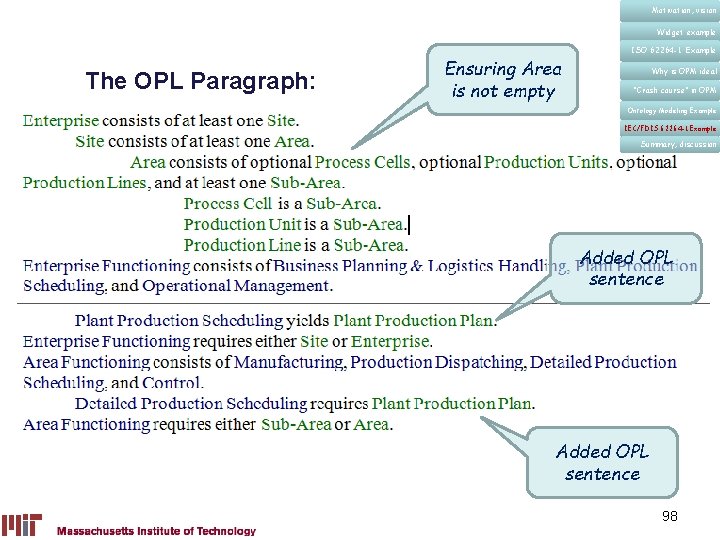
Motivation, vision Widget example The OPL Paragraph: Ensuring Area is not empty ISO 62264 -1 Example Why is OPM ideal “Crash course” in OPM Ontology Modeling Example IEC/FDIS 62264 -1 Example Summary, discussion Added OPL sentence 98
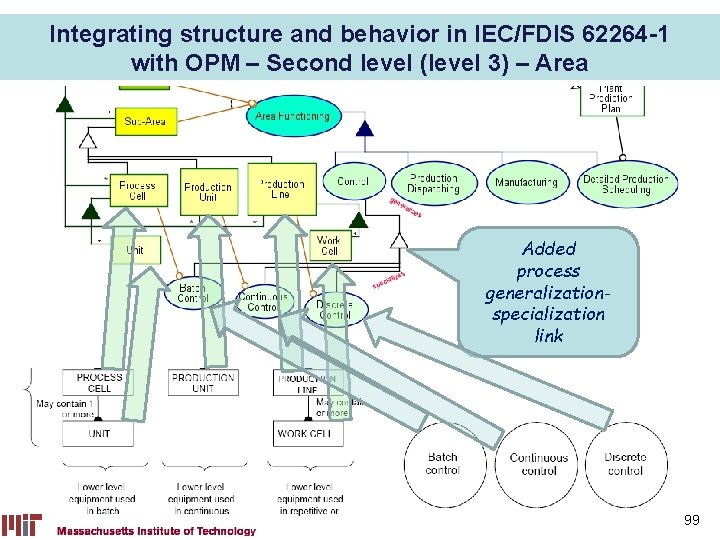
Integrating structure and behavior in IEC/FDIS 62264 -1 with OPM – Second level (level 3) – Area Added process generalizationspecialization link 99
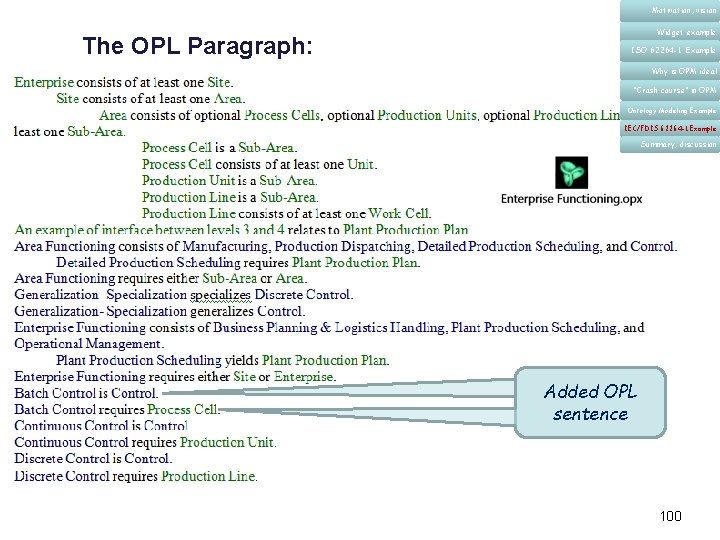
Motivation, vision The OPL Paragraph: Widget example ISO 62264 -1 Example Why is OPM ideal “Crash course” in OPM Ontology Modeling Example IEC/FDIS 62264 -1 Example Summary, discussion Added OPL sentence 100
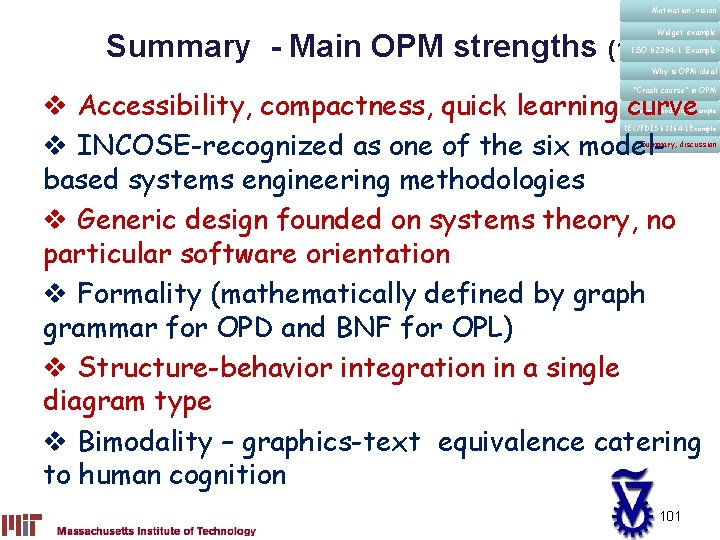
Motivation, vision Summary - Main OPM strengths (1) Widget example ISO 62264 -1 Example Why is OPM ideal v Accessibility, compactness, quick learning curve v INCOSE-recognized as one of the six modelbased systems engineering methodologies v Generic design founded on systems theory, no particular software orientation v Formality (mathematically defined by graph grammar for OPD and BNF for OPL) v Structure-behavior integration in a single diagram type v Bimodality – graphics-text equivalence catering to human cognition “Crash course” in OPM Ontology Modeling Example IEC/FDIS 62264 -1 Example Summary, discussion 101
Motivation, vision Summary - Main OPM strengths (2) Widget example ISO 62264 -1 Example Why is OPM ideal v Executability, animated simulation, verifiability v Exceptions modeling – time, resources (did not have time to show) v. Views generation ability (did not have time to show) v XML based (did not have time to show) v Automatically generates Web documentation, XML, JAVA code (did not have time to show) v Strong commercially-available tool support for client-server-based enterprise-wide collaboration, policy setting, versioning, templates… “Crash course” in OPM Ontology Modeling Example IEC/FDIS 62264 -1 Example Summary, discussion 102
Motivation, vision Discussion Widget example ISO 62264 -1 Example Why is OPM ideal v I have presented a proposal to adopt OPM as the modeling language for the various enterpriserelated standards ISO is developing and evolving. v I hope I have shown that OPM perfectly meets all the requirements set forth and needed for a modeling language for this purpose. v Main favorable points of OPM that make it especially suited for this urgent modeling need have been presented. v Would love to hear your opinion. “Crash course” in OPM Ontology Modeling Example IEC/FDIS 62264 -1 Example Summary, discussion 103
Motivation, vision Widget example ISO 62264 -1 Example Why is OPM ideal “Crash course” in OPM Discussion? Ontology Modeling Example IEC/FDIS 62264 -1 Example Summary, discussion Questions? Contact: Dov Dori dori@mit. edu 104
Some Background From: Sent: To: Subject: Attachments: Richard Martin [richardm@tinwisle. com] Dec 30 12: 05 2008 Dov Dori SC 5 Plenary demonstration Dori. Suggestion. doc Dov, Below you will find the very brief notes that I took during the discussion of your GERAM Generalised Enterprise-Reference Architecture and Methodologies model work. I did not capture the exchange as we worked to map your figures to our own understanding of GERAM. Attached is a further discussion concerning a possible SC 5 Plenary presentation. I look forward to continuing our discussion. Cheers, Richard Friday, Nov. 14, 2008 Afternoon session - Dov Dori OPM presentation and discussion R. M. - This is a brief submission from Dov Dori, which is an attempt to capture the introductory portions of GERAM into an OPM based model. We can think of this as an alternative to the UML-based model we have been discussing. It is another representational notation that is now used by several universities and industrial users. The presentation is in the form of a document with a couple of OPM graphic figures and a textual rendition of those figures. He has also included a dictionary for the elements identified. I believe all of this is generated by a tool set that supports OPM use. O. N. - While I do not understand the entire notation, it appears that he has not interpreted the standard as I would expect. P. B. - We have already talked about the need to revise GERAM to clarify the content and improve its usability. It is interesting to see how someone who has not been involved models the GERAM content. R. M. - I have been discussing with him the possibility of a presentation to SC 5 that includes using the simulation capabilities that are build into OPM, I believe using a product called OPCAT.
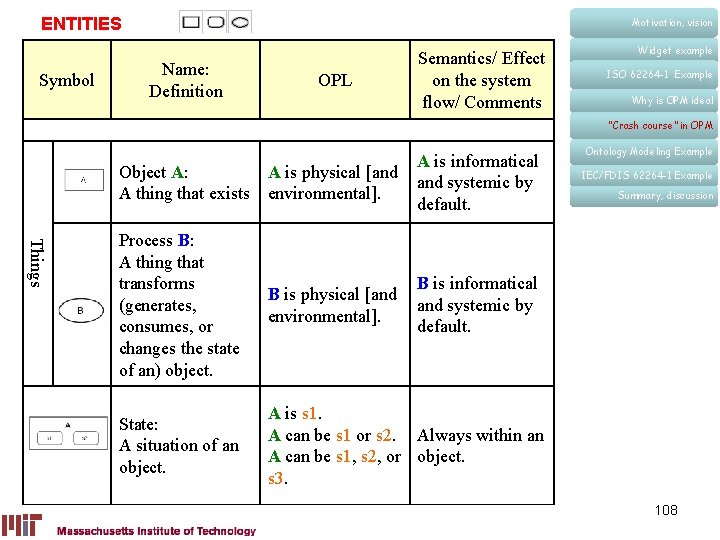
ENTITIES Symbol Motivation, vision Name: Definition OPL Semantics/ Effect on the system flow/ Comments Widget example ISO 62264 -1 Example Why is OPM ideal “Crash course” in OPM A is informatical Object A: A is physical [and systemic by A thing that exists environmental]. default. Things Process B: A thing that transforms (generates, consumes, or changes the state of an) object. B is informatical B is physical [and systemic by environmental]. default. State: A situation of an object. A is s 1. A can be s 1 or s 2. Always within an A can be s 1, s 2, or object. s 3. Ontology Modeling Example IEC/FDIS 62264 -1 Example Summary, discussion 108
- Slides: 107