
Model Task 2 Calculating CAPE and CIN ATM

- Slides: 12
Model Task #2: Calculating CAPE and CIN ATM 562 Fall 2018 Fovell (see course notes, Chapter 10) 1
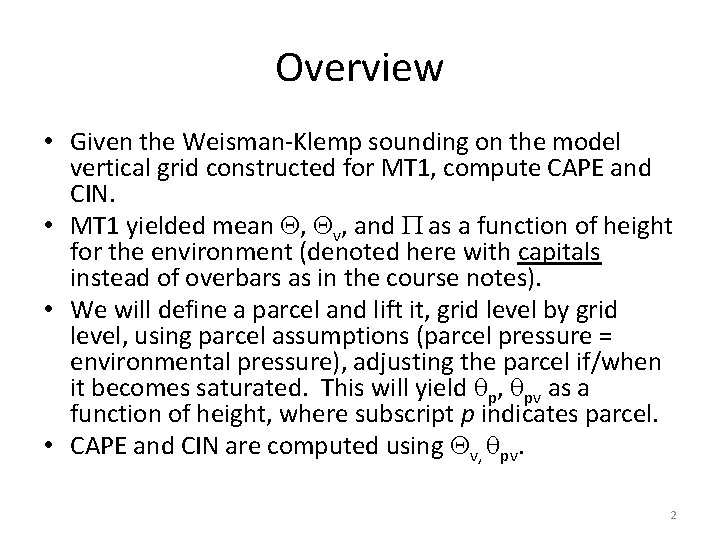
Overview • Given the Weisman-Klemp sounding on the model vertical grid constructed for MT 1, compute CAPE and CIN. • MT 1 yielded mean Q, Qv, and P as a function of height for the environment (denoted here with capitals instead of overbars as in the course notes). • We will define a parcel and lift it, grid level by grid level, using parcel assumptions (parcel pressure = environmental pressure), adjusting the parcel if/when it becomes saturated. This will yield qp, qpv as a function of height, where subscript p indicates parcel. • CAPE and CIN are computed using Qv, qpv. 2
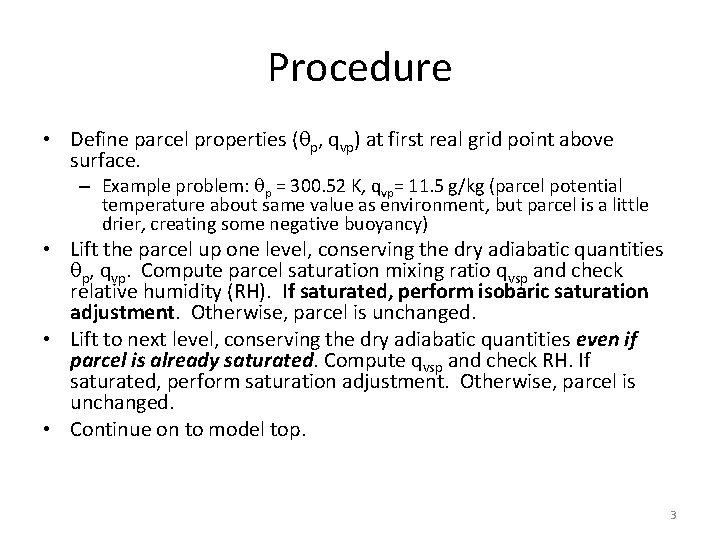
Procedure • Define parcel properties (qp, qvp) at first real grid point above surface. – Example problem: qp = 300. 52 K, qvp= 11. 5 g/kg (parcel potential temperature about same value as environment, but parcel is a little drier, creating some negative buoyancy) • Lift the parcel up one level, conserving the dry adiabatic quantities qp, qvp. Compute parcel saturation mixing ratio qvsp and check relative humidity (RH). If saturated, perform isobaric saturation adjustment. Otherwise, parcel is unchanged. • Lift to next level, conserving the dry adiabatic quantities even if parcel is already saturated. Compute qvsp and check RH. If saturated, perform saturation adjustment. Otherwise, parcel is unchanged. • Continue on to model top. 3
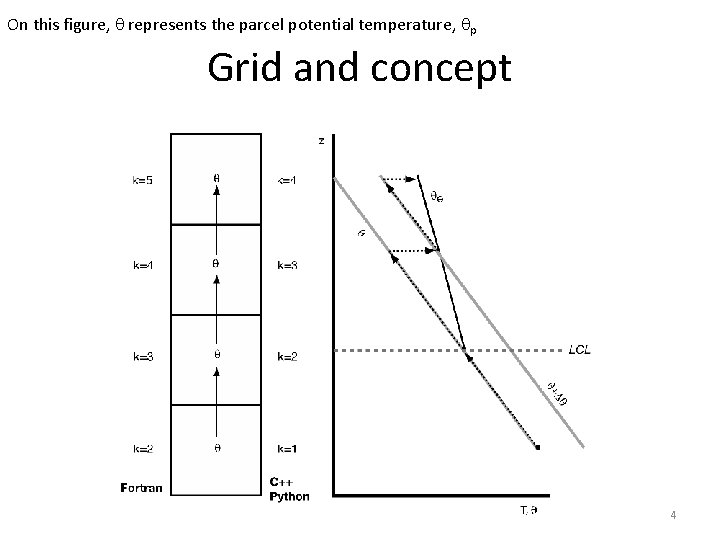
On this figure, q represents the parcel potential temperature, qp Grid and concept 4
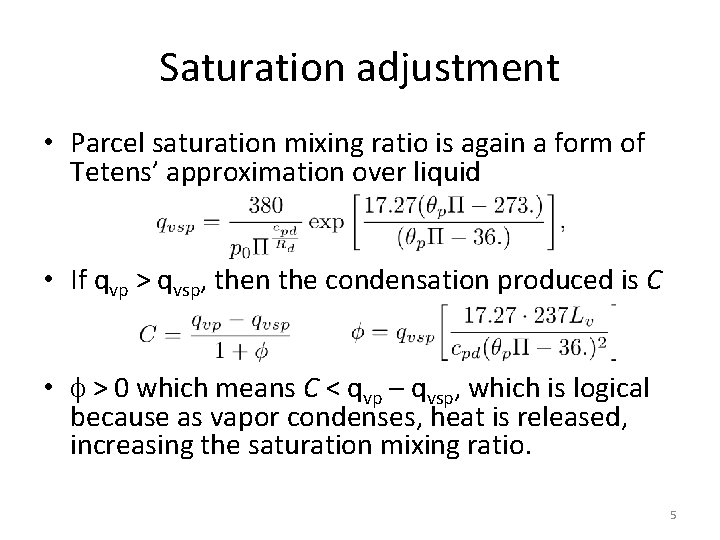
Saturation adjustment • Parcel saturation mixing ratio is again a form of Tetens’ approximation over liquid • If qvp > qvsp, then the condensation produced is C • f > 0 which means C < qvp – qvsp, which is logical because as vapor condenses, heat is released, increasing the saturation mixing ratio. 5
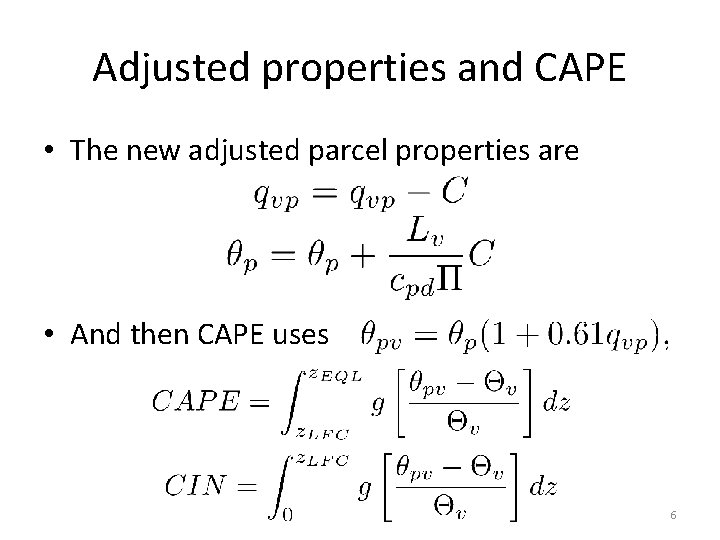
Adjusted properties and CAPE • The new adjusted parcel properties are • And then CAPE uses 6
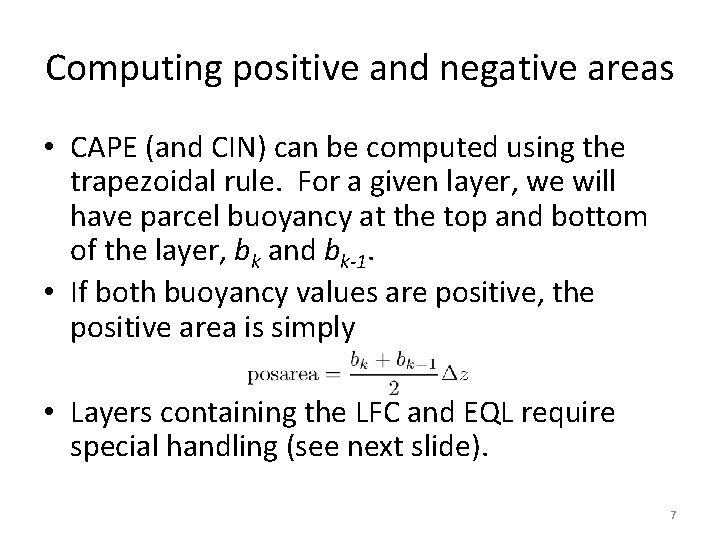
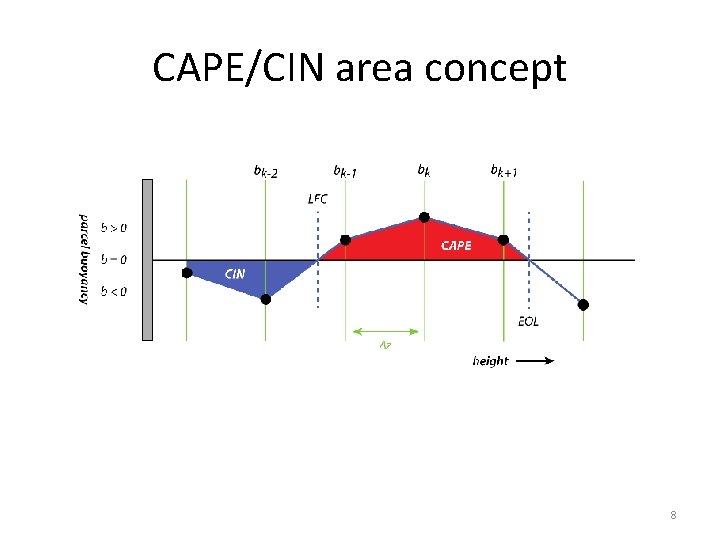
Computing positive and negative areas • CAPE (and CIN) can be computed using the trapezoidal rule. For a given layer, we will have parcel buoyancy at the top and bottom of the layer, bk and bk-1. • If both buoyancy values are positive, the positive area is simply • Layers containing the LFC and EQL require special handling (see next slide). 7
CAPE/CIN area concept 8
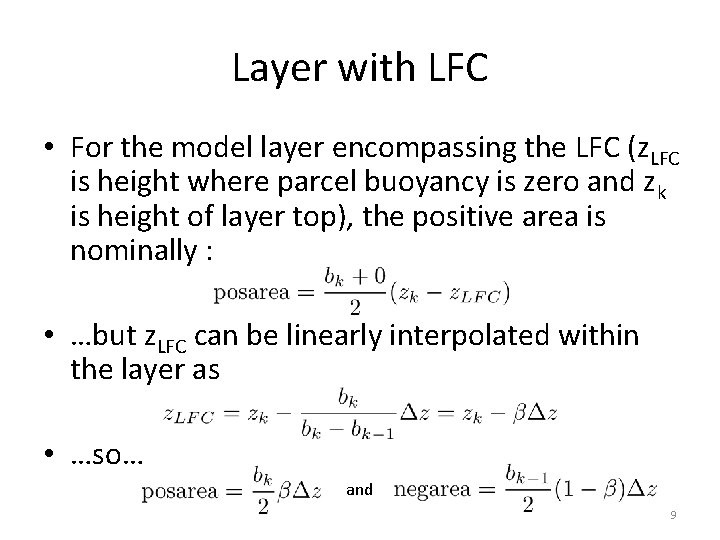
Layer with LFC • For the model layer encompassing the LFC (z. LFC is height where parcel buoyancy is zero and zk is height of layer top), the positive area is nominally : • …but z. LFC can be linearly interpolated within the layer as • …so… and 9
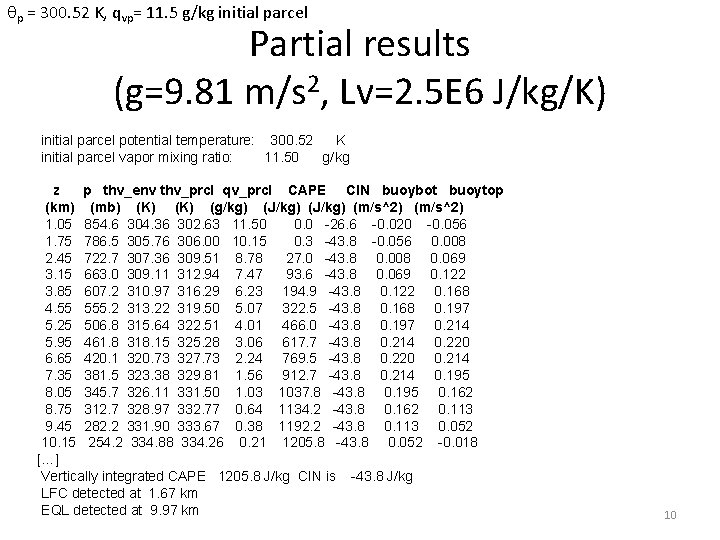
qp = 300. 52 K, qvp= 11. 5 g/kg initial parcel Partial results (g=9. 81 m/s 2, Lv=2. 5 E 6 J/kg/K) initial parcel potential temperature: 300. 52 K initial parcel vapor mixing ratio: 11. 50 g/kg z p thv_env thv_prcl qv_prcl CAPE CIN buoybot buoytop (km) (mb) (K) (g/kg) (J/kg) (m/s^2) 1. 05 854. 6 304. 36 302. 63 11. 50 0. 0 -26. 6 -0. 020 -0. 056 1. 75 786. 5 305. 76 306. 00 10. 15 0. 3 -43. 8 -0. 056 0. 008 2. 45 722. 7 307. 36 309. 51 8. 78 27. 0 -43. 8 0. 008 0. 069 3. 15 663. 0 309. 11 312. 94 7. 47 93. 6 -43. 8 0. 069 0. 122 3. 85 607. 2 310. 97 316. 29 6. 23 194. 9 -43. 8 0. 122 0. 168 4. 55 555. 2 313. 22 319. 50 5. 07 322. 5 -43. 8 0. 168 0. 197 5. 25 506. 8 315. 64 322. 51 4. 01 466. 0 -43. 8 0. 197 0. 214 5. 95 461. 8 318. 15 325. 28 3. 06 617. 7 -43. 8 0. 214 0. 220 6. 65 420. 1 320. 73 327. 73 2. 24 769. 5 -43. 8 0. 220 0. 214 7. 35 381. 5 323. 38 329. 81 1. 56 912. 7 -43. 8 0. 214 0. 195 8. 05 345. 7 326. 11 331. 50 1. 03 1037. 8 -43. 8 0. 195 0. 162 8. 75 312. 7 328. 97 332. 77 0. 64 1134. 2 -43. 8 0. 162 0. 113 9. 45 282. 2 331. 90 333. 67 0. 38 1192. 2 -43. 8 0. 113 0. 052 10. 15 254. 2 334. 88 334. 26 0. 21 1205. 8 -43. 8 0. 052 -0. 018 […] Vertically integrated CAPE 1205. 8 J/kg CIN is -43. 8 J/kg LFC detected at 1. 67 km EQL detected at 9. 97 km 10
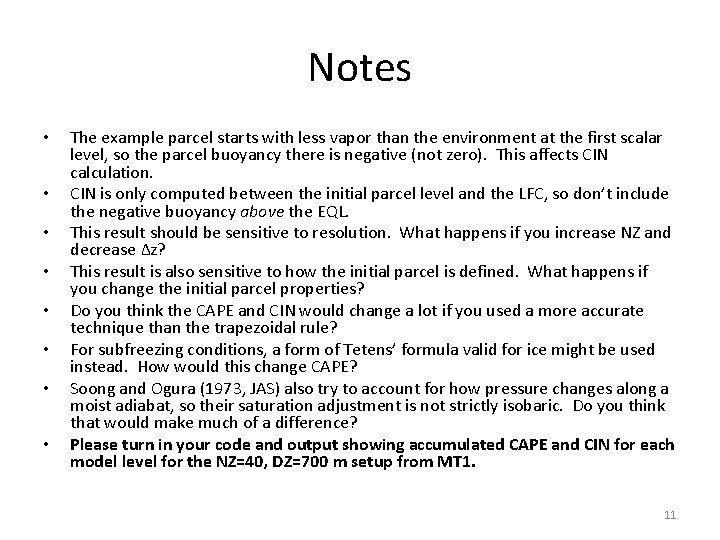
Notes • • The example parcel starts with less vapor than the environment at the first scalar level, so the parcel buoyancy there is negative (not zero). This affects CIN calculation. CIN is only computed between the initial parcel level and the LFC, so don’t include the negative buoyancy above the EQL. This result should be sensitive to resolution. What happens if you increase NZ and decrease ∆z? This result is also sensitive to how the initial parcel is defined. What happens if you change the initial parcel properties? Do you think the CAPE and CIN would change a lot if you used a more accurate technique than the trapezoidal rule? For subfreezing conditions, a form of Tetens’ formula valid for ice might be used instead. How would this change CAPE? Soong and Ogura (1973, JAS) also try to account for how pressure changes along a moist adiabat, so their saturation adjustment is not strictly isobaric. Do you think that would make much of a difference? Please turn in your code and output showing accumulated CAPE and CIN for each model level for the NZ=40, DZ=700 m setup from MT 1. 11
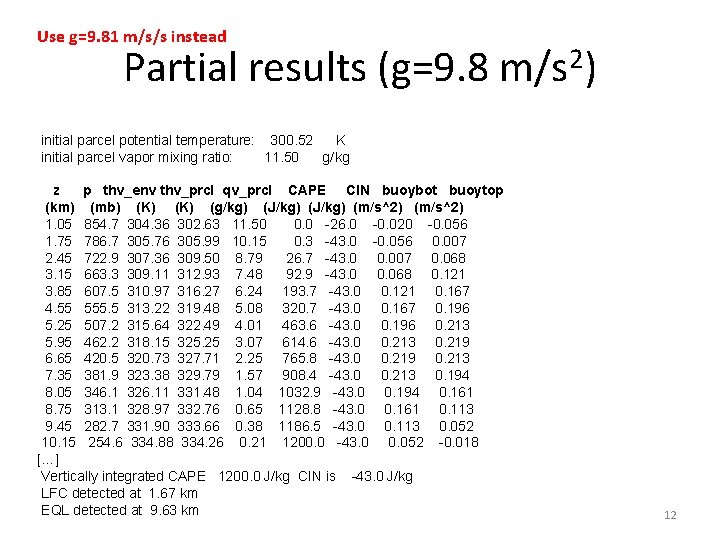
Use g=9. 81 m/s/s instead Partial results (g=9. 8 m/s 2) initial parcel potential temperature: 300. 52 K initial parcel vapor mixing ratio: 11. 50 g/kg z p thv_env thv_prcl qv_prcl CAPE CIN buoybot buoytop (km) (mb) (K) (g/kg) (J/kg) (m/s^2) 1. 05 854. 7 304. 36 302. 63 11. 50 0. 0 -26. 0 -0. 020 -0. 056 1. 75 786. 7 305. 76 305. 99 10. 15 0. 3 -43. 0 -0. 056 0. 007 2. 45 722. 9 307. 36 309. 50 8. 79 26. 7 -43. 0 0. 007 0. 068 3. 15 663. 3 309. 11 312. 93 7. 48 92. 9 -43. 0 0. 068 0. 121 3. 85 607. 5 310. 97 316. 27 6. 24 193. 7 -43. 0 0. 121 0. 167 4. 55 555. 5 313. 22 319. 48 5. 08 320. 7 -43. 0 0. 167 0. 196 5. 25 507. 2 315. 64 322. 49 4. 01 463. 6 -43. 0 0. 196 0. 213 5. 95 462. 2 318. 15 325. 25 3. 07 614. 6 -43. 0 0. 213 0. 219 6. 65 420. 5 320. 73 327. 71 2. 25 765. 8 -43. 0 0. 219 0. 213 7. 35 381. 9 323. 38 329. 79 1. 57 908. 4 -43. 0 0. 213 0. 194 8. 05 346. 1 326. 11 331. 48 1. 04 1032. 9 -43. 0 0. 194 0. 161 8. 75 313. 1 328. 97 332. 76 0. 65 1128. 8 -43. 0 0. 161 0. 113 9. 45 282. 7 331. 90 333. 66 0. 38 1186. 5 -43. 0 0. 113 0. 052 10. 15 254. 6 334. 88 334. 26 0. 21 1200. 0 -43. 0 0. 052 -0. 018 […] Vertically integrated CAPE 1200. 0 J/kg CIN is -43. 0 J/kg LFC detected at 1. 67 km EQL detected at 9. 63 km 12