
Model spread in the fast response of global
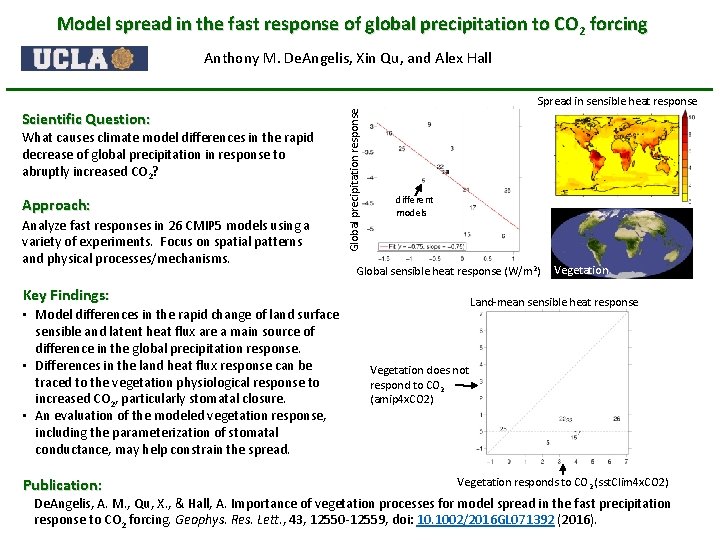
Model spread in the fast response of global precipitation to CO 2 forcing Anthony M. De. Angelis, Xin Qu, and Alex Hall Scientific Question: What causes climate model differences in the rapid decrease of global precipitation in response to abruptly increased CO 2? Approach: Analyze fast responses in 26 CMIP 5 models using a variety of experiments. Focus on spatial patterns and physical processes/mechanisms. Global precipitation response Spread in sensible heat response different models Global sensible heat response (W/m 2) Key Findings: • Model differences in the rapid change of land surface sensible and latent heat flux are a main source of difference in the global precipitation response. • Differences in the land heat flux response can be traced to the vegetation physiological response to increased CO 2, particularly stomatal closure. • An evaluation of the modeled vegetation response, including the parameterization of stomatal conductance, may help constrain the spread. Publication: Vegetation Land-mean sensible heat response Vegetation does not respond to CO 2 (amip 4 x. CO 2) Vegetation responds to CO 2 (sst. Clim 4 x. CO 2) De. Angelis, A. M. , Qu, X. , & Hall, A. Importance of vegetation processes for model spread in the fast precipitation response to CO 2 forcing. Geophys. Res. Lett. , 43, 12550 -12559, doi: 10. 1002/2016 GL 071392 (2016).
- Slides: 1