
Model SelectionComparison David Benrimoh Rachel Bedder Expert Dr
Model Selection/Comparison David Benrimoh & Rachel Bedder Expert: Dr Michael Moutoussis Mf. D – 14/02/2018
Outline Frequentist Techniques • Introduction to Models • F test for General Linear Model (GLM) • Likelihood ratio test • Akaike Information Criterion (AIC) • Cross validation Bayesian Methods • Conjugate priors • Laplace’s method • Bayesian information criterion (BIC) • Sampling • Variational Bayes
All models are wrong, but some are useful Models are only useful because they are wrong
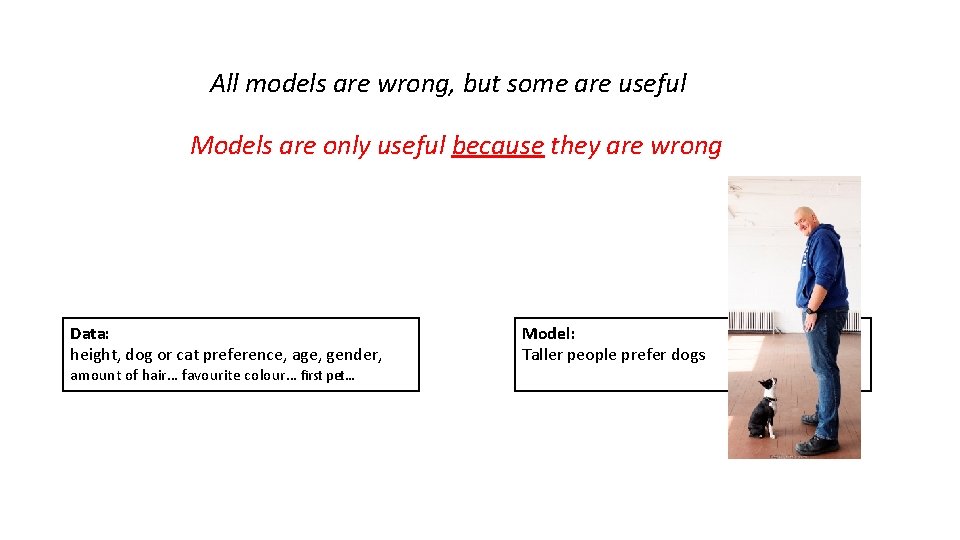
All models are wrong, but some are useful Models are only useful because they are wrong Data: height, dog or cat preference, age, gender, amount of hair… favourite colour… first pet… Model: Taller people prefer dogs
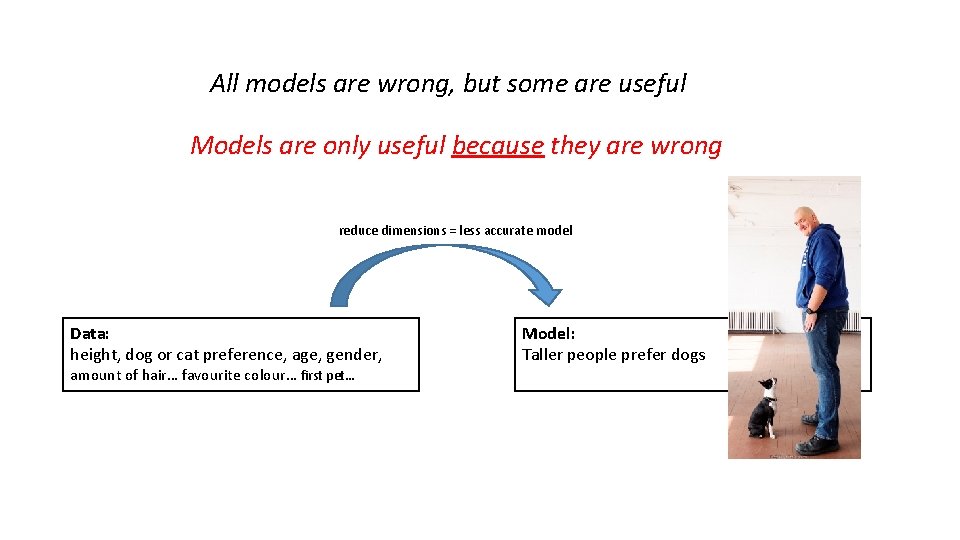
All models are wrong, but some are useful Models are only useful because they are wrong reduce dimensions = less accurate model Data: height, dog or cat preference, age, gender, amount of hair… favourite colour… first pet… Model: Taller people prefer dogs
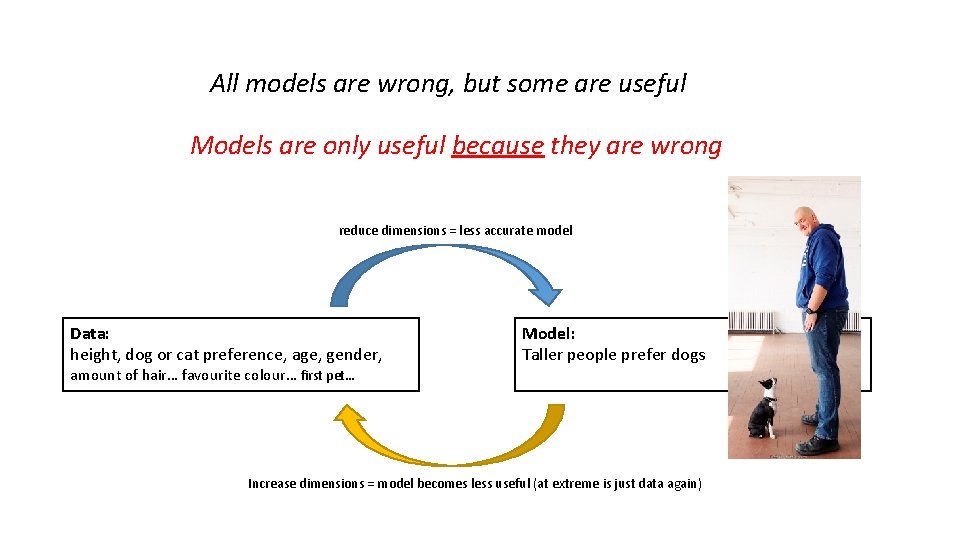
All models are wrong, but some are useful Models are only useful because they are wrong reduce dimensions = less accurate model Data: height, dog or cat preference, age, gender, amount of hair… favourite colour… first pet… Model: Taller people prefer dogs Increase dimensions = model becomes less useful (at extreme is just data again)
…but what really is a model?
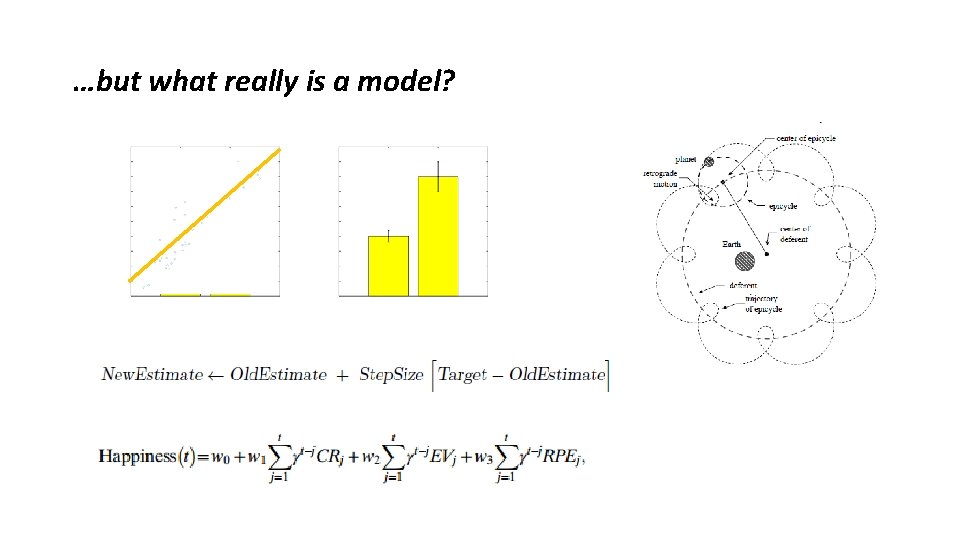
…but what really is a model?
Model fitting is not Model selection/comparison
Model fitting is not Model selection/comparison Model fitting: Tuning the presumed model best fit to the data. Finding parameters can be done analytically or using a parameter space search algorithm. Model selection: Evaluating the balance between goodness of fit and generalisability
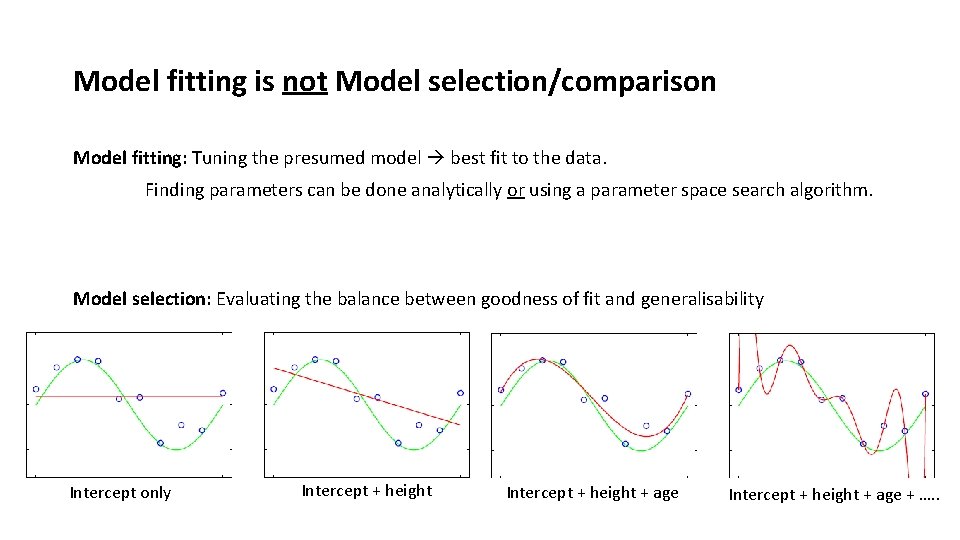
Model fitting is not Model selection/comparison Model fitting: Tuning the presumed model best fit to the data. Finding parameters can be done analytically or using a parameter space search algorithm. Model selection: Evaluating the balance between goodness of fit and generalisability Intercept only Intercept + height + age + …. .
Outline Frequentist Techniques • Introduction to Models • F test for General Linear Model (GLM) • Likelihood ratio test • Akaike Information Criterion (AIC) • Cross validation Bayesian Methods • Conjugate priors • Laplace’s method • Bayesian information criterion (BIC) • Sampling • Variational Bayes
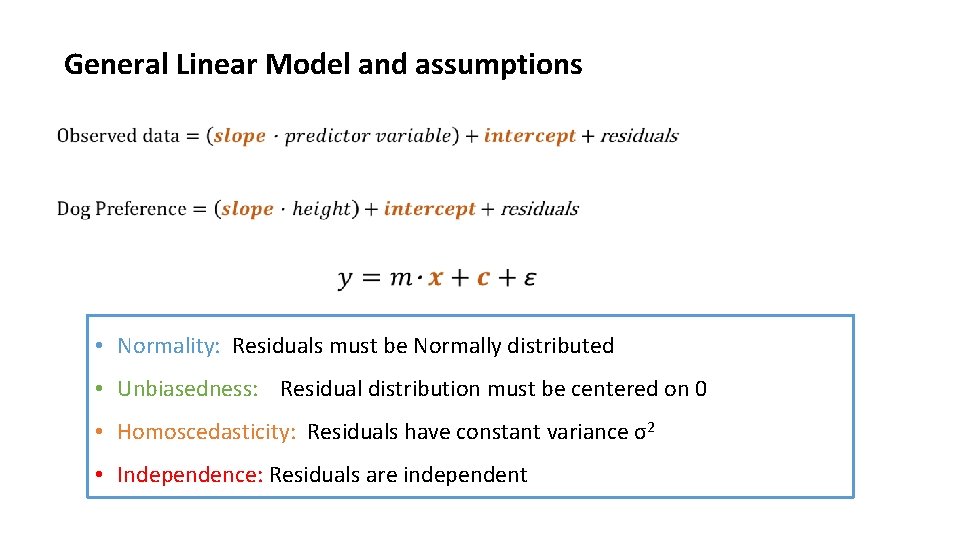
General Linear Model and assumptions • Normality: Residuals must be Normally distributed • Unbiasedness: Residual distribution must be centered on 0 • Homoscedasticity: Residuals have constant variance σ2 • Independence: Residuals are independent
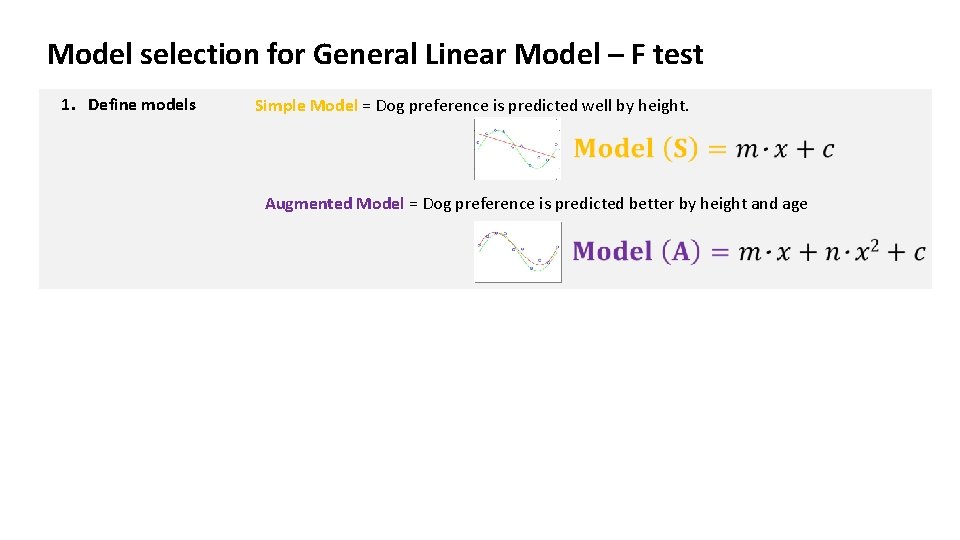
Model selection for General Linear Model – F test 1. Define models Simple Model = Dog preference is predicted well by height. Augmented Model = Dog preference is predicted better by height and age
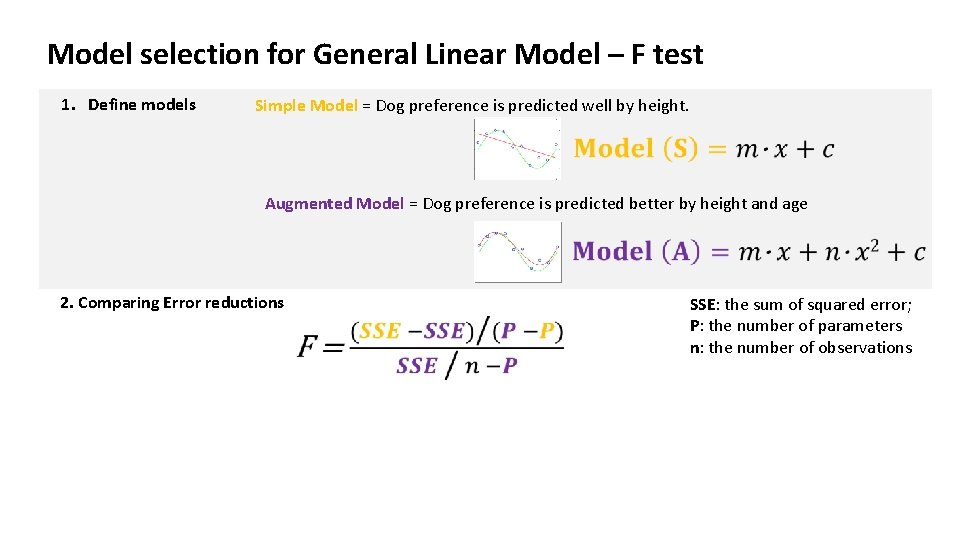
Model selection for General Linear Model – F test 1. Define models Simple Model = Dog preference is predicted well by height. Augmented Model = Dog preference is predicted better by height and age 2. Comparing Error reductions SSE: the sum of squared error; P: the number of parameters n: the number of observations
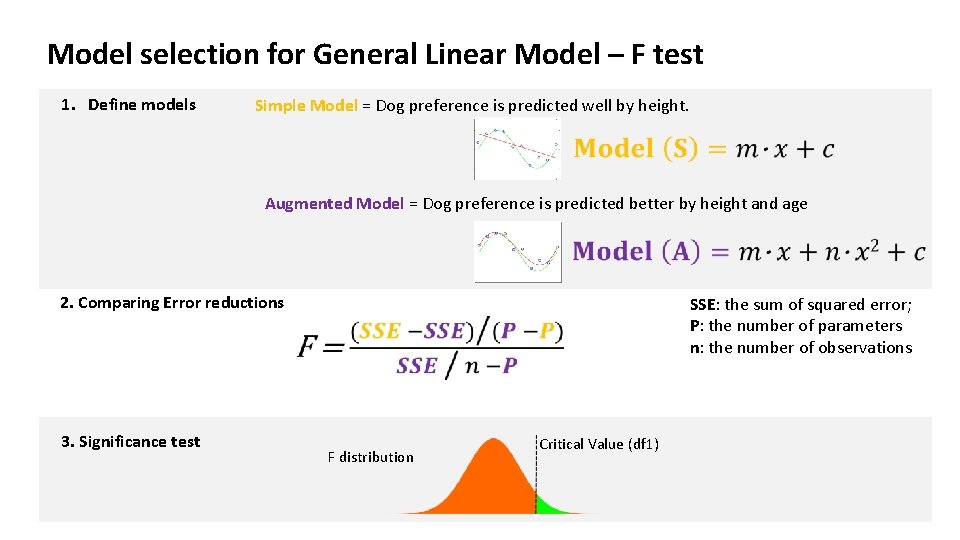
Model selection for General Linear Model – F test 1. Define models Simple Model = Dog preference is predicted well by height. Augmented Model = Dog preference is predicted better by height and age 2. Comparing Error reductions 3. Significance test SSE: the sum of squared error; P: the number of parameters n: the number of observations F distribution Critical Value (df 1)
Overfitting? What’s the problem?
Overfitting? What’s the problem? More parameters we have – the more variance in the data we will fit!
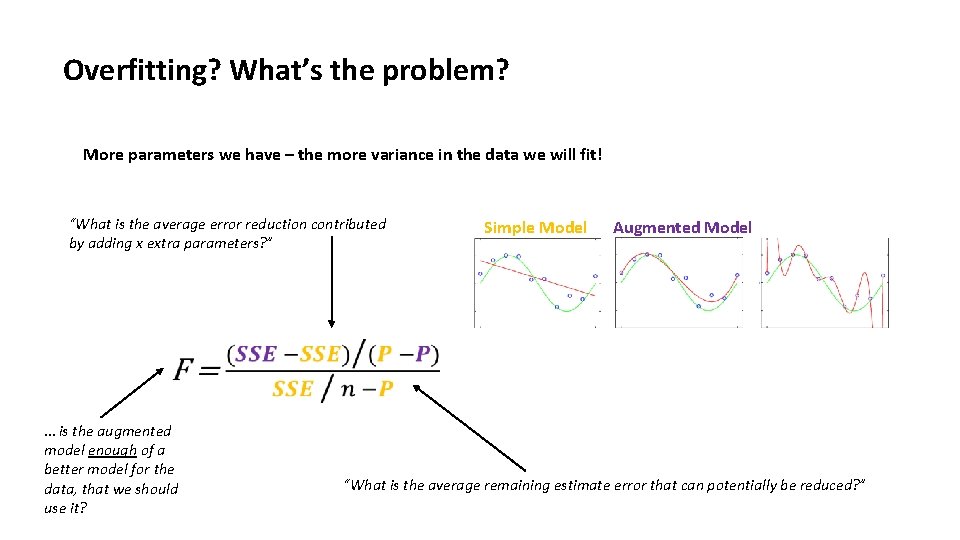
Overfitting? What’s the problem? More parameters we have – the more variance in the data we will fit! “What is the average error reduction contributed by adding x extra parameters? ” … is the augmented model enough of a better model for the data, that we should use it? Simple Model Augmented Model “What is the average remaining estimate error that can potentially be reduced? ”
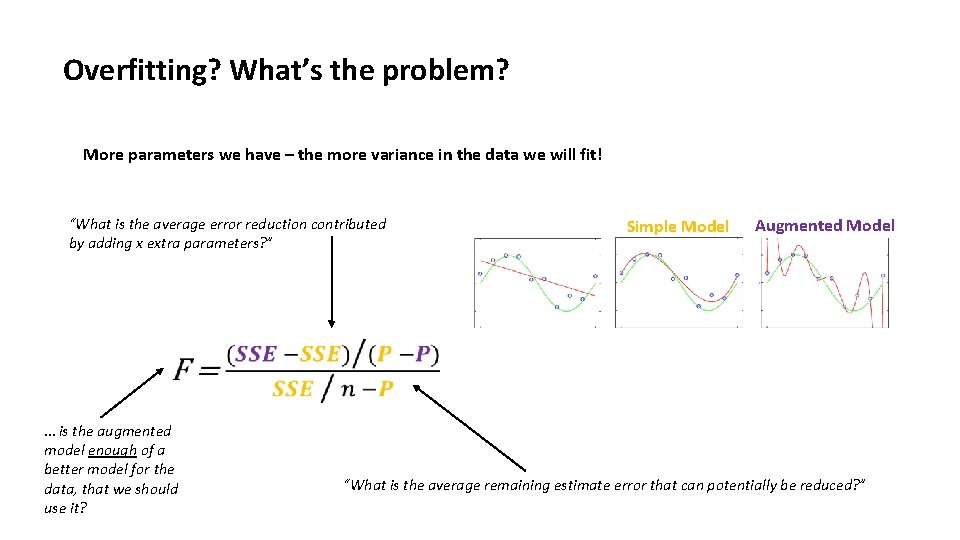
Overfitting? What’s the problem? More parameters we have – the more variance in the data we will fit! “What is the average error reduction contributed by adding x extra parameters? ” … is the augmented model enough of a better model for the data, that we should use it? Simple Model Augmented Model “What is the average remaining estimate error that can potentially be reduced? ”
Outline Frequentist Techniques • Introduction to Models • F test for General Linear Model (GLM) • Likelihood ratio test • Akaike Information Criterion (AIC) • Cross validation Bayesian Methods • Conjugate priors • Laplace’s method • Bayesian information criterion (BIC) • Sampling • Variational Bayes
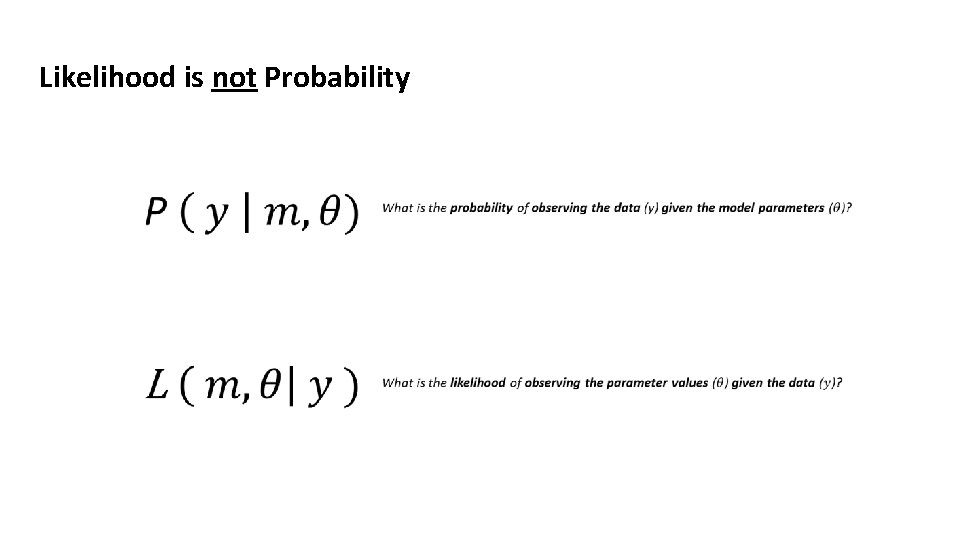
Likelihood is not Probability
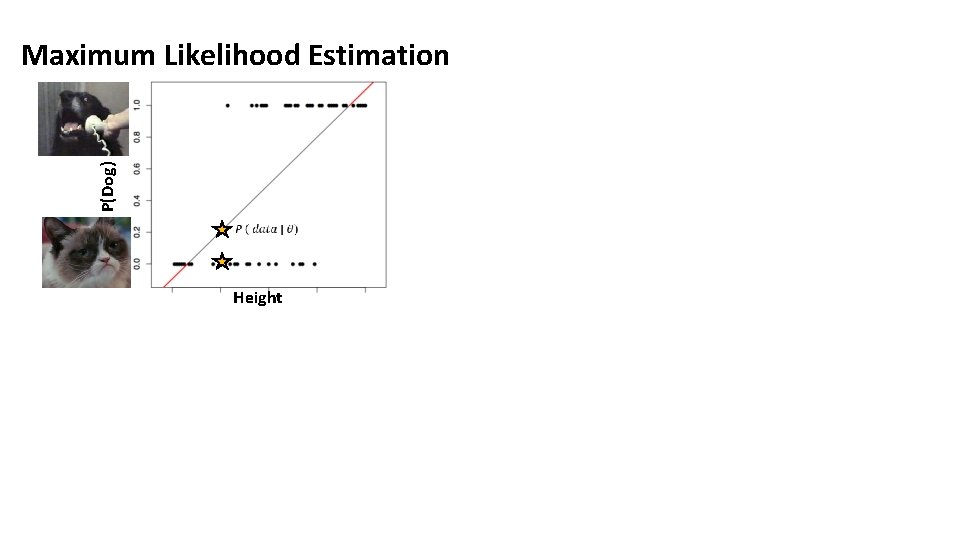
P(Dog) Maximum Likelihood Estimation Height
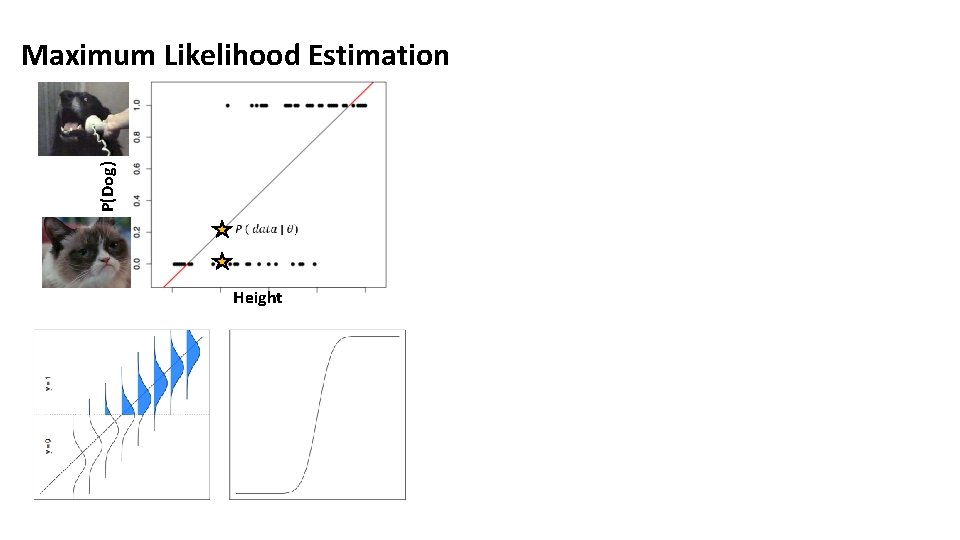
P(Dog) Maximum Likelihood Estimation Height
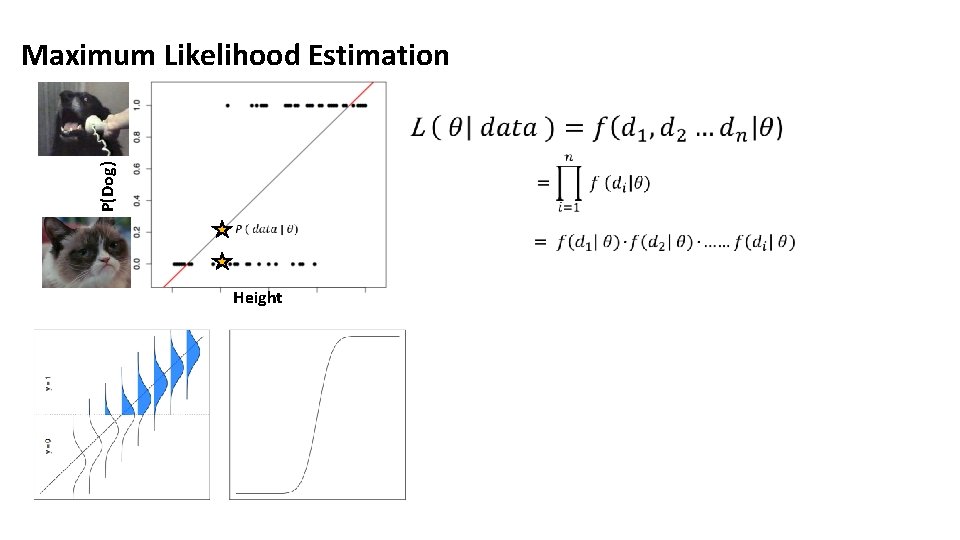
P(Dog) Maximum Likelihood Estimation Height
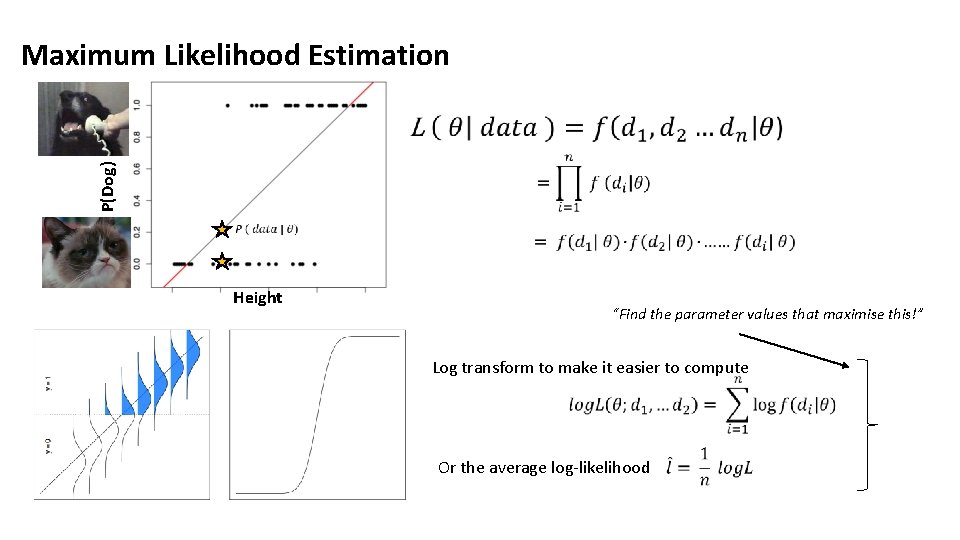
P(Dog) Maximum Likelihood Estimation Height “Find the parameter values that maximise this!” Log transform to make it easier to compute Or the average log-likelihood
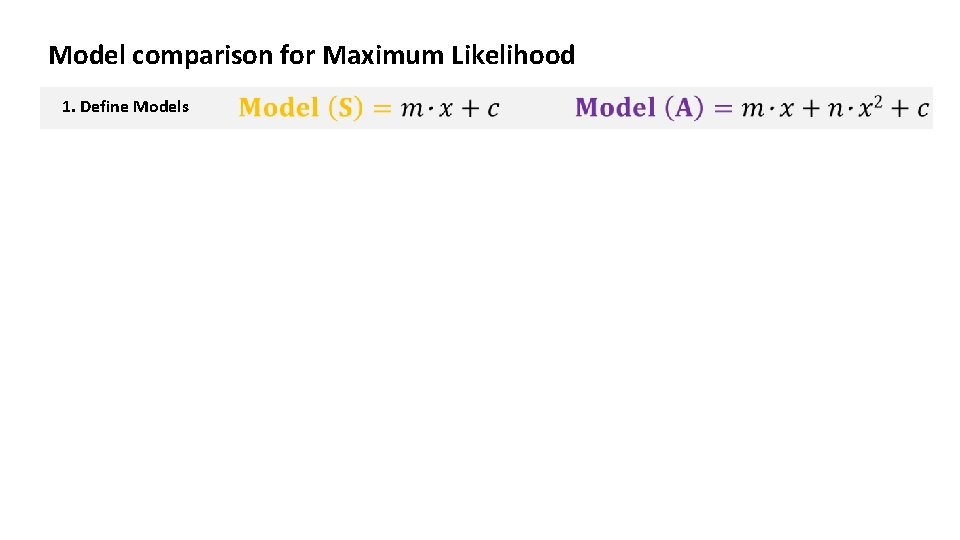
Model comparison for Maximum Likelihood 1. Define Models
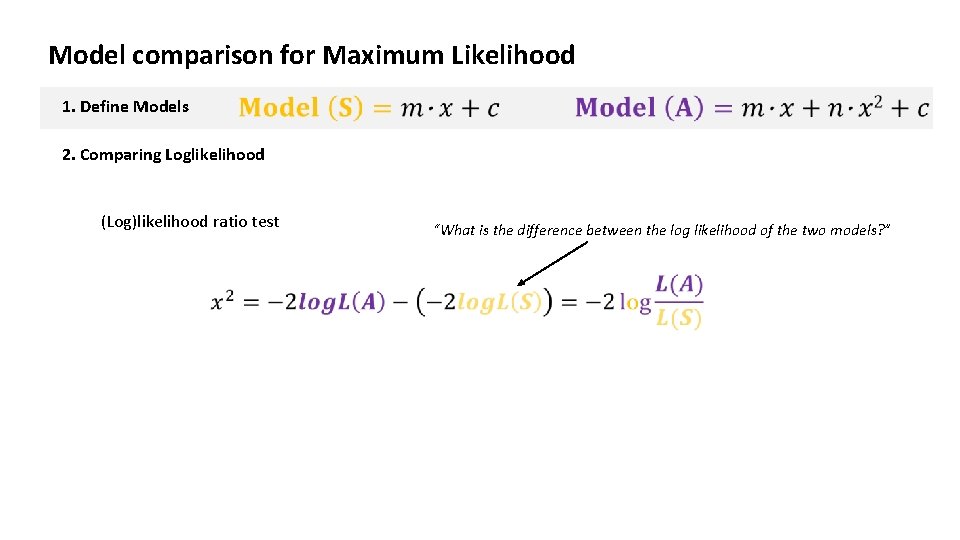
Model comparison for Maximum Likelihood 1. Define Models 2. Comparing Loglikelihood (Log)likelihood ratio test “What is the difference between the log likelihood of the two models? ”
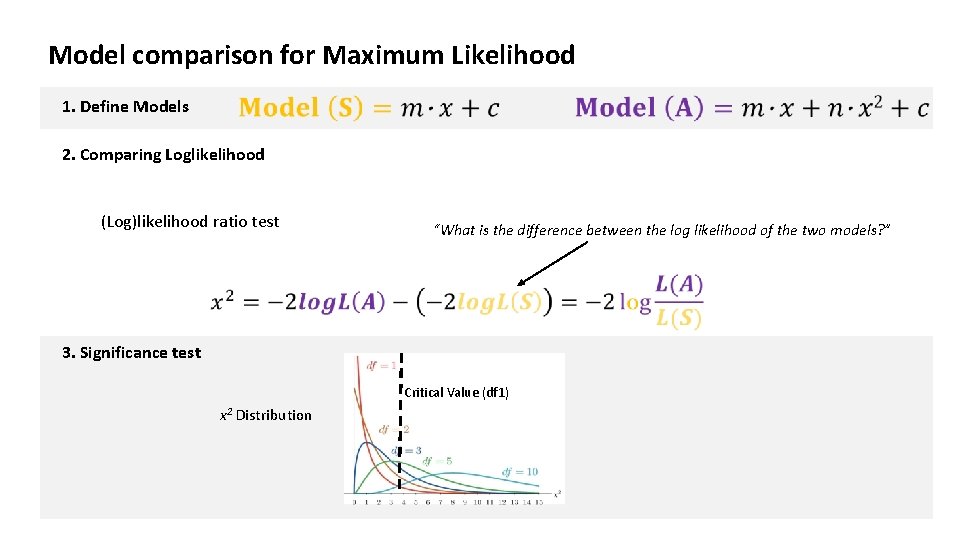
Model comparison for Maximum Likelihood 1. Define Models 2. Comparing Loglikelihood (Log)likelihood ratio test “What is the difference between the log likelihood of the two models? ” 3. Significance test Critical Value (df 1) x 2 Distribution
Outline Frequentist Techniques • Introduction to Models • F test for General Linear Model (GLM) • Likelihood ratio test • Akaike Information Criterion (AIC) • Cross validation Bayesian Methods • Conjugate priors • Laplace’s method • Bayesian information criterion (BIC) • Sampling • Variational Bayes
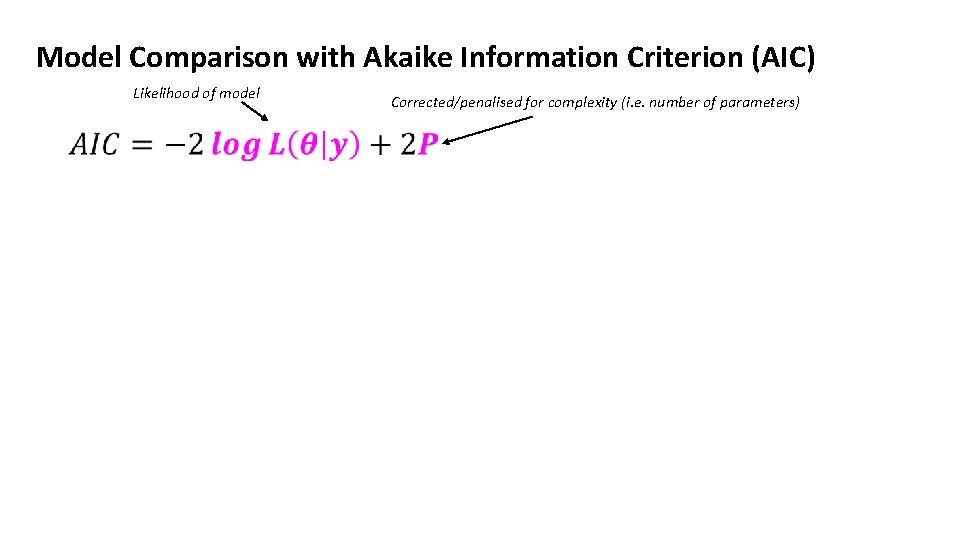
Model Comparison with Akaike Information Criterion (AIC) Likelihood of model Corrected/penalised for complexity (i. e. number of parameters)
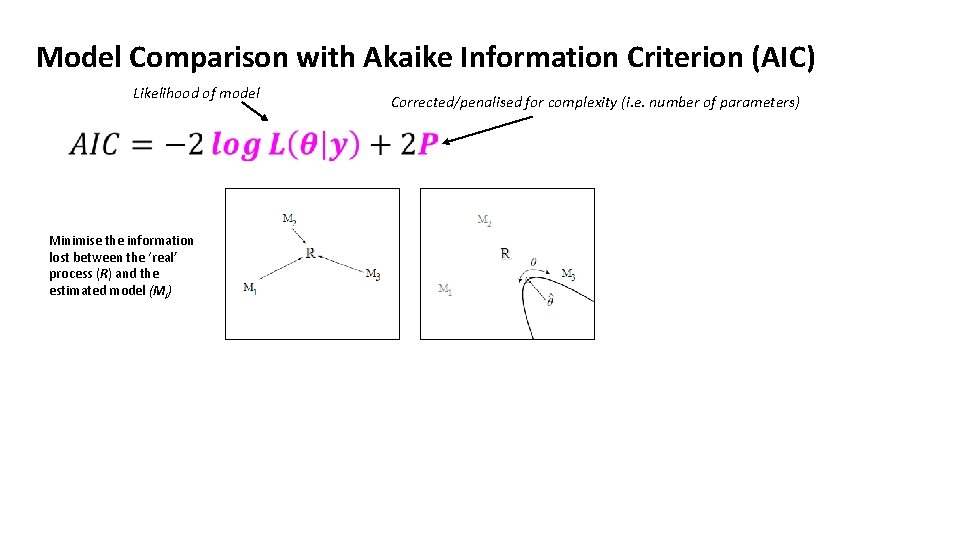
Model Comparison with Akaike Information Criterion (AIC) Likelihood of model Minimise the information lost between the ‘real’ process (R) and the estimated model (Mi) Corrected/penalised for complexity (i. e. number of parameters)
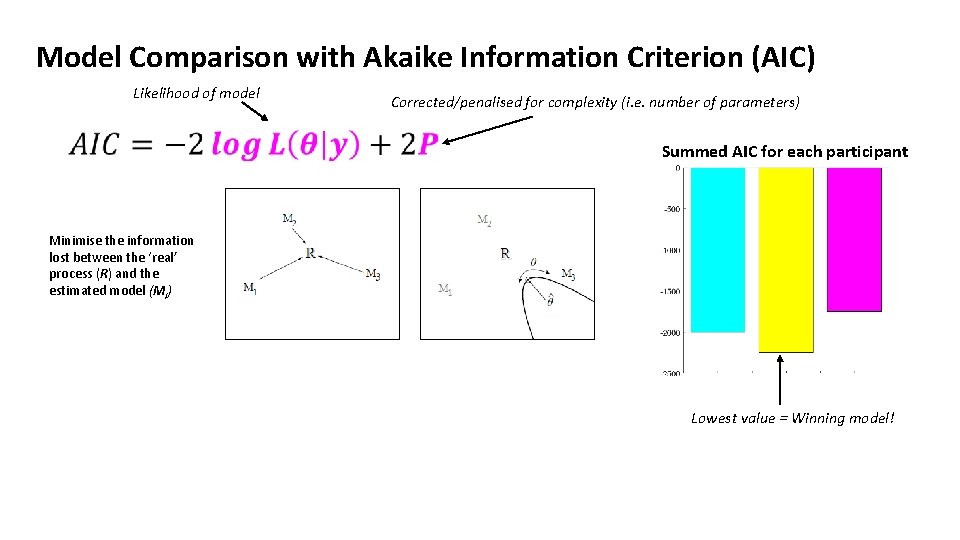
Model Comparison with Akaike Information Criterion (AIC) Likelihood of model Corrected/penalised for complexity (i. e. number of parameters) Summed AIC for each participant Minimise the information lost between the ‘real’ process (R) and the estimated model (Mi) Lowest value = Winning model!
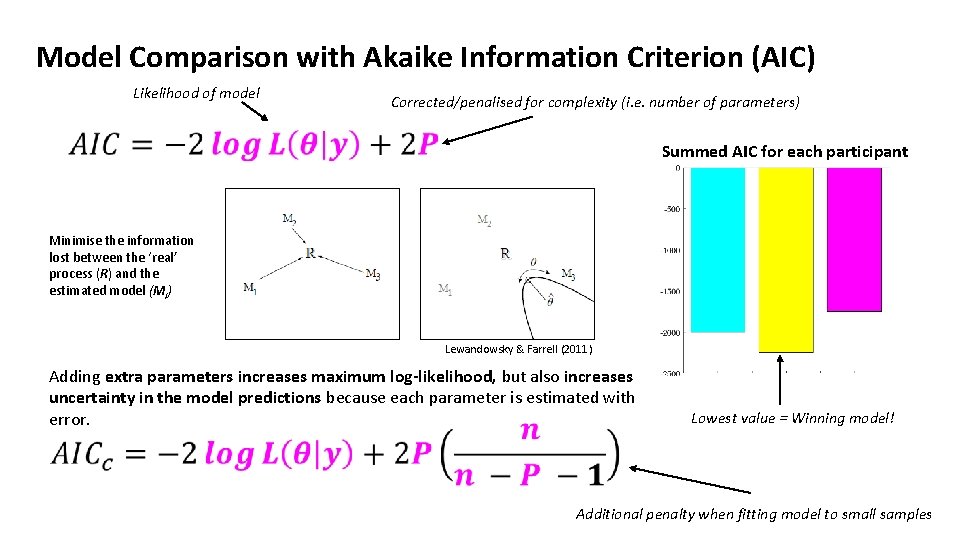
Model Comparison with Akaike Information Criterion (AIC) Likelihood of model Corrected/penalised for complexity (i. e. number of parameters) Summed AIC for each participant Minimise the information lost between the ‘real’ process (R) and the estimated model (Mi) Lewandowsky & Farrell (2011) Adding extra parameters increases maximum log-likelihood, but also increases uncertainty in the model predictions because each parameter is estimated with error. Lowest value = Winning model! Additional penalty when fitting model to small samples
Overfitting? Still a problem!!? !?
Overfitting? Still a problem!!? !? Model comparison tells us best/most useful model, but how useful is the model? How can we really know how well we can fit to future data sets? Redefine the problem… …as one of assessing how well a model’s fit to one data sample generalises to future samples generated by the same process” Pitt & Myung (2002)
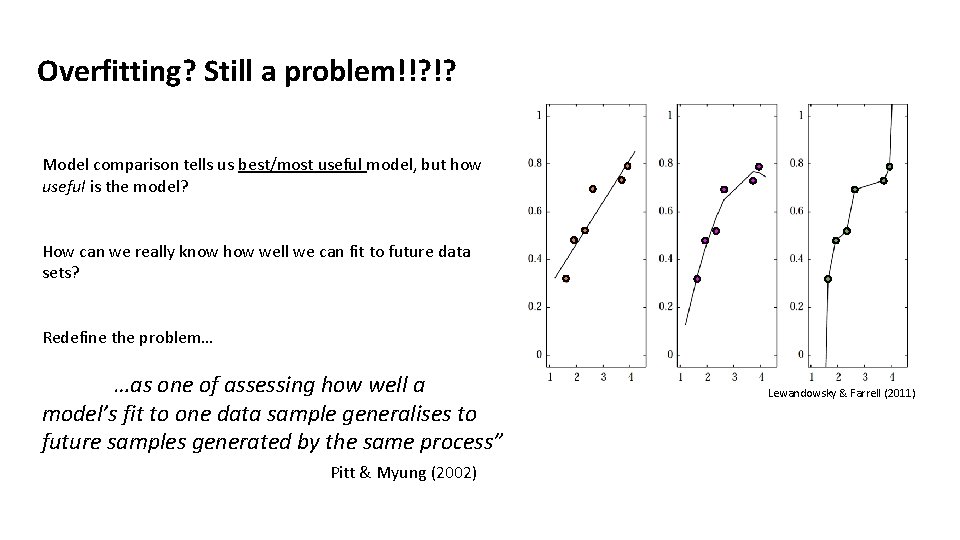
Overfitting? Still a problem!!? !? Model comparison tells us best/most useful model, but how useful is the model? How can we really know how well we can fit to future data sets? Redefine the problem… …as one of assessing how well a model’s fit to one data sample generalises to future samples generated by the same process” Pitt & Myung (2002) Lewandowsky & Farrell (2011)
Cross-validation Group of Techniques - Model is fit to a calibration sample and the best fitting model is compared to a validation sample. - New sample = different noise contamination!
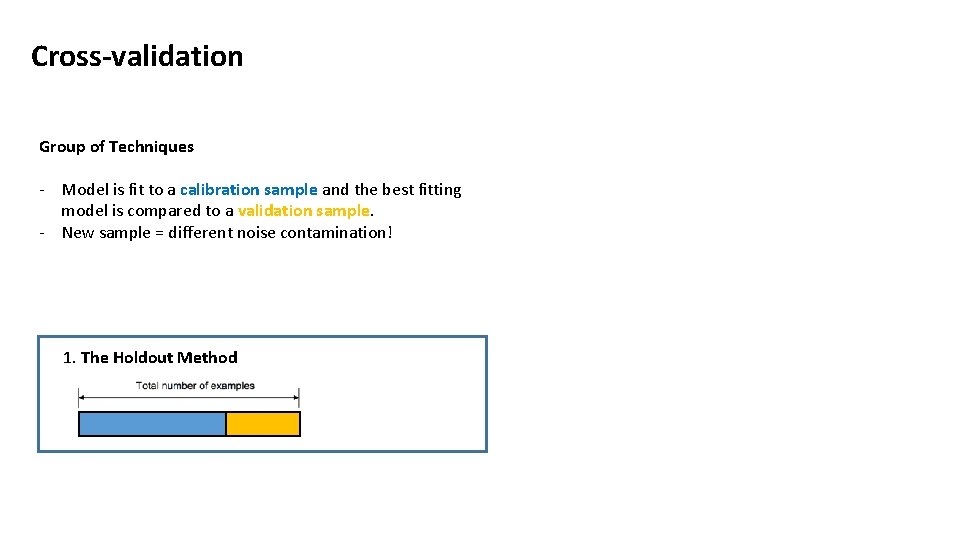
Cross-validation Group of Techniques - Model is fit to a calibration sample and the best fitting model is compared to a validation sample. - New sample = different noise contamination! 1. The Holdout Method
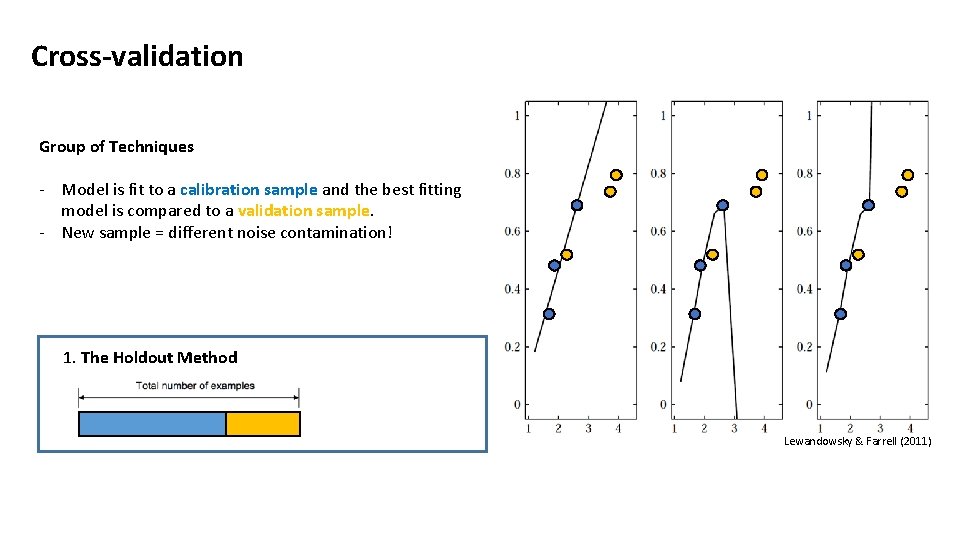
Cross-validation Group of Techniques - Model is fit to a calibration sample and the best fitting model is compared to a validation sample. - New sample = different noise contamination! 1. The Holdout Method Lewandowsky & Farrell (2011)
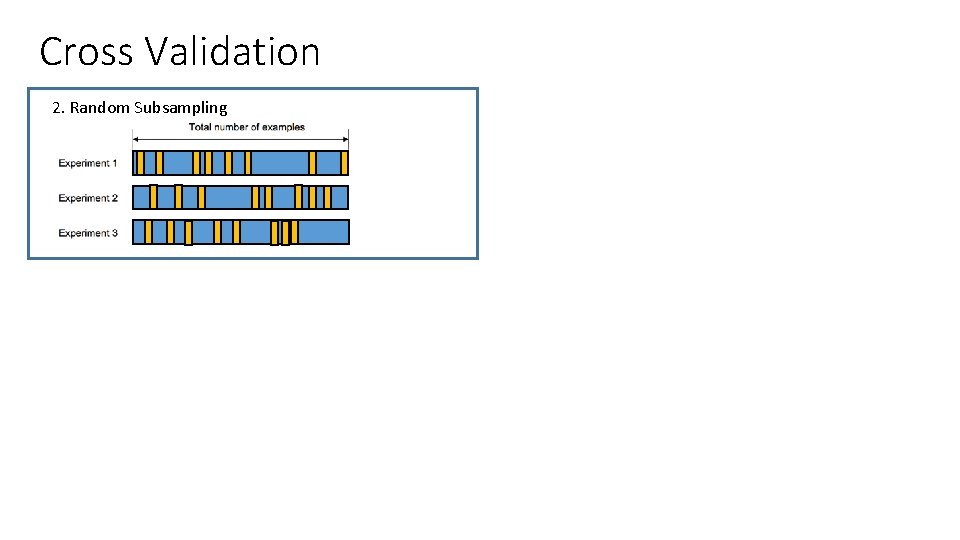
Cross Validation 2. Random Subsampling
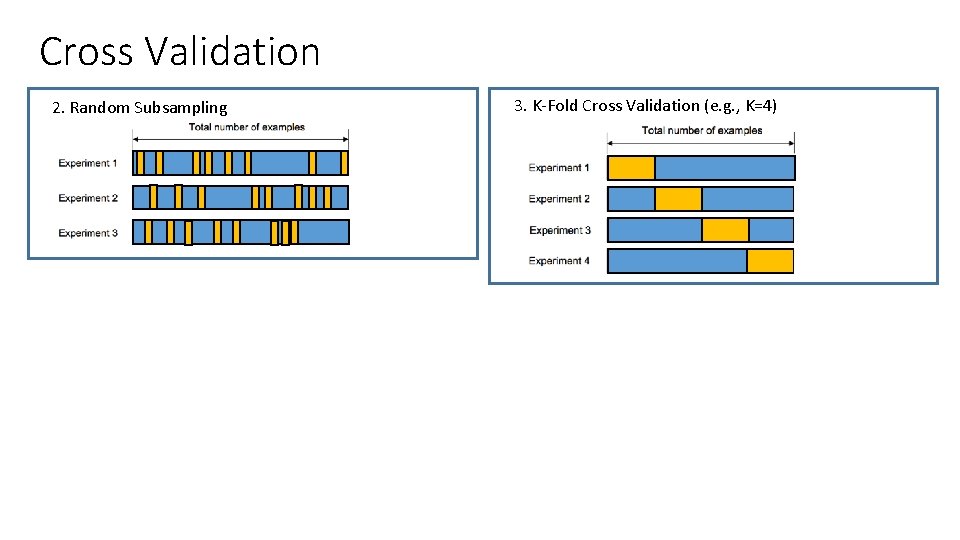
Cross Validation 2. Random Subsampling 3. K-Fold Cross Validation (e. g. , K=4)
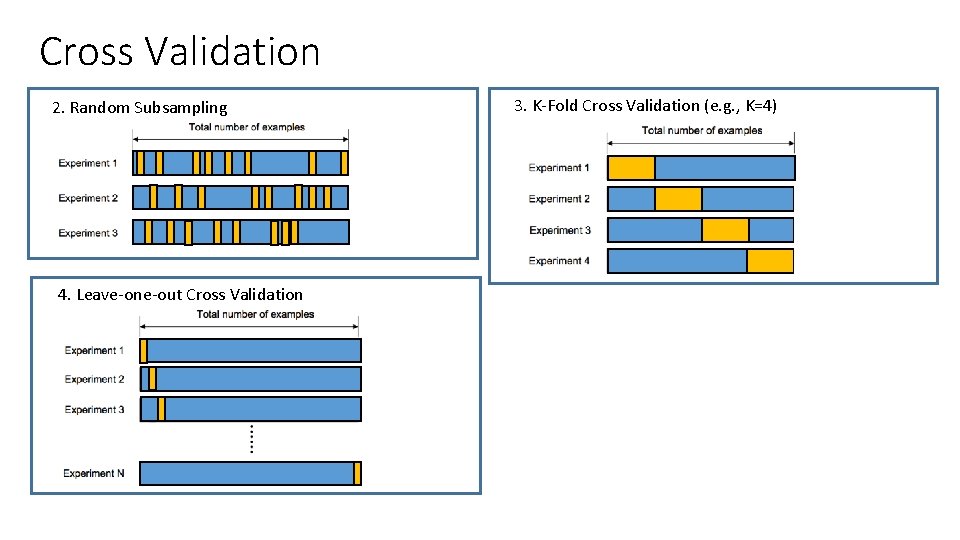
Cross Validation 2. Random Subsampling 4. Leave-one-out Cross Validation 3. K-Fold Cross Validation (e. g. , K=4)
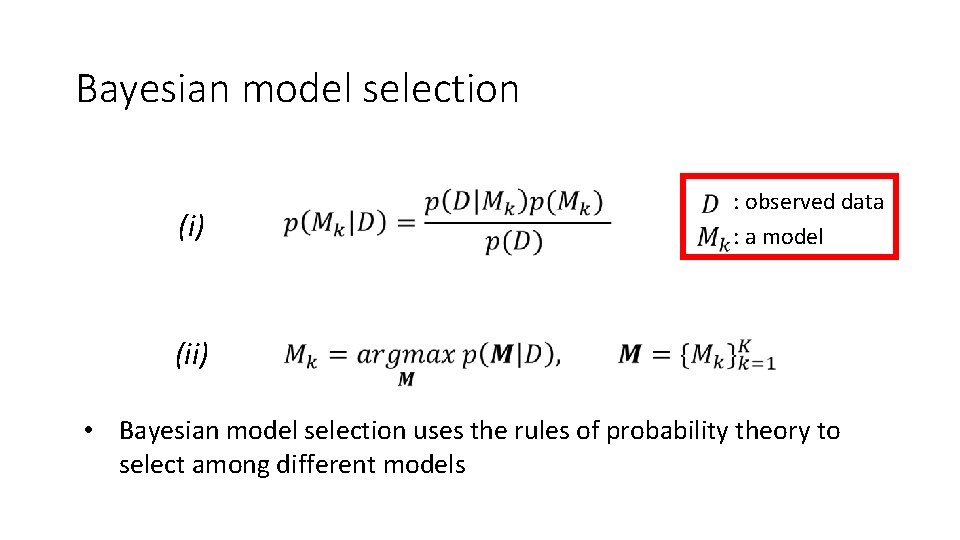
Bayesian model selection (i) : observed data : a model (ii) • Bayesian model selection uses the rules of probability theory to select among different models
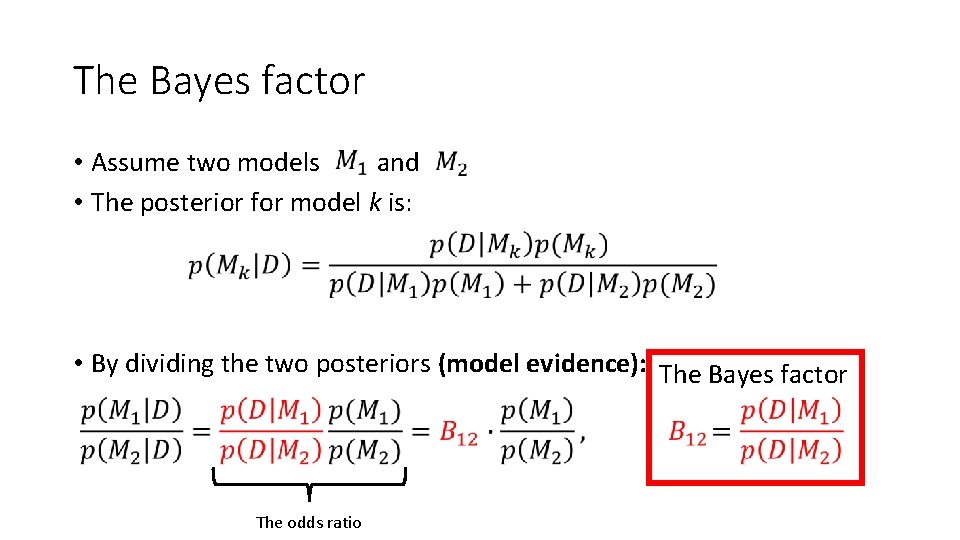
The Bayes factor • Assume two models and • The posterior for model k is: • By dividing the two posteriors (model evidence): The Bayes factor The odds ratio
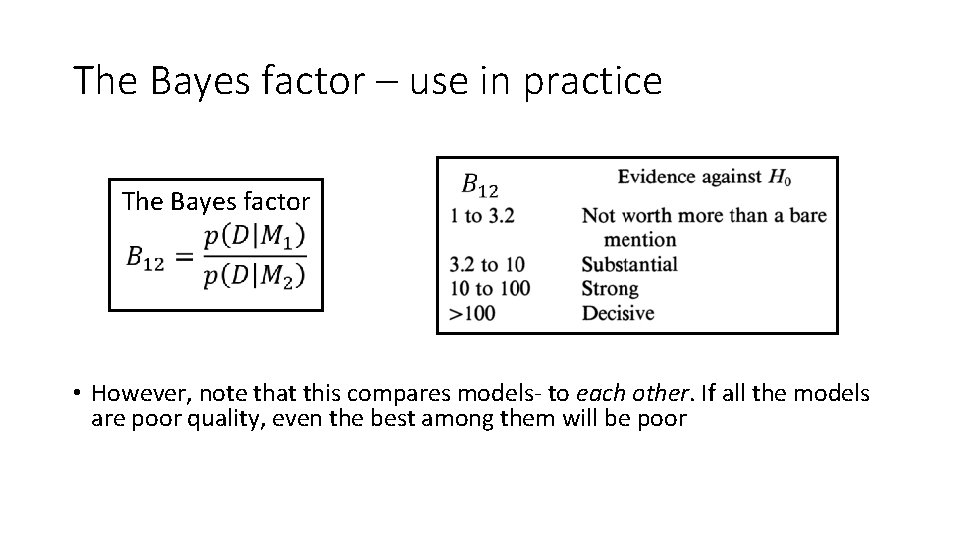
The Bayes factor – use in practice The Bayes factor • However, note that this compares models- to each other. If all the models are poor quality, even the best among them will be poor
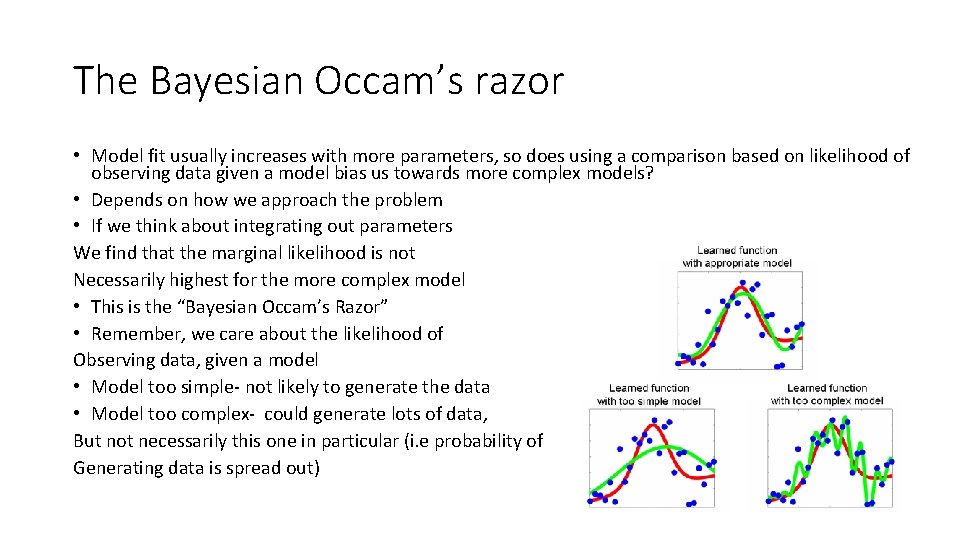
The Bayesian Occam’s razor • Model fit usually increases with more parameters, so does using a comparison based on likelihood of observing data given a model bias us towards more complex models? • Depends on how we approach the problem • If we think about integrating out parameters We find that the marginal likelihood is not Necessarily highest for the more complex model • This is the “Bayesian Occam’s Razor” • Remember, we care about the likelihood of Observing data, given a model • Model too simple- not likely to generate the data • Model too complex- could generate lots of data, But not necessarily this one in particular (i. e probability of Generating data is spread out)
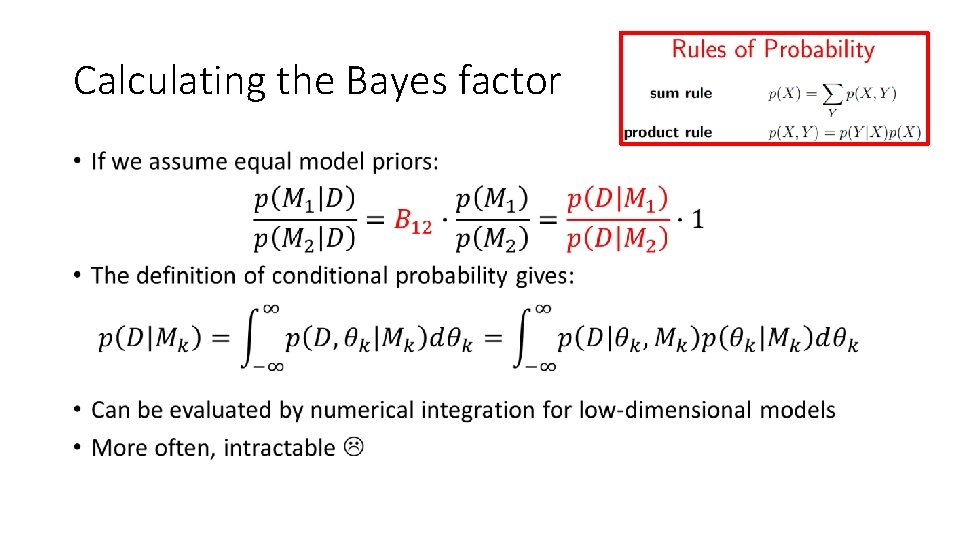
Calculating the Bayes factor •
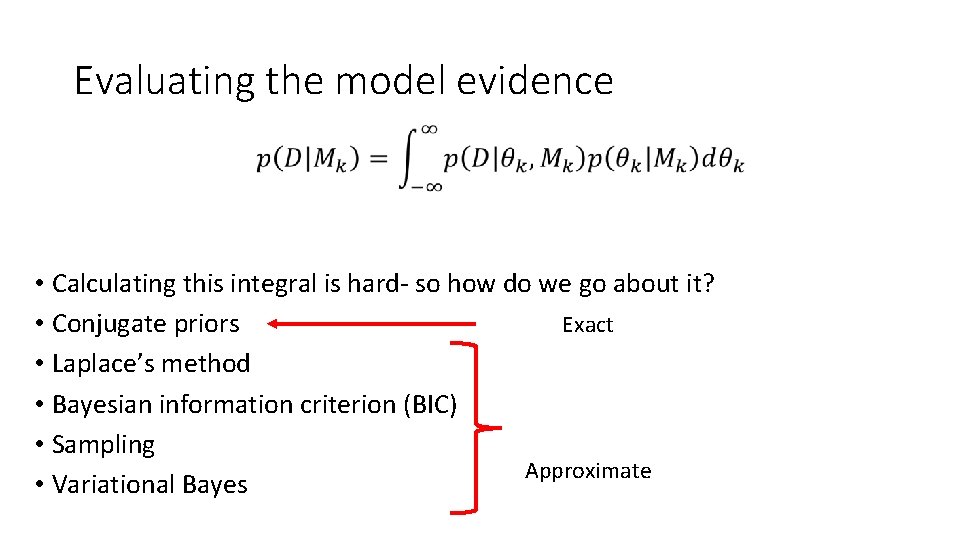
Evaluating the model evidence • Calculating this integral is hard- so how do we go about it? Exact • Conjugate priors • Laplace’s method • Bayesian information criterion (BIC) • Sampling Approximate • Variational Bayes
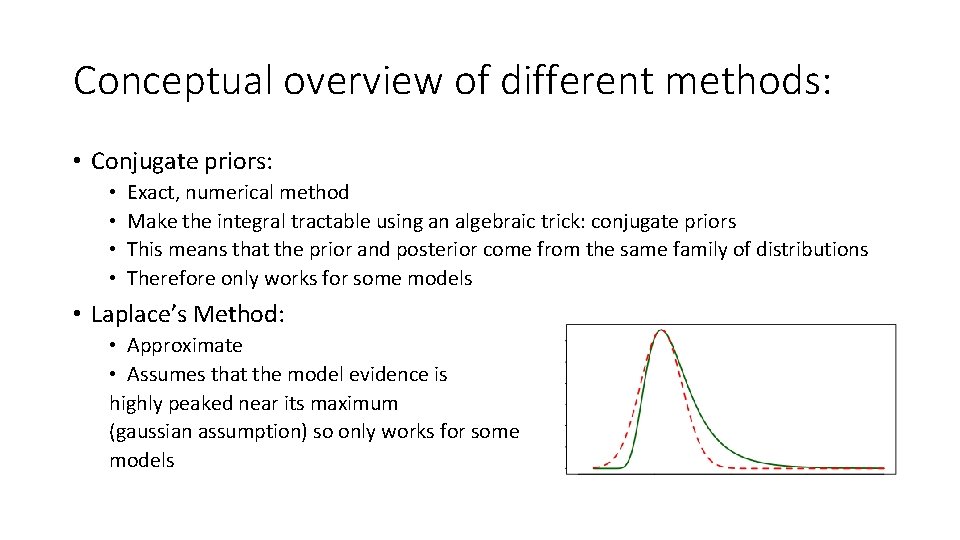
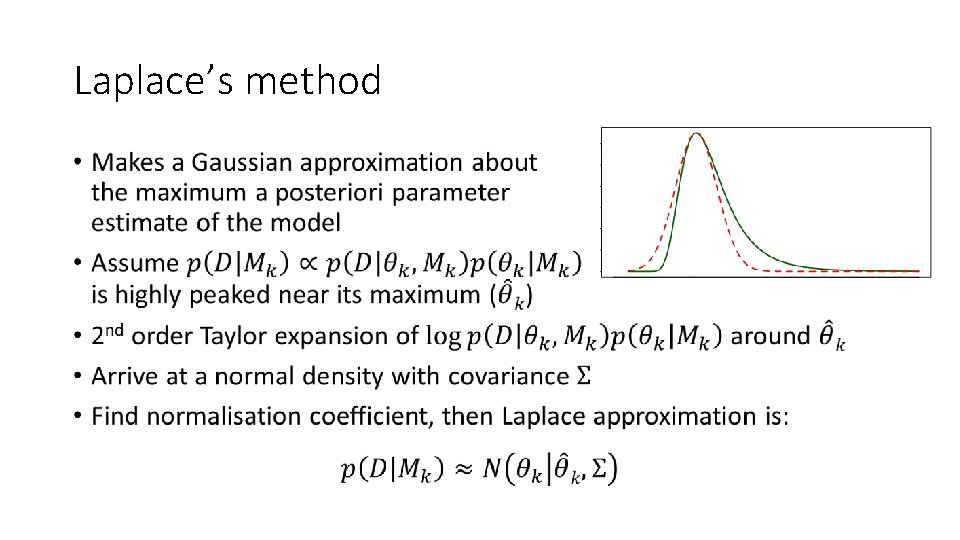
Conceptual overview of different methods: • Conjugate priors: • • Exact, numerical method Make the integral tractable using an algebraic trick: conjugate priors This means that the prior and posterior come from the same family of distributions Therefore only works for some models • Laplace’s Method: • Approximate • Assumes that the model evidence is highly peaked near its maximum (gaussian assumption) so only works for some models
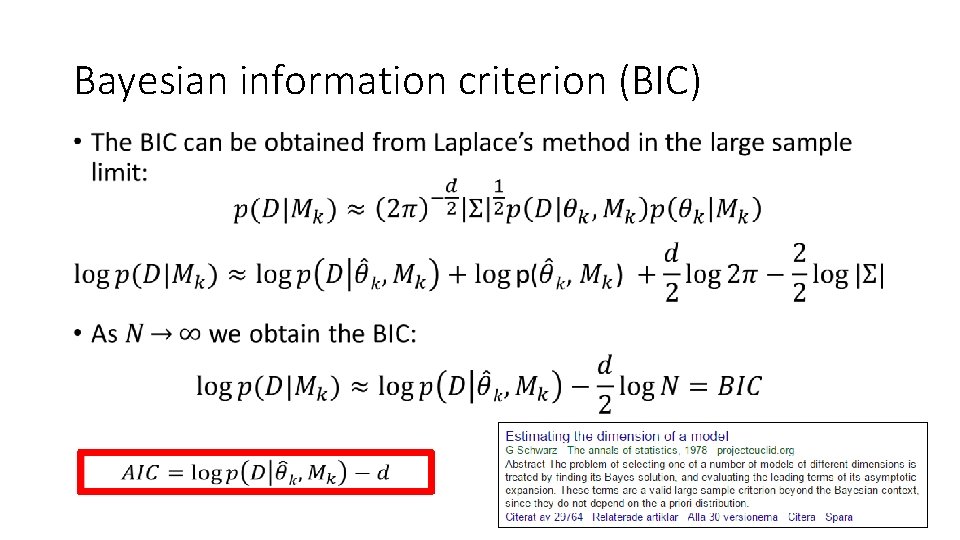
Conceptual overview of different methods: • BIC: • • Approximate Compares models, similar to AIC n must be >> than the number of model parameters BIC vs. AIC: • • BIC looks at the posterior, AIC at the likelihood More penalization for complex models than the AIC- helps avoid false –ve; BIC helps avoid false +ve Could use them together
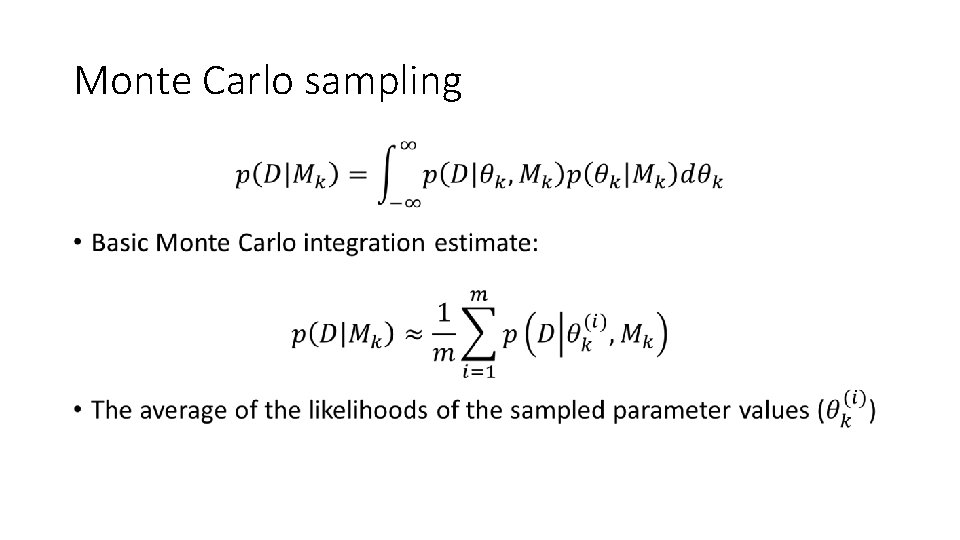
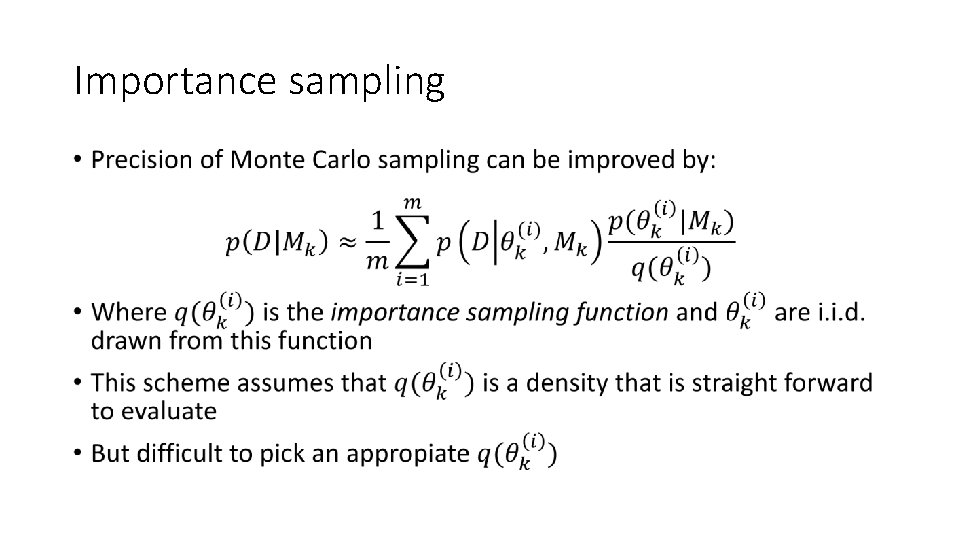
Conceptual overview of different methods: • Sampling/MCMC: • Approximate • Can be used to estimate parameters and parameter spaces by random sampling within and between parameter spaces • Computationally costly
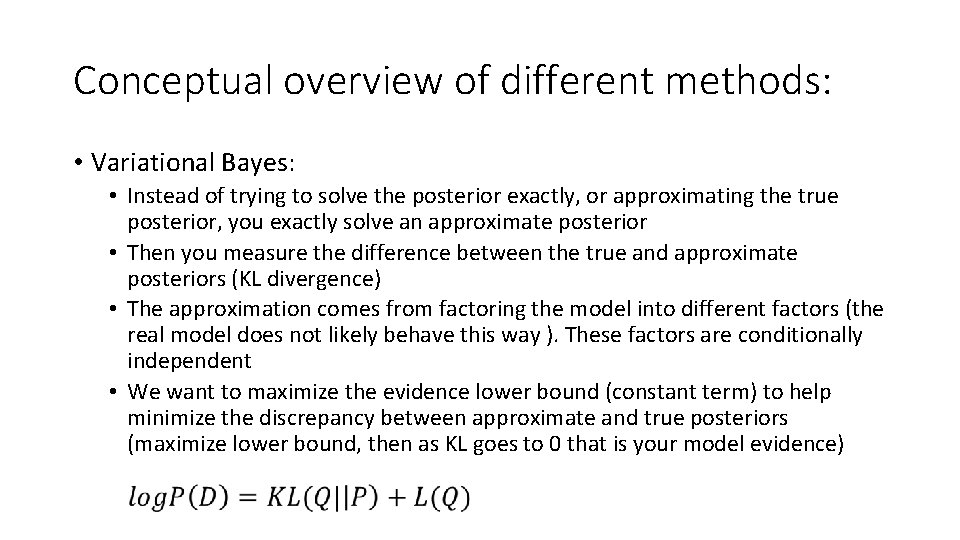
Conceptual overview of different methods: • Variational Bayes: • Instead of trying to solve the posterior exactly, or approximating the true posterior, you exactly solve an approximate posterior • Then you measure the difference between the true and approximate posteriors (KL divergence) • The approximation comes from factoring the model into different factors (the real model does not likely behave this way ). These factors are conditionally independent • We want to maximize the evidence lower bound (constant term) to help minimize the discrepancy between approximate and true posteriors (maximize lower bound, then as KL goes to 0 that is your model evidence)
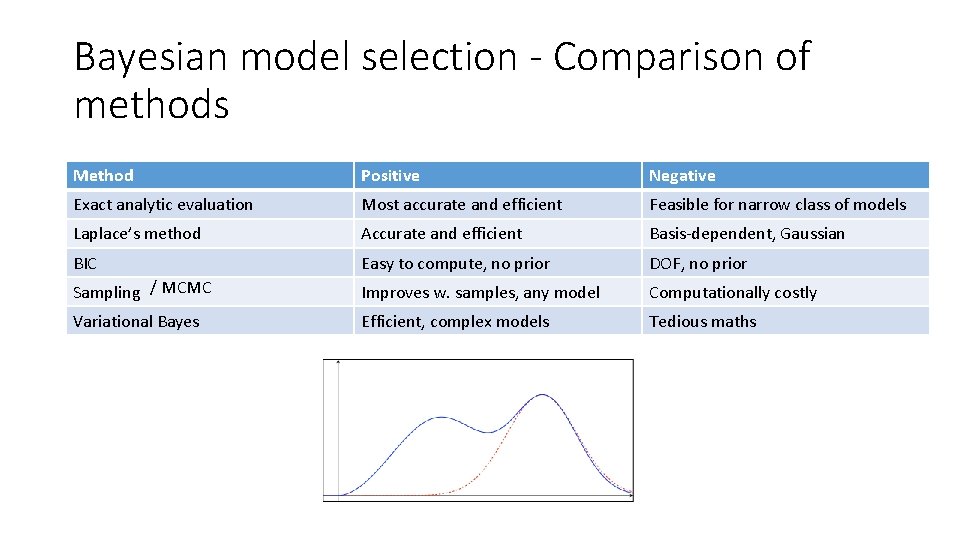
Bayesian model selection - Comparison of methods Method Positive Negative Exact analytic evaluation Most accurate and efficient Feasible for narrow class of models Laplace’s method Accurate and efficient Basis-dependent, Gaussian BIC Easy to compute, no prior DOF, no prior Sampling / MCMC Improves w. samples, any model Computationally costly Variational Bayes Efficient, complex models Tedious maths
The end! Questions?
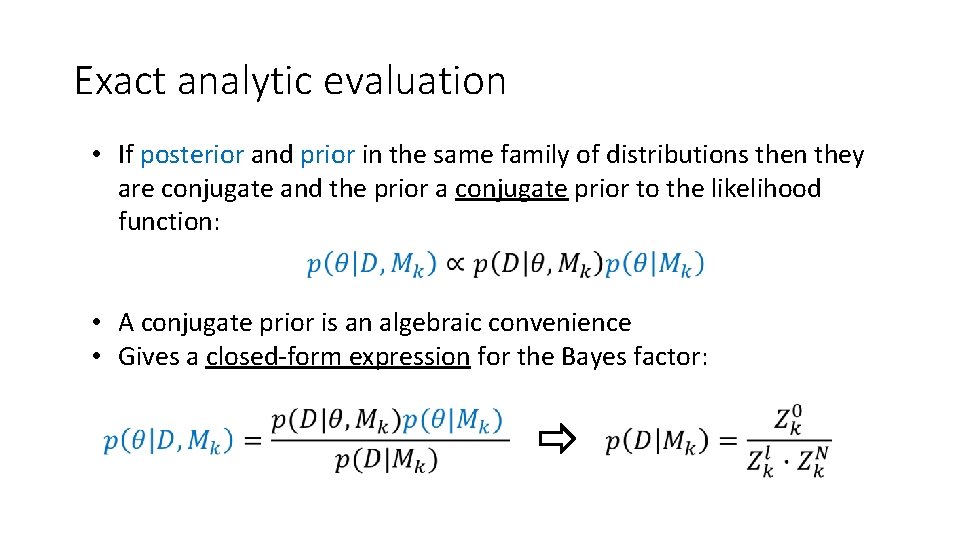
Exact analytic evaluation • If posterior and prior in the same family of distributions then they are conjugate and the prior a conjugate prior to the likelihood function: • A conjugate prior is an algebraic convenience • Gives a closed-form expression for the Bayes factor:
Laplace’s method •
Bayesian information criterion (BIC) •
Monte Carlo sampling •
Importance sampling •
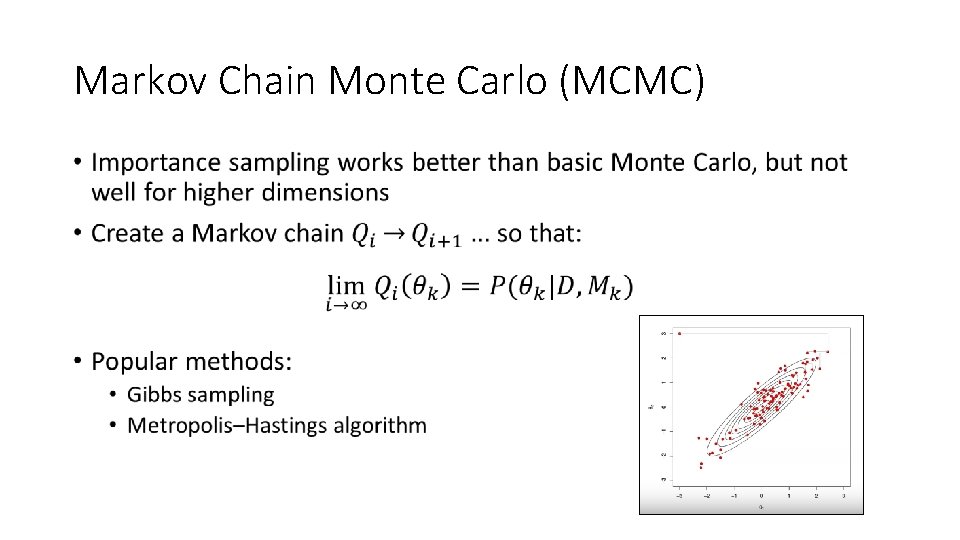
Markov Chain Monte Carlo (MCMC) •
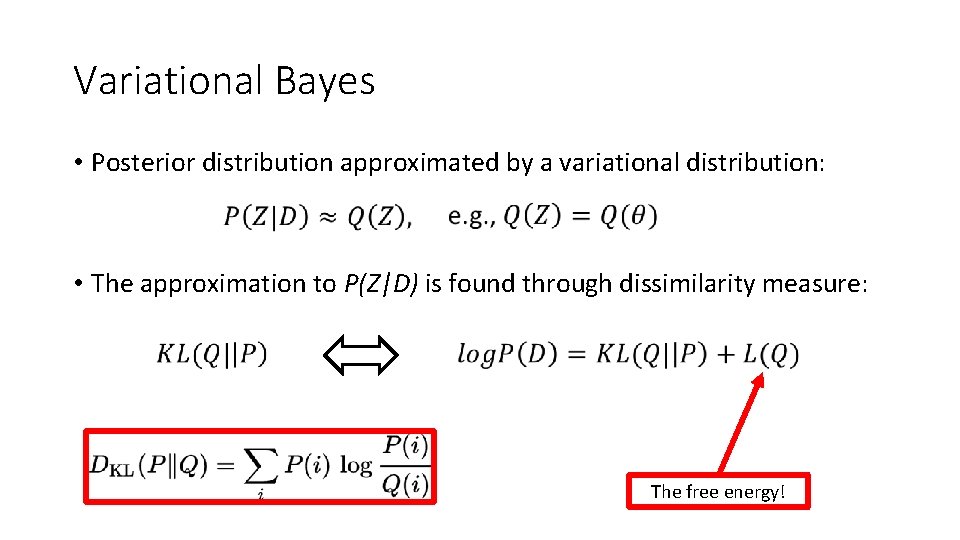
Variational Bayes • Posterior distribution approximated by a variational distribution: • The approximation to P(Z|D) is found through dissimilarity measure: The free energy!
Learning Resources • https: //www. youtube. com/watch? v=l. EDp. Zmq 5 r. Bw&t=529 s • Dienes, Z. (2014). Using Bayes to get the most out of non-significant results. Frontiers in Psychology, 5: 781. • Rouder, J. N. , & Morey, R. D. (2012). Default Bayes factors for model selection in regression. Multivariate Behavioral Research, 47, 877– 903. • Wagenmakers, E. -J. (2007). A practical solution to the pervasive problems of pvalues. Psychonomic Bulletin & Review, 14, 779– 804 • Judd, C. M. , Mc. Clelland, G. H. , & Ryan, C. S. (2008). Data Analysis: A Model Comparison Approach, Second Edition (2 edition). New York Hove: Routledge. • http: //www. gatsby. ucl. ac. uk/teaching/courses/ml 1 -2016. html • http: //theanalysisinstitute. com/assumptions-of-the-general-linear-model-andhow-to-check-them/ • Zucchini- An Introduction to Model Selection
- Slides: 63