
MODEL PSF EFFECTS OF PILEUP Jonathan Gimeno Boal

MODEL PSF EFFECTS OF PILE-UP Jonathan Gimeno Boal, UCM Tutor: Martin Stuhlinger Jonathan Gimeno Boal, UCM
Index: • Aim of the project. • Selection of the observations. • Selection of point sources. • Determination of the counts per second. • Determination of pile-up. • Next steps. Jonathan Gimeno Boal, UCM
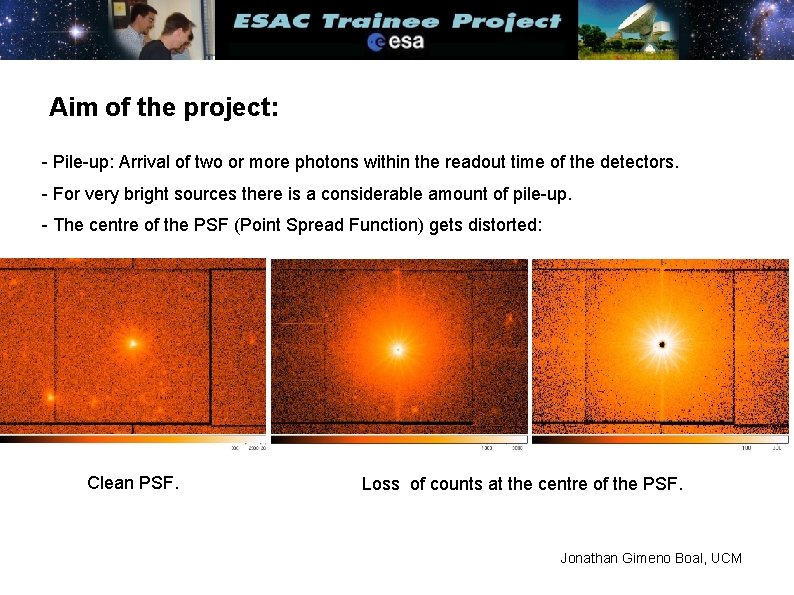
Aim of the project: - Pile-up: Arrival of two or more photons within the readout time of the detectors. - For very bright sources there is a considerable amount of pile-up. - The centre of the PSF (Point Spread Function) gets distorted: Clean PSF. Loss of counts at the centre of the PSF. Jonathan Gimeno Boal, UCM
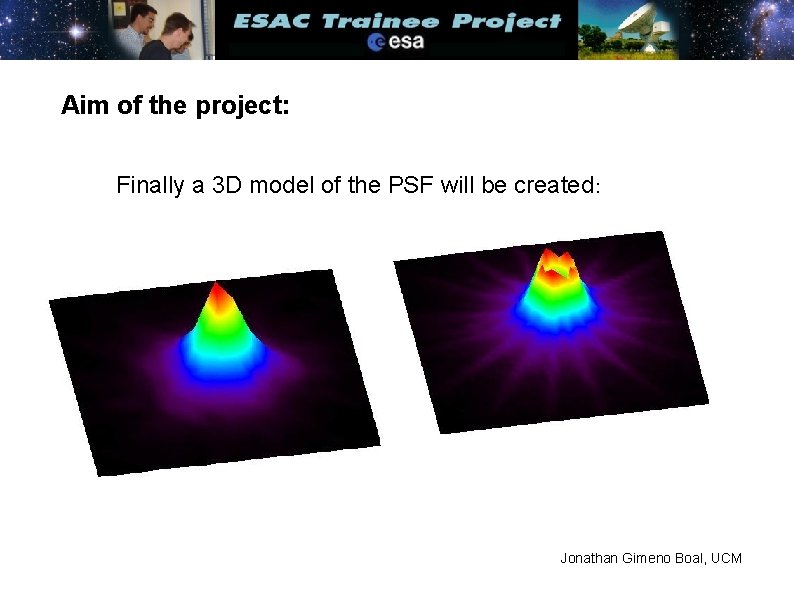
Aim of the project: Finally a 3 D model of the PSF will be created: Jonathan Gimeno Boal, UCM
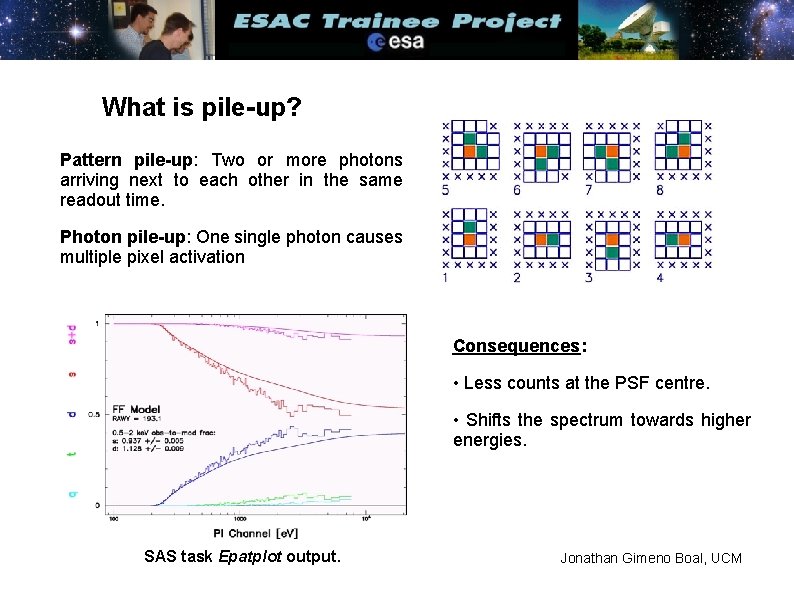
What is pile-up? Pattern pile-up: Two or more photons arriving next to each other in the same readout time. Photon pile-up: One single photon causes multiple pixel activation Consequences: • Less counts at the PSF centre. • Shifts the spectrum towards higher energies. SAS task Epatplot output. Jonathan Gimeno Boal, UCM
Selection of observations: ● Distinguish point sources: • Observation Modes • Filters Jonathan Gimeno Boal, UCM
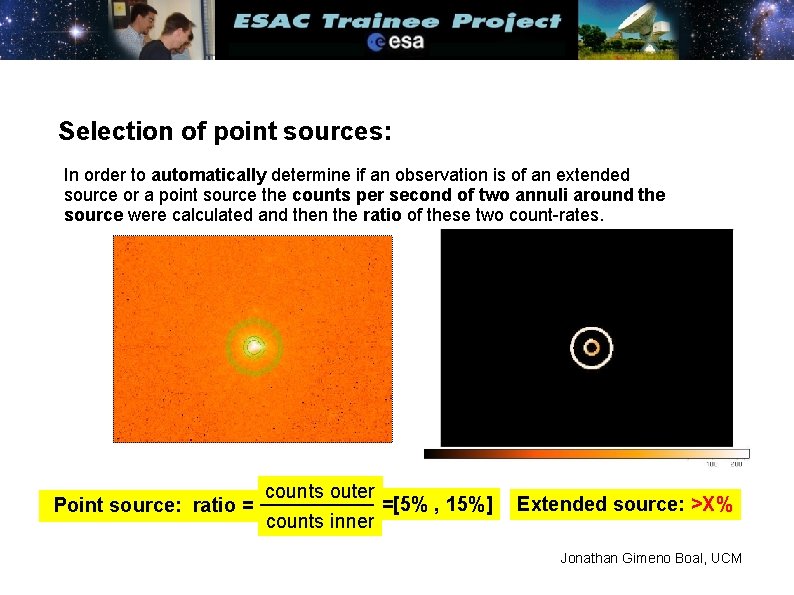
Selection of point sources: In order to automatically determine if an observation is of an extended source or a point source the counts per second of two annuli around the source were calculated and then the ratio of these two count-rates. counts outer =[5% , 15%] Point source: ratio = counts inner Extended source: >X% Jonathan Gimeno Boal, UCM
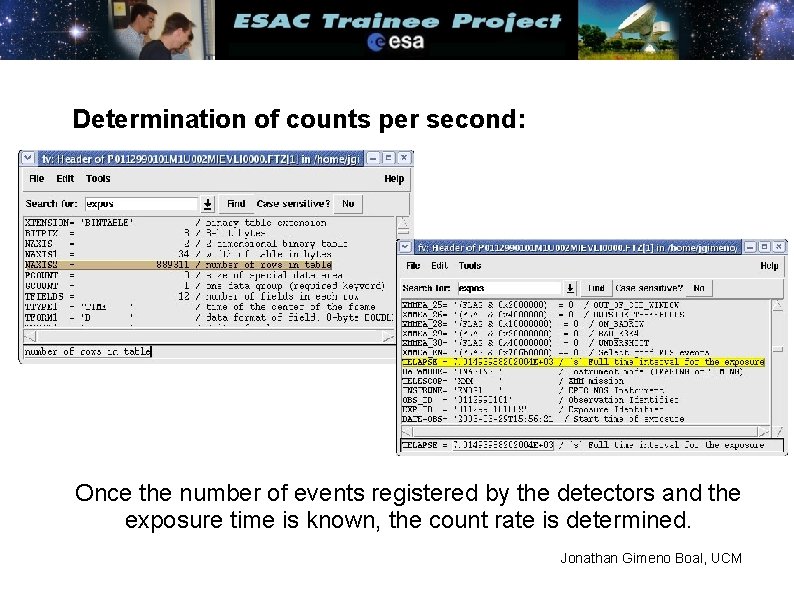
Determination of counts per second: Once the number of events registered by the detectors and the exposure time is known, the count rate is determined. Jonathan Gimeno Boal, UCM
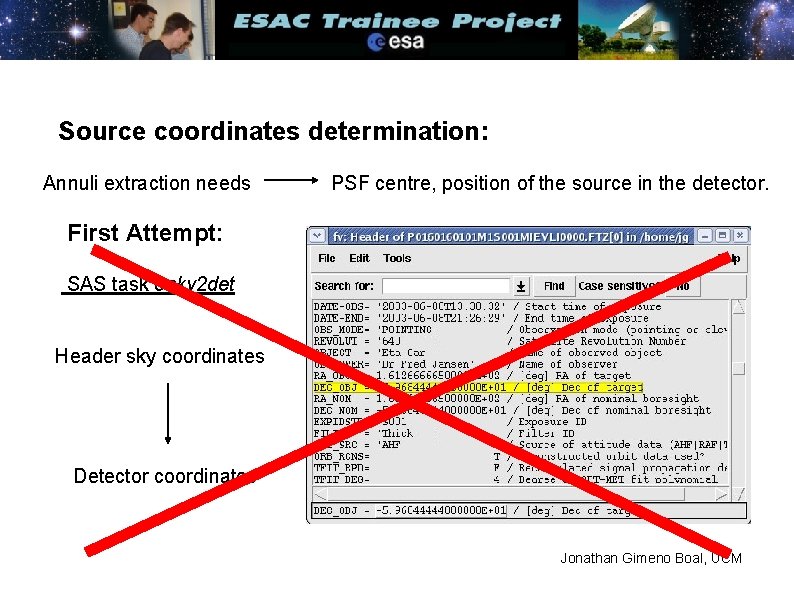
Source coordinates determination: Annuli extraction needs PSF centre, position of the source in the detector. First Attempt: SAS task esky 2 det Header sky coordinates Detector coordinates Jonathan Gimeno Boal, UCM
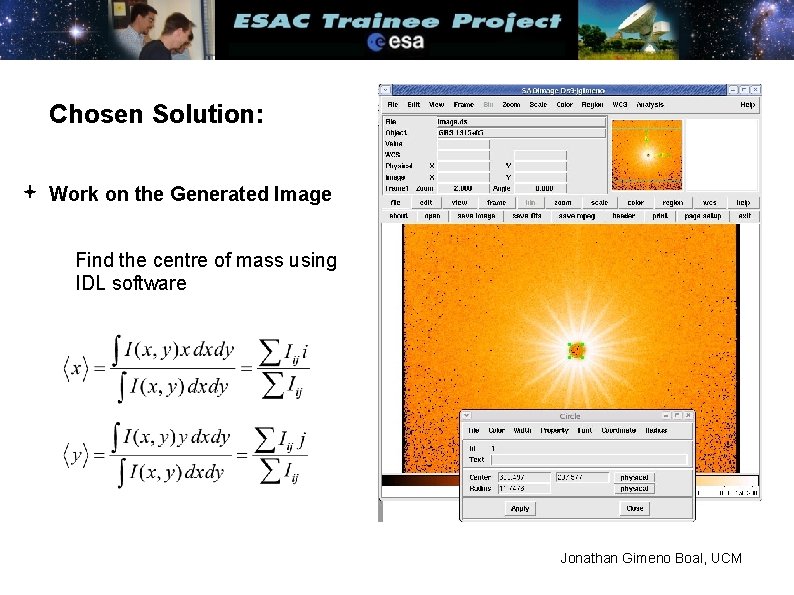
Chosen Solution: Work on the Generated Image Find the centre of mass using IDL software Jonathan Gimeno Boal, UCM
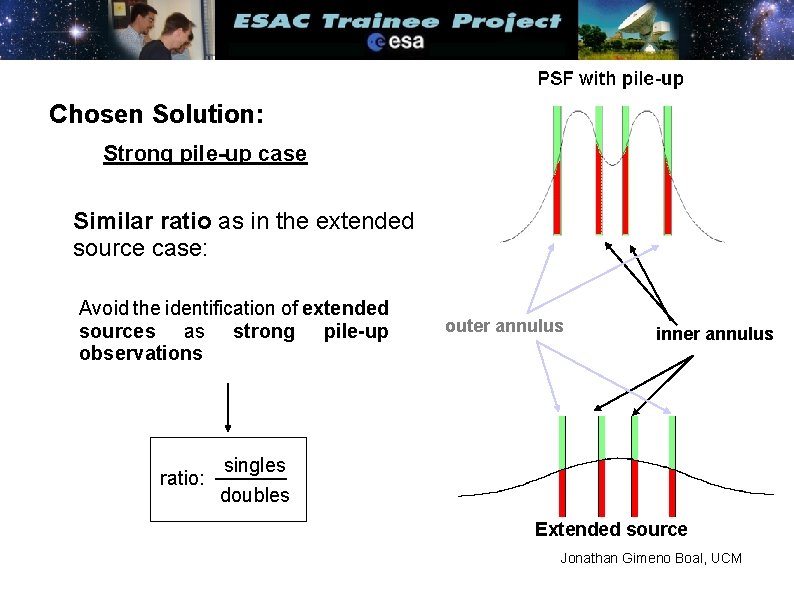
Chosen Solution: Strong pile-up case Similar ratio as in the extended source case: Avoid the identification of extended sources as strong pile-up observations ratio: outer annulus inner annulus singles doubles Extended source Jonathan Gimeno Boal, UCM
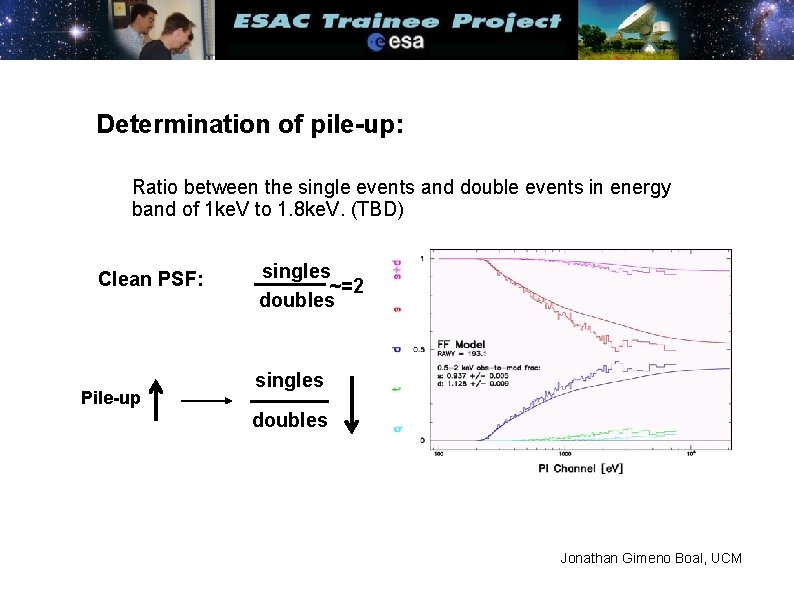
Determination of pile-up: Ratio between the single events and double events in energy band of 1 ke. V to 1. 8 ke. V. (TBD) Clean PSF: Pile-up singles ~=2 doubles singles doubles Jonathan Gimeno Boal, UCM
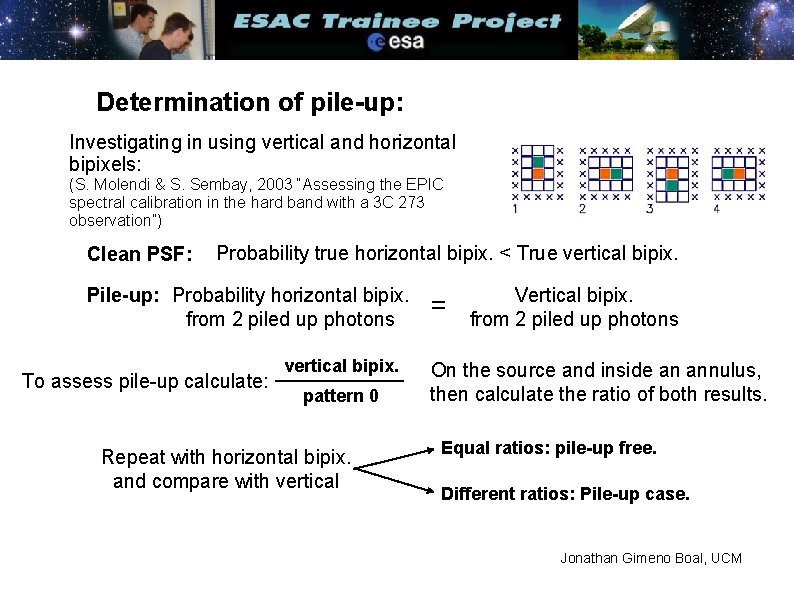
Determination of pile-up: Investigating in using vertical and horizontal bipixels: (S. Molendi & S. Sembay, 2003 “Assessing the EPIC spectral calibration in the hard band with a 3 C 273 observation”) Clean PSF: Probability true horizontal bipix. < True vertical bipix. Pile-up: Probability horizontal bipix. from 2 piled up photons To assess pile-up calculate: vertical bipix. pattern 0 Repeat with horizontal bipix. and compare with vertical = Vertical bipix. from 2 piled up photons On the source and inside an annulus, then calculate the ratio of both results. Equal ratios: pile-up free. Different ratios: Pile-up case. Jonathan Gimeno Boal, UCM
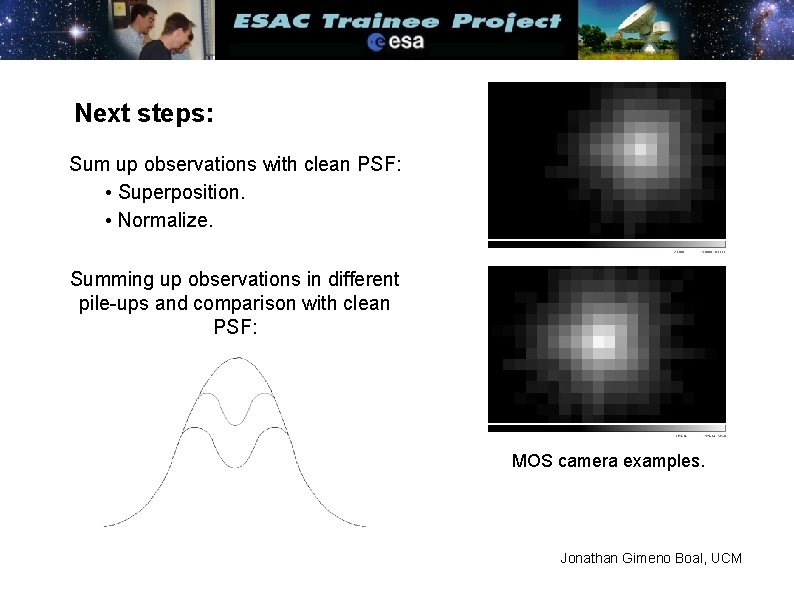
Next steps: Sum up observations with clean PSF: • Superposition. • Normalize. Summing up observations in different pile-ups and comparison with clean PSF: MOS camera examples. Jonathan Gimeno Boal, UCM

Questions? Jonathan Gimeno Boal, UCM
- Slides: 15