
Model Problem Solving Poissons equation for temperature k
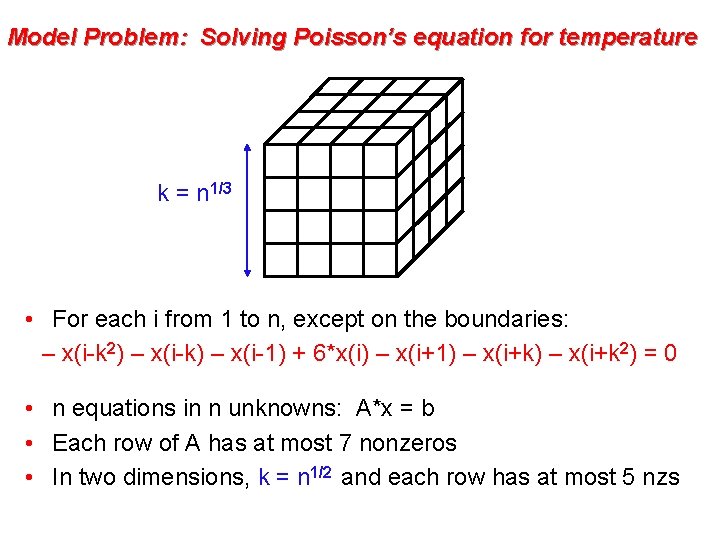
Model Problem: Solving Poisson’s equation for temperature k = n 1/3 • For each i from 1 to n, except on the boundaries: – x(i-k 2) – x(i-k) – x(i-1) + 6*x(i) – x(i+1) – x(i+k 2) = 0 • n equations in n unknowns: A*x = b • Each row of A has at most 7 nonzeros • In two dimensions, k = n 1/2 and each row has at most 5 nzs
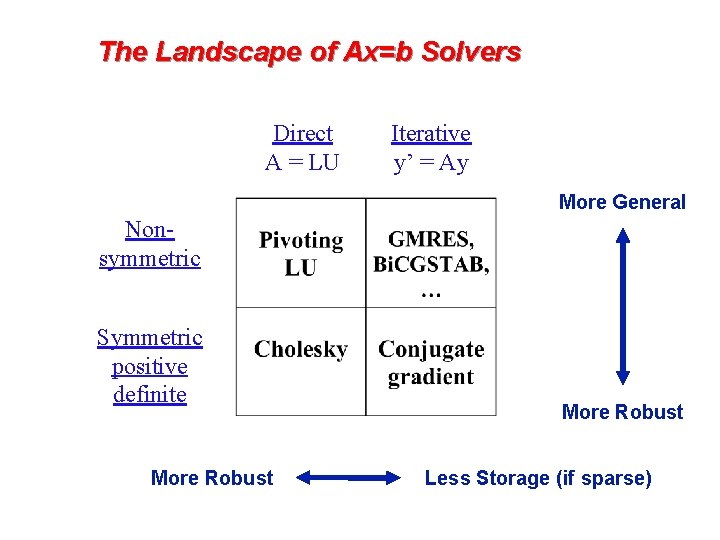
The Landscape of Ax=b Solvers Direct A = LU Iterative y’ = Ay More General Nonsymmetric Symmetric positive definite More Robust Less Storage (if sparse)

Complexity of linear solvers Time to solve model problem (Poisson’s equation) on regular mesh n 1/2 n 1/3 2 D 3 D Sparse Cholesky: O(n 1. 5 ) O(n 2 ) CG, exact arithmetic: O(n 2 ) CG, no precond: O(n 1. 5 ) O(n 1. 33 ) CG, modified IC: O(n 1. 25 ) O(n 1. 17 ) O(n 1. 20 ) -> O(n 1+ ) O(n 1. 75 ) -> O(n 1+ ) O(n) CG, support trees: Multigrid:
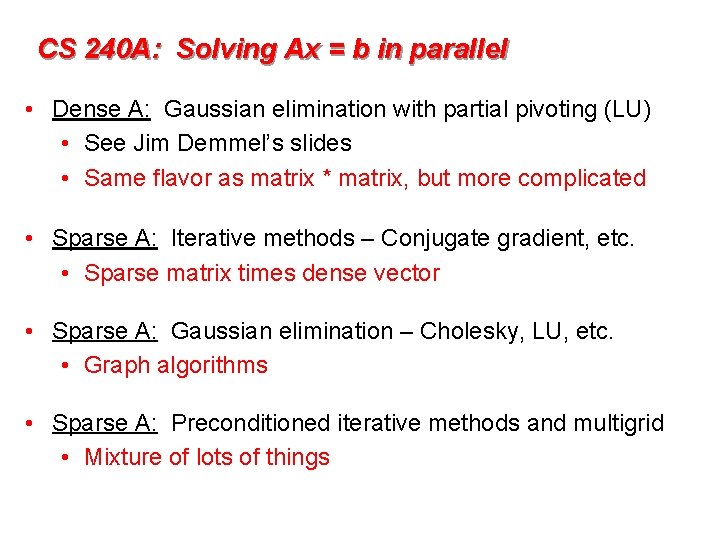
CS 240 A: Solving Ax = b in parallel • Dense A: Gaussian elimination with partial pivoting (LU) • See Jim Demmel’s slides • Same flavor as matrix * matrix, but more complicated • Sparse A: Iterative methods – Conjugate gradient, etc. • Sparse matrix times dense vector • Sparse A: Gaussian elimination – Cholesky, LU, etc. • Graph algorithms • Sparse A: Preconditioned iterative methods and multigrid • Mixture of lots of things
CS 240 A: Solving Ax = b in parallel • Dense A: Gaussian elimination with partial pivoting • See Jim Demmel’s slides • Same flavor as matrix * matrix, but more complicated • Sparse A: Iterative methods – Conjugate gradient etc. • Sparse matrix times dense vector • Sparse A: Gaussian elimination – Cholesky, LU, etc. • Graph algorithms • Sparse A: Preconditioned iterative methods and multigrid • Mixture of lots of things
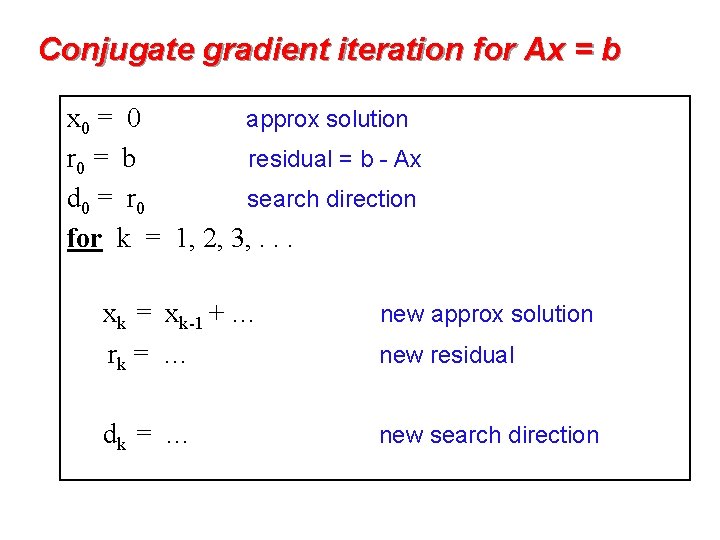
Conjugate gradient iteration for Ax = b x 0 = 0 approx solution r 0 = b residual = b - Ax d 0 = r 0 search direction for k = 1, 2, 3, . . . xk = xk-1 + … rk = … new residual dk = … new search direction new approx solution
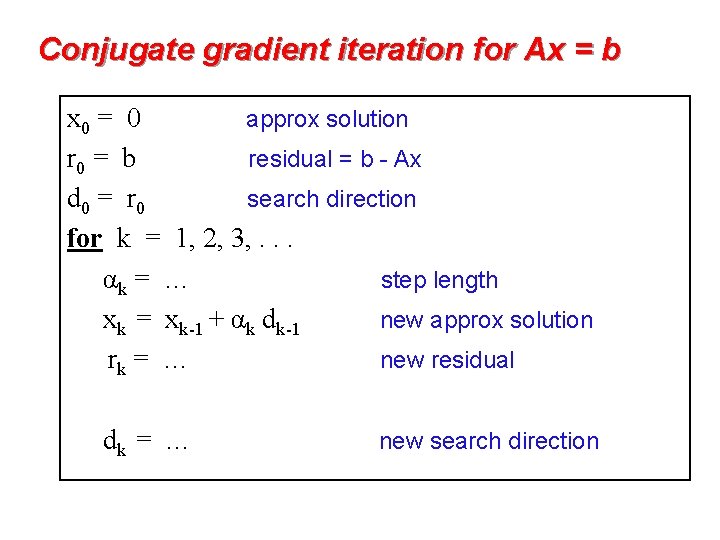
Conjugate gradient iteration for Ax = b x 0 = 0 approx solution r 0 = b residual = b - Ax d 0 = r 0 search direction for k = 1, 2, 3, . . . αk = … step length xk = xk-1 + αk dk-1 new approx solution rk = … new residual dk = … new search direction
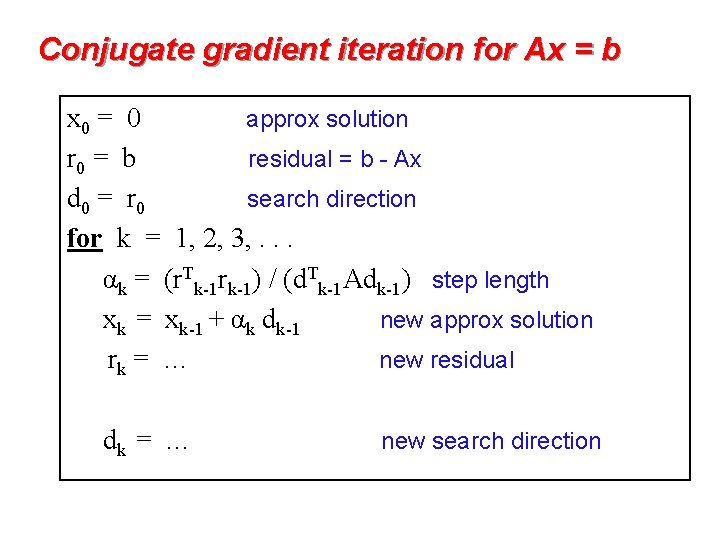
Conjugate gradient iteration for Ax = b x 0 = 0 approx solution r 0 = b residual = b - Ax d 0 = r 0 search direction for k = 1, 2, 3, . . . αk = (r. Tk-1 rk-1) / (d. Tk-1 Adk-1) step length xk = xk-1 + αk dk-1 new approx solution rk = … new residual dk = … new search direction
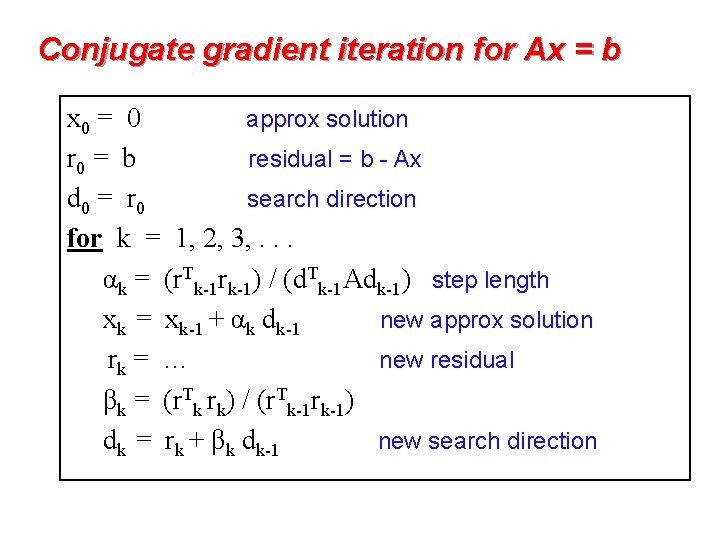
Conjugate gradient iteration for Ax = b x 0 = 0 approx solution r 0 = b residual = b - Ax d 0 = r 0 search direction for k = 1, 2, 3, . . . αk = (r. Tk-1 rk-1) / (d. Tk-1 Adk-1) step length xk = xk-1 + αk dk-1 new approx solution rk = … new residual βk = (r. Tk rk) / (r. Tk-1 rk-1) dk = rk + βk dk-1 new search direction
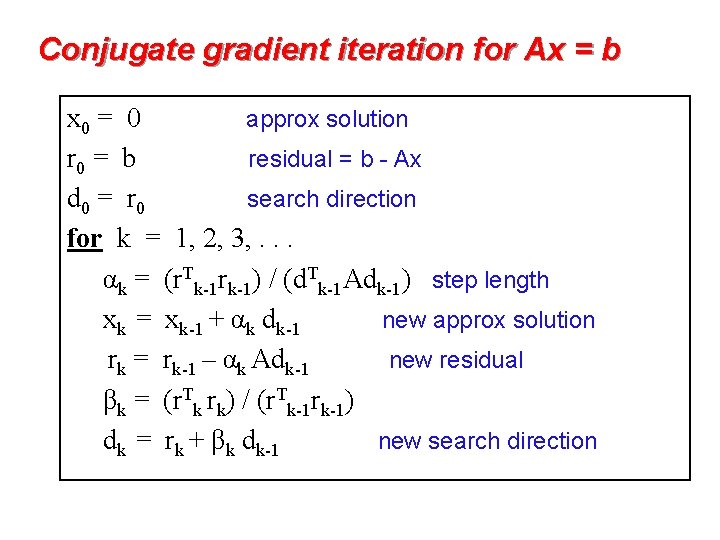
Conjugate gradient iteration for Ax = b x 0 = 0 approx solution r 0 = b residual = b - Ax d 0 = r 0 search direction for k = 1, 2, 3, . . . αk = (r. Tk-1 rk-1) / (d. Tk-1 Adk-1) step length xk = xk-1 + αk dk-1 new approx solution rk = rk-1 – αk Adk-1 new residual βk = (r. Tk rk) / (r. Tk-1 rk-1) dk = rk + βk dk-1 new search direction
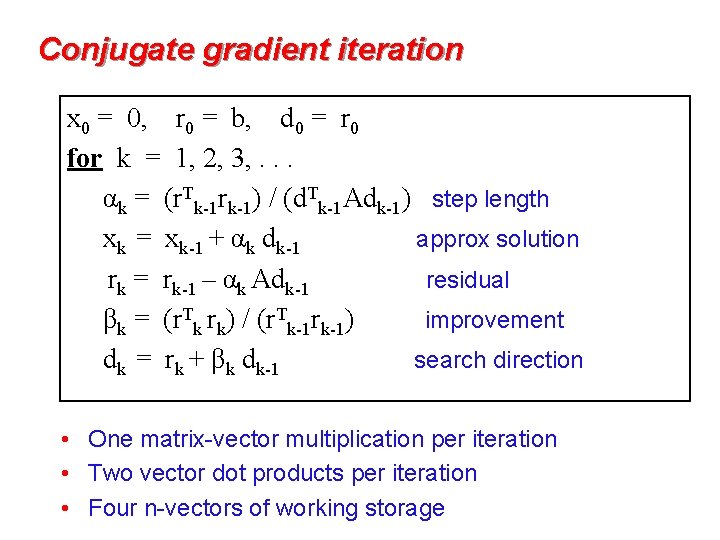
Conjugate gradient iteration x 0 = 0, r 0 = b, d 0 = r 0 for k = 1, 2, 3, . . . αk = (r. Tk-1 rk-1) / (d. Tk-1 Adk-1) step length xk = xk-1 + αk dk-1 approx solution rk = rk-1 – αk Adk-1 residual βk = (r. Tk rk) / (r. Tk-1 rk-1) improvement dk = rk + βk dk-1 search direction • One matrix-vector multiplication per iteration • Two vector dot products per iteration • Four n-vectors of working storage
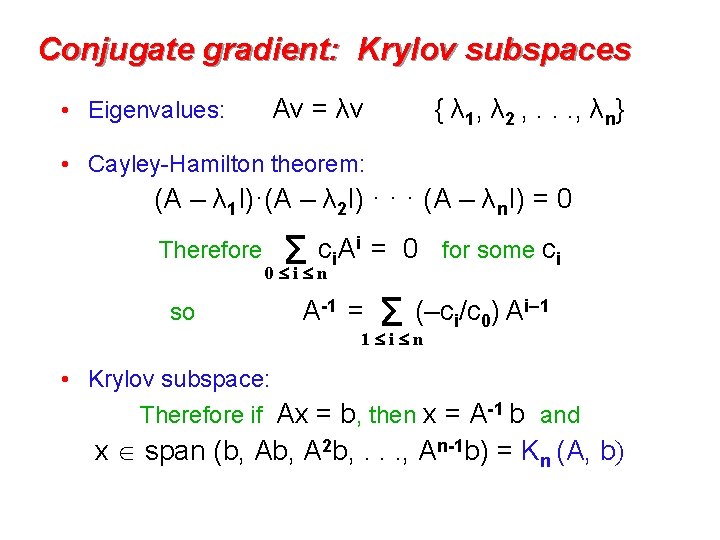
Conjugate gradient: Krylov subspaces • Eigenvalues: Av = λv { λ 1, λ 2 , . . . , λn} • Cayley-Hamilton theorem: (A – λ 1 I)·(A – λ 2 I) · · · (A – λn. I) = 0 Therefore so ci. Ai = Σ 0 i n 0 for some ci (–ci/c 0) Ai– 1 Σ 1 i n A-1 = • Krylov subspace: Therefore if Ax = b, then x = A-1 b and x span (b, A 2 b, . . . , An-1 b) = Kn (A, b)
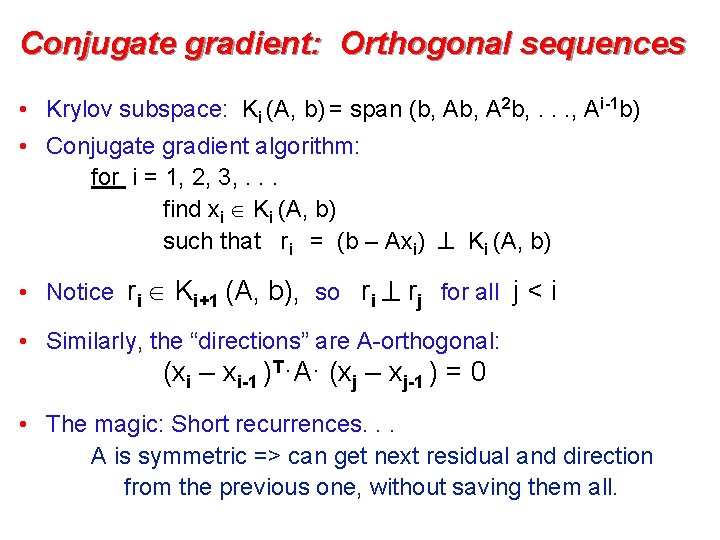
Conjugate gradient: Orthogonal sequences • Krylov subspace: Ki (A, b) = span (b, A 2 b, . . . , Ai-1 b) • Conjugate gradient algorithm: for i = 1, 2, 3, . . . find xi Ki (A, b) such that ri = (b – Axi) Ki (A, b) • Notice ri Ki+1 (A, b), so ri rj for all j < i • Similarly, the “directions” are A-orthogonal: (xi – xi-1 )T·A· (xj – xj-1 ) = 0 • The magic: Short recurrences. . . A is symmetric => can get next residual and direction from the previous one, without saving them all.
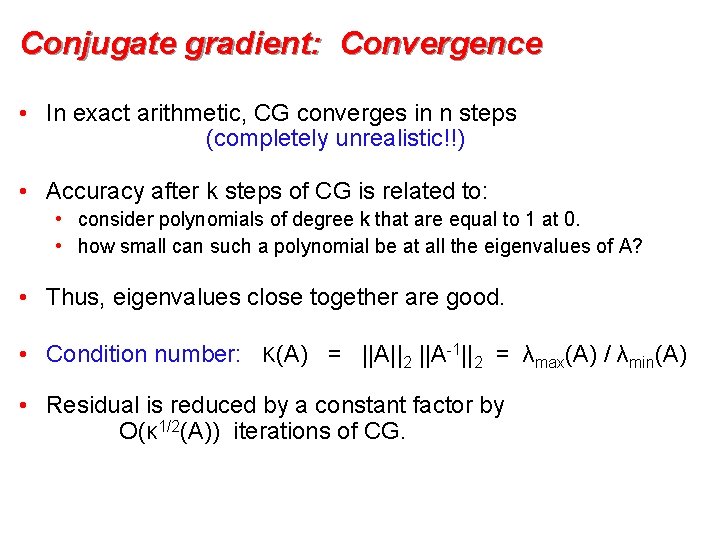
Conjugate gradient: Convergence • In exact arithmetic, CG converges in n steps (completely unrealistic!!) • Accuracy after k steps of CG is related to: • consider polynomials of degree k that are equal to 1 at 0. • how small can such a polynomial be at all the eigenvalues of A? • Thus, eigenvalues close together are good. • Condition number: κ(A) = ||A||2 ||A-1||2 = λmax(A) / λmin(A) • Residual is reduced by a constant factor by O(κ 1/2(A)) iterations of CG.
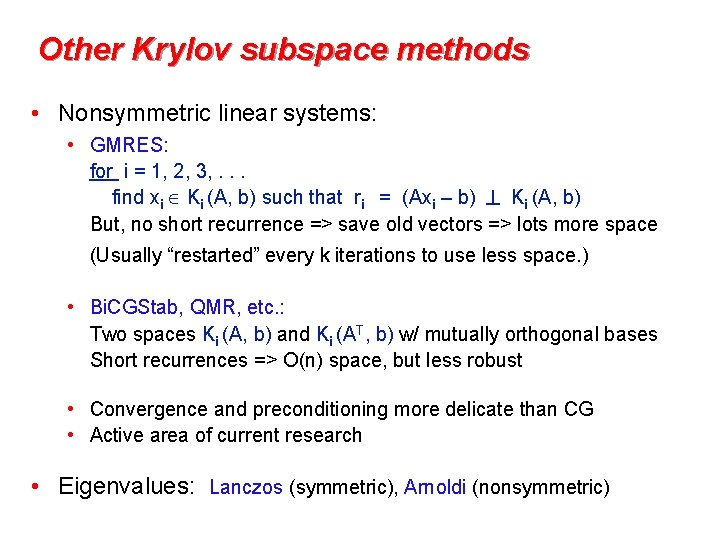
Other Krylov subspace methods • Nonsymmetric linear systems: • GMRES: for i = 1, 2, 3, . . . find xi Ki (A, b) such that ri = (Axi – b) Ki (A, b) But, no short recurrence => save old vectors => lots more space (Usually “restarted” every k iterations to use less space. ) • Bi. CGStab, QMR, etc. : Two spaces Ki (A, b) and Ki (AT, b) w/ mutually orthogonal bases Short recurrences => O(n) space, but less robust • Convergence and preconditioning more delicate than CG • Active area of current research • Eigenvalues: Lanczos (symmetric), Arnoldi (nonsymmetric)

to complexity slides…
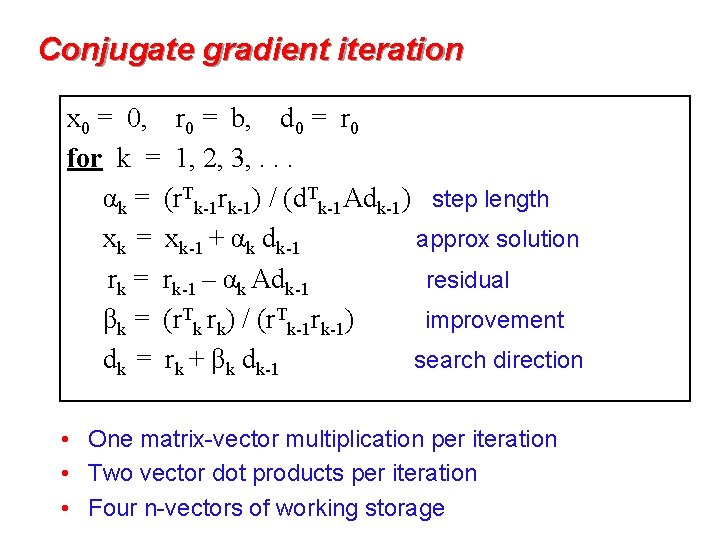
Conjugate gradient iteration x 0 = 0, r 0 = b, d 0 = r 0 for k = 1, 2, 3, . . . αk = (r. Tk-1 rk-1) / (d. Tk-1 Adk-1) step length xk = xk-1 + αk dk-1 approx solution rk = rk-1 – αk Adk-1 residual βk = (r. Tk rk) / (r. Tk-1 rk-1) improvement dk = rk + βk dk-1 search direction • One matrix-vector multiplication per iteration • Two vector dot products per iteration • Four n-vectors of working storage
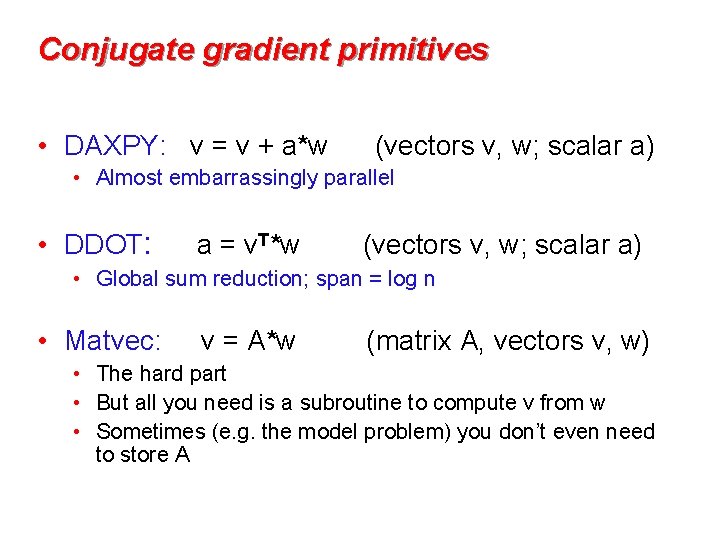
Conjugate gradient primitives • DAXPY: v = v + a*w (vectors v, w; scalar a) • Almost embarrassingly parallel • DDOT: a = v. T*w (vectors v, w; scalar a) • Global sum reduction; span = log n • Matvec: v = A*w (matrix A, vectors v, w) • The hard part • But all you need is a subroutine to compute v from w • Sometimes (e. g. the model problem) you don’t even need to store A
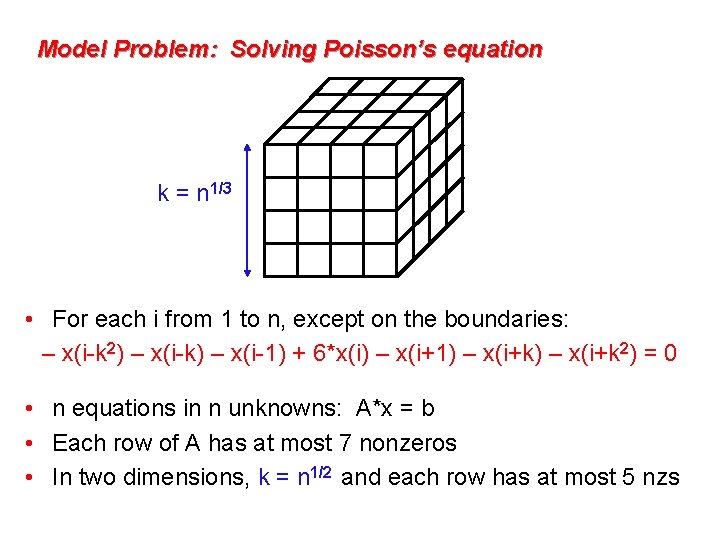
Model Problem: Solving Poisson’s equation k = n 1/3 • For each i from 1 to n, except on the boundaries: – x(i-k 2) – x(i-k) – x(i-1) + 6*x(i) – x(i+1) – x(i+k 2) = 0 • n equations in n unknowns: A*x = b • Each row of A has at most 7 nonzeros • In two dimensions, k = n 1/2 and each row has at most 5 nzs

Stencil computations • Data lives at the vertices of a regular mesh • Each step, new values are computed from neighbors • Examples: • Game of Life (9 -point stencil) • Matvec in 2 D model problem (5 -point stencil) • Matvec in 3 D model problem (7 -point stencil)
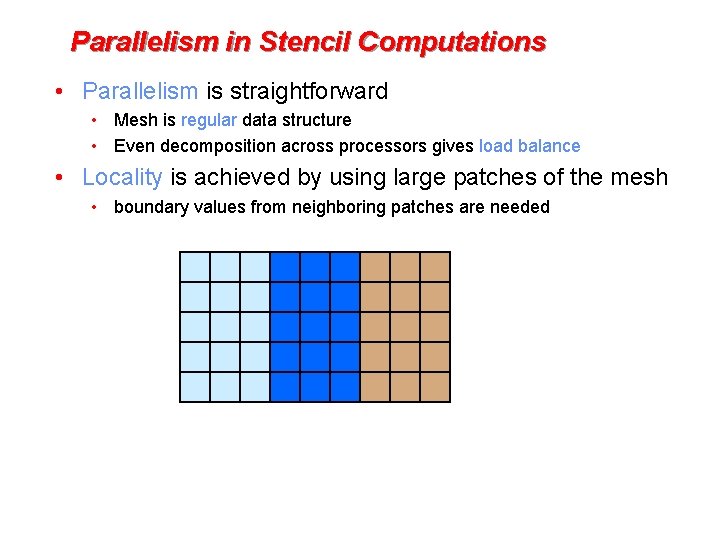
Parallelism in Stencil Computations • Parallelism is straightforward • Mesh is regular data structure • Even decomposition across processors gives load balance • Locality is achieved by using large patches of the mesh • boundary values from neighboring patches are needed

Where’s the data? • 1 -D vs 2 -D layout: Look at total communication volume
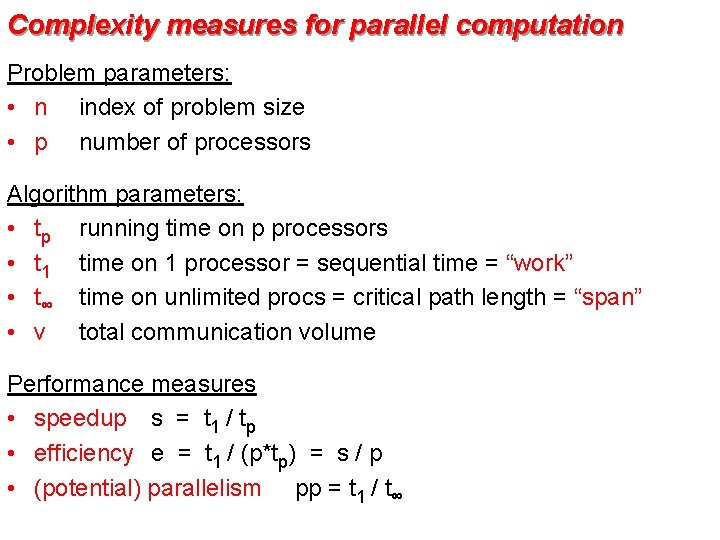
Complexity measures for parallel computation Problem parameters: • n index of problem size • p number of processors Algorithm parameters: • tp running time on p processors • t 1 time on 1 processor = sequential time = “work” • t∞ time on unlimited procs = critical path length = “span” • v total communication volume Performance measures • speedup s = t 1 / tp • efficiency e = t 1 / (p*tp) = s / p • (potential) parallelism pp = t 1 / t∞

Ghost Nodes in Stencil Computations To compute green Copy yellow Compute blue • Size of ghost region (and redundant computation) depends on network/memory speed vs. computation • Can be used on unstructured meshes
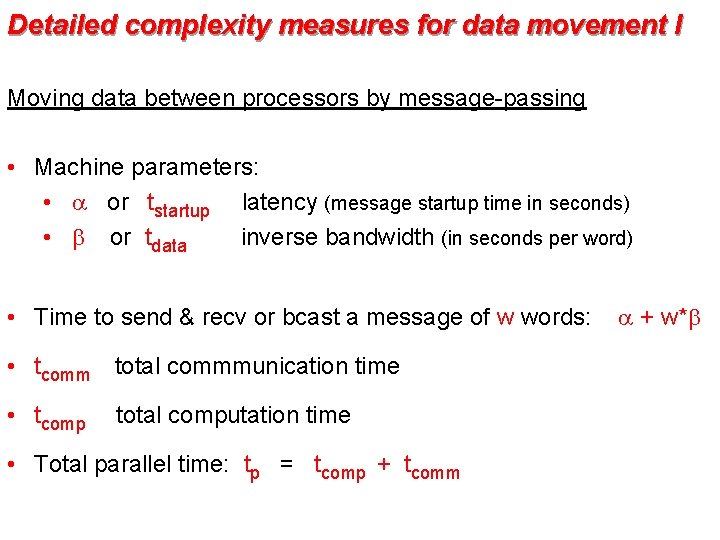
Detailed complexity measures for data movement I Moving data between processors by message-passing • Machine parameters: • a or tstartup latency (message startup time in seconds) • b or tdata inverse bandwidth (in seconds per word) • Time to send & recv or bcast a message of w words: • tcomm total commmunication time • tcomp total computation time • Total parallel time: tp = tcomp + tcomm a + w*b
- Slides: 25