
Model of TEC Provision Reaching the population scaling
- Slides: 13
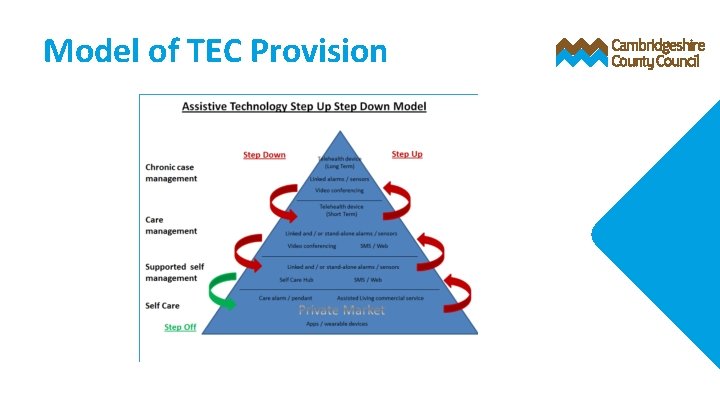
Model of TEC Provision
Reaching the population: scaling up TEC • Embedding TEC into every social care process • TEC prompts in every piece of care documentation • Knowledge and competencies of staff • From Trusted Assessor to TEC First • Stock management, delivery and fitting • Technology Enabled Discharges
TEC integration with ICES • Released capacity for TEC team for assessments and duty work • Assisted in removing the waiting list and capacity to deal with todays work today • ICES provider knowledge of products • Competencies of engineers for fitting and programming • Range of product types • Diversity in housing providers using Tunstall, Chubb, Tynetec
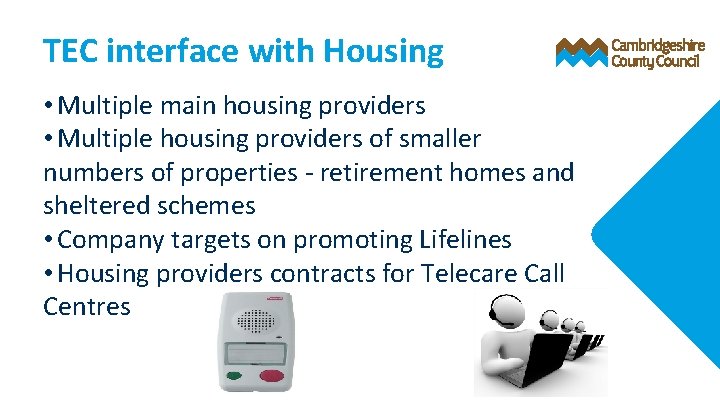
TEC interface with Housing • Multiple main housing providers • Multiple housing providers of smaller numbers of properties - retirement homes and sheltered schemes • Company targets on promoting Lifelines • Housing providers contracts for Telecare Call Centres
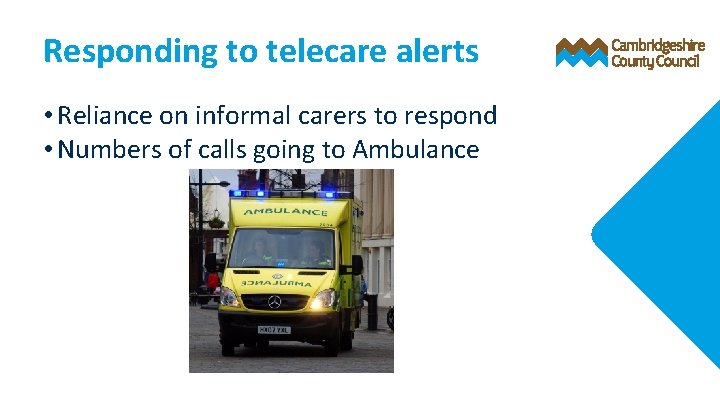
Responding to telecare alerts • Reliance on informal carers to respond • Numbers of calls going to Ambulance
Enhanced Response Service: Falls and Telecare • 24/7 365 days a year across Cambs • Working with 6 RSLs and 6 telecare call centres • Sharing information and GDPR • Reasons for calls: falls, personal care, silent • So far has responded to 1570 calls – only 60 then needed to call an Ambulance. 1510 calls avoided an unnecessary Ambulance call out • 43% of people have no other social care package • Next steps
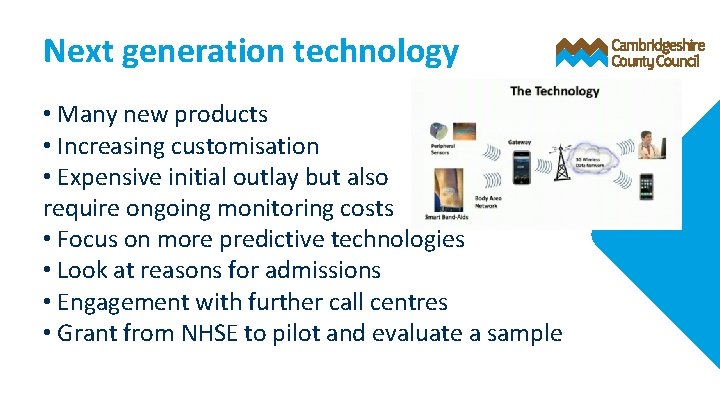
Next generation technology • Many new products • Increasing customisation • Expensive initial outlay but also require ongoing monitoring costs • Focus on more predictive technologies • Look at reasons for admissions • Engagement with further call centres • Grant from NHSE to pilot and evaluate a sample
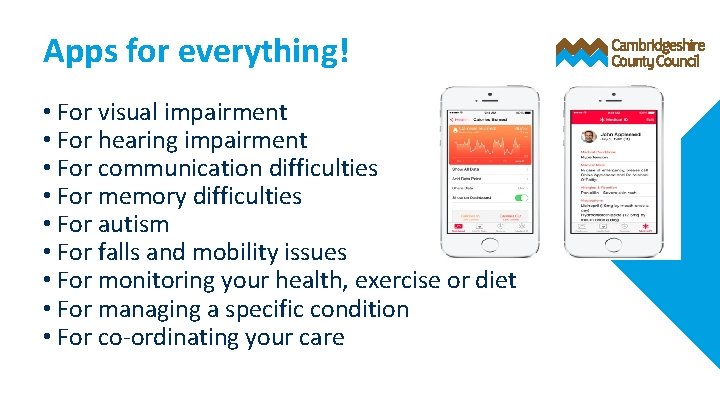
Apps for everything! • For visual impairment • For hearing impairment • For communication difficulties • For memory difficulties • For autism • For falls and mobility issues • For monitoring your health, exercise or diet • For managing a specific condition • For co-ordinating your care
The considerations for using apps • Reliability – battery and signal • Data ownership and security • Data transferability • Ability to use smart phone • Technical support • Costs – up front and ongoing • Professional knowledge • https: //www. orcha. co. uk Health apps reviewed
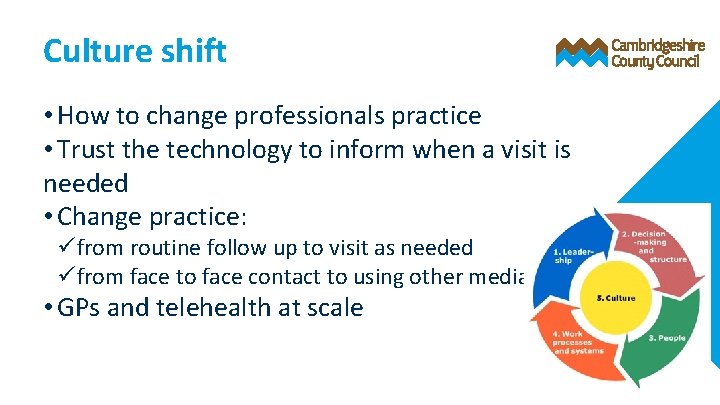
Culture shift • How to change professionals practice • Trust the technology to inform when a visit is needed • Change practice: üfrom routine follow up to visit as needed üfrom face to face contact to using other media • GPs and telehealth at scale
Evidence • Evidence for TEC has been mixed. • WSD was inconclusive for many reasons • CSED worked on a model of avoided costs • ATT commissioned an independent evaluation done by the University of Bedfordshire 2012 -4 üNo difference in acute hospital utilisation ü 20% fewer contacts with GP ü 40% more telephone contacts with community staff
Demonstrating outcomes • To secure investment in TEC need to demonstrate outcomes • Business cases based on cost saving evidence not avoided costs • Ability to demonstrate cost saving in the real world where service users receive multiple interventions – a problem of attribution. • Use DOH method applied to 39 councils demonstrated £ 1163 gross or £ 890 net savings pa per user